Cinematically stoned (Part 2)


© Taplin-Perry-Scorsese Productions / Warner Bros


I ended my previous post by promising I’d give a list of my favourite movie scenes wherein songs by the Rolling Stones are employed to memorable effect.  Here it is.


Jumpin’ Jack Flash (1968) in Mean Streets (1973)

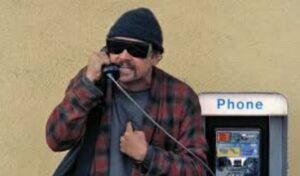
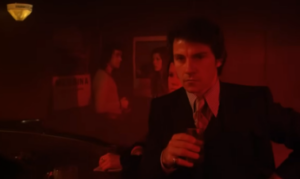
Wow.  Martin Scorsese really likes the Rolling Stones.  Not only has he made a concert movie about them, 2008’s Shine a Light, but he’s used their music in umpteen films: Goodfellas (1990), Casino (1995), The Departed (2006) and the one that first put him on the map, 1973’s Mean Streets.  Even today, more than 50 years later, the scene in Mean Streets where a young Robert De Niro comes swaggering through a bar, in slow motion, towards a pensive Harvey Keitel, while Mick Jagger hollers in the background about being “born in a cross-fire hurricane”, is a great synthesis of rock ‘n’ roll music and rock ‘n’ roll cinema.  Indeed, Jumpin’ Jack Flash is a fitting accompaniment for the arrival in popular consciousness of De Niro, who’d spend the rest of the 20th century showing Hollywood how to do proper acting.  The 21st century, featuring such efforts as The Adventures of Rocky and Bullwinkle (2000), Little Fockers (2010), New Year’s Eve (2011) and Dirty Grandpa (2016)…  Okay, not so much.


Satisfaction (1965) in Apocalypse Now (1979)

The Stones’ early, primordial and still potent stomper Satisfaction gets a brief but memorable airing in Francis Ford Coppola’s baroque Vietnam War masterpiece, playing on the radio while Captain Martin Sheen and his not-exactly-fighting-fit crew go cruising up the Nùng River in search of Marlon Brando.  Cue some funky on-deck dance moves by a frighteningly young-looking Laurence Fishburne and some funny / cringeworthy water-skiing moves by Sam Bottoms that knock various Vietnamese people out of their fishing boats.

 

© Omni Zoetrope / United Artists


Sympathy for the Devil (1968) in Alien Nation (1988) and in Interview with the Vampire (1994)

Graham Baker’s sci-fi / cop movie Alien Nation isn’t very good.  Its premise of an alien community getting stranded on earth and having to integrate as best as they can with the curmudgeonly human natives was handled much better in Neill Blomkamp’s District 9 (2009).  But I do like a woozy, hypnotic scene in it where alien-loathing cop James Caan enters a sleazy alien bar while a lady-alien performs an erotic dance to the strains of Sympathy for the Devil.  Not the original Stones song, but a correspondingly woozy, hypnotic cover-version of it by the great Jane’s Addiction.  I can’t find a film-clip of the scene, but here’s the Jane’s Addiction cover.


Meanwhile, Neil Jordan’s adaptation of Anne Rice’s Interview with the Vampire ends with Sympathy for the Devil on the soundtrack.  Again, this isn’t the Rolling Stones version but a cover, this time by Guns n’ Roses.  It’s every bit as ramshackle, shonky and (for me) enjoyable as the other covers Guns n’ Roses have done, for example, of Wings’ Live and Let Die (1973) and Bob Dylan’s Knockin’ on Heaven’s Door (1973).  Sympathy for the Devil kicks in when the vampire Lestat – Tom Cruise in one of his rare interesting roles – pops up to claim Christian Slater as his new vampirical companion for eternity.


Can’t You Hear Me Knocking? (1971) in Casino (1995)

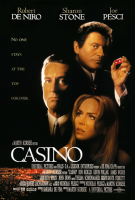
While Martin Scorsese serenades Robert De Niro and Harvey Keitel with Jumpin’ Jack Flash in Mean Streets, he employs the Stones song Can’t You Hear Me Knocking? for another of his regulars, Joe Pesci, in Casino.  Remarkably, Scorsese plays all seven minutes of the Santana-esque Can’t You… as an accompaniment to a lengthy sequence showing how Pesci’s Casino character Nicky Santoro gets established in Las Vegas.  Predictably, the sequence has Pesci doing what Pesci usually does in Scorsese movies: being a psychotic shit, barking orders at hoodlum sidekicks twice his size, eating in restaurants, ingratiating himself with fellow Mafiosi, being a psychotic shit, cursing and swearing, getting a blow-job, being a psychotic shit, talking about food, knocking off jewellery stores, acting the loving family man with his non-criminal relatives… and being a psychotic shit.
 

© Légende Entreprises / Universal Pictures


Ruby Tuesday (1967) in Children of Men (2006)

Wistful Stones ballad Ruby Tuesday features briefly on the soundtrack of Alfonso Cuarón’s gruellingly pessimistic science-fiction thriller Children of Men.  It’s another cover, sung by Franco Battiato.  We hear it during one of the movie’s calmer moments when Theo (Clive Owen) is visiting his old mate Jasper (Michael Caine), whose home provides a small pocket of sanity amid the unfolding dystopian grimness.  Amusingly, Caine, well known in real life for being a right-wing old grump with an aversion to paying tax, here plays an elderly anarcho-hippy with a fondness for smoking exceptionally strong pot.


Gimme Shelter (1969) in The Departed (2006)

Martin Scorsese loves the Rolling Stones and he loves their apocalyptic number Gimme Shelter in particular.  By my count he’s used it in three movies: Goodfellas, Casino and The Departed.  It’s best deployed at the beginning of The Departed, rumbling in the background while gangland thug Frank Costello (Jack Nicholson) expounds his philosophy.  “I don’t want to be a part of my environment,” he intones, imbuing his words with that leery, languid menace that only Nicholson is capable of.  “I want my environment to be a part of me.”  Strangely, in Scorsese’s Shine a Light two years later, Gimme Shelter was one of the songs the Stones didn’t perform on stage.  Marty missed a trick there.
 

© Plan B Entertainment / Warner Bros


Street Fighting Man (1968) in Fantastic Mr Fox (2009)

Director Wes Anderson also sticks Rolling Stones into his movies, but so far I haven’t mentioned him because I think most of his work is smug, pretentious and annoying.  For example, Play with Fire (1965) figures prominently in 2007’s The Darjeeling Limited, an Anderson movie so twee I find it the cinematic equivalent of being force-fed with chocolate-cake mix.  However, I like the scene in his stop-motion-animation adaptation of Roald Dahl’s Fantastic Mr Fox where, to the sound of the rabblerousing Stones anthem Street Fighting Man, Farmers Bean, Boggis and Bunce use three diggers to tear up the den of the titular Mr Fox; forcing the den’s inhabitants to frantically dig an escape-route.  Yes, they really ‘dig’ that song.  Sorry.


And finally…  Out of Time (1968) in Once Upon a Time in Hollywood (2019)

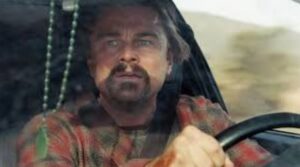
I’m not the biggest fan of the Stones song Out of Time – Jagger’s vocals get a bit too caterwauling for my liking – but it sees good satirical use in Once Upon a Time in Hollywood, Quentin Tarantino’s paean to the American movie-making capital in the late 1960s, a fascinating period when traditional notions about what made a good film were rapidly being undermined by an uppity younger generation.  Played when Rick Dalton (Leonardo DiCaprio), his new Italian spouse Francesca Capucci (Lorenza Izzo) and sidekick Cliff Booth (Brad Pitt) return from Italy, where Rick has been making spaghetti westerns and action thrillers with the likes of Sergio Corbucci and Antonio Margheriti, Out of Time gives an one-the-nose summation of DiCaprio’s sad-sack character – an actor a bit too old, un-hip and uncomprehending of the changing world around him to get the leading roles he once did, now doomed to playing villains in second-rate TV shows.

 

© Columbia Pictures / Sony Pictures Releasing 
Paul Thomas Anderson wins this battle


© Warner Bros. Pictures / Ghoulardi Film Company


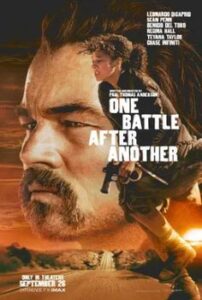
The critics have, almost universally, lavished praise on One Battle after Another (2025), the new movie written and directed by Paul Thomas Anderson.  (Though he didn’t try to adapt it directly, Anderson’s script took some inspiration from Thomas Pynchon’s 1990 novel Vineland.)  The praise is richly deserved.  I went to see it in my local cinema a few days ago and, afterwards, I hadn’t felt so exhilarated by a film since watching Mad Max: Fury Road (2015) on a big screen a decade earlier.


Heading the movie’s cast is Leonard DiCaprio, who plays Pat, a bomb-maker involved in a revolutionary American group called the French 75.  The ’75 stick it to The Man by freeing recent Latin-American immigrants from detention centres and blowing up banks and the offices of right-wing politicians.  Surprisingly, the plodding, unshowy Pat has a relationship, then sires a child, with fellow-revolutionary Perfidia Beverley Hills.  Essayed by Teyana Taylor in a short but devastating performance, Perfidia is the opposite of DiCaprio’s character.  She’s a force of nature: loud, fearless and given to flamboyant gestures, like humiliating the sleazy commander of a detention centre by forcing him to jerk off in front of her.  It’s entirely in keeping with her character when she’s shown firing a machine gun whilst massively pregnant.


To put an end to the French 75, the authorities appoint the ruthless and immoral Captain Steven Lockjaw (Sean Penn), coincidentally the detention-centre commander who was made to have that embarrassing, public wank.  Lockjaw captures Perfidia and compels her to rat on her colleagues, and thereafter it becomes open season on the ’75, with most of them being arrested or – more often – summarily executed.  Pat and his now-infant daughter manage to escape with new identities (‘Bob and Willa Ferguson’) and end up living a low-key, mostly off-grid existence in a Californian town called Baktan Cross.  Pat / Bob decays into a booze and dope-raddled paranoid, terrified the past will catch up with them.  Wilma (Chase Infiniti) grows up with no idea of her real origins and becomes a teenager bemused by, and frequently having to nursemaid, her eccentric old dad.


15 years later, Captain Lockjaw is invited to join an Illuminati-like organization called the Christmas Adventurers Club, whose members belong to the white American elite and are wealthy, powerful… and extremely racist.  Lockjaw’s relationship with Pefidia in the days of the French 75 was more than one of pursuer and quarry.  He came to fetishise her, his obsession triggered by that first, masturbatory encounter, and they were briefly intimate prior to her capture – which highlights what a wild, try-anything-once character Perfidia was.  Now Lockjaw fears that he might be Wilma’s father, not Pat / Bob, and having a mixed-race daughter would obviously torpedo his chances of joining the Christmas Adventurers.  So he launches a military crackdown on Baktan Cross, ostensibly to round up illegal immigrants, but really so he can find Pat / Bob and the inconvenient Wilma and erase them.


© Warner Bros. Pictures / Ghoulardi Film Company


That’s the set-up established during One Battle After Another’s first quarter and it’s all you need to know.  What follows is a cinematic rollercoaster ride as Pat / Bob and Wilma, in separate locations when Lockjaw and his uniformed, heavily-armed goons crash into Baktan Cross, flee, hide, fight back and try to find each other and escape.  Along the way, they  encounter Sensei Sergio St. Carlos (Benicio del Toro), Willa’s local karate teacher who’s much more than he seems; a bounty hunter with a conscience (Eric Schweig); an assassin sent by the Christmas Adventurers to clean up Lockjaw’s mess (John Hoogenakker); some skateboarding radicals; a nasty far-right militia who dispose of people for money; and a secret enclave of nuns with guns


As you’ll gather from the synopsis, One Battle After Another is a politically charged movie.  It regularly focuses on how how the USA reacts to immigrants,  often impoverished, frightened and vulnerable people, both mistreating them and unscrupulously using them as pawns in power games and culture wars.  This is timely considering what Trump and his minions are doing at the moment.  It has to be said, though, that Lockjaw and the police and troops under his command go about their business with much more precision, organization and efficiency than the masked, clumping thugs in Trump’s Immigration and Customs Enforcement (ICE) agency have managed so far.  Predictably, you don’t have to look far on the Internet before you find negative reviews of the movie posted by far-right frothers, incensed by what they see as its Marxist / communist / socialist / radical-leftist leanings.


But as well as being political, One Battle After Another is very funny.  DeCaprio’s Pat / Bob may have been a revolutionary once, but for most of the movie he’s an amusingly grumpy and befuddled middle-aged dad, showing zero patience, say, for his daughter’s insistence that he respects her schoolfriends’ preferred pronouns.  Particularly funny are the scenes where, on the run from Lockjaw, he tries to phone what’s left of the French 75 to beg them for help.  He’s far from impressed when they demand he reels off an array of code-phrases to prove he’s who he says he is – codes he’s mostly forgotten during the past 15 years.  DeCaprio’s subsequent meltdowns are hilarious, though these scenes will strike a chord with anyone who, in the days before voice-recognition, tried to phone their bank but failed to cite the right security numbers.


The film makes interesting parallels between the French 75 and the Christmas Adventurers Club.  Though they’re positioned at different ends of society, at the bottom and at the top, both are shrouded in secrecy and pompous security protocols and both believe they are doing great works and bending history to their wills.  Seen from outside, though, they seem like two groups of overgrown kids who’ve set up gangs with stroppy rules about who gets to be ‘in’ and who doesn’t.


One Battle After Another features, perhaps, Leonardo DeCaprio’s best-ever performance.  His Pat / Bob character is an extension of Rick Dalton, the frustrated over-the-hill movie star he played in Quentin Tarantino’s Once Upon a Time in Hollywood (2019).  But while Dalton had his loyal buddy and stunt double Cliff Booth (Brad Pitt) to keep him from going off the rails, Pat / Bob has no one when the shit hits the fan.  His daughter Willa is elsewhere and he has to overcome his many insecurities and get his act together alone.  At the same time, DeCaprio convinces us that Pat / Bob, despite his chaotic nature, is a loving father.  It’s his desire to save her that keeps him going, no matter what fate throws at him.  And in this film, it throws a lot.


© Warner Bros. Pictures / Ghoulardi Film Company


He’s excellently partnered by Chase Infiniti as Willa.  Though in reality the actress is 25 years old, she convincingly plays a teenager – one who has her head well-screwed-on at the start of proceedings, but who still has to deal with a very steep learning curve.


Meanwhile, Sean Penn is splendidly villainous as Lockjaw.  He’s memorable both because of his grotesque physicality – with his contorted face, weird musculature and lurching gait, he looks like Popeye the Sailor Man rendered in human flesh – and because of his deeply screwed-up personality, which is simultaneously psychotic and pathetic and driven by a juvenile sense of entitlement.


Great though DeCaprio, Infiniti and Penn are, Benicio del Toro comes close to quietly stealing the show.  When he first appears, you see him as a character who’s popped up in DeCaprio’s movie.  But later, having learnt more about him – his character runs an extensive and meticulously-organised sanctuary and support-network for undocumented immigrants in the town – you begin to feel DeCaprio has strayed into his movie.


There’s also a lovely score courtesy of Radiohead’s Johnny Greenwood and, late on, a car chase that could become as legendary as the one in the Steve McQueen classic Bullit (1968).  And Paul Thomas Anderson handles things at all times with aplomb.


One Battle After Another should win a slew of Oscars at next year’s Academy Awards.  By then, though, Donald Trump may have banned all opposition parties in the USA and put the country under martial law, enforced by real-life Steven Lockjaws in ICE, the National Guard and various far-right militias.  So it might not.


If that proves to be the case, I can only say, “Viva la revolution!”


© Warner Bros. Pictures / Ghoulardi Film Company