The missiles are flying… Hallelujah! Hallelujah!


© Paramount Pictures / Dino De Laurentiis Company


With Donald Trump enacting his latest insanity – joining forces with Israel and bombing the bejeezus out of Iran, which has prompted the latter country to retaliate by firing ordinance in all directions and lighting up the Middle East like a Christmas tree – I find myself thinking of Greg Stillson, a character featuring prominently in Stephen King’s novel The Dead Zone (1979).  In the David Cronenberg-directed movie version of The Dead Zone (1983), Stillson is played by Martin Sheen.  It’s Sheen, as Stillson, who utters the quote that’s this blog-entry’s title.


Stillson is a psychotic bully who begins as a salesman, becomes a businessman and then a politician, and finally leads a populist movement that sweeps him into the White House.  Well, he does in one timeline.  Before winning the presidency, while he’s on the campaign trail, he shakes hands with The Dead Zone’s hero, Johnny Smith, who’s been blessed – or cursed – with the power to see into people’s futures just by touching them.  He has a vision of Stillson’s future wherein, as a despotic and unhinged US president, he presses the buttons that trigger an apocalyptic nuclear war.  Thereafter, Smith has to decide how he’s going to stop him.  (Spoiler – he does, but with tragic consequences for himself.)


I don’t know if anyone with clairvoyant visions touched one of Trump’s little hands a couple of decades ago and witnessed him pressing buttons and wiping out humanity in 2026, the 250th anniversary of American independence.  But it wouldn’t surprise me if someone had.


Anyway, it doesn’t need saying, but Trump’s actions – which began on February 27th, when in conjunction with the Israelis and under the moniker ‘Operation Epic Fury’, he had his military bombard Iran with missiles and drones; one source estimating on March 4th that nearly 900 people had been killed so far, including Iran’s Supreme Leader Ayatollah Ali Khamenei – are a vastly bad idea for many reasons.  Here are some of those reasons.


From wikipedia.org / farsi.khamenei.ir


One.  The attack is illegal under international law.  In the Conversation, Shannon Brincat and Juan Zahir Naranjo Caceres have written that “Israel said the strikes were ‘preventative’, meaning they were to prevent Iran from developing a capacity to be a threat.”  However, they point out that “preventative war has no legal basis under international law. The UN Security Council did not authorize any military action, meaning the sole lawful pathway for the use of force for self-defence was never pursued.”


Two.  The attack went against the American constitution.  The American historian Heather Cox Richardson has noted on her Substack: “In his letter to Congress notifying them of his attack, Trump said he had acted under the 1973 War Powers Act, which permits a president to attack another country if there is an urgent threat.  But the letter itself doesn’t identify any such urgent threat.  It simply said Iran is one of the world’s largest sponsors of state terrorism and that it ‘continues to seek the means to possess and employ nuclear weapons’…  The Framers of the Constitution placed the power to declare war in the hands of Congress and not in the president above all because they did not trust that much power in the hands of one man…”


Three.  It’s likely Benjamin Netanyahu bounced the USA into the attack.  Going back to Reason One, the supposedly ‘preventative’ nature of the USA and Israel’s assault on Iran is torturous to say the least.  A few days ago, US Secretary of State Marco Rubio said, “It was abundantly clear that if Iran came under attack by anyone – the United States or Israel or anyone – they were going to respond, and respond against the United States…  We knew that there was going to be an Israeli action. We knew that that would precipitate an attack against American forces, and we knew that if we didn’t pre-emptively go after them before they launched those attacks, we would suffer higher casualties.”


In other words..  We had to attack them before they attacked us, which they would surely do because Israel intended to attack them first.  This means the USA’s vast military firepower isn’t actually under the control of the American commander-in-chief, but under that of Israeli Prime Minister Benjamin Netanyahu.  The wily Netanyahu says ‘Jump’, the Americans say ‘How high?’


Four.  Dodgy Middle Eastern deals are possibly involved.  Who else, besides Netanyahu, has a finger in the pie here?  In 2025 Trump did investment deals with Saudi Arabia, Qatar and the United Arab Emirates, which he claimed were worth over two trillion dollars.  Qatar saw fit to gift – some would use the verb ‘bribe’ – Trump with a 400-million-dollar Boeing jumbo jet that he plans to turn into a new Air Force One, making one wonder how much of these investments will be enriching Trump and his clan rather than the USA itself.  Also, Trump’s son-in-law Jared Kushner and Steve Witkoff – the real-estate developer whom, laughably, Trump sent into negotiations with Russia about the Ukraine War even though he had zero diplomatic experience – have been in the Middle East lately as ‘envoys’, hawking the idea that the decimated Gaza should be reinvented as a luxury resort with ‘180 skyscrapers’ (and any remaining Palestinians, presumably, doing jobs like cleaning the toilets).


In the future, if a saner administration ever comes to power in Washington DC and launches an investigation into this debacle, it’d be wise to ‘follow the money’.  I’ll bet at least some of the encouragement for this war came from business interests and wealthy leaders in the Middle East who regarded the Iranian regime as an undesirable neighbour, lowering the tone and property value of the area, and wanted it removed.


Five.  It’s actually Operation Forget Epstein.  Trump likes to distract.  When the headlines look bad for him, he does something outrageous that generates different headlines – not necessarily favourable ones, but enough to banish the previous, bad headlines from people’s memories.  This works especially well in our screen-obsessed, social-media-fixated era where attention-spans are short.


On February 25th, the New York Times published a report under the headline EPSTEIN FILES ARE MISSING RECORDS ABOUT WOMAN WHO MADE CLAIMS AGAINST TRUMP.  This mentioned documents “released by the Justice Department” that “briefly mention a woman’s unverified accusation that Donald J. Trump assaulted her in the 1980s, when she was a minor.”  Yet other documents relating to these allegations have been withheld or removed from the public database about Trump’s paedophilic, sex-trafficking old buddy Jeffrey Epstein.


And two days later, the assault began on Iran.  Funny, that.


From wikipedia.org / © Jesse Monford


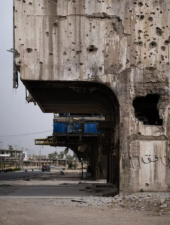
Six.  There’s no plan and no objectives.  The George Bush Jr-led invasion of Iraq in 2003, which toppled Saddam Hussein but created massive instability and led to huge numbers of fatalities – estimates of which range “from 151,000 violent deaths as of June 2006 (per the Iraq Family Health Survey) to 1,033,000 excess deaths (per the 2007 Opinion Research Business [ORB] Survey)” – was a ruinous fiasco. It was also built on the lie that Saddam possessed ‘Weapons of Mass Destruction’.  But compared to Trump’s Iran incursion, it looks like a masterpiece of planning.


For one thing, to have a plan, you actually need to have objectives, i.e., things to plan towards. Trump and his cabinet apparently have no idea what the goal of all this is.  Rubio, as we’ve seen, has said they’re waging war simply because that’s what the Israelis are doing.  Meanwhile, Trump has suggested at one point it’s to achieve regime-change in Iran and replace Khamenei with someone more compliant to US interests, as was allegedly done in Venezuela after the abduction of its former president, Nicolas Maduro.  Though the other day Trump admitted there was a problem with this because his airstrikes had killed all the possible candidates to take over: “…none of the people we had in mind are going to come to power, because they are all dead.”  No, so far, that doesn’t sound like a brilliantly executed plan.


Trump has also claimed the war is to prevent Iran developing nuclear weapons, even though after the USA carried out a bombing raid on Iran in June last year he was adamant that “Iran’s key nuclear enrichment facilities have been completely and totally obliterated.” Trump has tried to justify this new war by saying Iran was – here plucking a figure out of his arse – ‘two weeks’ away from acquiring a nuclear weapon.


Elsewhere, it’s been suggested the war is to encourage the Iranian people to rise up and overthrow the regime that’s oppressed and abused them for 47 years; to stop Iran sponsoring terrorism; and to destroy Iran’s navy.  But most likely it’s because Trump woke up the other morning, looked out of the window and thought, “Gee, this would be a good day to bomb Iran back to the Stone Age.”


Seven.  This sort of thing has been tried before.  Vietnam…  Afghanistan…  Iraq…  Libya.


Eight.  Possible destabilization of the Middle East.  Even if by some fluke Iran ends up with a Trump-and-Netanyahu-approved government, it’s difficult to see how it can impose order on a country so diverse and, after all this devastation and upheaval, febrile.  Iran’s population is 61 percent Persian, 16 percent Azerbaijani and 10 percent Kurdish, and the rest of it includes people like Lurs, Arabs, Baloch, Arabs and Turkish groups.  While it’s overwhelmingly Shia Muslim, 9 percent of the population are Sunni and other sects of Muslim and there are also Baha’i, Christians, Zoroastrians, Jews and Sabean Mandeans.  That’s before we get to political differences.  Has anyone in Washington DC considered this?  I doubt it.


Civil war in Iran could have devastating consequences for the Middle East.  We’ve already seen the current conflict’s knock-on effects on the world’s oil supply, especially the disruption of tanker-traffic in the Strait of Hormuz, and on air travel, with more than 20,000 flights grounded and a million people stranded around the world since late February.  The Middle East going J.G. Ballard is not good news for anyone.  Well, apart from Vladimir Putin, who’ll see an increase in demand for Russian oil.


Nine.  China may be thinking, “Hold my beer!”  Trump’s rhetoric about attacking Iran sounds uncomfortably like Putin’s excuse for invading Ukraine in 2022 – his goal was to ‘demilitarise’ and ‘denazify’ the country.  I also suspect China is watching keenly and wondering how it could cook up a similar motive for taking over Taiwan in the future.


Incidentally, Taiwan is the world’s foremost producer of Artificial Intelligence chips and according to the New York Times, without those chips, “the tech industry and the US economy would be crippled.”  Haven’t thought that one through either, have you, Donald?
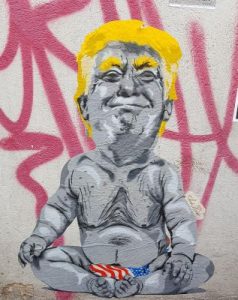
 

From pixabay.com / © clecaux
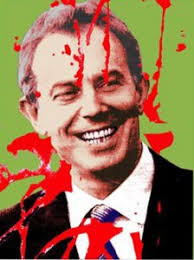
The butcher boy


From leftfutures.org


One feature of growing older is that every new day seems to be an anniversary of some sort or other – an anniversary of something you did, or something you experienced, or something big or small that you witnessed happening in the world.  For instance, just last Friday, March 17th – St Patrick’s Day 2023 – I realised it was 30 years exactly since some friends and I went to see the great Belfast punk band Stiff Little Fingers at Glasgow Barrowland.  Both Stiff Little Fingers and the Barrowland, I’m pleased to report, are still on the go; and their histories have been happily entwined during the three decades since.  As the latter’s Wikipedia entry reports: “Northern Irish punk band Stiff Little Fingers have played sold-out concerts at the venue every St Patrick’s Day since 1992, and recorded their Best Served Loud album there in 2016 to celebrate 25 years at Barrowland.”


Even if it reminds me of how ancient I am now, that’s at least an anniversary of something I remember fondly.  However, there’s nothing fond I remember about the event that today, March 20th, is the anniversary of.  It’s now been twenty years since Western military forces, mainly American and British ones directed by President George W. Bush and Prime Minister Tony Blair, blasted their way into Iraq.


The invasion was launched in order to depose Saddam Hussein who, it was claimed, possessed Weapons of Mass Destruction.  It transpired, though, that these WMDs didn’t exist and it became obvious that Bush and Blair had spun a web of lies beforehand to make people believe that they did.  In the two decades since the invasion, those WMDs haven’t been the only things to not exist.  The Iraq Body Count Project has calculated that, up until 2019, between 183,535 and 206,107 Iraqi people have stopped existing too.  Their deaths have been a result of Bush and Blair’s actions – of the invasion, the bungled Western occupation and its chaotic aftermath.


George Bush once donned a flak jacket, posed on the deck of an American aircraft-carrier and boasted that the ‘mission’ in Iraq was ‘accomplished’.  That seems a very long time ago now.  Mind you, through the dubious involvement in the supposed occupation and ‘reconstruction’ of Iraq by outfits such as Haliburton, the debacle succeeded in lining the likes of Dick Cheney’s pockets very nicely.  I suppose that was the real point of it.


Of course, the Iraq War helped to put some coinage into Tony Blair’s pockets too.  Thanks to his support for the second-most right-wing and incompetent president in American history, the former PM was for a long time revered in Republican sectors of the USA and he made more than a few bob on the public speaking circuit there.  (He also profited from a dodgy job negotiating the movement of oil between Iraq and South Korea.)  I suppose his popularity in America reduced his pain at being less admired in other parts of the world.  For instance, I was working in India during the worst phase of the ‘official’ Iraq War – Abu Ghraib and all that – and whenever I read the Indian English-language newspapers, his name seldom appeared in a sentence without being accompanied by the words ‘poodle’ or ‘lapdog’.


I’d never trusted Blair.  His big smile and ingratiating, want-to-be-your-pal manner struck me as phoney, especially compared to the plain-speaking, no-nonsense demeanour of his predecessor as Labour Party leader, John Smith, who died unexpectedly in 1994.  However, up until 2003, and having recently endured 18 years of Conservative government, I’d consoled myself with the thought that “At least he isn’t as bad as that other lot.”  He headed a political party that claimed to have some conscience, principles and scruples, the supposed antithesis of Maggie Thatcher and her cynical gang.  But events in March 2003 changed my opinion.


To be fair, in Britain, it wasn’t just Blair who willed the invasion into happening.  He had the support of many in his party, though with a few noble objectors like the late Robin Cook, and the Tories backed him to the hilt.  In fact, among the Westminster-based parties, it was only Charles Kennedy’s Liberal Democrats who showed some spine and opposed the bloody thing.  It goes without saying that the majority of Britain’s predominantly right-wing newspapers were cheerleaders for it too.


From wikipedia.org / © William M. Connelly


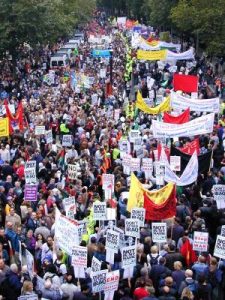
And, though people still talk about the anti-war protests on February 15th, 2003, which saw the biggest ever political demonstration in London’s history take to the capital’s streets (and was the subject of Ian McEwan’s rather annoying 2005 novel Saturday), I’m afraid to say it had the support of a good chunk of the British population as well. Before and during the initial invasion, I was living in Newcastle-upon-Tyne, but for personal reasons I also spent a lot of time down in East Anglia.  Nearly everyone I know in Newcastle – Labour supporters to a man and woman – was horrified by what Blair was doing.  But down south, it was a different story.  I heard people saying it in pubs, and saw it on stickers in car windows.  This war was right, Saddam Hussein was going to blow us up with his WMDs, we needed to hit him before he hit us, we had to support ‘our boys’, and if you were anti-war you were unpatriotic, a coward, a traitor.  It was the mentality that, nearly 80 years earlier, had seen young men humiliated by getting white feathers if they didn’t sign up to fight amid the mud and bloodshed of the trenches.


Everything that happened in Iraq was a reprehensible failure – morally, politically, even in terms of making ground against Osamu Bin Laden in the supposed War on Terror.  (It took a Navy SEALs raid in Pakistan during the Obama era to put an end to him.)  In Britain, it loosened the Labour Party’s hold on power and paved the way for the David Cameron government and its disastrous austerity policies.  It also shook the public’s faith in politicians and what they saw as ‘the establishment’ and, arguably, helped lead to the 2016 vote to leave the European Union, which was Britain’s other huge, idiotic mistake of the 21st century.  But all this never dented Blair’s belief that invading Iraq with Bush was the correct thing to do.  He was right and those millions of people who came onto the streets to protest against the invasion were wrong.


A lot of this, I suspect, was down to Blair being a devout Christian.  Since God was on his side, he reasoned, his decision to back Bush must have divine sanction.  Bush, of course, professed to being a Christian too, although I couldn’t imagine the gimlet-eyed Texan being as zealous about it as Blair.


Actually, Blair’s Christianity puts me in mind of something said by the late William S. Burroughs in his spoken lyrics for the Bill Laswell song Words of Advice for Young People: “If you’re doing business with a religious sonofabitch, get it in writing.  His word isn’t worth shit, not with the good Lord telling him how to f**k you on the deal.”


From unsplash.com / © Levi Meir Clancy

Ian McEwan’s Saturday: Tony Blair and tone-deaf


© Vintage


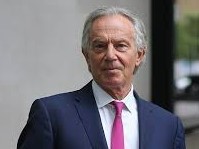
“The butcher boy gets a bauble,” was my reaction to the news that former UK Prime Minister Tony Blair was to be made ‘a Knight Companion of the Most Noble Order of the Garter’, whatever that means, in the Queen’s New Year Honours List.  I call Blair ‘the butcher boy’ because of his role in the invasion of Iraq, which happened during his watch in 2003.  The invasion was launched to depose Saddam Hussein who, it was claimed, possessed Weapons of Mass Destruction.  However, these WMDs turned out to not actually exist and it became obvious that Blair and his invasion partner George W. Bush had spun a web of lies beforehand to make people believe that they did.


And it wasn’t just the WMDs that didn’t exist.  Since the invasion took place, up until the beginning of 2021, due to ‘coalition and insurgent military action’ and subsequent ‘sectarian violence and criminal violence’, between 185,000 and 209,000 Iraqi civilians are estimated to have stopped existing too – their deaths the direct and indirect results of Blair and Bush’s actions.


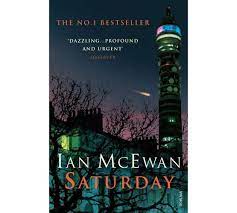
Actually, I’d been thinking about Tony Blair and Iraq before word came through of Blair’s ennoblement, because late last year I read Ian McEwan’s 2005 novel Saturday.  This describes 24 hours in the life of a middle-aged, London-based neurosurgeon called Henry Perowne, starting on the morning of Saturday, February 15th, 2003.  In real life, that date saw the biggest political demonstration in British history.  A million people took to the streets of London in an anti-war protest organised by the Stop the War Coalition, the Campaign for Nuclear Disarmament and the Muslim Association of Britain.  Blair, of course, had a messianic belief in his own rightness and ignored the many arguments against war voiced by the protestors, and just over a month later Britain joined the USA and its allies in starting hostilities against Iraq.  The demonstration forms a backdrop to the events in McEwan’s novel and the forthcoming invasion is prominent in the thoughts and conversations of its characters.


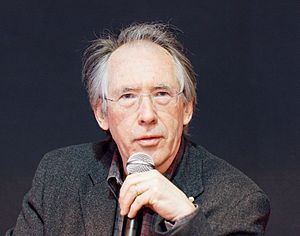
I was a big fan of McEwan during my youth.  This was while he was in a weird, morbid, modern-gothic phase and wrote the novel The Cement Garden (1978) and the short stories collected in First Love, Last Rites (1975) and In Between the Sheets (1978).  Thereafter, McEwan became more wholesome and respectable and found success and acclaim as a writer of mainstream literature.  Saturday is only the third novel I’ve read by McEwan since he stopped being ghoulish. The others were The Child in Time (1987), which I enjoyed with some reservations, and Atonement (2001), which I thought was excellent, although a later allegation of plagiarism tarnished it a bit for me.  However, while I’ve generally reacted positively to McEwan’s work, I found Saturday problematic.  It seemed naïve in the statements it was making.  Also, its depiction of its central characters I found downright annoying.


From wikipedia.org / © Thesupermat


The day described in Saturday begins before dawn.  Perowne gets out of bed and notices an object that he first assumes is ‘a meteor burning out in the London sky’. He realises, though, that it’s a plane with an engine on fire, which makes him wonder if he’s witnessing an act of terrorism – terrorism being on everyone’s minds since events in New York a year-and-a-half earlier.  But it turns out that he’s seen an accidental fire on board a cargo plane, which manages to make an emergency landing at Heathrow.  Reassured, he gets on what’s been planned for the day ahead.


His first engagement is at a sports centre where he has a game of squash with his anaesthetist, an American called Jay Strauss.  Then he visits his mother, stricken with dementia in a care home, and does some shopping for a family gathering at his house that evening.  In addition to Perowne and his wife Rosalind, the get-together is attended by their daughter Daisy, son Theo and Rosalind’s father, the quaintly named John Grammaticus.  Later that night, he gets an urgent request from Strauss to perform some emergency surgery: “We got an extradural, male, mid-twenties, fell down the stairs… a depressed fracture right over the sinus…  I want someone senior in here and you’re the nearest.  Plus you’re the best.”


However, two more incidents make the day darker.  On his way to play squash, a distracted policeman allows Perowne to drive along Tottenham Court Road, officially closed off for the anti-war demonstration – with the result that he prangs another car coming out of a side-street, whose driver didn’t expect him to be there.  When he gets out to speak to the other car’s three occupants, Perowne realises the men are criminals, ready to beat him up if he doesn’t immediately pay for the damage their car has suffered.  But he also notices that the leader of the trio, a man called Baxter, is showing symptoms of a serious neurological disorder.  Using his knowledge of the illness, Perowne is able to distract and disorientate Baxter long enough to get back into his car and escape.


But that isn’t the end of it.  That evening, just after Perowne has welcomed his family into his house, a vengeful Baxter and one of his henchmen burst in and hold them at knifepoint.  There ensues violence, threatened violence and sexual humiliation, before Perowne and his son Theo manage to repel the invaders.  Baxter is thrown down some stairs, knocked unconscious and taken away in an ambulance.  When the phone call comes from Strauss, Perowne realises the injured man he’s being asked to operate on is Baxter, who traumatised his family a short time ago. As he prepares to leave, Rosalind demands, “You’re not thinking about doing something, about some sort of revenge are you?”


“Of course not,” Perowne replies, and proves to be as good as his word.


As McEwan was in 2003, Perowne is in favour of the Iraq invasion.  He’s not as gung-ho as Strauss, who grumbles about the protestors, “They dislike your Prime Minister, but boy do they f*cking loathe my President,” or indeed as Baxter, who snarls at them in an aside, “Horrible rabble.  Sponging off the country they hate.”  But to his daughter Daisy, who takes part in the day’s demonstration, he says: “No rational person is for war.  But in five years’ time we might not regret it.  I’d love to see the end of Saddam.  You’re right.  It could be a disaster.  But it could be the end of a disaster and the beginning of something better.”  Perowne has been influenced by the testimony of an Iraqi patient of his, an academic called Miri Taleb.  Saddam’s secret police once arrested Taleb and subjected him to ten months of physical and mental torment: “Even on the day of his release he didn’t discover what the charges were against him.”


Elsewhere, McEwan’s descriptions of the anti-war protestors seem a bit patronising: “The general cheerfulness Perowne finds baffling.  There are whole families, ones in various sizes of bright red coats, clearly under instructions to hold hands; and students, and a coachful of greying ladies in quilted anoraks and stout shoes.  The Women’s Institute, perhaps…  The scene has an air of innocence and English dottiness.”  Mind you, years later in an interview with Channel 4 News, McEwan admitted that he’d changed his opinion about the war and felt that the marchers in 2003 were ‘vindicated’.


From aa.com.tr


While I read Saturday, I tried to work out the significance of the villainous Baxter.  Was he a metaphor for Saddam Hussein and his brutal regime?  Or was Baxter’s intrusion into the Perownes’ home a metaphor for terrorism, erupting without warning in everyday life, destroying all notions of normality and security for its victims?  And what’s to be made of Perowne’s eventual decision to do the decent thing, operate on Baxter and save his life?  I got the impression Perowne represented McEwan’s ideal of an enlightened, democratic, liberal West, intervening in Iraq but doing so with everyone’s best interests at heart, including the Iraqis.  Unfortunately, the ‘ignorance, arrogance, neglect, stubbornness, panic, haste and denial’ displayed by Iraq’s Western occupiers following the invasion, which rapidly turned the country into a failed state, showed this to be a pipe dream.  The USA, Britain and their allies were a hell of a lot less benevolent, magnanimous and expert at what they were doing in Iraq than Henry Perowne was in the operating theatre.


If the political statement McEwan seems to make in Saturday is wishful thinking, certainly in hindsight, I was more troubled by the lack of self-awareness displayed by the main characters.  Fair enough, as a London neurosurgeon, Perowne is going to be a wealthy man.  His car, McEwan notes, is a “silver Mercedes S500 with cream upholstery – and he’s no longer embarrassed by it.  He doesn’t even love it – it’s simply a sensuous part of what he regards as his overgenerous share of the world’s goods.”


But his son Theo is an up-and-coming blues guitarist.  His mother arranged for him to get lessons from Jack Bruce, no less.  “Through Bruce, Theo met some of the legendary figures.  He was allowed to sit in on a Clapton masterclass.  Long John Baldry came over from Canada for a reunion…  By some accident Theo jammed for several minutes with Ronnie Wood and met his older brother Art…”  So, while most kids his age are worrying about entry-level jobs, rents and college fees, Theo, through his family wealth and connections, gets stupendous opportunities to develop his skills playing music – ironically, a type of music that was invented by impoverished black people living in America’s rural south.


Similarly, Perowne’s daughter Daisy is a graduate of Oxford University and a poetess who’s just had a collection of poems published.  It no doubt helps that her grandfather, John Grammaticus, is a famous English poet who lives in a chateau in France.  Though both lauded and loaded, the old man is bitter about how the world has treated him: “John minded when Spender and not he was knighted, when Raine not Grammaticus got the editorship at Faber, when he lost the Oxford Professorship of Poetry to Fenton, when Hughes and later Motion were preferred as Poets Laureate, and above all when it was Heaney who got the Nobel.”


I may have missed it in Saturday, but I don’t remember the Perownes reflecting on their good fortune, on having so much in a world where many people have so little.  It’s especially galling that Theo and Daisy, whom we’re supposed to like as characters, don’t acknowledge their luck in having fulfilling, creative lives, doing the things they enjoy doing, that most people their age can’t have because they lack the wealth, security, support, time and connections.  Perhaps once, back when many of Theo’s British-blues heroes were youngsters from working-class or lower-middle-class backgrounds, Britain offered some social mobility and the arts weren’t necessarily the preserve of the elite.  But that’s hardly the case in 21st century Britain, when money, poshness and who-you-know seems to be prerequisites for careers in music (Florence Welch, Mumford and Sons, James Blunt), acting (Cumberbatch, Hiddleston, Pattinson, various Foxes) and literature (while the 2003 and 2013 Granta lists of ‘Best Young British Novelists’ showed some ethnic diversity, about 60% of those novelists had still attended Oxford or Cambridge Universities).


I’d assumed McEwan would use Baxter, who’d obviously never had the opportunities gifted to Theo and Daisy, as an instrument to comment on this when he crashes into the Perownes’ comfortable world.   However, the ‘home invasion’ section of Saturday is relatively brief and the bitter commentary I expected didn’t appear.  Baxter gets strangely emotional after he forces Daisy to recite a poem to him, Matthew Arnold’s Dover Beach, but that’s all.


This muted acceptance of the advantages enjoyed by the Perowne family irritated me most about Saturday.  In this respect, it seems as tone-deaf as Tony Blair was about the war that the novel ruminates on.


From change.org

George, where did it all go wrong?


© The Belfast Telegraph


Last Thursday saw the Prime Minister of England – sorry, Prime Minister of Britain – Boris Johnson arrive in Scotland for a one-day charm offensive.  This was intended to remind Scottish people of how lucky they were to be part of the Union of Great Britain and Northern Ireland, the ‘mighty’ union as Johnson grandly put it, and dissuade them of any mad notions of voting for Scottish independence, which, according to recent opinion polls, 54% of them are now minded to do.  Determined to press the flesh with the maximum number of Scottish people during his visit, Johnson flew into the bustling Caledonian metropolises of the Orkney Islands and RAF Lossiemouth.  A little unfortunately, the Orcadian mainland is home to a small settlement called Twatt, which led to some unkind quips being made on social media about there already being ‘one Twatt in the Orkneys’.  It was also slightly unwise for the PM to parley with some local fishermen and pose for photographers holding a pair of clawed, antennae-ed crustaceans, as social media was soon heaving with comments about how he ‘had crabs’.


But Johnson isn’t the only British political chancer to have foisted himself upon Scotland recently, proclaiming the message that red, white and blue unionism is good while Saltire-waving indie is bad.  For July 2020 has seen the return to Scottish soil of one George ‘Gorgeous’ Galloway.  Or to give him the title that immediately appears when you type his name into Google, ‘George Galloway cat.’


It’s hard to believe now, but once upon a time I considered Galloway one of the good guys.  Well, one of the goodish guys at least.  This was while he served as Labour Member of Parliament for Glasgow Hillhead, later Glasgow Kelvin, from 1987 to 2005.  For many years Labour MPs formed the bulk of Scotland’s representation in the House of Commons, but apart from a few high-fliers like Gordon Brown, Robin Cook, Donald Dewar and George Robertson, destined for cabinet jobs under Tony Blair, they were an uninspiring lot – a big, grey Scottish-accented blob whose only function was to shamble through the voting lobbies at their party’s bidding.  They were nicknamed the ‘low-flying Jimmies’, though to my mind they were a living, if barely sentient, definition of the Scots word ‘numpties’.


However, the Scottish Labour MPs contained a small but interesting awkward squad.  The squad included the admirably his-own-man Tam Dalyell; and the very leftward Ron Brown (who shocked the British establishment by heading off to Soviet-occupied Afghanistan and then on his return warning that it probably wasn’t a good idea for the West to fund the Mujahideen, later to morph into the Taliban); and the trio of Dick Douglas, John McAllion and Dennis Canavan, all of whom would later end up estranged from the Labour Party and end up supporting the cause of Scottish independence.  Plus, of course, the ultra-awkward George Galloway.


Galloway was too left-wing for traditional mainstream Labourites’ liking, which was fine by me.  I also approved of his constitutional stance.  Though he didn’t go as far as espousing independence for Scotland, he advocated a large measure of home-rule for the country within the framework of the UK.  And when John Major’s Conservative Party won the British general election in 1992 and dashed hopes of a devolved Scottish parliament being set up for at least another half-decade, and a campaign movement called Scotland United was formed to maintain pressure for the creation of such a parliament, I wasn’t surprised when Galloway became one of the movement’s leading lights.


From twitter.com/thoughtland


To keep the issue in the public consciousness, Scotland United held rallies in Edinburgh and Glasgow.  I participated in a couple of these, though I can’t remember Galloway addressing the crowds.  I do remember, however, one Saturday marching down to Leith Links in Edinburgh where, after speeches, we were treated to a gig by the Scotland United-supporting pop / soul band Deacon Blue.  At one point, singer Ricky Ross pointed out the nearby premises of Leith’s Conservative and Unionist Association and started singing a cover of Bob Dylan’s Like a Rolling Stone, which contains the pertinent lyrics, “…how does it feel / To be on your own, with no direction home / A complete unknown…?”  The memory makes me nostalgic.  Trying to establish a Scottish parliament by having Deacon Blue sing Bob Dylan at the Tories.  Those were the days.


Still, it was already clear that Galloway had a dodgy side.  From 1983 to 1987 he’d served as general secretary of the British charity War on Want and stories of his antics during a conference in Greece – Galloway confessed to getting to know some local ladies ‘carnally’ – led to embarrassing tabloid coverage.  I seem to remember one newspaper reporting his attempts to justify his behaviour with the headline I BONKED FOR BRITAIN.  This presumably helped give rise to Galloway’s nickname ‘Gorgeous’.  Meanwhile, his simultaneously smooth and self-righteous manner caused a lot of people I knew, even ones who shared his politics, to profess that they hated his guts.


During the next two decades, following Galloway’s exploits was a seesawing experience.  He’d do something crap, then redeem himself by doing something impressive, then blow his restored credibility by doing something crap again.  At the crap end was his grovelling to the Iraq despot Saddam Hussein, which in 1994 saw him utter the famous line, “Sir, I salute your courage, your strength, your indefatigability.”  Later, Galloway claimed, not very convincingly, that he’d aimed this line at the long-suffering Iraqi people rather than at Saddam himself.


But he deserved kudos for his opposition to George Bush Jnr and Tony Blair’s misguided, mendacious and ultimately catastrophic invasion of Iraq in 2003.  He denounced Bush as a terrorist, got himself expelled from the Labour Party, sued and won against the Daily Telegraph after it claimed Iraqi agents had secretly paid him with cash from the United Nations Oil for Food programme, and then squared up to a US Senate committee investigating the Food for Oil programme in 2005.  The senate confrontation was probably his finest hour.  He gave those senators a mauling.  “…(I)n everything I said about Iraq I turned out to be right,” he declared, “and you turned out to be wrong.  And 100,000 have paid with their lives, 1600 of them American soldiers sent to their deaths on a pack of lies.”


Though he’d  torched his bridges with the Labour Party, Galloway managed for a time to defy Enoch Powell’s famous adage that ‘all political lives… end in failure.’  He formed the Respect Party, stood for election in the London constituency of Bethnal Green and Bow in 2005 and won it from Labour.  He stood down as MP there following a schism in the Respect Party, but in a 2012 by-election pulled off a similar stunt by winning Bradford West from Labour.  Both constituencies had sizable Muslim communities and there were copious allegations about Galloway dishing religious-related dirt on his opponents – that in Bethnal Green he’d played up the fact that the Labour incumbent, Oona King, had a Jewish mother; that in Bradford West he’d raised the issue of the Labour Party’s Muslim candidate drinking alcohol; and that in the run-up to the 2015 general election he’d accused his Labour challenger, another Muslim, Naz Shah, of supporting Israel and lying about an arranged marriage.  But Shah had the last laugh because she won Bradford West back for Labour.


© Channel 4


True to form, Galloway’s 2005 triumph in Bethnal Green was soon negated by his idiotic decision to take part in the 2006 series of Celebrity Big Brother.  This resulted in such colossally cringy moments as George, no longer so gorgeous, dancing in a leotard beside the late Pete Burns of the band Dead or Alive, or pretending to be a cat and licking cream off the lap of actress Rula Lenska.  Hence the word ‘cat’ popping up beside his name on Google searches.


More seriously, Galloway secured a job as a host on the Iran-government-funded Press TV in 2008 and that same year earned himself the ire of gay-rights campaigner Peter Tatchell for claiming that a gay man executed in Iran was punished for ‘sex crimes’ rather than for being gay.  He landed himself in more hot water in 2012 when he defended Julian Assange against rape charges by describing having non-consensual sex with a sleeping woman (after consensual sex with her when she was awake), which Assange was accused of doing, as ‘bad sexual etiquette’ but ‘not rape’.


Galloway’s support for Assange was evidence that, as the 2010s progressed, he was increasingly happy to clamber onto any bandwagon that he thought would boost his profile.  So he campaigned vociferously for a ‘no’ vote in the 2014 referendum on Scottish independence – ‘just say naw’.  Mind you, he was scathing of his ex-comrades in the Labour Party who’d joined forces with the Conservatives in the anti-independence Better Together movement.  “If you ever see me standing under a Union Jack shoulder-to-shoulder with a Conservative,” he told Prospect magazine, “please shoot me.”  Remember those words.  Prior to the referendum, I watched him in a televised debate and discovered that, like a cartoon character, he’d now acquired a costume, a rarely-off-his-head fedora, and a catchphrase: “That is nonsense on stilts!”


© The Jewish Chronicle / twitter/@VirendraSharma


Perhaps upset that his contribution to saving the United Kingdom didn’t result in ennoblement by a grateful David Cameron – he could have been Lord Galloway of Nonsense-on-Stilts – George then threw his lot in with the Brexiteers and campaigned for Britain to leave the European Union in 2016’s referendum on that matter.  This spawned some nauseating photographs of him, a supposed socialist, posing with Nigel Farage, ex-City of London spiv, immigration dog-whistler and Donald Trump’s biggest British fanboy.  That said, pictures of Galloway embracing the extreme right-wing nutjob Steve Bannon at a debate in Kazakhstan in 2019 were even more mind-melting.


The increasing number of causes that Galloway hitched himself to seemed in inverse proportion to the number of votes being cast for him in elections.  A 2011 attempt to get into the Scottish parliament saw him win a less-than-awesome 3.3% of the vote in Glasgow.  His performance in the 2016 London Mayoral contest was even worse (1.4%) and attempts to run in English constituencies in the 2017 and 2019 general elections had equally dire results.


Now George has a new wheeze, which is to run in next year’s Scottish parliamentary elections as head of something called Alliance for Unity, of which he says: “We have only one goal – to get the SNP out.”  To this end, Galloway has declared himself willing to work with even the Conservatives.  Yes, this is the man who a half-dozen years ago invited folk to shoot him if they ever saw him do that.


He intends to stand in the south of Scotland, a rural, down-to-earth area where I can’t see many people falling for his self-serving, narcissistic brand of bullshit.  Maybe he figures he stands a chance because he shares a name with one of the regions there, Dumfries and Galloway.  And who does he really expect to vote for him?  Not Scottish independence supporters, obviously.  Labour supporters will hardly vote for someone so willing to climb into bed with the Tories.  And the hard-line loyalists / British nationalists who increasingly form the main support for the Scottish Conservative Party these days will hardly be enamoured with someone who’s said of Northern Ireland: “There is no Northern Ireland.  It is six counties in the north of Ireland.  It should have never been in the British state in the first place.”  Nor will his urging of Arabs to kill British troops in Iraq in 2003, one of the final straws that got him chucked out of Labour, win him their admiration either.


George Galloway may still look, talk and act like the cat that’s got the cream.  But I suspect he’s now used up the last of his nine lives.


© The Sunday Mail / From pressreader.com