

In 2024, Penguin Books launched its Weird Fiction series. So far, this series has consisted of five classic titles: Robert Chambers’ The King in Yellow (1895); William Hope Hodgeson’s The House on the Borderland (1908); Gertrude Barrows Bennett’s Claimed! (1920); Algernon Blackwood’s Ancient Sorceries; and a collection of well-known stories of the weird by the likes of Edgar Allan Poe, H.P. Lovecraft, W.W. Jacobs, May Sinclair, M.R. James and Sir Arthur Conan Doyle called Weird Fiction: An Anthology (2024). When I saw these books on sale in my local bookstore, I bought the two by Gertrude Barrows Bennett and Algernon Blackwood, which I hadn’t read before.
A while back, I posted my thoughts on Blackwood’s Ancient Sorceries. Here’s what I made of Bennett’s Claimed!
While the content of Ancient Sorceries could be described as horror with a strong dose of the weird, Claimed! is a banquet of weirdness with the occasional plate of horror placed here and there. It’s a short novel whose plot hinges around a strange box – “an oblong, bluish-green box, about a dozen inches long by half as many wide, highly polished, but severely simple of workmanship. Its sole decoration was a single short line of characters belonging to some foreign language, which had apparently been incised across the top with an engineer’s tool and the lines filled in with scarlet enamel.” The box won’t open and the inscription has a disconcerting habit of disappearing from its top surface and reappearing on its bottom surface, making those who possess it wonder if they’d turned the thing upside down without remembering doing so.
Ownership of the box passes from a mad sailor to a shopkeeper, who soon becomes mad, and then to a wealthy and irascible old industrialist called J.J. Robinson. The latter doesn’t quite tip over into madness, but he certainly develops an unhealthy obsession with the box and with deciphering its secrets. After an assault by a mysterious nighttime intruder, Robinson is left ailing and bedridden, though he insists on keeping the box by his side: “…he sank back, clasping the thing right to his breast… ‘I got it!’ he croaked. ‘What I want I get, and – what I get I keep! They can’t take it away from – old Jesse Robinson! Nobody – can take it! You – hear me?’”
At this point, Robinson’s niece Leilah and a young doctor called John Vanaman get involved in the strangeness while they try to care for the stricken but uncooperative old man. Vanaman realises something odd is afoot when he sits by the slumbering Robinson’s bed one night and has a vision whereby a sea-tide seems to sluice in under the door and across the floor, even though he’s “sitting in the bedroom on the second floor of a house in Tremont, over fifty miles from the Atlantic shore.”
Even worse, something unspeakable enters the room with that impossible tide: “That which was in the room beneath the tide, and which had pushed the tide hither – before it, now gathered, took form, and rose up, sudden and monstrous… Exactly what shape it had, Vanaman could not later clearly remember. He could recall only his own fear and intuitive sense of it as a thing of awful force and of a potential destructiveness terrific beyond finite comprehension.”
Bennett sets up this scenario in the first 20 pages of the novel and it’s great, phantasmagorical stuff. Alas, the mid-section of the book is less gripping. There are a few incidents that set the pulse racing, such as a mysterious suicide and a bit where a hapless spiritualist tries to help, only to get her come-uppance. But mainly it’s about the romance that inevitably brews between Leilah and Vanaman while they look after Robinson and try to work out what’s wrong with him. As the straightforward, clean-cut hero and heroine of the story, they aren’t terribly interesting – and neither is their romance.
However, after the plot has become bogged down in Robinson’s mansion, page 65 sees a dramatic and welcome shift of gears. Restored, the old man informs Vanaman: “We’re going to sea, my son.” The action then shifts to a ship Robinson has chartered in order “to meet the party that wants my property, fair and square.” He’s referring to the people, or beings, who created the box and who belonged to an ancient land that long ago sank below the ocean during a natural cataclysm. In due course, we’re introduced to the Jack-London-esque character of the ship’s master, Captain Tom Porter – “well known and liked among the blunt, outspoken fraternity of his own kind” – and his hardy crew. Happily, these new characters and the new locale give the novel a second wind.
There follows an unexpected abduction, a stirring nautical chase, and an impressively psychedelic finale wherein the protagonists cross a portal in time and space. And this ties up all the mysteries surrounding the box… Well, at least, I think it does. For a 127-page novel, there’s been an awful lot going on.
One nice thing about Claimed! was that it introduced me to its remarkable author, whom I hadn’t heard of before. The Minneapolis-born Gertrude Barrows Bennett spent her adult life working as a stenographer, but for three years from 1917 to 1920 – a fraught period when she had to support both a daughter and an invalid mother – she also earned money as a writer. She had short stories and novellas published in magazines like Argosy and All-Story Weekly and produced four novels: The Citadel of Fear (1918), The Heads of Cerberus (1919), Avalon (1919) and finally Claimed! According to her Wikipedia entry, her writing ceased when her mother passed away and she was suddenly under less financial pressure.
Brief though her writing career was, Bennett did enough for the noted science-fiction critic and historian Sam Moskowitz to hail her as “the great woman writer of science fiction in the period between Mary Wollstonecraft Shelley and C.L. Moore.” And though there’s debate about whether or not the legendary H.P. Lovecraft – who started his writing career around the same time she did – was aware of and influenced by Gertrude Barrows Bennett, there’s so much mind-boggling weirdness present in Claimed! that it wouldn’t surprise me if he was.
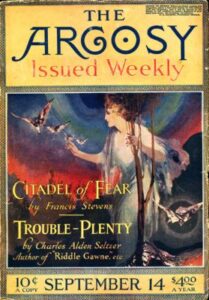
From philsp.com