Cinematically stoned (Part 2)


© Taplin-Perry-Scorsese Productions / Warner Bros


I ended my previous post by promising I’d give a list of my favourite movie scenes wherein songs by the Rolling Stones are employed to memorable effect.  Here it is.


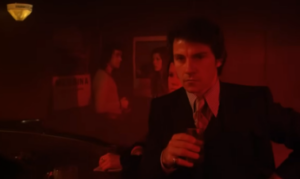
Jumpin’ Jack Flash (1968) in Mean Streets (1973)

Wow.  Martin Scorsese really likes the Rolling Stones.  Not only has he made a concert movie about them, 2008’s Shine a Light, but he’s used their music in umpteen films: Goodfellas (1990), Casino (1995), The Departed (2006) and the one that first put him on the map, 1973’s Mean Streets.  Even today, more than 50 years later, the scene in Mean Streets where a young Robert De Niro comes swaggering through a bar, in slow motion, towards a pensive Harvey Keitel, while Mick Jagger hollers in the background about being “born in a cross-fire hurricane”, is a great synthesis of rock ‘n’ roll music and rock ‘n’ roll cinema.  Indeed, Jumpin’ Jack Flash is a fitting accompaniment for the arrival in popular consciousness of De Niro, who’d spend the rest of the 20th century showing Hollywood how to do proper acting.  The 21st century, featuring such efforts as The Adventures of Rocky and Bullwinkle (2000), Little Fockers (2010), New Year’s Eve (2011) and Dirty Grandpa (2016)…  Okay, not so much.


Satisfaction (1965) in Apocalypse Now (1979)

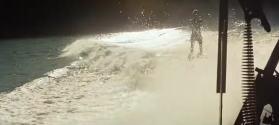
The Stones’ early, primordial and still potent stomper Satisfaction gets a brief but memorable airing in Francis Ford Coppola’s baroque Vietnam War masterpiece, playing on the radio while Captain Martin Sheen and his not-exactly-fighting-fit crew go cruising up the Nùng River in search of Marlon Brando.  Cue some funky on-deck dance moves by a frighteningly young-looking Laurence Fishburne and some funny / cringeworthy water-skiing moves by Sam Bottoms that knock various Vietnamese people out of their fishing boats.
 

© Omni Zoetrope / United Artists


Sympathy for the Devil (1968) in Alien Nation (1988) and in Interview with the Vampire (1994)

Graham Baker’s sci-fi / cop movie Alien Nation isn’t very good.  Its premise of an alien community getting stranded on earth and having to integrate as best as they can with the curmudgeonly human natives was handled much better in Neill Blomkamp’s District 9 (2009).  But I do like a woozy, hypnotic scene in it where alien-loathing cop James Caan enters a sleazy alien bar while a lady-alien performs an erotic dance to the strains of Sympathy for the Devil.  Not the original Stones song, but a correspondingly woozy, hypnotic cover-version of it by the great Jane’s Addiction.  I can’t find a film-clip of the scene, but here’s the Jane’s Addiction cover.


Meanwhile, Neil Jordan’s adaptation of Anne Rice’s Interview with the Vampire ends with Sympathy for the Devil on the soundtrack.  Again, this isn’t the Rolling Stones version but a cover, this time by Guns n’ Roses.  It’s every bit as ramshackle, shonky and (for me) enjoyable as the other covers Guns n’ Roses have done, for example, of Wings’ Live and Let Die (1973) and Bob Dylan’s Knockin’ on Heaven’s Door (1973).  Sympathy for the Devil kicks in when the vampire Lestat – Tom Cruise in one of his rare interesting roles – pops up to claim Christian Slater as his new vampirical companion for eternity.


Can’t You Hear Me Knocking? (1971) in Casino (1995)

While Martin Scorsese serenades Robert De Niro and Harvey Keitel with Jumpin’ Jack Flash in Mean Streets, he employs the Stones song Can’t You Hear Me Knocking? for another of his regulars, Joe Pesci, in Casino.  Remarkably, Scorsese plays all seven minutes of the Santana-esque Can’t You… as an accompaniment to a lengthy sequence showing how Pesci’s Casino character Nicky Santoro gets established in Las Vegas.  Predictably, the sequence has Pesci doing what Pesci usually does in Scorsese movies: being a psychotic shit, barking orders at hoodlum sidekicks twice his size, eating in restaurants, ingratiating himself with fellow Mafiosi, being a psychotic shit, cursing and swearing, getting a blow-job, being a psychotic shit, talking about food, knocking off jewellery stores, acting the loving family man with his non-criminal relatives… and being a psychotic shit.
 

© Légende Entreprises / Universal Pictures


Ruby Tuesday (1967) in Children of Men (2006)

Wistful Stones ballad Ruby Tuesday features briefly on the soundtrack of Alfonso Cuarón’s gruellingly pessimistic science-fiction thriller Children of Men.  It’s another cover, sung by Franco Battiato.  We hear it during one of the movie’s calmer moments when Theo (Clive Owen) is visiting his old mate Jasper (Michael Caine), whose home provides a small pocket of sanity amid the unfolding dystopian grimness.  Amusingly, Caine, well known in real life for being a right-wing old grump with an aversion to paying tax, here plays an elderly anarcho-hippy with a fondness for smoking exceptionally strong pot.


Gimme Shelter (1969) in The Departed (2006)

Martin Scorsese loves the Rolling Stones and he loves their apocalyptic number Gimme Shelter in particular.  By my count he’s used it in three movies: Goodfellas, Casino and The Departed.  It’s best deployed at the beginning of The Departed, rumbling in the background while gangland thug Frank Costello (Jack Nicholson) expounds his philosophy.  “I don’t want to be a part of my environment,” he intones, imbuing his words with that leery, languid menace that only Nicholson is capable of.  “I want my environment to be a part of me.”  Strangely, in Scorsese’s Shine a Light two years later, Gimme Shelter was one of the songs the Stones didn’t perform on stage.  Marty missed a trick there.
 

© Plan B Entertainment / Warner Bros


Street Fighting Man (1968) in Fantastic Mr Fox (2009)

Director Wes Anderson also sticks Rolling Stones into his movies, but so far I haven’t mentioned him because I think most of his work is smug, pretentious and annoying.  For example, Play with Fire (1965) figures prominently in 2007’s The Darjeeling Limited, an Anderson movie so twee I find it the cinematic equivalent of being force-fed with chocolate-cake mix.  However, I like the scene in his stop-motion-animation adaptation of Roald Dahl’s Fantastic Mr Fox where, to the sound of the rabblerousing Stones anthem Street Fighting Man, Farmers Bean, Boggis and Bunce use three diggers to tear up the den of the titular Mr Fox; forcing the den’s inhabitants to frantically dig an escape-route.  Yes, they really ‘dig’ that song.  Sorry.


And finally…  Out of Time (1968) in Once Upon a Time in Hollywood (2019)

I’m not the biggest fan of the Stones song Out of Time – Jagger’s vocals get a bit too caterwauling for my liking – but it sees good satirical use in Once Upon a Time in Hollywood, Quentin Tarantino’s paean to the American movie-making capital in the late 1960s, a fascinating period when traditional notions about what made a good film were rapidly being undermined by an uppity younger generation.  Played when Rick Dalton (Leonardo DiCaprio), his new Italian spouse Francesca Capucci (Lorenza Izzo) and sidekick Cliff Booth (Brad Pitt) return from Italy, where Rick has been making spaghetti westerns and action thrillers with the likes of Sergio Corbucci and Antonio Margheriti, Out of Time gives an one-the-nose summation of DiCaprio’s sad-sack character – an actor a bit too old, un-hip and uncomprehending of the changing world around him to get the leading roles he once did, now doomed to playing villains in second-rate TV shows.
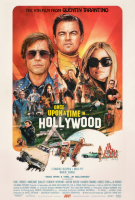
 

© Columbia Pictures / Sony Pictures Releasing 

Morricone no more


© enniomorricone.org


The death of legendary film composer Ennio Morricone a fortnight ago shouldn’t have been a surprise since he was at the big age of 91.  But he’d shown such a cussed approach to life and art, still composing music, going on world tours and quarrelling with young whippersnappers like Quentin Tarantino while he was in his ninth decade, that you assumed he was going to continue living and composing forever.  Anyway, a heavy workload earlier this month prevented me from penning a tribute to the great man at the time of his passing.  Here’s my belated tribute now.


Ennio Morricone was the first film composer I knew.  I recognised his work well before I recognised that of John Barry, Bernard Hermann, Leonard Bernstein or Henry Mancini and even before the blockbuster themes of Jaws (1976) and Star Wars (1977) acquainted me with the name of John Williams.  As a boy I was daft about western movies and as soon as Sergio Leone’s spaghetti westerns started showing up on TV I realised that Morricone’s exhilarating music, soaring and swooping along the soundtracks with twangy acoustic guitars, electric guitars, whistles, chimes, bells, flutes and aah-ing choirs, was as much a character of the films as Clint Eastwood’s cigar-smoking Man with No Name.  Remove Morricone’s music and they wouldn’t be the same.  There’d be a gaping Clint-sized hole in them.


Morricone’s music for A Fistful of Dollars (1964), the film that put him, Leone, Eastwood and spaghetti westerns on the map, is great but I think his theme for the sequel For a Few Dollars More (1965), with added Jew’s harp and ocarina, is greater still.  Maybe I’m biased since the film is my favourite of Leone’s Dollars trilogy.  It has Eastwood, the Man with No Name, team up with the splendid Lee Van Cleef, the Man in Black, and take on Gian Maria Volonté as evil scumbag bandit El Indio.  The climax sees Van Cleef facing up to Volonté in a duel whereby the participants can only draw their guns on the final chime of a musical pocket watch, which had belonged to Van Cleef’s murdered sister.  It’s absolutely epic, thanks largely to Morricone’s music, which climbs majestically and drowns out the plaintive tones of the pocket watch, then plunges and dies away again a few palm-sweating seconds before the watch stops and the shooting starts.


© Produzioni Europee Associati / United Artists


The third and final movie of the trilogy, The Good, the Bad and the Ugly (1966), confused me when I saw it as a kid because although Lee Van Cleef starred in it alongside Eastwood again, this time he played a different character from the one in For a Few Dollars More and was as evil as Volonté had been in the previous film.  I assumed he was the same guy and couldn’t figure out why he’d suddenly become so bad.  Morricone’s theme here is perhaps his most famous work – I still hear blokes in the pub, after a few pints too many, going “Na-Na-Na-Na-Naaah….  NA-NA-NAAAH!” for no good reason.  But it’s perhaps the accompaniment he provides for the Ecstasy of Gold sequence, in which an increasingly delirious Eli Wallach spends four minutes running around a cemetery while Leone’s camerawork becomes correspondingly frenzied, that’s the film’s musical highlight.


© Paramount Pictures


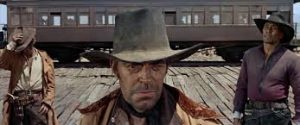
Of course, we hadn’t heard the last of Morricone as far as Leone’s westerns were concerned, because in 1968 he contributed to Leone’s Once Upon a Time in the West, a movie that regularly gets mentioned in ‘best film of all time’ lists.  (It’s certainly in my top three.)  Morricone’s magnificent score ticks all the boxes.  At times, it does the customary soaring and swooping.  At others, it’s playful and jaunty.  And at other times, it’s marked by a haunting and pained-sounding harmonica.  Like Lee Van Cleef, Gian Maria Volontè and the musical pocket watch in For a Few Dollars More, we discover the tragic significance of that harmonica at the end when hero Charles Bronson has a showdown with villain Henry Fonda.  Ironically, the film’s most breath-taking sequence, the lengthy opening where three gunmen played by Woody Strode, Jack Elam and Al Mulock await, with murderous intent, the arrival of Bronson at a remote, rickety train station, unscrolls without Morricone’s music (and indeed, without any dialogue) until nearly ten minutes in when that melancholy harmonica strikes up.


Morricone toiled away on many other Italian, and occasionally American, westerns and his CV surely makes him one of the great figures in the western genre.  His work appears in Duccio Tessari’s The Return of Ringo (1965), Franco Giraldi’s Seven Guns for the MacGregors (1966), Carlo Lizzani’s The Hills Run Red (1966), Sergio Sollima’s The Big Gundown (1966), Giulio Petroni’s Death Rides a Horse (1967), Don Taylor and Italo Zingarelli’s The 5-Man Army (1969) and Don Siegel’s Two Mules for Sister Sarah (1970).  He also contributed to a few westerns like Navajo Joe (1966),  The Hellbenders (1967), The Mercenary (1968) and The Great Silence (1968) that were directed by another Sergio, Sergio Corbucci, who was honoured in Quentin Tarantino’s recent Once Upon a Time in Hollywood (2019) when Al Pacino described him as “the second best director of spaghetti westerns in the whole wide world!”  Meanwhile, Morricone was reunited with the first best director of spaghetti westerns in the whole wide world with Leone’s late-period western Duck You Sucker (1971), a movie that I like but don’t consider in the same league as Leone’s earlier efforts.  (James Coburn’s Irish accent doesn’t help.)


By the early 1970s Leone had shifted from spaghetti westerns to another staple of traditional Italian cinema, the giallo – the horror-thriller hybrid wherein a group of people, usually affluent and beautiful, get despatched by a mysterious killer (whose identity is revealed only in the closing moments) stabbing, slashing and hacking his or her way through them for some unlikely reason.  The results are often Italian films at their most stylish, glamorous, violent, ridiculous and politically incorrect.


Morricone’s giallo music is frequently mannered, genteel and dreamy, at odds with the bloody events happening onscreen but matching the well-upholstered lifestyles of the doomed protagonists.  He contributed to Elio Petri’s supernaturally tinged A Quiet Place in the Country (1968), Paolo Cavara’s slick but dodgy Black Belly of the Tarantula (1971), Aldo Ladi’s rather brilliant Short Night of Glass Dolls (1971), Massimo Dallamano’s fairly reprehensible What Have You Done to Solange? (1972) and Umberto Lenzi’s lovably barmy Spasmo (1974).   He also did the music for Lucio Fulci’s A Lizard in a Woman’s Skin (1971), but I haven’t seen that one, so I can’t provide it with suitable adjectives.


© Seda Spettacoli / Universal


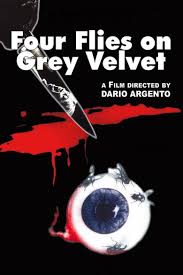
He also worked on three movies directed by the man who’s arguably the maestro of the giallo, Dario Argento: The Bird with the Crystal Plumage (1970), The Cat o’ Nine Tails (1971) and Four Flies on Grey Velvet (1971).  He didn’t, however, supply the music for Argento’s giallo masterpiece Deep Red (1976).  That role went to the German prog-rock band Goblin and I have to say, with apologies to Morricone, that I think their baroque, intense Deep Red score just about pips his work as the best giallo music of all time.


By then, of course, Hollywood had discovered Morricone and his scores for such prestigious productions as Terence Mallick’s Days of Heaven (1978) and Rolande Jaffé’s The Mission (1986) won him international acclaim.  A digression here – I remember reading an interview with Will Carling, the nice but dull skipper of the England rugby team in the late 1980s and early 1990s.  Carling told the evidently bored interviewer that before games, to settle his nerves, he listened to ‘The Mission’.  The interviewer thought Carling was talking about the 1980s British Goth band the Mission and, believing he’d discovered something interesting about Carling at last, that he was a Goth, asked him if he liked Gene Loves Jezebel too.  “No,” retorted a perplexed Carling, “The film The Mission.  The music from The Mission!”


Morricone also enjoyed a final reunion with his old comrade Sergio Leone, creating a majestic but wistful score for Leone’s Hollywood gangster epic Once Upon a Time in America (1984).


Leone didn’t just provide the music for good films.  He also plied his trade with many bad ones and often the music coming out of the cinema speakers and what was happening on the screen seemed to belong to two different aesthetic universes.  I’m thinking of Reagan’s Theme, the haunting guitar-and-choir piece he composed for John Boorman’s much-derided Exorcist II: The Heretic (1978), or the soulful, religious sounding theme he provided for Michael Anderson’s Orca: The Killer Whale (1977), totally at variance with the ridiculous plot that has Richard Harris going Captain Ahab against a vengeful cetacean.


© Turman-Foster Company / Universal Pictures


Among Leone’s Hollywood scores, I particularly admire the one he did for John Carpenter’s excellent remake of The Thing (1982).  At the time, disdainful mainstream critics (who also hated the film generally) dismissed his work as being like one of Carpenter’s own, pulsating synthesiser scores ‘slowed down’ or ‘played at the wrong speed.’  Heard today, its doomy sound encapsulates the film’s claustrophobic and literally under-the-skin horror, whilst reminding you that, yes, this is a John Carpenter film but it’s a special John Carpenter film.  I also like his subtle, creepy score for Mike Nichol’s underrated Wolf (1994), wherein a tired, middle-aged and downtrodden publisher (Jack Nicholson) gets bitten by a werewolf and discovers that his newly acquired lupine powers actually serve him well in the aggressive, cutthroat world of the 1990s New York publishing industry.


© FilmColony / The Weinstein Company


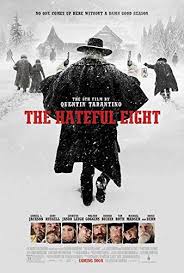
One of Morricone’s last major commissions was for Quentin Tarantino’s The Hateful Eight (2015).  The two men had previously fallen out over Morricone’s contribution, eventually non-contribution, to Tarantino’s 2012 western Django Unchained, but Morricone was back on board for this and contributed an urgent and ominous main theme.  Appropriately, seeing as The Hateful Eight and The Thing feature the same star (Kurt Russell) and a similar scenario (a stranded group trying to identify an enemy hiding among them), Morricone also donated some pieces he’d created for but hadn’t used in the 1982 John Carpenter film.  And as extra icing on the cake, Reagan’s Theme from Exorcist II: The Heretic was borrowed to accompany a brief, arty sequence of coach-horses making their way through the snow.  So it was gratifying that near his life’s end Morricone got an opportunity to show his mastery again of the genre that established his name, the western.


From open.spotify.com