Nostalgic wallows 6: 1970s visions of the future


From wikipedia.org / © NASA / Josh Valcarcel


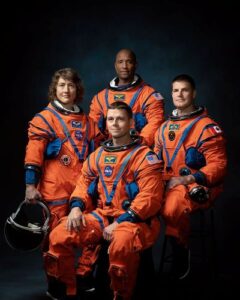
Three days ago, the crew of Artemis II returned to earth.  They had taken part in a lunar flyby mission launched by the United States’ National Aeronautics and Space Administration (NASA) that saw human beings leave low earth orbit and travel around the moon for the first time in over 50 years.  I would have posted something on this blog about Artemis II before now, but didn’t want to tempt fate.  “Let’s wait until they get back safely,” I thought.  The fact that the current US government, which gives NASA its orders, seemingly doesn’t give a f*ck about matters such as health and safety or, indeed, science generally made me worry the mission had been insufficiently prepped and might end in disaster.


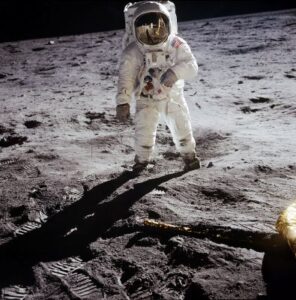
Happily, though, the Artemis II mission has been a resounding success.  It’s also made me think back to when I was a little kid, in the early 1970s, the last time that humans went to the moon.  In fact, it was in 1969, when I was three years old and NASA’s Apollo programme was underway, that the late Neil Armstrong became the first human to set foot on an alien world.  All right, it was only the moon, which is hardly in the same league as Krypton or Tatooine, but for a wee species that evolved out of the Homo genus just 200,000 years ago, Armstrong’s ‘small step’ 57 years ago was pretty impressive.


However, it has also made me wonder.  After all the excited expectations raised by the Apollo programme about space travel, how come the half-century between it and Artemis II has turned out to be so rubbish?


I’m too young to remember seeing Armstrong plant his spacesuit-encased foot on the lunar turf in 1969, but I can just about recall live TV pictures of a subsequent Apollo mission to the moon in the early 1970s.  Admittedly, I wasn’t altogether sure what I was watching.  At the time my family and I were huddled around a tiny black-and-white television in Northern Ireland, which only picked up one channel, the BBC.  (It showed a second channel, RTE, from the Republic of Ireland, if my Dad poked a screwdriver into a hole at the set’s side and did some awkward and potentially dangerous fiddling with the wiring.)  All I could make out on the screen were some fuzzy pale blobs floating against a fuzzy grey background.  However, my Dad assured me these were men walking about on the moon, high above us, at that very moment, so I took his word for it.
 

From wikipedia.org / © NASA


It must have been in 1973 that my imagination took a leap that was almost as giant as the ‘leap for mankind’ that Armstrong spoke of when he descended from the lunar landing module.  The cause of this were two sets of newly-published encyclopaedias that my parents had seen advertised somewhere and ordered – a 15-volume set with lemony-coloured covers called the Childcraft books that, accordingly, were for children; and a 24-volume set called the World Book series that were for adults and came in sombre, mossy-green covers.  That was 39 encyclopaedias in all and, amazingly, they fitted perfectly into the big display shelf that ran along the top of the sideboard in our living room.


I immediately set about reading these encyclopaedias, both the juvenile and adult ones, and my horizons were swiftly widened.  Not all the consequences of this were positive.  My parents had neglected to read the small print in the advertisement.  If they had, they would have discovered that the encyclopaedias had been printed in America, by Americans, for Americans, and their contents were duly biased towards America.  As a result, I wasted a lot of time searching in the fields of our farm for evidence that woodchucks, porcupines, prairie dogs and Gila monsters had been foraging there.  Also, some quaint words started to appear in my vocabulary – diaper, candy store, soda fountain, rest room – which inevitably had my classmates at primary school tearing the piss out of me.


One feature of these encyclopaedias that really rubbed off on me was that, because they were American and because they’d been published just after the moon landings, they were dripping with optimism.  And this was a scientific as well as an American optimism.  Yes, it’s hard to believe today, now that one of the two main American political parties is infested with far-right-wing religious fruitcakes who maintain that the universe was created in six days a few thousand years ago (and vaccines are bad, and manmade climate change is a hoax), but there was a time not long ago when America took science seriously and saw it as one of the key tools in converting the rest of the world to the glories of the American way.  At the age of eight or nine, I lapped all this up – even those assertions in the encyclopaedias that, with the benefit of hindsight, were a bit over-optimistic.


For example, the encyclopaedias predicted that, having reached the moon, it would only be a short time – the 1980s, at the latest – before human beings were tramping around the surface of Mars too.  The ‘S’ volume of the World Book encyclopaedias had a lengthy entry about ‘space travel’ and on one page I found a multi-pictured diagram showing how astronauts were going to get to Mars.  Admittedly, the Mars spaceship in that diagram, as well as having a long, sleek fuselage and a beak-like nose, had wings, which seemed a bit suspicious because by then I knew that in outer space there wasn’t any air and wings were thus superfluous.  (I suspect the artist behind those pictures had been unconsciously influenced by a non-space vehicle that was making a stir at the time, Concorde.)  Elsewhere, there were pictures of what a moonbase – only a few decades away in the future, I was told – would look like, although it was an unprepossessing cylindrical structure that resembled a giant tin can.


Anyway, I assumed this was what I could expect by the time I’d reached my thirties.  I’d be living on a moonbase, watching Concorde-like spaceships streak past on their way to Mars.


My expectations were buoyed further when in the mid-1970s my parents finally got round to buying a new TV set that got three channels, the BBC, RTE and ITV – Independent Television.  Although ITV had (and still has) a reputation for cheap and lowbrow programming in comparison with that made by the BBC, it did broadcast at the time various action / adventure series made by a subsidiary called ITC entertainment, run by the cigar-smoking impresario Lord Lew Grade.  Aimed at international markets and at the American market in particular, ITC’s shows commanded higher-than-average budgets and looked quite glossy by the standards of 1960s and 1970s British TV.  They included The Prisoner (1967-68), Department S (1969-70) and The Persuaders (1971) and a host of science-fiction shows made by the remarkable Gerry Anderson.  I was able to watch these for the first time.
 

From gerryanderson.com / © ITV Studios


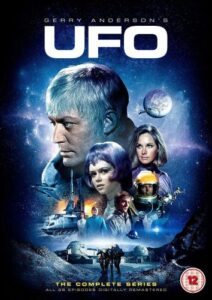
It was watching repeats of Anderson’s live-action sci-fi show, UFO, made in 1970 and starring Ed Bishop, George Sewell, Michael Billington, Peter Gordeno, Wanda Ventham (Benedict Cumberbatch’s mum) and Gabrielle Drake (Nick Drake’s sister), that convinced me that the future was going to be absolutely brilliant.  For UFO, Anderson’s production team envisioned the shape of things to come through a prism of gaudy late-1960s design and fashion, with a smidgeon of then-fashionable psychedelia.  It didn’t just feature spaceships and moonbases, but also sleek super-cars, talking computers with hallucinogenic panels of flashing lights, giant submarines with detachable nose-modules that turned into aircraft when they reached the ocean surface, guys in groovy-looking suits that didn’t have lapels, and ladies wearing silver miniskirts and sporting purple hairdos.


So, I thought, I’d be living on a moonbase, watching spaceships streak past towards Mars, and Gabrielle Drake would be shimmying around me looking fetching in silver and purple.  The future seemed better than ever.


Needless to say, as the 1970s wore on, I began to get uneasy about the fact that very little futuristic stuff was happening any more.  As far as manned spaceflight was concerned, not much occurred after the Skylab project – yes, there was the space shuttle, but that didn’t venture beyond earth’s orbit and, frankly, seemed a bit shit.  Meanwhile, the Viking 1 probe landed on Mars but, alas, found nothing interesting.  There were no aliens, Martian canals or H.G. Wells-style three-legged war machines shooting death-rays – just some boring geological formations that had once been river valleys.  And what had happened to that you-can-do-anything-if-you-put-your-mind-to-it American optimism?  It seemed to fizzle out as the 1970s became one long litany of American trauma: the Vietnam War, the 1973 oil crisis, Watergate and the Iran hostage saga.


I still had hope, though.  In the mobile library that came to our village every week, I picked up a copy of Arthur C. Clarke’s novelisation of 2001: A Space Odyssey, the classic 1968 sci-fi movie he’d co-written with director Stanley Kubrick.  It was reassuring to read Clarke’s sober, matter-of-fact account of a journey from the earth to the moon and then on to Saturn.  (In Kubrick’s film, the final destination was changed to Jupiter because of the job of convincingly depicting Saturn’s rings was too much for his special effects team.)  By then I was well-versed in astronomy and space travel and the book seemed to reinforce everything I knew already about the subjects.  It also seemed to make the idea that humanity would be out exploring more of space in the early 21st century feasible and, indeed, logical.
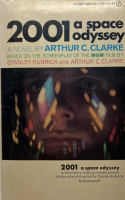
 

© Signet Books


When I finally saw 2001 the movie, however, it was in 1982 and even I had to concede it’d become a bit of a museum piece.  In some ways it possessed an admirable, almost documentary-like realism – for instance, I was impressed by the fact that, unlike the spaceships in every other science fiction movie I’d seen, Kubrick’s spaceships didn’t make any noise (because sound doesn’t travel in the vacuum of space) – but it struck me as a historical artefact nonetheless because it was clearly rooted in a past time and in past conceptions of what lay ahead.  It offered a late-1960s view of the future, one that just wasn’t plausible any longer in the early 1980s.


By then, the Mad Max movies (1979, 81 & 85) had started to do the rounds and, after the oil shortages of the 1970s, they presented an unfortunately more credible vision of what the 21st century might be like.  It was also telling that a couple of years earlier, in 1978, Lord Grade’s ITC Entertainment, which had once stimulated my space-age fantasies with Gerry Anderson’s UFO, had produced the movie Capricorn One – a cynical sci-fi thriller about a NASA expedition to Mars that is actually a hoax, with the supposed landing on the Martian surface being filmed in a TV studio in the American desert.


And now in 2026 I find myself inhabiting a world far removed from the visions that Neil Armstrong, Gerry Anderson and Arthur C. Clarke inspired in me during my childhood.  The Artemis programme promises that human beings will once again set foot on the moon but I’m sceptical that people will get to Mars in my lifetime and I’m beginning to wonder if they’ll ever get there at all.  I know Elon Musk keeps vowing to do it but, given the logistics involved and given our current levels of technology, I think that’s bollocks.  (Talking bollocks comes as naturally to Musk as breathing.)


It doesn’t help that the orange narcissist currently residing in the White House is trying to cut 23 percent of NASA’s funding – though he’ll no doubt attempt to grab the credit for Artemis II’s success and make it all about himself.


Still, thank you, Artemis II crew. You’ve kindled some fond nostalgia in me and given me a sliver of hope, at least, that humanity’s future might extend beyond the gravitational pull of its home world.
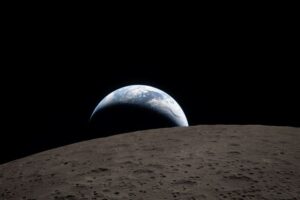
 

From wikipedia.org / © NASA

No way-sis


From wikipedia.org / © Will Fresch


I’ve just Googled ‘the universe’s smallest sub-atomic particle’ and been told that, from what we currently know, the title belongs to those classes of particles known as quarks and leptons.  So, let me say that even a quark, or a lepton, is considerably bigger than the amount of enthusiasm I can summon about the news that legendary 1990s rock band Oasis have reformed and will embark on a five-city / 17-gig tour of Wales, England, Scotland and Ireland in the summer of 2025.  (The tour has already sold out, which suggests some folk are more enthusiastic about the reunion than I am.)


Oasis have not been a thing since 2009, when the arguing, quarrelling, sniping and feuding that’d always featured in the relationship between the band’s two mainstays, Mancunian siblings Noel and Liam Gallagher, finally went supernova – as opposed to going Champagne Supernova – resulting in the band’s break-up and the pair not sharing a stage or studio since.  From 2009 until recently, they’ve only acknowledged each other’s existence by flinging insults.  Liam, the younger and less cerebral Gallagher, has frequently called his older brother a ‘potato’ and referred to his post-Oasis band the High Flying Birds as the ‘High Flying Smurfs’.  Noel, meanwhile, has memorably described his little brother as “a man with a fork in a world of soup.”


Oasis first appeared on my radar in the mid-1990s, when I was working at Hokkai-Gakuen University in Sapporo, capital of the northern Japanese island of Hokkaido.  A student approached me one day and inquired if I was ‘Bra’ or ‘O-aaa-sis’.  (No, I’m not trying to indulge in Sofia Coppola-style mockery of how Japanese people speak English – I’m simply describing how the student, with her pronunciation, sounded to me at the time.  I’m sure my Japanese sounded even weirder to her.)  I realised she wasn’t referring to a lady’s undergarment but to British rock / pop band Blur.  She was also talking about Oasis, with whom – if the British press was to be believed at the time – Blur were locked in the bitterest and most vitriolic rivalry since the Hatfields and the McCoys.  (Noel Gallagher once remarked, “I wish Blur were dead, John Lennon was alive and the Beatles would reform.”)  Not very familiar with either band – there was no Internet in those days and it was much harder to keep up with events in the UK – I visited Sapporo’s Tower Records soon after and bought a couple of their albums.


How would I answer that student?  Was I Blur or Oasis?


© Creation Records


The Oasis album I bought was 1994’s Definitely Maybe and by my reckoning it’s a very good record.  It’s not particularly innovative, with the ghosts of the Beatles, T-Rex and Slade never far away, but it has several memorable toe-tappers and stompers like Columbia and Supersonic and one genuinely great track, Live Forever.  The latter made me think that if I was a teenager, I could seriously fall in love with these guys.  The song encapsulates those feelings of hope and optimism you have in your teens, no matter how humble or ordinary your origins, about your whole life being ahead of you and great things possibly awaiting – no more so than when the refrain kicks in near the end, “Gonna live forever!”


The songs of rock’s previous big thing, the Seattle-centred grunge movement, had been introspective, melancholic, downright miserable at times, and on April 5th, 1994, less than five months before Definitely Maybe’s release, its biggest star Kurt Cobain had blown his brains out.  So, in Britain at least, young music fans must have been ready for something more joyous.


Hope was also in the air politically.  After a decade-and-a-half of Britain being ruled by the Conservative party – peachy for anyone living in booming, investment-heavy south-east England, crap for anyone living in the now-post-industrial rest of the country – and with the current Tory government of John Major looking clueless, a brighter future seemed to be on the cards.  The Labour Party was reinventing itself as ‘New Labour’ and, mindful of the prevailing Zeitgeist, its shiny, photogenic young leader was keen to rub shoulders with Oasis, Blur and other representatives of the country’s burgeoning new rock scene that’d become known as ‘Britpop’.  That smiley, nice-seeming Prime Minister-in-waiting was called Tony Blair…  Well, okay.  We know how that worked out.


From wikipedia.org / © Raph_PH


I also acquired Blur’s Parklife (1994) and liked it less.  If Oasis drew on the Beatles for inspiration, then the spark for Parklife-era Blur was another 1960s British band, the Kinks.  This resulted in a number of chirpy, quirky songs that I found irritating and made me agree with Noel Gallagher, who slagged them off as ‘chimney-sweep music’.  That said, the title song (‘Shitelife’ as Liam once dubbed it), which has actor Phil Daniels babbling non-stop while singer Damon Albarn shouts “Parklife!” every so often, has been stuck in my head ever since.  Even today, when I find myself in a work-meeting with a superior who drones on endlessly, their voice dripping with meaningless corporate jargon, I have to fight off the urge to shout “Parklife!” at half-minute intervals.


Anyhow, though I  regarded Blur’s album as the weaker one, I still liked them.  This was because I could remember seeing them live – at London’s Brixton Academy back in 1992, when hardly anyone had heard of them, on a bill that also included the Jesus and Mary Chain, My Bloody Valentine and Dinosaur Jr.  I thought they’d been all right.


So, during the Blur vs. Oasis wars, I ended up neutral.


The 1990s continued.  So did Oasis, Blur and the Britpop craze, which spawned dozens of bands I only have vague memories of now: Cast, Kula Shakur, Ocean Colour Scene, Heavy Stereo, Sleeper, Echobelly, Dodgy, Menswear, Mansun…  Actually, I’ll admit to having a strange fondness for Mansun’s song Take It Easy Chicken.


© Creation Records


In 1995 Oasis unveiled their second album, (What’s the Story) Morning Glory?, which went on to sell 22 million copies worldwide and became one of the decade’s most acclaimed records.  I wasn’t impressed, though.  The opening number (and first single) Roll with It seemed shockingly generic to me – no wonder Damon Albarn nicknamed them ‘Oasis Quo’ – and it also spawned one of the world’s worst jokes: “Why did Oasis choose soup on the menu?  Because they got a roll with it.”  Some people adore the anthemic Don’t Look Back in Anger and Champagne Supernova but I’ve always found them overwrought.  And while initially I thought the ballad Wonderwall was quite nice, I got sick of it after hearing it for the 10,000th time.  (My partner and I were in a restaurant a fortnight ago when, from a speaker, Liam started intoning, “Today is gonna be the day…”  We groaned and rolled our eyes.)


(What’s the Story) Morning Glory?’s huge, if in my opinion undeserved, success meant Oasis became even more of a rock-and-roll behemoth, doing all the customary rock-and-roll things.  Cocaine-fuelled excess?  Check.  Infighting?  Check.  Disappearing drummers?  Check.  Hanging out with Johnny Depp?  Check.  Marrying Patsy Kensit?  Check.  With so much going on, it was inevitable that the band’s third album, 1997’s Be Here Now, would (a) be presaged with more, over-the-top hype than ever and (b) prove a bloated disappointment whose sales were only a third of those of its predecessor.  It brought the band’s ascendancy to an abrupt end and helped pop the bubble of Britpop itself.  Afterwards, Oasis made more albums and I think I’ve heard most of them.  But I can’t remember a single song off them.


© Creation Records


The band’s boorish, obnoxious image put me off them too.  And when people criticise Oasis for boorishness and obnoxiousness, it’s basically Liam they’re complaining about.  While some of the abuse he’s doled out raises a smile – grumbling, for instance, that Florence Welch from Florence and the Machine “sounds like someone’s stood on her f**king foot” – there’s other stuff he’s said and done that just makes him seem like an arsehole.  An incident at Q magazine’s awards ceremony in 2000 where he heckled Kylie Minogue by yelling ‘lesbian!’ at her is also a reminder that, over the years, a fair amount of homophobia has issued from the younger Gallagher’s gob.


Yet, despite this, many journalists and critics have given Liam an easy ride – even when they’ve been on the receiving end of his loutishness.  One possible reason why is the belief that because he comes from an ‘authentic’ working-class background in Manchester, Liam is somehow the ‘authentic’ voice of the working class.  Therefore, if you criticise his antics, you’re being ‘class-ist’.  Indeed, this argument has re-ignited in the wake of the news about 2025’s reunion tour.  The British media is suddenly full of commentators accusing other commentators, ones not delighted by Oasis’s return, of being snobbish and anti-working class.


But I don’t think any of this holds water.  For one thing, I’ve known working-class people who’ve also been unimpressed by Liam’s yobbishness.  And, in my time, I’ve seen plenty of middle-class and upper-class people make knobheads of themselves, and their social status didn’t make me think they were any less arseholey than the Oasis frontman.


From wikipedia.org / © Alexander Frick


Tellingly, Mark Lanegan – singer with 1990s grunge band the Screaming Trees and somebody whose upbringing in Ellensburg, Washington, sounds much tougher than the Gallaghers’ in Manchester – didn’t have a high opinion of Gallagher the Younger.  In his 2020 autobiography Sing Backwards and Weep, Lanegan recalls how in 1996 the Screaming Trees supported Oasis during a North American tour.  At the tour’s start, Liam accosted Lanegan with a mocking cry of “Howling Branches!” – Howling Branches, Screaming Trees, get it?  Lanegan described his response thus: “‘F**k off, you stupid f**king idiot’ was my brief blasé retort, spoken as if to a bothersome mosquito.”


This was not the beginning of a beautiful friendship.  Lanegan came to detest Liam so much that he wrote: “I couldn’t believe someone hadn’t beaten, knifed, or shot him to death by now, such was the reckless, witless, and despotic nature of his insufferable façade.”


So, I wasn’t subject to even a fleeting moment of temptation to spend hours in a Ticketmaster queue and shell out eye-watering sums of money to see Oasis perform next summer.  As far as I’m concerned, the band have only one really decent album behind them.  Besides, I’m not sure they’ll even make it through the tour.  Noel may well bail out before the end, deciding that occupying the same airspace as his tosser-ish brother again is more than his sanity is worth.


© Food Records / Virgin Records


Finally, returning to the old Blur-Oasis rivalry, I have to say I’m now in the Blur camp.  I think they’re the better band because, in the end, they’ve produced more good songs that Oasis have: This is a Low (1994), He Thought of Cars, The Universal (both 1995), Beetlebum, Song 2, Death of a Party (all 1997), Coffee & TV (1999), Out of Time (2003)…  Incidentally, given that Oasis were always supposed to be hard-men northerners while Blur were poncy, studenty southerners, the video for The Universal, inspired by Stanley Kubrick’s A Clockwork Orange (1971), makes Blur look far more disturbing than their Mancunian adversaries ever looked.  Damon Albarn and co. make great Droogs.


But if I had to choose one band that represented the peak of Britpop, it wouldn’t be Blur or Oasis.  No, it’d be Sheffield’s Pulp, led by the sublimely sly Jarvis Cocker.  Pulp’s Common People (1995), for instance, brilliantly captures one of the indignities of being working class – that of having moneyed people trying to ‘slum it’ by hanging out with you in order to look cool.  No wonder that in 2004 Common People received the ultimate accolade – William Shatner sang a cover version of it.  I can’t imagine the former Captain Kirk ever wanting to wrap his tonsils around Wonderwall.


© Island Records

Spice-world: the movie


© Legendary Pictures / Warner Bros. Pictures


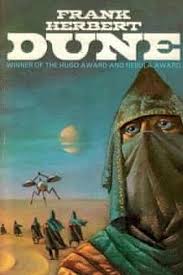
Like everywhere else, one sector in Sri Lanka heavily hit by Covid-19 was the country’s cinemas.  In Colombo, establishments like the Liberty, Savoy and Regal had stood closed-up, empty and silent for so long that I’d begun to doubt if they’d ever open their doors again.  However, with the Sri Lankan Covid-19 death toll down (for now), the authorities have permitted cinemas to reopen, albeit working at a reduced capacity.  During the first half of November, their auditoriums could only be 25% full.  For the month’s second half, the maximum capacity has been increased to 50%.  To do our bit to help Sri Lanka’s beleaguered cinema industry, myself and a mate went a few days ago to the Scope multiplex at Colombo City Centre shopping mall.  There, we watched Dune, this year’s big-budget, Denis Villeneuve-directed adaptation of the famous 1965 science-fiction novel by Frank Herbert.  Or at least, Villeneuve’s adaptation of the first half of it, as Dune is one fat book.


And we had no regrets about seeing Dune in a cinema.  It’s a visually majestic creation that needs to be seen on a big screen to be properly appreciated.  In fact, you’ll be committing a minor crime against celluloid if you watch it in reduced form on a TV or laptop screen.  And if you dare to watch it on a phone-screen…  Well, you don’t deserve to live.


I have to say, though, that I read Herbert’s novel as a teenager and it was no favourite of mine.  In part, my being unimpressed by it was probably down to bloody-mindedness.  A lot of earnest, nerdy people gushed about how great it was, which probably predisposed me to not liking it.  This was similar to my less-than-enthusiastic reaction to J.R.R. Tolkien’s much-worshipped Lord of the Rings – although unlike Rings, I did read Dune to the end.  (With Rings, I gave up four-fifths of the way through.)  Also, it didn’t help that I read Dune a couple of years after Star Wars (1977) came out.  Many of the book’s plot elements – a scheming galactic empire, a desert planet, an elite sect with psychic powers – had recently featured in George Lucas’s sci-fi / fantasy blockbuster, so they seemed less fresh than they had in 1965.


© New English Library


Though I found Lord of the Rings overrated on the page, I did enjoy the movies that Peter Jackson made of it in 2001, 2002 and 2003.  Well, apart from the last half-hour of the final one, The Return of the King, which consisted of nothing but various characters getting married.  A second-rate reading experience can, with an excellent cast, a great director and all the epic locations and special effects that Hollywood money can buy, be turned into a first-rate viewing experience.


And so it is with Dune.


Its cast is wonderful – Oscar Isaac, Rebecca Ferguson, Timothée Chalamet, Stellan Skarsgard, Dave Bautista, Josh Brolin, Jason Mamoa, Charlotte Rampling, Stephen McKinley Henderson, Sharon Duncan-Brewster and Javier Bardem – and director Villeneuve has already helmed two of the past decade’s greatest sci-fi movies, Arrival (2016) and Blade Runner 2049 (2017).  And its 165-million-dollar budget has been put to good use.  The filming locations in the UAE and Jordan really do transport you to the film’s main setting, the endlessly sandy and murderously hot desert-planet Arrakis; while the special effects, conjuring up fleets of spacecraft that stand like gigantic, angular cathedrals when they’re parked on planets’ surfaces, but look as tiny and inconsequential as pollen-grains when they’re bobbing in the black void of space, are stunning.  Hence, the absolute necessity to see Dune on a large screen.


© Legendary Pictures / Warner Bros. Pictures


Denis Villeneuve, of course, isn’t the first filmmaker to bring Dune to the screen, for an earlier cinematic version of it had appeared in 1984, directed by that genius of visionary weirdness, David Lynch.  The 1984 Dune was a box-office flop and received much abuse from critics – I remember the New Musical Express retitling it Dung – but I didn’t think it was that bad.  Lynch added some delightfully bizarre touches to the story and he arguably had an even better cast of actors than Villeneuve: Kyle MacLachlan, Jurgen Prochnow, Francesca Annis, Kenneth McMillan, Paul Smith, Patrick Stewart, Richard Jordan, Freddie Jones, Sian Phillips, Virginia Madsen, Jack Nance, José Ferrer, Everitt McGill, Brad Dourif, Max von Sydow and the great (and now, sadly, late) Dean Stockwell.  Sting was in it too.


Alas, Lynch’s producer was old-school movie mogul Dino De Laurentiis, who wanted Dune to be a regulation two-hour movie.  Cramming all the events of Herbert’s doorstop-sized book into that caused massive problems for the script.  Early on, Lynch had wisely envisioned Dune as two movies, and then proposed it as a three-hour film, but this cut no ice with old Dino.


I remember going to see Lynch’s Dune at a cinema in Aberdeen with my girlfriend of the time.  Having read the book I was familiar with the plot, which goes like this…  (Beware – spoilers are coming.)  In the distant 102nd century, the galaxy is ruled by an empire that incorporates a number of powerful families, or Houses.  One of these, the House Atreides, headed by the well-meaning Duke Leto (Isaacs in the new Dune, Prochnow in the old one), his ‘concubine’ Lady Jessica (Ferguson now, Annis then) and their son, the young Paul (Chalamet now, MacLachlan then), is entrusted with running the desert-planet Arrakis.  Arrakis is vital for the Empire because a mysterious ‘spice’- in reality a consciousness-expanding drug – is mined there and its properties enable spaceship-navigators to find their way through interstellar space.  The planet’s indigenous inhabitants, the reclusive and Bedouin-like Fremen, are suspicious of the Atreides because previously the Empire had put them under control of another House, the Harkonnen, who treated them genocidally.


Before Leto can win hearts and minds on Arrakis, the Harkonnen launch an attack to retake the planet, with the Emperor’s blessing – the whole manoeuvre has been a plot to get rid of the potentially troublesome Atreides.  The Atreides are wiped out, save for Paul and his mother Jessica, who flee into the planet’s deserts.  They now have the formidable task of rallying the distrustful Fremen and persuading them to retake Arrakis from the homicidal Harkonnen – which, in the book’s later stages, they do.


Villenueve’s film ends with Paul and Jessica fleeing the Harkonnen – a second Dune movie, which will tell the remaining story, has now been greenlighted.  Poor old Lynch, though, had to squash everything into just over two hours.  I remembering being in an Aberdonian pub after seeing his Dune with my ex-girlfriend, who hadn’t read the book.  I spent about an hour trying to explain the film’s plot to her, which she’d been flummoxed by.


© Legendary Pictures / Warner Bros. Pictures


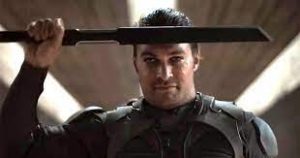
Villeneuve’s Dune only covers half of the book and is still 19 minutes longer than Lynch’s version, so obviously the story gets more space to breath.  This also enables Villeneuve to do a lot of the important sci-fi business of ‘world-building’.  It’s gratifying too that Dune’s secondary characters, the various soldiers, courtiers and allies of the House Atreides, like Gurney Halleck (Brolin now, Stewart then), Duncan Idaho (Mamoa now, Jordan then), Thufir Hawat (McKinley Henderson now, Jones then) and Dr Liet-Kynes (Duncan-Brewster now, von Sydow then) get much more time to establish themselves and win the audience’s sympathy.  In the compressed 1984 Dune, their roles were brief and their deaths, if they occurred, were blink-and-you’ll-miss-them events.


Certain critics have sniped at this new version of Dune for being humourless.  Now while I admit to counting a total of three jokes during the film’s entire 157-minute running time – it’s telling that two of those jokes turn up in the trailer – I have to say I found it refreshing to experience a science fiction film willing to treat its subject matter seriously and not populate it with, say, bumbling comedy droids or wisecracking bipedal rodents.  In effect, those critics are showing their snobbery.  They’re protesting: “But this is just science fiction!  It’s not, it can’t be serious!  You’ve got to have bumbling comedy droids in it!  And wisecracking aliens!”  So, stuff ’em.


© Legendary Pictures / Warner Bros. Pictures


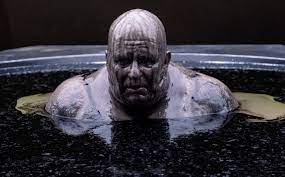
One thing David Lynch’s Dune was memorable for was its depiction of the Harkonnen.  Played by Kenneth McMillan, Paul Smith, Brad Dourif and Sting, they were a grotesque, evilly-perverted bunch – no more so than McMillan’s Baron Harkonnen, who was a levitating, leering sack of pus.  Probably wisely, Villeneuve doesn’t try to out-Lynch Lynch here and makes his Harkonnen a more sombre lot, communicating their malevolence through stillness rather than histrionics.  Stellan Skarsgard is especially effective as a brooding, Brando-esque Baron.


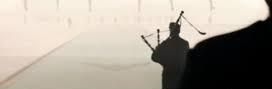
I read somewhere that Frank Herbert intended the good guys, the Atreides, to be descended from the Greeks on faraway, long-ago earth, although some visual and verbal references to bullfighting in both his book and Villeneuve’s film suggest they’re Spaniards.  However, when the Duke, his family and courtiers arrive on Arrakis, the film shows them being led out of their spaceship by a bagpiper… which implies they’re actually Scottish.  Well, their home planet’s name is Caladan, which sounds like ‘Caledonia’.  One of them is called Duncan and another is called Gurney – Scots gurn a lot.  And by half-time they’ve already been slaughtered.  So yup, I think they’re Scottish.


© Legendary Pictures / Warner Bros. Pictures


One thing I believe makes this version of Dune so good is that, in telling only the book’s first half, it’s a story of tragedy.  And tragedy, as any student of Shakespeare will confirm, is one of the most powerful forms of narrative.  I suspect Villeneuve will find it harder to make the next instalment of Dune, dealing with how Paul marshals his forces and finally restores order on Arrakis, as gripping.  For me, at least, downbeat endings last longer in the imagination than happy ones.


Anyway, for now, after Arrival and Blade Runner 2049, Dune completes a science-fictional hat-trick for Villeneuve.  Perhaps it’s not quite as impressive a run as Stanley Kubrick achieved with the sci-fi or sci-fi-related Dr Strangelove (1964), 2001: A Space Odyssey (1968) and A Clockwork Orange (1972), but it’s still pretty amazing.  Let’s hope he can knock Dune 2 out of the park and make this triumphant threesome a foursome.


© Legendary Pictures / Warner Bros. Pictures