The Darkness descends on Singapore


Andy Warhol’s prediction that one day everyone would be famous for 15 minutes seems cruelly appropriate when I think about English glam rock / metal band the Darkness.  In 2003 they released their debut album Permission to Land and for the next year they were huge. The album went platinum and the band racked up three awards – Best British Group, Best British Rock Act and Best British Album – at 2004’s BRIT Awards.


But then…  Suddenly, they weren’t huge.  Their second album One Way Ticket to Hell… and Back (2005) being a flop and their singer and lead guitarist Justin Hawkins quitting the band after struggling with drug and alcohol addiction didn’t help, though overall they gave the impression their popularity would be brief.  With the over-the-top theatricality of their music – crowned by Hawkins’ falsetto vocals – and the cartoonish-ness of their videos and general image, the band obviously didn’t take themselves seriously, which was admirable.  Alas, there’s a problem with presenting yourself as something of a joke, i.e., even the funniest joke in the world stops being funny when you’ve heard it a number of times.


For the record, I should say I liked One Way Ticket to Hell… and Back, if only for its title track, which contained the immortal lyrics: “The first line hit me like a kick in the face / Thought I better have another one just in case…”  I also liked them because they came from Lowestoft, the rather rough-and-ready seaside resort in County Suffolk.  I was spending much of my time in Suffolk when, temporarily, they hit the big time.  Indeed, at the height of their celebrity, they threatened to buy big, fancy houses in Southwold, the more upmarket, snootier seaside resort a few miles along the coast from Lowestoft – a threat some Southwolders took seriously.  I seem to recall a newspaper article where the journalist visited Southwold and interviewed some locals about the prospect of having Justin Hawkins and co. as residents.  One old lady expressed her disapproval of them because they ‘had tattoos’.


However, as evidenced by John Travolta – who went from the highs of Saturday Night Fever (1977) and Grease (1978) to the lows of the Look Who’s Talking movies (1989-93), but then enjoyed a comeback with Pulp Fiction (1994) – or Robert Downey Jr – who, after Air America (1990) and Chaplin (1992), seemingly destroyed his career with cocaine and heroin abuse, but then made a half-billion dollars playing Iron Man in the Marvel Cinematic Universe – or even Sir Michael Caine – whose route from Zulu (1964) and Alfie (1966) to having roles in eight Christopher Nolan movies and becoming a British national treasure had to go through a mid-career trough containing the likes of The Swarm (1978), Beyond the Poseidon Adventure (1979), The Island (1980), The Hand (1981) and Jaws: the Revenge (1987) – just because you were once fashionable, but then went out of fashion, doesn’t mean you won’t ever come back into fashion.   So it is with the Darkness.  After being off the radar for a long time, they’ve lately acquired some retro-coolness.


Their eighth and most recent album, 2025’s Dreams on Toast, got to Number 2 in the British charts.  They’re due to support Iron Maiden at their 50th anniversary show at Knebworth Park in July this year.  And in December 2026 they’ve lined up no fewer than seven UK arenas to perform in for their Band of Brothers tour.  They even generated some headline-making controversy when Justin Hawkins, who reunited with the Darkness in 2011, and younger brother Dan, who plays lead guitar in the band too, criticized Yungblud’s performance at the late Ozzy Osbourne’s farewell concert last summer.  The elder Hawkins commented: “…if the future of rock comes from musical theatre and Disney, if this is Ozzy’s heir, we’re in trouble.”  Finally, it hasn’t done the band’s renewed popularity any harm that, since 2021, Justin Hawkins has had a YouTube channel where he reviews and analyses songs.  It currently has 600,000 subscribers.


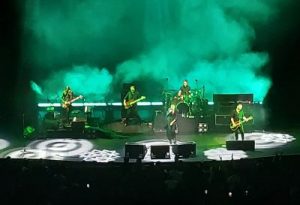
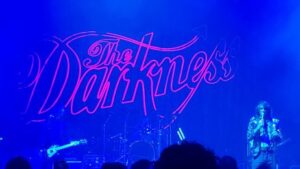
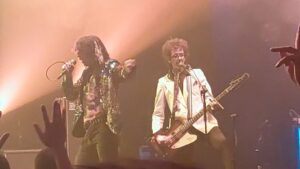
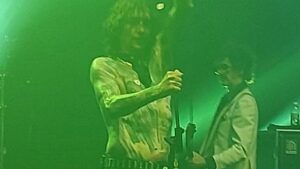
Last week, the Darkness made their first-ever appearance in Singapore, my current abode, with a gig at the Capitol Theatre.  In terms of musicality, it wasn’t the best concert I’ve attended in the city-state.  That accolade probably belongs to Jack White, whom I saw at the same venue three-and-a-half years ago.  But in terms of showmanship… This gig was pretty awesome.


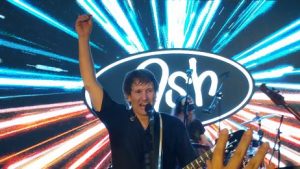
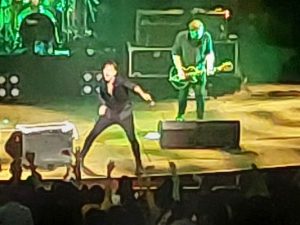
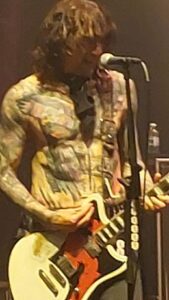
Yes, the band-members are two decades older than they were in their mid-noughties heyday – bassist Frankie Poullain, who once resembled a moustached villain from a spaghetti western, appears to have transformed into Kurt Vonnegut – but the encroachment of middle age hasn’t slowed, calmed or subdued them.  Justin Hawkins, for example, in an impressive display of spriteliness, performed a handstand at one point.  Also, admirably un-self-conscious, he stripped off to the waist early in the gig and flaunted a torso slathered in tattoos.  No wonder that old lady in Southwold objected to him.


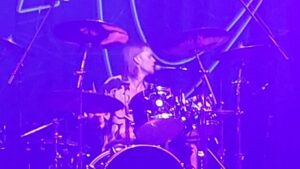
When you list the bands that had an influence on the Darkness, the one topping the list is surely Queen.  Accordingly, there were moments tonight when I felt I was listening to the rockier end of Queen’s musical repertoire – without the detours into opera, funk, disco, music hall, electronica and so on that the older band were so fond of – with Justin Hawkins providing plenty of Freddie Mercury-style flamboyance.  But I mean that in a good way.  Those Queen-esque moments smacked of loving homage rather than slavish imitation.  And on the subject of Queen, I should mention that since 2015 the Darkness’s drummer has been Rufus Tiger Taylor, whose dad is none other than the legendary Queen tub-thumper Roger Taylor.  Justin Hawkins cracked a joke about this at one point, quipping that Rufus’s father used to ‘play the drums in Status Quo’.  I laughed, though nobody else in the crowd seemed to.  Maybe because I was the only audience-member old enough to know who Status Quo were.


The setlist balanced half-a-dozen songs from their first and still most famous album Permission to Land, including such crowd-pleasing items as I Believe in a Thing Called Love and Get Your Hands Off My Woman Motherf*cker, with half-a-dozen from their recent comeback Dreams on Toast.  Of the latter songs, Rock and Roll Party Cowboy, which served as the opening number and set the tone for what was to follow, was a particularly glorious slab of glam-metal genius / stupidity (“Leather jacket, no sleeves / Harley-Davidson? Yes, please!“).  Some of their in-between albums were represented by a song each and they also did a cover, a guitar-heavy rendition of Jennifer Rush’s The Power of Love (1984), which Hawkins’ voice was highly suited to.  The cover was fun, though one ironic take on a power ballad was enough.  They thankfully didn’t follow it up with versions of, say, Bonnie Tyler’s Total Eclipse of the Heart (1983) or Celine Dion’s It’s All Coming Back to Me Now (1996).
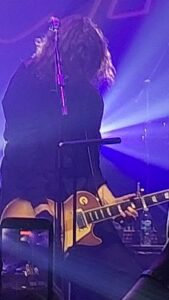
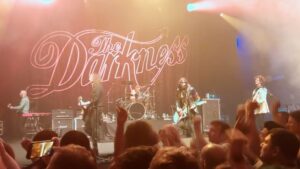


The band played epically with instruments cranked up to 11 at all times, Justin Hawkins antics’ as frontman achieved the right alchemy of melodrama and hilarity, and consequently the evening was high in entertainment value and the crowd had an excellent time. What helped, I felt, was that the Darkness came across as being a bunch of genuinely decent lads.  For instance, Justin Hawkins showed his appreciation of the guitar-tech guy who sporadically had to run on and off-stage.  The band also made sure their touring member, the keyboardist and guitarist Ian Norfolk – who, with his bald head, trimmed beard and sensible clothes looked as unlike the other performers as was possible – got a minute in the limelight.  By the way, I appreciate a guy called Norfolk playing with a band from Suffolk.


Moreover, the one moment that could have soured things – the band stopped a half-minute into I Believe in a Thing Called Love to ask certain members of the audience at the front of the stalls to stop filming on their phones – was well-handled by Hawkins.  Speaking like the nice, popular teacher at school who, once in a blue moon, has to discipline an unreasonably rowdy class, he pointed out in an I’m-not-angry-just-a-bit-disappointed voice, “Imagine if I sang the song while filming you on my phone…  It’d be really boring!”  He was more restrained than Brett Anderson of Suede, who in a 2023 gig at Singapore’s Star Theatre reacted to phone-filming spectators by tussling with them and knocking the infernal devices out of their hands.


Incidentally, when I arrived before the show, I noticed that one of the counters selling drinks at the back of the stalls belonged to the Flying V, Singapore’s premiere – well, probably only – heavy-metal bar.  And when I approached that counter to buy a beverage, I discovered they were selling Aspall Cyder.  The cidery producing this particular brew is located in the Suffolk village of Aspall, about 30 miles southwest of Lowestoft.  Wow, I thought, is this on sale because the Darkness are performing tonight?  Are they supporting the Suffolk economy whilst playing in Asia?  Momentarily, I had a vision of the Darkness’s tour-jet being accompanied by a cargo plane loaded with bottles of East Anglian scrumpy.  However, I visited the Flying V after the gig and learnt that they sell Aspall Cyder there all the time.  So it was just a coincidence.
 

A bash with Ash


The passage of time is a strange and frightening thing.  When they first got airplay on Britain’s Radio 1, the three members of the indie-pop-punk-rock band Ash were still at school in Downpatrick, Northern Ireland.  At that point the combined ages of their three members, vocalist and guitarist Tim Wheeler, bassist Mark Hamilton and drummer Rick McMurray, must have added up to a number in the low 50s, similar to (perhaps less than) the average age of a member of the Rolling Stones back then.  In other words, they seemed stupendously young to me.


So, it was a shock when I went to see Ash perform at Singapore’s Hard Rock Café last Friday night and discovered that suddenly all three are now well into their 40s.  How did that happen?  Surely, it was only a few months ago that I bought their first album after reading a good review of it in Q magazine?


But actually, that was back in 1996.  Where does the time go?


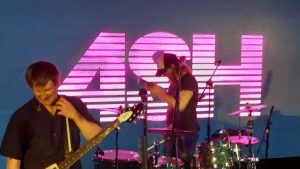
I think it was also in the now-defunct Q magazine, in the 1990s, that I read how Ash were rumoured to be the favourite band of a young Prince William.  Well, it has to be said that Ash in 2024 have weathered the years rather better than their royal fan, who these days is first in line to the throne.  Unlike the follicly-challenged Prince William, Wheeler and Hamilton still have full heads of hair – although, suspiciously, McMurray sported a baseball cap throughout the gig.


The many Western expats present in tonight’s audience looked of a similar vintage to Ash and Prince William — teenagers back in the 1990s but now middle-aged.  Incidentally, the crowd also contained a fair sprinkling of Singaporeans.  From what I can gather, this was Ash’s fourth visit to the city-state, so they’d evidently acquired a few local fans too.


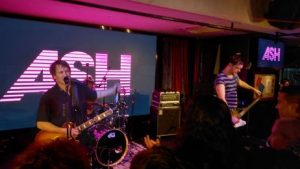
Tonight was the first time I’d attended a gig in the Hard Rock Café.  I’m not a fan of this particular dining franchise, though I have to admit they did a good job of transforming it from a restaurant to a concert venue – a venue with an old-fashioned ‘small, sweaty club’ vibe, which was especially welcome in Singapore, where too often you have to watch bands in sedate, sit-down establishments, stuck among endless rows of seats, unable to move about and shake a leg.  The café could have done with a higher stage, however.  I felt sorry for the shorter Ash fans.  Jammed behind taller folk, probably all they could see of the band were the tops of Wheeler and Hamilton’s still-hirsute heads.


One other feature of the Hard Rock Café I wasn’t thrilled by was its bar prices.  A small glass of Carlsberg beer cost 14 dollars, which meant you’d be paying in the region of 30 dollars for something approximating a pint, a costly sum even by Singapore’s standards.  Presumably because the café wanted to do some normal Friday-evening business beforehand, Ash didn’t come onstage until ten o’clock, with the doors opening for the gig at nine.  I arrived shortly after nine, saw the prices, popped out again and headed along the street to the craft-brewery bar-and-restaurant Brewerkz, where a pint cost me a slightly less eye-watering 23 dollars.


When I returned to the café just before ten, it was mobbed.  Since I wouldn’t see much of the band from the back, where the bar was, I decided to forego further boozing, burrowed my way through the crowd, secured myself a spot about two yards from the barrier before the stage, and stayed there for the show’s duration.  Even there, my view wasn’t perfect – I saw Wheeler and Hamilton’s upper halves, though they often vanished when excitable people in front of me waved their arms in the air, and I needed to stand on tiptoe to see McMurray at his drumkit.


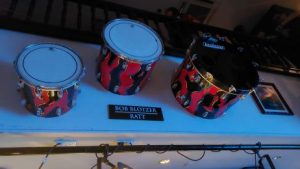
And mounted on the wall above my head was an example of the rock-and-roll memorabilia that famously decorates the Hard Rock Café franchise all over the world.  This was the drumkit of Rob Blotzer, drummer with the 1980s hair metal band RATT.   I’d completely forgotten about the dreadful, poodle-headed RATT until I saw that drumkit.  But now I remember them again.  Thanks for that, Hard Rock Café.


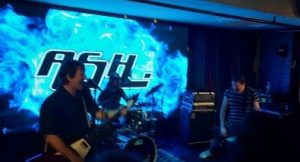
The omens were not good when Ash began the gig.  Firstly, a forest of hands shot up around me, clutching smartphones, all filming, and I had a sickening premonition of being surrounded by dozens of tiny glowing screens, each showing a tiny glowing image of the band, for the next hour-and-a-half.  Secondly, it quickly became obvious that there were sound problems, with Wheeler’s vocals almost buried by the noise of Hamilton’s bass.  Thankfully, most of the phones were soon lowered again – the crowd had just wanted some footage of their heroes coming onstage – and, a few songs in, the sound-mix became more balanced.


And what followed was very enjoyable.  The crowd, at least where I was, had fun and Ash looked like they were having a good time too.  Unlike a number of bands I’ve seen at gigs in various parts of the world, this band gave the impression that they knew, and appreciated, where they were.  For example, at one point, McMurray told the audience a funny anecdote from the previous time they’d played Singapore.


Also, due to the fact that I was standing near one of the main speakers, I was left partially deaf for the next 24 hours.  Which was a pain in the arse at work the next day, but surely a sign that I’d been to a good gig.


The 40-something Ash fans in attendance must have found it a nostalgic treat, because half of the 18-song setlist came off the two hit albums of their early years, 1977 (1996) and Free All Angels (2001).  These songs included Angel Interceptor, Goldfinger and Girl from Mars from the former and Shining Light, Burn Baby Burn and Sometimes from the latter.  Oh, and the famously Jackie Chan-referencing Kung Fu from 1977 got an airing too.  (I’m sure Ash were delighted when Kung Fu actually got used in a Jackie Chan movie, playing during the bloopers reel at the end of 1995’s Rumble in the Bronx.)  To give proceedings a slightly more up-to-date feel, they also played three tracks from their most recent album, 2023’s Race the Night.  When, between songs, Wheeler mentioned the album they’d ‘recorded last year’, an Ash fan behind me remarked in a loud and serious voice: “Surprisingly good!”  So maybe I should check it out.


Alas, the Ash album I like best – the guitar-heavy Nu-clear Sounds (1998), which was released between 1977 and Free All Angels, got a mixed reception from the critics and had disappointing sales – was represented by just one song tonight, Wildsurf.  I would have loved to hear them play more songs off it, especially the singles Jesus Says and Numbskull, which I think are cracking tunes.  The same thing happened last November when I went to see the Manic Street Preachers (they played only one song from my favourite Manics album, 1993’s Gold Against the Soul) and Suede (ditto for my favourite Suede album, 1994’s Dog Man Star).  Maybe this is a quaint Singaporean curse I’ve fallen victim to.


The per-Suede-er


At first glance, the pairing of the Manic Street Preachers and Suede at the concert I attended at Singapore’s Star Theatre on November 22nd seemed the musical equivalent of Neil Simon’s play The Odd Couple (1965).  Famous for their left-wing politics, the Manics got together as a band while they were at a comprehensive school in south Wales and they’ve forged a sound described by their Wikipedia page as variously ‘alternative’, ‘hard’, ‘punk’ and ‘glam’ rock.  The founders of Suede, on the other hand, put their band together while they were at University College London.  They were influenced by David Bowie and Roxy Music and their Wikipedia page describes their music with, among other things, the dreaded term ‘arthouse rock’.


Yes, as a former London university-student, Brett Anderson, Suede’s singer, lyricist and general lynchpin, seemed to me far removed from James Dean Bradfield and the other working-class Welsh lads in the Manic Street Preachers.  Which is unfair of me, as Anderson is actually the son of a taxi-driver.  (Maybe the name ‘Brett’ makes me biased.  The only other Brett I can think of is Lord Brett Sinclair, the posh playboy aristocrat played by Roger Moore in that dreadful / brilliant old TV show from 1972, The Persuaders.)


Still, in certain ways, the two bands are similar.  Both achieved success in the early 1990s, shortly before the advent of the Britpop movement that briefly set the world – or, at least, set those excitable hacks in the English media – on fire.  And instead of worshipping 1960s outfits like the Beatles and the Kinks, like the Britpop musicians did, the Manics and Suede were inspired by other things, such as the aforementioned punk rock and David Bowie.


Anyway, having experienced the Manics on the evening of the 22nd, I then sat through an hour-and-a-half of Suede.  And I was surprised.  I’d never seen the band before and I’d assumed that Brett Anderson was a cerebral, aesthetic type, not given to extroversion.  At least, that was the impression I’d got from interviews with him I’d read.  (I also seem to remember reading an interview that he’d conducted once, with one of his heroes, Brian Eno.)  So, I didn’t expect him to be the showman that he was tonight.  He strutted around, dropped dramatically onto his knees, perched himself on top of the front stage lights, and a couple of times descended into the stalls, where he prowled between the stage and the barrier holding back the audience.  He even went behind the barrier and into the audience.  He was a pretty belligerent in his showmanship too, constantly getting the crowd going, goading them to sing along and clap their hands.  This was Freddie Mercury with attitude.


The set-list was weighted with songs from their eponymous first album, released in 1993, and their most recent album, 2022’s Autofiction, which between them accounted for more than half the numbers played.  Autofiction has been described as a ‘back-to-basics triumph’ and its songs slotted in seamlessly with the jagged, urgent sound of early 1990s classics like Animal Nitrate, Metal Mickey and So Young.  Since Anderson is now in his fifties, with So Young he must be starting to feel like the Who’s Roger Daltrey every time he sings the ‘Hope I die before I get old’ line from 1965’s My Generation.


I was slightly disappointed that almost nothing was featured from 1994’s Dog Man Star, Suede’s second album, which is my favourite thing among their output.  Mind you, the one item from Dog Man Star that was played, The Wild Ones, was certainly memorable.  Anderson performed it by himself, on acoustic guitar, and made it even more memorable by preceding it with a rant at certain members of the audience who were filming the show on their phones.  He pleaded: “It’s so much better if you could possibly put your phones down…  Put your f**king phones down.  If you want to film, go to the back.  Don’t take up space out here.  These people want to have fun.  If you want to stare at you f**king phone, go to the f**king back.  Am I right…?  It just kills the gig.”


Being at the rear end, and at the very top, of the auditorium – from where the theatre’s lower level had looked so densely flecked with dots of phone-light that I sometimes felt I was flying over a city at night-time – I hadn’t been able to see precisely what Anderson was doing during his forays into the stalls.  However, according to the following day’s report in the Straits Times newspaper, he’d “tussled with a front-row male audience member, demanding that he put down his device” and “leapt over the barricade… confronted those in the front section of the venue who were busy filming him… started pushing fans’ hands down, grabbing phones off them, and putting them on the floor.”


Well, good on Brett Anderson, I say.  These days at concerts there seems to exist a great divide.  On one side of it are folk who simply want to experience and lose themselves in the live-music performance.  On the other side are numpties with one arm permanently hoicked up in the air, with a hand clutching the latest slab of technology from Motorola, Sony, Apple or Nokia, with eyes fastened on a tiny screen where tinier figures move around on a stage, with a mind focused only on getting the clips despatched to social-media platforms as swiftly as possible to show off to their ‘followers’.  I know which side of that gulf I’m on.  The other side can just f**k off into the sea.


Anyway, that piece of drama merely added to the emotionality and intensity of the Suede experience.  The band produced a glorious clangour of noise that,  thanks to the Star Theatre’s excellent acoustics, reached me and rattled me even at the very back of the venue.  I still had ghostly reverberations from Animal Nitrate in my ears while I travelled home on the Singapore MRT.


This being my first-ever Suede concert, and not having heard their music for many years, I hadn’t known what to expect during the second leg of tonight’s show.  But yes, I ended up per-Suede-ed.


Rock star insults


From youtube.com


This blog entry starts with Kate Bush… but isn’t about Kate Bush.


The other day I read a news report about how Kate Bush’s 1985 song Running Up That Hill had just gone to number one in the United Kingdom, Australia, Belgium and Sweden and reached number five in the United States.  The renewed popularity of the song was due to it being featured in season four of the American sci-fi / horror TV series Stranger Things.  My curiosity was sufficiently piqued for me to go to YouTube and type ‘running up that hill’ into its search-bar, wondering if it would provide the clip from the TV show where the song was used.  That didn’t happen, however.  Instead, YouTube – presumably its algorithms had taken note of my past musical preferences at the site – sent me to a cover version of Running Up That Hill performed by the late 1990s / early 2000s band Placebo.  I have to say the cover version didn’t sound bad at all.  And incidentally, the comments below were full of Americans saying things like, “I’d always assumed this was an original Placebo song.  I hadn’t known some English chick had sung it first, back in the 1980s!”


Meanwhile, my reaction at that time was: Placebo?  Wow, I haven’t heard of them for years…


And then I thought: Hold on! They were responsible for the greatest rock ‘n’ roll insult I’ve ever heard live!


Let me explain.  In 1999, I attended T in the Park, then the biggest annual music festival held in Scotland.  Placebo was one of the bands performing on the main stage and I was near the front of the crowd at the start of their set.  Also appearing that day was the rock band Gay Dad, who’d recently scored hit singles with the songs To Earth with Love and Joy, although sceptics grumbled that the hype surrounding the band was nothing to do with quality and everything to do with the fact that its singer Cliff Jones had previously been a music journalist – his former colleagues in the media were promoting his outfit as a favour.  Placebo’s singer Brian Molko was obviously one of the sceptics.  Before they began playing, Molko apologised for the band being slightly late in coming onstage.


This, he said, was because: “I was getting a blowjob backstage from the singer of Gay Dad.”  He paused, then added with timing worthy of a master comedian: “Believe me, it’s not just their music that sucks!”


Anyway, that memory got me thinking about the following question.  What are the best rock star insults of all time?


There are a few famous ones that come immediately to mind.  I recall Robert Smith of the Cure saying of the self-consciously fey and militantly vegetarian frontman of the Smiths, “If Morrissey says not to eat meat, then I eat meat. That’s how much I hate Morrissey.”  Also memorable was Nick Cave’s comment on a well-known Californian funk-rock band: “I’m forever near a stereo saying, ‘What the f*ck is this garbage?’ And the answer is always the Red Hot Chili Peppers.”  Van Halen singer Dave Lee Roth was pretty brutal about a certain post-punk troubadour of the late 1970s and early 1980s: “Music journalists like Elvis Costello because music journalists look like Elvis Costello.”  Though for brutality, you can’t beat the Manic Street Preachers’ Richey Edwards talking about Slowdive, one of the key bands of the shoegaze movement of the late 1980s: “We hate Slowdive more than we hate Hitler.”


George Melly, though strictly speaking not a rock star – he was a jazz / blues singer – deserves inclusion here for his response to Mick Jagger.  Melly had drawn attention to the deep grooves on the Rolling Stone’s face and Jagger had tried to dismiss them as ‘laughter-lines’.  “Nothing,” pronounced Melly, “is that funny.”  Meanwhile, I was never a fan of Boy George but I’ve always chuckled at his verdict on Elton John: “All that money and he’s still got hair like a f*cking dinner lady.”  And just to prove that the art of the rock-star insult remains alive and well in 2022, there was recently a spat between Joan Jett and gun-humping, Trump-worshipping rock-neanderthal Ted Nugent, which produced this Jett-gem: “Ted Nugent has to live with being Ted Nugent.  He has to be in that body, so that’s punishment enough.”


From wikipedia.org / © Will Fresch


The world of rock contains certain individuals who can be relied upon to denigrate their contemporaries practically every time they open their mouths.  Two who spring to mind are siblings Liam and Noel Gallagher, late of Britpop mega-band Oasis.  Among those suffering the wrath of Liam Gallagher have been Keith Richards and George Harrison (“jealous and senile and not getting enough f*cking meat pies”), Bob Dylan (“a bit of a miserable c*nt”), Billie Joe Armstrong of Green Day (“I don’t like his head”), Bono (“he looks like a fanny”) and Florence Welch from Florence and the Machine (“sounds like someone’s stood on her f*cking foot”).  For my money, though, his best insult was heard at a Q Magazine Awards ceremony, where he yelled at Coldplay’s Chris Martin, “You’re a plant pot!”


As the older and supposedly more cerebral Gallagher, Noel’s insults have been more elaborate, if a tad less savage.  Of the musical output of Justin Bieber, he once opined, “My cat sounds more rock ‘n’ roll than that.”   He likened the appearance of the White Stripes’ Jack White to “Zorro on doughnuts” and mused about skatey Canadian punk rockers Sum 41: “After I heard Sum 41, I thought, I’m actually alive to hear the shittiest band of all time.”  Needless to say, Oasis’s Britpop arch-enemies Blur came in for some stick too: “I wish Blur were dead, John Lennon was alive and the Beatles would reform.”  And inevitably he’s had some choice words for his wayward younger brother since they acrimoniously parted company in 2009.  That same year he famously described Liam to “a man with a fork in a world of soup.”  (For his part, the younger Gallagher has repeatedly referred to Noel as a ‘potato’ and called his post-Oasis band the High Flying Birds ‘the High Flying Smurfs’.)


© Weidenfeld & Nicolson


The Rolling Stones’ Keith Richards has also had a famously barbed tongue, powered by his apparent disdain for any form of music that isn’t structured around a 12-bar blues progression.  He’s dissed Prince as “an overrated midget”, REM as “a whiny college rock band” and P Diddy as “bereft of imagination.  What a piece of crap.”  He dumped on the Grateful Dead for “Just poodling about for hours and hours.  Jerry Garcia, boring shit, man. ”  Of Metallica he speculated, “I don’t know where Metallica’s inspiration comes from, but if it’s from me, I f*cked up.”  Hilariously, he said of Elton John after the death of Princess Diana in 1997 and after John had reworked his 1973 ode to Marilyn Monroe, Candle in the Wind, as a tribute to the deceased princess: “His writing is limited to songs about dead blondes.”  (To which Elton John retorted that the venerable Stones guitarist resembled “a monkey with arthritis.”)


But surely the man who’s suffered the most ignominious put-down from Keith Richards is his long-term singer, writing partner and fellow Rolling Stone Mick Jagger.  Jagger’s image as a tireless lothario took a dent when Richards wrote about his manhood in his 2010 autobiography Life: “Marianne Faithful had no fun with his tiny todger.  I know he’s got an enormous pair of balls but it doesn’t quite fill the gap.”


From vassifer.blogs.com


However, when it comes to rock-star insults, one man is – or alas, was – the undisputed champion.  Mark E. Smith, for four decades until his death in 2018 the driving force behind the fascinatingly off-the-wall post-punk / alternative rock group the Fall, was never more entertaining in interviews than when he directed his guns at his peers and rivals in the music world.  Among those getting it in the neck from Smith over the years were Badly Drawn Boy (“fat git”), Echo and the Bunnymen (“old crocks”), Garbage (“like watching paint dry”), Bob Geldof (“a dickhead”), Sonic Youth’s Thurston Moore (“should have his rock licence revoked”), Mumford and Sons (“We were playing a festival in Dublin…  There was this other group, like, warming up… and they were terrible.  I said, ‘Shut them c*nts up!’  And they were still warming up, so I threw a bottle at them…  I just thought they were a load of retarded Irish folk singers”), Pavement (“They haven’t got an original thought in their heads”), Ed Sheeran (like “a duff singer songwriter from the 70s you find in charity shops”) and Suede (“Never heard of them,” said Smith cruelly, just after off coming off a tour where Suede were the support band).


And in fact, not even a songstress as lauded as Kate Bush escaped Smith’s vitriol.  In 2014, when Bush’s Before the Dawn concerts – her first live performances since 1979 – triggered massive interest in her and her music again, Smith told the Manchester Evening News: “Who decided it was time to start liking her again?  I never even liked her the first time round.  It’s like all these radio DJs have been raiding their mam and dad’s record collections and decided that Kate Bush is cool again.  But I’m not having it!”


It’s a shame the wonderfully curmudgeonly Smith isn’t around today to witness Kate Bush’s latest return to prominence with Running Up That Hill.  I’m sure he’d have some entertaining pronouncements to make on the matter.


© EMI