You can’t say those things nowadays… unless you’re a politician


From wikipedia.org / © House of Lords / Roger Harris


In this post I’m not going to repeat the three most depraved and revolting jokes I’ve ever heard.  But I’ll say when and where I heard them, and from whom.


The first joke concerned a medical tragedy and a hideous crime, both involving children, which’d made headlines in the UK during the 1980s.  One night in a pub in Aberdeen, where I was a college student, a friend told a 13-word joke that combined the two cases.  The friend was a decent guy who was drunk at the time and he uttered the joke during a moment of reckless bravado.  Immediately afterwards, he looked disgusted with himself and spent the rest of the evening in a state of depression.  I don’t think I heard him tell an even vaguely risqué joke after that.


I wasn’t as shocked as I might have been because I’d already encountered the joke in written form.  Some degenerate had scribbled it on the back of a toilet-door in Aberdeen University’s Queen Mother Library and I’d noticed it whilst ‘on the john’.


The second joke was two words longer – 15 – and I heard it in the context of a supposedly real-life anecdote.  Another guy I’d known as a student had, following graduation, gone on a trip to the USA where, one day, he’d ended up at an outdoor music festival.  He too was somewhat inebriated.  The festival’s compere decided, at one point, to leave the stage and wander among the crowd, sticking his microphone into people’s faces and asking them how they were getting on.  He stopped by my old acquaintance and, discovering he was from ‘Scaaat-land’, asked him to tell a ‘Scaaat-tish’ joke.  So my acquaintance spewed those 15 words into the microphone, which boomed across the field from the festival’s speakers and left the entire crowd in mortified, disbelieving silence.  I’m not sure if I really believe that story happened – but if it did happen, it was quite something.


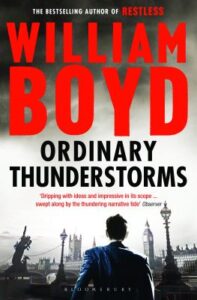
Incidentally, the same joke appears in William Boyd’s 2009 novel Ordinary Thunderstorms.  An unsavoury character tells it to the book’s hero, who responds by tipping him over a bridge and dropping him into the River Thames, where he drowns.  To be fair, the character had antagonized him a lot before that, so he wasn’t just reacting to the joke’s depravity.
 

© Bloomsbury


The third joke I heard in the early 1990s.  I was sitting at the counter of an Edinburgh pub when a drunken guy beside me told it.  It was a longer and more elaborate joke and featured Freddie Mercury, singer of the rock band Queen, who was famously gay and had died of AIDS a while earlier, and another famous showbusiness personage, also gay, who’s still with us in 2026.


Ooph, I thought, that’s really horrible. I hope I never hear a joke like that again.  


Well, I have just encountered a joke like that again.  In fact, it’s the same joke, though updated from the 1990s and now about the gay singer George Michael, who passed away in 2016, and his former partner Fadi Fawaz.  According to the Daily Record newspaper last week, it was told by Malcolm Offord, leader of the far-right-wing Reform party’s branch in Scotland.  In 2018, he included it in a speech he delivered at a Burns Supper held by a rugby club he was a director of.  In the kerfuffle following the Daily Record’s report, Offord admitted telling the joke was ‘a mistake’ and denied being homophobic.  “I don’t have any issue with homophobia,” he said.  “I’ve got a lot of gay friends.”


Nigel Farage, Reform’s Britain-wide leader, has defended Offord, saying, “If we’re going to drum people out of public life for telling a joke at a boozy rugby club dinner that’s amongst friends, we’ll finish up with the dullest group of individuals, looking a bit like, sounding a bit like Keir Starmer.”  Less forgiving was John Swinney, leader of the Scottish National Party and currently First Minister of Scotland – the post Offord aspires to take over following the Scottish parliamentary election this May.  Swinney said of Offord, “He’s unfit to be leader of any political party, unfit to be a member of the Scottish Parliament with views and attitudes like that…  I think we’ve got to be really careful as a country about where we are heading, and Reform have got no part to play in it if they represent views of intolerance, prejudice and hatred of that type.”


What are we to make of this?  Should we regard Offord’s faux pas as regrettable, alcohol-fuelled ‘banter’, accept his apology and move on?  And are we, as Farage suggests, in danger of becoming too puritanical, of scaring all the interesting people away from public office, of ending up with humourless dullards in power over us?  Is society getting – oh God, here we go again – too woke?


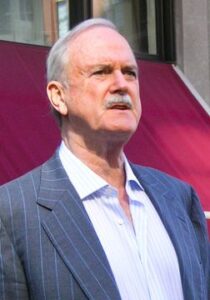
It calls to mind the lamentations of Monty Python (1969-74) and Fawlty Towers (1975-79) star John Clleese, who’s spent a good part of the last few years complaining that you can’t tell a good, impactful, close-to-the-bone joke anymore because folk get too offended: “I don’t think we should organize a society around the sensibilities of most easily upset people because then you have a very neurotic society.”  Incidentally, the 86-year-old Cleese appears to have thrown in his lot with Rupert Lowe’s party Restore UK, an outfit even further to the right than Farage’s Reform.
 

From wikipedia.org / © Paul Boxley


Well, in my view, we’re never going to stop hearing sick, horrible and downright racist / misogynist / homophobic / transphobic / etc. jokes.  For as long as the urge to be ‘edgy’ persists in the human psyche, such jokes will continue to be told in pubs and clubs, on sports terraces, in Internet forums, on WhatsApp and other messaging platforms, in countless situations where people interact.  But anyone who thinks it’s a good idea to spout a joke of that sort in public – supposedly 200 people attended Offord’s Burns Supper – shouldn’t be presenting themselves as a politician qualified to take over the highest political office in Scotland.  Especially when as holder of that office you’ll be representing, and making decisions that affect, the group of people your joke cruelly mocked.


Call me old-fashioned, but I prefer my political leaders to be dull – and serious, and sensible.  I remember British Prime Ministers like Labour’s Jim Callaghan and the Conservatives’ John Major, both rather grey and uninteresting, but whom I felt a lot safer having in Number 10, Downing Street than, say, an alleged laugh-a-minute ‘personality’ like Boris Johnson.  Between Callaghan and Major, of course, Britain was subjected to the 11-year reign of Margaret Thatcher, who had many qualities – mainly negative qualities, in my opinion – but being a barrel of laughs who told good jokes wasn’t one of them.


Offord must have thought he was on safe ground with his joke because he was at a well-lubricated rugby club event, not what you’d expect to be the most politically correct of gatherings.  But according to the Daily Record, even his rugby-loving audience was unimpressed.  One witness said, “I was sitting next to a gay man and it was clearly an extremely uncomfortable and unpleasant experience for him…  At the time I thought it pretty awful and indeed that was the feeling in the room.  Even for a rugby club it was a crude, bad taste and insulting spectacle…  I don’t know who in their right mind would say something like that.”


Even some of the usual suspects in Scotland’s mostly right-wing, Unionist media have turned on Offord because of this.  Scottish Times columnist Alex Massie penned a piece entitled Reform may already regret its choice of leader in Scotland, whilst Scottish journalist Stephen Daisley, who frequently writes for the very right-wing Spectator, messaged, “Malcolm Offord is single-handedly wrecking Reform’s chances in the Scottish parliament.  Can the Holyrood campaign be salvaged?”


I haven’t heard any reaction yet from Chris Deerin, who’s somehow the Scotland editor at the supposedly left-leaning New Statesman.  When Offord became Scottish Reform leader, Deerin tweeted, “Malcolm Offord is a seriously great get for Reform.  Very smart, ambitious for Scotland, excellent communicator, properly Scottish, experience of government, hugely successful in business – working class boy made good.  Ooft.”  (‘Ooft’, of course, was my first thought when I heard that joke.)  And in a couple of New Statesman articles Deerin penned about Offord, he talked breathlessly about the wealthy politician’s ‘gilded life’ and particularly admired his “vintage, open-top Jaguar sports car, Bond-esque in its sleek lines and growling power,” in which Offord “roared off into the countryside.”


Alas, despite everything, I don’t think Offord will be roaring off into the countryside, never to be seen or heard of again.  There are too many people who’ll rally to his cause rather than reject it after this furore.  That’s because they believe the line, fed to them endlessly by Britain’s right-wing media and pundits, that everything is too puritanically woke now, that you can’t crack a joke about gays or women or religious or ethnic minorities without the roof falling on your head, that you “can’t say those things nowadays”.  The irony is that you can say those things nowadays, and totally get away with them, at least if you’re a British politician.


Nigel Farage has recently courted controversy over the personalized messages he’s sent as Cameo videos – one of several lucrative side-projects he has in addition to being Reform party leader and a Member of Parliament.  A Guardian investigation found that the messages included ones “supporting a convicted rioter, repeating extremist slogans, and endorsing a neo-Nazi event” and where he “referenced antisemitic conspiracy theories, and made misogynistic remarks about leftwing politicians, including a comment about the US congresswoman Alexandria Ocasio-Cortez’s breasts.”


Previously, Farage was in hot water because of allegations made by over 30 people who’d known him during his schooldays.  According to their accounts, the teenaged Farage was quite the dedicated follower of fascism – among other things, singing Hitler Youth songs and growling “Hitler was right” and “Gas them” at Jewish pupils. He’s variously responded to these allegations by calling them ‘fantasies’, saying he can’t remember saying such stuff or dismissing it as – there’s that word again – ‘banter’.


Not that this has dented Farage’s popularity much.  His party is still leading in British opinion polls.

 

From wikipedia.org / © Roger Harris

From wikipedia.org / © Roger Harris


Elsewhere, Robert Jenrick, formerly the Conservatives’ Shadow Justice Secretary and now a defector to Reform, caused outrage last year when he said a 90-minute visit to the Handsworth part of Birmingham was “as close as I’ve come to a slum in this country” and one where he didn’t encounter “another white face“.  And earlier this month, the Conservatives’ Nick Timothy, who’s inherited Jenrick’s role as Shadow Justice Secretary, described an open Iftar event in Trafalgar Square as “an act of domination…  not welcome in our public places and shared institutions…  straight from the Islamist playbook.”  In previous years open Iftar events had been held in the square without anyone objecting, as had other religions’ celebrations such as Chanukah, Vaisakhi and Diwali.  And it had also hosted Christian events like mass prayers and Good Friday passion plays.


Rather than discipline them, Conservative party leader Kemi Badenoch backed both Jenrick and Timothy.  The latter case inspired the double-barreled, hard-right-wing rabble-rouser Stephen Yaxley-Lennon to crow on social media about how, just two years ago, a Conservative Member of Parliament making Timothy’s anti-Islamic comments would have been expelled from the party.  But not in 2026.


Yes, call me old-fashioned…  But I prefer the good old days when not only were British mainstream politicians grey and dull, but if they’d spouted anything blatantly racist, misogynistic, homophobic, or Islamophobic, they’d immediately have been out on their ear.

Go west, young Scots (if you can)


From bellacaledonia.org.uk


Once upon a time, the misery involving Scotland and the FIFA World Cup hinged around the fact that, though the Scottish men’s football team usually qualified for the thing, they never, ever managed to progress beyond its first round.  This was irrespective of whether they played well (in 1974, managing a win and two draws, one of those draws with Brazil, but going out on goal difference); badly but with a flash of genius when it was too late (in 1978, getting beaten by Peru, drawing with Iran, finally finding their mojo and defeating the tournament’s eventual runners-up Holland, but going out on goal difference); or simply badly (most of the rest of the time).


My family moved from Northern Ireland to Scotland in 1977, in time for Scotland’s campaign in the 1978 World Cup.  As I noted above, that performance wasn’t all bad.  However, the team’s departure for Argentina, the host country, had been accompanied by a Scotland-wide tsunami of insane expectation and over-optimism.  The madness was caused by some witlessly hopeful predictions from Scotland manager, Ally MacLeod, which an irresponsible and headline-hungry Scottish press had amplified.  (The team had some good players, but not that good.)   When their country didn’t win the World Cup, as everyone had been braying they would, but flopped in the first round, the Scots treated it as a national humiliation.  And for years, if not decades, afterwards, they suffered from Post-Ally-MacLeod-Stress-Disorder.


During the 1982 World Cup, I was working in Northern Ireland.  I got caught up in the euphoria of Northern Ireland’s unexpected and brilliant run in it – they got past the first round and beat host nation Spain along the way – and, probably fortunately, I didn’t have to focus too much on Scotland.  By 1986, I was studying in Aberdeen.  For Scotland’s final first-round match of that competition, in Mexico, they needed to beat Uruguay by at least two goals.  A mate called Alan Kennedy invited me and a few others to his house to watch the game on TV.  For the occasion we ordered a keg of beer and tucked into it several hours before the kick-off.  Well lubricated, I dozed off in an armchair not long into the match.  What a lucky man I was.


Four years later, in 1990, I was working in Hokkaido in northern Japan.  This time, with the World Cup taking place in Italy, I invited a few of my friends to my apartment for Scotland’s final first-round game.  Their campaign had begun with another gut-wrenching, soul-destroying defeat – by Costa Rica – that added yet more scars to the nation’s psyche.  But then they’d beaten Sweden and now they needed to see off Brazil.  They didn’t.  The folk I invited to my apartment for the game consisted of some Japanese colleagues and a football-daft Glaswegian called Bill Quinn.  Afterwards, one Japanese colleague remarked, “I’ve never seen anyone look so sad as your friend Mr Quinn when the match finished.”


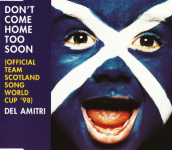
Scotland didn’t qualify for the 1994 World Cup in the USA but made it to the 1998 one in France.  By now the nation was well past any delusions that they might come near to winning the damned thing. They just prayed that their team would get past that f**king first round and into the second one.  Small wonder that for Scotland’s official 1998 World Cup anthem, the Scottish Football Association got Del Amitri to sing a wistful song called Don’t Come Home Too Soon.


From wikipedia.org / © A&M Records


During this competition I was at my family’s home in the Borders town of Peebles and I watched all three Scotland games in the town’s cosy Bridge Inn, known locally as ‘the Trust’.  After the third game, a three-goal humping by Morocco that ensured that, yes, Scotland were coming home too soon, I left the Trust and headed for the Green Tree Hotel at the far end of the High Street.  The public bar there was full of people who’d just been watching the game in full regalia – team shirts, tammy hats, tartan scarves and kilts – and whom I expected to be miserable beyond belief.  They weren’t.  Their team had taken an early bath for the umpteenth time, but what the hell?  They’d decided they might as well party.  The ensuing evening was one of the best I’ve ever had in a pub.  Someone behind the bar stuck on a compilation record called The Best Scottish Album in the World Ever (1997) and I couldn’t believe how many grown men around me knew all the words to Shang-a-Lang (1974) by the Bay City Rollers.


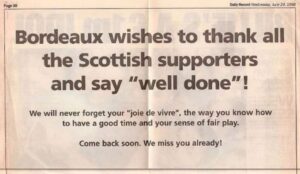
That evening in 1998 was symbolic of what’d happened regarding the Scottish football team and its supporters.  While the former seemed doomed to flounder at these big events, the latter had given up on any expectation of their team doing well and were simply determined to enjoy themselves, win, lose or draw.  In the process, their self-deprecating humour and dedication to good-natured partying earned them the reputation of being one of the best sets of football fans in the world.  For instance, the city council of Bordeaux, where Scotland had played two of their 1998 World Cup games, took out a full-page advert in Scottish newspaper the Daily Record to thank the fans for their behaviour: “We will never forget your ‘joie de vivre, the way you know how to have a good time and your sense of fair play.  Come back soon.  We miss you already!”  I’m sure those sentiments were shared by Bordeaux’s bar and off-licence industry.


Indeed, I felt sorry for bigger countries with a reputation for greater footballing prowess, whose fans did expect them to deliver the goods.  I’d see those countries’ fans gather to watch a make-or-break World Cup game…  And, when the final whistle blew and their country had messed up, lost the game and exited the competition, those fans immediately headed home with scowls on their faces.  Wait, I’d think, aren’t you at least going to hang around and party?  (Yes, I’m looking at you, England fans.)


We’re more than a quarter-century on from the 1998 World Cup.  The issue with Scotland since then is that they’ve failed to qualify for the competition at all.  Bellyaching about them never progressing beyond the first round of it seems like an unobtainable luxury now.  We didn’t know how lucky we were back in the late 20th century.


Happily, though, all that has changed.  November 18th saw Scotland clinch qualification for next year’s World Cup tournament in Mexico, Canada and the USA by beating Denmark 4-2 at Hampden Park in Glasgow.  Sure, Denmark had the lion’s share of the play, and John McGinn was perhaps not being too modest when he commented afterwards, “I thought we were pretty rubbish to be honest, but who cares?”  But three of Scotland’s four goals were amazing: Scott McTominay managing to backwards / overhead-kick the ball into the Danish net whilst seemingly levitating in the air; Kieran Tierney sending the ball scouring around the penalty area and just making it inside the Danes’ goalpost; and, with brilliant insouciance, Kenny McLean punting the ball in the final seconds from the halfway line – and seeing it go over the Danish goalie’s head and into the net.


Mads Mikkelsen, your boys took a hell of a beating.


From wikipedia.org / © Luca Faz


My excitement about Scotland being on their way to a World Cup for the first time in 28 years is tempered, though, by the fact that it’s being held in North America.  Under the FIFA presidency of Gianni Infantino – a man who’s managed the difficult feat of making Sepp Blatter look wholesome – the sale of tickets has been, in the words of the Guardian, ‘a late capitalist hellscape’ plagued by ‘dynamic pricing, crypto detritus and corporate doublespeak’.  How many ordinary Scotland fans, whose presence at past matches has created such a memorable atmosphere, can afford to attend a game?  Not so many, I imagine.  Plus, if Scotland’s games are played in the USA, the fans will have to get past that country’s increasingly autocratic rules on who gets allowed in.  Dare to criticize President Trump on social media and you get barred, apparently.  And I’d guess that, online, more than a few Scotland fans have referred to the American Commander-in-Chief as ‘a big orange bawbag’ at some point.


No, I have a horrible suspicion that the majority of Scotland’s support at any USA-held games would consist of well-heeled, conservative and sober Americans who happen to have a ‘Mac’ in their surnames thanks to some Scottish ancestor – folk who like to see a few kilts at their weddings but who quietly prefer American football and baseball to what they call ‘soccer’.  The atmosphere at those games could be terribly lame.


That’s on top of my horrible suspicion, based on past experience, that Scotland will screw up against some embarrassing opposition.  I have a bad feeling about the Dutch Caribbean island of Curaçao, who have just become the smallest-ever country to qualify for a World Cup, under the management of none other than former Glasgow Rangers boss Dick Advocaat.  I can just imagine them ending up in Scotland’s first-round group.  And then Scotland making a giant hash of things against them…


Meanwhile, as the USA’s orange Commander-in-Chief loves bragging about his Scottish roots – his mother came from the Isle of Lewis – I bet he’d make a great show of turning up in person to watch any Scottish World Cup game that takes place on American soil.  Mind you, he might not survive the ordeal.


From the Daily Record / © Bordeaux City Council


The power of Friedkin compels you! (Part 2)


© Hoya Productions / Warner Bros. Pictures


William Friedkin’s most influential movie arrived two years after The French Connection.  This was his horror masterpiece about a demonically-possessed child, The Exorcist (1973), which achieved two things the mainstream  film industry had previously thought impossible.  Firstly, it showed that horror movies could do big box-office business (something reinforced by Steven Spielberg’s Jaws two years later).  Secondly, it proved that horror movies could be as hard-hitting and adult in tone as anything coming from the New Hollywood Generation, who shook up American filmmaking in the 1970s and included Francis Ford Coppola, Martin Scorsese, Peter Bogdanovich, Paul Schrader and John Milius.  Mind you, the idea of serious horror movies had diminished again by the 1980s.  That was when many horror filmmakers decided it was more fun to tell stories about horny teenagers being murdered in inventive ways by homicidal maniacs in hockey masks.


The Exorcist was released in cinemas around the time I first saw The Night They Raided Minsky’s on TV.  My family was living in Northern Ireland then and I remember a young guy called Lawrence Timlin, who worked for my dad, telling me about how he’d seen The Exorcist twice.  The first time was during his wanderings in London and the second time was after he’d returned home to Northern Ireland.  The version he’d seen in a Northern Irish cinema, he said indignantly, had had many things cut out of it, no doubt from fear of what Northen Ireland’s sizeable communities of religious nutcases (both Catholic and Protestant) would say if they were left in.  Mind you, that didn’t stop those nutcases picketing cinemas when the film opened in the province anyway.


A decade later, when I finally saw The Exorcist, it wasn’t in ideal circumstances.  I was at college and staying in a hall of residence.  The hall’s residents’ committee organised a showing of it one Sunday afternoon.  As a result, I saw it in a common room with about 40 other people, all of us squinting at a TV set, on which it was playing from a VCR.  Definitely not a big-screen experience.  Still, I was lucky that I saw it at all.  For, in a decision that highlights yet again the cultural idiocy of Maggie-Thatcher-era Britain, video sales of The Exorcist were banned by the British Board of Film Classification in 1988.  They were afraid of the effect it might have on ‘young people’ who saw it at home: “At the cinema it had been relatively easy to ensure that young people would be excluded, but video was another matter.”  Home video sales of The Exorcist remained illegal in the UK until 1999.  At least in 1998 I managed to catch it in a cinema, on a big screen at last, during a special release marking its 25th anniversary.


I have misgivings about The Exorcist’s philosophy.  I find facile its depiction of evil as an opportunistic, external force – when the idea that evil is something internal, that potentially resides inside every human being and can be activated by the right combination of circumstances (especially weakness of character), is more disturbing.  Even more facile is the idea that the Catholic Church is the line of defence holding evil at bay.  That seems laughable today, given that in the half-century since 1973 it’s become clear that the church’s cassocked ranks have harboured far more threats to young people than video sales of The Exorcist could ever have posed.


But those are issues I’d blame on the movie’s script and source novel by William Peter Blatty.  Its performances and Friedkin’s direction can’t be faulted.  He handles the famous set-pieces – rotating heads, projectile vomiting, the manifestation of the demon Pazuzu to Father Merrin (Max von Sydow) in Iraq – with aplomb.  And von Sydow’s arrival at the residence of Chris MacNeil (Ellen Burstyn) and possessed daughter Reagan (Linda Blair), when he stands silhouetted in mist, his outline delineated by a glowing streetlamp mixed with a shaft of light from an upstairs bedroom-window, is absolutely magical – perhaps the most seminal image of the horror genre.  The insertion of music from Mike Oldfield’s classic prog-rock album Tubular Bells (1973) during an early scene works brilliantly too.  And I say that as someone who normally hates progressive rock.


© Hoya Productions / Warner Bros. Pictures


Seven years later, Friedkin generated more controversy with his 1980 thriller Cruising.  This has Al Pacino playing a New York cop who goes undercover in the city’s gay S&M scene, in order to track down a serial killer who’s murdering gay men.  I didn’t see Cruising until the 1990s and I watched it at the insistence of an ex-girlfriend who was enthralled by the film.  Maybe she got turned on by seeing Al Pacino in a tableau of gay sex and S&M.  The film was condemned by New York’s gay community, who felt that by focusing on the city’s ‘leather bars’ it was linking all gay culture with violent sex.  In the film’s defence, Pacino claimed that it concentrated only on one sub-culture and could no more be accused of slandering the whole gay community than a film that dealt with the Mafia could be accused of slandering the whole Italian-American community.  Maybe so, but in 1980 mainstream America was a lot more aware of and at ease with its Italian-American component than it was with its gay component.  It might be able to distinguish between the specific and general in the former community, but could it do so in the latter?


Whatever – despite the issues about what it portrayed and how it portrayed it, I think Cruising is a pretty good thriller.  Though I obviously didn’t get the kick out of it that my ex-girlfriend did.


It was also in the 1990s that I saw a Friedkin movie that made me wonder if, creatively, he’d fired his last bolt.  This was the 1990 horror movie The Guardian, which has Jenny Seagrove playing an angelic English nanny who’s actually a dryad.  She abducts the children entrusted to her care and sacrifices them to the gnarly old tree that she’s an extension of.  Seagrove had form playing mythological creatures, having turned up in Bill Forsyth’s Local Hero (1983) as a mermaid who bewitches Peter Capaldi.


Horror movies about trees are generally not good – see From Hell It Came (1957), The Woman Eater (1958), Maneater of Hydra (1967) or the anthology movie Tales That Witness Madness (1973), which has an episode where Joan Collins is spurned by her husband because he’s become obsessed with a weirdly human-female-shaped tree trunk he’s found out in the woods.  (No jokes please about the tree trunk being a better actress.)  The Guardian unfortunately doesn’t buck the trend.  About the nicest comment about it was made by Time Out magazine, which chortlingly described it as: “A severely flawed but not unamusing venture from a director who should know better.”  The film was co-scripted by the estimable Welsh writer Stephen Volk.  It was Volk, apparently, who got Friedkin hooked on the tree angle – the film’s source novel, Dan Greenburg’s The Nanny (1987), has no such material in it.  However, once Volk had shown Friedkin the 1904 short story The Ash-Tree by M.R. James, the director was adamant.  His movie had to have a killer tree!


© Universal Pictures


But happily, Friedkin enjoyed a renaissance in the early 21st century.  This was largely thanks to an association with the playwright Tracy Letts.  First came the claustrophobic and entomophobic Bug (2006), based on Letts’ 1996 play of the same name and starring Ashley Judd and Michael Shannon.  Many people reacted to Bug by hailing it as an accomplished horror movie, which caused Friedkin to grumpily complain that it was no such thing.  For him it was ‘a black comedy love story.’  Well, I consider Bug to be both a pretty smart horror movie and an unsettling character study, with its two lead actors playing the messed-up protagonists with wonderful intensity.


Then in 2011 we got Killer Joe, an adaptation of Letts’ 1993 play, again of the same name.  This is about a family of Texan trailer trash hiring the titular hitman (Matthew McConaughey) to rub out their estranged wife / mother so they can get their hands on her life insurance policy.  A flamboyantly unhinged character, Joe agrees to the job, but only if he gets custody of the family’s youngest daughter, the simple-minded Dottie (Juno Temple), as a down-payment for it.  An unhealthy relationship soon develops between Dottie and the forty-something Joe.  “How are you gonna kill my mama?” she asks him at one point. “That’s not appropriate dinner conversation, Dottie,” he chides her.


From there, things become even darker and there’s a simultaneously horrific and hilarious finale that involves the family’s devious stepmother (Gina Gershon) being forced to do some unspeakable stuff with a chicken drumstick.  Killer Joe is an excellent slice of ‘Southern Gothic’ and benefits hugely from a barnstorming central performance by McConaughy.  When he warns, “If you insult me again, I will cut off your face and wear it over my own – do you understand?”, you believe him.


There are still Friedkin movies I haven’t seen but would like to.  I hear that 1985’s To Live and Die in L.A. with William Petersen and Willem Dafoe is very good, and I’d also like to catch up with his 1968 film version of Harold Pinter’s play The Birthday Party with Robert Shaw, Dandy Nichols and Patrick Magee.  The latter film was produced by Max J. Rosenberg and Milton Subotsky, whose company Amicus Productions was better known for making horror films.  I doubt if it’s a coincidence that images from Rosenberg and Subotsky’s first-ever horror venture, 1960’s City of the Dead, appear on a television screen during a scene in Killer Joe.


So… William Friedkin was a filmmaker who brought us harrowing tales of serial killers, deranged hitmen and psychotic cops.  He raced cars against elevated trains and coaxed explosives-laden trucks across flimsy rope bridges.  He consorted with monstrous woodland entities, with the devil, and with Norman Wisdom.  He even managed to make progressive rock sound cool – twice.  Truly a man of many achievements.


© Voltage Pictures / LD Entertainment