Spying economy class


© Gardner VI Books AMS006


So it’s farewell to Len Deighton, the author, military historian, screenwriter, illustrator and gastronomist who passed away on March 15th at the venerable age of 97.  As a tribute, here’s something I wrote a few years ago after I’d finally got around to reading The IPCRESS File (1962), the spy thriller that made Deighton’s name and supposedly provided an antidote to the more romanticised spy novels popular at the time featuring a certain James Bond.


Regular readers of this blog will know that I’m a James Bond buff.  Because of this, I’d wanted for a long time was get my hands on a copy of Len Deighton’s 1962 spy novel The IPCRESS File – my interest in it being that it’s often touted as the anti-Bond.


Whereas 007 is a posh ex-public schoolboy with oodles of money and charm at his disposal, Harry Palmer, spy hero of The IPCRESS File, is an unprivileged and ordinary-seeming bloke with only his working-class wits to help him negotiate the hazardous, occasionally dangerous world of espionage.  Whereas Bond swans around in glamorous international locations enjoying the finest in cuisine, liquor and cars, Palmer trudges the lugubrious streets of London peering at the rain and pigeons through an oversized pair of glasses.  Whereas Bond wins ladies’ hearts with his unflappable insouciance, Palmer gets dumped on by his superiors for his insolence, which to them signifies that he’s a troublesome oik who doesn’t know his place.


But hold on.  That’s the impression I always had of Deighton’s character thanks to seeing in my youth the 1965 film version of The IPCRESS File, which featured in its lead role that impeccably deadpan man of the people Michael Caine.  (At least, he was a man of the people until the 1970s, when he started moaning about having to pay tax.)  It was a surprise, then, to finally open the original novel recently and discover that it wasn’t what the film version had led me to believe.  It wasn’t quite as different from the Bond novels as I’d expected.


I should qualify that by saying I’m talking in terms of characterisation, not in terms of plot.  For unlike the straightforward, action-adventure plot dynamics of the average Bond novel, the narrative of The IPCRESS File is a twisty, at times head-scratching thing that produces plenty of surprises about who’s working for, and spying on, whom.

 

© Lowndes Productions / Rank Organisation


Anyway, firstly, forget about Harry Palmer.  The hero of Deighton’s novel goes through its 250-odd pages without ever revealing his name.  Early on, somebody calls him ‘Harry’, but he immediately muses: “Now my name isn’t Harry, but in this business it’s hard to remember whether it ever has been.”  All we have is an anonymous narrator recounting events with a laconic turn of phrase whilst giving few clues about his personality and background.  In other words, the main character in The IPCRESS File is a cypher, an empty space into which readers can project their own personalities and so imagine themselves at the centre of the intrigue.


A cypher was pretty much what James Bond was too – not so much a properly-rounded character as a device for drawing in the reader.  His creator Ian Fleming was careful not to give him too much individuality.  This policy extended from his bland name (famously borrowed from the ornithologist who wrote the book Birds of the West Indies) to his lack of a life-history – it was only in You Only Live Twice (1964), the last novel published in Fleming’s lifetime, that we learn much about it and even then it turns out that Bond was orphaned at an early age, i.e. denied anything as character-forming as a family background.


Being a blank canvas isn’t the only thing that Deighton’s protagonist has in common with Bond.  Both their jobs involve some globe-trotting.  Now this came as a shock to me after seeing the film The Ipcress File – unlike the book, ‘Ipcress’ isn’t capitalised in its title – which determinedly confines its action to the British capital.  However, the book sees him pursue a kidnapped scientist to Lebanon – resulting in a deadly blunder that the film has happening in a London car-park – and later being posted to a Pacific atoll that the American military have commandeered in order to observe and measure the explosion of a neutron bomb.  The Pacific episode, set in a remote and inhospitable fragment of the tropics that the Americans have converted into a base containing “two athletic fields, two movie theatres, a chapel, a clothing store, beach clubs for officers and enlisted men, a library, hobby shops, vast quarters for the Commanding General, a maintenance hangar, personnel landing pier, mess hall, dispensary, a PX, post office, a wonderful modern laundry and a power plant”, is at times so odd and surreal it doesn’t so much resemble a spy story as something by J.G. Ballard.


And like Bond, the hero of the literary IPCRESS File has refined taste buds.  We variously see him tucking into ‘Russian tea and apple strudel’, ‘Dgaj Muhshy (chicken stuffed with nutmeg, thyme, pine nuts, lamb and rice and cooked with celery)’, ‘totem poles of lamb, aubergine, onion and green pepper’, ‘iced Israeli melon’ and ‘fine lobster salad and carefully-made mayonnaise’.  Even his sandwiches seem classy by 1962 standards, consisting of ‘cream cheese with pineapple, and ham with mango chutney… with rye bread’.  Admittedly, this theme appears too in the film, which has a scene where Caine’s Harry Palmer bumps into a superior in a shop and is chided for paying “ten pence more for a fancy French label” of button mushrooms.  The disdainful superior adds: “You’re quite a gourmet, aren’t you, Palmer?”


The character’s enthusiasm for a quality meal reflects a similar enthusiasm on his creator’s part.  Indeed, when he was still working an illustrator, Deighton spent four years producing Cookstrips for the Observer newspaper.  These were what nowadays we’d call ‘infographics’.  Each presented a recipe for a particular dish, with pictures, arrows and a minimum of text making the preparation process as simple and clear as possible.

 

From Wikipedia / © Harper Collins


Where Deighton’s hero and Fleming’s hero part ways is in their relationships with their employers.  While Bond seems at ease in the secret service, Deighton’s character lacks the wealthy and privileged background that most of his colleagues and superiors have.  And he isn’t impressed by what that background has produced.  He begins the novel working for Military Intelligence under a man called Ross, “a regular officer, that is to say he didn’t drink gin after 7.30 P.M. or hit ladies without first removing his hat.”  Ross, we hear, has given him plenty of ‘toffee-nosed dressing downs’ and at one point he rambles at inordinate length about his huge and lavish garden.  “Ross,” the perplexed narrator breaks in, “Mrs Laing and Dorothy Perkins are roses, aren’t they?”


Early in The IPCRESS File, though, he’s transferred from Ross’s unit to a civilian intelligence department of the Home Office called the WOOC(P).  Not that he’s much happier with the person in charge there, a character called Dalby who’s “an elegant languid public-school Englishman of a type that can usually reconcile his duty with comfort and luxury.”  When Dalby asks him if he “can handle a tricky little special assignment,” he retorts, “If it doesn’t demand a classical education I might be able to grope around it.”


Having to work with people from moneyed backgrounds presents him with another problem.  His superiors don’t seem to appreciate the fact that he needs a steady income and regular payment of expenses to survive.  When he switches from Ross’s outfit to Dalby’s, he wonders how long he “would have to make the remnants of this month’s pay last before the new scale began.”  Later, he complains that he’s “still two months behind with pay and three with allowances” and that “a claim for £35 in overseas special pay” was “overdue by ten and a half months.”


This also surfaces in the film, with Ross and Dalby (played by Guy Doleman and Nigel Green) depicted as a pair of condescending bowler-hatted toffs who view Palmer as an irritant with ideas above his station.  But the unflattering commentary about Britain’s class system is diluted slightly by the addition of a military theme.  Ross and Dalby are both of upright army-officer stock while Palmer, we hear, had an inglorious time in uniform.  (I assume that as an ordinary soldier he was caught up in illegal black-market activities in Germany, though I could be wrong.)  Anyway, he’s spent time in a military prison and might be thrown into one again if he gets on the wrong side of his employers.


Thus, Palmer’s insolence isn’t just the result of a general social resentment – it comes too from a particular resentment against an institution, the army, that’s blighted his past and could potentially blight his future.  Meanwhile, the film plays down his financial frustrations and shows him protesting instead against the needless bureaucracy of his work.  Dalby, for instance, insists on a lengthy report being written after every excursion he makes ‘into the field’.


Incidentally, James Bond gets the best of both worlds.  He’s well-bred enough to know his way around a flashy casino or expensive golf club, and is choosy about what he eats, drinks and drives, but he knows how to avoid coming across as an arse when mingling with ordinary working folk.  Note how easily he gets into conversation with a pub landlord in Moonraker (1955), say, or with Tiffy, the bargirl at the bordello in The Man with the Golden Gun (1965).  As Henry Chancellor puts it, he’s a ‘snob about things’ but not ‘about people’.


To sum up then, I found the hero of Len Deighton’s The IPCRESS File rather more Bondian than I’d anticipated.  But what distinguishes him from Ian Fleming’s super-spy is class.  One has an ample supply of it.  For the other, it’s the bane of his bloody life.

 

From Wikipedia / © David Rose / The Daily Telegraph
It could have happened here


© Triad Granada


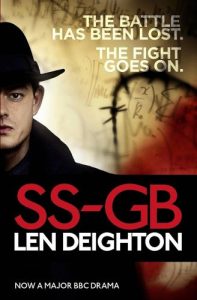
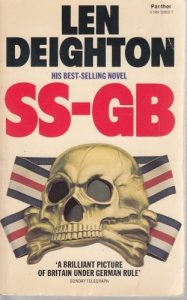
Recently, I’ve read a couple of ‘alternative history’ novels that imagine different realities in the 1930s and 1940s: wherein Britain and the USA were taken over by fascism just as Germany and Italy were.  What could have induced me, in 2025, to read novels about Britain and the USA succumbing to fascism?  I really can’t imagine.  Here are my thoughts on one of those books, Len Deighton’s SS-GB (1978).


Deighton is best known as the author of The IPCRESS File (1962), the book that introduced the world to Harry Palmer, a down-at-heels spy whose humdrum experiences are a corrective to the glamorous espionage fantasy-world inhabited by Ian Fleming’s James Bond.


Actually, that description does both Deighton and Fleming a disservice.  Harry Palmer isn’t even the name of the protagonist in The IPCRESS File.  Deighton keeps its first-person narrator anonymous.  The name was only devised for the character in 1965 when the book was made into a film with the non-capitalised title The Ipcress File, directed by Sidney J. Furie and starring Michael Caine.  Also, while the film version is determinedly unexotic and, possibly for budgetary reasons, restricts its action to a non-swinging 1960s London, Deighton’s novel is more expansive.  It allows its hero to do some properly exciting, Bondian things, such as participate in a rescue mission in Beirut and visit an American neutron-bomb test site in the Pacific Ocean.


Meanwhile, Fleming’s novels certainly featured exotic locations (the Caribbean, the Swiss Alps, the French coast), exotic activities (scuba diving, skiing, gambling in casinos) and exotic food and drink (caviar, stone crabs, Dom Pérignon champagne), which no doubt tantalised his readers, many of whom were living in drab, austere, post-war Britain and eating such rationing-era fare as pig’s trotters, spam and lardy cake.  But he invested at least some of those novels with a little grit and realism too.  However, just as the medium of film made Harry Palmer more lowkey than the literary original, so a series of over-the-top movies unanchored the character of Bond and floated him off into the realms of total fantasy.  Ironically, the Harry Palmer movies and the first nine Bond movies shared the same producer, Harry Saltzman.


© Lowndes Productions / Rank Film Distributors


I was reminded of this dichotomy when reading SS-GB because, while its hero inhabits a grey, downbeat world, where dealing with even the simplest details of everyday life can be exhausting, some big, almost Bondian things hove into view and require his attention.  These, though, hardly make his existence any more glamorous.  Rather, they make it a lot harder for him than it was already.


In Deighton’s imagined alternative universe, SS-GB begins in November 1941.  Nine months earlier, in February, Britain surrendered to Germany.  February 1941 was four months before, in real history, Hitler turned against Stalin and ordered the invasion of the Soviet Union, an event that in in SS-GB evidently didn’t happen because the novel depicts Germany and the Soviet Union as, still, firm allies.  Japan’s attack on Pearl Harbour, which drew the USA into the war against the Axis powers, occurred at the end of 1941 and hasn’t happened yet.  One wonders if, here, it will happen, given the alterations elsewhere on the timeline.  The USA remains neutral in SS-GB, whilst peering across the Atlantic at a fully Nazi-controlled Europe with wariness and trepidation.  Incidentally, Deighton provides almost no exposition about what has gone on and it’s left to the reader to infer.


SS-GB’s hero, Detective Superintendent Douglas Archer, is a policeman at Scotland Yard who finds himself having to do his police-work under the supervision of the German occupiers.  His immediate superior is General – ‘or, more accurately in SS parlance, Gruppenführer’ – Fritz Kellerman: “a genial-looking man in his late fifties… of medium height but his enthusiasm for food and drink provided a rubicund complexion and a slight plumpness…”  Obviously, it was never put to the test, but Kellerman represents a good guess on Deighton’s part about how many German officials would have behaved if they had been posted to a defeated Britain and put in power there.   They’d have behaved like amiable Anglophiles, dressing in tweed suits, going hunting and fishing on country estates, playing golf, guzzling Scotch whisky and stocking their rooms with British antiques.  (Deighton has fun developing that last idea.  He depicts a bunch of 1940s British spivs running an illicit trade in British heirlooms, aimed at the German occupiers.)


Archer fits neatly into those Germans’ image of Britain because he represents another cosy and much-loved British cliché: the famous sleuthing detective.  Recognising him, one occupier exclaims, “You’re Archer of the Yard… You’re the detective who solved the Bethnal Green Poisonings and caught ‘the Rottingdean Ripper’ back before the war.”  Later in the book, Archer plays up his fame among the Germans – at least, the ones who enjoy true-life crime stories – to his advantage.


Behind the bonhomie of the likes of Kellerman, however, lurks the despotic ruthlessness of Nazi Germany.  Early on, Kellerman warns Archer about what may be coming.  Of Scotland Yard, he says, “Neither of us want political advisors in this building, Superintendent.  Inevitably, the outcome would be that your police force is used against British Resistance groups, uncaptured soldiers, political fugitives, Jews, gypsies and other undesirable elements.”


The story begins with Archer assigned to what looks like a straightforward murder case, a shooting in a rundown neighbourhood called Shepherd Market.  The murder scene is a flat “crammed with whisky, coffee, tea and so on, and Luftwaffe petrol coupons lying around on the table.  The victim is a well-dressed man, probably a black-marketeer.”  Of course, Archer gradually realises there’s more to the case than initially meets the eye.  And, as he grapples with the increasingly serious implications of what he’s investigating, he encounters a variety of characters who may be on his side or may be out to get him.


These include an officer in the SS’s intelligence service, an intense and driven man called Oskar Huth, who’s flown in from Berlin and put in charge of Archer and his investigation, and who’s the antithesis of the jocular Kellerman.  When Archer meets him off his Lufthansa plane and inquires where his bags are, he snaps, “Shotguns, golf-clubs and fishing tackle, you mean?  I’ve no time for that sort of nonsense.”  Constituting the one glamorous element that enters Archer’s life during the book is Barbara Barqa, a foxy American journalist who’s been allowed into London by the press attaché of the German Embassy in Washington.  She unexpectedly turns up at the murder scene and, predictably, isn’t all that she seems.  Meanwhile, additional tension comes from Archer’s elderly sergeant, and mentor, Harry Woods.  He’s a man ‘who fought and won in the filth of Flanders’ and ‘would never come to terms with defeat.’  It’s whispered that he has connections with the British Resistance movement, which makes Archer’s position very precarious.


As Archer’s investigation continues, I was, initially, a little disappointed by two of the main plot devices that Deighton uses.  These devices seemed to me slightly obvious ones for an alternative-history / World War II novel set in early-1940s London.  One is the race by various countries to develop a game-changing weapon – guess which weapon that is.  Indeed, when Archer learns that the murder-victim was suffering from radiation poisoning, I was reminded of Troy Kennedy Martin’s masterly TV miniseries Edge of Darkness (1985), which had a policeman investigating a killing and finding himself embroiled in a huge conspiracy involving the nuclear industry.  The other plot device is an operation to rescue an important personage whom the Germans have imprisoned in the Tower of London.  If the rescue is successful, it’ll be a boost for Britain’s battered morale and a propaganda win for the British Resistance.  Again, guess who that personage is.


To be fair, Deighton keeps both plot devices grounded. They’re wrapped in believably authentic realpolitik involving the neutral Americans, different elements in the British Resistance, and competing factions among the occupying Germans.  And the way one of them is resolved, near the end, caused me genuine surprise.  Also, there’s a subplot involving Karl Marx – whose remains are buried at London’s Highgate Cemetery – that I thought Deighton handled ingeniously.


But what really makes SS-GB a pleasure are Deighton’s descriptions of everyday life in occupied London – and what the ordinary population, war-weary, demoralised and living near the breadline, have to put up with.  There’s ‘the green, sooty fog’ with its ‘ugly smell’, which doesn’t quite hide ‘advertisement hoardings, upon which appeals for volunteers to work in German factories, announcements about rationings and a freshly pasted German-Soviet Friendship Week poster shone rain-wet.’  There’s Archer’s landlady, whose soldier-husband is in ‘a POW camp near Bremen, with no promised date of release.’  She serves her policeman lodger eggs she got from a neighbour as payment for an ‘old grey sweater to unravel for the wool’, and a cube of margarine, ‘the printed wrapper of which declared it to be a token of friendship from German workers.’


And there’s a rather desperate-sounding gala evening at the Metropolitan Music Hall.  This ends with the cast trying to cheer up the dejected London audience by ‘throwing paper streamers, wearing funny hats and popping balloons that descended from a great wire basket suspended from the ceiling’ – leaving the theatre ‘in a chaos of litter that had to be salvaged for re-use.’  The line-up for the evening includes Gracie Fields and Flanagan and Allen.  No George Formby, though.  Probably he’s in a prison camp, as a punishment for punching Hitler in his 1940 movie Let George Do It! 


And there are the ruins and wreckage left both by the Blitz and by Deighton’s imagined German invasion.  It’s a grey, wet, cold, blasted place, full of dejected and frustrated people, and it isn’t difficult to envision the London of George Orwell’s 1984 (1949) being a little further along the road.  Deighton, who’s still with us at the venerable age of 96, was ten years old when World War II broke out, and he came from the Marylebone area of London.  Presumably, he had images of the city in wartime seared into his memory and didn’t have to stretch his imagination too much to describe SS-GB’s version of it.


Thus, SS-GB’s crowning achievement is a depiction of Nazi-controlled London, and Britain, that you can practically see, hear, feel, smell and taste.  Though of course, you really wouldn’t have wanted to.


© Harper Collins Publishers


Apparently, in 2017, the BBC turned SS-GB into a five-episode TV miniseries, starring Sam Riley, Rainer Bock, Lars Eidinger, Kate Bosworth and James Cosmo.  I haven’t seen it, but let’s hope the BBC made a good job of it.