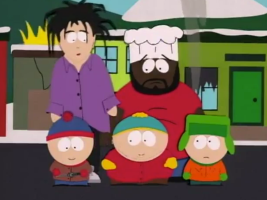
Happy World Goth Day 2026


From youtube.com© South Park Studios


I know time seems to speed up as you grow older, but it still feels weird to me that we’re not only into another year, 2026, but we’re already nearing its halfway point.  In fact, today, we’ve reached May 22nd.  And rolling around again – again? – is World Goth Day.


According to its Wikipedia entry, May 22nd became the annual day of celebration for the world’s darkest-clad, whitest-eyelinered, most sunlight-shunning musical sub-culture when “UK-based goth DJ Lee Meadows, aka DJ Cruel Britannia (currently known as BatBoy Slim), wrote a MySpace blog suggesting the idea of initiating a ‘Goth Day’ to a very positive reception.  In 2010, he and London-based DJ Martin Oldgoth decided to make the concept global, both ‘as a bit of fun’ and to create an environment of positivity and unity within the goth community.”
 

From worldgothday.com / © BatBoy Slim


As is customary on this blog, I’ll mark the occasion by providing links to a dozen of my favourite Goth songs on YouTube.  As ever, I apologise if you first have to endure some annoying corporate and insipid YouTube advertisements, packed with AI-generated visual crap, which are the antithesis of the mystical, elegiac and tenebrous aesthetic of Goth culture.


To get the ball rolling, here’s Wytches Chant ’98 by English Goth band Inkubus Sukkubus, whom noted punk / Goth journalist Mick Mercer described as ‘a zombie version of Fleetwood Mac.’  (Many would argue that the real Fleetwood Mac have been fairly zombified for the past few decades anyway.)  So, let’s raise our voices and sing along to that Wytches Chant ‘98: “Isis, Astarte, Diana, Hecate, Demeter, Kali, Inanna…”


A while ago I was looking at an online list of ‘underrated Goth bands’ and discovered Container 47 and their song Razor End Falling.  The band don’t have a Wikipedia page and all I know about them is that they’re from Italy and have been on the go since the early 2000s.  This song, to me at least, is agreeably heavy.


On the same ‘underrated Goth bands’ list, I noticed the name the Rose of Avalanche.  Wow, I thought – I hadn’t heard of them since they supported the Mission at a gig in Aberdeen in the mid-1980s.  They originally broke up in 1993 but, following a 26-year hiatus, reformed in 2019.  I found their 1985 single LA Rain enjoyably audacious – it takes the sound, ambience and languid pace of a typical Lou Reed / Velvet Underground song and drenches it in a shimmery, Gothy 1980s guitar-sound.  Though some people may not feel the same way about it.
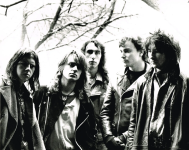
 

From roseofavalanche.com / © The Rose of Avalanche


Here’s some more rain, served up by the Swedish Goth band Miazma (which, from soon after its inception in the late 1990s, has apparently consisted of just one musician, Kristian Olofsson).  It’s called Black Rain.  Including this song on the list saves me having to include anything by the seminal Goth outfit the Sisters of Mercy because, frankly, Miazma sounds uncannily like the Sisters of Mercy, down to Olofsson’s vocals, which reproduce the nonchalant gruffness of the Sisters’ frontman, Andrew Eldritch.  On the other hand, a band whom this Miazma shouldn’t be confused with is another band called Miazma, which is actually a death metal one from Australia’s Alice Springs.


And yet more rain…  If Scottish alternative-rock brothers Jim and William Reid, aka the mighty Jesus and Mary Chain, knew I’d included one of their songs in a list of Goth tunes, I suspect they’d come round to my house and murder me – using hammers.  Well, tough luck, guys – I am including you.  I saw the Jesus and Mary Chain perform in Singapore last month and the gig, at the city-state’s Esplanade Theatre, attracted a fair number of Singaporean Goths.  And I think their song Nine Million Rainy Days, from the aptly titled 1987 album Darklands, is dripping with Gothic doom, gloom and darkness, as evidenced by the lyrics, “As far as I can tell / I’m being dragged from here to hell / All my time in hell was spent with you…”


Halfway through, however, Nine Million Rainy Days veers off in an unexpected direction when it borrows the famous ‘woo-woo’ backing vocals that grace the Rolling Stones’ Sympathy for the Devil (1969), though here they mutate into ‘woo-woo, woo-woo, woo!’


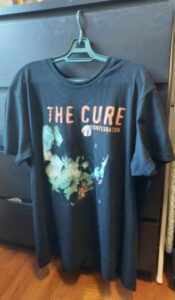
Talking of the Rolling Stones, eyebrows were recently raised when Mick, Keef and Ronnie announced that Robert Smith of the legendary Goth band the Cure would be contributing to their next album.  The Stones’ straight-up, unpretentious, bluesy, rock ‘n’ roll swagger seems light-years removed from the Cure’s meticulous, brooding atmospherics, so I don’t know how that’ll work out.  Meanwhile, the Cure and possibly their greatest album, 1989’s Disintegration, have been on my mind lately because my lovely mother-in-law gave me a Cure / Disintegration T-shirt as a present for my last birthday.  So, from that album, here’s the song Lullaby.  The link takes you to the song’s memorable video, where Smith, in pyjamas, sings worriedly about “Mr Spider-man” having him “for dinner tonight.”


In fact, Disintegration is such a masterpiece I could have included any song off it: Fascination Street, Plainsong, Pictures of You, etc.  No wonder that in a 1998 episode of South Park, Kyle Broflovski shouts at Robert Smith, “Disintegration is the best album ever!”  (Admittedly, he was rather excitable by that point.  His town had been pulverised by Barbra Streisand, who’d transformed into a giant, robot-kaiju called Mecha-Streisand, and Robert Smith had saved the day by transforming into a giant moth and hurling her into outer space: “I have to try,” sighed the Cure’s front-man. “I can’t let Barbra Streisand do this to the entire world.”)


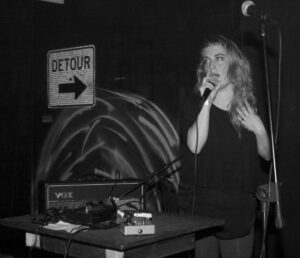
And now for a younger band.  Boy Harsher are a darkwave duo consisting of singer Jae Matthews and producer Augustus Muller, who hail from the American state of Georgia.  They cite among their influences the late, visionary filmmaker David Lynch, though with the next track on my list, a remastered version of Boy Harsher’s 2014 single Pain, I get more of a vibe of the synth tracks John Carpenter devised for the soundtracks of his 1970s and 1980s movies.  That’s initially at least, before Pain’s propulsive beat carries all before it.


Actually, Pain features in a movie itself.  It can be heard during a party scene in the 2022 horror film Terrifier 2.  I haven’t seen it, but I think that’s the one where the villain (Art the Clown) flays a victim and then rubs salt into the wound by, er, rubbing salt into the victim’s catastrophic wounds.  So, having a song called Pain in the film was appropriate.
 

From wikipedia.org / © GRIT PHOTOZINE


In fact, Pain got a remix in 2018 courtesy of the American musician and producer Luis Vasquez who from 2009 was also the single, official member of the band the Soft Moon.  Fittingly, an influence on the Soft Moon’s sound was the celebrated industrial / electronic rock band Nine Inch Nails, itself a one-man-band for the musician and producer Trent Reznor.  (More on Nine Inch Nails later.)  The next item on the list is one of my favourite Soft Moon songs, Become the Lies, from the band’s final album, Exister (2022).  I have to write about Luis Vasquez and the Soft Moon in the past tense because, tragically, Vasquez died in 2024 aged just 44.


Another musician specialising in dark electronica who left us much too soon was Frank Tovey, who as Fad Gadget at the very end of the 1970s and in the early 1980s helped pioneer both the synth-pop and darker Goth sounds that became popular soon after.  Alas, a heart attack claimed Tovey / Gadget at the age of 45 in 2002.  Here’s his first and possibly most famous single, Back to Nature, from 1979.


Fad Gadget has been credited as a big influence on Depeche Mode, though beyond the use of newly affordable musical technology, like synthesisers, I personally can’t see much connection between the ruminative likes of Back to Nature and Depeche Mode’s early, chirpy (and for me, annoying) hits like New Life and Just Can’t Get Enough (both 1981).  Despite being irritated by the early ‘Mode’, I’ve gradually grown to love them as, in their later incarnations, they’ve shifted away from a poppy, kid-friendly synth sound and embraced a darker, harsher, more industrial and Gothic one.


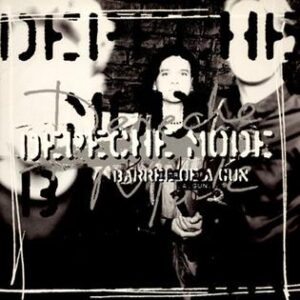
Here’s the stomping Barrel of a Gun, the first single off Depeche Mode’s 1997 album Ultra.  The accompanying video shows how far they’d progressed by then from their early-1980s clean-cut-boys-with-synthesisers phase – this is grungy, decadent, Anton Corbijn-directed artiness.  At least, it is until Dave Gahan starts wandering around in a silly coat covered in Christmas-tree lights.
 

From wikipedia.org / © Mute Records


Here’s something else that’s silly, this time involving America’s awesomely dark and bleak industrial-rock juggernaut Nine Inch Nails (which is basically musician / vocalist / producer Trent Reznor and whoever happens to be in the studio with him at the time).  No, I’m not saying Nine Inch Nails are silly.  But some years ago, they were the subject of a celebrated musical / video ‘mashup’ whereby editor and content creator Garren Lazar married the band’s disturbing song Closer, from the 1994 album The Downward Spiral, onto clips taken from the beloved children’s TV programme The Muppet Show (1976-81).  Hence, the song’s opening drumbeat is performed in the video by Animal, the drummer in the Muppets’ house band, Dr Teeth and the Electric Mayhem.  (Thankfully, Animal doesn’t feature when Reznor sings Closer’s most notorious lyric, “I want to f**k you like an animal.”)


Watching Kermit, Gonzo, Miss Piggy and the rest cavort to this song is a reminder that, loveable though the Muppets are, if you first encountered them at a very young age you might have found them a bit sinister.  For example, the stuff in the video involving a frenetically speeded-up Dr Teeth is downright freaky.  Also featured are some of the human guests who appeared on The Muppet Show, such as Alice Cooper, Cloris Leachman, Rita Moreno, Harry Belafonte and Dudley Moore – Moore’s cameo is particularly worth waiting for.


However, should anyone be upset at me linking to a comical Nine Inch Nails / Muppets mashup, I’ll throw in a bonus link – to a more sombre and majestic mashup where Rory Gamble transposes Nine Inch Nails’ The Day the World Went Away (from 1999’s The Fragile) onto the trailer for Mad Max: Fury Road – Black & Chrome.  Both sonically and visually, it’s a work of genius.  You’ll punch the air when, one minute and ten seconds in, things get cranked up to 11.


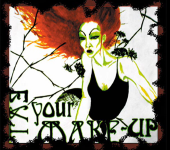
Eat Your Makeup is the name of a short film made by American’s God-Emperor of Bad Taste, John Waters, back in 1968.  However, Eat Your Make Up – note the slight difference in the wording – is also the name of a French Goth band and here, to round things off, is their 2005 song I was the Murderer.  It’s a pleasant reminder that at least some of Goth’s musical roots lie in punk rock.
 

© Adipocere Records
Happy World Goth Day 2022


© Halperin Productions


Does the sun seem to be shining a little less brightly, or a little more darkly, today?  Does the air seem unusually clammy, redolent of Edgar Allan Poe’s ‘the bleak December’ rather than the cusp-of-summer May?  Do the people walking past on the street seem to be sporting a tad more kohl eyeliner than normal?  Are you staring at your TV, unsure if the pudgy, chaotic, tousle-haired figure you see on the screen is indeed Boris Johnson and not Robert Smith?


If the answer is ‘yes’…  Well, this is probably because today, May 22nd, is World Goth Day.  According to Wikipedia, the idea of having a day dedicated to the planet’s blackest-clad subculture ‘originated in the United Kingdom in 2009 initially as Goth Day, a smaller scale celebration… inspired from the broadcasting of a special set of shows on BBC Radio 6.’


So, to mark the occasion, here’s a playlist of my dozen favourite Goth tunes, with YouTube links.  (My apologies for any ultra-irritating YouTube advertisements that might pop up at the beginning.)


© Cleopatra


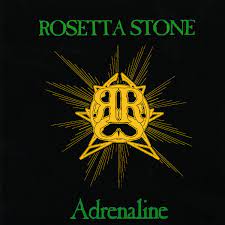
First up is the Goth-dancefloor fixture Adrenaline by Liverpudlian band Rosetta Stone.  Actually, when I think of all the Goth nights I attended in my youth in places like Edinburgh, Norwich and Newcastle-upon-Tyne, this is the only tune I remember the DJs playing.  Yes, I know they must have played other stuff, but this is the one song that accompanies my memories of those events.  (Maybe they did play Adrenaline all night long, in a Gothic variation on that Father Ted episode where Ted and Dougal organise a charity disco and then realise they only have one record, the Specials’ Ghost Town.)


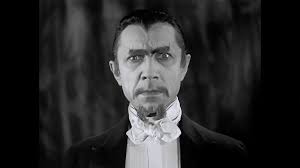
I’ve heard many authorities declare that Bauhaus’s Bela Lugosi’s Dead is the greatest Goth song of all time.  But by way of something different, I’ll offer this tune instead, which is a cheeky riposte to the venerable Bauhaus anthem: Bela Lugosi’s Back by the fabulously titled Lesbian Bed Death.  I love how they’ve peppered the song’s video with footage from that hypnotically weird and dream-like movie White Zombie, which had Lugosi as its villain back in 1932.


© Polydor


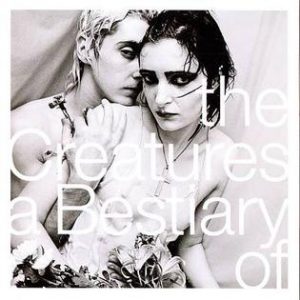
I’m a big fan of Siouxsie and the Banshees, but I thought on this playlist I’d include something from the formidable SIouxsie Sioux’s other band the Creatures, which she formed with fellow Banshee and one-time husband Peter ‘Budgie’ Clarke.  I’ve had a fondness for the Creatures ever since seeing them perform a storming set at Edinburgh’s Queen’s Hall in 1999.  This is called Pluto Drive and listening to it always lets a few tingles loose on my spine.


© The Mission


A band I saw in Edinburgh during the same period, though this time at the city’s Liquid Rooms, was the Mission.  Now it was customary that when the Mission played their most famous number, the Led Zeppelin-esque Tower of Strength, their die-hard fans – who were known as ‘the Eskimos’ – would climb on top of each other and create a human tower in the middle of the auditorium.  Well, not so much a tower as a pyramid, with lots of Eskimos on the floor forming its base, and smaller numbers of them forming the higher levels that tapered up to its apex.  This was easy to do during the Mission’s heyday in the 1980s, when those Eskimos were mostly lean, lithe and light teenagers.   However, by the late 1990s, the Eskimos had got not only a wee bit older but also a wee bit heavier… And I watched the building of that human Tower of Strength with some trepidation.   Predictably, the whole thing soon wobbled and toppled over.  But at least no Eskimos were hurt.


Anyway, here’s the song Belief from the Mission’s 1990 album Carved in Sand.  I don’t know why this song isn’t better known, as I always thought it was an epic, relentless thing epitomising the band at their bombastic best.  (Though some unkind critics would probably reword that as ‘at their bombastic worst’.)


Similarly, I don’t know why this next tune, Number One by the German outfit Clan of Xymox, isn’t better known either.  It soars in an impeccably synth-y way.


I’d like to think that if, besides being tested for the ethnic groups you came from, your DNA could be tested for the musical sub-cultures you belonged to, my DNA would show a strong ‘Goth’ component.  However, also being a fan of heavy metal, I’d hope that it showed a big ‘metalhead’ component too.  Thus, my next two choices lie in that fascinating area where the two genres, Goth and heavy metal, overlap.  First, here’s the wonderfully sepulchral – thanks to the band’s vocalist, the late Peter Steele – Everyone I Love is Dead by Type O Negative.


© Music for Nations


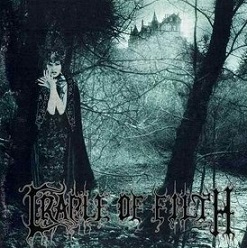
And here’s the finest goth-metal band to ever hail from Country Suffolk, East Anglia: Cradle of Filth.  Their song A Gothic Romance: Red Roses for the Devil’s Whore follows a tried-and-trusted Cradle of Filth formula, starting with a civilised, classical-music opening, but rapidly descending into howling, pounding, guitar-mangling chaos.  As ever, the croaking / shrieking vocals of Suffolk icon Dani Filth are at the forefront.


Now it’s time for another Goth dancefloor-stomper.  It’s hard to resist Doctor Online by industrial Norwegian outfit Zeromancer, a song I assume was inspired by the infamous, euthanasia-supporting Doctor Jack Kevorkian, aka ‘Doctor Death’.


Canadian band the Birthday Massacre are smartly named.  The word ‘birthday’ suggests glowing candles, ornately decorated birthday cakes and, generally, the magical happiness that people associate with childhood memories of their Big Day; while the word ‘massacre’ suggests, well, blood, darkness and death.  That juxtaposition sums up Goth perfectly.  And here’s their song Happy Birthday, whose vibe nicely blends that sense of child-like wonder with sinister premonitions that something bad is going to happen.


© Beggars Banquet


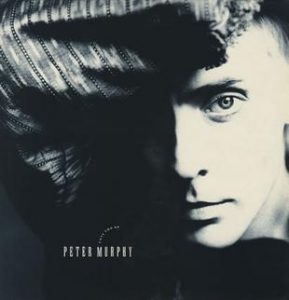
Returning to Bauhaus for a moment, I find this solo effort by their celebrated frontman Peter Murphy, Cuts You Up, poignant and rather lovely.


The young band Savages – okay, that’s young by my standards: they formed in 2011 – are described in their Wikipedia entry as a ‘post-punk, noise rock, alternative rock’ outfit.  That description sneakily avoids using the ‘G’ word…  But come on.  I defy anyone to listen to their song Husbands and not think of Siouxsie and the Banshees at their imperious best.


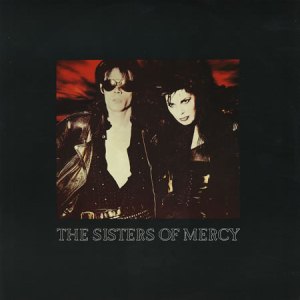
Finally, how else could I finish this post but with a link to the greatest Goth anthem ever, the Sisters of Mercy’s majestic, thunderously operatic This Corrosion?  Be warned – this is the 11-minute remix.  By the end of those 11 minutes, after you’ve been bludgeoned into submission by singer Andrew Eldritch and Patricia Morrison’s caterwauling vocals, by producer Jim Steinman’s celestial choirs and Wagnerian guitar-squalls, and by that never-ending chorus of “Hey, now / Hey, now now…”, you will be begging the Sisters for mercy.


© Merciful Release

A sad day for the Sisters


© Merciful Release


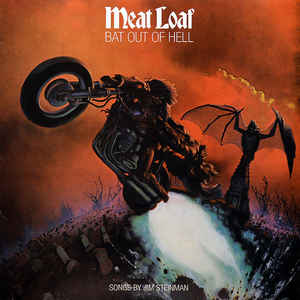
When American music composer and producer Jim Steinman died last week, the tributes paid to him made heavy mention of two titles: 1977’s Bat Out of Hell, the album by Meat Loaf, and 1983’s Total Eclipse of the Heart, the ballad by Bonnie Tyler.  Steinman wrote the songs, played keyboards and percussion and provided ‘lascivious effects’ on the former and wrote and produced the latter.  He was not a man who did things by halves in his orchestrations, in his lyrics or in the performances he encouraged from his singers.  Thus, both Bat and Eclipse are synonymous with bombast, histrionics, chest beating, garment rending, howling at the moon and general wildly over-the-top melodrama.


Which makes my experiences with Steinman’s two most famous pieces of work strange.  Because when I hear Bat Out of Hell nowadays, the images that it conjures up in my head are of the summer landscapes of bucolic Country Tyrone in Northern Ireland: of hayfields, barley-fields and pastureland populated by herds of cattle and flocks of sheep.  Whereas if I hear a burst of Total Eclipse of the Heart, I’m immediately transported to the wolds of equally bucolic County Lincolnshire in England, during the early springtime, with freshly ploughed fields undulating off into the soft morning mist.


To elaborate. In the summer of 1982 I worked on the farm of my Uncle Annett, in the Clogher Valley in County Tyrone. My cousin there was a big Meat Loaf fan and when we weren’t toiling in the fields and were back in the farmhouse, Bat Out of Hell never seemed to be off the stereo. The farmhouse reverberated with the vrooming of motorcycles and Meat Loaf hollering about screaming sirens, howling fires, evil in the air, thunder in the sky, being all revved up with nowhere to go, praying for the end of time, glowing like metal on the edge of a knife, etc.  Stirring stuff, but it was incongruous background music for my life at the time, which consisted of lugging around bales of hay, mucking out cowsheds, feeding pigs, thinning turnips and holding down sheep while they had their fleeces sheared.


Admittedly, I did ride a motorbike that summer.  My cousin had recently graduated from riding a motorbike to driving a car and his old motorcycle was stashed in an outhouse on the farm. My uncle took it out and taught me how to ride it.  I didn’t venture out onto the roads, though.  Instead, I’d ride it up the surrounding slopes and across the surrounding fields when I had to check on my uncle’s sheep.  So no doubt while I cruised past those woolly flocks, Meat Loaf was roaring in my brain about hitting the highway like a battering ram on a silver-black phantom bike and so on.


© Sony / Epic / Cleveland International Records


Fast-forward eight months from then to March 1983 and I was employed in a different job in a different part of the world. I was working as a volunteer houseparent and classroom-assistant at a residential school for ‘maladjusted boys’, which was the un-politically correct 1980s parlance for what today would be termed ‘boys with behavioural issues’.  The school was on the outskirts of the town of Louth in Lincolnshire, in the English Midlands. Walk one way from the school and you’d end up in the town, walk the other way and you’d soon be among the gently curving Lincolnshire wolds.  The school’s older boys stayed in their own residence, with its own kitchen and living room, and I was doing an evening shift there one Thursday when Top of the Pops started on the living-room TV. The show aired a newly released song and video by Bonnie Tyler, Total Eclipse of the Heart.


The Lincolnshire lads in the residence were either sharp-footed Michael Jackson wannabes or bequiffed rockabilly types who’d been influenced by the Elvis albums in their dads’ record collections. Their immediate reaction, and my immediate reaction, was: “What the f**k are we listening to?”  For Ms Tyler’s tonsil-rattling performance, caterwauling about falling in love, falling apart, living in a powder keg, giving off sparks, forever going to start tonight, etc., was unlike anything we’d heard before.


It was also unlike anything we’d seen before.  The video, directed by Australian filmmaker Russell Mulcahy, and full of fluttering candles, billowing lace curtains, slow-motion flapping doves, dancing ninjas, nocturnal fencers, indoor American football players, acrobats in bondage gear and glowing-eyed demonically possessed choirboys, was pretty far-out too.


The song immediately went to number one in the British singles charts so I heard a lot of it in the ensuing weeks.  In particular, it got played a lot in Louth’s top – only? – post-pub nightspot of the time, which was the social club for the local branch of the Liberal Party.  Thus, while its dance floor quaked to the bellowing of Bonnie Tyler, I’d be sitting having a pint with some regulars who were proudly telling me for the umpteenth time how they’d ‘had David Steel in here just the other year.’


Today I don’t mind Bat Out of Hell too much, but I could happily live the rest of my life – and any future lives, if reincarnation is a thing – without ever hearing Total Eclipse of the Heart again.  For one thing, Eclipse’s success spawned a zillion hideous 1980s and 1990s power ballads, sung under the misapprehension that the louder and shriller you are, the greater the emotion you convey.  The biggest culprit here is Celine Dion and yes, it was Jim Steinman who penned her interminable 1996 ballad It’s All Coming Back to Me Now.


From jimsteinman.com


And yet…  I can forgive Steinman for any crimes he indirectly committed against music by encouraging the growth of the power ballad.  That’s because for a couple of years at the end of the 1980s he worked with the Goth-rock band the Sisters of Mercy and made them sound like the mightiest group in the universe.  In 1990 he co-wrote and co-produced the storming tune More with the band’s frontman Andrew Eldritch, while in 1987 he produced two Sisters songs, Dominion / Mother Russia and This Corrosion.  The latter is surely one of the greatest Goth anthems ever.


Although This Corrosion was written by Andrew Eldritch, it has Steinman’s aural fingerprints all over it, most notably the Wagnerian squalls of guitar and the use of the 40-strong New York Choral Society to provide a celestial choir at the beginning.  Sweetly, the first comment below the song’s video on YouTube claims that “When a Goth dies, their voice gets added to the choir at the intro.”


Eldritch once told Sounds magazine that “It’s about the idiots, full of sound and fury, who stampede around this world signifying nothing… about people who sing about the corrosion of things while they themselves are falling apart.”  Supposedly, the sound-and-fury-filled idiots he had in mind were his former colleagues Wayne Hussey and Craig Adams, who quit the Sisters of Mercy in 1985 and formed their own band the Mission.  Elsewhere, in Q magazine, he likened the relationship between the Sisters of Mercy and the Mission to that between China and Taiwan.  It was obvious which band Eldritch considered the equivalent of the massive, nuclear-armed superpower.


Now I like the Mission.  However, in 1998, a 36-song compilation of 1980s and 1990s Goth, industrial, synth and dark indie music was put together under the title of Nocturnal and it had This Corrosion as its opening track and then the Mission’s song Deliverance as its second one.  And when I heard the two played together, I realised that with their Steinman-produced opus the Sisters of Mercy blasted the Mission out of the water.  Incidentally, This Corrosion is used to great effect in the finale of Edgar Wright’s underrated 2013 sci-fi / horror / comedy movie The World’s End.


Despite having a reputation for being a bit of a dick to work with, Eldritch spoke generously of Steinman.  For instance, he said that Steinman “really knows how to make a wonderfully stupid record.  Totally outrageous.  Every time you think to yourself, do we really want to go this far, and you say to Jim, ‘Jim, are sure about this?’ and anybody else will go, ‘Don’t do it!’, Jim goes, ‘More!  More!  More people singing!’  It works.”


That’s the spirit.  And here, for anyone wishing to really immerse themselves in Jim Steinman’s glorious bombast, is a link to the 11-minute remix of This Corrosion.


From marktracks.blogspot.com / youtube.com

Morricone no more


© enniomorricone.org


The death of legendary film composer Ennio Morricone a fortnight ago shouldn’t have been a surprise since he was at the big age of 91.  But he’d shown such a cussed approach to life and art, still composing music, going on world tours and quarrelling with young whippersnappers like Quentin Tarantino while he was in his ninth decade, that you assumed he was going to continue living and composing forever.  Anyway, a heavy workload earlier this month prevented me from penning a tribute to the great man at the time of his passing.  Here’s my belated tribute now.


Ennio Morricone was the first film composer I knew.  I recognised his work well before I recognised that of John Barry, Bernard Hermann, Leonard Bernstein or Henry Mancini and even before the blockbuster themes of Jaws (1976) and Star Wars (1977) acquainted me with the name of John Williams.  As a boy I was daft about western movies and as soon as Sergio Leone’s spaghetti westerns started showing up on TV I realised that Morricone’s exhilarating music, soaring and swooping along the soundtracks with twangy acoustic guitars, electric guitars, whistles, chimes, bells, flutes and aah-ing choirs, was as much a character of the films as Clint Eastwood’s cigar-smoking Man with No Name.  Remove Morricone’s music and they wouldn’t be the same.  There’d be a gaping Clint-sized hole in them.


Morricone’s music for A Fistful of Dollars (1964), the film that put him, Leone, Eastwood and spaghetti westerns on the map, is great but I think his theme for the sequel For a Few Dollars More (1965), with added Jew’s harp and ocarina, is greater still.  Maybe I’m biased since the film is my favourite of Leone’s Dollars trilogy.  It has Eastwood, the Man with No Name, team up with the splendid Lee Van Cleef, the Man in Black, and take on Gian Maria Volonté as evil scumbag bandit El Indio.  The climax sees Van Cleef facing up to Volonté in a duel whereby the participants can only draw their guns on the final chime of a musical pocket watch, which had belonged to Van Cleef’s murdered sister.  It’s absolutely epic, thanks largely to Morricone’s music, which climbs majestically and drowns out the plaintive tones of the pocket watch, then plunges and dies away again a few palm-sweating seconds before the watch stops and the shooting starts.


© Produzioni Europee Associati / United Artists


The third and final movie of the trilogy, The Good, the Bad and the Ugly (1966), confused me when I saw it as a kid because although Lee Van Cleef starred in it alongside Eastwood again, this time he played a different character from the one in For a Few Dollars More and was as evil as Volonté had been in the previous film.  I assumed he was the same guy and couldn’t figure out why he’d suddenly become so bad.  Morricone’s theme here is perhaps his most famous work – I still hear blokes in the pub, after a few pints too many, going “Na-Na-Na-Na-Naaah….  NA-NA-NAAAH!” for no good reason.  But it’s perhaps the accompaniment he provides for the Ecstasy of Gold sequence, in which an increasingly delirious Eli Wallach spends four minutes running around a cemetery while Leone’s camerawork becomes correspondingly frenzied, that’s the film’s musical highlight.


© Paramount Pictures


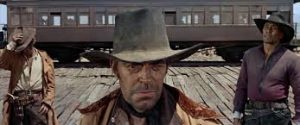
Of course, we hadn’t heard the last of Morricone as far as Leone’s westerns were concerned, because in 1968 he contributed to Leone’s Once Upon a Time in the West, a movie that regularly gets mentioned in ‘best film of all time’ lists.  (It’s certainly in my top three.)  Morricone’s magnificent score ticks all the boxes.  At times, it does the customary soaring and swooping.  At others, it’s playful and jaunty.  And at other times, it’s marked by a haunting and pained-sounding harmonica.  Like Lee Van Cleef, Gian Maria Volontè and the musical pocket watch in For a Few Dollars More, we discover the tragic significance of that harmonica at the end when hero Charles Bronson has a showdown with villain Henry Fonda.  Ironically, the film’s most breath-taking sequence, the lengthy opening where three gunmen played by Woody Strode, Jack Elam and Al Mulock await, with murderous intent, the arrival of Bronson at a remote, rickety train station, unscrolls without Morricone’s music (and indeed, without any dialogue) until nearly ten minutes in when that melancholy harmonica strikes up.


Morricone toiled away on many other Italian, and occasionally American, westerns and his CV surely makes him one of the great figures in the western genre.  His work appears in Duccio Tessari’s The Return of Ringo (1965), Franco Giraldi’s Seven Guns for the MacGregors (1966), Carlo Lizzani’s The Hills Run Red (1966), Sergio Sollima’s The Big Gundown (1966), Giulio Petroni’s Death Rides a Horse (1967), Don Taylor and Italo Zingarelli’s The 5-Man Army (1969) and Don Siegel’s Two Mules for Sister Sarah (1970).  He also contributed to a few westerns like Navajo Joe (1966),  The Hellbenders (1967), The Mercenary (1968) and The Great Silence (1968) that were directed by another Sergio, Sergio Corbucci, who was honoured in Quentin Tarantino’s recent Once Upon a Time in Hollywood (2019) when Al Pacino described him as “the second best director of spaghetti westerns in the whole wide world!”  Meanwhile, Morricone was reunited with the first best director of spaghetti westerns in the whole wide world with Leone’s late-period western Duck You Sucker (1971), a movie that I like but don’t consider in the same league as Leone’s earlier efforts.  (James Coburn’s Irish accent doesn’t help.)


By the early 1970s Leone had shifted from spaghetti westerns to another staple of traditional Italian cinema, the giallo – the horror-thriller hybrid wherein a group of people, usually affluent and beautiful, get despatched by a mysterious killer (whose identity is revealed only in the closing moments) stabbing, slashing and hacking his or her way through them for some unlikely reason.  The results are often Italian films at their most stylish, glamorous, violent, ridiculous and politically incorrect.


Morricone’s giallo music is frequently mannered, genteel and dreamy, at odds with the bloody events happening onscreen but matching the well-upholstered lifestyles of the doomed protagonists.  He contributed to Elio Petri’s supernaturally tinged A Quiet Place in the Country (1968), Paolo Cavara’s slick but dodgy Black Belly of the Tarantula (1971), Aldo Ladi’s rather brilliant Short Night of Glass Dolls (1971), Massimo Dallamano’s fairly reprehensible What Have You Done to Solange? (1972) and Umberto Lenzi’s lovably barmy Spasmo (1974).   He also did the music for Lucio Fulci’s A Lizard in a Woman’s Skin (1971), but I haven’t seen that one, so I can’t provide it with suitable adjectives.


© Seda Spettacoli / Universal


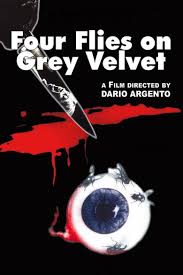
He also worked on three movies directed by the man who’s arguably the maestro of the giallo, Dario Argento: The Bird with the Crystal Plumage (1970), The Cat o’ Nine Tails (1971) and Four Flies on Grey Velvet (1971).  He didn’t, however, supply the music for Argento’s giallo masterpiece Deep Red (1976).  That role went to the German prog-rock band Goblin and I have to say, with apologies to Morricone, that I think their baroque, intense Deep Red score just about pips his work as the best giallo music of all time.


By then, of course, Hollywood had discovered Morricone and his scores for such prestigious productions as Terence Mallick’s Days of Heaven (1978) and Rolande Jaffé’s The Mission (1986) won him international acclaim.  A digression here – I remember reading an interview with Will Carling, the nice but dull skipper of the England rugby team in the late 1980s and early 1990s.  Carling told the evidently bored interviewer that before games, to settle his nerves, he listened to ‘The Mission’.  The interviewer thought Carling was talking about the 1980s British Goth band the Mission and, believing he’d discovered something interesting about Carling at last, that he was a Goth, asked him if he liked Gene Loves Jezebel too.  “No,” retorted a perplexed Carling, “The film The Mission.  The music from The Mission!”


Morricone also enjoyed a final reunion with his old comrade Sergio Leone, creating a majestic but wistful score for Leone’s Hollywood gangster epic Once Upon a Time in America (1984).


Leone didn’t just provide the music for good films.  He also plied his trade with many bad ones and often the music coming out of the cinema speakers and what was happening on the screen seemed to belong to two different aesthetic universes.  I’m thinking of Reagan’s Theme, the haunting guitar-and-choir piece he composed for John Boorman’s much-derided Exorcist II: The Heretic (1978), or the soulful, religious sounding theme he provided for Michael Anderson’s Orca: The Killer Whale (1977), totally at variance with the ridiculous plot that has Richard Harris going Captain Ahab against a vengeful cetacean.


© Turman-Foster Company / Universal Pictures


Among Leone’s Hollywood scores, I particularly admire the one he did for John Carpenter’s excellent remake of The Thing (1982).  At the time, disdainful mainstream critics (who also hated the film generally) dismissed his work as being like one of Carpenter’s own, pulsating synthesiser scores ‘slowed down’ or ‘played at the wrong speed.’  Heard today, its doomy sound encapsulates the film’s claustrophobic and literally under-the-skin horror, whilst reminding you that, yes, this is a John Carpenter film but it’s a special John Carpenter film.  I also like his subtle, creepy score for Mike Nichol’s underrated Wolf (1994), wherein a tired, middle-aged and downtrodden publisher (Jack Nicholson) gets bitten by a werewolf and discovers that his newly acquired lupine powers actually serve him well in the aggressive, cutthroat world of the 1990s New York publishing industry.


© FilmColony / The Weinstein Company


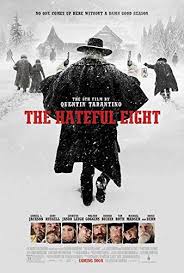
One of Morricone’s last major commissions was for Quentin Tarantino’s The Hateful Eight (2015).  The two men had previously fallen out over Morricone’s contribution, eventually non-contribution, to Tarantino’s 2012 western Django Unchained, but Morricone was back on board for this and contributed an urgent and ominous main theme.  Appropriately, seeing as The Hateful Eight and The Thing feature the same star (Kurt Russell) and a similar scenario (a stranded group trying to identify an enemy hiding among them), Morricone also donated some pieces he’d created for but hadn’t used in the 1982 John Carpenter film.  And as extra icing on the cake, Reagan’s Theme from Exorcist II: The Heretic was borrowed to accompany a brief, arty sequence of coach-horses making their way through the snow.  So it was gratifying that near his life’s end Morricone got an opportunity to show his mastery again of the genre that established his name, the western.


From open.spotify.com