Films I’d like to see remade (Part 1)


From imdb.com / © Rank Organisation


I still find it disconcerting when films I enjoyed in my youth are remade in the 21st century: for example, 1980’s The Fog (remade in 2005), 1981’s The Evil Dead (remade in 2013) and Clash of the Titans (remade in 2010), 1986’s The Hitcher (remade in 2007), 1987’s Robocop (remade in 2014) and 1988’s Hairspray (remade in 2007).  My immediate and automatic response to such remakes is, “What, they’re remaking that movie already?  Have you no shame, Hollywood?”


This is followed by a feeling of horror as I realise just how long ago it was when those original movies were released.  The first Evil Dead movie was 32 years old – 32 years! – when its remake surfaced, though in my mind it was only yesterday when Sam Raimi’s Deadites made their first-ever appearance and started making life difficult for Bruce Campbell.   And actually, three of the films I remember most fondly from my youth, Philip Kaufman’s Invasion of the Body Snatchers (1978), John Carpenter’s The Thing (1982) and Brian De Palma’s Scarface (1983) were remakes themselves.  Body Snatchers appeared just 22 years after the 1956 original and The Thing appeared 32 years after its 1950 one.  Scarface was an outlier, since the first Scarface came out in 1932, more than a half-century earlier.


Maybe I shouldn’t be so concerned about how soon after the original movie that a remake appears.  I should be concerned about the quality of it – for remakes tend to be shite.  I haven’t seen all those mentioned at the beginning of this entry, but the ones I have seen have been nowhere near as good as the originals.  (The Evil Dead remake probably comes closest, but I still much prefer the ramshackle and low-budget, but resourceful, charm of Raimi’s 1981 film.)  That said, remakes don’t have to be bad all the time – the aforementioned ones by Kaufman, Carpenter and De Palma testify to that.


So, without further ado, here are some films – and one series of films – I wouldn’t mind seeing remade in the 21st century, with bigger budgets and better special effects.  But remade decently.
 

From wikipedia.org / © Rank Organisation


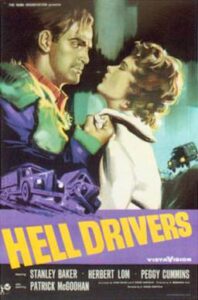
Hell Drivers (1957)

Blacklisted by the House Committee on Un-American Activities in 1951, American director Cy Endfield moved to Britain where, half-a-dozen years later, he made Hell Drivers.  Given the persecution Endfield had suffered, it unsurprisingly takes a dim view of American-style, cut-throat capitalism.  It has that underrated but magnificent actor Stanley Baker as an ex-con who finds a job as a truck driver with a dodgy haulage company, which threatens its drivers with the sack if they don’t deliver loads of gravel across treacherous roads at breakneck speeds.  The reason there aren’t more drivers employed to relieve the pressure, and reduce the danger, is because of a scam involving the local depot manager and its off-his-head Irish foreman (played by Patrick McGoohan like a brawnier version of Shane MacGowan).  The latter soon becomes Baker’s nemesis.


As well as a political message, Endfield injects Hell Drivers with an American-style grittiness rarely seen in British films of the period.  But what really makes the film a joy to watch nowadays is the cast.  As Kim Newman has written of it in Empire Magazine, “how many other movies have an ensemble which includes the original Dr Who (Hartnell), the first James Bond (Sean Connery), the Prisoner (McGoohan), a Man From UNCLE (David McCallum), a Professional (Gordon Jackson), Clouseau’s boss (Herbert Lom), plus Alfie Bass, the excellent Peggy Cummins (of the cult items Gun Crazy and Night of the Demon), the inimitably boozy Wilfrid Lawson, Jill Ireland and Sid James?”


In 2026, with capitalism more cut-throat than ever, a remake of Hell Drivers would be timely.  I don’t think, though, setting it in the wilds of Middlesex, West Sussex and Buckinghamshire, where the original was filmed, would work now, so it’d have to have its hard-pressed truck drivers pounding the roads of a less hospitable locale – the Alaskan tundra, say, or somewhere that retains some near-impenetrable tropical rainforest.


And to pay proper homage to the original, you’d definitely need a cast made up of actors who’ve played iconic roles in iconic TV shows or movie series.  You could have one of the grittier Bonds (Daniel Craig or Timothy Dalton), one of the grittier Doctors Who (Christopher Eccleston or Peter Capaldi), plus a Sherlock Holmes (Benedict Cumberbatch, maybe), a Harry Potter (Daniel Radcliffe), perhaps someone from the Breaking Bad universe (Bryan Cranston, say, or Bob Odenkirk)…  The possibilities are endless.


From wikipedia.org


The Margaret Rutherford Miss Marple movies (1961-64)

This is a little different.  I’d like to see the four movies made about Agatha Christie’s genteel sleuth of a certain age, Miss Marple, which had the delightful Margaret Rutherford in the leading role – Murder She Said (1961), Murder at the Gallop (1963), Murder Most Foul (1964) and Murder Ahoy! (1964) – rebooted as a TV show.  Not just another show about Miss Marple per se – there have been ones with Joan Hickson, Geraldine McEwan and Julia McKenzie – but one set in the universe of the four Rutherford movies.


Thus, its episodes would be set against the tableau of early-1960s England, with Miss Marple depicted as an obstinate, feisty old lady who refuses to know her place and keeps barging into and solving mysteries.  There’d be as much as humour as tension and the show would have the films’ supporting characters, like the timid librarian Mr Stringer (Rutherford’s real-life husband Stringer Davis), who reluctantly helps Miss Marple out, and the exasperated copper Inspector Craddock (Charles Tingwell), who begins each instalment telling her to mind her own business but ends it taking orders from her.  Meanwhile, Ron Goodwin’s jaunty Miss Marple Theme would burble in the background.


I suspect in a 2026 version Mark Gatiss would make a lovely Mr Stringer, while Daniel Mays would nicely fill the shoes of the long-suffering Inspector Craddock.  But who would play Miss Marple – or more precisely, play Margaret Rutherford playing Miss Marple?  Perhaps Dawn French, though she’d have to spend a long time in the make-up chair to recreate Rutherford’s famously jowly, hangdog features.


In the original movies, each murder that Rutherford / Marple investigated involved a British institution – a country manor, horse riding, the theatre and the Navy.  She’d duly rattle establishment cages by sticking her nose in where it wasn’t welcome.  So perhaps each episode of this hypothetical series would have her ruffling the feathers of other British institutions of the time – the Army, the House of Lords, Savile Row, Crufts, the country’s nascent rock ‘n’ roll industry…  Miss Marple meets the young Rolling Stones?  I’d pay good money to see that.
 

From wikipedia.org / © 20th Century Fox


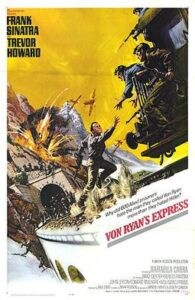
Von Ryan’s Express (1965)

I never had much time for Frank Sinatra, neither as an entertainer nor as a person, but he left an impression on my 10-year-old self the first time I saw the ripping World War II yarn Von Ryan’s Express.  It’s the story of an American airman, Ryan (Sinatra), downed in Italy, who joins forces with some Allied prisoners of war, led by Trevor Howard.  They attempt an audacious escape into neutral Switzerland by seizing control of a train and steering it up a railway line into the Alps.  Much derring-do is involved as German troops and aircraft go all-out to stop them reaching their destination.


It’s great, crowd-pleasing stuff until the ending – spoilers are coming! – which is depicted on the movie poster, painted by the great Frank McCarthy.  The train has almost made it to safety.  Having fought a rearguard action against the Germans, Sinatra is running after the train and has almost caught up with it.  But then….  What happened next put a dampener on things.  But it also lodged the film in my mind forever.


With 2009’s Inglourious Basterds, Quentin Tarantino showed his love for rip-roaring if cheesily improbable World War II adventures, so perhaps he could helm a remake of Von Ryan’s Express?  To stick to the innocent, uncomplicated spirit of the original, though, he’d have to forgo his use of the F-word and N-word, and his fetish for close-ups of ladies’ feet, and his nerdish references to ‘film-study criticism of the work of German director G.W. Pabst’.
 

© Hammer Film Productions / Seven Arts Productions


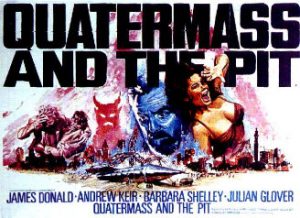
Quatermass and the Pit (1967)

Hammer Films’ sci-fi horror film Quatermass and the Pit was based on the 1958 BBC TV serial of the same name.  Both film and serial were written by Nigel Kneale.  It begins with workers on a London Underground extension project digging up an alien spacecraft full of dead, horned, insect-like creatures that are identified by scientist-hero Professor Bernard Quatermass (Andrew Keir) as inhabitants of the now-lifeless planet Mars.  It transpired that millions of years ago, these sneaky Martians arrived on earth and did some evolutionary tinkering on the apes who were the ancestors of modern humanity.  This tinkering included implanting in the apes an urge to conduct occasional culls whereby those with pure Martian programming exterminated those who’d developed mutations and lost that programming.


When some TV news crews descend on the scene, a power surge from their camera-cables reactivates the spacecraft and it triggers a new cull.  London becomes an apocalyptic hellscape where the human inhabitants who retain their Martian conditioning roam around, zombie-like, and use newly awoken telekinetic powers to kill everyone who’s lost it.


I still find Quatermass and the Pit impressive today, and scary, though inevitably there are special effects that reflect the limitations of Hammer’s budget.  I’d relish the prospect of a modern, big-budget retelling of the story.


One thing that makes the film effective, and affecting, is Kneale’s portrayal of the scientists.  Unlike usual movie-scientists, they aren’t cold-blooded, delusional, self-serving or plain weird.  Instead, Quatermass and his colleagues, Dr Roney (James Donald) and Barbara Judd (Barbara Shelley), are portrayed as decent human beings, working with an eager curiosity, a sense of duty and a sense of humour.  Keir and Donald were both Scots, so maybe a modern movie could cast Brian Cox as Quatermass and James McAvoy as Dr Roney.  Actually, I think a third Scottish actor, Karen Gillan, would be excellent as Barbara Judd.


To be continued…


© Metro-Goldwyn-Mayer

Literary things


© The Turman-Foster Company / Universal Pictures


I reckon John Carpenter’s 1982 movie The Thing is one of the best horror films ever.  Its story of a shape-shifting alien organism that infiltrates a base in Antarctica, absorbing and assuming the forms of more and more of the base’s human (and canine) personnel, is a masterpiece of claustrophobia, paranoia and all-round scariness.


And its special effects, courtesy of make-up / effects genius Rob Bottin, massively raised the bar for what was achievable in horror movies at the time.  During those moments when it reveals itself, Bottin’s alien Thing is a hellish, glistening, squirming, tentacled nightmare made of bits and pieces of all the Earth creatures it’s consumed already.  It resembles a canvas painted and splattered simultaneously by Hieronymus Bosch and Jackson Pollock.


What makes Bottin’s work all the more remarkable, and believable, is that it consists of real, solid, practical effects.  For The Thing was made in the days was before digital technology took over and filmmakers went crazy using cartoonish and insubstantial-looking computer-generated imagery.  That’s the reason why I’ve never bothered watching Matthijs van Heijningen Jr’s 2011 prequel to Carpenter’s movie, also called The Thing.  Although practical special effects were used during the prequel’s shooting, studio executives later lost their nerve, decided 2011 audiences couldn’t handle an absence of CGI and had the wretched stuff superimposed over those practical effects in post-production.


Anyway, today – June 25th – is exactly 40 years since Carpenter’s The Thing was first released in cinemas.  Which, as well as making me feel bloody ancient, makes we want to post something about it on this blog.  But rather than write about the movie itself, as countless film critics, commentators and enthusiasts have over the years, I thought I’d look instead at its literary roots.  Because The Thing is an adaptation (scripted by Bill Lancaster, son of Burt) of a novella called Who Goes There?, written by science-fiction writer and editor John W. Campbell and published in 1938.


Who Goes There? had already been filmed in 1951 as The Thing from Another World, directed by Christian Nyby and produced by the legendary Howard Hawks.  The 1951 version keeps the story’s basic premise of the crew of a polar camp coming up against a malevolent alien.  But instead of depicting it as a shape-shifting beastie, which would have been difficult to do convincingly in 1951, the Hawks / Nyby film merely depicts it as a lumbering, pasty-skinned, dome-headed muscle-man played by none other than James Arness, later to star in the 1950s-1970s Western TV show Gunsmoke.   Howard Hawks’s trademark no-nonsense directorial style and brisk, punchy dialogue are much in evidence in The Thing from Another World and it’s often been speculated that he, rather than Nyby, shot much of the film.


© Winchester Pictures Corporation / RKO


John Carpenter was well-known for his admiration of Howard Hawks and his 1976 movie Assault on Precinct 13 in particular shows a big Hawksian influence.  So, when Carpenter’s version of The Thing was announced, I suspect many critics assumed it’d be a straightforward remake of the 1951 movie.  And I suspect that’s why it got such a hostile reception when it was released in 1982.  For although the movie has since been reappraised and is now regarded as a sci-fi / horror classic, it initially earned Carpenter some of the worst reviews of his career.  I seem to remember, for instance, the Observer slamming it under the headline JUST ONE DAMNED THING AFTER ANOTHER.  Those 1982 critics got something very different from what they were expecting and didn’t react well.


What they got, in fact, was a film capturing the shape-shifting concept of the alien in the real source material, the 1938 story by John W. Campbell – a story most of those critics were probably unfamiliar with.


I recently came across and read Who Goes There? online.  What did I think of it?


Well, what I immediately thought after reading it was “Phew!”  Experienced in 2022, with its dollops of torturous pose and pages upon pages of dialogue-framed exposition, Campbell’s story is hard going indeed.


It’s fun to see so many character-names that crop up in Carpenter’s film – McReady (in the film spelt ‘MacReady’), Blair, Copper, Garry, Norris, Clark, Benning – but the descriptions of those characters are madly overwrought.  The hero McReady is likened by Campbell to “a figure from some forgotten myth, a looming, bronze statue that held life, and walked.  Six-feet-four inches he stood…  And he was bronze – his great red-bronze beard, the heavy hair that matched it.  The gnarled, corded hands gripping, relaxing on the table planks were bronze.  Even the deep-sunken eyes beneath the heavy brows were bronze.”  This Wagnerian, and bronze, version of McReady is far removed from the morose, tetchy git played in the film by Kurt Russell.


The scientist Blair, meanwhile, is described with this peculiar sentence: “His little birdlike motions of suppressed eagerness danced his shadow across the fringe of dingy grey underwear hanging from the low ceiling, the equatorial quiff of stiff, greying hair around his naked skull a comical halo about the shadow’s head.”  At least he sounds more like his cinematic incarnation, who’s played by the character actor Wilfred Brimley.


© Barnes & Noble


How the characters discover and bring into their camp their soon-to-be-unwelcome visitor is related in three pages of conversational backstory, which includes such unlikely pieces of dialogue as: “Right there, where that buried thing was, there is an ice-drowned mountain ridge, a granite wall of unshakable strength that has dammed back the ice creeping from the south.”   Later, as the Thing starts to imitate the base’s inhabitants, there are many talky pages where people speculate on its biology, its capabilities and how it can be detected; and also, where they start to crack up with paranoia.  “You sit as still as a bunch of graven images,” exclaims one man while his colleagues regard him suspiciously.  “You don’t say a word, but oh Lord, what expressive eyes you’ve got.  They roll around like a bunch of glass marbles spilling down a table.  They wink and blink and stare and whisper things.”


There are moments when Campbell’s prose conveys the bleakness of the situation, recording how the Antarctic wind created an “uneasy, malicious gurgling in the pipe of the galley stove” and how “the snow picked up by the mumbling wind fled in level, blinding lines across the face of the buried camp”.  But overall, thanks to its dire writing, Who Goes There? is a work to be endured rather than enjoyed.   It isn’t a patch on that other famous 1930s tale of Antarctica-set horror, H.P. Lovecraft’s At the Mountains of Madness (1936).


Still, the story provides the film with its most celebrated scene, the ‘blood-test’ one wherein McReady hits on a method of identifying who’s-been-got and who’s not.  However, while John W. Campbell has McReady laboriously testing the blood of some 35 base-members, in the movie John Carpenter waits until there’s only half-a-dozen men left standing, which makes his enactment of the scene much more intense, focused and suspenseful.


And to be fair to Campbell, his story clarifies the Thing’s modus operandi.  At times the film is hazy about just what the humans are up against.  For example, watching The Thing, I was initially puzzled by the idea that the intruder could take the form of more than one victim at a time.  In the story, it’s made clear that when it absorbs an organism it adds the organism’s body mass to its own; and when the organism is replaced, that hives off again with the original’s massMeanwhile, the original Thing goes back to its original bulk too, free to absorb and replicate something else.


Then there’s the sub-plot with Blair.  In both the novella and film, Blair loses his mind as the horror unfolds and is locked up for his own and everyone else’s safety.  It later becomes apparent that he’s part of the Thing too, has its alien intelligence, and has spent his time in captivity assembling a mysterious machine.  The novella describes how he’s imprisoned in an equipment storeroom, where he uses pieces of the equipment to fashion a small anti-gravity device that’ll transport him from Antarctica to a populated continent where he can start replicating.  The film is murkier about what he’s up to.  We get a glimpse of some sort of capsule, like a mini-flying saucer, but there’s little explanation why and nothing about his place of incarceration being an equipment storeroom.  I was left with the impression that Blair for some reason had managed to construct a spacecraft out of empty soup cans and pieces of string.


Finally, I should point out that Who Goes There? isn’t the only literary work connected with the scary world of The Thing.  In 2010, Clarkesworld Magazine published a short story called The Things, written by Peter Watts, which retells the events of Carpenter’s movie through the eyes, if that’s the word, of the Thing itself.


Here, the Thing isn’t such a bad old thing.  It genuinely believes it’s doing the humans a favour by taking them over, which it describes as an act of ‘communion’.  It views their biology as ‘ill-adapted’, ‘inefficient’ and ‘disabled’ and wants to ‘fix’ them.  At times, it’s repulsed by their physical circumstances, calling their brains ‘tumours’ and their bodies ‘bony caverns’.  No wonder it’s upset when the humans respond to its kindness by using flamethrowers on it.


A thought-provoking and bleakly-amusing take on John Carpenter’s movie from the very last character in it you’d expect, Peter Watts’ The Things can be read on this webpage.  Meanwhile, John W. Campbell’s Who Goes There? is available for reading here.  The 2010 story is 7,000 words long while the 1938 one clocks in at a hefty 30,000 words.  Comparing them, I have to say I agree with the old adage that the best Things come in small packages.


© Shasta Publishers

Morricone no more


© enniomorricone.org


The death of legendary film composer Ennio Morricone a fortnight ago shouldn’t have been a surprise since he was at the big age of 91.  But he’d shown such a cussed approach to life and art, still composing music, going on world tours and quarrelling with young whippersnappers like Quentin Tarantino while he was in his ninth decade, that you assumed he was going to continue living and composing forever.  Anyway, a heavy workload earlier this month prevented me from penning a tribute to the great man at the time of his passing.  Here’s my belated tribute now.


Ennio Morricone was the first film composer I knew.  I recognised his work well before I recognised that of John Barry, Bernard Hermann, Leonard Bernstein or Henry Mancini and even before the blockbuster themes of Jaws (1976) and Star Wars (1977) acquainted me with the name of John Williams.  As a boy I was daft about western movies and as soon as Sergio Leone’s spaghetti westerns started showing up on TV I realised that Morricone’s exhilarating music, soaring and swooping along the soundtracks with twangy acoustic guitars, electric guitars, whistles, chimes, bells, flutes and aah-ing choirs, was as much a character of the films as Clint Eastwood’s cigar-smoking Man with No Name.  Remove Morricone’s music and they wouldn’t be the same.  There’d be a gaping Clint-sized hole in them.


Morricone’s music for A Fistful of Dollars (1964), the film that put him, Leone, Eastwood and spaghetti westerns on the map, is great but I think his theme for the sequel For a Few Dollars More (1965), with added Jew’s harp and ocarina, is greater still.  Maybe I’m biased since the film is my favourite of Leone’s Dollars trilogy.  It has Eastwood, the Man with No Name, team up with the splendid Lee Van Cleef, the Man in Black, and take on Gian Maria Volonté as evil scumbag bandit El Indio.  The climax sees Van Cleef facing up to Volonté in a duel whereby the participants can only draw their guns on the final chime of a musical pocket watch, which had belonged to Van Cleef’s murdered sister.  It’s absolutely epic, thanks largely to Morricone’s music, which climbs majestically and drowns out the plaintive tones of the pocket watch, then plunges and dies away again a few palm-sweating seconds before the watch stops and the shooting starts.


© Produzioni Europee Associati / United Artists


The third and final movie of the trilogy, The Good, the Bad and the Ugly (1966), confused me when I saw it as a kid because although Lee Van Cleef starred in it alongside Eastwood again, this time he played a different character from the one in For a Few Dollars More and was as evil as Volonté had been in the previous film.  I assumed he was the same guy and couldn’t figure out why he’d suddenly become so bad.  Morricone’s theme here is perhaps his most famous work – I still hear blokes in the pub, after a few pints too many, going “Na-Na-Na-Na-Naaah….  NA-NA-NAAAH!” for no good reason.  But it’s perhaps the accompaniment he provides for the Ecstasy of Gold sequence, in which an increasingly delirious Eli Wallach spends four minutes running around a cemetery while Leone’s camerawork becomes correspondingly frenzied, that’s the film’s musical highlight.


© Paramount Pictures


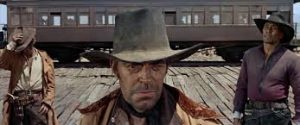
Of course, we hadn’t heard the last of Morricone as far as Leone’s westerns were concerned, because in 1968 he contributed to Leone’s Once Upon a Time in the West, a movie that regularly gets mentioned in ‘best film of all time’ lists.  (It’s certainly in my top three.)  Morricone’s magnificent score ticks all the boxes.  At times, it does the customary soaring and swooping.  At others, it’s playful and jaunty.  And at other times, it’s marked by a haunting and pained-sounding harmonica.  Like Lee Van Cleef, Gian Maria Volontè and the musical pocket watch in For a Few Dollars More, we discover the tragic significance of that harmonica at the end when hero Charles Bronson has a showdown with villain Henry Fonda.  Ironically, the film’s most breath-taking sequence, the lengthy opening where three gunmen played by Woody Strode, Jack Elam and Al Mulock await, with murderous intent, the arrival of Bronson at a remote, rickety train station, unscrolls without Morricone’s music (and indeed, without any dialogue) until nearly ten minutes in when that melancholy harmonica strikes up.


Morricone toiled away on many other Italian, and occasionally American, westerns and his CV surely makes him one of the great figures in the western genre.  His work appears in Duccio Tessari’s The Return of Ringo (1965), Franco Giraldi’s Seven Guns for the MacGregors (1966), Carlo Lizzani’s The Hills Run Red (1966), Sergio Sollima’s The Big Gundown (1966), Giulio Petroni’s Death Rides a Horse (1967), Don Taylor and Italo Zingarelli’s The 5-Man Army (1969) and Don Siegel’s Two Mules for Sister Sarah (1970).  He also contributed to a few westerns like Navajo Joe (1966),  The Hellbenders (1967), The Mercenary (1968) and The Great Silence (1968) that were directed by another Sergio, Sergio Corbucci, who was honoured in Quentin Tarantino’s recent Once Upon a Time in Hollywood (2019) when Al Pacino described him as “the second best director of spaghetti westerns in the whole wide world!”  Meanwhile, Morricone was reunited with the first best director of spaghetti westerns in the whole wide world with Leone’s late-period western Duck You Sucker (1971), a movie that I like but don’t consider in the same league as Leone’s earlier efforts.  (James Coburn’s Irish accent doesn’t help.)


By the early 1970s Leone had shifted from spaghetti westerns to another staple of traditional Italian cinema, the giallo – the horror-thriller hybrid wherein a group of people, usually affluent and beautiful, get despatched by a mysterious killer (whose identity is revealed only in the closing moments) stabbing, slashing and hacking his or her way through them for some unlikely reason.  The results are often Italian films at their most stylish, glamorous, violent, ridiculous and politically incorrect.


Morricone’s giallo music is frequently mannered, genteel and dreamy, at odds with the bloody events happening onscreen but matching the well-upholstered lifestyles of the doomed protagonists.  He contributed to Elio Petri’s supernaturally tinged A Quiet Place in the Country (1968), Paolo Cavara’s slick but dodgy Black Belly of the Tarantula (1971), Aldo Ladi’s rather brilliant Short Night of Glass Dolls (1971), Massimo Dallamano’s fairly reprehensible What Have You Done to Solange? (1972) and Umberto Lenzi’s lovably barmy Spasmo (1974).   He also did the music for Lucio Fulci’s A Lizard in a Woman’s Skin (1971), but I haven’t seen that one, so I can’t provide it with suitable adjectives.


© Seda Spettacoli / Universal


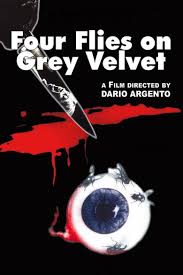
He also worked on three movies directed by the man who’s arguably the maestro of the giallo, Dario Argento: The Bird with the Crystal Plumage (1970), The Cat o’ Nine Tails (1971) and Four Flies on Grey Velvet (1971).  He didn’t, however, supply the music for Argento’s giallo masterpiece Deep Red (1976).  That role went to the German prog-rock band Goblin and I have to say, with apologies to Morricone, that I think their baroque, intense Deep Red score just about pips his work as the best giallo music of all time.


By then, of course, Hollywood had discovered Morricone and his scores for such prestigious productions as Terence Mallick’s Days of Heaven (1978) and Rolande Jaffé’s The Mission (1986) won him international acclaim.  A digression here – I remember reading an interview with Will Carling, the nice but dull skipper of the England rugby team in the late 1980s and early 1990s.  Carling told the evidently bored interviewer that before games, to settle his nerves, he listened to ‘The Mission’.  The interviewer thought Carling was talking about the 1980s British Goth band the Mission and, believing he’d discovered something interesting about Carling at last, that he was a Goth, asked him if he liked Gene Loves Jezebel too.  “No,” retorted a perplexed Carling, “The film The Mission.  The music from The Mission!”


Morricone also enjoyed a final reunion with his old comrade Sergio Leone, creating a majestic but wistful score for Leone’s Hollywood gangster epic Once Upon a Time in America (1984).


Leone didn’t just provide the music for good films.  He also plied his trade with many bad ones and often the music coming out of the cinema speakers and what was happening on the screen seemed to belong to two different aesthetic universes.  I’m thinking of Reagan’s Theme, the haunting guitar-and-choir piece he composed for John Boorman’s much-derided Exorcist II: The Heretic (1978), or the soulful, religious sounding theme he provided for Michael Anderson’s Orca: The Killer Whale (1977), totally at variance with the ridiculous plot that has Richard Harris going Captain Ahab against a vengeful cetacean.


© Turman-Foster Company / Universal Pictures


Among Leone’s Hollywood scores, I particularly admire the one he did for John Carpenter’s excellent remake of The Thing (1982).  At the time, disdainful mainstream critics (who also hated the film generally) dismissed his work as being like one of Carpenter’s own, pulsating synthesiser scores ‘slowed down’ or ‘played at the wrong speed.’  Heard today, its doomy sound encapsulates the film’s claustrophobic and literally under-the-skin horror, whilst reminding you that, yes, this is a John Carpenter film but it’s a special John Carpenter film.  I also like his subtle, creepy score for Mike Nichol’s underrated Wolf (1994), wherein a tired, middle-aged and downtrodden publisher (Jack Nicholson) gets bitten by a werewolf and discovers that his newly acquired lupine powers actually serve him well in the aggressive, cutthroat world of the 1990s New York publishing industry.


© FilmColony / The Weinstein Company


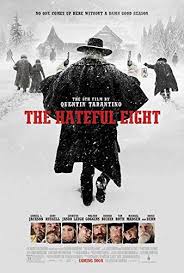
One of Morricone’s last major commissions was for Quentin Tarantino’s The Hateful Eight (2015).  The two men had previously fallen out over Morricone’s contribution, eventually non-contribution, to Tarantino’s 2012 western Django Unchained, but Morricone was back on board for this and contributed an urgent and ominous main theme.  Appropriately, seeing as The Hateful Eight and The Thing feature the same star (Kurt Russell) and a similar scenario (a stranded group trying to identify an enemy hiding among them), Morricone also donated some pieces he’d created for but hadn’t used in the 1982 John Carpenter film.  And as extra icing on the cake, Reagan’s Theme from Exorcist II: The Heretic was borrowed to accompany a brief, arty sequence of coach-horses making their way through the snow.  So it was gratifying that near his life’s end Morricone got an opportunity to show his mastery again of the genre that established his name, the western.


From open.spotify.com