You can’t say those things nowadays… unless you’re a politician


From wikipedia.org / © House of Lords / Roger Harris


In this post I’m not going to repeat the three most depraved and revolting jokes I’ve ever heard.  But I’ll say when and where I heard them, and from whom.


The first joke concerned a medical tragedy and a hideous crime, both involving children, which’d made headlines in the UK during the 1980s.  One night in a pub in Aberdeen, where I was a college student, a friend told a 13-word joke that combined the two cases.  The friend was a decent guy who was drunk at the time and he uttered the joke during a moment of reckless bravado.  Immediately afterwards, he looked disgusted with himself and spent the rest of the evening in a state of depression.  I don’t think I heard him tell an even vaguely risqué joke after that.


I wasn’t as shocked as I might have been because I’d already encountered the joke in written form.  Some degenerate had scribbled it on the back of a toilet-door in Aberdeen University’s Queen Mother Library and I’d noticed it whilst ‘on the john’.


The second joke was two words longer – 15 – and I heard it in the context of a supposedly real-life anecdote.  Another guy I’d known as a student had, following graduation, gone on a trip to the USA where, one day, he’d ended up at an outdoor music festival.  He too was somewhat inebriated.  The festival’s compere decided, at one point, to leave the stage and wander among the crowd, sticking his microphone into people’s faces and asking them how they were getting on.  He stopped by my old acquaintance and, discovering he was from ‘Scaaat-land’, asked him to tell a ‘Scaaat-tish’ joke.  So my acquaintance spewed those 15 words into the microphone, which boomed across the field from the festival’s speakers and left the entire crowd in mortified, disbelieving silence.  I’m not sure if I really believe that story happened – but if it did happen, it was quite something.


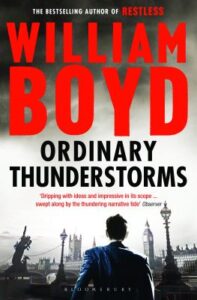
Incidentally, the same joke appears in William Boyd’s 2009 novel Ordinary Thunderstorms.  An unsavoury character tells it to the book’s hero, who responds by tipping him over a bridge and dropping him into the River Thames, where he drowns.  To be fair, the character had antagonized him a lot before that, so he wasn’t just reacting to the joke’s depravity.
 

© Bloomsbury


The third joke I heard in the early 1990s.  I was sitting at the counter of an Edinburgh pub when a drunken guy beside me told it.  It was a longer and more elaborate joke and featured Freddie Mercury, singer of the rock band Queen, who was famously gay and had died of AIDS a while earlier, and another famous showbusiness personage, also gay, who’s still with us in 2026.


Ooph, I thought, that’s really horrible. I hope I never hear a joke like that again.  


Well, I have just encountered a joke like that again.  In fact, it’s the same joke, though updated from the 1990s and now about the gay singer George Michael, who passed away in 2016, and his former partner Fadi Fawaz.  According to the Daily Record newspaper last week, it was told by Malcolm Offord, leader of the far-right-wing Reform party’s branch in Scotland.  In 2018, he included it in a speech he delivered at a Burns Supper held by a rugby club he was a director of.  In the kerfuffle following the Daily Record’s report, Offord admitted telling the joke was ‘a mistake’ and denied being homophobic.  “I don’t have any issue with homophobia,” he said.  “I’ve got a lot of gay friends.”


Nigel Farage, Reform’s Britain-wide leader, has defended Offord, saying, “If we’re going to drum people out of public life for telling a joke at a boozy rugby club dinner that’s amongst friends, we’ll finish up with the dullest group of individuals, looking a bit like, sounding a bit like Keir Starmer.”  Less forgiving was John Swinney, leader of the Scottish National Party and currently First Minister of Scotland – the post Offord aspires to take over following the Scottish parliamentary election this May.  Swinney said of Offord, “He’s unfit to be leader of any political party, unfit to be a member of the Scottish Parliament with views and attitudes like that…  I think we’ve got to be really careful as a country about where we are heading, and Reform have got no part to play in it if they represent views of intolerance, prejudice and hatred of that type.”


What are we to make of this?  Should we regard Offord’s faux pas as regrettable, alcohol-fuelled ‘banter’, accept his apology and move on?  And are we, as Farage suggests, in danger of becoming too puritanical, of scaring all the interesting people away from public office, of ending up with humourless dullards in power over us?  Is society getting – oh God, here we go again – too woke?


It calls to mind the lamentations of Monty Python (1969-74) and Fawlty Towers (1975-79) star John Clleese, who’s spent a good part of the last few years complaining that you can’t tell a good, impactful, close-to-the-bone joke anymore because folk get too offended: “I don’t think we should organize a society around the sensibilities of most easily upset people because then you have a very neurotic society.”  Incidentally, the 86-year-old Cleese appears to have thrown in his lot with Rupert Lowe’s party Restore UK, an outfit even further to the right than Farage’s Reform.

 

From wikipedia.org / © Paul Boxley


Well, in my view, we’re never going to stop hearing sick, horrible and downright racist / misogynist / homophobic / transphobic / etc. jokes.  For as long as the urge to be ‘edgy’ persists in the human psyche, such jokes will continue to be told in pubs and clubs, on sports terraces, in Internet forums, on WhatsApp and other messaging platforms, in countless situations where people interact.  But anyone who thinks it’s a good idea to spout a joke of that sort in public – supposedly 200 people attended Offord’s Burns Supper – shouldn’t be presenting themselves as a politician qualified to take over the highest political office in Scotland.  Especially when as holder of that office you’ll be representing, and making decisions that affect, the group of people your joke cruelly mocked.


Call me old-fashioned, but I prefer my political leaders to be dull – and serious, and sensible.  I remember British Prime Ministers like Labour’s Jim Callaghan and the Conservatives’ John Major, both rather grey and uninteresting, but whom I felt a lot safer having in Number 10, Downing Street than, say, an alleged laugh-a-minute ‘personality’ like Boris Johnson.  Between Callaghan and Major, of course, Britain was subjected to the 11-year reign of Margaret Thatcher, who had many qualities – mainly negative qualities, in my opinion – but being a barrel of laughs who told good jokes wasn’t one of them.


Offord must have thought he was on safe ground with his joke because he was at a well-lubricated rugby club event, not what you’d expect to be the most politically correct of gatherings.  But according to the Daily Record, even his rugby-loving audience was unimpressed.  One witness said, “I was sitting next to a gay man and it was clearly an extremely uncomfortable and unpleasant experience for him…  At the time I thought it pretty awful and indeed that was the feeling in the room.  Even for a rugby club it was a crude, bad taste and insulting spectacle…  I don’t know who in their right mind would say something like that.”


Even some of the usual suspects in Scotland’s mostly right-wing, Unionist media have turned on Offord because of this.  Scottish Times columnist Alex Massie penned a piece entitled Reform may already regret its choice of leader in Scotland, whilst Scottish journalist Stephen Daisley, who frequently writes for the very right-wing Spectator, messaged, “Malcolm Offord is single-handedly wrecking Reform’s chances in the Scottish parliament.  Can the Holyrood campaign be salvaged?”


I haven’t heard any reaction yet from Chris Deerin, who’s somehow the Scotland editor at the supposedly left-leaning New Statesman.  When Offord became Scottish Reform leader, Deerin tweeted, “Malcolm Offord is a seriously great get for Reform.  Very smart, ambitious for Scotland, excellent communicator, properly Scottish, experience of government, hugely successful in business – working class boy made good.  Ooft.”  (‘Ooft’, of course, was my first thought when I heard that joke.)  And in a couple of New Statesman articles Deerin penned about Offord, he talked breathlessly about the wealthy politician’s ‘gilded life’ and particularly admired his “vintage, open-top Jaguar sports car, Bond-esque in its sleek lines and growling power,” in which Offord “roared off into the countryside.”


Alas, despite everything, I don’t think Offord will be roaring off into the countryside, never to be seen or heard of again.  There are too many people who’ll rally to his cause rather than reject it after this furore.  That’s because they believe the line, fed to them endlessly by Britain’s right-wing media and pundits, that everything is too puritanically woke now, that you can’t crack a joke about gays or women or religious or ethnic minorities without the roof falling on your head, that you “can’t say those things nowadays”.  The irony is that you can say those things nowadays, and totally get away with them, at least if you’re a British politician.


Nigel Farage has recently courted controversy over the personalized messages he’s sent as Cameo videos – one of several lucrative side-projects he has in addition to being Reform party leader and a Member of Parliament.  A Guardian investigation found that the messages included ones “supporting a convicted rioter, repeating extremist slogans, and endorsing a neo-Nazi event” and where he “referenced antisemitic conspiracy theories, and made misogynistic remarks about leftwing politicians, including a comment about the US congresswoman Alexandria Ocasio-Cortez’s breasts.”


Previously, Farage was in hot water because of allegations made by over 30 people who’d known him during his schooldays.  According to their accounts, the teenaged Farage was quite the dedicated follower of fascism – among other things, singing Hitler Youth songs and growling “Hitler was right” and “Gas them” at Jewish pupils. He’s variously responded to these allegations by calling them ‘fantasies’, saying he can’t remember saying such stuff or dismissing it as – there’s that word again – ‘banter’.


Not that this has dented Farage’s popularity much.  His party is still leading in British opinion polls.

 

From wikipedia.org / © Roger Harris

From wikipedia.org / © Roger Harris


Elsewhere, Robert Jenrick, formerly the Conservatives’ Shadow Justice Secretary and now a defector to Reform, caused outrage last year when he said a 90-minute visit to the Handsworth part of Birmingham was “as close as I’ve come to a slum in this country” and one where he didn’t encounter “another white face“.  And earlier this month, the Conservatives’ Nick Timothy, who’s inherited Jenrick’s role as Shadow Justice Secretary, described an open Iftar event in Trafalgar Square as “an act of domination…  not welcome in our public places and shared institutions…  straight from the Islamist playbook.”  In previous years open Iftar events had been held in the square without anyone objecting, as had other religions’ celebrations such as Chanukah, Vaisakhi and Diwali.  And it had also hosted Christian events like mass prayers and Good Friday passion plays.


Rather than discipline them, Conservative party leader Kemi Badenoch backed both Jenrick and Timothy.  The latter case inspired the double-barreled, hard-right-wing rabble-rouser Stephen Yaxley-Lennon to crow on social media about how, just two years ago, a Conservative Member of Parliament making Timothy’s anti-Islamic comments would have been expelled from the party.  But not in 2026.


Yes, call me old-fashioned…  But I prefer the good old days when not only were British mainstream politicians grey and dull, but if they’d spouted anything blatantly racist, misogynistic, homophobic, or Islamophobic, they’d immediately have been out on their ear.

Steve Cashel has the last laugh


© Close to the Bone Publishing


Steve Cashel, the pseudonym I use when I write fiction set in Scotland and without any elements of the fantastic, has had a new story published in Close to the Bone Magazine.  The magazine describes itself as “publishing weekly hard-hitting crime fiction since 2012”.


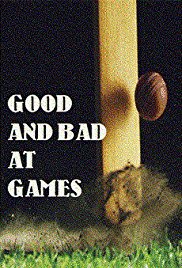
My story, entitled Last Laugh, doesn’t contain any crime that necessitates the involvement of the police force, detectives and / or private investigators.  But it does concern behaviour that’s criminal in nature.  It tells the tale of a man who suddenly finds himself reflecting on a boy he bullied in his schooldays, the bullying becoming more and more extreme until it got entirely out of hand.  The story owes something to Good and Bad at Games, the 1983 British TV drama written by William Boyd and directed by Jack Gold, which was published with another of Boyd’s TV plays in a volume called School Ties in 1985.


Good and Bad at Games was based on Boyd’s experiences at the posh private school Gordonstoun, to which he was packed at the age of nine.  Gordonstoun is famous for having helped to educate Prince Philip, the late Duke of Edinburgh, and his sons King Charles III, Prince Edward and Andrew Mountbatten-Windsor, the arsehole formerly known as ‘Prince’.


However, in Boyd’s introduction to School Ties, the author wrote that in his day the school was ”comparatively unknown and inexpensive, distinguished only by its remoteness (in the far north of Scotland), a reputation for its somewhat Spartan lifestyle (boys wore shorts throughout their school career) and the idiosyncrasies of the educational ethos of its founder, who thought a school could be run along principles laid down in Plato’s Republic.”  Boyd also described being a small boy there, at the mercy of bigger boys, as being ”like a medieval peasant during the Hundred Years War.  One never knew when another marauding army might march by, randomly distributing death and destruction.”


In a nod to Boyd, I made the imaginary posh school in Last Laugh a Scottish one, though in Edinburgh rather than the remote north.  It takes both day-pupils, who are mostly Scottish, and boarders, who are mostly English, which doesn’t exactly enhance its social cohesion.


For now, Last Laugh can be read here, while you can access the home page of Close to the Bone Magazine here.


© Channel 4

The literary Bond revisited: Colonel Sun


© Vintage Publishing


Here’s the latest in a series of posts wherein I look at the original James Bond novels and short-story collections from the 1950s and 1960s.  This time, however, I’m looking at a Bond novel that wasn’t written by Ian Fleming.  It’s 1968’s Colonel Sun, by Kingsley Amis.  Why?  Well, I slagged off Amis’s The Old Devils (1986) on this blog a few months ago, and I feel a bit guilty about giving poor old Kingsley a (verbal) kicking then.  So here’s my take on Colonel Sun, which I believe is much better.


In some ways, the 21st century has been a difficult time for James Bond.  On the film front, the new century began with one of the worst Bond movies ever, 2002’s Die Another Day, an ignoble end to Pierce Brosnan’s tenure in the role.  And, though the franchise was steadied with the recruitment of Daniel Craig and a more serious, mature and sensitive approach to the character, trouble never felt far away.  See, for example, the long periods between productions – six years from Spectre (2015) to No Time to Die (2021) – and Craig’s well-publicised reluctance to play Bond again after Spectre.  And the fact that, in the most recent movie, the filmmakers took the unprecedented step of – MASSIVE SPOILER AHEAD! – killing him off at the end.


Plus, there’s been much talk in recent years about Bond’s ‘obsolescence’.  The thinking goes that as a privileged, white, stuck-up, sexist macho-man rooted in the early decades of the Cold War, Bond has become embarrassingly anachronistic in our more socially-aware era today.  Laurie Penny, for instance, said as much in a New Statesman article in 2015.  There’s a parallel argument that in the high-tech modern world Bond is obsolescent too.  This was even referred to in Spectre, when Bond is faced with a new, tech-obsessed superior called C (Andrew Scott).  C vows to “bring British intelligence out of the dark ages, into the light” and argues that “an agent in the field”, like 007, can’t “last long against all those drones and satellites.”


And yet, no matter how unfashionable Bond might be nowadays, you can’t deny that well-regarded modern writers are still keen to follow in Ian Fleming’s footsteps and have a go at writing new Bond novels.  These include Sebastian Foulkes (with 2008’s Devil May Care), Jeffery Deaver (with 2011’s Carte Blanche), William Boyd (with 2013’s Solo) and Anthony Horowitz (with 2015’s Trigger Mortis and 2018’s Forever and a Day).  Long before Foulkes, Deaver, Boyd and Horowitz got in on the act, though, another writer attempted to construct a novel around Fleming’s legendary superspy.


In 1968, just four years after Fleming’s death, Kingsley Amis wrote a Bond adventure called Colonel Sun and published it under the pseudonym Robert Markham.  By then, Amis was a big noise in British letters thanks to works like 1954’s Lucky Jim and 1960’s Take a Girl Like You.  I should say my 2015 Vintage Classics edition of Colonel Sun makes no mention of Robert Markham on its cover and advertises it unapologetically as a Kingsley Amis novel.  Anyway, before I offer my thoughts on Colonel Sun, here’s another spoilers warning.  There are lots of them ahead…


© Ian Fleming Publications


The novel is set a little while after the events of Fleming’s Bond swansong, The Man with the Golden Gun (1965), which Amis is rumoured to have polished up when Fleming died before he could revise it himself.  It begins with an audacious attempt by some unidentified villains to kidnap both Bond and his secret-service boss M.  They’re only half-successful.  M is abducted and whisked out of England, but Bond manages to elude his would-be abductors and is tasked with tracking M down.  He soon homes in on an island in the Aegean Sea.  There, M is being held by a Chinese officer, ‘Colonel Sun Liang-tan of the Special Activities Committee, People’s Liberation Army’.


The Colonel has a dastardly plan.  The Soviet Union is hosting a secret international conference in the area and Sun plans to destroy it and the delegates in a mortar attack, the blame for which will then be pinned on Britain.  Sun intends to make it look like one of the last mortars blew up accidentally, before firing, and leave Bond and M’s dead, but still identifiable, bodies in the wreckage.  Thus, China will benefit from the discrediting not only of the USSR for sloppy security, but also of the UK for warmongering.


To rescue M and thwart Sun’s scheme, Bond joins forces with a woman called Ariadne Alexandrou, a Greek communist who’s been working for the Soviets; and a Greek World War II veteran called Niko Litsas who, after fighting Nazis, fought communists during the 1946-49 Greek Civil War.  Amis discreetly skates over Britain’s sorry role in this episode of Greek history.  In 1944 the British government decided to back the anti-communist faction in Greece against the left-leaning one, even though the former faction contained many Nazi sympathisers and collaborators and the latter contained many partisans who’d fought for the Allies.  Despite their ideological differences, the trio bond – ouch – and are soon prowling the Aegean Sea in a vessel called The Altair whilst figuring a way of taking the fight to Sun and his many henchmen.


Amis’s plot is generic and a few things don’t make sense.  For example, why does Sun want to plant the elderly and normally deskbound M at the scene of the crime?  This is the literary M we’re talking about, not the feistier and more empowered cinematic version played by the likes of Judi Dench and Ralph Fiennes.  Wouldn’t it look more believable if the body of another, physically-able British agent was found there next to Bond’s?  It’s hard to see this as anything more than a perfunctory excuse for the novel’s main gimmick, the kidnapping of M.


But Colonel Sun is still good entertainment and feels more credible as a Bond novel than the other non-Fleming Bonds I’ve read.  For one thing, unlike the rather bland villains in most of the 21st century Bond-novels I mentioned above, Colonel Sun makes a memorable baddie.


© Methuen


Yes, he belongs to a long tradition of Oriental supervillains found in pulpy colonial adventure fiction – Sax Rohmer’s Fu Manchu books being the most notorious examples.  He’s not even the first bad guy in the Bond canon to follow this dubious blueprint, an honour that belongs to the titular character of Fleming’s Dr No (1957).  But Sun is splendidly eccentric.  He’s irritatingly polite and addresses friends and foes alike by their first names.  He also sees himself as an Anglophile: “Sun did not share his colleagues’ often-expressed contempt… for everything British.  He was fond of many aspects of their culture and considered it regrettable in some ways that that culture had such a short time left.”


Then there’s his penchant for torture.  Near the novel’s end, just before he lays into Bond with an array of kitchen utensils (‘knives, skewers, broom-straws’), he explains: “True sadism has nothing whatever to do with sex.  The intimacy I was referring to is moral and spiritual, the union of two souls in a rather mystical way.”  Later still, he surprises us when he confesses to Bond that “I didn’t feel like a god when I was torturing you back there.  I felt sick and guilty and ashamed.”


Admittedly, I could have done without the linguistic quirk that Amis gives him.  Thanks to his “quick ear and passionate desire to learn” English and a “total ignorance of the British dialect pattern”, he’s ended up with a bizarre accent combining the “tones of Manchester, Glasgow, Liverpool, Belfast, Newcastle, Cardiff and several sorts of London…”  As a result, every time Colonel Sun opens his mouth in the book, I imagine his voice sounding like an Artificial Intelligence one created from a dataset involving Liam Gallagher, Billy Connolly, Ringo Starr, Van Morrison, Jimmy Nail, Charlotte Church and Ray Winstone.


Colonel Sun also feels like a proper Bond novel because Kingsley Amis’s authorial voice doesn’t sound that different from Ian Fleming’s.  Putting it more crudely, it feels closer to the originals than the modern pastiches do because Amis was as much of a curmudgeonly snob as Fleming was.  By the 1960s, Bond’s rarefied world of Bentleys, dinner jackets and private members’ clubs were on their way out; and Amis bellyaches about it as you’d imagine Fleming would.  When Bond drives through some English farmland, he writes: “Places like this would last longest as memorials of what England had once been.  As if to contradict this idea, there appeared ahead of him a B.E.A. Trident newly taken off from London Airport, full of tourists bringing their fish-and-chip culture to the Spanish resorts, to Portugal’s lovely Algarve province, and now… as far as Morocco.”


Also activating Amis’s Licence to Grump is the prospect of the great, fish-and-chip-loving unwashed discovering the Greek islands.  Describing a waterfront, he observes: “At the near end were whitewashed cottages with blue or tan shutters and doors, then a grocery, a ship’s supplier, harbour offices, a tavérna with a faded green awning.  No neon, no cars, no souvenir shops.  Not yet.”


Still, some aspects of Colonel Sun are surprisingly liberal, considering Amis’s cranky right-wing politics.  Adriane, the book’s heroine, is resourceful and able to look after herself and Bond comes across as less of a sexist boor than one might expect.  Meanwhile, some Soviet characters are depicted sympathetically: for example, Gordienko, Moscow’s man in Athens, who believes Bond’s warnings that something fishy is afoot and will have bad consequences for both their countries; and Yermolov, the pragmatic, vodka-loving dignitary who at the end expresses the USSR’s gratitude to Bond for foiling Sun’s plan.  Indeed, Yermolov feels like a prototype for the tough but avuncular General Gogol, the KGB head played by Walter Gottel, who appeared in every Bond movie from The Spy Who Loved Me (1977) to The Living Daylights (1987).  In Colonel Sun, Yermolov even offers Bond the Order of the Red Banner; just as Gogol awards Roger Moore (‘Comrade Bond’) the Order of Lenin at the end of 1985’s A View to a Kill.


© Eon Productions


But before we assume that old Kingsley has gone all hippy-dippy and peace-and-love, we should bear in mind that the Soviets are the good guys here only comparatively – because the bad guys are the Chinese.  The novel even postulates that the West and the Soviet Union are on the brink of working together because of the increasing threat posed by China.  Richard Nixon’s jaunt to China in 1972 must have knocked that notion on the head.  Happily, by the time of the 1997 Bond movie Tomorrow Never Dies, which has Pierce Brosnan joining forces with Michelle Yeoh to take on Rupert Murdoch, sorry, an evil, fictional media mogul played by Jonathan Pryce, the Bond-verse had decided that the Chinese could be good guys too.


While Colonel Sun has never been filmed, it’s interesting how a few of its ideas have turned up in the Bond movies.  The kidnapping of M was a key plot element in 1999’s Tomorrow Never Dies, while a villain called Colonel Tan-Sun Moon features in Die Another Day.  And if Colonel Sun’s musings during the book’s climactic torture scene sound familiar – “Torture is easy, on a superficial level.  A man can watch himself being disembowelled and derive great horror from the experience, but it’s still going on at a distance…  a man lives inside his head.  That’s where the seed of his soul is…  So James, I’m going to penetrate to where you are.  To the inside of your head….” – it’s because they were used as dialogue in Spectre, during the scene where Christoph Waltz violates Daniel Craig’s skull using a torture device that looks like a dentist’s drill on a robotic tentacle.


In Spectre, Waltz’s character is revealed as being none other than Ernst Stavro Blofeld.  Having James Bond’s great arch-enemy borrow his best lines?  Colonel Sun would have been flattered.


© Eon Productions

Favourite Scots words, P-R


From pixabay.com / © Dimitris Vetsikas


Today, November 30th, is Saint Andrew’s Day, the national day of Scotland.  Also, I’m in the middle of reading Douglas Stuart’s 2022 novel Young Mungo, which is set in Glasgow during the 1990s and is choc-a-bloc with cherishable Scots vocabulary: bevvy, chib, doo, midden, schemie, sook, smirr, tattiebogle, wean, winchin’…  Thus, this seems an opportune time to post the latest instalment of my attempt to catalogue my favourite words from the Scots language.


Patter (n) – A long time ago, I remember Iain Jenkins, my English teacher at Peebles High School, trying to explain to my class why William Shakespeare placed Mercutio’s monologue about Queen Mab in the middle of Act 1, Scene 4 of Romeo and Juliet.  After all, the monologue didn’t have any bearing on the plot that came before or after it.  It was merely Shakespeare showing off his own verbal flamboyance and inventiveness.  Eventually, Jenkins exclaimed, “Patter!  It’s just patter!  It’s Mercutio indulging in a bit of patter!”


Patter, then, is smooth talk, smart talk or funny talk – often delivered by someone, like a politician or a salesman, who’s trying to sell you something.  The word crops in phrases like, “I gave her the auld patter,” or “Enough ay yer patter!”   And a person who comes out with it a lot is called a pattermerchant.  The city of Glasgow seems full of pattermerchants, surprisingly enough.


Pawkie (adj) – used to describe a person possessed of a dry and quietly mocking sense of humour.


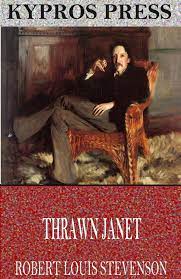
Pech (v) – to gasp or wheeze breathlessly.  In Robert Louis Stevenson’s short supernatural story Thrawn Janet, you get the line: “Even the auld folk cuist the covers frae their beds an’ lay pechin’ for their breath.”


© Kypros Press


Peely-wally (adj) – looking pale and sick-looking.  That’s why in Solo (2013), the James Bond ‘continuity’ novel written by William Boyd, there’s a bit where an injured Bond is scolded by May, his formidable old Scottish housekeeper, for looking ‘awfy peely-wally’.


I’d assumed this was derived from ‘peeling wall’, something that obviously doesn’t look healthy.  But I’ve recently learnt that peely comes from an early 19th century word peelie, meaning ‘a gaunt, pale person’.  And wally is a Scots word meaning ‘made of china’.  Even now, people refer to an ornamental china dog as a wally dug and to false teeth (once made of porcelain) as wallies.  So peelywally really means ‘as pale as china’.


Peep (n) – the lowest level at which you can set a gas flame before it goes out.  To ‘put someone’s gas at a peep’ is to seriously knock them out of their stride or deprive them of their vigour.


Peewit (n) – a lapwing.


Pieces (n) – sandwiches.  Years ago, while I was living with my Dad, I got a job at a local warehouse.  I needed to make myself a packed lunch every morning, to eat during the short break I got in the middle of the day.  My Dad would always inquire before I left the house if I’d remembered to get my pieces together.


Pisht (adj) – drunk.  Just as the Eskimos are said to have a hundred words for snow, there must be at least a hundred words in Scots for being inebriated.  See also arsed, bevied, bleezin’, blootered, buckled, fou’, gubbered, hingin’, minced, mingin’, miraculous, miracked, mortal, reekin’, reelin’, steamboats, steamin’, stocious, wellied, etc.  This, of course, is a tragic reflection on the state of the Scottish psyche…  I wrote, whilst sipping a large whisky.


From pixabay.com / © rebcenter-moscow


Plook (n) – the curse of many a Scottish person’s adolescence,  plooks are pus-filled pimples.  It was rumoured at my school that every time you ate a Mars Bar, you got a plook.  The adjective is plooky and, predictably, this figured in countless playground insults: “Ye plooky bastart, ye!”


Plump (n) – as in ‘a plump ay rain’, i.e., a sudden downpour.


Poke (n) – a small paper bag.  I suspect this word is most commonly heard in Scotland’s chippies, where people request ‘a poke ay chips’.


Poultice (n) – an arsehole.  For example, “Thon Boris Johnson is a right poultice, so he is.”


Puddock (n) – a frog.


Pure (adv) – popularised by the actress Elaine C. Smith, whose character in the Glasgow-set comedy TV show City Lights (1984-1991) used the catchphrase, “Pure deid brilliant!”  Placed before adjectives to amplify their meaning to the nth degree, it crops up in phrases like ‘pure mental’, ‘pure radge’ and ‘pure sleekit’.


Puggled (adj) – exhausted.


Quaich (n) – in the words of the Meriam-Webster dictionary, ‘a small shallow drinking vessel with ears for use as handles.’  These days, ornate quaichs are often used as pint-sized trophies at Scottish sports events.


Quine (n) – a girl or young woman.  This is commonly used in Scotland’s North-East, where boys and young men are also described as loons, so you hear a lot about quines an’ loons.  In the early 1990s, a group of Scottish feminists, including the journalist Lesley Riddich, started up a magazine called Harpies and Quines – harpy being a word commonly used in Scotland to describe a grumpy, ill-tempered and mean-minded woman.  The famous high-society magazine Harpers and Queen failed to see the joke and attempted to sue them.


© Channel Four Films / Polygram Filmed Entertainment


Radge (adj) – violently wild and crazy.  Used as a noun, it refers to a mad hooligan.  It had humble beginnings in Eastern Scotland, where it may have come from a Romany word with a similar meaning, ‘raj’, but radge was for a while a trendy term used the length and breadth of Britain.  This was because of its copious use in Danny Boyle’s hit movie Trainspotting (1996), where it was associated with Robert Carlyle’s ultra-violent character Frank Begbie.  I seem to remember the author Irvine Welsh, on whose novel the film was based, remarking disgustedly that he’d heard Hooray Henrys using the word radge in London wine bars.  And I also remember Q magazine running an interview with Robert Carlyle under the memorable headline RADGE AGAINST THE MACHINE.


Rammy (n) – a fight or brawl.  A stairheid rammy is a brawl that breaks out among the womenfolk in the staircases and on the landings of Scotland’s urban tenement buildings.  During the run-up to the Scottish independence referendum in 2014, a heated television debate between then-SNP deputy leader Nicola Sturgeon and then-Scottish Labour leader Johann Lamont was described afterwards by journalist Ruth Wishart as “a right good stairheid rammy” that “made strong men avert their eyes”.


Randan (n) – a drunken knees-up, as in “He’s away oot on the randan!


Rector (n) – the Scottish term for headmaster.


Redd (v) – to tidy up.  I’ve rarely heard this verb used in Scotland, or at least in the parts of it I’ve inhabited.  But I frequently heard it during my childhood in Northern Ireland, where a good number of the people are descended from Scots.  My Mum would frequently explain, “Get this room redd up!” or “Give that place a wee redd!


Riddy (n) – an embarrassment.  As in: “Liz Truss!  What an absolute riddy!


Right (adj) – uttered with the appropriate intonation, right becomes a contemptuous response, dismissing something that another person has just said.  Though for maximum impact, use the phrase Aye, right.  “Maggie Thatcher wis the best prime minister since Churchill?  Aye, right.”  And indeed, Glasgow’s annual book festival is called Aye Write.


© Glasgow Life


Rone (n) – the length of guttering along the edge of a roof for collecting and removing rainwater.


That’s all for now.  More Scots words, and more example-sentences that insult famous Conservative Party politicians, will come shortly…

Dragged through a hedge backwards


© BBC


I’m currently halfway through William Boyd’s 2009 London-set thriller Ordinary Thunderstorms which, after a rather unengaging start, I’m happy to say is now shaping up to be a gripping read.  It’s interesting how quickly Boyd’s plot, of an innocent man being accused of a murder he didn’t commit and having to go to ground – literally so, hiding in a neglected patch of waste ground by the Embankment – to avoid both the police and the real killers, reminded me of several other books, namely, John Buchan’s The 39 Steps (1915), Geoffrey Household’s Rogue Male (1939) and, in a rather more skewed way, J.G. Ballard’s Concrete Island (1974).


It’s been a good while since I read The 39 Steps and Concrete Island, but I read Rogue Male just a couple of years ago and was impressed enough to post something about it on this blog.  Here’s the entry again, slightly updated to incorporate some Benedict Cumberbatch-related news.


For a novel whose plot hinges around an attempt to kill Adolf Hitler, there’s remarkably little about Hitler in Geoffrey Household’s Rogue Male.  In fact, the genocidal German dictator isn’t mentioned once.  Presumably this is because although Rogue Male first appeared in print in late 1939, after war had broken out between Britain and Germany, it was written before the outbreak of war when Household felt it would be diplomatic not to name names.


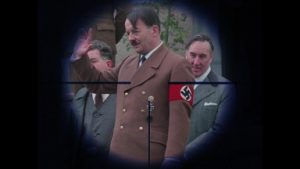
Thus, the book’s hero goes boar-hunting in Poland, crosses the border into a neighbouring country that isn’t identified, and one day ends up with the brutish leader of that country, also not identified, in the sights of his hunting rifle.  Is he actually in Germany and on the point of bagging Hitler?  Or could he be somewhere else, Russia say, where he’s targeting Joseph Stalin?  But although Household keeps it ambiguous, given historical events soon after the story’s late-1930s setting, it’s impossible to read Rogue Male now and not visualise in those sights a bloke with a square-shaped scrap of a moustache, an oily side-parting and a swastika armband.


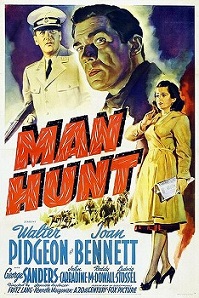
Incidentally, when Rogue Male was brought to the screen, the filmmakers didn’t follow Household’s ambiguity.  A 1941 Hollywood adaptation called Manhunt, directed by Fritz Lang – who’d bailed out of Germany in 1933 after Joseph Goebbels started taking an interest in him – readily depicted the target as Hitler and, viewed today, the film feels like an unabashed wartime propaganda piece.  Meanwhile, a 1976 adaptation by the BBC, directed by Clive Donner, was also unequivocal that its hero was going after Hitler.  The actor playing Hitler was none other than Michael Sheard, fondly remembered by kids of my generation for playing Mr Bronson, the hard-nut deputy headmaster on the BBC’s children’s drama / soap opera Grange Hill (1978-2008).


Just as the book’s target is anonymous, so is its hero, even though he tells the story in the first person.  Again, the film versions differ from the book in giving him an identity.  In 1941’s Manhunt, he’s called Captain Thorndyke and is played by Walter Pidgeon.  In 1976’s Rogue Male, he’s called Sir Robert Hunter and is played by the marvellous Peter O’Toole.


© Penguin Books


Whoever he is, he’s apprehended before he can fire the rifle and subjected to a brutal interrogation.  Then his captors decide that the easiest way to deal with him is to bump him off and make his death look like an unfortunate hunting accident.  The ensuing story can be divided into two parts, with each part having a similar, contracting, funnelling structure where the action begins in an expansive setting but ends in a cramped, claustrophobic one.  First, Rogue Male’s hero manages to escape from his captors and is pursued by them across the countryside of whatever foreign nation he’s in.  Okay, for the sake of simplicity, let’s just say his captors are the Gestapo and the nation is Germany.  His pursuers close in but he manages to elude them by stowing away on a London-bound ship, hiding on board inside an empty water tank.


Then begins the second, longer part of the narrative.  Back in Blighty, he discovers that Hitler’s agents are still on his trail.  They don’t just want to eliminate him but also want to make him sign a document saying that he carried out his attempted assassination with the blessing of the British government.  Again, the pursuit begins against a broad vista, this time the streets of London and landscapes of southern England.  But again, his options narrow and eventually he digs and hides himself in a little cubbyhole under an unruly and remote hedgerow marking the boundary between two farms in Dorset.


One thing that surely inspired Rogue Male was Richard Connell’s short story The Hounds of Zaroff (1924) about a big-game hunter who gets hunted as game by another, even bigger-game hunter.   However, while Household borrows this ironic scenario of a hunter becoming the hunted, he explores it with surprising depth.  His hero obviously grew up in a rural aristocratic culture of shooting and hunting but he’s remarkably empathetic with the creatures on the receiving end of the bullets and hounds.  He mentions once or twice that he got sick of hunting rabbits because of their harmlessness and defencelessness.  And, holed up in his Dorset burrow, he becomes rabbit-like himself.


He also bonds with a cat living wild in the hedge above him, whom he names ‘Asmodeus’, presumably after the ‘worst of demons’ described in the Catholic and Orthodox Book of Tobit.  At one point he speculates of Asmodeus, “there is, I believe, some slight thought transference between us…  back and forth between us go thoughts of fear and disconnected dreams of action.  I should call these dreams madness, did I not know they came from him and that his mind is, by our human standards, mad.”


Later, he comments, “I had begun to think as an animal; I was afraid but a little proud of it.  Instinct, saving instinct, had preserved me time and again…  Gone was my disgust with my burrow; gone my determination to take to open country whatever the difficulties of food and shelter.  I didn’t think, didn’t reason.  I was no longer the man who had challenged and nearly beaten all the cunning and loyalty of a first-class power.  Living as a beast, I had become a beast, unable to question emotional stress, unable to distinguish danger in general from a particular source of danger.”


While Rogue Male’s central character becomes unhealthily animal-like, his main adversary is a hunter extraordinaire.  A German agent masquerading as an English country gent called Major Quive-Smith appears on the scene, displaying impeccable upper-class charm towards the civilians he encounters, whist ruthlessly pursuing his quarry.  Quive-Smith books a room in one of the farms adjacent to the hedge and burrow, pretending that he wants to spend a few weeks in the area doing some shooting.  Spying on him from afar, Household’s narrator notes uneasily that “the major carried one of those awkward German weapons with a rifled barrel below the two gun barrels… the three barrels were admirably adapted to his purpose of ostensibly shooting rabbits while actually expecting bigger game.”


© 20th Century Fox


In addition to The Hounds of Zaroff, Household was probably influenced by John Buchan’s The 39 Steps (1915).  But while there’s more to Buchan’s novel than its conventional action-adventure reputation would suggest, due to its recurrent theme of disguise and imposture, I think Rogue Male is superior in terms of characterisation and psychological tension.  Buchan’s Richard Hannay is an outsider in that he’s a veteran of the African colonies who finds life back in the ‘Old Country’ stuffy, pretentious and tedious; but the hero of Rogue Male is an outsider in more complex ways.  He comes from a world of wealth and entitlement but treats that world with indifference and it’s noticeable that when he’s back in London he has a lack of friends in high places to call upon for help.  Indeed, he’s such a loner that at times you wonder if he wants to resign from the human race itself.  This is even without the mental and physical stress of being hunted making him less like a man and more like an animal.  Household provides a few clues about a past tragedy that may explain his disenchantment but wisely he doesn’t get bogged down in too much backstory.


And though Hannay is no shrinking violet, it’s doubtful if he could put with living for long in the burrow that the narrator digs for himself in Dorset and where he spends a good part of 90 pages, first hiding in it from Quive-Smith and his men, and then besieged in it by them.  Household manages the tricky task of not overly describing the dirt, muck and claustrophobic darkness of this hideaway whilst implying its squalor.  His hero is accustomed to it while he’s inside it but realises how horrible it is when he’s out of it and then comes back: “The stench was appalling.  I had been out only half an hour, but that was enough for me to notice, as if it had been created by another person, the atmosphere in which I had been living.”  Then again, like many men of his generation, he’s already undergone something traumatic that puts this experience in perspective: “…my God, I remembered that there were men at Ypres in 1915 whose dugouts were smaller and damper than mine!”


I’ve known the story of Rogue Male for a long time thanks to seeing the two film adaptations.  I didn’t like the 1941 Hollywood version, which downplays the rawness of the novel and turns it into a conventional espionage thriller, reducing the amount of time Walter Pidgeon spends in the burrow and padding things out with extra characters and plot twists.  The film’s low-point comes when Pidgeon gets off the ship and is greeted by a parade of Cockney Pearly Kings and Queens waltzing and singing down a foggy street. I guess that was the filmmakers’ way of assuring American audiences that, yes, he is back in London.


But I enjoyed the 1976 BBC version.  Its scriptwriter, Frederick Raphael, streamlines parts of Household’s narrative and embellishes others – most notably, adding a new character, a pompous and unhelpful representative of the British government sublimely played by Alastair Sim – but it’s gritty and, for the time, brutal, even if Peter O’Toole never quite becomes the desperate, filthy, animalistic figure that his counterpart in the book becomes.  In addition, it has a great cast (John Standing, Harold Pinter, Michael Byrne and Mark McManus as well as O’Toole and Sim) and it even slips in a cheeky visual reference to Michael Powell and Emeric Pressburger’s wartime classic, The Life and Times of Colonel Blimp (1943).


And coincidentally, it looks like Rogue Male could be back in vogue.  For the past few years, it’s been known that Benedict Cumberbatch wants to produce (and presumably star in) a new version of it.  Let’s hope the Cumberbatch version, if it appears, is closer to the sombre tone of the 1976 adaptation than the anodyne, crowd-pleasing tone of the 1941 one.  Or, better still, it makes a real effort to capture the fascinatingly introspective, misanthropic and grimy mood of the novel that inspired those versions in the first place.


© BBC