Bad hombres


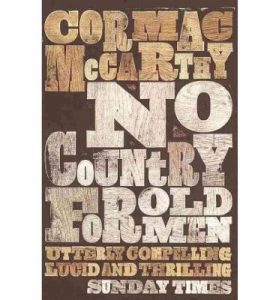
© Pan Macmillan 


June 13th saw the death of Cormac McCarthy, reckoned by many to be the greatest American novelist of his generation.  (However, he certainly wasn’t the last great American novelist, as some excitable types have suggested.  Don DeLillo is still with us, and Donna Tartt surely has much petrol left in her tank, and no doubt more notables will emerge in the future.)  Anyway, as a tribute, here’s a piece I wrote a few years ago after reading McCarthy’s No Country for Old Men (2005), and when I felt an urge to compare it with the Oscar-winning film version of the same name, directed by Joel and Ethan Coen, which had been released two years after its publication. 


A word of warning…  Just as there were in my entry a few days ago about the literary and cinematic versions of Jurassic Park – many spoilers lie ahead about No Country for Old Men in its book and film forms!  


I greatly admire Cormac McCarthy’s novels Blood Meridian (1985) and The Road (2006).  However, I hadn’t felt any overwhelming desire to read another of his most famous works, 2005’s No Country for Old Men, because I’d already seen the 2007 movie adaptation of it by Ethan and Joel Coen and I’d heard that the film followed the book closely.


Thus, thanks to the Coen Brothers, I already knew No Country for Old Men’s plot and characters.  I’d also found the film vaguely dissatisfying.  As I rather pretentiously explained to a friend at the time, “It’s like a Frankenstein’s monster where Jean-Paul Sartre’s head is stitched onto Clint Eastwood’s body.”  What I meant was that for most of its running time the film was a lean, ruthless thriller, a gripping piece of modern western noir.  But then near the end, its remorseless storyline just stops.  After that, there’s a protracted scene where Tommy Lee Jones’s Sheriff Bell character visits an elderly relative and announces his intention to retire because, basically, the world is a terrible place and he can’t handle it any longer.  And so the film seems to peter out amid lamentations of existentialist angst.


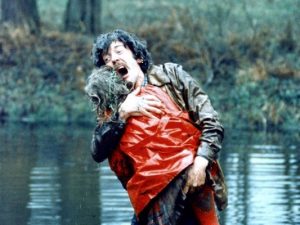
© Miramax Films / Paramount Vantage


I’d assumed that, since it was supposedly a faithful adaptation of the book, the book would have a similarly dissatisfying ending.  Which admittedly was a bit unfair towards Cormac McCarthy.


A while ago I spotted a second-hand copy of No Country for Old Men, the book, on sale in a charity shop.  And with that jolt of horror you get occasionally when you’re growing older and realise how quickly time seems to be passing, it occurred to me how it’d been a dozen years since I’d seen the movie.  I’d also forgotten a lot of what’d happened in it.  This seemed a good opportunity to buy the literary version of No Country for Old Men and acquaint myself with it.


My main impression after reading No Country for Old Men was that, yes, for the most part, the Coen Brothers were remarkably faithful to the original when they made their movie.  As the story unfolds – a hunter and Vietnam vet called Llewellyn Moss stumbles across the bloody, corpse-strewn aftermath of a drug-deal-gone-wrong on the remote Texas / Mexico border, lifts a satchel full of money and makes a run for it, only to be pursued by a gang of vengeful narcos, as well as by a certain Anton Chigurh, a hitman so relentless, merciless and fearsome he makes the Terminator look like Bambi – I found near-identical scenes from the movie returning to my memory after many years.


One difference between the book and the film I noticed early on was when Moss, having scarpered with the money, nobly but foolishly decides to return to the scene of the massacre because he’d left behind one survivor, a badly-injured gangster who was begging for water.  When he comes back with some water for that survivor, the survivor is surviving no longer; and one of the cartels involved has sent along some new hoodlums to find out what’s happened to their drugs and money.  There follows a nail-biting chase across the desert, climaxing with Moss flinging himself into a river to escape the hoodlums.  In the film, the Coen Brothers ratchet the suspense up further by introducing a big attack dog that doesn’t appear in the book.  Even the river doesn’t deter the brute in its pursuit of Moss because it’s a powerful swimmer.  In fact, the dog is a crafty metaphorical foreshadowing of Anton Chigurh, who is soon pursuing Moss too.  If there’s one thing you want following you even less than a big attack dog, it’s him.


The book also has more of Sheriff Bell, the ageing lawman trying to find and save Moss whilst also keeping tabs on Carla Jean, Moss’s young wife.  At regular intervals, there are short chapters showing Bell’s stream of consciousness while he ruminates on existence and the general state of things.  “My daddy always told me to just do the best you know how and tell the truth…” he says at one point.  “And if you done somethin wrong just stand up and say you done it and say you’re sorry and get on with it.”  This makes him a likeable and sympathetic character, but not too much so.  Later, as we hear more of his musings, we discover some of his views are pretty reactionary and probably if he was still around in 2016 – the story is set in the 1980s – he’d have voted for Donald Trump.  These interludes also prepare us for the gloomy philosophical ending, in a way we weren’t prepared for it whilst watching the film.


For much of the book and film, the plot is an increasingly desperate and nasty cat-and-mouse game between Moss and Chigurh, while various foot-soldiers arrive from the cartels and get blown away in the crossfire.  McCarthy describes it all in his admirably economical and deceptively simple-looking prose, though lovers of punctuation will cringe at his brutal disregard for inverted commas.


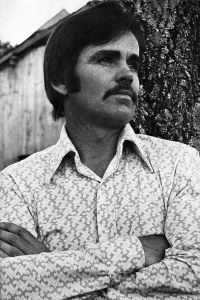
From wikipedia.org / © David Styles


It helps too that McCarthy really seems to know the macho, rural and violent world he’s writing about: its cartel machinations, its police procedures, its vehicles, its guns: “The rifle had a Canjar trigger set to nine ounces and he pulled the rifle and the boot towards him with great care and sighted again and jacked the crosshairs slightly up the back of the animal standing most broadly to him…  Even with the heavy barrel and the muzzlebrake the rifle bucked up off the rest.  When he pulled the animals back into the scope he could see them all standing as before.  It took the 150-grain bullet the better part of a second to get there but it took the sound twice that.”  I’m unfamiliar with McCarthy’s background – he was very reclusive – and have no idea if he was really the man’s man, the rugged Hemmingway type, that he comes across as here.  But the fact that he does certainly doesn’t harm the telling of the story.


I felt apprehensive as I approached the novel’s end.  Would the main storyline finish as abruptly and unsatisfyingly as it did in the film?  In the latter, Bell arrives at a motel for a rendezvous with Moss, only to discover that Moss has just been killed (offscreen) by some cartel hoodlums.  After that, the film has only the scene where Bell decides to call it quits, plus one where Chigurh pays a visit to the now-widowed Carla Jean and it’s implied that he executes her.  (In the book, it’s spelt out more clearly.)  No doubt the Coen Brothers were happy to make a statement about the fickleness of fate and the randomness of life and death, and by this late moment in the film, Moss had surely used up all of his nine lives.  But having spent the most of two hours rooting for him, I wanted something more than a brief, flippant reference to him getting killed.  Call me old-fashioned, but I’d have liked a little more closure with the character.


In the book, Moss dies with an equal sense of arbitrariness – Bell shows up at the motel and finds out that his man has just been assassinated.  However, there’s more.  The Coen Brothers made a major break with this section of the book because they left out a character, a female teenage runaway.  McCarthy has Moss pick the girl up while she’s hitchhiking and while he’s making the fateful journey to the motel.  To be honest, the girl isn’t much of a character, being a teenage brat who thinks she knows it all.  But at least her naivete provides context for Moss, who by now is feeling as old, jaded and world-weary as Bell.  Later, at the motel, she offers to sleep with Moss, but wanting to stay faithful to Carla Jean he turns her down.


When Moss finally gets there, yes, the gangsters have intervened and Moss is dead, as was the case in the film.  However, the book has a deputy tell Bell what happened from the eyewitness reports: “…the Mexican started it.  Says he drug the woman out of her room and the other man (Moss) came out with a gun but when he seen the Mexican had a gun pointed at the woman’s head he laid his own piece down.  And whenever he done that the Mexican shoved the woman away and shot her and then turned and shot him….  Shot em with a goddamned machinegun.  Accordin to this witness the old boy fell down the steps and then he picked up his gun again and shot the Mexican.  Which I dont see how he done it.  He was shot all to pieces.”  So at least Moss dies making a noble (if futile) self-sacrifice and goes down with guns blazing, taking out one last bad guy.  That’s more like the closure I was looking for.


I know people who’ve objected to both the book and film of No Country for Old Men because of another disappearing plotline, the one involving Anton Chigurh, who in the film was memorably played by Javier Bardem.  Both end with him still on the loose, presumably being unspeakably evil and continuing to kill people.  But I don’t mind that loose thread so much.  I find it appropriate that McCarthy wraps up the story with Bell lamenting about the darkness of the world; while Chigurh still lurks in that darkness as a symbolic bogeyman.


© Miramax Films / Paramount Vantage

Jurassic snark


© Universal Pictures / Amblin Entertainment


As yet another grim reminder that time stops for no man or woman, and that I’m gradually de-evolving into a doddery, senile old git, I’ve just read in a newspaper that it is now, exactly, thirty years since the release of Steven Spielberg’s Jurassic Park (1993), the epic monster movie about dinosaurs being cloned from ancient bits of DNA to be put on display in a lavish theme park.  It was based on a novel, published three years earlier, by Michael Crichton, and of course it led to a franchise of sequels and reboots that, despite being increasingly lame, generated billions of box-office dollars.


Wow!  Thirty years?  Was the original Jurassic Park movie really that long ago?


Anyway, readers, brace yourselves for a big shock.  I thought the 1993 movie was pretty lame itself.  Although a lot of people nowadays view the original Jurassic Park as a classic – here’s a hot-off-the-presses feature at the BBC website’s ‘Culture’ section praising it for how it ‘made scary movies accessible for young children’; and here’s another feature at the Guardian praising it for its prescient warnings about ‘self-styled geniuses’ who exploit new technology for their aggrandisement without thinking through the potential consequences – I found it a big let-down.


This was because I made the mistake of reading Crichton’s Jurassic Park-the-book before I went to see Spielberg’s JurassicPark-the-movie, and I felt miffed when what’d I’d visualised in my head during the book failed to materialise on the cinema screen.  And before you read further, here’s a spoiler alert.  This entry will give away a lot about the plots of both the book and the film.


Three decades ago, I certainly had high hopes for the film.  Firstly, with Spielberg at the helm and a ton of Hollywood money behind it, Jurassic Park looked like being a very rare beast, a dinosaur movie with proper dinosaurs in it.  I’ve always loved the idea of dinosaur movies, but apart from those ones where the prehistoric beasties were powered by stop-motion animation – like the silent-movie version of Sir Arthur Conan Doyle’s The Lost World (1925) and the original King Kong (1933), whose dinosaurs were animated by Willis O’Brien, and The Beast from 20,000 Fathoms (1953), One Million Years BC (1966) and The Valley of Gwangi (1969), whose special effects were the work of the late, great Ray Harryhausen – dinosaur movies before 1993 had contained dinosaurs that looked, frankly, rubbish.


© Universal Pictures / Amblin Entertainment


I’m thinking of ones where the dinosaurs were plainly stuntmen lumbering about in rubbery dinosaur suits, like The Land Unknown (1957).  Or magnified glove puppets, like The Land that Time Forgot (1974).  Or unfortunate modern-day lizards who’d also been magnified and had had fake spikes, horns and fins glued onto them to make them look big and fierce.  The worst offender in that last category is surely Irwin Allen’s terrible 1960 remake of The Lost World, during which Claude Rains exclaimed at the sight of one supposed sauropod: “It’s a mighty brontosaurus!”  While I was watching the film on TV, at the age of ten, I yelled back: “No, it’s not!  It’s just a stupid iguana!”


The big-budget Jurassic Park was going to employ all the latest advances in animatronics and computer-generated imagery to get its dinosaurs right, so I wouldn’t have to worry about having my intelligence insulted by the spectacle of men in monster suits and overblown puppets and lizards.


Secondly, there was a buzz about Jurassic Park because it was rumoured that, for the first time in yonks, Spielberg was going to do something dark.  He’d spent the past dozen years making movies with unbearably-high schmaltz levels: movies about cute aliens phoning home (1982’s ET), and ghostly pilots moping about their still-alive girlfriends (1989’s Always), and Robin Williams turning out to be Peter Pan (1991’s Hook).  Once upon a time, though, he’d directed punchy, at times nightmarish films like Duel (1972) and Jaws (1975).  Prior to Jurassic Park’s release, I was told by more than one film magazine to expect Spielberg to be back to his old schmaltz-free best.  Supposedly, Jurassic Park was going to be like Jaws on dry land.


As for Michael Crichton’s original novel – well, it would never be mistaken for great literature but, reading it, I did think that with cutting-edge special effects and a skilful director it could make a hell of a movie.  Many of its scenes seemed intensely cinematic.  Actually, this wasn’t a surprise because Crichton himself had made films.  Most notably, he’d wrote and directed 1973’s Westworld, which is about a futuristic theme park that allows its visitors to enact their most homicidal fantasies in mock-ups of the American Wild West, medieval Europe and Roman-era Pompeii.  These are populated by scores of human-like robots whom it’s okay to shoot or hack or stab to death because they can’t actually die.  Of course, a glitch in the system eventually compels the robots to start fighting back and then it’s the holiday-makers who get slaughtered.  Westworld, in fact, is a prototype for Jurassic Park, with the same theme-park setting but with robots instead of dinosaurs as the exhibits-that-turn-nasty.


From wikipedia.org / © Jon Chase, Harvard News Office


I knew Crichton’s novel would get trimmed as it was turned into a film, but I was dismayed at how much of it was trimmed.  While Jaws shed a few gratuitous sub-plots that’d made its source novel, the 1974 bestseller by Peter Benchley, seem flabby, and it was a lean, muscular movie as a result, Spielberg’s Jurassic Park was pared to the bone.  In its final reel the park’s pack of deadly velociraptors have escaped from their compound, the surviving humans are running around trying to avoid being eaten by them, and that’s about it.  The velociraptors rampage through the book’s final chapters too, but there are other matters adding to the suspense.  It becomes clear that some velociraptors have managed to board the supply-ship that services the island where the park is located, and there’s a real danger that they’ll reach the American mainland and become an ultra-lethal invasive species.  The humans are also on a desperate quest to count the hatched eggs in the velociraptors’ nests, so that they can calculate just how many of the scaly killers are on the loose.


Also simplified are the fates of the characters.  The main characters, palaeontologists Alan Grant and Ellie Sattler, chaos theorist Ian Malcolm and the billionaire mastermind behind the park, John Hammond, don’t all make it to the end of the book.  Malcolm expires from injuries sustained from a dinosaur attack while Hammond dies after he hears the roar of a tyrannosaurus rex, panics and falls down a hillside.  (Ironically, the roar comes from the park’s PA system – Hammond’s two young grandchildren have been mucking around in a control room with some dinosaur recordings.)  Meanwhile, certain secondary characters, like the park’s lawyer Gennaro and its game warden Muldoon, survive the dino-carnage.  Gennaro is even allowed to show a degree of courage, which is unusual for a fictional corporate lawyer.


In the movie, though, Grant, Sattler, Malcolm and Hammond are played by big-name stars – Sam Neill, Laura Dern, Jeff Goldblum and veteran British actor / director Sir Richard Attenborough – who clearly had it in their contracts that none of them would suffer the indignity of being eaten by a dinosaur.  So, they all survive.  But because this is a monster movie, which demands that monsters eat people at regular intervals, the supporting characters are gradually bumped off, including Gennaro and Muldoon.  This makes the plot very predictable.  Interestingly, one supporting character who got killed in the book but made it out of the movie alive is the geneticist Henry Wu.  Played by B.D. Wong, he’s ironically become the character with the most appearances in the Jurassic Park franchise – Wu’s now turned up in four of the movies.


Meanwhile, the casting of Attenborough symptomizes one of the film’s worst features.  The cuddly, twinkly Attenborough, who one year later would play Santa Claus in a remake of Miracle on 34th Street, is way nicer than the John Hammond of the book, who’s a callous, conniving and delusional arsehole.  He should have been played by Christopher Lee or Donald Pleasence.


© Universal Pictures / Amblin Entertainment


Spielberg couldn’t bring himself to be nasty to Hammond, whom he probably regarded as a kindred spirit.  Hammond at his dinosaur theme park, like Spielberg in Hollywood, is merely trying to wow the masses by giving them spectacles they haven’t seen before.  How could he be bad?  Thus, we get a maudlin scene where Hammond explains his motives to Dern’s character by reminiscing about his first venture in the entertainment business – a flea circus.  (Attenborough also gives Hammond the worst Scottish accent in movie history, so he tells Dern how he brought his wee flea circus “doon sooth frae Scotland” to London.)  Look how big the fleas are in his circus now, Spielberg seems to tell us.  What a visionary!


The softening of Hammond’s character infects the rest of the film.  Though some of the velociraptor and tyrannosaurus-rex scenes are scary, it’s all a bit too feel-good.  Spielberg wants us to be awed by the dinosaurs, not shit ourselves at them.  John Williams’ musical score adds to the problem – his Jurassic Park theme, according to Billboard magazine, oozes with ‘astonishment, joy and wonder’; but since this is supposedly a sci-fi horror movie, shouldn’t it be oozing with some old-fashioned fear too?


But my biggest frustration about the film was that while Spielberg portrays Hammond as being like Walt Disney, the park isn’t like Disneyland – and it ought to be.  In the novel Crichton wonderfully juxtaposes the primeval and the high-tech.  There might be hordes of monstrous reptiles from earth’s distant past stumping around the wilds of Hammond’s island, but at the same time the place bristles with state-of-the-art sensors and cameras and is honeycombed with service tunnels crammed full of power-cables.  At its centre is Hammond’s console-packed control room where he squats like a space-age spider in a technological web.  The joy of the book is watching all this technology slowly, gradually start to malfunction and break down – until finally it’s useless.  And meanwhile, the prehistoric stars of the show are clawing at the scenery, hungry to get at the humans who’ve been pulling the levers behind it.


You don’t really get this impression in the film.  Attenborough’s control room looks a bit dingy, like he’s set it up in his garden shed.  And the dinosaurs just seem to be out in big fields with big fences around them – nothing in the background but foliage, nothing underneath but soil.  This Jurassic Park is more like Jurassic Farm.


No, while I sat through Jurassic Park in a cinema 22 years ago, I didn’t feel like I was watching a classic.  The main thing I felt was a huge sense of disappointment – crushing me as effectively as if one of the behemoths onscreen had suddenly stepped out into the auditorium and trod on me.  For the authentic Jurassic Park thrill-ride, check out Crichton’s book.


© Alfred A. Knopf

Remembering Iain Banks


From wikipedia.com / © Tim Duncan


Ten years ago today, on June 9th, 2013, the Scottish novelist Iain Banks passed away at the age of 59, struck down by a gall-bladder cancer that’d only been diagnosed two months earlier.  Here’s a slightly updated version of the tribute to him I wrote at the time. 


Iain Banks became a big thing for me, and for many people like me, when he found success, fame and a certain notoriety with the publication of his first novel, The Wasp Factory, in 1984.  This was because he seemed to tick a lot of important boxes.


Like me and the crowd I hung out with, he came from a Scottish background, so we were familiar with many of the places he wrote about.  Like us, his politics were left-of-centre, with a leaning towards the cause of Scottish independence because independence seemed the best way to avoid being saddled with right-wing Tory governments whom few people in Scotland ever voted for.  And like us, he was obviously into literature, but he was also into some strange, off-beat writers whom stuffy literary critics would dismiss as being too ‘genre’ for serious consideration – Mervyn Peake, Brian Aldiss, M. John Harrison, and so on.


You could argue that Alasdair Gray had blazed the same trail a few years earlier with his 1980 novel Lanark, but there was one important difference.  Gray had been a young man in the 1950s.  Banks, like us, was clearly of the 1980s.  Like it or not – and we did not – Banks and us, his readers, were Maggie Thatcher’s children.


The Wasp Factory made an immediate stir with its blackly funny plot about Frank Cauldhame, a maimed delinquent living in a remote part of Scotland, who amuses himself with the shamanistic killings of insects, seagulls, rabbits and young children.  In quick succession Banks followed it with Walking on Glass (1985), which showed the influence of Mervyn Peake’s Gormenghast books (1946-59); The Bridge (1986), a paean to both the Forth Rail Bridge and Gray’s Lanark, with a healthy dose of the J.G. Ballard short story Concentration City (1957) mixed in; and in 1987 Consider Phlebas, the first of many epic outer-space novels about an interstellar anarcho-utopian society called the Culture.  The Culture novels were attributed to Iain M. Banks, a move by his publisher to help fans of ‘serious’ mainstream fiction and fans of science fiction identify what was what in his output.  At the time, the speculative fiction magazine Interzone remarked that it was delighted to see Banks at last ‘come out of the closet’ as a sci-fi writer.


In August 1987 Banks was scheduled to appear on a discussion panel at the Edinburgh Book Festival.  Around the same time I’d agreed to edit the latest edition of a small literary magazine called Alma Mater, published by some fellow-students at the University of Aberdeen’s English Literature Department.  Dr Isobel Murray, who’d been my tutor at Aberdeen for the past year, was chairing the Book Festival panel and I used my connection with her to persuade Banks’s agent to let me interview him after the panel, for Alma Mater.  I later offered Dr Murray a grovelling apology for brazenly using her name as my calling card.


© Abacus Books


The panel, which I attended, produced a few sparks.  In addition to Banks and Murray, it featured the Glaswegian writer Frederic Lindsay, whose 1983 novel Brond had recently been made into a TV series, directed by Michael Caton-Jones and starring a very young John Hannah.  (By a sad coincidence, Lindsay also died in 2013, just ten days before Banks did.)  And it was rounded off by another Glaswegian, Ronald Frame, author of the just-published novel Sandmouth People.  If it’s unfair to say that the tweedy Frame was a young fogey at the time, he certainly gave the impression of being one.  When somebody in the audience asked the authors about their views on self-censorship, he said pompously: “I would never include anything I might regret in five years’ time.”


Banks immediately spluttered, “But those are the best bits!”


Afterwards I met up with Banks and a few of his friends and conducted the interview in a pub in Edinburgh’s Rose Street – either the Kenilworth or the Auld Hundred, if I remember correctly – with Banks speaking into the mic of the clunky tape recorder I’d bought with me, transferring his voice onto a crackly cassette tape that, like almost everything else I possess, now resides inside a cardboard box somewhere in my Dad’s attic.


I asked him about the hostile reception that The Wasp Factory had received in some quarters.  (The Irish Times had described it as ‘a work of unparalleled depravity’.)  Banks had been surprised by this.  He’d expected some flak from animal rights groups, but not from the critics.  He’d learned that one reviewer who’d blasted the book as ‘the literary equivalent of a video nasty’ also worked in the Conservative Party office in London, which pleased him no end.  Offending that guy had been an honour.


I also asked him about his fondness for peppering his novels with references to the popular culture of the time.  In The Bridge, for example, just before the car accident that sets the surreal plot in motion, the hero slots a copy of the Pogues album Rum, Sodomy and the Lash (1985) into his car stereo.  Wouldn’t that make the books look rather dated a few years later?  “Yeah,” he agreed, “it’ll date them.  But what the hell?”  He believed that characters living in a particular time and particular place would be influenced by the current popular culture, so he didn’t see why he should shirk from mentioning the music, books, films and TV programmes of the moment.


I quoted Brian Aldiss at him – Aldiss had famously said that all good science fiction hovers at the edge of being something different from science fiction.  Banks agreed with that, sort of, but he also disagreed.  Enthusiastically, he told me how Consider Phlebas came with all the trimmings of the traditional Isaac Asimov / Robert Heinlein ‘space opera’: giant spaceships, laser cannons, inter-planetary battles.


© Little, Brown


Did he, I asked finally, worry about being pigeon-holed, with one half of the world viewing him as a ‘Scottish’ author and the other half viewing him as a ‘sci-fi’ one?  Not at all, he said.  He was quite at ease with being regarded as Scottish.  And being seen as a sci-fi author didn’t bother him either, since science fiction was an ‘old love’ for him.


From Rose Street, we moved to Greyfriars Bobby’s Bar in Candlemaker Row, just behind the statue of the famous Edinburgh terrier who’d spent 14 years in the adjacent graveyard guarding the grave of his dead master.  Poor wee Bobby, I remember musing, wouldn’t have lasted long if he’d been a character in The Wasp Factory.  By then a good number of pints had been drunk and the conversation had descended somewhat from the lofty heights of literary discussion.  I recall talking to Banks about Arthur Montford, the lugubrious Scottish TV football commentator famous for his eccentrically patterned sports jackets and for his catchphrases that included “What a stramash!” and (uttered all too often) “Disaster for Scotland!”  At some point too we discussed the 1966 Hammer horror film Dracula Prince of Darkness, which had featured the Scottish actor (from Shotts in North Lanarkshire) Andrew Keir.


The next issue of Alma Mater, containing my interview with Iain Banks, was published later that year.  A series of cock-ups by the typesetter meant that it looked pretty ropey, though thankfully the pages featuring Banks were okay.  The following year, I heard that Banks would be making an appearance at Edinburgh’s Science Fiction Bookshop in West Crosscauseway (now long vanished) and I went along to give him a copy of the magazine.  To my surprise, he remembered me and enthused about the mini-pub crawl we’d done that day: “That was a good afternoon!”


After that I read several more Banks novels: Espedair Street (1987), Canal Dreams (1989), The Crow Road (1992), Complicity (1993).  The Crow Road, his stab at writing a sprawling family saga, is the book that everyone talks about, although I have to say that it’s not one of my favourites.  Sure, it has one of the best opening lines in modern literature (“It was the day my grandmother exploded”), but as with most other sprawling sagas about eccentric families, I find it too contrived for its own good.


© Little, Brown


On the other hand, I think Espedair Street, which is about a hapless rock musician who’s found fame, fortune and much unhappiness and is now trying to live anonymously in a rough part of Glasgow, is marvellous.  I also think it’s the warmest and most relatable Iain Banks book that I’ve read.  Among my all-time favourite novels about rock ‘n’ roll, it’s up there with Harlan Ellison’s Spider Kiss (1961) and John Niven’s Kill Your Friends (2008).


And I like Complicity, which welds a serial-killer plot onto Banks’ intense distaste for the corruption and inequalities of the recently-ended Thatcher era.  Much of it is set in Edinburgh, where scuzzy journalist-hero Cameron Colley boozes in a series of pubs ranging from the upmarket Café Royal on West Register Street to the desperate, late-opening Casbah in the Cowgate.  By then I’d lived in Edinburgh and I knew Colley’s haunts well.  I’d even had an experience similar to one he has in the Café Royal, when he stands in front of the bar’s gantry (which doesn’t contain a mirror although it looks as though it does), can’t see his reflection and in a drunken panic believes himself to be a vampire.


After Complicity, however, I stopped reading Iain Banks, probably because by then there were just too many young Scottish writers competing for my attention: Irvine Welsh, Alan Warner, James Robertson.  Banks’s success in the 1980s, of course, had helped pave the way for all these slightly younger Turks.  It wasn’t until after his death that I read more of his stuff: the collection State of the Art (1991), whose stories lean towards science fiction, so the name ‘Iain Banks’ on the cover contains that all-important initial-letter ‘M’ to warn readers of serious mainstream literature to keep clear; The Steep Approach to Garbadale (2007); Stonemouth (2012); The Quarry, published posthumously in 2013; and Banks’s one book of non-fiction, Raw Spirit (2003), which details his experiences while he works on the rather enviable assignment of visiting, and sampling the products of, as many of Scotland’s whisky distilleries as he can.


Among these later novels, The Steep Approach to Garbadale, another sprawling family saga, perhaps sticks most in my mind.  That’s largely because of the following quote, wherein the narrator muses on the connection between being right-wing and not having an imagination, and which could be the manifesto for Banks’s own politics: “We got talking about how some people were selfish and some weren’t, and the difference between right-wing people and left-wing people.  You said it all came down to imagination.  Conservative people don’t usually have very much, so they find it hard to imagine what life is like for people who aren’t just like them.  They can only empathise with people just like they are: the same sex, the same age, the same class, the same golf club or nation or race or whatever.  Liberals can pretty much empathise with anybody else, no matter how different they are.  It’s all to do with imagination, empathy and imagination are almost the same thing, and it’s why artists, creative people, are almost all liberals, left-leaning.”


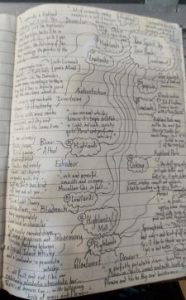
Meanwhile, I found Raw Spirit so informative that, as I read it, I tried to record what it said about the distilleries Banks visited, the whiskies he drank, and his opinions on their flavours, in a series of mind-maps.


Banks was so prolific that, looking at his bibliography, I see there are still nearly 20 books of his that I haven’t read yet.  That includes the entire series of Culture novels.  So, I still have much catching up to do with the great man’s oeuvre.

When novelists and films collide


From Wikipedia / © Antonio Monda


May 19th saw the death of Martin Amis, reckoned by some to be the greatest British novelist of his generation.  I have to say that’s not an opinion I shared, although I liked his 1984 novel Money and some of the stories in his 1987 collection Einstein’s Monsters.  Anyway, one thing I noticed about the lengthy obituaries of Amis I read after his passing – none of them mentioned the fact that he wrote the script for 1980’s science-fiction movie Saturn 3.  This features a saucy robot, programmed with the libido of Harvey Keitel, pursuing Farah Fawcett around a base on one of Saturn’s moons.  Why the omission?  No doubt Amis’s obituarists declined to mention it out of respect.  Saturn 3 was an embarrassment and Amis surely left it off his CV.


However, Amis and Saturn 3 do highlight how, over the decades, well-respected authors have been involved with the film industry – a world less interested in creative endeavour and excellence and more interested in giving the public what it wants, putting bums on seats and making a fast buck – and the results have frequently not been pretty.


Here are a few of my favourite examples of novelists and filmmakers colliding and the movies birthed by those collisions being, let’s say, memorable for the wrong reasons.


© Amicus Productions


John Brunner and The Terrornauts (1967)

The science-fiction author John Brunner was highly regarded in his day and won both the Hugo and the British Science Fiction Association (BSFA) Awards for his 1968 novel Stand on Zanzibar.  Also, his 1979 novel The Jagged Orbit netted another BSFA award and his pessimistic and prescient 1972 novel, The Sheep Look Up, about extreme pollution and environmental disaster, was much admired too.  Though he’s not so well-remembered now, the BBC website did devote a feature to him in its Culture section a few years back.


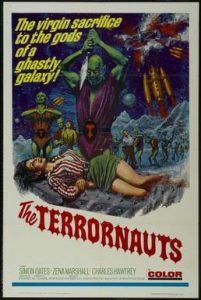
Perplexingly, the only film script Brunner ever wrote was for the ultra-low-budget British sci-fi movie The Terrornauts (1967), which is about some astronomers contacting the remnants of an alien civilisation stowed away on an asteroid, being abducted and taken to that asteroid, and eventually having to fight off an invasion fleet that’s heading towards earth.  Brunner’s script was based on a book called The Wailing Asteroid (1960) by another sci-fi writer, Murray Leinster.  I saw The Terrornauts on late-night TV when I was 11 and even at that young age thought it was dreadful, with its poverty-row special effects, its cardboard sets, and the thuddingly incongruous presence of comedy actors Charles Hawtrey and Patricia Hayes, inserted into the proceedings for alleged ‘comic relief’.  Still, The Terrornauts was so terrible that it burned itself into my memory and I’ve never been able to forget the bloody thing since.  For the filmmakers, I guess that was some sort of achievement.


Chief among those filmmakers was producer Milton Subotsky, who ran Amicus Productions with Max J. Rosenberg during the 1960s and 1970s and was better known for making horror movies.  I read an interview with Brunner once and he confessed to writing The Terrornauts as a favour to Subotsky, who was a friend of his.  Subotsky and Rosenberg, incidentally, had form in getting literary folk to pen their screenplays. They drew at various times on Robert Bloch, Margaret Drabble, Harold Pinter and Clive James, the latter for a film that never got off the drawing board.  And for their 1974 lost world / dinosaur epic The Land That Time Forgot, they hired another esteemed science-fiction writer, Michael Moorcock.  The low-budget dinosaurs in The Land That Time Forgot are rubbery and a bit laughable by today’s standards, but Moorcock was gracious enough to describe the film as ‘a workmanlike piece of crap.’


And speaking of dinosaurs…


© Hammer Films


J.G. Ballard and When Dinosaurs Ruled the Earth (1969)

Ballard is one of my all-time favourite writers.  While a few filmmakers have come close to successfully translating his disturbing, dystopian and hallucinogenic literary visions into celluloid, such as David Cronenberg did with Crash (1996) and Ben Wheatley with HighRise (2015), the pulpy When Dinosaurs Ruled the Earth was, weirdly, the only film that Ballard himself scripted.  This was a sequel by Hammer Films – like Subotsky and Rosenberg’s Amicus, a British company best known for making horror movies – to its 1965 epic One Million Years BC, featuring Raquel Welch as a fur-bikini-clad cavewoman and with splendid stop-motion-animation dinosaurs courtesy of special-effects genius Ray Harryhausen.


While One Million Years BC is a movie to watch and enjoy with your brain set at low gear, When Dinosaurs Ruled the Earth is one where you need to switch your brain off altogether.  Aside from the obvious scientific absurdity of human beings and dinosaurs being shown to exist at the same time, when they’d really missed each other by 65 million years, the film ends with a natural cataclysm so violent that part of the earth breaks off and creates the moon.  But somehow, its main characters survive the carnage.  The dinosaurs this time were animated by Jim Danforth and, though not up to Harryhausen’s standard, they’re good fun.


How, you wonder, did Ballard get emmeshed in such hokum?  In his 2008 autobiography Miracles of Life, he gives an amusing account of meeting Hammer producers Aida Young and Tony Hinds when they were trying to brainstorm ideas for the film.  The meeting had not gone well, but then Ballard rather desperately suggested that the big cataclysm at the end contain not a tidal wave crashing in, but one surging out from the shoreline.  This would reveal “’…All those strange creatures and plants…’ I ended with a brief course in surrealist biology…  There was silence as Hinds and Aida stared at each other.  I assumed I was about to be shown the door…  ‘When the wave goes out…’  Hinds stood up, clearly rejuvenated, standing behind his huge desk like Captain Ahab sighting the white whale.  ‘Brilliant.  Jim, who’s your agent?’”


© Rothernorth Films / Redemption Films  


Fay Weldon and Killer’s Moon (1978)

Here’s the most mind-boggling collaboration on this list.  On one hand, we have the feminist author Fay Weldon, who in works like The Life and Loves of a She-Devil (1983) strove to “write about and give a voice to women who are often overlooked or not featured in the media.”  On the other, we have Alan Birkinshaw’s bonkers, grubby, low-budget horror effort Killer’s Moon, which seems the last thing Weldon would get involved with.  Yet, uncredited, she rewrote the film’s dialogue.


Killer’s Moon has a quartet of escaped lunatics (wearing bowler hats like the Droogs in Stanley Kubrick’s controversial 1971 classic A Clockwork Orange) stalking the Lake District and terrorising some teenaged girls on a school trip whose coach has broken down.  The loonies’ psychiatric treatment has included being dosed with LSD and now, mistakenly, they believe themselves to be dreaming.  This makes them think they’re free to indulge without any repercussions in their darkest fantasies, which consist of rape, murder and animal mutilation.  But don’t worry, animal-lovers.  The dog that loses a limb early on, and spends the rest of the film hobbling about on three legs, was three-legged in real life.  According to Killer’s Moon’s Wikipedia entry, she “was originally a pub dog who had lost a leg as the result of a shotgun wound sustained during an armed robbery.  She was later awarded the doggy Victoria Cross award for bravery.”


Weldon’s involvement was for a familial reason.  Director Birkinshaw was none other than her brother.  She grumbled that by working on Killer’s Moon, she’d turned it into a ‘cult film’, but that’s exaggerating things a bit.  Seen in 2023, Killer’s Moon is no cult film.  It’s still daft, badly-made tat, and the bits of it that once seemed shocking just seem funny today.


© ITC Entertainment


Martin Amis and Saturn 3 (1980)

And now the movie that inspired this entry, the dire Saturn 3.  Amis’s script was based on a story by John Barry – not the composer most famous for his work on the James Bond films, but John Barry the set designer on Star Wars (1977), who died of meningitis the year before Saturn 3 was released.  Horror writer Stephen Gallagher was assigned the job of writing Saturn 3’s tie-in novelisation and once said of it: “The script was terrible.  I thought it was bad then but in retrospect, and with experience, I can see how truly inept it was.”  Gallagher added that this may not have been Amis’s fault and the script could have fallen victim to the film industry’s penchant for endless re-writing.  He heard later that “every script-doctor in town had taken an uncredited swing at it, so it’s impossible to say if it was stillborn or had been gangbanged to death.”


Supposedly, Amis based some of his novel Money on his experiences with Saturn 3.  It’s even said that one of Money’s characters, the ageing movie star Lorne Guyland, who’s convinced of his enduring youth and virility and isn’t afraid to disrobe and flaunt his body in an effort to prove it, was inspired by Saturn 3’s star Kirk Douglas.  Years later, Amis remarked: “When actors get old they get obsessed with wanting to be nude…  And Kirk wanted to be naked.”


© Zoetrope Studios / Golan-Globus


Norman Mailer and Tough Guys Don’t Dance (1987)

Three years after the publication of his crime-noir pastiche Tough Guys Don’t Dance, Norman Mailer got the chance to turn the book into a film starring Ryan O’Neal, Isabella Rossellini, Lawrence Tierney and Wings Hauser.  The venerable American novelist was both co-scripter and director.  I wrote extensively about Tough Guys Don’t Dance-the-movie a couple of months ago, so I won’t repeat here too much of what I said.  It was, I wrote, “a delirious slice of so-bad-it’s-good campness”,  where the cast visibly struggle “as they try to get their tongues, and their minds, around Mailer’s dialogue, which is largely fixated on performing the sex-deed with adequate levels of manliness.  At one point Rossellini tells O’Neal that she and her husband, Hauser, ‘make out five times a night.  That’s why I call him Mr Five.’  Though this is contradicted when Rossellini and Hauser have an argument.  ‘I made you come 16 times – in a night.’  ‘And none of them was any good!’”


And of course, there’s the scene where hero Ryan O’Neal “finds out about his wife’s infidelity and reacts with a jaw-dropping display of bad acting – ‘Oh man!   Oh God!  Oh man!  Oh God!’ – which, over the years, has become so infamous it’s now an Internet meme.”


© Scott Free Productions / 20th Century Fox


Cormac McCarthy and The Counselor (2013)

Also not having much success with sexy dialogue was legendary American author Cormac McCarthy, who wrote the script for the Ridley Scott-directed movie The Counselor.  At one point in The Counselor, we get an auto-erotic scene – that’s ‘auto’ as in ‘involving automobiles’ – where Cameron Diaz makes out with Javier Bardem’s sports car.  While grinding against the windscreen on her way to a climax, and flashing a certain part of her anatomy at Bardem on the other side of the glass, he likens the sight to “one of those catfish things, one of the bottom-feeders you see go up the side of the fish tank.”


Most critics panned The Counselor, presumably because they’d hoped that it would combine the intensity of McCarthy’s celebrated ultra-violent Western novel Blood Meridan (1985) with the intensity of Scott’s darkly-perverse space-horror movie Alien (1980).  What they got, though, was a bewildering crime thriller about drug cartels that, to quote Mark Kermode in the Observer, “gets an A-list cast to recite B-movie dialogue with C-minus results.”


Michel Houellebecq and the KIRAC arthouse porn movie (2023)

Many writers have turned up in films as actors, usually in supporting or cameo roles – Maya Angelou, William S. Burroughs, Stephen King, Salman Rushdie and, indeed, Norman Mailer and Martin Amis (who as a blond 13-year-old starred in 1965’s A High Wind in Jamaica).  I doubt, though, if any of these have generated as much noise as French author Michel Houellebecq’s recent, er, performance in a film production from radical Dutch art collective KIRAC (Keeping It Real Art Critics).  I haven’t managed to find the title of the film — which sounds like it belongs to the ‘arthouse porn’ category — in the news reports about it.


Houellebecq, it transpires, agreed to be filmed having sex in the movie and signed a waiver saying that the only restriction on his participation was that his face and his ‘block and tackle’ didn’t appear together in the same shot.  KIRAC didn’t even extend an invitation to him originally.  It was Qianyun Lysis, Houellebecq’s better half, who suggested they use her husband – and no, it’s not her, but another woman who appears in bed with Houellebecq in the film.  Now anyone who’s read his sex-filled and provocative novels, such as Atomised (1998) and Platform (2001), would assume this sort of thing is right up Houellebecq’s street.  However, he lost his enthusiasm for the project after a few days of filming (and after the deed had been captured on camera).  He then denounced the production and has since been trying, and failing, to stop KIRAC releasing the film in France and Netherlands.


If I was crass and prurient, I would roll my eyes at this and give a little cry of “Oh là là!”  But I’m not.  So, I won’t.


© From Wikipedia / © Fronteiras do Pensamento

The literary Bond revisited: Octopussy and The Living Daylights


© Jonathan Cape


I once read a comment made by esteemed poet Philip Larkin about James Bond’s unsuitability for a short-fiction format: “I am not surprised that Fleming preferred to write novels.  James Bond, unlike Sherlock Holmes, does not fit snugly into the short story length: there is something grandiose and intercontinental about his adventures that require elbow room and such examples of the form as we have tend to be eccentric and muted.”


As a boy, I would have agreed.  I read most of Ian Fleming’s James Bond books back then and the one I was least enamoured with was For Your Eyes Only.  Actually, FYEO (as I’ll refer to it) wasn’t a novel but a collection of short stories featuring Bond.  In one of them, Quantum of Solace – which had nothing to do with the 22nd official Bond movie, made with Daniel Craig in 2008 – all 007 did was sit and listen to somebody else narrate a story about a different set of characters.


For me at the age of 11, a good Bond story needed a super-villain with an imposing HQ, and a nefarious scheme involving espionage and / or criminality, and a love interest, and various action scenes where said super-villain tried, unsuccessfully, to bump Bond off.  And of course, with Ian Fleming, there’d also be a wealth of background detail culled from Fleming’s experiences as a globetrotting journalist, naval intelligence officer and bon viveur and from his research – research was something he was scrupulous about.  Cramming all these things into a short story was not viable, I thought.  Thus, the truncated slices of Bondery that appeared in FYEO just seemed weird to me.


They seem much less weird to me today – especially since, after reading FYEO, I saw such opulent but ramshackle Bond films as The Spy Who Loved Me (1977) and Moonraker (1979).  Their plots were so disjointed, thanks to the filmmakers’ wish to squeeze in as many different, exotic locations and spectacular action set-pieces as possible, that they often felt like a series of short, barely-connected stories rather than a single, coherent, movie-length one.


Anyway, Larkin wasn’t talking about FYEO but about Fleming’s other collection of James Bond short stories, Octopussy and The Living Daylights, which was published in 1966, two years after Fleming’s death.  This book constitutes Bond’s final appearance in print, as penned by his creator.  It originally consisted of just the two stories mentioned in the title, although subsequent editions beefed it up with the addition of two more, The Property of a Lady and 007 in New York.  Nonetheless, it remains a slim volume.  Even with four stories, it comes to a mere 123 pages.


Since then, of course, Octopussy and The Living Daylights have lent their titles to Bond movies, in 1982 and 1987 respectively.  A film has yet to be made called The Property of a Lady and to be honest I think Adele or Billie Eilish would have difficulty wrapping their vocal chords around the title in a Bond-movie theme song.  (“The proper-TEE… of a lad-EE…!”  No, can’t imagine it.)  Obviously, 007 in New York wouldn’t cut it as a movie title at all.  Mind you, there was a TV movie made in 1976 called Sherlock Holmes in New York starring, heaven help us, Roger Moore as Sir Arthur Conan Doyle’s deerstalker-wearing detective, so anything is possible.


© Eon Productions


Octopussy and The Living Daylights was one of the few Fleming-Bond books I hadn’t read in my boyhood, so when I encountered a copy of it in a bookstore a while ago thought I’d give it a shot.  How would I get on with it?  Four decades after I’d read FYEO, would I find the short-story James Bond more palatable?


The opening story, Octopussy, is the longest one in the collection but it has Bond only as a secondary character.  The story concerns a Major Dexter Smythe, described acidly by Fleming as “the remains of a once brave and resourceful officer and of a handsome man…”  Now “he was fifty-four, slightly bald and his belly sagged in the Jantzen trunks.  And he had had two coronary thromboses…  But, in his well-chosen clothes, his varicose veins out of sight and his stomach flattened by a discreet support belt behind an immaculate cummerbund, he was still a fine figure of a man at a cocktail party or dinner on the North Shore…”


The North Shore mentioned in that excerpt is the north coast of Jamaica.  During the post-war years Smythe and his wife, now deceased, established themselves there after escaping from hard-pressed, austerity-era Britain: “They were a popular couple and Major Smythe’s war record earned them the entrée to Government House society, after which their life was one endless round of parties, with tennis for Mary and golf (with the Henry Cotton irons!) for Major Smythe.  In the evenings there was bridge for her and the high poker game for him.  Yes, it was paradise all right, while, in their homeland, people munched their spam, fiddled in the black market, cursed the government and suffered the worst winter weather for thirty years.”


Yet this easy, comfortable life in Jamaica didn’t fall into Smythe’s lap.  Gradually, Fleming enlightens us on how Smythe was able to afford it.  In a back story that has echoes of B. Traven’s 1927 novel and John Huston’s 1948 movie The Treasure of the Sierra Madre, we learn that in the Austrian Alps at the end of World War II, he stumbled across something immensely valuable that he hoarded for himself.  To do this, however, he also had to commit murder.  Octopussy describes what happens when Smythe’s ‘ancient sin’ finally catches up with him.  The bearer of the bad news – that the authorities have found out what he did back in the war and intend to arrest him – is a ‘tall man’ in a ‘dark-blue tropical suit’ with ‘watchful, serious blue-grey eyes’.  It’s Bond.  But Bond isn’t just carrying out a professional errand.  Eventually we discover that he has a personal stake in bringing Smythe to justice.


Once you accept that the story is about Smythe rather than Bond, it proceeds agreeably.  The plump and comical Smythe, who paddles about the reef in front of his villa and rather pathetically talks to the fish that swim there – plus an unfriendly, tentacled mollusc whom he’s christened ‘Octopussy’ – gradually loses our sympathy as Fleming peels back the layers and we discover the cruel, and unnecessary, deed he committed to enrich himself decades earlier.  Bond is hardly a paradigm of virtue but, equipped with a conscience and a rough-and-ready code of ethics, he’s the antithesis of what’s represented by Smythe.  The scene where the flaccid and weak-willed Smythe confesses his crime to Bond is admirably low-key, but Fleming infuses it with a cold, sadistic tension.


The Property of a Lady, on the other hand, is a conventional Bond adventure in miniature.  It has 007 turn the auctioning at Sotheby’s of an artwork designed by Carl Faberge – according to the catalogue, “(a) sphere carved from an extraordinarily large piece of Siberian emerald matrix weighing approximately one thousand three hundred carats” – into a trap to catch the KGB’s director of operations in London.  Also involved is a female Russian double-agent working in the British Secret Service, whom the service is aware of and uses to feed fake information back to Moscow.  To be honest, the plot didn’t make sense to me.  I didn’t see how Bond, by snaring London’s top KGB man at Sotheby’s, could avoid alerting Moscow to the fact that British intelligence had cottoned onto the double agent’s existence and were using her for their own ends.


Still, the story is readable and the scenes set in Sotheby’s allow Fleming to show off his knowledge, acquired through research or personal experience, of the world’s most famous broker in fine art.  When Bond expresses surprise that the auctioneer doesn’t bang his gavel three times and declare, “Going, going, gone,” an expert informs him, “You may still find that operating in the Shires or in Ireland, but it hasn’t been the fashion at London sales rooms since I’ve been attending them.”


Elements from both Octopussy-the-short-story and The Property of a Lady turn up in Octopussy-the-1982-film, which starred Roger Moore.  In the film, the title character is not an octopus but a beautiful and mysterious woman played by Maud Adams, whose father, it transpires, once received a visit from visit by Bond similar to the visit that Major Smythe received in the original story.  The film also features a proper octopus, and there’s some business too about a Faberge egg being auctioned off at Sotheby’s.  However, if you’ve seen Octopussy-the-movie and don’t remember these things, that’s hardly surprising because it’s a mad mishmash of things – involving nuclear warheads, circuses, exiled Afghan princes, feuding Russian generals, knife-throwing identical twins, hot-air balloons, snake charmers, gorilla suits, everything bar the proverbial kitchen sink.  It’s one of the very worst Bond movies in my opinion.


Meanwhile, Hannes Oberhauser, the character murdered by Major Smythe in Octopussy-the-story, plays a small but important role in the backstory of Spectre (2015), the fourth Bond with Daniel Craig in the title role.  He’s mentioned in a plot twist that bears upon Bond’s relationship with his old nemesis Ernst Stavro Blofeld (Christoph Waltz).  That twist was much derided by the critics, though as a fan of the books I was pleased that Oberhauser got name-checked in a Bond movie at last.


© Eon Productions


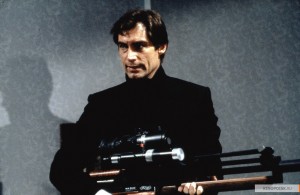
The third story in the book, The Living Daylights, sees Bond assigned a mission in Berlin.  He has to kill a Soviet sniper whom the KGB have lined up to shoot a defecting scientist while he flees from the east to the west of the city – the story is set shortly before the creation of the Berlin Wall and Checkpoint Charlie.  Bond has a crisis of conscience when he discovers that the enemy sniper is a woman, an attractive blonde whom he’s seen posing as a member of an orchestra that’s performing over on the Communist-Bloc side of town.  This story is incorporated, more or less intact, into the early part of the 1987 movie The Living Daylights, which was the first one to star Timothy Dalton as Bond.  In the film, however, the action is moved to Bratislava, the defector is a KGB officer and his defection is planned to take place during an orchestral performance in a concert hall.


Although the rest of the plot of The Living Daylights-the-film is rather convoluted and unsatisfactory, and there are a few daft moments seemingly left over from the previous movies in the series, it felt like a breath of fresh air to me at the time. It was an attempt at a slightly more sensible Bond film and had an actor in the lead role trying to depict Bond as the moody, occasionally conscience-stricken character that Fleming had originally written.  And having a big chunk of Fleming’s story in it at the start definitely helped.


The final story, 007 in New York, is a trifle – Bond is sent into the Big Apple to warn a former Secret Service member that the man she’s cohabiting with is actually a Soviet agent, though he spends most of the story’s eight pages planning the shopping, eating, drinking, clubbing and wenching that he’s going to do while he’s there.  This allows Fleming to show off his knowledge of the city – “Hoffritz on Madison Avenue for one of their heavy, toothed Gillette-type razors, so much better than Gillette’s own product, Tripler’s for some of those French golf socks made by Izod, Scribner’s because it was the last great bookshop in New York and because there was a salesman there with a good nose for thrillers, and then to Abercrombie’s to look over the new gadgets…  And then what about the best meal in New York – oyster stew with cream, crackers and Miller High Life at the Oyster Bar at Grand Central?  No, he didn’t want to sit up at a bar…  Yes.  That was it!  The Edwardian Room at the Plaza.  A corner table.”


Fleming was known to have a predilection for sadomasochism, so it’s telling that 007 in New York also sees Bond considering a visit to a bar he’d heard about that “was the rendezvous for sadists and masochists of both sexes.  The uniform was black leather jackets and leather gloves.  If you were a sadist, you wore the gloves under the left shoulder strap.  For the masochists it was the right.”  Bond has an old flame in New York whom he intends to meet up with and enjoy some nightlife with, including the S-&-M-themed nightlife, and it’s here that a tiny sliver of 007 in New York makes it into the movies too.  The old flame’s name is Solange, which is the name of the character played by Caterina Murino in Casino Royale, which saw Daniel Craig’s debut as Bond, in 2006.


007 in New York is tied up with a gentle, though unexpected, twist that’s worthy of Somerset Maugham – a writer whom Fleming was a big admirer of.  And that, unfortunately is it.  Fleming had passed away prior to this collection’s publication and no further Bond material was to be published under his name.  Thus, Octopussy and The Living Daylights marked the end of James Bond as a literary phenomenon…


For all of two years, until 1968, when Kingsley Amis published Colonel Sun.


© Eon Productions

A mish-mash from Mish


© Penguin Books


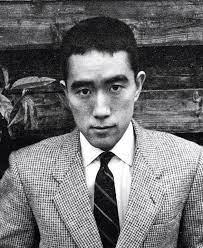
Anyone familiar with my wokey, lefty, liberal politics might be surprised to hear that I’m an admirer of the Japanese author Yukio Mishima.  Indeed, I’d probably include his Sea of Fertility tetralogy – or at least, its first two entries, Spring Snow and Runaway Horses (both 1969) – among my top two-dozen novels of all time.


Yes, that’s Yukio Mishima, the ultra-right-wing Japanese nationalist who rejected democracy, formed his own militia, and in 1970 attempted to take over a military base in Tokyo while calling on the members of Japan’s Self-Defence Force to stage a coup and restore the Japanese Emperor to his former glory. And who, when it became clear that the attempted coup was a flop, committed seppuku, i.e., ritually disembowelled himself.


When I lived in Japan in the 1990s, I remember Japanese acquaintances who leaned leftwards in their politics wincing in horror when I said I liked Mishima’s books. One guy who was in his forties, and had been a ‘New Left’ student in the late 1960s, told me he’d been terrified when he first heard the news that Mishima was attempting a coup d’état.  For a moment, he genuinely feared that Japan was going to end up under the heel of a right-wing, militaristic, Emperor-worshipping regime like the one that’d dominated the country in the 1930s and led it to disaster in the 1940s.


And I seem to remember reading an interview with the Japanese composer and occasional actor Ryuichi Sakamoto – now, alas, the late Ryuichi Sakamoto – in which he stated bluntly that he’d hated Mishima and was glad when he heard that he’d done himself in.  This was despite Sakamoto supposedly basing his performance in the 1983 movie Merry Christmas, Mr Lawrence on the author, and despite him titling the music he composed for the film Forbidden Colours, after Mishima’s 1951 novel of the same name.


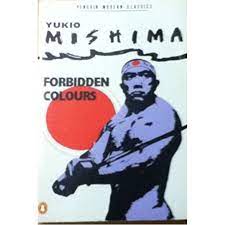
I won’t deny that I find Mishima’s extreme politics as objectionable and doolally as the next person.  (At least, the next sane person.  In 1990s Japan, there were plenty of Uyoku dantai around, i.e., fascistic dingbats who prowled the streets in flag-emblazoned black vans, ranting and blasting patriotic music out of loudspeakers and generally making tits of themselves, and no doubt they thought Mishima’s ideas were wonderful.)  But I can forgive him for his politics because I find his writing exquisite.  That’s with a couple of exceptions.  Forbidden Colours, a book I just could never get my head around, is one.


© Penguin Books


A friend and former colleague called Eiji Suenaga told me back then about the afore-mentioned Sea of Fertility novels and gave me some interesting advice about how to read them.  Don’t, he said, try to read them until you’ve reached middle-age.  Only at that stage in your life can you grasp their full significance and really appreciate them.  Thus, I didn’t read them until I was in my forties.  As I said, the first two in the series absolutely blew me away.  However, the third novel, 1970’s The Temple of Dawn, gets rather bogged down with its copious musings on Buddhism, while the fourth and final one, the same year’s Decay of the Angel, feels slightly rushed and sketchy in comparison to its predecessors.  Though to be fair to Mishima, he had rather a lot on his mind by then.  It’s said that he penned Angel’s final lines on the morning of his suicide.  (You can’t accuse Mishima of being a writer who talked the talk but didn’t walk the walk.  I mean, he polished off his last novel in between attempting to overthrow his country’s government and ritually gutting himself…  I couldn’t imagine Martin Amis doing that.)


One thing that makes Mishima an acquired taste is his bleak intensity.  You don’t read his work if you’re looking for some laughs.  Thus, in Confessions of a Mask (1949), you get a coming-of-age novel, an obviously autobiographical one, involving suppressed homosexuality and graphic, at times violent and macabre, sexual fantasies.  In The Sailor Who Fell from Grace with the Sea (1963), you get a sect of young boys who quietly go Lord of the Flies, convince themselves they don’t have to abide by the rules of common morality, and start mutilating kittens – with the implication that soon they’ll be doing similar things to human beings.  In The Temple of the Golden Pavilion (1956), you get a mentally-ill Buddhist acolyte setting fire to the titular temple, the Kinkaku-ji, in Kyoto – an act of arson that’d actually befallen that temple in real life in 1950.


Admittedly, Mishima’s 1954 novel The Sound of Waves is a nice, happy love story.  During my Japan days, I noticed how popular it was among certain Westerners living there.  I suspect they liked Waves because it allowed them to boast they’d read a book by one of their host-country’s most important 20th-century novelists – but it spared them having to grapple with that novelist’s normal, angsty, messed-up stuff.  However, Mishima himself didn’t rate Waves highly. He once brutally dismissed it as ‘that great joke on the public’.


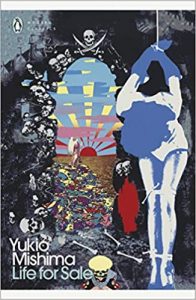
Well, I recently read Mishima’s 1968 novel Life for Sale and I now wonder if I should revise my ideas about him and the sort of literature he specialised in.  It’s unlike anything I’ve read by him before.  Unashamedly pulpy in content, wildly episodic in nature, quite outrageous in its plot-twists, the book often feels like Mishima wrote it with his tongue so far into his cheek that it’s a surprise the cheek didn’t burst.  At times, it seems a million miles away from the gloom and seriousness of his other work.  That’s ‘at times’, though.  There are moments when the sombre, highbrow Mishima of old does resurface… But never for long.


It kicks off in the conventional Mishima style I’m familiar with.  Page one has the hero, Hanio, attempting to commit suicide.  He consumes “a large amount of sedative in the last overground train that evening.  To be precise, he gulped it down at a drinking fountain in the station before boarding the train.  And no sooner had he stretched out on the empty seats than everything went blank.”  Mishima-esque too is the fact that Hanio is driven to this attempt on his own life by nothing of great significance: “Suicide was not something he had put much thought into.  He considered it likely that his sudden urge to die arose that evening while he was reading the newspaper… he could only conclude that he had attempted to end It all on a complete whim.”


Hanio survives, however.  With a rather more nihilistic mindset than before, he abandons his nine-to-five job and puts an advert in a newspaper: “Life for Sale.  Use me as you wish.  I am a twenty-seven-year-old male.  Discretion guaranteed.  Will cause no bother at all.”  And that’s when the fun starts.  The advert’s first reply comes from an embittered old man with a much younger and voluptuous wife.  The wife is currently cuckolding him with a mobster.  The old man hires Hanio – who now considers his life both meaningless and expendable – to seduce his wife and make sure that her mobster boyfriend finds them both ‘at it’: “When he claps eyes on you, you’re sure to be killed, and she’ll probably be dead meat too.”  Hanio does as he’s told, but things don’t go according to plan.  Someone gets killed, but not him.


He then proceeds to his next case.  A librarian, “an utterly nondescript middle-aged woman… more like an elderly spinster, perhaps someone who taught English literature at a girls’ college of higher education,” involves him in a plot with some criminals, a rare book about Japanese beetles that’s housed in her library, and a particular type of beetle that supposedly can be ground down and made into a deadly poison.  Hanio, with zero interest in remaining alive, is asked to act as a guinea pig for the newly-manufactured poison.  He agrees, but again the unexpected happens, and again he survives while someone else gets killed.  Meanwhile, in both episodes so far, mention is made of a mysterious, secret crime syndicate called the ACS, the ‘Asia Confidential Service’.
 

From wikipedia.org / © Ken Domon


Things become yet more outlandish.  Hanio is hired next by a schoolboy who wants him to look after his mother: “She’s ill, but she’ll recover right away with care from you.”  What makes this life-threatening is the fact that the boy’s mother is a vampire.  Hanio soon finds himself living with the pair, having his blood gradually and gently siphoned away by the vampirical mum, but he’s languidly happy as his death seems to draw near: “he truly enjoyed lounging around at home, basking in the family atmosphere.”  This is the most baroque part of the book, but it actually works well.  (Thinking about it, I’m not surprised that Mishima and vampires – at least, those of the brooding, aristocratic sort – are a good match.)


The next episode – following another death, again not Hanio’s – is less effective.  He becomes embroiled in an espionage saga involving two foreign powers, ‘Country A’ and ‘Country B’, a stolen necklace, an all-important cipher key, and several dead secret agents.  It all feels a bit tired, despite Mishima throwing into the plot some mysterious carrots as a whacky extra ingredient.  The ‘Country A’ and ‘Country B’ stuff reminds me of old 1960s TV shows like Voyage to the Bottom of the Sea (1964-68), where the villains were often foreigners, but ones acting on behalf of ‘unnamed hostile powers’, to avoid the show offending anybody.


After that, Hanio ends up living in a new, lavish apartment – his ‘Life for Sale’ business has earned him a fair amount of yen by this point – which he rents off a rich, drug-addled hippy-chick called Reiko.  (Reiko’s dotty old mum explains to him that her daughter takes “that drug beginning with L…”)  This enables Mishima, through the character of Hanio, to express his opinion of hippies, which as you might expect is not high.  “They were seekers after ‘meaninglessness’, all right, but he could not imagine them having the guts to confront the real thing when it inevitably came calling.”  Hanio gets romantically involved with the unhinged Reiko who, for all her wild talk, has a worryingly conventional vision of what married life with him will be like: “Daddy comes home every day at six-fifteen, so I have to start cooking.  When everything’s bubbling away nicely, I’ll hurry up and put on my make-up in time for when Daddy turns up…”


Hanio eventually flees from Reiko.  In the book’s closing pages, becoming increasingly paranoid, he believes that it’s not just her who’s pursuing him.  He might also have the ACS – the Asia Confidential Service mentioned by characters in the novel’s earlier sections – chasing him too.


Thus, Life for Sale is a mish-mash of crime, spy, horror, romance and comedy themes, leavened with a little of Mishima’s characteristic angst.  If not every episode is successful, that’s not a great problem – a few pages later, another episode arrives, which the reader may enjoy better.  Meanwhile, it suggests the books by Mishima that have long been available in translated form may have given English-language readers a blinkered view of him, i.e., that he was a humourless, cerebral misery-guts who specialised in Literature with a capital ‘L’.  But Life for Sale, whose English-language translation didn’t appear until 2019, gives a rather different impression, that he was less of a literary snob, enjoyed genre fiction and had a playful side.


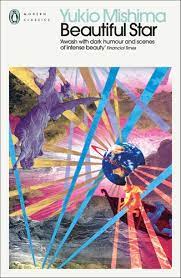
And I hear that last year saw the first English translation of another Mishima novel, a 1962 one called Beautiful Star.  Its translator was Stephen Dodd, who also rendered Life for Sale into English.  Beautiful Star sees Mishima having a go at science fiction.  It’s about “a Japanese family who wake up one day convinced that they are each aliens from a different planet inhabiting human bodies.”


Mishima and aliens?  I can’t wait to read that one.


© Penguin Books

More sinister sides of Singapore


© Epigram Books


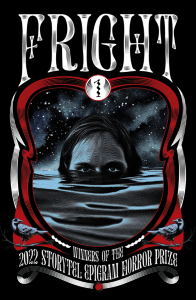
A couple of months ago on this blog, I reviewed an anthology of horror stories set in modern-day Singapore called, appropriately, The New Singapore Horror Collection, written by local author S.J. Huang.  Now I’ve just finished reading a collection called Fright 1, containing 11 more scary stories set in the southeast Asian city-state, which my partner was kind enough to buy for me as a Christmas present.


Unlike The New Singapore Horror Collection, each story in Fright 1 is penned by a different person.  These 11 writers were the top-ranking entrants in a short-fiction competition held last year.  As the book’s introduction explains, Fright 1 “showcases the winners and finalists of the 2022 Storytel Epigram Horror Prize, and celebrates all subsets of the horror genre, told with a Singaporean twist.”


The first thing that struck me about Fright 1 was the preponderance of female writers – eight out of 11.  This might be a surprise to the many people who’ve traditionally associated the horror genre with male writers, although anyone familiar with the work of Angela Carter, Shirley Jackson, May Sinclair, Daphne du Maurier, Anne Rice, Charlotte Perkins Gilman, Mary Elizabeth Braddon and the criminally underrated Dorothy K. Haynes, to say nothing of Mary Shelley, would argue otherwise.  Thus, the collection was doubly interesting for me.  Not only did its stories have a setting, Singapore, that I’m not very familiar with, but many of its themes were ones that impact on women – arranged marriages, pregnancy, sexting and, generally, being wronged by duplicitous men.  These being horror stories, such themes are refracted through a lens that sends them into the realm of the supernatural and macabre.


Fright 1 gets off to a solid start with Meihan Boey’s The General’s Wife, which is set in past times and is about an unremarkable young woman (‘with crooked shoulders and a pockmarked face’) whose family are desperate to get her married off to someone, anyone, so that they no longer have to be responsible for her.  When a mysterious, older, wealthy man known as the ‘General’, living on one of Singapore’s little satellite islands, requests her hand in marriage for no obvious reason, they don’t ask questions.  She’s hurriedly packed off to the island.  What follows is a tale of skulduggery involving deceit and sorcery, with suggestions of Bluebeard and even Jane Eyre (1847), impressively told and grippingly paced.  My only criticism is that I found the ending slightly rushed, although it contains a satisfying hint that the story’s narrator is no longer the shrinking violet she used to be.


Also set in historical Singapore is Dew M. Chaiyanara’s Under the Banana Tree, which is about a kampung – the Malaysian term for village – that’s terrorised by a pontianak when it takes up residence by the tree of the title and starts making “agonised wails that pierced the night and made all the villagers rush to slam their windows shut, bolt their doors and hold each other tight.”  According to Wikipedia, a pontianak is a supernatural creature found in Singaporean, Malaysian and Indonesian folklore that “usually takes the form of a pregnant woman who is unable to give birth to a child.  Alternatively, it is often described as a vampiric, vengeful female spirit.”  A woman in the village – evidently the only person there with a spine – resolves to go and tell the ponianak to, basically, shut up.  To her surprise, she finds herself developing a bond with the creature.  She also learns that they have more in common that she could ever have imagined.


Meanwhile, a non-folkloric and very modern supernatural being is devised for Kelly Leow’s story Breakwater.  This posits the idea that people subjected to extreme humiliation on social media, so that their lives are ruined, they end up living in shame and they vanish from their former social circles, actually, to a certain extent, ‘die’.  Not enough to leave behind a ghost, as many people believe happens when you physically die, but enough to create a semi-ghost, a ‘shade’.  Breakwater features a serial online-abuser being trailed, unbeknownst to him, by the shades of his former victims – one of which partly narrates the story.  I liked Breakwater a lot, not only because its central conceit feels genuinely new, but also because it’s set in Singapore’s East Coast Park.  The park is at the back of my residence and is an evocative place at night, one where, as Leow observes, “Cargo ships form a ghostly city out on the horizon, lights glittering in rows like the windows of apartments.”


Among the male writers represented, Teo Kai Xiang’s Untitled Train Story uses another well-known part of Singapore as its setting, the city’s MRT system.  Workers digging out a new MRT line discover a mysterious tunnel that seems to have existed a long time before trains began running underground.  It’s apparently man-made, its walls are covered in strange symbols, and it’s formed out of some ‘sleek and almost metallic black substance’.  I began the story wondering if it would turn into a Singaporean variant on H.P. Lovecraft’s seminal story Pickman’s Model (1927), which helped establish the trope, now common in the horror genre, of fleshing-eating, ghoul-like creatures living in secrecy under the streets of a modern-day city – see, for example, the movies Death Line (1973) and C.H.U.D. (1984).  Later, however, it becomes clear that Xiang’s story has more in common with a different strand of Lovecraft’s work – his tales of cosmic horror.  There’s something at the end of the tunnel that isn’t just deadly.  It also has the power to do disturbing things to the minds of those who encounter it and manage to survive.


For my money, however, the collection’s best tale is Dave Chua’s Hantu Hijau, which in Malay means ‘green ghost’.  It’s narrated by a young girl who becomes obsessed with a ghost, a female one, that’s said to haunt her Singaporean public housing estate: “Some doubted her existence; merely a hyper-localised myth to get children to return early and in bed before eleven, but I knew she had always been here, biding her time.”  The story is atmospheric and also manages the important trick of making the reader both frightened of its ghost and sympathetic towards it.  At the same time, Chua makes it believable by lacing the supernatural plot with descriptions of the block and its assorted inhabitants (“Despite the decrepit state of some of the storeys, the residents were full of kindness and humanity”) and with accounts of the girl’s mum – a hard-pressed single mother whose desperate attempts to make money and keep them afloat gradually become shady and even criminal.  With its blend of the ghostly, the grittily realistic and an urban myth that might not be so mythical, Hantu Hijau reminded me slightly of the Clive Barker story The Forbidden (1986), which later became the basis for the Candyman movies.


Not quite everything in the collection was to my tastes.  I felt a few stories had rather too much happening for them to be properly frightening.  Also, a couple of times, the social issues being explored were used for ‘body-horror’ moments that had me thinking of films like David Cronenberg’s The Brood (1979) or Brian Yuzna’s Society (1989) – good, grotesquely-surreal fun, yes, but too far-fetched for the build-up that’d preceded them.  Maybe it’s just me.  I feel that to be truly scary, a story has to be at least partway believable.  But if it contains too many incidents, or too much over-the-top gloop, it becomes less believable and hence less scary.  Overall, though, I was impressed by Fright 1  and I strongly recommend it.


For the record, the 2022 Storytel Epigram Horror Prize judges ranked Dew M. Chaiyanara’s Under the Banana Tree as the third-best entry, Dave Chua’s Hantu Hijau as the runner-up, and Kelly Leow’s Breakwater as the winner.  The collection can be purchased here, as can an audiobook version of it.

Norm!


From wikipedia.org / © Gerald Lucas


I’m aware that some of the writers, artists, musicians and filmmakers whose work I admire were total arseholes in their personal lives.  Possessing ‘artistic genius’, or just having an ‘artistic temperament’, was for them an excuse to commit all manner of heinous sins.  Yet all I can do, I feel, is separate the art from the inadequate and disappointing personality that created it – and focus on and enjoy the former.  As the writer Poppy Z. Brite (who sometimes goes by the name of Billy Martin) wrote recently about the author V.S. Naipaul: “Past a point, you can’t help what you love.  Naipaul is my own problematic favourite, a sexist, racist, often unkind man, but I love his writing and he fascinates me as a person.”


To some extent, that sums up my feelings about that famous post-war American man of letters Norman Mailer, who would have been 100 years old today if he’d still been on the go.  To say Mailer was problematic as a person is an understatement.  From all the accounts the guy was a belligerent, egotistical, self-promoting, homophobic and misogynistic dickwad who lamented about ‘the womanisation of America’ and was preoccupied with the sort of toxic masculinity that, in the 21st century and as embodied by the likes of Putin and Trump, seems capable of threatening the continued existence of humanity.


Most notoriously, in 1960, he stuck a knife into his second wife, Adele Morales, enraged when she told him he wasn’t as good a writer as Dostoyevsky.  Morales survived and divorced him two years later.  For that reason, my partner never refers to Norman Mailer as ‘Norman Mailer’, but as ‘Stabby’.


Among other things on Mailer’s charge-sheet, in 1981 he was instrumental in securing parole for murderer, bank robber and forger Jack Abbott.  Abbott was also a writer, which for Mailer apparently righted all his other wrongs.  Six weeks after his parole, Abbott stabbed to death a waiter following an argument about whether or not he could use a café’s toilet.


And yet…  I’ve always enjoyed Mailer’s books when I’ve come across them, to greater or lesser degrees.  This is despite – or if I’m in the right mood, because of – the rampant egotism of their author often finding its way onto their pages.


© Rhinehart & Company


Mailer’s first novel The Naked and the Dead (1948) is to my mind one of the great novels written about World War II.  Mailer wrote about it from experience, as he’d been posted to the Philippines with the 112th Cavalry.  It made an impact on me with its pessimism, which isn’t just about human nature when it’s put under hideous pressure in a theatre of war.  The pessimism also concerns the current, and likely future, condition of the USA, which is symbolised by the platoon at the centre of the plot.  They represent an assortment of different ethnic and regional groups that make up American society – Jewish, Italian, Irish, Mexican, Southern – and they generally don’t like or trust each other.  In charge of them are a psychotic sergeant, an educated and liberal-minded lieutenant and, at the top of the chain of command, a fascistic general who believes the war against Japan is soon going to morph into a war against the Soviet Union.  The enlightened lieutenant offers the novel its one sliver of hope, but that hope is abruptly snuffed out in a plot-twist some way before the end.


However, even if you find the political allegory in The Naked and the Dead clunky, there’s no denying that it conveys the numbing physical exhaustion of warfare – especially a war fought in a jungle on a tropical Pacific island.  If George Orwell’s Homage to Catalonia (1938) gets across the idea that more than anything else war will leave you bored witless, The Naked and the Dead persuades you that it’ll leave you utterly knackered too.


One unfortunate feature of the novel, and something that modern-day readers will no doubt find hilarious, is that Mailer had to pepper his prose with the word ‘fug’, an invented substitute for the F-word.  Warned by his publishers that the dialogue of his soldier-characters couldn’t be too realistic, even though in a real combat zone hard-pressed soldiers would be spewing the F-word endlessly,  Mailer ended up having them say things like ‘Fug you!’ and ‘Fugging hell!’  It must have stuck in Mailer’s craw – and Mailer had a big craw for things to get stuck in – when, later, he was introduced to the celebrated writer and wit Dorothy Parker and she exclaimed, “So you’re the young man who can’t spell f*ck!”


A decade after its publication, The Naked and the Dead was turned into a movie. It’s a prime example of Hollywood taking something with an uncompromising message and watering it down to make it more palatable to mainstream cinema audiences – and losing what made the original effective in the process.  Not only does the lieutenant (Cliff Robertson) survive at the end but, if I remember correctly, he gets to make an inspirational speech about the value of everyone pulling together.  However, Mailer was already aware of the rottenness of Hollywood and in 1955 had written a novel on the topic, The Deer Park.  This was the era when the House of Representatives’ Committee on Un-American Activities was at its most powerful and the notorious Hollywood Blacklist was ending filmmakers’ careers, events that are referred to in his book.


© G.P. Putnam’s Sons


I don’t remember much about the plot or characters of The Deer Park, but I recall the vividness of its setting, Desert D’Or, a desert town that’s become a fashionable resort and refuge for Hollywood bigwigs.  Its existence as a pocket of lavish make-believe amid the desert’s harshness is matched by the artificiality of its inhabitants, who are an immoral, scheming, backstabbing, bullying lot.  Wikipedia informs me that the novel’s title “refers to the Parc-aux-Serfs (‘Deer Park’), a resort Louis XV of France kept stocked with young women for his personal pleasure”, which seems appropriate.


Unsurprisingly, when the 1960s began to swing with sex, drugs and rock ‘n’ roll, and the Vietnam War, Mailer took to the decade like a duck to water.  At a young and impressionable age – 17 years old – I read Mailer’s Armies of the Night, in which he recounts how he marched on the Pentagon in October 1967 and told the US government to stop the war in Vietnam.  To be honest, Mailer did have a bit of help here.  About 100,000 people marched with him, including Allen Ginsburg, Abbie Hoffman and Jerry Rubin, who tried to use concentrated, psychic hippie-power to levitate the Pentagon building and ‘exorcise the evil within’.


© Penguin Books


A ’fictionalised work of non-fiction’, Armies of the Night was the first such book I’d encountered and it took me a while to get used to its central conceit, wherein Mailer describes what happened at the march not as some omnipotent narrator, or in the first person, but in the third person, so that he becomes a character in the action itself.  Yes, it’s a memorable device but, inevitably with Mailer, it’s self-aggrandising too.  At one point, possibly inspired by Armies of the Night, I wrote entries in my journal for a few months in the third person.  Years later, when I re-read what I’d written, my main thought was: “What a big-headed wanker I must have been back then.”


Mailer was in the first person for the next book by him I’ve read, also a work of non-fiction, 1975’s The Fight.  This is about the ‘Rumble in the Jungle’, the famous boxing match between Muhammad Ali and George Foreman (who, to a younger generation, is primarily known as the inventor of the George Foreman Lean Mean Fat-Reducing Grilling Machine).  With Ali at his peak, and Foreman at his meanest and most lethal, this was, for boxing fans, an epic event.  It was also a grotesque one, because one of the 20th century’s most opulently corrupt dictators, Zaire’s Mobutu Sese Seko, hosted the fight in his country.  Sparing no expense, Mobutu also flew in some of the world’s greatest musicians, like James Brown and B.B. King, for a musical gala to accompany it.  And it was no surprise that the world’s biggest literary ego, Mailer, rocked in too to write a book about it.


While I prefer the 1996 documentary When We were Kings (to which Mailer contributes) as the definite account of the Rumble in the Jungle, I think The Fight is pretty good.  Mind you, with so much going on in Zaire at the time, Mailer could hardly fail to write an entertaining book about it all.  And it does provide a fascinating insight into the mind of the man who called himself the greatest…  The book mentions Muhammad Ali a few times as well.


Random House USA Inc


Having read one Mailer book from the 1940s, the 1950s, the 1960s and the 1970s, it’s fitting that the last of his works I’ve encountered is from the 1980s, 1984’s Tough Guys Don’t Dance.  Mailer didn’t take the writing of this novel terribly seriously.  It was something he dashed off in two months, to fulfil a contract, and is very obviously a pastiche / piss-take of the crime-thriller noir genre, vaguely in the tradition of Mickey Spillane and Raymond Chandler.  Its plot twists all over the place before, unconvincingly, the hero’s dad – a no-nonsense hard man, but with a heart of gold, no doubt representing Mailer’s own image of himself – pops up out of nowhere to sort everything out.


I thought it was basically rubbish, then, but it was enjoyable rubbish.  Maybe I liked it because, as with Tough Guys Don’t Dance’s hero Tim Madden, I was going through a hard-drinking phase at the time, waking up occasionally with a raging hangover but no firm idea of what I’d ended up doing the previous night.  Thus, I could relate to what Madden goes through in the book.  Though unlike Madden, I never woke up to find (1) an inexplicable tattoo on my body that hadn’t been there before, and (2) an inexplicable severed head in my possession that hadn’t been there before, either – the events that set the story in motion.


One thing that’s genuinely good about Tough Guys Don’t Dance is its setting, which is Provincetown in Cape Cod, Massachusetts – in real life Mailer had a house there, in Commercial Street.  He nicely captures the eeriness of the place when the summer weather has receded and the tourist season has ended, when ‘one chill morose November sky went into another’ and, seemingly, the town’s ‘true number of inhabitants must be thirty men and women, all hiding’.


© Penguin Random House


Three years later, Mailer got the chance to turn Tough Guys Don’t Dance into a movie, which he directed, and co-scripted with the distinguished screenwriter Robert Towne, and with Francis Ford Coppola’s Zoetrope Studios as one of the production companies.  Sounds good, yes?  Well, no.  The producers were Menahem Golan and Yoram Globus of the notorious Cannon Group, whose previous meisterwerks included Breakin’ 2: Electric Boogaloo (1984), Bolero (1984), Invasion USA (1985), Cobra (1986) and Death Wish 4: The Crackdown (1987).  And despite the talent involved, Tough Guys Don’t Dance definitely bears the Cannon imprint most strongly in terms of quality.  It’s a delirious slice of so-bad-it’s-good campness.


Thus, you get a party sequence, which appears to be Mailer’s idea of what a decadent 1980s shindig would be like – yuppies with feather-cut hairdos cavorting like arthritic elephants to some god-awful 1980s soft-rock music while nose-hoovering cocaine off the tabletops and brazenly opening the front door stark-naked because they think it’s their ‘boyfriend’.  (No, it’s actually the local police chief, played by Wings Hauser, come to ask them to turn the noise down.)  Still, I’m told that Mailer filmed much of the movie at his own house in Provincetown, so maybe he did hold parties like this.  Then there’s the scene where Madden (Ryan O’Neal) finds out about his wife’s infidelity and reacts with a jaw-dropping display of bad acting – “Oh man!   Oh God!  Oh man!  Oh God!” – which, over the years, has become so infamous it’s now an Internet meme.


To be fair to O’Neal, almost everyone in the film is having a bad-acting day.  This ranges from the way-over-the-top ‘southern’ accents sported by Debra Sandlund and John Bedford Lloyd – “Madden, take it in the mouth or you’ll die.  Will you take my pride and joy into your mouth?” – to the stilted awkwardness of just about everyone else (Hauser, Isabella Rossellini, Frances Fisher) as they try to get their tongues, and their minds, around Mailer’s dialogue, which is largely fixated on performing the sex-deed with adequate levels of manliness.  At one point Rossellini tells O’Neal that she and her husband, Hauser, “make out five times a night.  That’s why I call him Mr Five.”  Though this is contradicted when Rossellini and Hauser have an argument.  “I made you come 16 times – in a night.”  “And none of them was any good!”


On the plus side, Lawrence Tierney gives a solid performance as Madden’s dad.  I’ve read somewhere that after seeing him in this, a young Quentin Tarantino decided to hire him for Reservoir Dogs (1993).  Also, Mailer adds some supernatural elements that I don’t recall being in the book, and ramps up the general weirdness, so that the film becomes an oddly prescient mixture: a superficially sleepy little town, dark secrets, murder, drugs, violence, corruption, the uncanny, the strange…  There’s even a creepy forest where O’Neal has hidden his marijuana stash.  Yes, three years before the real event, did Mailer accidentally create the prototype for David Lynch’s Twin Peaks (1990-91, 2017)?


© Zoetrope Studios / Golan-Globus


Like Captain Ahab and his whale, Mailer spent his literary life pursuing that elusive beast, the writing of the Great American Novel.  Though the critical consensus is that he never managed it, he did produce some very big books along the way, like Ancient Evenings (1983) and Harlot’s Ghost (1992), neither of which I’ve read – and with them weighing in at 709 and 1168 pages respectively, I doubt if I ever will read them.  Nonetheless, I suspect I’ll find myself perusing Mailer’s other, more digestible books in future, because basically I enjoy his stuff.  My partner may not approve, but there are still works by old ‘Stabby’ that I’d like to have a stab at.


And the only possible reaction to that distasteful pun is: “Oh man!  Oh God!  Oh man!  Oh God!”

The literary Bond revisited: Moonraker


© Penguin Books


As a ten or eleven-year-old kid I read a lot of Ian Fleming’s James Bond novels.  Indeed, I read most of them before I ever saw any of the films.  However, it was only a few years ago, after Penguin Books brought out new editions of the novels, using the same covers that’d graced them in the 1950s and early 1960s and having contemporary writers like Val McDermid write introductions to them, that I got round to reading the novels I hadn’t come across in my boyhood – Moonraker (1955), The Spy Who Loved Me (1962), On Her Majesty’s Secret Service (1963) and Octopussy and the Living Daylights (1966).   I also reread a few of the novels I’d read at a young age which, for one reason or other, had gone over my head or not left much of an impression – I still vividly remembered Live and Let Die (1954) or You Only Live Twice (1964) from those far-off days, but almost nothing of Diamonds are Forever (1956) or The Man with the Golden Gun (1965).


And in the case of From Russia With Love (1957)…  Well, as a kid, I started reading it, but unfortunately at the time I was staying at my grandmother’s house in rural Northern Ireland.  My grandmother noticed I had my nose stuck in a book, insisted on reading the blurb on its back cover and confiscated it from me, saying she didn’t think it was suitable reading matter for someone my age.  To rub salt into the wound, she then started reading it herself.  “I’m really enjoying it,” she told me a few days later.


Anyway, here is the first in a series of posts in which I describe my reactions to the Fleming / Bond novels I’ve read or re-read in the 21st century.  Starting with Moonraker.


It’s difficult to approach Moonraker the novel without having your brain fogged by memories of Moonraker the 1979 movie, which for good or bad – well, bad, actually – was a milestone in the James Bond cinematic franchise.  The Bond movies had become increasingly absurd over the years and by 1979 both the filmmakers and cinema audiences were firmly aware of their silliness. But with Moonraker, those filmmakers – Cubby Broccoli and his team – seemed to abandon all restraint.  It was as if they decided, “The audiences know that we know the movies are silly…  And we know that they know…  So, let’s have a ball!”  The result was that Moonraker, which has James Bond (Roger Moore) blasting off in a space shuttle and taking on an orbiting space station full of villains, also blasted off into whole new realms of galaxy-sized daftness.


Apart from the far-fetched science-fictional plot (which might have had something to do with the success of a certain movie called Star Wars two years earlier), the stupidity includes the hulking, steel-toothed villain Jaws (Richard Keil), who’s not only invulnerable to mishaps such as falling out a plane and hitting the ground without a parachute or having a cable-car crash down on top of him, but who’s also given a cringe-inducing, comedic love interest.  But even the business with Jaws pales into insignificance compared to the sequence where Bond escapes from some baddies in Venice using a gondola that transforms into a speedboat and then into a hovercraft, whose appearance in St Mark’s Square causes a pigeon – yes, a pigeon – to do a double-take.  I remember the movie critic John Brosnan writing that at that moment he concluded “the Bond series had gone about as far down the tube it could possibly go without reaching China.”


© Eon Films


But… Trying to erase all thoughts of the movie, I started reading the book from 24 years earlier.  Unlike the film version, whose plot ricochets between the USA, Italy, South America and outer space, the novel’s action takes place entirely in England, where immensely rich industrialist, stockbroker and rocket-designer Sir Hugo Drax has built a base, with a launch site, on the south coast.  From this he intends to test-fly a new missile called the Moonraker, potentially a valuable new means of defence against the Soviet Union.  Bond first crosses paths with Drax at Blades, an exclusive and opulent London gentleman’s club, where he discovers he’s been cheating at cards.  This suggests he’s less saintly than the adoring British media has made him out to be.  Later, Bond is sent to investigate the death of a security officer at Drax’s base, where he finds further, and much more serious, evidence that Drax is a bad ’un.  In fact, Drax is an embittered former Nazi, now employed by the USSR, who plans to fit a nuclear warhead into the Moonraker and send it ploughing into downtown London during its test flight.


During his mission, Bond joins forces with a policewoman called Gala Brand, who’s working undercover at the base.  After Drax’s goons make a couple of unsuccessful attempts to eliminate them, they manage to thwart the scheme by sending the Moonraker off course.  Rather than striking London, it niftily lands on top of a submarine transporting Drax and his minions back to the Soviet Union.  The novel ends on a rather un-Bondian note, however.  Gala Brand reveals to 007 that she already has a fiancé and isn’t about to swoon into his arms.  So, instead, Moonraker’s final line is: “He touched her for the last time and they turned away from each other and walked off into their different lives.”


In Moonraker the film, Gala Brand is replaced by an American heroine called Holly Goodhead, played by Lois Chiles.  (Goodhead… Get it?  Goodhead…?)  In fact, according to jamesbond.fandom.com, poor Gala is “the only lead female character of the Fleming canon not to have appeared as a character in a James Bond film”, which is puzzling given the quip-friendly nature of her name.  I could just imagine Roger Moore hoisting a crinkly eyebrow at her and intoning, “Well, this is going to be a Gala affair…” or “I know where I’d like to Brand you…”


© Eon Films


Reading Moonraker, what struck my 21st century self was the shadow that World War II casts over the plot.  It has a heavy bearing on the characters – not just on the villainous ex-Nazi Drax, who draws on German V2 technology for his missile project and intends to destroy London as revenge for his country’s defeat in 1945, but on minor ones like the lift operator in the secret-service headquarters who lost an arm during the conflict.  And of course, there are references to how Bond served in the war himself and has scars on his back to prove it.  I didn’t notice this so much when I read other Bond novels in the 1970s probably because, then, the war didn’t seem so far back in time.  I knew middle-aged people who had vivid memories of it.  And it was still being enacted on television in countless documentaries, comedies and dramas like The World At War (1973-74), Dad’s Army (1968-77), It Ain’t Half Hot Mum (1974-81), Secret Army (1977-79) and Colditz (1972-74), and the stories in practically every boys’ comic on sale in the newsagents at the time – Victor, Battle, Warlord – dealt with nothing else.  Indeed, there were probably some kids my age who believed we were still fighting the Germans.


And no doubt the war, or more specifically the war’s aftermath, played a part in the Bond novels’ huge success in the 1950s.  Those six years of conflict had broken Britain’s economy and Fleming’s readers inhabited a drab, grey world of rationing and austerity.  I recall a remark J.G. Ballard made in his memoir Miracles of Life (2008), about leaving Shanghai and arriving in Britain for the first time in 1946.  Taking his first steps on the soil of his home country, Ballard wondered why the British claimed to have won the war.  From the worn-out faces and rundown landscapes around him, it very much looked like they’d lost it.  Another pertinent quote is one made by Keith Richards, who said that growing up in early 1950s Britain was like living in black and white.  Only when rock ‘n’ roll arrived from America did life suddenly switch to being in colour.


But reading Moonraker, I also realised how far Bond is removed from the dreary reality of post-war Britain.  Fleming portrays him as a shameless consumer, one with a seemingly inexhaustible shopping budget.  He wears the most expensive labels, smokes the costliest cigars, drinks the finest wines and spirits, helps himself to the fanciest foods.  Accordingly, Bond’s first encounter with Drax in Moonraker is in the club Blades, whose service, food-and-drink and furnishings were things that most of Fleming’s 1950s readers could only dream about.  Though Fleming was accused of marketing watered-down pornography in his books, it surely wasn’t pornography of a sexual or violent nature that titillated his readers so much at the time.  It was consumer porn, intended to give a perverse, if futile, thrill to underfed and down-at-heels readers who were still carrying ration books.


Mind you, the fact that Moonraker’s plot is confined to 1950s England didn’t go down well with those readers who’d started reading the Bond books – Moonraker was the third in the series – for the pleasure of being transported in their imaginations to exotic locales, which in real life they lacked the financial means to visit themselves.  My trusty copy of Henry Chancellor’s guide to the novels, James Bond: The Man and his World (2005) tells me that “Fleming received a number of letters from disappointed readers complaining that Kent, even on the most glorious English summer’s day, did not compare with the tropical heat of the Caribbean.  ‘We want taking out of ourselves,’ declared one old couple, who read Bond novels to each other aloud, ‘not sitting on the beach in Dover.’”  Fleming took note of the complaints.  None of his later novels restricted Bond to English soil.


© Hammer Films


I have to say that nowadays Fleming’s descriptions of Drax’s base and its technology sound decidedly low-fi.  The references to ‘gyros’, ‘radio homing beacons’, ‘ventilation tunnels’ and, indeed, ‘rockets’ had me thinking of some old black-and-white British sci-fi movie.  They particularly made me think of the Hammer film Quatermass 2 (1957), which features both rockets and a big secret base where the villains – aliens – hang out.  For their depiction of the base, the filmmakers used the sprawling and suitably eerie oil refinery at Thurrock in Essex for location shooting, and I imagined Bond and Gala battling Drax and his minions against a similar backdrop.


On the other hand, one element of Moonraker’s plot that feels more relevant than ever is its notion that a super-rich tycoon could become so enthused about, and involved in, developing futuristic rocket technology.  I can think of one billionaire… no, two billionaires… no, three billionaires in 2023 whose fascination with space-going vehicles is like that of little boys with toy train-sets.


Finally, even as a ten or eleven-year-old, one thing I did pick up from Fleming’s novels was a sense of Bond’s melancholia – a melancholia that wasn’t hinted at in the movies until the tenures of Timothy Dalton and, later, Daniel Craig in the lead role.  You get this in Moonraker at the very beginning, with Bond calculating how many more missions he has to go on before he can retire from the secret service and what the odds are for surviving that number of missions.  Retirement for Bond, I was shocked to discover, comes at the age of 45.  Yikes, I thought.  If I’d been an agent in Fleming’s version of MI6, I’d be way beyond pensionable age now.


So, readers of post-war Britain, forget the thrills and spills, and forget the fine living and exotic locations, and forget the fancy cars and beautiful women.  Even Commander Bond has reasons to gripe about his lot.

Not the best book from an 18-year-old Shelley


© Heperus Books


The genesis of Frankenstein; or, the Modern Prometheus (1818) is well-known.  It was written by Mary Shelley in 1816 while she and her husband, Romantic poet Percy Bysshe Shelley, were staying at the Villa Diodati by Lake Geneva as guests of Percy’s fellow Romantic poet Lord Byron.  Mary was 18 years old at the time and Frankenstein sprang out of a resolution by the group to each write a ‘ghost story’.  This was largely because the wet and dreary weather that summer prevented them from doing much outdoors.  Mary duly concocted Frankenstein, which of course is one of the seminal novels of the horror genre.  Also, while it certainly wasn’t the world’s first horror story, there’s a good case to be made that it was the first work of science fiction. Victor Frankenstein, after all, assembles his creature out of pieces of dead bodies and brings it to life using technology, not magic.


Actually, a joke I’ve seen on social media runs along these lines: Mary Shelley went off and invented science fiction so that she didn’t have to endure listening to Byron and Percy Bysshe Shelley talking shite all summer.


I think Frankenstein is an amazing book, though a logically flawed one.  The creature is totally inarticulate when he comes into the world, but soon picks up the ‘lingo’ by spying on a room where a foreign woman is receiving language lessons and secretly learning alongside her.  Before long he’s able to read and understand a copy of John Milton’s Paradise Lost (1667) and spends five whole chapters talking non-stop at his understandably flummoxed creator.  As someone who’s spent a good bit of his career teaching the English language to people, that’s a result I could only dream of.


Later, Victor Frankenstein retreats to a remote island in the Orkneys where he manages to find the body parts for, and assemble, a female mate for the creature without being noticed by the island’s inhabitants. He then ends up adrift in a boat that takes just one night to float all the way from the Orkneys to the coast of Ireland, and there the creature frames him for the murder of his best friend, Henry Clerval, whose body is discovered on the same coastline.  We last heard tell of Clerval in the central Scottish city of Perth, so how did the creature get his body to Ireland and know where to dump it?  After being freed, Frankenstein is collected by his elderly father, who makes a journey from Geneva to Ireland even though earlier we’d been told he was too infirm to travel between Geneva and Ingolstadt in Bavaria.


Yes, the fact that Mary Shelley was only 18 at the time does show through occasionally in Frankenstein’s plotting.  You get the impression she’s impatient to get on with the story, and move from one event to the next, and like any impulsive teenager isn’t too bothered about the logistics of how exactly she manages this.


But hey…  I’ve recently read Percy Bysshe Shelley’s short novel Zastrozzi (1811), which he had published at the age of 18 (though he wrote it a year earlier).  I have to say that compared with the scribblings of her teenaged husband, the teenaged Mary Shelley that’s suggested by Frankenstein is a model of good sense, decorum, level-headedness and maturity.


I’ve nothing against a good gothic potboiler and Zastrozzi begins in good-gothic-potboiler fashion. The mysterious but obviously villainous Zastrozzi of the title, and his two henchmen Bernardo and Ugo, abduct the book’s hero, Verezzi, from an inn near Munich and drive him off in a coach – or ‘chariot’ as the young Shelley insists on calling it.  They transport him while he’s asleep and the implication is that he’s been drugged, though this isn’t made clear – you’re left wondering of Verezzi is just an abnormally heavy sleeper.


Verezzi wakes up to find the three rogues imprisoning him inside a cavern – “Verezzi beheld the interior of this cavern as a place where he was never again about to emerge – as his grave.” – and Zastrozzi gets to inform him: “Resistance is futile.”  Yes, that’s the catchphrase of the Borg, from Star Trek: The Next Generation (1987-94).  Subsequently, a violent thunder-and-lightning storm tears asunder the rock above the cavern and exposes it to the elements.  This doesn’t provide Verezzi with an opportunity to escape, as you might expect, but leaves him with a ‘burning fever’ and ‘delirious with a despairing illness’.  Verezzi is going to suffer a lot of despairing illnesses during this book.


Deciding it’d be a mistake to keep the ailing Verezzi in the cavern, Zastrozzi, Bernardo and Ugo convey him instead to a cottage ‘on an immense heath, lonely, desolate, and remote from other human habitation.’  Verezzi recovers and, this time, does manage to escape, though with his three persecutors giving chase.  He makes it to the Bavarian city of Passau, where he meets and is offered refuge by an old woman called Claudine, who’d suffered the death of her son just the previous week.  The work done by her son had provided Claudine with a little income and she’s quick to invite Verezzi to take the son’s place in return for board and lodgings in her humble cottage,


From British Literature Wiki


While Verezzi finds a temporary hiding place with Claudine, Zastrozzi, Bernardo and Ugo, still hunting him, become lost in a forest.  In a baffling plot-twist, they stumble across ‘a large and magnificent building whose battlements rose above the lofty trees’, seemingly by accident.  This, it transpires, is the suitably gothic abode of Matilda, the noblewoman who’s masterminded the scheme to abduct and imprison Verezzi.  Matilda, you see, is madly in love with Verezzi, but Verezzi is unfortunately madly in love with, and betrothed to, someone else – a lady called Julia, who’s currently resident in Italy.  Matilda will consider committing any crime to thwart the relationship between Verezzi and Julia.


Meanwhile, it’s hinted, and in the book’s final pages confirmed, that Zastrozzi is not simply Matilda’s loyal minion.  He has his own reasons for wanting Verezzi to suffer.


And here, the plot seems to stop – or disappear up its own arse – for a long time.  Verezzi crosses paths with Matilda, whom he likes if doesn’t actually love, and about whose nefarious scheme he knows nothing.  She persuades him to leave Claudine’s cottage and stay at her chateau in the forest for a while.  There he falls critically ill, again – Matilda telling him a malicious lie about Julia being dead has something to do with it.  And the book’s most interesting character, Zastrozzi himself, fades into the background, leaving the reader to wade through pages of melodramatic blather where Verezzi and Matilda indulge in many ‘ecstasies of melancholia’, ‘floods of tears’, ‘gentle sighs’ and, yes, ‘heaving’ of ‘bosoms’.  There’s also much wandering done in the local forest, with the word ‘cataract’ cropping up as frequently as the word ‘chariot’ does elsewhere.  Now that he believes Julia to be deceased, will Verezzi get over his grief, succumb to temptation, and do the business with that duplicitous minx Matilda?  Honestly, I couldn’t have cared less.


At least things pick up later.  The action relocates to Venice, Zastrozzi becomes prominent again, and the book’s two most annoying characters are unexpectedly killed off 20 pages before the end.  Matilda and Zastrozzi end up on trial for their lives, in front of a horde of torture-loving Inquisitors.  Matilda  crumbles and finds religion: “God of mercy!  God of heaven… my sins are many and horrible, but I repent.”  However, the atheistic and – surprise! – Byronic Zastrozzi is made of tougher stuff and goes to his doom unrepentantly and defiantly.


I’d be more generous towards the book – which was, after all, the work of a 17-year-old – if the plot was less flabby.  It needed to centre less on the tormented, wimpy and seriously illness-prone Verezzi and more on Zastrozzi, who has some dynamism and agency.  Indeed, the book’s most memorable scene has Matilda out in the forest, sitting on a granite boulder, while a fearsome storm rages around her.  Zastrozzi is suddenly revealed to her by a flash of lightning: “His gigantic figure was again involved in pitchy darkness as the momentary lightning receded.  A peal of crashing thunder again madly rattled over the zenith, and a scintillating flash announced Zastrozzi’s approach, as he stood before Matilda.”  It’s uncannily reminiscent of the scene in Frankenstein where Victor encounters his creation during a tempest in the Alps.  Mind you, it’s a shame that Zastrozzi’s most notable feature here – his gigantic stature – isn’t actually mentioned by the author, or remarked on by the other characters, when he appears in the novel’s early pages.  This gives the impression that somewhere along the way he had a sudden and impressive growth-spurt.


The foreword to my edition of Zastrozzi was penned by Germaine Greer, who’s unexpectedly indulgent of Shelley’s excesses.  She views the helpless, fever-stricken Verezzi, at the mercy of the conniving, dominating but not undesirable Matilda, as symbolic of the fixation the very young Shelley had for his mother: “…Shelley’s mother, who was more in sympathy with him than his father, was from all accounts a very beautiful woman…  As the youngest of five children, Shelley’s infant passion for his mother probably went largely unrequited; his best chance of getting her to himself was when he was in the throes of one of his childhood illnesses which were, like Verezzi’s, ‘of a nervous or spasmodic nature’.”


However, while I struggled through Zastrozzi’s purpler patches, I found myself less in sympathy with Germaine Greer and more in sympathy with Rowan Atkinson’s Edmund Blackadder, who in the 1987 TV series Blackadder the Third said witheringly of the Romantic poets: “…there’s nothing intellectual about wandering around Italy in a big shirt, trying to get laid.”


© BBC