A peripheral vision


© Penguin Books


For someone who’d normally describe himself as a ‘voracious’ reader, I’ve read a shockingly small number of books in 2022.  I’d like to think this was due to the stress and disruption I’ve suffered this year while moving from Sri Lanka (which had been my home for the previous eight years) to Singapore. However, back in January 2022, I contracted Covid-19.  Although it was a very mild dose, and seemed to have minimal effects on me, I’ve worried since then that it impacted on my powers of concentration, made me less able to process information, and slowed down the mental faculties I use when reading.


This worried me particularly a few weeks ago when I started reading The Peripheral, the 2014 novel by cyberpunk maestro William Gibson – which, coincidentally, has lately been made into a TV series starring Chloë Grace Moretz.  During The Peripheral’s first 100 pages or so, I struggled to follow what was going on, found everything bewildering and came close to giving up on it.  Was Covid-19 brain-fog stopping me from getting to grips with the book?


In fact, beforehand, I could have just read the blurb on The Peripheral’s back cover, where the book’s central gimmick that caused me so much initial confusion is plainly explained.  But I didn’t read it, wanting to avoid ‘spoilers’.


All of William Gibson’s fiction – of which I’ve read two-thirds of the Sprawl trilogy (1984-1988), all of the Bridge trilogy (1993-1999) and two-thirds of the Blue Ant trilogy (2003-2010) – is disorientating at first.  Gibson is not one for exposition.  He drops you straight into the action, which invariably unfurls in some near-future scenario with characters peppering their speech with unfamiliar techno-talk, jargon and cultural references.  All of which your reading-brain simply has to get acclimatised to.  So, I knew what to expect, but with The Peripheral I was alarmed at how long the process of acclimatisation took.  For a large, early section of it, I felt I was sinking.


But finally, after the 100-page-mark, I began to swim.  That’s when the book became really enjoyable, as enjoyable as anything else that Gibson’s done.  And before I proceed any further, I should warn you that there’ll be spoilers here too.


Once you grasp the novel’s basic premise, following it becomes much easier.  For events aren’t happening in one future scenario but in two. There’s a setting not too far into the future, featuring a rural American town where life isn’t much different from that in 2022 – just a bit cruddier.  The environment has been even more degraded, it sounds like warfare has become more high-tech but no less brutal, there are possibly even more chain stores and fast-food joints, and much of the local economy seems based on drug production.  Meanwhile, the characters make extensive use of 3-D printing and drone technology, and we hear of a recent fad where kids played with cute little Transformers-like robots that had iPads instead of heads.


In this setting, the novel’s heroine, Flynne, fills in for her brother Burton for a few days while he’s out of town. Burton, a former soldier, gets paid for playing a role in a strange new virtual reality / video game – presumably testing it out – by an ask-no-questions company that’s supposedly based in South America.  Flynne takes over his role in the game and, while playing, witnesses a murder in a cityscape that looks weirdly similar to London but at the same time isn’t London.


This strange version of London provides the book’s other setting.  It’s a real place, only seven decades further into the future.  The murder that Flynne believed she witnessed in a game has happened in reality, and a publicist called Wilf Netherton and his wealthy pal Lev Zubov, scion of a family of London-based Russian oligarchs, are informally investigating the disappearance of the person Flynne saw killed.  Lev has been using a form of time travel – well, time-travelling communication via a mysterious ‘server’ created in China – to hire people in the past to carry out operations for him.  Those hirelings believe they’re working in computer simulations in their own time.  It becomes obvious they need to get in closer contact with Flynne, who’s the only witness to what happened.  However, whoever engineered the murder has access to the server too and is soon hiring assassins in Flynne’s time to take out her and her brother.


Gibson explores the book’s two-different-futures-in-communication gimmick to the full.  The protagonists living in the further-away future have full knowledge of the earlier one, including its economy.  Thus, using the server and their knowledge, they can manipulate that economy to finance interventions in it.  While Wilf and Lev tamper with the world around Flynne and Burton, making them exponentially richer, able to create their own corporation and pay for their own protection, the villains of further-future London intervene too – not only staging assassination attempts, but also recruiting to their cause the unsavoury corrupt politician / drug manufacturer who controls Flynne and Burton’s hometown, and sending against them a cult of demented Christian fanatics (whom Gibson has evidently modelled on the real-life, loathsome Westboro Baptist Church).


Things step up a further gear when Wilf and Lev manage to send back in time some advanced technology, via a 3-D printing company run by Flynne and Burton’s friends.  This allows Flynne, Burton and others to transfer their minds to the future London, where they’re embedded inside ‘peripherals’ – artificial, semi-cyborg bodies that can be humans, animals or homunculi – which the people of the era hire out and inhabit for special occasions in the way that people of past eras hired out and wore fancy dress.  And Wilf amusingly gets to make a trip in the other direction, where he’s psychically installed inside one of the iPad-robot toys of Flynne’s time.


One thing that I’ve noticed about Gibson is the importance he attaches to communities.  This was especially noticeable in his Bridge trilogy, where he had San Francisco’s Golden Gate Bridge taken over by a band of outsiders, misfits and radicals and turned into a township where they live their lives according to their non-corporate, eco-friendly ideals; or a ‘cardboard city’ of homeless people at a major Japanese railway station that’s actually a refuge for computer hackers, otaku and general ‘cyber-gypsies’.  In The Peripheral, much is made of the rundown, hard-pressed and exploited community that’s home to Flynne, Burton and their family and friends – many of those friends being military veterans like Burton.  They don’t have it easy, but they stand by one another, even when threatened by murderous thugs employed by dark forces from the future.  This includes looking out for an ex-soldier called Conner, who’s returned from the battlefield both mentally and (severely) physically damaged.  Indeed, one highlight is when Conner’s mind get transferred to future London and, to his joy, he finds himself inhabiting a full-bodied peripheral.  A full body is something he hasn’t had for a long time.


Meanwhile, Gibson’s description of London in that further-off future is ripe with satire.  Russian oligarchs are so established there they’ve practically become the aristocracy, while advanced technology has allowed areas of it to be turned into tourist-orientated recreations of the Victorian past – as if parts of London aren’t that way now.  He also gently takes the piss with the character of Inspector Ainsley Lowbeer, a police detective investigating the murder who seems to know more about what’s happening than she lets on.  Lowbeer embodies every imperturbable, raffish crime-fighter in a long tradition of non-realistic British crime stories.  I wondered at first if Lowbeer was conceived as a female version of John Steed from the TV show The Avengers (1961-69), but recently on social media I saw Gibson state that he’d imagined her as ‘Tilda Swinton channelling Quentin Crisp.’


Faults?  Well, occasionally, Gibson’s description of the action – the full-on action scenes, with danger and violence – can be frustratingly sparse, to the point where you have to reread his descriptions a couple of times to figure out what’s just happened.  He’s a writer who’s interested in fast-moving narratives but not so much in action itself.  Also, while the peripherals are a logical plot-component, the concept of them seems slightly old-hat after James Cameron made extensive use of the same concept five years earlier in his movie Avatar (2009).  Not that that’s Gibson fault, of course.


And connoisseurs of time-travel stories might find it a cop-out that Wilf and Lev can interfere in their past as much as they like without suffering any effects in their present.  This is because, Gibson explains, the moment they start interfering they create a ‘stub’ – an alternative timeline where the reality containing Flynne, Burton and the others begins to branch off from the established, ‘official’ timeline, developing in its own way towards its own, unknown future.  The idea makes sense, but some may miss the complexity of a traditional time-travel story where interference in the past has unexpected and unwelcome consequences in the interferers’ present.  See Ray Bradbury’s 1952 short story A Sound of Thunder for the classic example.


The Peripheral is very entertaining, then, but there’s a grimness at its heart that’s rather like finding a dollop of ultra-sour cream within an ice-cream sundae.  The grimness is something called the Jackpot.  This isn’t a single cataclysmic event but a protracted series of smaller ones – “droughts, water shortages, crop failures, honeybees gone like they almost were now, collapse of other keystone species, every last alpha predator gone, antibiotics doing even less than they already did, diseases that were never quite the one big pandemic but big enough to be historic events in themselves” – that represent humanity reaping what it sowed with its onslaught against the natural environment.  The Jackpot occurs between the novel’s two time-settings and accounts for something Flynne notices when, in peripheral form, she arrives in future London.  There seem to be very few people around.


Late on in The Peripheral there are suggestions that, as their timeline diverges from the established one, Flynne, Burton and her friends, empowered by future technology and investment, can do something to avert or at least alleviate the Jackpot and create a better future for themselves.  Meanwhile, away from the pages of Gibson’s novel and looking at the dismal, real-life events of the early 21st century, I fear we’ll be hitting our own Jackpot all too soon.


From wikipedia.org / © Gonzo Bonzo

The sinister side of Singapore


© Marshall Cavendish


Here’s a review of another book that’d make an appropriate Halloween present tomorrow…


A while ago on this blog, I wrote, “When you’re in a new culture, a good way to get insight into that culture is to read a selection of traditional ghost and horror stories from the place.  Finding out what makes people scared and finding out how they like to scare others give you some appreciation of their psychology.”


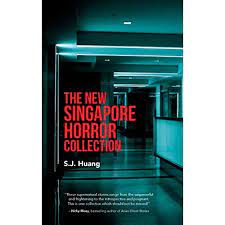
Thus, after I arrived in Singapore earlier this year, and found myself for the first time in a Singaporean bookstore (Kinokuniya in the Takashimaya Shopping Centre on Orchard Road), and saw a volume called The New Singapore Horror Collection by local author S.J. Huang, I immediately purchased it.  Not that the 13 short stories inside are what you’d call ‘traditional’.  They don’t have historical settings or folkloric ghosts or monsters.  Huang’s stories take place in the 21st century and in a modern-day Singapore that’s instantly recognisable to me.  It’s the place I see every day from the windows of my apartment, my office and the bus I take to work.  Also, while the horrors featured in many of these stories may be supernatural, they may equally be psychological, created by the minds of their beleaguered protagonists as events tip them over the edge.


Huang’s work still provides insight into the character and culture of the formidable city-state they’re set in.  Boasting the second-highest GDP per capita in the world, Singapore is one of the biggest economic success stories of the past 50 years.  But in a society where so much value is placed upon ambition, drive and work-ethic, there are inevitably a few casualties – people who can’t handle the pressure.  And some of Huang’s most effective stories explore what happens when those casualties end up in dark places indeed.


The main character of The Office, for example, quickly unravels when he finds himself trapped and alone in his workplace one evening, 66 floors up.  This is just after he’s heard that the former colleague he pushed aside in order to get a promotion has committed suicide by jumping off another tall building.  In Penance, a man who’s always in a hurry – presumably for work-related reasons – causes a fatal traffic accident one day.  He escapes prosecution, but then becomes the subject of a bizarre and madness-inducing haunting that has his mind working at ever-increasing speeds his body can’t keep up with: “His eyes and the corners of his mouth twitched  as if they had a life of their own, quickened by a manic pulse of electricity that coursed through his features every few seconds.  It was exhausting to watch, and I could only imagine what it had to be like for him.”  In The Last Goodbye, a loser who messes up a lucrative business deal desperately summons supernatural forces and makes a bargain with them to turn the situation around.  Or does he?  Perhaps he merely imagines that he has.  Then, after the business deal somehow turns good again and he’s rewarded with a promotion, he realises he has to honour his side of the supernatural bargain he (might have) made…


Elsewhere, there are many references to contemporary Singaporean life: national service, which provides the male characters with something to reminisce about, years later, as they start to slip into middle age; the country’s HDB (Housing and Development Board) public housing, which accommodates the majority of the population, but which high-flyers look down on (someone sneers in The Last Goodbye, “As the VP of Sales and Distribution, he was probably the most senior guy at the bank still living in public housing.  It’s totally ridiculous”); the nightlife, which forms the starting point for Taken for a Ride, another psychological horror tale, one that has a nice, nasty twist; and the conservative social attitudes, which form the context for the sad ghost story Lines.


Singapore’s education system also gets a look-in with Lights, in which two teams of competitive schoolboys play a ‘wargame’ on one of their school’s sports fields, at night-time, with the floodlights turned off – carrying red or blue light-sticks to show their position and their team’s identity.  There’s an uneasy undercurrent to the game because, some time before, one of their fellow pupils disappeared without trace while crossing the same field after dark.  And when the spectators notice mysterious lights of a different colour starting to appear on the black field, while the game is in progress, things become truly creepy…  In fact, I’d say Lights is my favourite story in the collection.  There’s no explanation given for what ultimately happens, which makes it creepier.


Although there’s a Poe-esque emphasis on the psychological, Huang also finds room to experiment and a few stories go off on unexpected tangents.  The Elixir is essentially an old-fashioned Egyptian-mummy tale, although the embalmed cadaver featured isn’t ancient Egyptian, but ancient Chinese, the concubine of a cruel, long-ago emperor.  The Chinese authorities, it transpires, have entrusted her perfectly-preserved body to a ‘Singapore government research agency’ to determine the composition of her mysterious embalming fluid.  Charmingly, The Elixir reminded me of the 1971 Hammer horror movie Blood from the Mummy’s Tomb which, similarly, didn’t feature a lumbering, bandaged mummy but a miraculously-undecayed lady from ancient times.


Meanwhile, The Legacy takes place in 2031.  It has astronauts from “the Perses program… founded on 2nd February 2025, as a joint initiative between the Republic of Singapore and the United States of America,” landing on Mars and discovering a cave that leads into a strange extraterrestrial cathedral or temple.  Inevitably, things then take a dark turn.  The Legacy is initially reminiscent of the movie Alien (1980) – or God help us, Lifeforce (1985) – but its final paragraphs made me think of the social satire / comet-disaster film Don’t Look Up (2021).


I felt The Elixir and The Legacy were the least effective stories in the collection, as they seemed a little too ‘far out’ to be properly disturbing, though I did find both of them good fun.


Overall, I really enjoyed The New Singapore Horror Collection.  I especially appreciated S.J. Huang’s prose, which is straightforward, solid and unshowy – and all the better for that.  I look forward to his next collection, which I trust will further explore, to good effect, the sinister side of Singapore.

The man who mentored Wheatley


© Senate Books


With Halloween just three days away, here’s a timely book review.


When I was 12 or 13 years old, you couldn’t keep me away from the novels of Dennis Wheatley.  More precisely, you couldn’t keep me away from Wheatley’s occult novels, such as The Devil Rides Out (1934), To the Devil a Daughter (1953), They Used Dark Forces (1964) and Gateway to Hell (1970).  They were crammed with things that at the time seemed utterly cool to me, things such as astral projection, demonic possession, revived corpses, evil slug-like elemental beings from other planes of existence, diabolic homunculi needing virginal blood to be brought to life, chalk pentacles offering shelter from assaults by the powers of darkness, unholy talismans with the potential to unleash the Four Horsemen of the Apocalypse, and devil-worshipping Sabbats climaxing in the summoning of the Goat of Mendes.


Incidentally, among Wheatley’s huge catalogue, which included war, espionage and historical-adventure stories, these are the only books of his that anyone remembers today.


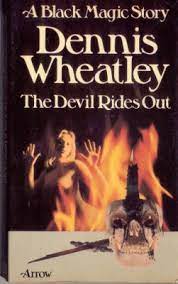
There was a problem with getting hold of Wheatley’s fiction, however.  In the 1970s, his occult thrillers were published by Arrow Books in a variety of saucy covers.  Each book was adorned with a picture of a naked, big-breasted lady dancing about a flame while some Satanic-looking artefact – a skull, a ghost’s head, a broken cross, a pagan devil-mask – hovered in the foreground.  With so much naked female flesh displayed, I felt extremely awkward as a 12 or 13-year-old boy buying those novels in Whitie’s, which at the time was the main bookshop on Peebles High Street, near where I lived in Scotland.  In fact, when I bought my first Wheatley novel, The Devil Rides Out, I remember Mrs Whitie, a formidable old lady who could probably have taken on a coven of Wheatley’s devil worshippers and beaten them up, staring over the counter at me with a withering mixture of pity and contempt.  Then she sighed and said, “I suppose we’d better stick this in a brown paper bag for you.”


From wikipedia.org / © Allan Warren


Dated and corny though they seem today, Wheatley’s Satanic potboilers surely unsettled many genteel readers in 1930s, 40s and 50s Britain with their premise that in mansion houses and estate grounds across the land, beastly, posh devil-worshippers were getting up to hijinks during unspeakable black-magic rituals.  Ever the showman, Wheatley made his subject matter seem that little bit more threatening by prefacing his novels with a solemn warning: “All of the characters and the situations in this book are entirely imaginary, but, in the inquiry necessary to writing of it, I found ample evidence that Black Magic is still practised in London, and other cities, at the present day…  Should any of my readers incline to a serious study of the subject, and thus come into contact with a man or woman of Power, I feel it is only right to urge them, most strongly, to refrain from being drawn into the practice of the Secret Art in any way.  My own observations have led me to an absolute conviction that to do so would bring them into dangers of a very real and concrete nature.”


“The inquiry necessary to the writing of it”, i.e., the research Wheatley conducted prior to The Devil Rides Out, brought him into contact with author and clergyman Montague Summers, who’d written a History of Witchcraft and Demonology in 1926 and translated the notorious witch-hunters’ manual Malleus Maleficarum (1486) into English in 1929; with the occultist Aleister Crowley, the notorious self-styled ‘Great Beast’ and ‘Wickedest Man in the World’ whose antics in the early 20th century had terrified God-fearing folk who believed everything they read in Britain’s popular press; and with one Rollo Ahmed, whom Wheatley would later describe as “a man of profound knowledge and one whose very presence radiates power” and “a Master, who had devoted a lifetime to acquiring a first-hand knowledge of that grim ‘other world’ which lies so far from ordinary experience, and yet is so very near for those who have the power to pierce the veil.”


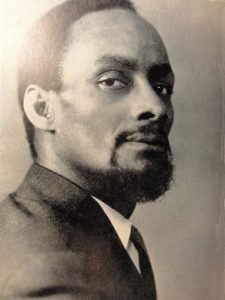
Ahmed claimed to have been born in Egypt and was of Egyptian and Guyanese parentage.  Before his arrival in Britain, he’d knocked around South America and the Caribbean, where he’d supposedly gained knowledge of everything from lycanthropy to Voodoo and Obeah.  With his opportunities to earn proper money in a proper job in Britain stymied by the era’s widespread racism, he had to play up his dark-skinned exoticness to survive – which meant selling himself as a yoga teacher, herbalist and general authority on the occult.  Despite his own racist attitudes, which sometimes bubbled up in his novels, Wheatley took a shine to Ahmed, started learning Raja Yoga from him, and happily embroidered his memories of the man with little details that suggested, yes, there was something other-worldly about him.


For example, Wheatley alleged that one night Ahmed accepted an invitation to dine with him and walked a long way across London to his house.  The evening was freezing, yet Ahmed arrived without an overcoat or gloves, completely unaffected by the cold and with hands that were ‘as warm as toast’.  A more alarming claim by Wheatley was that, after introducing Ahmed to an acquaintance in the Society for Psychical Research, the acquaintance worriedly asked Wheatley if he too had seen the ‘little black imp’ that he’d seen standing next to Ahmed.


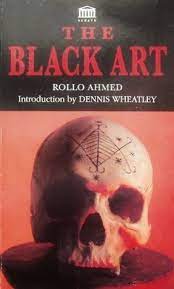
Wheatley did Ahmed a favour when, after the success of The Devil Rides Out, he was approached by Hutchinson, the publisher, and asked if he would like to write a non-fiction book about the occult.  Wheatley declined, feeling he wasn’t knowledgeable enough.  (Three-and-a-half decades later, he obviously did feel he had the knowledge, for in 1971 he published a book on the subject entitled The Devil and All His Works.)  Instead, he advised Hutchinson to hire Ahmed for the job.  They did, and the result was The Black Art, originally published in 1936, with an enthusiastic introduction by Wheatley.


I recently read a 1994 reprint of Ahmed’s The Black Art, mainly because of my interest in Wheatley.  It’s an exhaustive and, dare I say it, exhausting book.  Its 22 chapters explore every historical period from ‘antediluvian times’ to the modern day, with plenty of detail in between about the ancient Egyptians and Jews, the Greeks and Romans, and the practitioners of the Middle Ages.  Geographically, they cover North and South America, India, ‘the East’ and the British Isles.  And they examine the associated phenomena of ‘vampirism and werewolves’, ‘symbols and accessories of magic’, ‘sex-rites’, ‘necromancy and spiritualism’ and ‘the Black Mass’, as well as the church’s reactions to these shenanigans.


Ahmed’s technique with the book is to throw in everything bar the kitchen sink, so that the reader is bombarded by one anecdote or snippet of information after another, sometimes two or three barely-related items cropping up in the same paragraph.  This makes it difficult to process more than a few pages of The Black Art in one sitting.  At the same time, no effort is made to attribute sources to all the anecdotes and information – there’s no footnotes or appendix.  Indeed, I’ve seen one brutal review online where Ahmed is accused of filling the book with material plagiarised from the works of the afore-mentioned Montague Summers.


Still, if you’ve enjoyed Wheatley’s novels and you make it to near the end of The Black Art, it’s fun in the final chapters to encounter information that Wheatley apparently incorporated into The Devil Rides Out.  For example, there are instructions on how to create a ‘protective circle’ in which you can carry out, say, an exorcism ceremony without being attacked by the forces of darkness: “a large, five-pointed star should be drawn with chalk and a circle of double lines drawn around it…  The participants should wear garlands of asafoetida and garlic flowers, and where the disturbances are of a material nature they should on no account leave the circle until peace and harmony have been restored.”  Perhaps the most famous scene in The Devil Rides Out involves the Duc De Richleau and his followers taking refuge in such a circle, while the villainous Mocata directs his satanic powers against them.


© Arrow Books


There’s also an interesting chapter on elementals, supernatural entities that are created, Ahmed says, by humans’ “unexpressed thoughts… upon the mental plane.”  Thus, “evil and destructive thoughts produce ugly and revolting forms as malevolent and harmful as any ‘demon’ could be.”  I suspect that’s what inspired the evil, slug-like thing that plops out of nowhere in a scene during Wheatley’s To the Devil a Daughter.


Interestingly, Ahmed doesn’t try to gloss over the multiple failings of famous alchemists and sorcerers of yesteryear.  The 18th-century Italian adventurer and magician Count Alessandro di Cagliostro, who “evolved a masonic system of his own which he called ‘Egyptian Freemasonry’” (and whom, incidentally, Aleister Crowley claimed was a previous incarnation of his), gets six pages dedicated to him.  During these, Ahmed makes it pretty clear he was a thief, vagabond, womaniser, opportunist, manipulator and all-round fraud.  Of Cagliostro’s Egyptian Masonic Lodge, which became quite the thing in Paris for a while, Ahmed notes: “the fair intimates” had “to undergo some very remarkable experiences of an enthralling and slightly ridiculous nature, after having sacrificed large sums of money on the altar to the grand copt.”  Meanwhile, he makes a cutting observation about Franz Mesmer, proponent of ‘animal magnetism’, the man who lent his name to the term ‘mesmerism’ and inventor of the supposed healing device the magnetic tub (again, popular in Paris): the tub “was a very profitable craze for its creator”.


Even Dr John Dee, who was genuinely remarkable, gets short shrift from Ahmed, mainly because of his association with the disreputable, alleged scryer Edward Kelley: “In the course of time… he (Dee) became hopelessly credulous, and after he had taken Kelly into partnership he allowed himself to be involved in various nefarious schemes, completely under the domination of the other.”  Dee’s achievements as a cartographer, mathematician, antiquarian and political advisor get no mention.


I suspect Ahmed was jaded about his occult predecessors because he knew all too well himself that establishing yourself as a master of the black arts required more than a little self-promotion and grift.  No matter how genuinely interested you were in the field, you were aware that, to keep the money rolling in to feed you and your family, and pay the rent, you depended on the interest of other people – and especially the interest of gullible people, who could be easily exploited, manipulated and parted from their cash.  And while Ahmed undoubtedly cut a striking figure around bohemian 1930s London, his story had a sordid side too.  He was arrested for fraud several times and, later in life, was reduced to posing as a fortune teller and preying on gullible old ladies.  Along the way he lost all his teeth, an indignity he put down to a black magic operation going wrong – it’d happened while he’d been trying to trap a demon.  Anything to shore up those occult credentials.


The Black Art is a slog, then, and I’d recommend it only to Dennis Wheatley completists.  However, Ahmed wrote one other, very different book that I’d like to read sometime.  It has a self-explanatory title: I Rise: The Life Story of a Negro (1937).  Dedicated to the mighty Paul Robeson, no less, the autobiographical I Rise chronicles the racism that Ahmed and other people of his ethnicity had to endure in 1930s Britain.  It’s a reminder that, while he spent much of his time in an exotic, esoteric and largely make-believe world, where he mentored Dennis Wheatley and wrote knowledgeably of protective circles and elementals, he had a depressingly real and hostile world to negotiate too – its attitudes “ugly and revolting… as malevolent and harmful as any ‘demon’ could be.”


From horroraddicts.wordpress.com

More Wordsworth’s ghosts


© Wordsworth Editions


Another Halloween-inspired reposting about books of Victorian and Edwardian ghost stories…


I’ve just read two more collections of ghost stories published in the excellent Wordsworth Editions’ Tales of Mystery and Imagination series.  Other books in this series have featured work by still-celebrated writers like E.F. Benson, Sir Arthur Conan Doyle, M.R. James and Edith Wharton; but also by writers like Gertrude Atherton, Amayas Northcote, J.H. Riddell and May Sinclair, who were prolific and / or acclaimed in their day but whose names slipped into obscurity following their deaths.  Getting republished by Wordsworth Editions might, of course, help to rescue their names from obscurity.


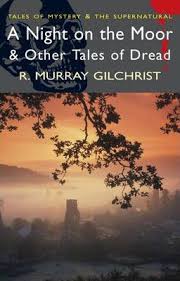
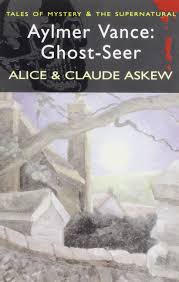
The two latest Wordsworth collections I’ve read were both published in 2006. They are A Night on the Moor and Other Tales of Dread by R. Murray Gilchrist and Aylmer Vance: Ghost-Seer by Alice and Claude Askew.


Firstly, I’ll talk about the collection I enjoyed less.  R. Murray Gilchrist was born in Sheffield but lived for much of his life in Holmesfield, 800 feet up in Derbyshire’s Peak District.  By the time of his death in 1917 at the age of 50, he was responsible for 22 novels and about 100 short stories.  However,  A Night on the Moor and Other Tales of Dread is something of a misnomer because most of the stories featured don’t particularly evoke feelings of ‘dread’.  Rather, they are tales of darkly gothic romance, where the atmosphere – and, alas, the prose – is often stiflingly thick.


These are stories where every building is an imposing structure with ‘stacks of twisted chimneys’ and ‘great square windows’ and is ‘a vision of gables’ that’s ‘so covered in ivy that from a distance it seems like a cluster of rare trees with ruddy trunks and branches’; where every garden is adorned with statues of satyrs, nymphs, dryads, dragons and the goddess Diana; and where the air is always suffused with the sickly-sweet smells of flowers, such as roses, lilies, honeysuckle, ‘withering snowdrops’ and ‘scarlet poppies, with hearts like fingers’ that effuse ‘a close and sleepy perfume’.  The villain of the story The Manuscript of Francis Shackerley even gives off ‘a rich smell of violets’ and it’s said that ‘his skin by some artificial means had been impregnated lastingly with their odour.’


Unfortunately, Gilchrist’s writing is frequently hamstrung by melodrama (“O the midsummer noontide; the trembling air; the golden dusk that clung around the fir trunks!”) and is occasionally, clunkingly awful (“My thoughts had withered, my words had grown unpregnant”).  There’s an attempt to emulate the morbid, decadent intensity found in such tales by Edgar Allan Poe as Berenice (1835), Ligeia (1938), The Oval Portrait (1842) and Eleonora (1850), but while characters indulge in much internal and external pontificating and running hither and thither to no great effect, the impression you get is one of bluster rather than of anything genuinely, dissolutely macabre.  Some of the stories I found a real chore to get through.


Still, there are a few items where Gilchrist dials it down a bit and manages to strike a properly creepy note.  The Lover’s Ordeal is a tale of a dare that unexpectedly ends up featuring a vampire.  The Grotto at Ravensdale sees a newly married couple encounter tragedy at the titular, and haunted, cavern.  The Priest’s Pavan is about a harpsichordist forced to play some demonic music at a wedding party.  And A Night on the Moor itself is an atmospheric piece where the main character experiences a time-slip.


Also, two additional stories, The Panicle and The Witch in the Peak, are tagged on in an appendix at the end.  Presumably this is because they eschew the aristocratic characters, lavishly gothic settings and rather po-faced tone of the other stories and instead have straightforward and refreshingly humorous narratives where working-class people experience supernatural goings-on in the Peak District.  The 19-century Derbyshire dialect is rather hard to decipher, but I enjoyed these two stories more than anything else in the collection and would have liked more with their flavour.


© Wordsworth Editions


Aylmer Vance: Ghost-Seer is more modest in its ambitions and I have to say I found it the more enjoyable read because of that.  It has eight stories, all connected by the recurring character of Aylmer Vance – ‘a curious-looking man, tall and lean in build, with a pale but distinctly interesting face’ – who as the title indicates is sensitive to paranormal activity and acts as a supernatural detective, trying to explain and put an end to hauntings suffered by other people.  The narrator, however, is an acquaintance of Vance’s called Dexter.  Vance tells the first three stories to Dexter, then Dexter becomes an unwilling participant in the fourth one, and then for the remaining four stories joins forces with Vance and serves as a Dr Watson to his Sherlock Holmes.


There’s nothing spectacular here, but there are some imaginative ideas – the fire-raising ghost of a frustrated poet in The Fire Unquenchable, for example, or the malevolent spirit of a pianist using his music to haunt the woman he lusted after when alive in The Indissoluble Bond.  Meanwhile, The Stranger, about a young woman attracted to a mysterious figure she encounters in a local wood, is a nicely pagan affair with a hint of Arthur Machen; and the final story, The Fear, is impressively oppressive and ‘does what it says on the tin’.


Unfortunately, I didn’t enjoy Aylmer Vance as much as I might have done.  This was because a year earlier I’d read a Wordsworth Editions collection called Carnacki, the Ghost-Finder, written by William Hope Hodgson, which was a set of tales about, yes, another supernatural detective called Thomas Carnacki.  The Carnacki stories were good enough to have influenced later writers like H.P. Lovecraft and Dennis Wheatley and the Vance stories can’t help but seem a little pedestrian in comparison.


Aylmer Vance also suffers from a problem that’s inevitable when you have a series of supernatural stories that are mostly self-contained and have different elements (ghosts, poltergeists, vampires, etc.) but also have the thread of a recurring character.  If paranormal activity does happen, it must happen incredibly rarely.  Otherwise scientists would have observed and recorded it and acknowledged its existence by now.  So how does someone like Vance manage to defy all laws of probability and have eight full-blooded encounters with the supernatural in its different forms?  William Hope Hodgson at least seemed aware of this credibility problem, for he interspersed his genuinely supernatural Carnacki stories with ones where the hauntings turn out to be hoaxes.


Vance writers Alice and Claude Askew, incidentally, were a husband-and-wife team who supposedly penned over 90 novels during a 14-year period in the early 20th century.  During World War One, they found themselves in Serbia and later in Greece, working at a British field hospital and then for the Serbian Red Cross and also writing war despatches for publications like the Daily Express.  Like R. Murray Gilchrist, they died in 1917 but in a particularly tragic manner.  Both were killed while they were travelling from Italy to Corfu, when their boat was torpedoed by a German submarine.  Claude’s body was never found.  However, Alice’s body was recovered and she’s buried on the Croatian island of Korčula.

Wordsworth’s ghosts


© Wordsworth Editions


I’ve just realised that two-and-a-half weeks from now it’ll be Halloween.  Therefore, as I usually do at this time of year, I’ll be posting a few entries on this blog about the dark, the spooky, the supernatural and the macabre.  To begin with, here’s something I originally wrote in 2019 about three collections of ghostly tales by three forgotten writers of yesteryear.


I’ve read a lot of 19th century ghost stories recently.  These have featured in collections published by Wordsworth Editions in its series Tales of Mystery and the Supernatural, which I’ve picked up in various library clearance sales and second-hand bookshops.  The last time I checked, Wordsworth’s Mystery and the Supernatural series consisted of 80 different titles and they’re an admirable balance between works by authors who are well-known, like H.P. Lovecraft, M.R. James, Edgar Wallace, Edith Wharton and Henry James, and works by authors who aren’t – or, in some cases, were famous once but have now disappeared off the reading public’s radar.  By acquainting modern readers with writers in the latter category, the series performs an invaluable service.  It was through reading one of its books a few years ago, for instance, that I discovered the excellent but now neglected writer May Sinclair, about whom I wrote here.


Anyway, I’ve just finished reading Wordsworth collections by Amayas Northcote, Gertrude Atherton and J.H. Riddell.  How do their ghost stories measure up?


Amayas Northcote is the most elusive figure of the three.  His Wikipedia entry merely states that he was the seventh son of the First Earl of Iddesleigh, who was Benjamin Disraeli’s Chancellor of the Exchequer; he was a businessman in Chicago at one time and a Justice of the Peace in Buckinghamshire at another; and he “wrote ghost stories in the line of those of M.R. James, which were compiled in his only book, In Ghostly Company.”  One likely reason why Company was Northcote’s only book was because it was published in 1921 and he died soon afterwards in 1923, before he had much chance to follow it with further fiction, ghostly or otherwise.


I have to admit that while I found Northcote’s stories enjoyable, most of them feel a bit run-of-the-mill.  Often, as in the case of Mr Kershaw and Mr Wilcox, The Late Earl of D., The Steps and The Governess’s Story, they involve manifestations of the supernatural linked to murders, untimely deaths and disappearances.  The two most interesting stories are those that stray furthest from the formula.  The Downs deals with a secluded stretch of British countryside that, one night a year, becomes the scene of a haunting on a spectacular scale; while The Late Mrs Fowke strays unexpectedly into the realms of devil worship and reads like a prototype for the occult potboilers that Dennis Wheatley would start writing little more than a decade later.


© Wordsworth Editions


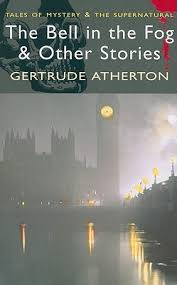
Considerably greater in range and ambition are the stories of American author Gertrude Atherton collected in The Bell in the Fog and Other Stories, originally published in 1905.  These are tales that are by turns grisly (The Striding Place), phantasmagorical (The Dead and the Countess) and imbued with a psychological intensity reminiscent of Edgar Allan Poe (Death and the Woman).


Some aren’t supernatural at all but are grim character studies.  A Monarch of a Small Survey is about a sad and frumpy lady’s companion who suffers the double misfortune of being cut out of her employer’s will and becoming futilely besotted with a younger man.  Similarly, The Tragedy of a Snob looks at the gulf between the haves and have nots, chronicling the efforts of a man of limited means to gain access to the world of high society.  And The Greatest Good of the Greatest Number is about a physician who convinces himself that by eliminating the life of one worthless person he can improve the lives of all the decent people who’ve been blighted by her – but finds the execution of the deed harder than he’d expected.  Simply but compellingly set up, The Greatest Good feels like a Roald Dahl story with a stern moral conscience.


I have to say, though, that my respect for Atherton was diminished by the inclusion of A Prologue, which is presented as the first part of an unfinished play.  It’s a brooding, gothic piece set on a West Indian island about to be pulverised by a hurricane and is slightly reminiscent of Jean Rhys’s Wide Sargasso Sea (1966).  It’s also racist, with a household’s black slaves cowering and wailing pathetically on the floor while their white owners stomp around, cursing them for their superstitious uselessness and trying to secure the premises without their help.  Yes, I know the work simply reflects the attitudes of white people towards slaves and slavery back then and  should be taken as being ‘of its time’.  But it still left a bad taste in my mouth.


I’d been looking forward to J.H. Riddell’s Night Shivers, a volume that contains 14 short stories and is rounded off with a short novel, The Uninhabited House, which was first published in 1875.  This was because Riddell originated in Northern Ireland, like I did.  She was born in Carrickfergus, County Antrim, in 1832 and lived there until 1855, when she and her mother moved to London.  She remained in England until her death in 1906 and during the intervening years established herself as a prolific author.  Her Wikipedia entry lists some 40 novels and a half-dozen short story collections.


I’d been hoping that Ms Riddell’s ghostly fiction would have a strong Irish flavour and, occasionally, it does – to good effect.  The Last of Squire Ennismore sees a dissolute Irish landowner come to an infernal end for his misdeeds, through the agency of a mysterious stranger with ‘an ambling sort of gait, curious to look at’ who leaves cloven hoof-prints on the sand of the local beach.  Hertford O’Donnell’s Warning features that most Irish of supernatural creature, the banshee, though in the incongruous (but effective) setting of a Victorian London hospital.  And Conn Kilrea features another Irish family haunted by a spectral, though non-banshee, harbinger of death.


However, most of the stories take place in England and, because I’ve read countless other English ghost stories over the year, their scenarios seem very familiar and they have the same generic feel as Amyas Northcote’s work.  Riddell enjoys presenting her ghosts and supernatural phenomena as puzzles that the living characters have to solve.  Invariably, they turn out to be traces and echoes of nefarious incidents – usually murders – that once upon a time occurred in the ‘real’ world.


One thing I like about Riddell’s fiction is her depiction of unusually (for the era) feisty and unconventional female characters, even if they come across as somewhat grotesque. The most notable of these are Miss Gostock, the hard-working, hard-bargain-driving and hard-drinking landlady in Nut Bush Farm; and the formidable Miss Blake, ‘the child of a Scottish-Ulster mother and a Connaught father’ who ‘had ingeniously contrived to combine in her person the vices of two distinct races, and exclude the virtues of both’, in The Uninhabited House.


Also, I like how she portrays the main character in Walnut-Tree House.  He’s an unpretentious fellow who comes into possession of a haunted property in London after spending years as a ‘digger’ in the Australian goldfields.  The snobby Londoners he has dealings with disdain him as ‘a rough sort of fellow’ who’s ‘boorish’ and has ‘never mixed with good society’.  But when he encounters the ghost in his house, that of a child, he doesn’t react as characters normally do in these stories and cringe or flee in terror.  Instead, he feels sorry for the poor child’s ghost and resolves to find a way to make it rest in peace.


© Wordsworth Editions

It’s all gone J.G.


© Fay Godwin / The Paris Review


Recent events have inspired me to update and repost this, which first appeared on this blog in 2019, on the tenth anniversary of J.G. Ballard’s death.


The visionary writer James Graham Ballard, known to his readers as ‘J.G.’, officially succumbed to prostate cancer and ceased to be a presence in our universe in April 2009.  However, the past 13 years have been so baroquely and surreally insane that at times I’ve had a troubling thought.  In 2009, did Ballard cease to exist in the universe or did the reverse happen?  Did the universe stop existing as a physical entity at that moment and, since then,  has it continued only as a figment of J.G. Ballard’s imagination?


Could we be living now as ghosts in Ballard’s fiction without realising it?


Recent historical trends have suggested this is not merely a crazy hypothesis on my part.  The fact that people are finally talking seriously about the dire threat to human civilisation posed by global warming – talking seriously but, alas, still doing very little about it – makes me think of Ballard’s 1962 novel The Drowned World, where climate change has jacked up the temperatures, melted the ice caps, inundated London with water and turned the city into a balmy and hallucinogenic landscape of lagoons and tropical flora and fauna; or the following year’s novel with the self-explanatory title The Drought; or his 1961 short story Deep End, where ‘oxygen mining’ has drained the oceans and a few remaining humans skulk around their dried-out beds at night-time, when the heat and radiation levels aren’t as lethal as they are in the daytime.


Meanwhile, our ever-spiralling-out-of-control and ecologically suicidal dependency on the internal combustion engine, and the social maladies (like road rage) that go with it, make me think of 1973’s Crash – the initial manuscript of which caused one publisher’s reader to splutter, “This author is beyond psychiatric help.”  Whereas the increasing fragmentation of society through the proliferation of social media platforms and devices brings to mind Ballard’s short story The Intensive Care Unit, which turned up in the 1982 collection Myths of the Near Future and contained the prophetic line, “All interaction is mediated through personal cameras and TV screens.”  And the tendency among the elite to shut themselves off in gated communities, where they not only relax, play and sleep but also, increasingly, work, evokes such novels as 1975’s High Rise and 2000’s Super-Cannes – where in both cases the set-up memorably ends in tears.


© Penguin Books / David Pelham


More generally, spending a few minutes channel-surfing through TV’s 24/7 news outlets is enough to make you feel you’re inhabiting Ballard’s experimental, narrative-less collage of ‘condensed novels’, 1970’s aptly-titled The Atrocity Exhibition.  And the sorry state of America, where the now openly authoritarian Republican Party could easily win the presidency in 2024 and return Donald Trump to the White House, reminds me of his 1981 novel Hello America, which has an ecologically devastated USA run by someone calling himself ‘President Charles Manson’.


And as I witness the madness of Brexit in the UK, facilitated by a cadre of rich, privately-educated posh-boys like Nigel Farage, Jacob Rees Mogg and Boris Johnson, I can think of half-a-dozen Ballard stories that have rich, privately-educated Britishers losing their marbles, becoming unhinged and embracing chaos and catastrophe.


Indeed, events in the UK at the moment, with all of its media, most of its politicians and a large part of its public indulging in near-deranged displays of grief over the death of a 96-year-old lady worth something between 370 and 500 million pounds while the country totters into a potentially disastrous cost-of-living crisis, are all very ‘Ballardian’.  ‘The Queue’ – the term applied to the line of mourners spending 24 hours shuffling across ten kilometres of London in order to view the Queen’s coffin at Westminster Abbey – could easily have been the title, and plot-premise, of one of Ballard’s novels or short stories.  Meanwhile, the much-publicised behaviour of the Centre Parcs holiday-villages company, which first tried to evict its vacationing residents on the day of the Queen’s funeral, then relented but warned them to stay inside their lodges on the day, prompted author Paul McAuley to send out a tweet slightly rephrasing Ballard’s most famous opening sentence, the one that kicked off High Rise: “Later, as he sat on his balcony eating the dog, Dr Robert Laing reflected on the unusual events that had taken place within this Centre Parcs village the previous three months.”


Occasionally, the idea that we could be living unawares in a giant virtual-reality system dreamed into existence by J.G. Ballard strikes me on a personal level.  For example, while I was living in Tunisia just after the 2011 revolution and the advent of the so-called Arab Spring, I arranged one afternoon to meet up with friends in Carthage, the swankiest of Tunis’s suburbs.  My friends hadn’t appeared yet when I got off at the TCM station, next door to Carthage’s branch of the French supermarket-chain Monoprix.  So, I waited there and passed the time by reading a few pages of Ballard’s final novel, 2006’s Kingdom Come.  It took me a minute to notice that the Monoprix was closed.  And not just closed.  During the revolution, it’d been trashed and looted and left a razed shell.  Its ruins looked sinisterly incongruous in the middle of this plush neighbourhood of high white walls and thick iron gates, four-by-fours and swimming pools, orange trees and jasmine plants.  And what was Kingdom Come about?  A community succumbing to dystopian chaos thanks to the arrival of a fancy new shopping centre.


It’s been claimed that Ballard’s writing wasn’t influenced so much by other fiction (except perhaps that of William S. Burroughs) as by visual forces like surrealism and Dadaism and the ‘media landscape’ of modern-day advertising and consumerism.  But I have to say I find him a very traditional author in some ways.  Reality may be crumbling around the edges of his scenarios, but at the same time he shows an admirable commitment to telling a gripping, old-fashioned yarn.  Stiff-upper-lipped British types – emotionally-repressed, able only to address each other by their surnames as if they were still back at boarding school – have adventures in exotic locales while they try to do the right thing, though as some hallucinogenic apocalypse unfolds and madness leaks into their thought processes, they invariably end up doing the wrong thing.


© Penguin Books / David Pelham


Ballard’s work calls to mind – my mind, anyway – the work of another storyteller not adverse to spicing his highbrow themes with derring-do and intrigue, Graham Greene.  Indeed, I’ve sometimes thought of Greene as a mirror image of Ballard.  That’s with Greene in the real world, though, posing before a fairground mirror and with Ballard as his warped, twisted reflection.  While Greene’s characters are usually tortured by Catholicism, Ballard’s usually have to contend with creeping and finally overwhelming psychosis.


And besides Greene, another literary influence on Ballard is surely Joseph Conrad.  I wouldn’t say Conrad’s Heart of Darkness (1899) lurks in the DNA of every Ballard story, but a good many of them feature darkness of some form and, yes, a character who feels duty-bound to journey into the heart of it.  When I was in my mid-teens, the first book by Ballard I ever read was his short-story collection The Terminal Beach (1964) and its opening story, A Question of Re-entry, begins with these deliciously Conradian lines: “All day they had moved steadily upstream, occasionally pausing to raise the propeller and cut away the knots of weed, and by two o’clock had covered some 75 miles…  Now and then the channel would widen into a flat expanse of what appeared to be stationary water, the slow oily swells which disturbed its surface transforming it into a sluggish mirror of the distant, enigmatic sky, the islands of rotten balsa logs refracted by the layers of haze like the drifting archipelagos of a dream.  Then the channel would narrow again and the cooling jungle darkness enveloped the launch.”


Those introductory lines so captivated me that, from that moment on, I was completely hooked on Ballard’s work.


Now, 40 years later, I still haven’t quite read everything by him.  For the record, though, here are my favourite things among what I have read.  Among his novels, The Drowned World, Crash, High Rise, Hello America, Empire of the Sun (1984) and Rushing to Paradise (1994).


Good though his novels are, I think his short fiction is even better.  Picking a favourite dozen from his short stories is a near-impossible task, but I’ll have a go.  Off the top of my head, I would nominate A Question of Re-entry, Deep End, The Illuminated Man – later expanded into the 1966 novel The Crystal World – and The Drowned Giant from The Terminal Beach; Chronopolis, The Garden of Time and The Watch Towers from the collection The 4-Dimensional Nightmare (1963); Concentration City and Now Wakes the Sea from The Disaster Area (1967); The Smile from Myths of the Near Future; and The Enormous Space and The Air Disaster from War Fever (1990).


Meanwhile, of his 19 novels, I have yet to read 1961’s The Wind from Nowhere, 1988’s Running Wild and 1996’s Cocaine Nights.  And there’s at least one of his short story collections, 1976’s Low-Flying Aircraft, that I haven’t read either.  Which is good.  I might be an old git now, but I’m glad that reading some new stuff by J.G. Ballard is still one of the things I can look forward to in life.


© Penguin Books / David Pelham

What kind of asshat stabs a writer?


From wikipedia.com / © ActuaLitté


During the fortnight since August 12th, when author Salman Rushdie was attacked and seriously injured before he was due to give a lecture in Chautaugua, New York, I’ve been trying to write something here about the incident.  But to be honest, I can’t express my reaction any more succinctly than Stephen King did when he tweeted a day afterwards: “What kind of asshat stabs a writer, anyway?  F*cker!”


The asshat and f*cker in question, a 24-year-old called Hadi Matar, was inspired by the fatwa issued in 1989 by Ayatollah Khomeini, then Supreme Leader of Iran, and reaffirmed in 2017 by Khomeini’s successor as Supreme Leader, Ayatollah Ali Khamenei.  Rushdie, of course, received the fatwa on account of his supposedly blasphemous-against-Islam novel The Satanic Verses (1988).


I have to admit that my knowledge of The Satanic Verses is limited.  When I tried reading it, I found the opening section, in which the two protagonists Farishta and Chamcha are thrown from an airplane as it explodes over the English Channel, pretentious and badly written and felt disinclined to read the rest of the book.  I remember Rushdie using the phrase ‘like titbits of cigar’ to describe how the two men fell from the fragmenting fuselage, and thinking to myself what a bloody horrible simile it was.


Still, I persevered with The Satanic Verses and thought the part that came next, describing Bollywood, was quite engaging.  But that dodgy opening section had fatally weakened my interest in it.  I was preparing to move to another country at the time and, unfinished, the book got stashed away in a box with some things I wasn’t taking with me.  Neither the box nor book have been opened since.  I’ve heard that the plot later on has Farishta and Chamcha transforming into an angel and a devil, which sounds intriguing, if a tad similar to what happens in Mervyn Peake’s fantasy novel Mr Pye (1953).


Still, I read 50 pages of the book, which is probably 50 pages more than 99.99% of those clamouring for Rushdie’s execution over the years have read of it.  One person I met who definitely had read The Satanic Verses was the CEO of an oil company in Tunisia whom, many years later, I was hired to give English lessons to every week.  As his English was already excellent, ours was hardly a teacher-student relationship and I suspect he just wanted a regular opportunity to blether with someone in English about whatever caught his fancy.  In addition to being a cerebral and erudite man, he was an observant Muslim.  Our lessons took place in the middle of Friday afternoons and were sometimes delayed by 10 or 15 minutes because he was slightly late getting back from Friday prayers at his mosque.


One afternoon, he wanted to talk to me about an incident at the Printemps des Art Fair in La Marsa, a few miles along the coast from Tunis.  A couple of the artworks displayed there had caused a riot by hard-line Islamic Salafists, who believed them to be ‘blasphemous’, and during the protests the venue had been looted.  My student was incensed by this and particularly incensed at how the Salafists had targeted a painting by the artist Mohamed Ben Slama.  This featured God’s name spelt out in configurations of tiny ants which, the Salafists claimed, sacrilegiously reduced Allah to the level of puny insects that scurried about in the dirt.  But in fact, my student pointed out, the Koran depicts ants as an intelligent and noble species, even in possession of their own language, and arguably the artist was trying to glorify God through the marvellous intricacies of His creations, even the smallest ones.  “Those people who attacked the painting,” he snorted, “haven’t read or understood the Koran properly.”


Then, not missing a beat, he continued, “It’s like Rushdie’s book.  Those people calling for him to be killed, they don’t know what they’re talking about.  They haven’t even read The Satanic Verses.  I have read it and I don’t think it’s blasphemous.”


Meanwhile, depressingly but predictably, the attack on Rushdie has been hijacked by a lot of extreme right-wing, GB News-watching, Enoch Powell-worshipping morons who are trying to peddle it as yet more evidence of the need to stand up against the woke mob.  Because apparently that’s what those hideous, Guardian-reading Wokerati will do if they’re not able to cancel your right to free speech – they’ll stab you instead.  Oh, and of course it provides them with another excuse to bash Muslims.


Never mind the fact that Rushdie finds their right-wing views abhorrent and indeed, in The Satanic Verses, referred to their heroine Margaret Thatcher as ‘Mrs Torture’.  And never mind the fact that their right-wing counterparts in the USA are currently getting onto school boards and purging the libraries and curriculums of the schools under their jurisdiction of books they don’t approve of, usually books that have non-white or gay people as characters, touch on issues such as racism and homophobia, and generally imply that life in the USA isn’t as hunky-dory as it’s supposed to be.  Those right-wing gits are as twisted and blinkered as Rushdie’s would-be assassin.


One consequence of this horribleness – I’m now planning to dig out that old copy of The Satanic Verses and give it a second try.  And apparently I’m not alone in my new-found desire to read it.  Reports say that, in the UK alone, sales of The Satanic Verses have surged so much that Rushdie’s publisher is currently rushing out a reprint.  So, Hadi Matar, not only did you fail in your attempt to kill Rushdie, but you’ve given a huge boost to the book you detest so much (though you’ve probably never read it) and more people than ever are being exposed to its blasphemous musings.  Well done.


© Viking Penguin

Literary things


© The Turman-Foster Company / Universal Pictures


I reckon John Carpenter’s 1982 movie The Thing is one of the best horror films ever.  Its story of a shape-shifting alien organism that infiltrates a base in Antarctica, absorbing and assuming the forms of more and more of the base’s human (and canine) personnel, is a masterpiece of claustrophobia, paranoia and all-round scariness.


And its special effects, courtesy of make-up / effects genius Rob Bottin, massively raised the bar for what was achievable in horror movies at the time.  During those moments when it reveals itself, Bottin’s alien Thing is a hellish, glistening, squirming, tentacled nightmare made of bits and pieces of all the Earth creatures it’s consumed already.  It resembles a canvas painted and splattered simultaneously by Hieronymus Bosch and Jackson Pollock.


What makes Bottin’s work all the more remarkable, and believable, is that it consists of real, solid, practical effects.  For The Thing was made in the days was before digital technology took over and filmmakers went crazy using cartoonish and insubstantial-looking computer-generated imagery.  That’s the reason why I’ve never bothered watching Matthijs van Heijningen Jr’s 2011 prequel to Carpenter’s movie, also called The Thing.  Although practical special effects were used during the prequel’s shooting, studio executives later lost their nerve, decided 2011 audiences couldn’t handle an absence of CGI and had the wretched stuff superimposed over those practical effects in post-production.


Anyway, today – June 25th – is exactly 40 years since Carpenter’s The Thing was first released in cinemas.  Which, as well as making me feel bloody ancient, makes we want to post something about it on this blog.  But rather than write about the movie itself, as countless film critics, commentators and enthusiasts have over the years, I thought I’d look instead at its literary roots.  Because The Thing is an adaptation (scripted by Bill Lancaster, son of Burt) of a novella called Who Goes There?, written by science-fiction writer and editor John W. Campbell and published in 1938.


Who Goes There? had already been filmed in 1951 as The Thing from Another World, directed by Christian Nyby and produced by the legendary Howard Hawks.  The 1951 version keeps the story’s basic premise of the crew of a polar camp coming up against a malevolent alien.  But instead of depicting it as a shape-shifting beastie, which would have been difficult to do convincingly in 1951, the Hawks / Nyby film merely depicts it as a lumbering, pasty-skinned, dome-headed muscle-man played by none other than James Arness, later to star in the 1950s-1970s Western TV show Gunsmoke.   Howard Hawks’s trademark no-nonsense directorial style and brisk, punchy dialogue are much in evidence in The Thing from Another World and it’s often been speculated that he, rather than Nyby, shot much of the film.


© Winchester Pictures Corporation / RKO


John Carpenter was well-known for his admiration of Howard Hawks and his 1976 movie Assault on Precinct 13 in particular shows a big Hawksian influence.  So, when Carpenter’s version of The Thing was announced, I suspect many critics assumed it’d be a straightforward remake of the 1951 movie.  And I suspect that’s why it got such a hostile reception when it was released in 1982.  For although the movie has since been reappraised and is now regarded as a sci-fi / horror classic, it initially earned Carpenter some of the worst reviews of his career.  I seem to remember, for instance, the Observer slamming it under the headline JUST ONE DAMNED THING AFTER ANOTHER.  Those 1982 critics got something very different from what they were expecting and didn’t react well.


What they got, in fact, was a film capturing the shape-shifting concept of the alien in the real source material, the 1938 story by John W. Campbell – a story most of those critics were probably unfamiliar with.


I recently came across and read Who Goes There? online.  What did I think of it?


Well, what I immediately thought after reading it was “Phew!”  Experienced in 2022, with its dollops of torturous pose and pages upon pages of dialogue-framed exposition, Campbell’s story is hard going indeed.


It’s fun to see so many character-names that crop up in Carpenter’s film – McReady (in the film spelt ‘MacReady’), Blair, Copper, Garry, Norris, Clark, Benning – but the descriptions of those characters are madly overwrought.  The hero McReady is likened by Campbell to “a figure from some forgotten myth, a looming, bronze statue that held life, and walked.  Six-feet-four inches he stood…  And he was bronze – his great red-bronze beard, the heavy hair that matched it.  The gnarled, corded hands gripping, relaxing on the table planks were bronze.  Even the deep-sunken eyes beneath the heavy brows were bronze.”  This Wagnerian, and bronze, version of McReady is far removed from the morose, tetchy git played in the film by Kurt Russell.


The scientist Blair, meanwhile, is described with this peculiar sentence: “His little birdlike motions of suppressed eagerness danced his shadow across the fringe of dingy grey underwear hanging from the low ceiling, the equatorial quiff of stiff, greying hair around his naked skull a comical halo about the shadow’s head.”  At least he sounds more like his cinematic incarnation, who’s played by the character actor Wilfred Brimley.


© Barnes & Noble


How the characters discover and bring into their camp their soon-to-be-unwelcome visitor is related in three pages of conversational backstory, which includes such unlikely pieces of dialogue as: “Right there, where that buried thing was, there is an ice-drowned mountain ridge, a granite wall of unshakable strength that has dammed back the ice creeping from the south.”   Later, as the Thing starts to imitate the base’s inhabitants, there are many talky pages where people speculate on its biology, its capabilities and how it can be detected; and also, where they start to crack up with paranoia.  “You sit as still as a bunch of graven images,” exclaims one man while his colleagues regard him suspiciously.  “You don’t say a word, but oh Lord, what expressive eyes you’ve got.  They roll around like a bunch of glass marbles spilling down a table.  They wink and blink and stare and whisper things.”


There are moments when Campbell’s prose conveys the bleakness of the situation, recording how the Antarctic wind created an “uneasy, malicious gurgling in the pipe of the galley stove” and how “the snow picked up by the mumbling wind fled in level, blinding lines across the face of the buried camp”.  But overall, thanks to its dire writing, Who Goes There? is a work to be endured rather than enjoyed.   It isn’t a patch on that other famous 1930s tale of Antarctica-set horror, H.P. Lovecraft’s At the Mountains of Madness (1936).


Still, the story provides the film with its most celebrated scene, the ‘blood-test’ one wherein McReady hits on a method of identifying who’s-been-got and who’s not.  However, while John W. Campbell has McReady laboriously testing the blood of some 35 base-members, in the movie John Carpenter waits until there’s only half-a-dozen men left standing, which makes his enactment of the scene much more intense, focused and suspenseful.


And to be fair to Campbell, his story clarifies the Thing’s modus operandi.  At times the film is hazy about just what the humans are up against.  For example, watching The Thing, I was initially puzzled by the idea that the intruder could take the form of more than one victim at a time.  In the story, it’s made clear that when it absorbs an organism it adds the organism’s body mass to its own; and when the organism is replaced, that hives off again with the original’s massMeanwhile, the original Thing goes back to its original bulk too, free to absorb and replicate something else.


Then there’s the sub-plot with Blair.  In both the novella and film, Blair loses his mind as the horror unfolds and is locked up for his own and everyone else’s safety.  It later becomes apparent that he’s part of the Thing too, has its alien intelligence, and has spent his time in captivity assembling a mysterious machine.  The novella describes how he’s imprisoned in an equipment storeroom, where he uses pieces of the equipment to fashion a small anti-gravity device that’ll transport him from Antarctica to a populated continent where he can start replicating.  The film is murkier about what he’s up to.  We get a glimpse of some sort of capsule, like a mini-flying saucer, but there’s little explanation why and nothing about his place of incarceration being an equipment storeroom.  I was left with the impression that Blair for some reason had managed to construct a spacecraft out of empty soup cans and pieces of string.


Finally, I should point out that Who Goes There? isn’t the only literary work connected with the scary world of The Thing.  In 2010, Clarkesworld Magazine published a short story called The Things, written by Peter Watts, which retells the events of Carpenter’s movie through the eyes, if that’s the word, of the Thing itself.


Here, the Thing isn’t such a bad old thing.  It genuinely believes it’s doing the humans a favour by taking them over, which it describes as an act of ‘communion’.  It views their biology as ‘ill-adapted’, ‘inefficient’ and ‘disabled’ and wants to ‘fix’ them.  At times, it’s repulsed by their physical circumstances, calling their brains ‘tumours’ and their bodies ‘bony caverns’.  No wonder it’s upset when the humans respond to its kindness by using flamethrowers on it.


A thought-provoking and bleakly-amusing take on John Carpenter’s movie from the very last character in it you’d expect, Peter Watts’ The Things can be read on this webpage.  Meanwhile, John W. Campbell’s Who Goes There? is available for reading here.  The 2010 story is 7,000 words long while the 1938 one clocks in at a hefty 30,000 words.  Comparing them, I have to say I agree with the old adage that the best Things come in small packages.


© Shasta Publishers

Climbing Mount Ulysses


© Penguin


Today is June 16th, a day that connoisseurs of Irish literature will recognise as Bloomsday, the date on which the events described in James Joyce’s epic novel Ulysses took place in Dublin in 1904.  Literary legend has it that on the real June 16th, 1904, Joyce and his muse and future wife Nora Barnacle – “She stuck to him like a limpet!” one of my university lecturers liked to quip – acquired carnal knowledge of each other for the first time.  And since 2022 is the centenary of Ulysses‘ original publication in 1922, today is a special Bloomsday indeed.


Ah, Ulysses.  I first encountered it in 1982, when I spied a hefty copy of it reposing on a rack in Whitie’s, the main bookshop in my hometown of Peebles.  As someone who was into books and writing, I decided that this was something I ought to experience.  So I purchased it, lugged it home and started reading: “Stately, plump Buck Mulligan came from a stairhead, bearing a bowl of lather on which a mirror and a razor lay crossed…”


The task took me several months.  This amused my school English teacher Iain Jenkins, who cheerfully admitted that he’d never read Ulysses and never intended to, believing it to be a pile of pretentious twaddle.  Whenever he bumped into me, he’d mischievously inquire how I was getting on with Joyce’s masterwork, assuming sooner or later I’d throw in the towel and never get to the end of Bloomsday.


But I persevered.  The months passed.  April, May, June, July…  In fact, the countries I was in changed too, for I finished school in May and left Scotland for some pre-university wandering: France, Northern Ireland, Switzerland, Austria, Germany, Belgium…  And I took Ulysses with me.


As far as I can remember, it was in a chilly youth hostel in Brussels in November, as far away from Dublin on June 16th as seemed possible, that I navigated the book’s final section.  This is the lengthy stream of consciousness going on inside Molly Bloom’s head that ends: “…yes I said yes I will Yes.


I should point out that during those half-dozen months I didn’t just read Ulysses. Over the same period I remember reading stuff by Ernest Hemmingway, Ray Bradbury, Jerome K. Jerome, Sean O’Faolain and Anthony Burgess.  Incidentally, Burgess, who was still alive at the time, was probably the world’s most famous Joyce authority and had written a book about him called Here Comes Everybody in 1965.  It actually helped that I would read a section of Ulysess, leave the book for a couple of weeks, read something by someone else, and return to it.  I’d discovered how episodic it was, each episode having its own theme, style and literary gimmicks, and reading it this way gave me time to process one episode before I started on the next.


Famously, the episodes of Ulysses parallel the adventures of the mythological Ulysses in Homer’s Odyssey, although this didn’t dawn on my 16 / 17-year-old self until the scene set in Barney Kiernan’s Pub.  This climaxes with the Citizen hurling a biscuit tin at Leopold Bloom’s head, which I realised was a representation of Polyphemus the Cyclops lobbing a rock after the escaping Ulysses in the Odyssey.


How did I find it? Well, there were times early on when it was bloody hard work.  At one point in June, while I was in France, I nearly did give up.  I was possibly mired in the book’s third section, which is notoriously abstruse.  But later it all seemed to click for me.  Joyce’s prose, however complicated it got, settled into a comforting, familiar rhythm.  The external and internal voices of its two main characters, Leopold Bloom and Stephen Dedalus, became like the banter of old friends.  And when I finished, I felt I’d read a truly great book.  I suspect, though, my admiration for it then was like the admiration a climber feels for the grandeur of Mount Everest while standing on its summit.  The admiration is mingled with his or her own sense of achievement at having climbed the beast.


One thing that impressed me was that Joyce had obviously gone out and done some living.  He knew and was able to convincingly portray Dublin and its inhabitants – all its inhabitants, not just the posh or arty ones.  Perhaps that’s why I was never enthused by the works of Virginia Woolf, which I tackled soon afterwards.  Surely Woolf and her affected Bloomsbury (as opposed to Bloomsday) set wouldn’t have lasted long in Barney Kiernan’s Pub.


Talking of pubs, while I was wandering around Switzerland in October that year, I happened across an establishment in Zurich called the James Joyce Pub.  It cashed in on the fact that much of Joyce’s post-Ireland life had been spent in Zurich.  Eagerly, I popped inside for a Guinness. What a disappointment the place was.  It was full of people who regarded themselves as intellectuals and took themselves way too seriously – the opposite of what I believed Ulysses, in which all human life seemed present, was about.


And now?  Well, I wouldn’t like to read the book again.  One thing I’ve noticed about growing older is that, as the years and experiences accumulate, it becomes harder to feel impressed.  New people I meet, whom I would have found fascinating in my youth, make less of an impression because I’ve met their type before and their personality traits no longer seem special.  The same goes with books.  Literary razzle-dazzle that might have blown me away when I was younger just annoys me in my middle-age.  Sorry, I’ve seen all that already.  When I read Milan Kundera’s The Unbearable Lightness of Being (1984) in my twenties, I thought, “Wow!  This the profoundest book ever!”  Whereas I read Kundera’s Slowness (1995) last month and thought, “Oh, stop showing off, you poser.”  I’d hate it if I read Joyce’s opus again and reacted with the same weariness.


Some things are best left in the past. And though I still think it’s a great book, Ulysses is probably one of them.


From wikipedia.org

Ian McEwan’s Saturday: Tony Blair and tone-deaf


© Vintage


“The butcher boy gets a bauble,” was my reaction to the news that former UK Prime Minister Tony Blair was to be made ‘a Knight Companion of the Most Noble Order of the Garter’, whatever that means, in the Queen’s New Year Honours List.  I call Blair ‘the butcher boy’ because of his role in the invasion of Iraq, which happened during his watch in 2003.  The invasion was launched to depose Saddam Hussein who, it was claimed, possessed Weapons of Mass Destruction.  However, these WMDs turned out to not actually exist and it became obvious that Blair and his invasion partner George W. Bush had spun a web of lies beforehand to make people believe that they did.


And it wasn’t just the WMDs that didn’t exist.  Since the invasion took place, up until the beginning of 2021, due to ‘coalition and insurgent military action’ and subsequent ‘sectarian violence and criminal violence’, between 185,000 and 209,000 Iraqi civilians are estimated to have stopped existing too – their deaths the direct and indirect results of Blair and Bush’s actions.


Actually, I’d been thinking about Tony Blair and Iraq before word came through of Blair’s ennoblement, because late last year I read Ian McEwan’s 2005 novel Saturday.  This describes 24 hours in the life of a middle-aged, London-based neurosurgeon called Henry Perowne, starting on the morning of Saturday, February 15th, 2003.  In real life, that date saw the biggest political demonstration in British history.  A million people took to the streets of London in an anti-war protest organised by the Stop the War Coalition, the Campaign for Nuclear Disarmament and the Muslim Association of Britain.  Blair, of course, had a messianic belief in his own rightness and ignored the many arguments against war voiced by the protestors, and just over a month later Britain joined the USA and its allies in starting hostilities against Iraq.  The demonstration forms a backdrop to the events in McEwan’s novel and the forthcoming invasion is prominent in the thoughts and conversations of its characters.


I was a big fan of McEwan during my youth.  This was while he was in a weird, morbid, modern-gothic phase and wrote the novel The Cement Garden (1978) and the short stories collected in First Love, Last Rites (1975) and In Between the Sheets (1978).  Thereafter, McEwan became more wholesome and respectable and found success and acclaim as a writer of mainstream literature.  Saturday is only the third novel I’ve read by McEwan since he stopped being ghoulish. The others were The Child in Time (1987), which I enjoyed with some reservations, and Atonement (2001), which I thought was excellent, although a later allegation of plagiarism tarnished it a bit for me.  However, while I’ve generally reacted positively to McEwan’s work, I found Saturday problematic.  It seemed naïve in the statements it was making.  Also, its depiction of its central characters I found downright annoying.


From wikipedia.org / © Thesupermat


The day described in Saturday begins before dawn.  Perowne gets out of bed and notices an object that he first assumes is ‘a meteor burning out in the London sky’. He realises, though, that it’s a plane with an engine on fire, which makes him wonder if he’s witnessing an act of terrorism – terrorism being on everyone’s minds since events in New York a year-and-a-half earlier.  But it turns out that he’s seen an accidental fire on board a cargo plane, which manages to make an emergency landing at Heathrow.  Reassured, he gets on what’s been planned for the day ahead.


His first engagement is at a sports centre where he has a game of squash with his anaesthetist, an American called Jay Strauss.  Then he visits his mother, stricken with dementia in a care home, and does some shopping for a family gathering at his house that evening.  In addition to Perowne and his wife Rosalind, the get-together is attended by their daughter Daisy, son Theo and Rosalind’s father, the quaintly named John Grammaticus.  Later that night, he gets an urgent request from Strauss to perform some emergency surgery: “We got an extradural, male, mid-twenties, fell down the stairs… a depressed fracture right over the sinus…  I want someone senior in here and you’re the nearest.  Plus you’re the best.”


However, two more incidents make the day darker.  On his way to play squash, a distracted policeman allows Perowne to drive along Tottenham Court Road, officially closed off for the anti-war demonstration – with the result that he prangs another car coming out of a side-street, whose driver didn’t expect him to be there.  When he gets out to speak to the other car’s three occupants, Perowne realises the men are criminals, ready to beat him up if he doesn’t immediately pay for the damage their car has suffered.  But he also notices that the leader of the trio, a man called Baxter, is showing symptoms of a serious neurological disorder.  Using his knowledge of the illness, Perowne is able to distract and disorientate Baxter long enough to get back into his car and escape.


But that isn’t the end of it.  That evening, just after Perowne has welcomed his family into his house, a vengeful Baxter and one of his henchmen burst in and hold them at knifepoint.  There ensues violence, threatened violence and sexual humiliation, before Perowne and his son Theo manage to repel the invaders.  Baxter is thrown down some stairs, knocked unconscious and taken away in an ambulance.  When the phone call comes from Strauss, Perowne realises the injured man he’s being asked to operate on is Baxter, who traumatised his family a short time ago. As he prepares to leave, Rosalind demands, “You’re not thinking about doing something, about some sort of revenge are you?”


“Of course not,” Perowne replies, and proves to be as good as his word.


As McEwan was in 2003, Perowne is in favour of the Iraq invasion.  He’s not as gung-ho as Strauss, who grumbles about the protestors, “They dislike your Prime Minister, but boy do they f*cking loathe my President,” or indeed as Baxter, who snarls at them in an aside, “Horrible rabble.  Sponging off the country they hate.”  But to his daughter Daisy, who takes part in the day’s demonstration, he says: “No rational person is for war.  But in five years’ time we might not regret it.  I’d love to see the end of Saddam.  You’re right.  It could be a disaster.  But it could be the end of a disaster and the beginning of something better.”  Perowne has been influenced by the testimony of an Iraqi patient of his, an academic called Miri Taleb.  Saddam’s secret police once arrested Taleb and subjected him to ten months of physical and mental torment: “Even on the day of his release he didn’t discover what the charges were against him.”


Elsewhere, McEwan’s descriptions of the anti-war protestors seem a bit patronising: “The general cheerfulness Perowne finds baffling.  There are whole families, ones in various sizes of bright red coats, clearly under instructions to hold hands; and students, and a coachful of greying ladies in quilted anoraks and stout shoes.  The Women’s Institute, perhaps…  The scene has an air of innocence and English dottiness.”  Mind you, years later in an interview with Channel 4 News, McEwan admitted that he’d changed his opinion about the war and felt that the marchers in 2003 were ‘vindicated’.


From aa.com.tr


While I read Saturday, I tried to work out the significance of the villainous Baxter.  Was he a metaphor for Saddam Hussein and his brutal regime?  Or was Baxter’s intrusion into the Perownes’ home a metaphor for terrorism, erupting without warning in everyday life, destroying all notions of normality and security for its victims?  And what’s to be made of Perowne’s eventual decision to do the decent thing, operate on Baxter and save his life?  I got the impression Perowne represented McEwan’s ideal of an enlightened, democratic, liberal West, intervening in Iraq but doing so with everyone’s best interests at heart, including the Iraqis.  Unfortunately, the ‘ignorance, arrogance, neglect, stubbornness, panic, haste and denial’ displayed by Iraq’s Western occupiers following the invasion, which rapidly turned the country into a failed state, showed this to be a pipe dream.  The USA, Britain and their allies were a hell of a lot less benevolent, magnanimous and expert at what they were doing in Iraq than Henry Perowne was in the operating theatre.


If the political statement McEwan seems to make in Saturday is wishful thinking, certainly in hindsight, I was more troubled by the lack of self-awareness displayed by the main characters.  Fair enough, as a London neurosurgeon, Perowne is going to be a wealthy man.  His car, McEwan notes, is a “silver Mercedes S500 with cream upholstery – and he’s no longer embarrassed by it.  He doesn’t even love it – it’s simply a sensuous part of what he regards as his overgenerous share of the world’s goods.”


But his son Theo is an up-and-coming blues guitarist.  His mother arranged for him to get lessons from Jack Bruce, no less.  “Through Bruce, Theo met some of the legendary figures.  He was allowed to sit in on a Clapton masterclass.  Long John Baldry came over from Canada for a reunion…  By some accident Theo jammed for several minutes with Ronnie Wood and met his older brother Art…”  So, while most kids his age are worrying about entry-level jobs, rents and college fees, Theo, through his family wealth and connections, gets stupendous opportunities to develop his skills playing music – ironically, a type of music that was invented by impoverished black people living in America’s rural south.


Similarly, Perowne’s daughter Daisy is a graduate of Oxford University and a poetess who’s just had a collection of poems published.  It no doubt helps that her grandfather, John Grammaticus, is a famous English poet who lives in a chateau in France.  Though both lauded and loaded, the old man is bitter about how the world has treated him: “John minded when Spender and not he was knighted, when Raine not Grammaticus got the editorship at Faber, when he lost the Oxford Professorship of Poetry to Fenton, when Hughes and later Motion were preferred as Poets Laureate, and above all when it was Heaney who got the Nobel.”


I may have missed it in Saturday, but I don’t remember the Perownes reflecting on their good fortune, on having so much in a world where many people have so little.  It’s especially galling that Theo and Daisy, whom we’re supposed to like as characters, don’t acknowledge their luck in having fulfilling, creative lives, doing the things they enjoy doing, that most people their age can’t have because they lack the wealth, security, support, time and connections.  Perhaps once, back when many of Theo’s British-blues heroes were youngsters from working-class or lower-middle-class backgrounds, Britain offered some social mobility and the arts weren’t necessarily the preserve of the elite.  But that’s hardly the case in 21st century Britain, when money, poshness and who-you-know seems to be prerequisites for careers in music (Florence Welch, Mumford and Sons, James Blunt), acting (Cumberbatch, Hiddleston, Pattinson, various Foxes) and literature (while the 2003 and 2013 Granta lists of ‘Best Young British Novelists’ showed some ethnic diversity, about 60% of those novelists had still attended Oxford or Cambridge Universities).


I’d assumed McEwan would use Baxter, who’d obviously never had the opportunities gifted to Theo and Daisy, as an instrument to comment on this when he crashes into the Perownes’ comfortable world.   However, the ‘home invasion’ section of Saturday is relatively brief and the bitter commentary I expected didn’t appear.  Baxter gets strangely emotional after he forces Daisy to recite a poem to him, Matthew Arnold’s Dover Beach, but that’s all.


This muted acceptance of the advantages enjoyed by the Perowne family irritated me most about Saturday.  In this respect, it seems as tone-deaf as Tony Blair was about the war that the novel ruminates on.


From change.org