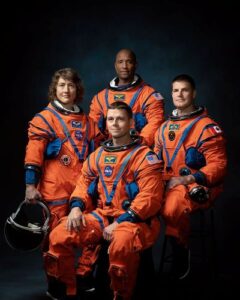
From wikipedia.org / © NASA / Josh Valcarcel
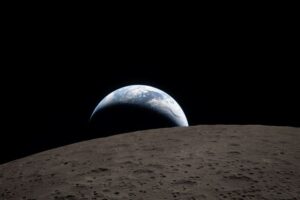
Three days ago, the crew of Artemis II returned to earth. They had taken part in a lunar flyby mission launched by the United States’ National Aeronautics and Space Administration (NASA) that saw human beings leave low earth orbit and travel around the moon for the first time in over 50 years. I would have posted something on this blog about Artemis II before now, but didn’t want to tempt fate. “Let’s wait until they get back safely,” I thought. The fact that the current US government, which gives NASA its orders, seemingly doesn’t give a f*ck about matters such as health and safety or, indeed, science generally made me worry the mission had been insufficiently prepped and might end in disaster.
Happily, though, the Artemis II mission has been a resounding success. It’s also made me think back to when I was a little kid, in the early 1970s, the last time that humans went to the moon. In fact, it was in 1969, when I was three years old and NASA’s Apollo programme was underway, that the late Neil Armstrong became the first human to set foot on an alien world. All right, it was only the moon, which is hardly in the same league as Krypton or Tatooine, but for a wee species that evolved out of the Homo genus just 200,000 years ago, Armstrong’s ‘small step’ 57 years ago was pretty impressive.
However, it has also made me wonder. After all the excited expectations raised by the Apollo programme about space travel, how come the half-century between it and Artemis II has turned out to be so rubbish?
I’m too young to remember seeing Armstrong plant his spacesuit-encased foot on the lunar turf in 1969, but I can just about recall live TV pictures of a subsequent Apollo mission to the moon in the early 1970s. Admittedly, I wasn’t altogether sure what I was watching. At the time my family and I were huddled around a tiny black-and-white television in Northern Ireland, which only picked up one channel, the BBC. (It showed a second channel, RTE, from the Republic of Ireland, if my Dad poked a screwdriver into a hole at the set’s side and did some awkward and potentially dangerous fiddling with the wiring.) All I could make out on the screen were some fuzzy pale blobs floating against a fuzzy grey background. However, my Dad assured me these were men walking about on the moon, high above us, at that very moment, so I took his word for it.
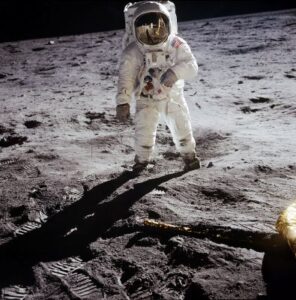
From wikipedia.org / © NASA
It must have been in 1973 that my imagination took a leap that was almost as giant as the ‘leap for mankind’ that Armstrong spoke of when he descended from the lunar landing module. The cause of this were two sets of newly-published encyclopaedias that my parents had seen advertised somewhere and ordered – a 15-volume set with lemony-coloured covers called the Childcraft books that, accordingly, were for children; and a 24-volume set called the World Book series that were for adults and came in sombre, mossy-green covers. That was 39 encyclopaedias in all and, amazingly, they fitted perfectly into the big display shelf that ran along the top of the sideboard in our living room.
I immediately set about reading these encyclopaedias, both the juvenile and adult ones, and my horizons were swiftly widened. Not all the consequences of this were positive. My parents had neglected to read the small print in the advertisement. If they had, they would have discovered that the encyclopaedias had been printed in America, by Americans, for Americans, and their contents were duly biased towards America. As a result, I wasted a lot of time searching in the fields of our farm for evidence that woodchucks, porcupines, prairie dogs and Gila monsters had been foraging there. Also, some quaint words started to appear in my vocabulary – diaper, candy store, soda fountain, rest room – which inevitably had my classmates at primary school tearing the piss out of me.
One feature of these encyclopaedias that really rubbed off on me was that, because they were American and because they’d been published just after the moon landings, they were dripping with optimism. And this was a scientific as well as an American optimism. Yes, it’s hard to believe today, now that one of the two main American political parties is infested with far-right-wing religious fruitcakes who maintain that the universe was created in six days a few thousand years ago (and vaccines are bad, and manmade climate change is a hoax), but there was a time not long ago when America took science seriously and saw it as one of the key tools in converting the rest of the world to the glories of the American way. At the age of eight or nine, I lapped all this up – even those assertions in the encyclopaedias that, with the benefit of hindsight, were a bit over-optimistic.
For example, the encyclopaedias predicted that, having reached the moon, it would only be a short time – the 1980s, at the latest – before human beings were tramping around the surface of Mars too. The ‘S’ volume of the World Book encyclopaedias had a lengthy entry about ‘space travel’ and on one page I found a multi-pictured diagram showing how astronauts were going to get to Mars. Admittedly, the Mars spaceship in that diagram, as well as having a long, sleek fuselage and a beak-like nose, had wings, which seemed a bit suspicious because by then I knew that in outer space there wasn’t any air and wings were thus superfluous. (I suspect the artist behind those pictures had been unconsciously influenced by a non-space vehicle that was making a stir at the time, Concorde.) Elsewhere, there were pictures of what a moonbase – only a few decades away in the future, I was told – would look like, although it was an unprepossessing cylindrical structure that resembled a giant tin can.
Anyway, I assumed this was what I could expect by the time I’d reached my thirties. I’d be living on a moonbase, watching Concorde-like spaceships streak past on their way to Mars.
My expectations were buoyed further when in the mid-1970s my parents finally got round to buying a new TV set that got three channels, the BBC, RTE and ITV – Independent Television. Although ITV had (and still has) a reputation for cheap and lowbrow programming in comparison with that made by the BBC, it did broadcast at the time various action / adventure series made by a subsidiary called ITC entertainment, run by the cigar-smoking impresario Lord Lew Grade. Aimed at international markets and at the American market in particular, ITC’s shows commanded higher-than-average budgets and looked quite glossy by the standards of 1960s and 1970s British TV. They included The Prisoner (1967-68), Department S (1969-70) and The Persuaders (1971) and a host of science-fiction shows made by the remarkable Gerry Anderson. I was able to watch these for the first time.
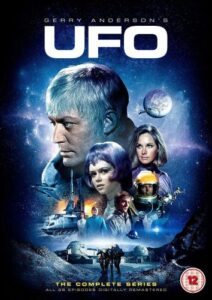
From gerryanderson.com / © ITV Studios
It was watching repeats of Anderson’s live-action sci-fi show, UFO, made in 1970 and starring Ed Bishop, George Sewell, Michael Billington, Peter Gordeno, Wanda Ventham (Benedict Cumberbatch’s mum) and Gabrielle Drake (Nick Drake’s sister), that convinced me that the future was going to be absolutely brilliant. For UFO, Anderson’s production team envisioned the shape of things to come through a prism of gaudy late-1960s design and fashion, with a smidgeon of then-fashionable psychedelia. It didn’t just feature spaceships and moonbases, but also sleek super-cars, talking computers with hallucinogenic panels of flashing lights, giant submarines with detachable nose-modules that turned into aircraft when they reached the ocean surface, guys in groovy-looking suits that didn’t have lapels, and ladies wearing silver miniskirts and sporting purple hairdos.
So, I thought, I’d be living on a moonbase, watching spaceships streak past towards Mars, and Gabrielle Drake would be shimmying around me looking fetching in silver and purple. The future seemed better than ever.
Needless to say, as the 1970s wore on, I began to get uneasy about the fact that very little futuristic stuff was happening any more. As far as manned spaceflight was concerned, not much occurred after the Skylab project – yes, there was the space shuttle, but that didn’t venture beyond earth’s orbit and, frankly, seemed a bit shit. Meanwhile, the Viking 1 probe landed on Mars but, alas, found nothing interesting. There were no aliens, Martian canals or H.G. Wells-style three-legged war machines shooting death-rays – just some boring geological formations that had once been river valleys. And what had happened to that you-can-do-anything-if-you-put-your-mind-to-it American optimism? It seemed to fizzle out as the 1970s became one long litany of American trauma: the Vietnam War, the 1973 oil crisis, Watergate and the Iran hostage saga.
I still had hope, though. In the mobile library that came to our village every week, I picked up a copy of Arthur C. Clarke’s novelisation of 2001: A Space Odyssey, the classic 1968 sci-fi movie he’d co-written with director Stanley Kubrick. It was reassuring to read Clarke’s sober, matter-of-fact account of a journey from the earth to the moon and then on to Saturn. (In Kubrick’s film, the final destination was changed to Jupiter because of the job of convincingly depicting Saturn’s rings was too much for his special effects team.) By then I was well-versed in astronomy and space travel and the book seemed to reinforce everything I knew already about the subjects. It also seemed to make the idea that humanity would be out exploring more of space in the early 21st century feasible and, indeed, logical.
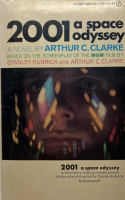
© Signet Books
When I finally saw 2001 the movie, however, it was in 1982 and even I had to concede it’d become a bit of a museum piece. In some ways it possessed an admirable, almost documentary-like realism – for instance, I was impressed by the fact that, unlike the spaceships in every other science fiction movie I’d seen, Kubrick’s spaceships didn’t make any noise (because sound doesn’t travel in the vacuum of space) – but it struck me as a historical artefact nonetheless because it was clearly rooted in a past time and in past conceptions of what lay ahead. It offered a late-1960s view of the future, one that just wasn’t plausible any longer in the early 1980s.
By then, the Mad Max movies (1979, 81 & 85) had started to do the rounds and, after the oil shortages of the 1970s, they presented an unfortunately more credible vision of what the 21st century might be like. It was also telling that a couple of years earlier, in 1978, Lord Grade’s ITC Entertainment, which had once stimulated my space-age fantasies with Gerry Anderson’s UFO, had produced the movie Capricorn One – a cynical sci-fi thriller about a NASA expedition to Mars that is actually a hoax, with the supposed landing on the Martian surface being filmed in a TV studio in the American desert.
And now in 2026 I find myself inhabiting a world far removed from the visions that Neil Armstrong, Gerry Anderson and Arthur C. Clarke inspired in me during my childhood. The Artemis programme promises that human beings will once again set foot on the moon but I’m sceptical that people will get to Mars in my lifetime and I’m beginning to wonder if they’ll ever get there at all. I know Elon Musk keeps vowing to do it but, given the logistics involved and given our current levels of technology, I think that’s bollocks. (Talking bollocks comes as naturally to Musk as breathing.)
It doesn’t help that the orange narcissist currently residing in the White House is trying to cut 23 percent of NASA’s funding – though he’ll no doubt attempt to grab the credit for Artemis II’s success and make it all about himself.
Still, thank you, Artemis II crew. You’ve kindled some fond nostalgia in me and given me a sliver of hope, at least, that humanity’s future might extend beyond the gravitational pull of its home world.
From wikipedia.org / © NASA