Films I’d like to see remade (Part 1)


From imdb.com / © Rank Organisation


I still find it disconcerting when films I enjoyed in my youth are remade in the 21st century: for example, 1980’s The Fog (remade in 2005), 1981’s The Evil Dead (remade in 2013) and Clash of the Titans (remade in 2010), 1986’s The Hitcher (remade in 2007), 1987’s Robocop (remade in 2014) and 1988’s Hairspray (remade in 2007).  My immediate and automatic response to such remakes is, “What, they’re remaking that movie already?  Have you no shame, Hollywood?”


This is followed by a feeling of horror as I realise just how long ago it was when those original movies were released.  The first Evil Dead movie was 32 years old – 32 years! – when its remake surfaced, though in my mind it was only yesterday when Sam Raimi’s Deadites made their first-ever appearance and started making life difficult for Bruce Campbell.   And actually, three of the films I remember most fondly from my youth, Philip Kaufman’s Invasion of the Body Snatchers (1978), John Carpenter’s The Thing (1982) and Brian De Palma’s Scarface (1983) were remakes themselves.  Body Snatchers appeared just 22 years after the 1956 original and The Thing appeared 32 years after its 1950 one.  Scarface was an outlier, since the first Scarface came out in 1932, more than a half-century earlier.


Maybe I shouldn’t be so concerned about how soon after the original movie that a remake appears.  I should be concerned about the quality of it – for remakes tend to be shite.  I haven’t seen all those mentioned at the beginning of this entry, but the ones I have seen have been nowhere near as good as the originals.  (The Evil Dead remake probably comes closest, but I still much prefer the ramshackle and low-budget, but resourceful, charm of Raimi’s 1981 film.)  That said, remakes don’t have to be bad all the time – the aforementioned ones by Kaufman, Carpenter and De Palma testify to that.


So, without further ado, here are some films – and one series of films – I wouldn’t mind seeing remade in the 21st century, with bigger budgets and better special effects.  But remade decently.
 

From wikipedia.org / © Rank Organisation


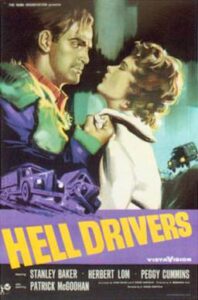
Hell Drivers (1957)

Blacklisted by the House Committee on Un-American Activities in 1951, American director Cy Endfield moved to Britain where, half-a-dozen years later, he made Hell Drivers.  Given the persecution Endfield had suffered, it unsurprisingly takes a dim view of American-style, cut-throat capitalism.  It has that underrated but magnificent actor Stanley Baker as an ex-con who finds a job as a truck driver with a dodgy haulage company, which threatens its drivers with the sack if they don’t deliver loads of gravel across treacherous roads at breakneck speeds.  The reason there aren’t more drivers employed to relieve the pressure, and reduce the danger, is because of a scam involving the local depot manager and its off-his-head Irish foreman (played by Patrick McGoohan like a brawnier version of Shane MacGowan).  The latter soon becomes Baker’s nemesis.


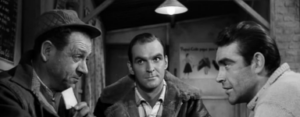
As well as a political message, Endfield injects Hell Drivers with an American-style grittiness rarely seen in British films of the period.  But what really makes the film a joy to watch nowadays is the cast.  As Kim Newman has written of it in Empire Magazine, “how many other movies have an ensemble which includes the original Dr Who (Hartnell), the first James Bond (Sean Connery), the Prisoner (McGoohan), a Man From UNCLE (David McCallum), a Professional (Gordon Jackson), Clouseau’s boss (Herbert Lom), plus Alfie Bass, the excellent Peggy Cummins (of the cult items Gun Crazy and Night of the Demon), the inimitably boozy Wilfrid Lawson, Jill Ireland and Sid James?”


In 2026, with capitalism more cut-throat than ever, a remake of Hell Drivers would be timely.  I don’t think, though, setting it in the wilds of Middlesex, West Sussex and Buckinghamshire, where the original was filmed, would work now, so it’d have to have its hard-pressed truck drivers pounding the roads of a less hospitable locale – the Alaskan tundra, say, or somewhere that retains some near-impenetrable tropical rainforest.


And to pay proper homage to the original, you’d definitely need a cast made up of actors who’ve played iconic roles in iconic TV shows or movie series.  You could have one of the grittier Bonds (Daniel Craig or Timothy Dalton), one of the grittier Doctors Who (Christopher Eccleston or Peter Capaldi), plus a Sherlock Holmes (Benedict Cumberbatch, maybe), a Harry Potter (Daniel Radcliffe), perhaps someone from the Breaking Bad universe (Bryan Cranston, say, or Bob Odenkirk)…  The possibilities are endless.


From wikipedia.org


The Margaret Rutherford Miss Marple movies (1961-64)

This is a little different.  I’d like to see the four movies made about Agatha Christie’s genteel sleuth of a certain age, Miss Marple, which had the delightful Margaret Rutherford in the leading role – Murder She Said (1961), Murder at the Gallop (1963), Murder Most Foul (1964) and Murder Ahoy! (1964) – rebooted as a TV show.  Not just another show about Miss Marple per se – there have been ones with Joan Hickson, Geraldine McEwan and Julia McKenzie – but one set in the universe of the four Rutherford movies.


Thus, its episodes would be set against the tableau of early-1960s England, with Miss Marple depicted as an obstinate, feisty old lady who refuses to know her place and keeps barging into and solving mysteries.  There’d be as much as humour as tension and the show would have the films’ supporting characters, like the timid librarian Mr Stringer (Rutherford’s real-life husband Stringer Davis), who reluctantly helps Miss Marple out, and the exasperated copper Inspector Craddock (Charles Tingwell), who begins each instalment telling her to mind her own business but ends it taking orders from her.  Meanwhile, Ron Goodwin’s jaunty Miss Marple Theme would burble in the background.


I suspect in a 2026 version Mark Gatiss would make a lovely Mr Stringer, while Daniel Mays would nicely fill the shoes of the long-suffering Inspector Craddock.  But who would play Miss Marple – or more precisely, play Margaret Rutherford playing Miss Marple?  Perhaps Dawn French, though she’d have to spend a long time in the make-up chair to recreate Rutherford’s famously jowly, hangdog features.


In the original movies, each murder that Rutherford / Marple investigated involved a British institution – a country manor, horse riding, the theatre and the Navy.  She’d duly rattle establishment cages by sticking her nose in where it wasn’t welcome.  So perhaps each episode of this hypothetical series would have her ruffling the feathers of other British institutions of the time – the Army, the House of Lords, Savile Row, Crufts, the country’s nascent rock ‘n’ roll industry…  Miss Marple meets the young Rolling Stones?  I’d pay good money to see that.
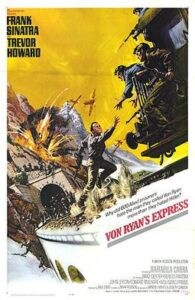
 

From wikipedia.org / © 20th Century Fox


Von Ryan’s Express (1965)

I never had much time for Frank Sinatra, neither as an entertainer nor as a person, but he left an impression on my 10-year-old self the first time I saw the ripping World War II yarn Von Ryan’s Express.  It’s the story of an American airman, Ryan (Sinatra), downed in Italy, who joins forces with some Allied prisoners of war, led by Trevor Howard.  They attempt an audacious escape into neutral Switzerland by seizing control of a train and steering it up a railway line into the Alps.  Much derring-do is involved as German troops and aircraft go all-out to stop them reaching their destination.


It’s great, crowd-pleasing stuff until the ending – spoilers are coming! – which is depicted on the movie poster, painted by the great Frank McCarthy.  The train has almost made it to safety.  Having fought a rearguard action against the Germans, Sinatra is running after the train and has almost caught up with it.  But then….  What happened next put a dampener on things.  But it also lodged the film in my mind forever.


With 2009’s Inglourious Basterds, Quentin Tarantino showed his love for rip-roaring if cheesily improbable World War II adventures, so perhaps he could helm a remake of Von Ryan’s Express?  To stick to the innocent, uncomplicated spirit of the original, though, he’d have to forgo his use of the F-word and N-word, and his fetish for close-ups of ladies’ feet, and his nerdish references to ‘film-study criticism of the work of German director G.W. Pabst’.
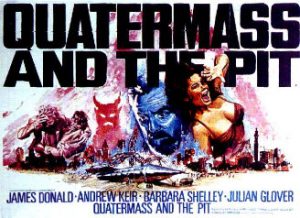
 

© Hammer Film Productions / Seven Arts Productions


Quatermass and the Pit (1967)

Hammer Films’ sci-fi horror film Quatermass and the Pit was based on the 1958 BBC TV serial of the same name.  Both film and serial were written by Nigel Kneale.  It begins with workers on a London Underground extension project digging up an alien spacecraft full of dead, horned, insect-like creatures that are identified by scientist-hero Professor Bernard Quatermass (Andrew Keir) as inhabitants of the now-lifeless planet Mars.  It transpired that millions of years ago, these sneaky Martians arrived on earth and did some evolutionary tinkering on the apes who were the ancestors of modern humanity.  This tinkering included implanting in the apes an urge to conduct occasional culls whereby those with pure Martian programming exterminated those who’d developed mutations and lost that programming.


When some TV news crews descend on the scene, a power surge from their camera-cables reactivates the spacecraft and it triggers a new cull.  London becomes an apocalyptic hellscape where the human inhabitants who retain their Martian conditioning roam around, zombie-like, and use newly awoken telekinetic powers to kill everyone who’s lost it.


I still find Quatermass and the Pit impressive today, and scary, though inevitably there are special effects that reflect the limitations of Hammer’s budget.  I’d relish the prospect of a modern, big-budget retelling of the story.


One thing that makes the film effective, and affecting, is Kneale’s portrayal of the scientists.  Unlike usual movie-scientists, they aren’t cold-blooded, delusional, self-serving or plain weird.  Instead, Quatermass and his colleagues, Dr Roney (James Donald) and Barbara Judd (Barbara Shelley), are portrayed as decent human beings, working with an eager curiosity, a sense of duty and a sense of humour.  Keir and Donald were both Scots, so maybe a modern movie could cast Brian Cox as Quatermass and James McAvoy as Dr Roney.  Actually, I think a third Scottish actor, Karen Gillan, would be excellent as Barbara Judd.


To be continued…


© Metro-Goldwyn-Mayer

Patrick’s progress


© John Murray


I’ve just finished reading a biography of one of the 20th century’s greatest travel writers, Patrick Leigh Fermor.  The biography, Patrick Leigh Fermor: An Adventure, was penned by Artemis Cooper, who’d known him since her childhood, and was published in 2012, a year after his death.


My problem with biographies is that invariably the subjects are, or were, famous and successful.  Although I find the story of their fortunes interesting while they’re on the way up, and having to overcome hardships and obstacles, those stories become less compelling when the subjects have achieved success and settled onto a plateau of comfort, wealth and well-being.  With Fermor, at least, that secure but less interesting plateau is delayed because his success didn’t really come until when he was middle-aged.  And the first 200 pages of this biography, more than half of it, are devoted to Fermor’s youth.  Happily, these pages contain the two most dramatic events of his life: the epic trek he embarked on in 1933, at the age of 18, from the Dutch coast to Istanbul; and, while a Special Operations Executive officer during World War II, his heading of a mission in 1944 to kidnap Major General Heinrich Kreipe, commander of German forces on Nazi-occupied Crete.


Furthermore, the number of books Fermor had published in his lifetime barely reached double figures.  He also continued to travel.  This means that the latter part of Patrick Leigh Fermor: An Adventure, while more sedate, is still interesting because it isn’t just about the boring business of writing.


Cooper is clearly a fan.  She admits to once having a ‘schoolgirl crush’ on Fermor and writes early on: “Radiating a joyful enthusiasm, he was one of those people who made you feel more alive the moment he came into the room, and eager to join in whatever he was planning to do…”


However, she quickly acknowledges one of the controversies about Fermor, that he wasn’t adverse to embroidering reality with fantasy in his supposedly factual writing.  Sometimes, this was unintentional because he was trying to remember events from decades earlier, but sometimes it happened because, well, the fantasy made for a better yarn.  Indeed, Cooper introduces the issue with examples from the early years of Fermor’s life when he was being looked after by a family called the Martins in Northamptonshire, while his real family were in India. The setting was not as bucolic as Fermor liked to recall: “Mr Martin, whom he was later to remember as a farmer, in fact worked at the Ordnance Depot as an engineer and served in the local fire brigade.”


Also, Weedon Bec, the Martins’ village in Northamptonshire, provided Fermor with a startlingly gruesome anecdote that he recounted in his book, A Time of Gifts (1977).  At a community bonfire celebrating the end of World War I, “…one of the boys had been dancing around with a firework in his mouth.  It had slipped down his throat, and he had died ‘spitting stars’.” However, Cooper notes: “There is no reference to this tragedy in the Northamptonshire Chronicle, nor is it mentioned in the Weedon Deanery Parish Magazine which described the celebrations in considerable detail.”


Similar question marks appear during Fermor’s accounts of his journey to Istanbul in his teens, which are recorded in A Time of Gifts, Between the Woods and the Water (1986) and the posthumously published (and edited by Cooper and Colin Thubron) The Broken Road (2013).  I’d known that the material about him crossing the Great Hungarian Plain on horseback in Between the Woods and the Water was suspect – the horse was a fanciful addition to events.  However, I wasn’t aware that a memorable scene in The Broken Road was questionable too. According to Fermor in 2003: “Slogging on south, I lost my way after dark, fell into the sea, and waded soaked into a glimmering cave full of shepherds and fishermen – Bulgars and Greeks – for a strange night of dancing and song.  It was like a flickering firelit scene out of Salvator Rosa.”  Cooper suggests that this incident was really a conflation of two incidents, one of which happened at a later time on Mount Athos.  As for the period described in The Broken Road, Cooper states: “At no point in his original account did he walk down this stretch of coast alone, nor did he lose his footing and find himself floundering among freezing rock-pools after dark.”


Unambiguous, though, is the bravery and audacity shown by Fermor and his comrades in wartime Crete.  It reflects well on Fermor that he valued the role played by the island’s tenacious resistance fighters in the operation to abduct General Kreipe from under the nose of the German forces he commanded.  Indeed, their high-ranking captive was astonished when he found out what was going on.  “For Kreipe,” writes Cooper, “being on the other side of the occupation was an eye-opener.  He had no idea that the Cretans and the British were working so closely together.”


© The Rank Organisation


Accordingly, Fermor wasn’t pleased at how the operation was portrayed on celluloid, in the 1957 Michael Powell / Emeric Pressburger movie IllMet by Moonlight, in which he was played by Dirk Bogarde.  Writing to another of the operation’s British participants, Billy Moss, Fermor said of the film: “You and I are perfectly OK, we emerge as charming, intrepid chaps.  It’s really the Cretans I’m worried about…”  The film’s depiction of the Cretans upset him because it relegated them “to the role of picturesque and slightly absurd foreigners constantly in a state of agitation, coolly managed by these two unruffled and underacting sahibs.”


Thereafter, with Fermor finding his vocation – a slow, gradual progress, because he was anything but a disciplined writer – the book inevitably becomes less eventful. However, there are still some intriguing moments.  A trip to the Caribbean brings him into the orbit of James Bond creator Ian Fleming, ensconced in his Goldeneye Estate in Jamaica.  I’ve heard speculation that the dashing war-hero Fermor inspired the character of Bond, but at this point Fleming was already “bashing away at a thriller”, the first Bond novel Casino Royale (1953), so Fermor couldn’t have been the original inspiration.  However, Fermor’s writings about voodoo, something he became immersed in whilst on the island of Haiti, informed Fleming’s depiction of it in the second Bond novel, Live and Let Die (1954).


Then we get an account of Fermor’s involvement with the 1958 John Huston movie The Roots of Heaven, for which he was commissioned to rewrite Romain Gary’s original screenplay and had to attend several weeks of filming in Chad, Cameroon and the Central African Republic.  The film, about “a maverick loner, Morel, who is determined to stop the slaughter of elephants by big game hunters and ivory poachers,” brought Fermor into contact with Trevor Howard, who “drank nothing but whisky from morning till night,” and Errol Flynn, of whom he wrote in a letter, “Errol and I have become great buddies…  He is a tremendous shit, but a very funny one…”  In a predictable instance of Hollywood hypocrisy, Cooper notes: “Despite the fact that The Roots of Heaven was a plea to save the elephants, John Huston was very keen to shoot one…  The back of his Land Rover was an arsenal of shotguns, rifles and ammunition, and it was obvious that he lived not for the film, but to slope off into the bush with a gun.”


© Darryl F. Zanuck Productions / 20th Century Fox


We also hear about Fermor participating in 1972 in a Greek TV programme reuniting the surviving members of the 1944 Kreipe operation.  The last participant to come onstage, “to gasps of surprise and a round of applause from the audience,” was the focus of the whole operation, General Kreipe himself.  When Fermor asked him in German if he held any grudges about what’d happened, the general gamely replied, “If I had any bad feelings…  I wouldn’t be here, would I?”


And we get some short but melancholic accounts of him revisiting eastern Europe during, and just after, Communism.  During these visits he tried, often fruitlessly, to track down people and places he’d known during his wanderings through the region in the 1930s.  He found one, formerly aristocratic acquaintance in an old folks’ home in Budapest, physically broken and wits wandering.  This sad exchange ensues: “‘My old friend Patrick Leigh Fermor lives in Greece.’ – ‘Yes, Elemér, it’s me, it’s Paddy!’ – ‘No, no, you are much too young…  But if you go to Greece tell him I’m here, I hope he remembers me.’


Fermor belonged to an era when travelling (for pleasure) and, indeed, writing were largely seen as activities for the upper classes.  Thus, certain of his traits can be annoying, traits emblematic of being raised in that privileged stratum of English society: his boundless self-confidence, his shamelessness at making use of the contacts he’s accrued, the fact that he has all those contacts in the first place.  This struck me especially when I read Between the Woods and the Water, which sees him stay with a succession of posh eastern European aristocrats and enjoy lavish hospitality that, at times, he seems to think is his entitlement.


Cooper is at least aware of these potential criticisms. Regarding what happens in Between the Woods, she points out: “For his hosts, there was nothing unusual in having guests stay for days or even weeks at a time.” Also: “The greatest blessing that a guest can bring is the right kind of curiosity, and it bubbled out of Paddy like a natural spring…”, which must have been gratifying for his hosts, who by then probably felt like “a useless fragment of a broken empire.”  It’s worth mentioning too that Fermor never received a university education which, if it had happened, would presumably have put him among the elite in Oxford or Cambridge Universities and set the seal on him as an establishment figure.  Perhaps the fact that the system never fully processed him, and didn’t condition him entirely about what an English gentleman was and wasn’t meant to do, explains why he retained the ‘common touch’ throughout his life.  He seemed as much at home blethering with a Macedonian shepherd as he was with a Romanian Count.


If Fermor appears blessed with more than his fair share of luck, it’s probably more to do with Joan Raynor, who became his long-term companion and finally his wife.  The daughter of someone who was, successively, a Conservative MP, a First Lord of the Admiralty and a Viscount, she received a private income that enabled Fermor to continue with his travel writing even when he wasn’t reaping great financial rewards from it.  She was also  broadminded about their relationship, which at times could be described as an ‘open’ one, allowing Fermor to indulge in a few dalliances on the side.


Eventually, the Fermors built a handsome villa for themselves in a rustic part of Greece.  As I approached the biography’s last chapters, I wondered how they’d reacted to the country’s growing tourist industry in the late 20th century.  Wouldn’t they have been disgruntled at how travellers of a different pedigree from them, folk from less well-off backgrounds intent on getting a week’s break in the sun rather than on experiencing the glories of Greek culture and history, were swamping the beauty spots of their adopted home?  But the changes caused by mass-tourism seemed not to impinge on their idyll.  Neither did they object to their Greek neighbours making some money out of it.  In fact, the building of a hotel nearby seems to have come as a relief to them.  Their villa was frequently crowded with guests and now they could farm some of them out to the new establishment.


It must have been tempting to portray Fermor simply as an unstoppable force of nature / Renaissance man-of-action.  To her credit, Cooper admits that while he had many admirers, he didn’t charm everyone.  Turning up in Athens in 1935, he soon got an invitation from the son of the British ambassador to stay at the embassy.  But the ambassador himself proved “quite immune, if not allergic, to Paddy’s high spirits and exotic conversation”, growled at him, “You seem bloody pleased with yourself, don’t you?” and soon gave him his marching orders.  Nor was a post-war stint at the British Council in Athens a great success.  As one colleague observed, “There was a very insensitive side to Paddy…  He was very bumptious, a bit of a know-all, and his enthusiasm and noisiness could be rather wearing.”


While Patrick Leigh Fermor: An Adventure is certainly no warts-and-all exposé, it doesn’t get entirely swept away by the awe-inspiring, larger-than-life aura that Fermor projected.  You’re left with the impression of someone who, yes, was remarkable but who, like all of us, sported a few imperfections too.  Which actually makes you like him more as a result.


Taken by Joan Leigh Fermor

Seriously Sean – ‘The Offence’


© Tantallon / United Artists


A warning – the following entry contains a lot of spoilers.


1973’s The Offence was the result of its star, Sean Connery, believing he could make a deal with the devil and get away with it.  The devil in question was Hollywood, always hungry for money-spinning escapist entertainment.  The deal was that he would, reluctantly, reprise his role as James Bond in Diamonds are Forever (1971).  In return, the distributor, United Artists, would support two film projects of his own choosing, budgeted at less than two million dollars.


What could go wrong?  Connery starring in the lazy, by-the-numbers Bondage that was Diamonds are Forever and being rewarded with two modestly budgeted but hopefully classy movies in which he could demonstrate his acting chops?  Well, the problem was that The Offence, the first film to emerge from of the deal, was a commercial flop.  Filmgoers evidently preferred to pay money to see Connery as Bond, even if by 1971 he was visibly middle-aged, wearing a toupee and merely going through the motions, rather than see him give the disturbing performance that he gave in The Offence. 


Connery’s second project was to have been an adaptation of Shakespeare’s Macbeth, which he planned to direct himself.  This became problematic when the Roman Polanski-directed Macbeth was released in 1971.  With The Offence a failure and Connery’s Macbeth looking unviable because Polanski had got to the material first, United Artists pulled the plug on the deal.  Connery’s second film didn’t see the light of day and, indeed, he never got to direct a film.  (His sole directing credit was the 1967 TV documentary The Bowler and the Bunnet.)


But at least we got The Offence, which features Connery in perhaps his most unsettling and least sympathetic role ever.  Viewed in 2021, it also provides a grim snapshot of life in Britain in the early 1970s.  Its story unfolds against a backdrop of brutalist architecture, anonymous municipal housing and concrete bunker-like interiors, an environment where toxic masculinity, blinkered prejudice and instinctive misogyny seem to flourish.


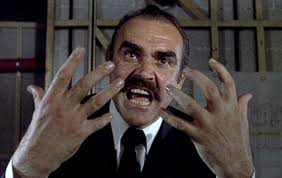
The Offence’s opening sequence takes place inside a police station.   A uniformed copper realises something is amiss in one of the interrogation rooms, raises the alarm and rushes inside with several colleagues.  Director Sidney Lumet, with whom Connery had previously made The Hill (1965) and The Anderson Tapes (1971), stages the sequence with memorable weirdness, having the characters move in slow motion, muting the dialogue, and making the soundtrack a collage of exaggerated, juddering noises and needling instrumental music courtesy of composer Harrison Birtwhistle.  At the sequence’s end, the distorted noises and music give way to the ringing of an alarm bell and we see Connery standing in the middle of the room.  He’s surrounded by the bodies of people, including policemen, whom he’s just clobbered.  What’s happened is a mystery, but Connery’s character is clearly giving off a bad vibe.


Then the narrative shifts back in time.  The police are shown to be out in force, keeping a close watch on a school at the edge of a non-descript English housing estate.  They are there because the area has recently seen a series of sexual assaults on young girls.  In the midst of the activity is Connery’s character, Detective Sergeant Johnson.  He struts around in a sheepskin jacket, drop-brim tweed hat and big 1970s moustache and sideburns, whilst being boorish, opinionated and self-consciously macho.


But the police mess up.  When the school-day ends and the kids leave, a girl goes missing.  A desperate search for her is launched in the fields and woods beyond the estate.  Lumet films this atmospherically – the daylight fading from a leaden sky, the lights of torches bobbing through the gloaming, the barking of tracker dogs and crackle of police walkie talkies pervading the air.  The girl is eventually found, brutalised and traumatised but still alive.  Johnson is the one who finds her.  As we’re aware of his bad karma from the opening sequence, there’s something disturbing in how he croons platitudes and struggles with the girl as he attempts to calm her.


© Tantallon / United Artists


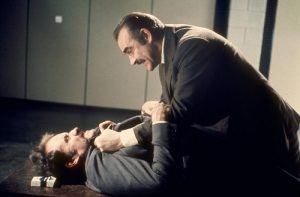
Later that evening, a suspect is picked up.  This is Baxter (Ian Bannen), whom the police first spy tottering drunkenly across a serpentine pedestrian bridge in the local town centre.  Unable to give an account of what he was doing that day, he’s taken into custody.  Something about Baxter seems to push all of Johnson’s buttons and Johnson becomes convinced of his guilt.  Baxter is seedy and louche, but also well-spoken and well-educated, and he’s obviously come down in the world for some reason.  Though the script doesn’t make anything of it, there’s a hint that he’s gay, which no doubt enflames Johnson’s alpha maleness too.  This part of The Offence culminates with Johnson sneaking into the interrogation room to speak to Baxter in private.  Lumet shows a little, not all, of the emotional and physical violence that follows.  Johnson beats Baxter to a pulp, presumably the first act in the mayhem that was glimpsed in the film’s prologue.


Thereafter, The Offence shifts gears and three long, dialogue-heavy scenes ensue.  These scenes reveal the film’s origins on the stage, for it’s based on a theatrical play called This Story of Yours, which was first performed in 1968 and written by John Hopkins.  The playwright also wrote the film’s script.  Intriguingly, when This Story of Yours was revived in 1987, the role of Johnson went to the actor who was the screen’s finest Hercule Poirot, David Suchet.


First comes a scene where, after the violence, a chastened Johnson returns home.  Unsurprisingly, from what we’ve seen of the neighbourhood so far, he lives in an identikit block of flats where for a moment he tries to enter the wrong apartment by mistake.  He talks bitterly with his wife (Vivien Merchant) until two of his colleagues show up to inform him that Baxter has died of his injuries in hospital and he needs to accompany them back to the station.  The second scene takes place the next day and sees Johnson interrogated by a Detective Superintendent (Trevor Howard) who’s been sent to the town to find out what the hell is going on.  The third scene is a flashback to Johnson’s confrontation with Baxter and this time it’s shown in full.


The scene between Johnson and his wife, whose relationship has so deteriorated that they torment each other, intentionally and unintentionally, just by being in each other’s presence, is painful enough.  “Why aren’t you beautiful?” he growls at her. “You’re not even pretty.”  It’s made worse by the knowledge that both performers were in ugly domestic situations in real life at the time.  Connery’s marriage to actress Diane Cilento ended the year that The Offence was released and Cilento later alleged that he’d subjected her to physical and emotional abuse. Merchant, meanwhile, died of alcoholism and depression in 1982, aged only 53, following the slow and traumatic breakup of her marriage to the playwright Harold Pinter.


© Tantallon / United Artists


The scene with Trevor Howard’s Detective Superintendent, rattled by what’s happened but trying to extend some sympathy to Johnson as a fellow copper, is merely tense.  But it’s the flashback to the events in the interrogation room that gives The Offence its devastating punch.  Johnson might be Baxter’s physical superior but, despite his attempts to intimidate him, it’s Baxter who gains the upper hand.  He’s smart enough to realise how screwed up Johnson is and taunts him about his obsession with this case.  Is it because of a deep-rooted fascination with the crimes?  Is he secretly turned on by these sexual assaults on children?  “Nothing I have done,” Baxter tells him, “can be one half as bad as the thoughts in your head.”


It’s comes as no surprise that there is bad stuff festering inside Johnson’s head.  During the film, we’ve seen him suffer brief but harrowing recollections of the grisly crimes he’s had to deal with as a policeman – hanging corpses, murdered women tied to beds, people throwing themselves off rooftops, bloodstained children’s toys.  He’s also been haunted by images of the abused schoolgirl he found the previous day, not hysterical, but smiling at him enticingly.


Finally, like a penitent sinner before his priest, Johnson confesses to Baxter that what he’s said is true – just before, unhinged, he subjects him to that fatal beating.  Also, in his blind rage, he floors several of his colleagues who burst in and try to intervene.


I don’t think Ian Bannen ever gave a better performance than as the perceptive and manipulative Baxter, who gets the last laugh even though it costs him his life.  There are good turns too from Howard, Merchant, future sitcom-star Peter Bowles as the police station’s token posh detective, and Durham-born Ronald Radd as its token gruff, northern one.  Also in the cast is strapping character actor John Hallam, who appeared in two more British crime movies on either side of The Offence, Villain (1971) and Hennessy (1975).


But Connery ultimately takes the acting honours, for daring to subvert the macho-ness of Bond and the other heroic roles he’d been associated with.  Here he explores the severely damaged psyche of someone who uses a macho exterior as something to hide behind.  I’ve read speculation that The Offence’s box-office failure persuaded Connery not to play more characters like Johnson, but I wonder if that’s really the case.  Even if the film had made money, having inhabited Johnson’s skin once, did he feel any need to do it again?


Though after The Offence he’d stick to more sympathetic and heroic roles, there were, thankfully, several more Connery movies to come that were serious in intent and tried to engage the intellect.  Highlander (1986) and The Rock (1996) were still some way off…


© Tantallon / United Artists