Richard Matheson – he was legend


© Orion Publishing Co


Something has got me thinking about Richard Matheson, the science-fiction and horror author and screenwriter who passed away in 2013 at the age of 87.


What thing?  Well, the news that the anti-Covid-19-vaxxers in America, determined to plumb the depths of stupidity to find new reasons for not getting vaccinated, have found the stupidest reason yet.  Speculation is rife that the vaccine could turn you in a zombie.  You know, like one did in the 2007 sci-fi / horror movie I am Legend, with Will Smith, which was based on Matheson’s 1954 novel of the same name.  This has prompted one of the movie’s scriptwriters, Akiva Goldsman, to step up and announce on social media: “Oh.  My.  God.  It’s a movie.  I made that up.  It’s not real.” In fact, the source of the contagion in the movie wasn’t a vaccine but a virus, genetically reprogrammed by Dr Emma Thompson to combat cancer, going spectacularly rogue.


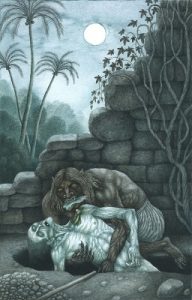
In Matheson’s novel I am Legend the monsters are vampires, not zombies.  Also, what turns people into those vampires isn’t the movie’s lab-reprogrammed virus, but a mysterious pandemic.  However, the book’s premise of the world being suddenly and nightmarishly turned upside down and a small number of uninfected humans finding themselves menaced by those who’ve been infected and turned into monsters, including their own loved ones, was one that a young George Romero appropriated for his seminal 1968 movie Night of the Living Dead.  In doing so, Romero made it the blueprint for at least 80% of the zombie movies that have lurched across cinema and TV screens ever since.


In the novel, the number of uninfected humans is small indeed: just one, Richard Neville, who is alone in the world during the daytime and then under siege in his fortified house at night, by the vampires that everyone else has turned into.  Gradually, Neville, researching the plague, stumbles on scientific explanations for the vampire-like symptoms of its victims, why they drink blood, why they can only be killed by stakes through the heart, and why they have an aversion to sunlight, garlic and crucifixes.  I am Legend also ends with an unnerving psychological twist.  Neville, who’s spent his days roaming the surrounding city and staking the slumbering vampires, realises that the vampires are now the normal ones and he’s become the monster of everyone’s nightmares, the deadly legend of the title.


It’s a pity that though I am Legend was filmed on several occasions, and though Matheson lived to a venerable age, he never got to see a satisfactory celluloid version of it.  The novel received its first film treatment in Italy, where Rome unconvincingly stood in for Los Angeles, with the cheaply and incompetently made L’Ultimo Uomo della Terra (The Last Man on Earth).  Neville was played by Vincent Price, whom Matheson admired as an actor but thought was miscast in the role.  L’Ultimo Uomo della Terra was at least fairly faithful to the book, unlike the subsequent film versions, 1970’s The Omega Man, with Charlton Heston, and the 2007 one.  In The Omega Man the vampires have become a group of demented albino mutants called, with an unsubtle reference to Charles Manson, the Family.  In the Will Smith version of I am Legend they’re even less impressive, a bunch of bald, hyperactive zombies animated by some shoddy CGI.


Both the later movie versions lack the courage to portray Neville as being totally alone and eventually have him encounter other, as yet uninfected survivors.  They also lack the courage to include Matheson’s game-changing ending.  Instead, they close with Heston and Smith depicted as Christ-like figures who nobly sacrifice themselves for the good of what’s left of humanity.  Neville was a more interesting character when he discovered he’d become a bogeyman.  Still, disappointing though all three film versions are, there’s at least a good graphic-novel adaptation of I am Legend available.


© Gold Medal Books


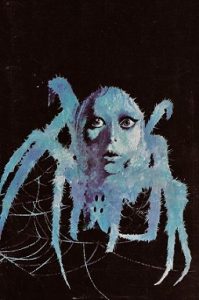
The more I reminisce about Matheson, the more I realise what a wonderful and influential writer he was.  His other big – though ‘big’ perhaps isn’t the most appropriate adjective – novel of the 1950s was The Shrinking Man (1956).  Its hero, an archetypal middle-class American male called Scott Carey, is exposed to a radioactive cloud that causes his body to shrink at the rate of a seventh of an inch every day.  Thereafter, Carey’s world turns nightmarishly upside down too, though at a more gradual rate than Richard Neville’s.  First, he experiences psychological and sexual humiliation as he finds himself increasingly dwarfed by his normal-sized wife.  Following an assault by the family cat, no longer a loveable moggie but a carnivorous monster, the now-tiny Carey loses all contact with humanity and finds himself trapped in his house’s basement where the dangers facing him become formidable indeed.  A common spider, for instance, takes on elephantine proportions.  And Carey’s shrinking doesn’t stop, let alone get reversed.  At the book’s close, he muses, “If nature existed on endless planes, so also might intelligence.”  Thereafter, he dwindles away into infinity.


A year after its publication, the novel was filmed as The Incredible Shrinking Man, directed by Jack Arnold and with Matheson providing the script.  Matheson was unhappy with how Arnold structured the film.  He told the story in linear fashion, whereas Matheson wanted it to begin with the shrunken Carey in the basement, reliving what had happened to him via a series of flashbacks.  However, it’s still one of the best science fiction movies of the 1950s.  It crucially retains the novel’s bleakly philosophical ending.  I can remember seeing the film on TV as a kid and being genuinely upset when the ending defied my expectations that things would finish on an upbeat note.  The Incredible Shrinking Man was, incidentally, one of the great J.G. Ballard’s top ten favourite sci-fi movies.


© Sphere Books


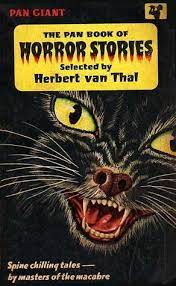
As well as novels, Matheson was a prolific writer of short stories, many of which were collected in four books called the Shock series.  Shock 1-4 were published in Britain in the 1970s by Sphere Books, who decorated the covers with lurid and gory images – the antithesis of the unsensational, non-violent and thoughtful works inside.  The stories I remember best include Long Distance Call, about a woman plagued by mysterious phone calls that, she discovers, emanate from a local cemetery into which the telephone wire has blown down; The Children of Noah, about a motorist who finds himself in Kafkaesque predicament when he breaks the 15-miles-per-hour speed limit of a tiny American town called Zachary; and the brilliant The Splendid Source, in which a man embarks on a quest to find out where dirty jokes really come from.


Long Distance Call was one of several Matheson stories that were turned into episodes of the celebrated TV anthology series The Twilight Zone (1959-64).  The best of these, adapted by Matheson himself, was of course Nightmare at 20,000 Feet.  In this, William Shatner essayed his second-most-famous role, that of a just-released psychiatric patient who’s on board a plane and, looking out of the window, sees a gremlin dismantling one of the engines on the wing.  Whenever he tries to alert the crew and fellow passengers, the beastie inconveniently disappears from view.  Particularly memorable is the moment when the traumatised Shatner dares to peek through the window again and discovers the gremlin pressing its face, which resembles that of a hare-lipped teddy bear, against the outside of the glass and staring in at him.  The episode was remade as a segment of the movie version of The Twilight Zone in 1983, with John Lithgow in the Shatner role, and ten years later it received the ultimate accolade – it was spoofed in a Treehouse of Horror edition of The Simpsons, with Bart Simpson the only passenger on the school bus able to see a gremlin sabotaging its engine.  This version was called Nightmare at 5½ Feet.


© Universal Pictures


Other episodes that Matheson penned for The Twilight Zone were also influential.  A World of Difference is about a businessman who makes the mind-blowing discovery that he’s a fictional character and his life is actually a movie.  Furthermore, the movie has just had its production halted, meaning he’ll have to live in the ‘real’ world as the declining, drunken movie star who’s been playing him.  This clearly informs Peter Weir’s 1998 film The Truman Show.  Meanwhile, Little Girl Lost tells the tale of a child who, one night, falls from her bed and into another dimension, a mysterious, misty void from which she can hear her parents’ concerned voices but can’t escape.  A young Steven Spielberg no doubt saw and remembered this one, because the same idea features in 1982’s Spielberg-produced Poltergeist, though this time the little girl is sucked into the other dimension through the household TV set.  And yes, The Simpsons spoofed it too in Treehouse of Horror.


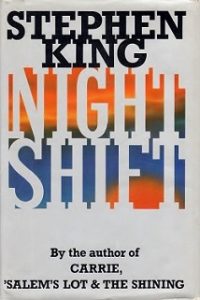
Steven Spielberg has much to thank Matheson for.  Matheson’s short story Duel, based on an experience he had on November 22nd, 1963 – of driving home depressed at the news of Kennedy’s assassination and being harassed by a large, tailgating truck – was filmed as a TV movie in 1971 by Spielberg and gave the young director his first big critical success.  Again, Matheson wrote the script.  Duel-the-movie has motorist Dennis Weaver and the psychopathic driver of a 1955 Peterbilt 281 truck get into a deadly game of cat and mouse around the roads and highways of rural California.   We never see the truck driver himself, just his immense, bellowing, dinosaur-like vehicle.  Duel is the archetypal man-versus-machine story and, again, has been influential.  Stephen King basically rewrote it (but upped the ante by adding lots of malevolent vehicles) with his short story Trucks, which he later filmed as Maximum Overdrive (1986).


The made-for-television movies that filled American TV schedules in the 1970s kept Matheson busy.  As well as Duel he scripted The Night Stalker (1972) about a reporter called Carl Kolchak (Darren McGavin) who investigates a series of killings in modern-day Los Angeles and discovers that the perpetrator is a vampire.  The Night Stalker was successful enough to eventually spawn a TV show called Kolchak: The Night Stalker (1974-75), also starring McGavin, in which Kolchak investigated other strange cases involving monsters and supernatural phenomena.  Though short-lived, the show was a major inspiration for Chris Carter, whose massively popular The X-Files (1993-2018) had a similar theme.  Carter acknowledged his debt to Kolchak by having Darren McGavin guest-star in two X-Files episodes.


Meanwhile, the TV anthology movie Trilogy of Terror, from 1975, was based on three of Matheson’s short stories.  The first two segments are unmemorable, but the third one, which Matheson scripted from his story Prey, is great.  It stars Karen Black as an insecure woman who tries to shore up her relationship with her boyfriend, a lecturer in social anthropology, by buying him an antique ‘Zuma fetish doll’ as a birthday present.  The doll is a hideous-looking thing and sports a many-fanged grin resembling a Venus flytrap.  Before she can give the doll to its intended recipient, it comes to violent, gibbering life and she spends the evening fighting it off in the confines of her apartment.  Black’s plight is the inverse of the shrinking man’s.  She’s normal-sized and the threat she faces is tiny, but terrifying.  This also creates the template for Joe Dante’s movie Gremlins in 1984.  In particular, the scene in Gremlins where Frances Lee McCain fights off a horde of the sneering, reptilian mini-monsters in her kitchen, employing a blender and a microwave oven as weapons, is very reminiscent of Trilogy of Terror.


When he wasn’t writing novels, short stories and television scripts, the ever-industrious Matheson was writing for the cinema.  In the early 1960s, he scripted several of the movies based on works by Edgar Allen Poe that were made by American International Pictures and directed by Roger Corman: The House of Usher (1960), The Pit and the Pendulum (1961), Tales of Terror (1962) and The Raven (1963).  All told, Matheson did a good job of preserving the original stories’ gloomy, clammy spirit, whilst meeting the commercial demands of a studio and a director who were already famous for their exploitation movies, and keeping engaged a star – Vincent Price – whose performances tended to slip into the knowingly hammy when his material bored him.  The movies aren’t the most faithful adaptations of Poe, but they’re surely the most fondly remembered ones.


© Academy Pictures Productions / 20th Century Fox


Matheson also worked on British movies.  For AIP’s trans-Atlantic rival, Hammer Films, he scripted The Devil Rides Out in 1968 and managed to turn Dennis Wheatley’s bloated, reactionary novel about upstanding Anglo-Saxon aristocrats fighting a bunch of ghastly Satan-worshipping foreigners into something rather good.  And in 1973, he adapted his haunted-house novel Hell House for the screen.  The result was The Legend of Hell House, directed by John Hough and starring Roddy McDowall, Clive Revill, Pamela Franklin and Gayle Hunicutt as psychic investigators trying to get to the bottom of terrifying supernatural manifestations in the titular mansion.  The movie’s ending, which has the surviving investigators finding a hidden sanctum where the psychic forces are emanating from an embalmed body, played by a very un-embalmed-looking Michael Gough, is pretty stupid, which Matheson himself admitted.  Still, John Hough directs the film’s scary set-pieces with vigour and there’s an unsettling electronic score by Delia Derbyshire and Brian Hodgson.


Matheson was a modest soul and in interviews he usually seemed puzzled that so many people could be so inspired by his work.  He might have ended up a very rich man if, like his famously litigious contemporary Harlan Ellison, he’d bothered to sue every filmmaker and writer who’d ripped off his ideas.  Mind you, he’d probably have spent all his time in court, so I’m glad he just turned the other cheek and devoted that time instead to writing his marvellous stories.


© Cayuga Productions / CBS Productions

Cinematic heroes 3: David Warner


© Warner Bros.


I’ve just discovered that a few days ago was the 80th birthday of the film and TV character actor David Warner.  In honour of the great man becoming an octogenarian, here’s an updated version of a post I wrote about him eight years ago.


For most actors, becoming typecast is a pain in the neck.  The day that the lugubrious-faced, distinctive-voiced David Warner became typecast, as an actor specialising in offbeat roles in offbeat films, often horror, science fiction and fantasy ones, it was actually a pane in the neck.


As Keith Jennings, the photographer who befriends Gregory Peck’s ambassador Richard Thorne in 1976’s The Omen, he is memorably decapitated when a sheet of glass comes crashing off the back of a truck and shears his head from his shoulders.  Indeed, though The Omen was choc-a-block with people dying in gruesome freak accidents, and later there were Omen sequels with more freak accidents, and later still there were a half-dozen Final Destination movies following a similar template and serving up many more freak accidents, the cinema has seen very few freak accidents as spectacularly shocking as Warner’s in that 45-year-old movie.


© 20th Century Fox


The main actors in the big-budget Omen – Peck, Lee Remick, Billie Whitelaw – were names not normally associated with horror movies.  Until then, Warner’s name hadn’t been associated with them either.  Mancunian by birth, he started acting professionally in 1962 and the following year joined the Royal Shakespeare Company, which led to stage roles in Henry IV Part 1, Henry VI Parts I-III, Julius Caesar, Richard II, The Tempest, Twelfth Night and, in 1965, playing the title role, Hamlet.  The earliest films he appeared in were sometimes theatrical in origin too, such as A Midsummer Night’s Dream and The Sea Gull, which both appeared in 1968.  However, it was in 1966’s Morgan: A Suitable Case for Treatment that he made his biggest impression on 1960s movie audiences.  In it he plays a working-class artist who’s abandoned by his posh wife, played by Vanessa Redgrave, and goes to unhinged extremes to win her back.


When Warner’s career is discussed, it’s often overlooked that he was once a regular performer with the legendary action-movie director Sam Peckinpah.  His association with the hard-drinking, coke-snorting, near-deranged filmmaker started with 1970’s The Ballad of Cable Hogue, in which he played an eccentric preacher who befriends Jason Robards’ titular hero.  Peckinpah often boasted, “I can’t direct when I’m sober,” and for the young Warner Hogue must have been quite an initiation into the director’s weird and wonderful ways.  When bad weather held up filming, Peckinpah and his crew went on a massive drinking binge and ran up a bar-bill worth thousands and thousands of dollars.


In the next year’s Straw Dogs, Peckinpah’s taboo-busting film set in the English West Country, Warner plays a simpleton who unwittingly kills a girl and then takes refuge in Dustin Hoffman and Susan George’s house with a squad of vigilantes on his trail.  In Cross of Iron, Peckinpah’s 1977 war movie about a doomed German platoon on the Russian front, he plays a humane German officer who just wants to get through the war in one piece.  In fact, in Cross of Iron, nearly all the Germans, including James Coburn’s gallant corporal and James Mason’s world-weary colonel, are humane types who view war with extreme distaste.  What upsets the apple-cart, and eventually gets most of them killed, is the arrival of Maximillian Schell’s glory-hunting Prussian officer.  Schell is obsessed with winning an iron cross for himself and isn’t worried about other soldiers dying in the process.


© Anglo-EMI Productions


In 1973 Warner made his first appearance in a horror film, the British anthology movie From Beyond the Grave, whose stories were based on the writings of Ronald Chetwyn-Hayes.  In the film’s first story, The Gate Crasher, he plays an arrogant prick called Edward Charlton who acquires an old mirror from an antique shop and gets it on the cheap by lying to the shop-owner about the mirror’s likely age.  Charlton obviously hasn’t seen many horror films before.  Otherwise, he might have thought twice about cheating a proprietor played by Peter Cushing in a shop called Temptations Inc.  He gets his just deserts.  The mirror turns out to be inhabited by a malevolent spirit, which possesses him and drives him to commit murder.


It was in the late 1970s and early 1980s that Warner got his fondest-remembered roles, starting with the kindly but ill-fated Jennings in The Omen.  Then, in 1979’s Time After Time, he switches from being a nice guy to being a bad one, playing John Leslie Stevenson, a Victorian gentleman and friend of the pioneering science-fiction writer H.G. Wells, who’s played by Malcolm McDowell.  Unbeknownst to Wells, Stevenson has been making a name for himself by butchering prostitutes in Whitechapel – for he is none other than Jack the Ripper.  When Wells unveils his latest invention, a working time machine like the one he would later write about in his famous 1895 novella, Stevenson uses it to escape the closing police net and scoots one century forward into the future.  But the machine has a recall function, so a horrified Wells summons it back to the 19th century and uses it to follow Leslie to 1979.  Wells assumes that he’s let Jack the Ripper loose on Utopia and, predictably, is more than a little disappointed to find that the 20th century is less utopian than he’d anticipated.  Meanwhile, the Ripper has taken to the era’s violence, sleaze and heavy-decibel rock music like a duck to water.


A quirky and very entertaining movie, Time After Time was written and directed by Nicholas Meyer who, regrettably, devoted most of his energies to the less adventurous and eccentric, and more mainstream and family-friendly Star Trek franchise during the 1980s.  Actually, it’s probably because of Meyer’s involvement that both Warner and Malcolm McDowell have made appearances in Star Trek films – Warner was in both Star Trek V and VI (1989 and 1991).  I’m not much of a fan of Star Trek or its movie spin-offs, but I like the sixth one, largely because Warner is in it.  He plays Chancellor Gorkon, charismatic leader of the Klingons and obviously modelled on the then Soviet leader Mikael Gorbachev, who’s decided it’s time for the Klingon Empire to pursue peace-talks with the Federation.


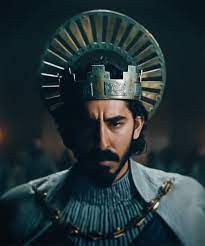
In 1981 Warner delivered another memorable performance in Terry Gilliam’s cinematic fairy tale The Time Bandits.  He plays Evil, who’s been created by Ralph Richardson’s Supreme Being and then imprisoned in a hellish place called the Fortress of Ultimate Darkness.  Obviously, Warner and Richardson’s characters are the Devil and God under different monikers.  Some fine actors have played Old Nick in movies over the years, including Robert De Niro, Al Pacino and Jack Nicholson, but for my money Warner’s portrayal is the most entertaining.  His Devil is a petulant and embittered type who spends his time ranting at his idiotic minions (“Shut up!  I’m speaking rhetorically!”) about how rubbish God is.  The Almighty, he argues, has wasted His time creating useless things such as slugs, and nipples for men, and 43 species of parrots, when He could have concentrated on making laser beams, car phones and VCRs.  Warner steals the show in The Time Bandits, which is no minor achievement considering that in addition to Richardson the film stars Ian Holm, John Cleese, Sean Connery, Michael Palin, Shelley Duvall and a delightful gang of time-traveling dwarves led by David Rappaport.


Thereafter, Warner’s CV filled with all manner of odd movies, hardly Shakespearean in the acting opportunities they offered, but relished by obsessives like myself.  These include 1979’s Nightwing, 1980’s The Island, 1987’s Waxwork, 1991’s Cast a Deadly Spell, 1995’s In the Mouth of Madness, 1997’s Scream 2 and 2010’s Black Death.


© Walt Disney Productions


As an actor he’s adept at playing out-and-out villains, for example, his Dillinger / Sark character in the 1981 Disney computer-game fantasy Tron, a movie that was unappreciated at the time but that, in the decades since, has been accorded considerable retro-cool.  He’s also good at doing mad scientists, like the splendidly named Doctor Alfred Necessiter in the whacky 1982 comedy The Man with Two Brains, which is poignant today as a reminder of the time when Steve Martin used to be funny.


But he also has harassed and melancholic qualities, which come nicely to the fore when he’s playing fathers.  He was, for instance, the heroine’s father in 1984’s The Company of Wolves, Neil Jordan’s atmospheric and sensual adaptation of Angela Carter’s gothic short stories.  Meanwhile, in Tim Burton’s 2001 remake of Planet of the Apes, he plays Senator Sandar, father of dishy chimpanzee Helena Bonham-Carter.  In heavy simian make-up and in Warner’s unmistakable tones, Sandar sighs at one point: “Youth is wasted on the young…”


In 1997 Warner found time to appear in James Cameron’s Titanic, then the biggest-grossest movie of all time.  Say what you like about Titanic, about the mawkish love story between Kate Winslet and Leonardo Di Caprio, about Billy Zane’s cartoonish performance as the villain, about the unspeakable theme song sung by Celine Dion, but you can’t deny that it has a great supporting cast: Warner, Kathy Bates, Bernard Hill, Victor Garber, Bill Paxton.  Warner, playing Spicer Lovejoy, Zane’s valet, doesn’t have much to do apart from connive with his master, stalk around, spy on Kate Winslet and generally behave sinisterly.  He does, though, get to punch Di Caprio in the guts after he’s been handcuffed to a railing on board the sinking liner, which is actually my favourite bit in the film.  (Warner also turned up in a 1979 movie called SOS Titanic and the Titanic features in The Time Bandits too.  Thus, he’s a titanic actor in all senses of the term.)


Warner has long been a fixture on television as well.  He’s appeared in one-off TV movies and dramas like 1984’s Frankenstein, where he plays the creature to Robert Powell’s Victor Frankenstein and Carrie Fisher’s Elizabeth, 1993’s Body Bags and 2003’s Dr Jekyll and Mr Hyde; appeared in series and mini-series like 1981’s Masada, 1982’s Marco Polo, 1984’s Charlie, 2011’s Secret of Crickley Hall and, from 2008 to 2016, Wallander, in which he plays another father, this time to Kenneth Branagh; and lent his voice to animated shows, including the Superman, Batman and Spiderman ones during the 1990s.


© Greengrass Productions / ABC Distribution Company


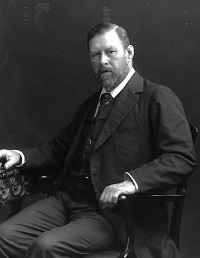
Some of his TV work is as cult-y as his film work.  In 1991, he guest-starred in three episodes of David Lynch’s glorious, off-the-wall crime / horror / sci-fi / soap opera Twin Peaks, playing Thomas Eckhardt, a Hong Kong-based crime-lord who has a long and dark history with Joan Chen’s Jocelyn Packard.  Two years after that, he appeared in the underrated, Oliver Stone-produced mini-series Wild Palms, a hybrid of conspiracy thriller, Alice in Wonderland and the then-recent literary genre of cyberpunk.  Set in a near-future USA, under the heel of an organisation that’s part multinational corporation and part Scientology-style religious sect, the show features Warner as Eli, the leader of an underground resistance movement.  (This clip neatly encapsulates Wild Palms’ weird energy.)  And in 2014 he popped up in John Logan and Sam Mendes’ gothic horror mash-up Penny Dreadful, in the role of Bram Stoker’s vampire hunter Abraham Van Helsing.  Because Warner played Frankenstein’s creature in 1984, it’s ironic that in Penny Dreadful – in a cheeky tangling of Stoker and Mary Shelley’s original narratives – Van Helsing gets killed by the same creature, played this time by Rory Kinnear.


In 2005 Warner was involved with the macabre TV comedy show The League of Gentlemen, written by and starring Mark Gatiss, Reece Shearsmith, Steve Pemberton and Jeremy Dyson.  In fact, he didn’t appear in the show itself, but in its cinematic spinoff The League of Gentlemen’s Apocalypse.  Like many a film-based-on-a-TV-show, it doesn’t really work on the big screen, though its most effective scenes are definitely those featuring Warner as a 17th century magician called Dr Erasmus Pea.  His character is rottenly evil but he’s very amusing too.  For example, while Dr Pea uses a pan to fry a hellish concoction including two recently gouged-out eyeballs, from which he plans to grow a monstrous homunculus, the camera cuts to a close-up and he pulls a pretentiously absorbed, TV-chef expression worthy of Jamie Oliver.


Warner clearly gets along with The League of Gentlemen’s creators, because since then he has appeared alongside Mark Gatiss in the radio comedy show Nebulous (2005-8); in The Cold War, a 2013 Gatiss-scripted episode of Doctor Who; and in The Trial of Elizabeth Gadge, a 2015 episode of Reece Shearsmith and Steve Pemberton’s acclaimed anthology show Inside No. 9.


The 21st century has seen Warner return to the stage, giving well-received turns as the venerable and vulnerable monarch in King Lear in 2005 and as Falstaff in Henry IV Parts I and II in 2007.  His IMDb entry lists his most recent movie appearance as 2018’s Mary Poppins Returns and says he was still doing voice-work last year.  Warner is now at an age where you wouldn’t begrudge for him retiring and choosing an easier life of armchairs, cardigan, slippers and pipe, but I for one hope that some young filmmakers – perhaps ones who grew up enjoying his performances in The Omen, Time After Time, The Time Bandits and Tron when they were shown on TV – coax him into making a few more movies.  He’s the sort of actor whose mere presence in a film, no matter how good or bad, gives you a glow.


© Handmade Films / Janus Films

Jim Mountfield takes a train


© Midnight Street Press


My short story Ballyshannon Junction is featured in the recent anthology Railroad Tales, edited by Trevor Denyer and published by Trevor’s Midnight Street PressRailroad Tales is a collection of stories ‘involving railroads, trains, stations, junctions and crossings’ that also involve the ‘horrific, supernatural or extraordinary’.  For that reason, Ballyshannon Junction is attributed to the pseudonym Jim Mountfield, the penname I attach to my macabre fiction.  (Well, my real name ‘Ian Smith’ hardly sounds as evocative as, say, ‘Edgar Allan Poe’ or ‘H.P. Lovecraft’ or even ‘Dean R. Koontz’.)


Ballyshannon Junction had a long gestation period.  It’s rooted in my childhood in Northern Ireland when, up until the age of eight or nine years old, I was lucky enough to have a former railway station as my personal playground.  My family were farmers and, after my parents got married, my grandparents decided to move out of the family farmhouse to let their son and new daughter-in-law get on with the running of the farm.  They bought the nearby Bundoran Junction, a former railway-station building and its surroundings that’d last seen trains in 1957 when the Irish Northwest line was closed, and they lived there in retirement.


The property had two platforms, one by the line to Enniskillen in County Fermanagh and one by the line to the seaside town of Bundoran in County Donegal.  My grandfather planted trees along one line and filled in part of the other to create a lawn.  I often spent the day there, or stayed with my grandparents overnight, and the place was like catnip to my young imagination.  The station house had a glasshouse-like annex that I’d always thought was the old waiting room, although I’ve recently learned that it operated as a ‘refreshment room’.  In addition, there were sheds, a pavilion building, a pond whose water was presumably used for filling the old steam locomotives and, best of all for a kid like me, an intact signal box with a staircase leading up to it – great for playing at being soldiers, knights, the Foreign Legion, the US Cavalry or anything else that might require a fort.  I also remember a section of rusty metal wall that, according to this website, had once been the station’s urinal and, obstinately, still stands today.


Just to make the Junction seem more exotic still, the strip of ground behind the station building, between the two platforms and lines, was covered in trees. This belt of woodland was only a few metres wide, but to someone of my small size and immaturity it seemed like a dense forest.


In the mid-1970s, my grandparents relocated to the village of Ballinamallard, three miles away, and Bundoran Junction was bought by a retired clergyman, the Reverend Robert Simmons, and his family.  However, after that, I remained a regular face at the Junction because I was at school with the Simmons’ two sons and sometimes got invited to visit them.


I’d been trying to use my memories of the Junction as the basis for a story since my teens. In fact, when I was 16, I wrote the first 20 pages of a story wherein a young homeless man, wandering about the countryside, stumbles across a disused railway line and starts living in an old signal box.  There were no station building or platforms in the story, and I added a railway tunnel, but otherwise the setting was identical to Bundoran Junction.  (The story’s premise was that the young man became convinced that something hideous and evil was lurking in the tunnel.  He’d even find weird slimy footprints in the mornings, leading up the stairs to the door of the signal box, which suggested the thing was stalking him.  But – curses! – I could never figure out what the thing in the tunnel actually was and eventually I abandoned the story.)


In the years since, I’ve tried several times to write other stories based on the Junction, but with a similar lack of success.  Then, earlier this year, when Trevor Denyer announced that Railroad Tales was open for submissions, I decided to try again.


It also occurred to me that with my previous attempts at Junction stories, I’d always set the action not in Northern Ireland, but in some anonymous, generic tract of the English countryside.  This time, I thought, why not write something about Bundoran Junction that’s actually set in Northern Ireland?  To my surprise, I got the story finished and, to my immense satisfaction, it was accepted for Railroad Tales.


Not only does Ballyshannon Junction – Ballyshannon is a town in Donegal that’s close to Bundoran, the place that the real Junction was named after – take place in Northern Ireland, but it’s set in the year 1982, which wasn’t long after the period when I played there as a kid.  For that reason, although it contains supernatural elements, Ballyshannon Junction is also informed by the mistrust, conflict, sectarianism and terrorism that blighted Northern Ireland at the time.


309 pages long, and bringing together 23 weird and creepy stories with a railway theme, Railroad Tales can be purchased through Amazon UK, here.


From eadiemcfarland.co.uk

How ZZ Top stopped me topping myself


From Wikipedia / © Brian Marks


It’s farewell, alas, to Dusty Hill, who recently passed away at the age of 72.  Hill was bassist and sometime vocalist with the mighty blues / boogie / hard-rock Texan power trio ZZ Top, and not only was his musicianship crucial for the muscular tempo of those much-loved Top songs, but his appearance was crucial for the band’s image.  Sporting Stetson, sunglasses, beard – a lot of beard – he was almost indistinguishable from the similarly hatted, shaded and hirsute Billy Gibbons, ZZ Top’s lead guitarist and vocalist.  This meant two-thirds of the band seemed to consist of man-sized, guitar-wielding, Texan versions of Cousin It from The Addams Family.


The band’s third member, drummer Frank Beard, had a moustache but a clean-shaven jaw.  This is probably the best-known amusing fact in the entire world, but it hasn’t stopped pub-bores during the past 40 years declaring: “Hey, here’s something funny you won’t know!  The guy in ZZ Top who doesn’t have a beard is called Frank Beard!”


ZZ Top don’t get much credit for being a blues band, but one reason why I like them is because of the obvious influence blues music has had on their sound.  Indeed, the ‘ZZ’ part of their name pays tribute to Texas bluesman ZZ Hill, and Billy Gibbons had toyed with the idea of calling the band ZZ King, in honour of the legendary BB King too, but decided that would be a bit much.  No matter how hard, raucous, even heavy metal-ish they became at times, and even when they hit paydirt in the 1980s after sprucing up their sound with new technology, like synthesizers, and embracing new media, like MTV, the chord progressions powering their songs remained defiantly bluesy – My Head’s in Mississippi from their 1990 album Recycler is a particularly exhilarating example.  Blues-music writer Charles Shaar Murray neatly described their sound from this period, lean and relentless, but with a crisp studio sheen, as ‘cyber-blues’.


When they made it big with the 1983 album Eliminator, they managed to make themselves cool by being determinedly uncool.  Their videos were packed with foxy, leggy 1980s babes, but whereas the members of your average 1980s hair-metal band would be strutting like randy tomcats among the luscious ladies, eyes goggling, tongues waggling, ZZ Top stayed on the sidelines.  Hill, Gibbons and Beard would suddenly appear in their videos as if they’d beamed down from the Starship Enterprise.  They wouldn’t interact with the ladies but just play a few riffs, throw some schmuck the keys of the ZZ Top car (a cherry red 1933 Ford Coupe), point mysteriously and de-materialise again.  This they did whilst clad in unphotogenic, dusty hats and denims.  No wonder that when they made a cameo appearance in one of the Wild West scenes in Back to the Future, Part III (1990), they had no problems blending in.


© Warner Bros.


All ZZ Top’s albums are worth a listen – I think their final album La Futura (2012), which has another corking blues track Heartache in Blue, is really good – but it’s their trilogy Eliminator (1983), Afterburner (1985) and Recycler (1990) that sees them capture the zeitgeist.  Recycler, which one critic described as ‘worth stepping over a few rattlesnakes to buy’, is for me their finest hour.  It effortlessly straddles the interface between modern America, a place of ‘concrete and steel’, ‘flying saucers off the Presley estate’, penthouses, fast food and 7-11s, and the America of old, one of the ‘Texas sand’, ‘dust and haze’, cowgirls and ‘old Levi’s’, with a clutch of songs that are both bracingly up-to-date and pleasingly retro.


There aren’t many culturally cool things that Texas is associated with.  After all, this is the place that’s given us George W. Bush, Ted Cruz, Vanilla Ice and the Dealey Plaza.  That’s why my partner’s parents, who live in the Texan city of San Antonio, always opt for a ZZ Top T-shirt when they want to give me a souvenir of their state of residence.  Thus, I’ve amassed quite a collection of ZZ Top T-shirts over the years.


And now for a personal digression.  Here’s how during 1984-85, ZZ Top helped keep me sane.


I’ve done many different jobs in my time.  If anyone asks me what my least favourite job was, I immediately reply: “Being a member of the floor-staff at Ritzy’s nightclub in Aberdeen.”  This was during my second year as a student at Aberdeen University and I worked at Ritzy’s three or four evenings a week, earning some money to compensate for the fact that I hadn’t been awarded any student grant that year.  (Yes, this was in the days when students in the UK not only had their tuition fees paid for but many of them received a grant to cover their living expenses too.  Of course, as soon as the generation that benefitted from this educational generosity graduated, became politicians and assumed positions of power – Tony Blair, I’m looking at you – they abolished the system for the kids who came after them and saddled them with potentially ruinous student loans instead.)


At Ritzy’s nightclub, I’d don a short-sleeved, light-blue boiler suit and lug around a plastic crate all evening.  In the crate I’d place empty glasses and full ashtrays from the punters’ tables, then carry them to the work-spaces behind the club’s bars where I’d empty the ashtrays and wash them and the glasses.  Then I’d return the clean glasses to the bar-shelves and the clean ashtrays to the tables.  Doing this job at Ritzy’s – which’d previously been known as ‘Fusion’ and would later be known as the subtle-as-a-brick ‘Bonkers’ – was shit for a great variety of reasons.


It was shit that I had to work till 2.00 AM every Friday and Saturday night while all my mates were out enjoying some social life.  It was shit that the club used a particular design of tumbler, a structurally unsound design, that exploded and sprayed you with shards if you stacked too many of them together.  It was shit that the glasses you collected were often phenomenally grotty, with booze still inside them and cigarette butts floating around in that.  (Not everyone in Aberdeen at this time had mastered the new-fangled invention that was the ashtray.)  It was especially shit that many of the punters were workers in the then-flourishing oil industry whose headquarters was in Aberdeen, and made barrow-loads of money, and believed that their earnings entitled them to behave like knob-heads at all times – especially towards serfs like myself, trying to scrape together a few pennies by carting crates of glasses and ashtrays around a nightclub at the weekends.


But worst of all was the nightclub music.  1984-85 was a particularly horrible era in terms of British popular music and it was grueling indeed to lug your crate of glasses about, get insulted by dickhead oilmen, and at the same time be blasted by likes of The Reflex by Duran Duran or Wake Me Up Before You Go-Go by Wham or,  joy, The War Song by Culture Club.  Even worse was how the DJ – a fellow whose day-job was with the local radio station, Northsound – would play certain songs, which in themselves weren’t so obnoxious, again and again until hearing them became the musical equivalent of the Chinese water torture.  Even today, if I ever hear Lost in Music by the Sisters Sledge, or Solid as a Rock by Ashford and Simpson, or No More Love on the Run by Billy Ocean, or Roni Griffith’s cover of The Best Part of Breakin’ Up, I suffer from a type of post-traumatic stress disorder where I have harrowing flashbacks to the hellscapes of mid-1980s Ritzy’s.


It wasn’t much better when I was scheduled to work mid-week at the special evening Ritzy’s held for the over-30s, which was known in local parlance as ‘grab-a-granny night’.  (Yes, back then, granny-dom began pretty early in Aberdeen.)  This featured a live band that performed cover versions of songs currently in the charts.  I realise the band did their best and I don’t want to slag them off…  But I have to say their front-man, a bloke called Stan, doing his Bruce Springsteen impersonation during Dancing in the Dark wasn’t the most edifying thing I’ve ever seen or heard.


© Warner Bros.


But mercifully, this was when ZZ Top were riding high in the British album charts with Eliminator and during my year at Ritzy’s the band released a mighty trio of singles from that record: Gimme All Your Lovin’, Sharp Dressed Man and Legs.  At least one of these would be played each evening in Ritzy’s and as soon as Frank Beard’s drumbeat started, followed by Billy Gibbons and Dusty Hill’s crunchy guitars, I’d actually smile.  I’d even find myself singing as I struggled with my heavy crate through the crowd: “You got to whip it up… And hit me like a ton of lead…!”  Etcetera.


I’d even swear that as soon as a ZZ Top number started playing, the dancing in Ritzy’s – which hitherto had resembled a net-load of flopping, convulsing fish being dumped across the deck of a North Sea trawler – would suddenly improve.  Folk would suddenly smarten up and jig with a military precision, courtesy of Beard and Hill’s infectious, but meticulously-measured rhythm section.  I’ll go further still and suggest that Stan at grab-a-granny night never sounded better than when he was wrapping his tonsils around Sharp Dressed Man.


If only, while I was wrestling my way through the punters at Ritzy’s in the mid-1980s, ZZ Top had actually materialized and tossed me their car-keys…


From antiquesnavigator.com 

Seriously Sean – ‘The Wind and the Lion’


© United Artists / Colombia Pictures / MGM


Written and directed by John Milius, released in 1975 and very loosely based on a real-life incident that occurred in 1904, The Wind and the Lion is a tale of derring-do in the Moroccan Rif combined with political intrigue in Washington DC.  I first saw it when I was in my late teens and appropriately for a film with ‘wind’ in its title – that’s wind of the meteorological, non-flatulent variety – it blew me away.


Following the death of its star Sean Connery last year, I decided to watch The Wind and the Lion again. I felt slightly trepidant doing so, as there’s more than one film that I admired in my youth but found less-than-brilliant when I saw it again at a more mature age.  A prime example is Robert Altman’s 1970 comedy about the Korean War, M*A*S*H, which once upon a time seemed exhilarating in its irreverence and anarchy, but nowadays strikes me as juvenile and mean-spirited.


The Wind and the Lion’s opening sees Connery’s character, master-brigand Mulai Ahmed el Raisuli – the Raisuli – lead a raid on the Moroccan home of wealthy American widow Eden Pedecaris (Candice Bergen) and abduct her and her young children (Simon Harrison and Polly Gottesman).  My hopes that I’d hang onto my previous high opinion of The Wind and the Lion took a blow at this early point.  It isn’t so much the fact that Eden’s houseguest at the time, Sir Joshua Smith (played by Billy Williams, not an actor but the movie’s cinematographer, who’d later win an Academy Award for his work on Richard Attenborough’s 1982 epic Gandhi), gallantly fights off the attacking hordes, is killed and then despite his heroism is barely mentioned by the Pedecarises or anyone else during the rest of the film.  No, it’s the fact that Eden, understandably upset by what’s happened, laughs in scorn when the Raisuli is thrown off a recalcitrant horse – and the Raisuli reacts by whacking her across the face.  “I am Raisuli,” he snarls.  “Do not laugh at me again.”


Yes, it’s 1904, when misogyny was a universal and unremarked-upon fact of life.  (It still is in many places, of course.)  But Connery’s later years and posthumous reputation were tainted by allegations of domestic abuse against his ex-wife Diane Cilento and by troubling comments he’d made about the acceptability of slapping women.  This moment in The Wind and the Lion is a dismaying reminder of that.


The Raisuli and his men carry the Pedecarises off to their camp in the Rif, beyond the reach of the Moroccan authorities.  His motive for kidnapping them is to damage Morocco’s Sultan Abdelaziz.  By issuing an extravagant ransom demand, he hopes to embarrass the Sultan, provoke the Americans and generally stir up trouble.  The Sultan’s uncle is the wily Bashaw of Tangier, the Raisuli’s brother, and he deeply resents how this wing of his family have allowed their country to become humiliatingly and corruptingly mired in foreign influence.  As the Bashaw himself admits at one point: “I have been threatened by the French, the Germans, the English… Yes, we have French infantry and German cavalry.  Our currency is Spanish.  But my nephew is the Sultan of Morocco.  As it is, it shall be.”


The Bashaw, incidentally, is played by the Polish character actor Vladek Sheybal, who was memorable as the villainous Kronsteen in Connery’s second Bond outing From Russia with Love (1963).  But it has to be said that the strapping, hairy Connery and the sleek, lupine Sheybal look as much like brothers as Arnold Schwarzenegger and Danny DeVito did in Ivan Reitman’s Twins (1988).


© United Artists / Colombia Pictures / MGM


Happily, once the main narrative of The Wind and Lion gets underway, the film becomes as good as I remembered it to be.  Connery and Bergen make the scenes featuring Eden Pedecaris and the Raisuli a joy.  She gradually shifts from being deeply unimpressed by him – “It is not my intention to encourage braggers,” she tells curtly him after he’s given a windy introduction calling himself ‘Raisuli the Magnificent’ and ‘the true defender of the faithful’ with the ‘blood of the prophet’ in his veins – to feeling affection for the twinkly-eyed old rogue.  Likewise, Connery’s admiration for her increases, although the banter between them never quite loses its edge.  After they start to spend the evenings playing chess, she warns him, “You are in a lot of trouble!  You should never have moved that knight or kidnapped me.  Both will see you undone.”  He responds, “It is not I who determine the outcome of events.  It is the will of Allah…”


Meanwhile, the Pedecaris children, removed from an upper-class Western world of manners, gentility and stuffiness, begin to have a whale of a time. For the boy, William, hanging out in a desert camp with the Raisuli and his sword-wielding, rifle-popping Berber militia is like Tom Sawyer’s dream of running away from home and becoming a pirate made real.


But this is only half of the story of The Wind and the Lion.  For on the far side of the Atlantic, President Teddy Roosevelt (Brian Keith) is seeking re-election.  He seizes upon the incident as an opportunity to show the voters his mettle, although his Secretary of State John Hay (John Huston) is less keen on the idea.  The garrulous and ebullient Roosevelt has his consul in Morocco (Geoffrey Lewis) and a US military force headed by an admiral (Roy Jenson) and a marine captain (Steve Kanaly) stage what nowadays would be called an intervention.  A squad of marines and sailors blast their way into the Bashaw’s palace in Tangiers, determined to knock heads together so that some sort of deal is reached and the Pedecarises are freed.  This is regardless of local sensibilities and the interests of the European colonial powers with fingers in the Moroccan pie.


A bargain is made and the three Pedecarises are released into the custody of a group of US marines headed by Kanaly’s character, Captain Jerome.  But the Sultan’s Moroccan soldiers and their German allies capture the Raisuli, going against what was agreed.  Thus, Eden, his erstwhile prisoner, has to persuade Jerome and his men to rescue him, so that the deal made in Roosevelt’s name is fully honoured…


Images of gung-ho Americans stomping into foreign lands they don’t properly understand, shooting first and asking questions later, trying to get the job (as they see it) done irrespective of local complexities, were not, it’s fair to say, popular in liberal mid-1970s Hollywood just after the Vietnam War.  And John Milius himself, co-writer of Apocalypse Now (1979) with Francis Ford Coppola, was obviously aware of the omnishambles Vietnam had been.  However, with The Wind and the Lion, he seems to hark back longingly to simpler times when America could do this sort of thing with fewer complications and consequences.  He particularly idolizes Teddy Roosevelt for embodying all the things he believes America should be about.  Roosevelt has brains, yes, but he has brawn too and is plain-speaking and no-bullshitting, and is none the worse for that.


© United Artists / Colombia Pictures / MGM


This adulation comes to the fore in a few scenes where Roosevelt joins a hunting party that shoots a grizzly bear and then he has the big, fearsome beast stuffed and mounted.  “The American grizzly,” he tells a reporter, “is a symbol of the American character: strength, intelligence, ferocity.  Maybe a little blind and reckless at times, but courageous beyond all doubt.  And one other trait…  Loneliness.  The American grizzly lives out his life alone.  Indomitable, unconquered, but always alone.  He has no real allies, only enemies, but none of them as great as he.”  Fair enough, you find yourself thinking – but if the grizzly bear is as noble as old Teddy claims it is, why did he have the poor bloody thing shot in the first place?


To be fair, the film gives a more rounded portrayal of Roosevelt than that.  He’s shown to be somewhat pompous and smug, annoying in his loquaciousness, and clearly a scheming sort.  I wonder, though, how much of this is due to Brian Keith’s performance rather than to Milius’s script.


What redeems the film politically – at least, if you’re a left-wing pinko like me – is the fact that as it progresses, Keith’s Roosevelt and Connery’s Raisuli, though they never get to meet, feel a growing respect and even kinship for each other.  By the film’s close, the Raisuli has penned Roosevelt a letter, which says: “…you are like the wind and I like the lion.  You form the tempest.  The sand stings my eyes and the ground is parched.  I roar in defiance but you do not hear…  I, like the lion, must remain in my place. While you, like the wind, will never know yours…”


If you’re going to have movies full of jingoistic American nonsense, at least have ones like this, where the American protagonists don’t see foreigners as drone-like commies, gooks or towel-heads but as fellow human beings with equivalent amounts of nobility and courage.  It just grieves me that a decade later, Milius had abandoned all attempts at nuance and was directing unashamedly right-wing and brainless shite like Red Dawn (1984).


Overall, then, I’m pleased and relieved to say that The Wind and the Lion still holds up well.  Milius directs with aplomb.  His orchestration of the sequence where the Americans storm the Bashaw’s palace is worthy of Sam Peckinpah while the desert scenes, accompanied by Jerry Goldsmith’s sumptuous and yearning score, are frequently gorgeous.  Brian Keith and Candice Bergen are excellent and Connery, intoning such great lines as “Ignorance is a steep hill with perilous rocks at the bottom,” or “If I miss the morning prayer, I pray twice in the afternoon – Allah is very understanding,” or finally, “I’ll see you again, Mrs Pedecaris, when we’re both like golden clouds on the wind!”, has never been better.


Although how this Moroccan Berber brigand ended up speaking with such a mellifluous brogue is a mystery.  Perhaps his English teacher came from Edinburgh.


© United Artists / Colombia Pictures / MGM

Travellers at the bar


As I mentioned in my previous blog-entry, the latest Covid-19 lockdown in Sri Lanka, which was imposed for a good part of May and June, has recently been relaxed.  This relaxation has allowed some eating and drinking places to re-open.


However, one place that my partner and I have often retreated to in the past, when we’ve felt the need for calm and a touch of soothing, old-school luxury (to convey the illusion for a few hours that we’ve actually got money), remains off-limits to us.  This is the Traveller’s Bar and its lovely outdoor verandah, which overlooks the Indian Ocean, at Colombo’s Galle Face Hotel.  For now, the bar and verandah are open only for hotel guests, not outside customers.  This is a shame because few things are as good for the soul as sitting there between six and six-thirty on a clear evening and watching the sky segue from one gorgeous colour to another while the sun sinks behind the distant waves.
 

The Galle Face Hotel will soon be a venerable 120 years old and it’s prestigious enough to have featured in Patricia Schultz’s 2003 travel book 1000 Places to See Before You Die.  Predictably, during its long history, it has accommodated some very famous guests.  Many of these are commemorated by a gallery of framed photographs adorning the interior of the Traveller’s Bar, with information about the years, occasionally just the decades, when they stayed there.


Among the earliest people featured in the gallery are writers.  You see Anton Chekov (credited with being at the Galle Face in 1890), George Bernard Shaw (in the 1930s), W. Somerset Maugham (the 1920s), Noel Coward (1944) and Evelyn Waugh (the 1950s).  D.H. Lawrence showed up there in 1922, presumably either on his way to or from the 99-day sojourn he had in Australia that gave rise to his novel Kangaroo, published the following year.


One literary hero of mine, Sir Arthur Conan Doyle, stayed at the Galle Face Hotel in 1920 and, unimpressed by its prices, described it as ‘a place where the preposterous charges are partly compensated for by the glorious rollers that break upon the beach outside.”  He was also unimpressed by the equally famous Mount Lavinia Hotel, which in those days stood beyond the southern edge of Colombo.  “There are two robbers’ castles, as the unhappy visitor calls them, facing the glorious sea, the one Galle Face, the other the Mount Lavinia Hotel.” At least he appreciated the journey between the castles: “They are connected by an eight-mile road, which has all the colour and life and variety of the East for every inch of the way.”


At this point Doyle was heavily into spiritualism and had been gullible enough to believe that the notoriously faked Cottingley fairies were real.  However, he retained enough of his wits not to be taken in by a display of the famous ‘mango-tree’ trick, which a Sri Lankan magician did for him just outside the hotel.  Doyle praised the magician’s skill, though: “He did it so admirably that I can well understand those who think that it is an occult process.”
 

I’m perplexed by the presence of a portrait of James Joyce, supposedly a guest of the Galle Face in 1904.  (Coincidentally, June 16th, 1904, was the date of ‘Bloomsday’, the day during which all the events of Joyce’s 1922 masterpiece Ulysses take place).  To the best of my knowledge, he never travelled outside Europe, let alone visited southern Asia.  In fact, the only connections I can dig up between Joyce and Sri Lanka are that: (1) he makes mention of the ‘Cinghalese’ in Ulysses; and (2) he was known to own a copy of Henry Olcott’s Buddhist Catechism According to the Sinhalese Canon – Olcott was the American army officer who became the first president of the Theosophical Society and was an important figure in the revival of Buddhism in Sri Lanka, so much so that he’s honoured with a statue in front of Fort Railway Station today.


Perhaps somebody else with the name ‘James Joyce’ stayed at the hotel in 1904?


One writer not displayed in the Traveller’s Bar is legendary science-fiction scribe Sir Arthur C. Clarke, even though it was in the Galle Face that he supposedly wrote the last chapters of the last volume of his Space Odyssey series, 3001: The Final Odyssey (1997).  However, Clarke had lived in Sri Lanka since 1956, so he wasn’t really what you’d call a ‘visitor’ or a ‘guest’.


The Traveller’s Bar gallery is mostly a collection of the great and good, but it has at least one rogue in it, namely Richard Nixon.  He stayed at the hotel in the 1950s, sometime before he became the second-most crooked US president in modern history.  Other political dignitaries who were guests there include father and daughter Indian Prime Ministers Pandit Jawaharlal Nehru (1950) and Indira Gandhi (1976); and iconic revolutionary Che Guevara, whose portrait says he stayed in 1958, although according to a feature in Sri Lanka’s FT his visit was actually in August 1959.  He’d come to Sri Lanka because it was one of the first countries to recognize Castro’s Cuba.


From the mid-20th century onwards, Sri Lanka began to appeal as an exotic location to Western filmmakers and so the Galle Face Hotel had Hollywood movie stars stay while on their way to or from film shoots.  These include Sir Alec Guinness (1957), in town for the making of Bridge on the River Kwai and, I have to say, looking a bit shifty in his photograph; Harrison Ford (1983), there to make Indiana Jones and the Temple of Doom (whose production had switched from India to Sri Lanka after the Indian government objected to the ‘thuggee’ elements in its script); and Ursula Andress, whom I trust enjoyed her stay in Sri Lanka in 1976 even though she probably prefers to forget the film she made there, the Italian horror movie The Mountain of the Cannibal God, directed by Sergio Martini and considered so offensive in Britain that it was classified as a ‘video nasty’ and banned until 2001.


Andress, of course, found international fame as the very first Bond girl.  Meanwhile, the man responsible for the third cinematic incarnation of James Bond, Roger Moore, appears in the Traveller’s Bar too.  He’s said to have stayed at the hotel in the 1960s, but he’s depicted in his famous 1970s Bondian bowtie and dinner-suit, so the photo obviously wasn’t taken at the time.


One star in the Traveller’s Bar who’s rather forgotten nowadays is Lex Barker, who took over the role of Tarzan from Johnny Weissmuller in 1949.  Barker’s picture says he was there in the 1950s, although the only thing I can find in his filmography that was made in Sri Lanka was a 1963 movie called Storm Over Ceylon.  While Barker’s Hollywood Tarzan movies were too low-budget to be filmed on location in a tropical country like Sri Lanka, money was not a problem for Bo Derek and her director-husband John Derek, who used Sri Lanka for the jungle scenes of their notorious, mammary-obsessed Tarzan the Ape Man (1981), while using the Maldives for its beach scenes.  For their salacious take on Edgar Rice Burroughs’ Lord of the Jungle, Bo, John and their crew imported some decidedly non-native wildlife into the country.  According to an article in the New York Times, they brought with them a lion (called Dandi), an orangutan (called C.J.), three chimpanzees, two Irish wolfhounds and an 18-foot, 120-pound python.  Thus, Ms Derek is now commemorated by a portrait in the Traveller’s Bar as well.


A nice story is attached to Gregory Peck, who stayed in 1954 whilst making a film called The Purple Plain.  Apparently, he came down with a nasty bout of flu, but recovered with the help of a traditional local remedy of plain tea incorporating inguru and kothamalli (ginger and coriander).  In the 1950s Peck was a global heartthrob and his use of this remedy didn’t go unnoticed by his lady admirers in Sri Lanka.  As another article in the Daily FT observes: “It used to be said in lighter vein those days that many upper-class ladies of Colombo 7 began drinking ginger / coriander tea only after Gregory Peck told them about it.”


Finally, the gallery sports a picture of the first man in space, Yuri Gagarin, symbolically holding a white dove.  The great Russian cosmonaut came to Sri Lanka in 1961 and among the things done to mark the visit was the planting of a tree in his honour at the botanical gardens in Peradeniya, close to Kandy.  According to a piece published by the Russian Centre for Science and Culture in Colombo, the tree was said to have stopped growing at the time of Gagarin’s death in a jet crash in 1968.  However, mysteriously, it continued to live, so that it’s resembled a young tree for the past half-century.  This is contradicted by an article in Ceylon Today, which claims it merely fell ill at the time of Gagarin’s death, but recovered and kept on growing.  I was at the botanical gardens a few years ago and really wish I’d examined the Yuri Gagarin tree to find out which of these accounts was true.


Still ruled by the Queen


© EMI / Elektra Records


Back in 2018, I found myself in a Colombo pub one evening having a blether with Suresh De Silva, the vocalist and co-founder of the Sri Lankan heavy metal band Stigmata.  Within seconds of the start of our conversation De Silva had asked me if I’d seen Bohemian Rhapsody, the movie biopic of the 1970s / 1980s rock band Queen, which’d been released in Colombo cinemas a few weeks earlier.  The unexpectedness of the question threw me a little.  It also reminded me of the hugeness of the phenomenon that is Queen.


It’s a phenomenon that transcends place.  National boundaries seem not to matter when it comes to liking Queen.  Meeting a Sri Lankan heavy metaller in 2018 who wanted to talk about the band wasn’t my first experience of this.  I remember working long ago at a language school in the UK that had weekend discos for its kids.  At one point there were a lot of self-consciously trendy and streetwise teenagers from Milan at the school and the DJ who oversaw that weekend’s disco thought he’d please his audience by playing then-modish big beat, drums and bass, UK garage and hard trance tunes.  But he ended up nearly causing a riot.  What did those trendy Italian teens want him to play? I Want to Break Free by Queen.  All bloody evening.


Their popularity also transcends time.  They remain fabulously popular today even though they’ve been creatively inert since 1991, when their singer Freddie Mercury passed away from AIDS.


I find this interesting because back in the days when they were a properly functioning band, friends of mine who considered themselves serious and knowledgeable connoisseurs of music would tell me that though they tried to be broad-minded, they just couldn’t stomach bloody Queen, whom they saw as purveyors of bloated, corny, stomp-along, guitar-twiddling shite.  Meanwhile, other folk, who bought at most three CDs a year and barely knew the difference between Elvis Costello, Elvis Presley and Reg Presley – the majority of the British population in other words – believed Queen were the absolute bees’ knees.


Incidentally, it seemed ironic to me how popular Queen were in the 1970s and 1980s among guys who were unreconstructed, macho and laddish and who, in all likelihood, were pretty homophobic too.  They were liable to punch you in the face if you suggested they were into anything that might be classified as ‘gay’ culture.  But after a few moments of hearing the unashamedly camp Freddie Mercury crooning, “Oooh, you make me live… / Oooh, you’re my best friend!”, they’d be hugging each other, shedding sentimental tears and singing along in emotion-cracked voices.


© 20th Century Fox / Regency Enterprises / GK Films


I wasn’t greatly impressed by Bohemian Rhapsody when I caught up with it, sometime after speaking to Suresh De Silva.  It takes many liberties with the truth.  For example, the band weren’t on the wane before their barnstorming appearance at the 1985 Live Aid concert at Wembley Stadium, which the film claims pulled them back from the brink.  On the contrary, during the previous year and following the release of their 1984 album The Works, I remember them being as popular and prominent as ever.  And there was no big emotional moment before they took the Wembley stage when Freddie told his bandmates he was HIV positive.  In reality, he didn’t know this until 1987.


Meanwhile the film airbrushes away the band’s real-life moral warts and carbuncles. We get nothing about, for instance, their misguided and money-fuelled decision to play at the Sun City Super Bowl in Bophuthatswana, South Africa, at the height of the apartheid era.  This act of unprincipled greed earned them a ban by the British Musicians’ Union.  Also doused in a tankerload of whitewash is the issue of Freddie’s promiscuity.  In 1984, the real Freddie bragged to the DJ Paul Gambaccini with hedonistic and, considering the times, reckless abandon: “Darling, my attitude is ‘f**k it’.  I’m doing everything with everybody.”  But in Bohemian Rhapsody he’s presented as a victim, insecure about his sexuality and led astray by his personal manager Paul Prenter, who introduces him to a world of partying, orgy-ing and general dissolution.


Still, the sequence in the film with Mike Myers as a (fictional) record executive called Ray Foster, who’s aghast at the idea that Bohemian Rhapsody-the-song should be released as a single, is funny.  “It goes on forever.  Six bloody minutes!”  To which Freddie retorts: “I pity your wife if you think six minutes is forever.”


Personally, I thought 1970s Queen were great.  They produced albums like Sheer Heart Attack (1974), A Night at the Opera (1975), A Day at the Races (1976) and News of the World (1977) that were studded with classic songs and, though they sometimes felt all over the place stylistically, were admirable for trying to explore a wide range of musical genres, everything from music-hall singalongs and salsa-y Spanish guitar workouts to blues and jazz and even, with 1974’s Stone Cold Crazy, nascent speed metal.  The rip-roaring Death on Two Legs, which kicks off A Night at the Opera, is one of my favourite songs ever.


But for me they seemed to lose their creative mojo at the beginning of the 1980s.  The last song by them that I liked was probably their 1981 duet with David Bowie, Under Pressure.  Actually, I didn’t think much of Under Pressure at the time, but it’s grown on me since then.  It’s certainly a zillion times better than Vanilla Ice’s dire 1990 single Ice Ice Baby, which appropriated Under Pressure’s memorably nagging bassline.  (I remember being at a Saturday-night disco in my hometown in Scotland – the clubhouse of Peebles Rugby Club to be precise – when the DJ put on Ice Ice Baby.  The bassline started and everyone cheered and hurried onto the dance floor, thinking it was Queen and David Bowie.  Then the lyrics started: “Yo!  Let’s kick it!  Ice, ice baby…”  Everyone threw up their hands in horror and shouted, “Och, shite!  It’s Vanilla Ice!”  The dance floor immediately cleared again.)


Anyway, a few days ago, taking advantage of the fact that Sri Lanka’s most recent Covid-19 lockdown has been lifted, I went for a walk and ended up at the area where Colombo’s Dehiwala Canal meets with the Indian Ocean. It’s a pleasantly grassy and leafy neighbourhood although, thanks to the condition of the water in the canal, it’s a bit smelly too.  And lo and behold, on a wall standing at the canal’s southern bank, I saw further evidence of the global love for Queen.


Yes, it was a mural of Freddie Mercury in his moustached, short-haired, white-vested Live Aid incarnation, which presumably someone had painted after seeing Bohemian Rhapsody in 2018.


As I’ve suggested in this post, I have mixed feelings about Queen overall.  But the fact that in the 21st century a Sri Lankan graffiti artist was inspired to paint their iconic vocalist and master showman on an out-of-the-way, canal-side wall makes me feel strangely happy.


Rab Foster gets theatrical


© Aphelion Webzine


I’m pleased to announce that my 13,000-word story The Theatregoers has been published in the July 2021 edition of the webzine AphelionThe Theatregoers is a sword-and-sorcery story in, I hope, the tradition of such revered pulp writers as Robert E. Howard, Clark Ashton Smith and C.L. Moore and, as usual with my fantasy fiction, I have published it under the pen-name Rab Foster.


On this blog I’m not normally presumptuous enough to offer other writers, or aspiring writers, advice on how they should go about creating stories.  On this occasion, though, I’ll suggest two strategies that helped me to put The Theatregoers together.


Firstly, when you have an idea for a story, get that idea written down as quickly as you can before it flits from your memory again.  (At my age, things flit from my memory with terrifying speed.)  I have a 17-page-long document on my computer hard drive containing more than 400 ideas I’ve had for stories over the years and I’m constantly adding to it.


Admittedly, many of those ideas will probably never see the light of day as stories and, to be honest, looking at some of the ideas I wrote down long ago thinking they were bolts of divine genius, I don’t think the world will be missing anything if they don’t.  I doubt if anyone really wants to read a story about the notoriously bad Dundonian poet William McGonagall building a time machine in order to travel back in time to prevent the Tay Bridge Disaster from happening; or about a Sri Lankan tuk-tuk driver who’s secretly a superhero; or about ‘a fashion show for serial killers’, where the dresses have been fashioned out of…  Well, you can probably guess what they’re made of.


The other writing strategy I’d suggest is to keep reviewing your list of ideas and particularly think about how two or more ideas can be incorporated into one story.  In other words, don’t see each idea as a single seed from which a single story is grown.  Many times, I’ve had an idea that’s looked good on paper but that has resolutely refused to develop into a story – until it’s occurred to me to try splicing it together with another, seemingly totally different idea elsewhere on the list.


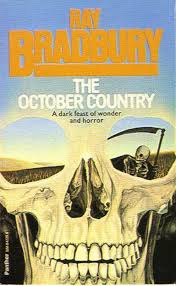
In fact, with The Theatregoers, I ended up throwing no fewer than four disparate ideas from my 17-page list into the creative blender.  I’d always wanted to write: (1) a story set in an abandoned city out in the middle of some inhospitable desert (similar to the setting of the 1921 H.P. Lovecraft story The Nameless City); (2) a story set in a theatre, where the characters would have adventures falling through trapdoors, scrabbling down stage curtains, flying about on wires above the stage, running through storerooms full of assorted props, and so on; (3) a story about vampire-like creatures that don’t drain their victims of blood but of moisture; and (4) a story about a tattooed person whose tattoos aren’t as inanimate as you’d expect, reminiscent of the title character in the classic Ray Bradbury collection The Illustrated Man (1951).  Somehow, I came up with a single, hopefully coherent narrative.


© Panther Books


For the next few weeks, the main page of the July 2021 edition of Aphelion can be accessed here, while The Theatregoers itself can be accessed here.

Scotland or Not-land?


From unsplash.com / © Stewart M


Most people in Scotland last week were disappointed, though probably not greatly surprised, to see their national team get a drubbing in the first round of the Euro 2021 tournament.  However, I suspect not everyone in Scotland was sad to see the team fail.


One person I’m sure was delighted was the Scottish, but very British-nationalist, blogger Effie Deans, who before the start of the tournament had tweeted a picture of a past Scotland-England football match and demanded angrily, “Why are there international matches between parts of the same country?” Similarly, I imagine certain fans of Glasgow Rangers, a football club whose culture revolves around such British symbols as the Queen and the Union Jack, weren’t sorry to see the Scottish national team flop.  Indeed, an article in the Daily Record newspaper on July 8th confirmed that some Rangers fans were unwilling to support Scotland during Euro 2021.


For Deans and a certain segment of the Rangers faithful, the belief seems to be that if you regard your country primarily as Britain, then you can’t support Scotland.  In fact, acknowledging Scotland on an international stage is damaging to your sense of Britishness and shouldn’t be encouraged.  Scotland?  No, it’s Not-land.


It’s not just in sport.  The idea that Scotland might have its own culture and languages is anathema to some people.  The right-wing Spectator magazine has printed pieces by embittered Scottish Daily Mail columnist Stephen Daisley and uptight Scottish composer James MacMillan complaining that (a) Scottish culture is infantile and embarrassing; but (b) if you’re stupid enough to be into Scottish culture, you’re somehow a Mussolini-type fascist too.  Amusingly, after MacMillan complained – falsely, because the man has actually won a number of Scottish awards – about Glaswegian novelist Andrew O’Hagan being cold-shouldered by the Scottish arts establishment for not being sufficiently supportive of Scottish independence, O’Hagan began, in the wake of the Brexit referendum, making favorable noises about Scotland becoming independent.


Particularly nasty has been the abuse aimed at the Scottish Gaelic and Scots languages.  Right-wing unionist twitter in Scotland is a constant whinge-fest about road-signs having names printed in Gaelic as well as in English.  Effie Deans again, complaining about travelling to Fort William last year: “The number of times I missed my turning made me wish the signs were in one language or the other, but not both…”  Well, dear, maybe try reading the parts of the signs that are written in the language you understand?


Meanwhile, dodgy, right-wing Unionist political carpetbagger George Galloway – at least, he’s right-wing when he’s in Scotland trying to hoover up Conservative votes; when he’s in England he campaigns as a left-wing man of the people – recently caused a pile-on on Scots-language poet Len Pennie after he made disparaging remarks on twitter about her and the medium in which she works.  And a few years back, Jackie Kay, Scotland’s Machar (poet laureate) received brickbats when one of her Scots-language poems was among the items given to new mothers as part of Scotland’s ‘baby box’ initiative.  “A woman from Bishopbriggs, writing doggerel,” sneered Ian Smart, prominent social media presence and self-styled ‘lefty lawyer’ and ‘Scottish Labour Party hack’.


Again, among many Scottish people who don’t see Scotland as a country but as a region, or as a big glorified county, of the mightier and more majestic entity that is the United Kingdom, there’s a conviction that Scottish culture can’t be real.  Accepting the existence of Scottish culture implies the place being different from the rest of the UK.  Therefore, culturally, there’s no such thing as Scotland either.  It’s Not-land.


From youtube.com


Predictably, the fact that there’s now a Scottish parliament in existence, separate from the parliament in London, is something that drives many British-loyal Scots to distraction, especially when the past 14 years have seen it run by a party, the Scottish National Party, dedicated to pulling Scotland out of their beloved UK.  Particularly guaranteed to make them gnash their teeth and froth at the mouth is any suggestion that the Scottish government, like the Scottish football team, might be recognized on an international level.  The moment First Minister Nicola Sturgeon pronounces on some international matter or dares to show her face at some international conference, Scottish twitter is raging with indignant people who have Union Jacks in their profiles (and usually the words ‘Rangers’ and the acronym ‘WATP’, which a Glasgow-Celtic-supporting friend assures me stands for ‘We adore the Pope’) slavering about her having ‘ideas above her station’ and being just the head of a ‘wee parish council’, and not knowing ‘her place’.  Can’t she see that she isn’t the First Minister of Scotland, but that of Not-land?


This desire to erase the concept of Scotland from everyone’s consciousness is, it has to be said, one that’s been exhibited lately by the British government too.  British diplomats have been ordered to stop talking about the ‘four nations’ of the UK and talk about it as a single country only, while supermarkets have seen a recent craze for plastering Union Jacks over foodstuffs made in Scotland.  Meanwhile, Prime Minister Boris Johnson, that symbol of everything decent, moral, honest and faithful about dear old Blighty, was heard bragging that at the upcoming COP26 climate summit in Glasgow he was going to slather the event in Union Jacks and wouldn’t allow Nicola Sturgeon anywhere near it.


Just last Friday, Johnson’s education minster urged schools across the UK to honour something called One Britain, One Nation Day, wherein schoolchildren were made to sing a song, specially composed for the occasion, that ended with the four-times-repeated refrain: “Strong Britain, great nation!”  Though considering what’d come to light by Friday, I suspect the savvier kids had changed the words to: “Matt Hancock, penetration!”  Unfortunately, hopes that this would convert all Scottish children to worshipping Winston Churchill, Spitfires and the Union Jack were dashed by the fact that in Scotland most schools had broken up for the summer holidays the day before.


This strikes me as ironic because I’m old enough to remember a time in Scotland when it was perfectly possible for many people, possibly even a majority of people, to wear their Scottish identity as proudly as they wore their British identity and segue effortlessly from one to the other even when it involved expressing contradictory sentiments.  This meant they enthusiastically supported Scottish sports teams, enthusiastically recited Scots-language poetry by Robert Burns and, generally, enthusiastically indulged in all things Scottish: golf, whisky, tartan, ceilidhs, Highland games, etc.  Simultaneously, though, they thought the Royal Family were wonderful, cheered on the British Olympics team and got misty-eyed with nostalgia about how ‘we’, meaning Britain, had fought off the Nazis during World War II.


They also voted for anti-Scottish-independence political parties, mainly the Labour Party, although there was support for the Conservative Party too.  Scotland’s Tory MPs, incidentally, were experts at broadcasting a dual Scottish / British identity.  See Albert McQuarrie, MP for Banff and Buchan, who loved whisky and called himself the ‘Buchan Bulldog’; or Nicholas Fairbairn, the tartan-swathed representative of Perth and Kinross.  Although McQuarrie worshipped the ground Margaret Thatcher walked on, I think he was at heart a decent bloke.  Fairbairn, however, was a vile specimen.


When I look at Scottish right-wing / pro-British twitter, I see a common sentiment expressed in many of the profiles: “Hate what the SNP have done to Scotland!”  Which suggests that in the old days, before the SNP achieved political dominance, Scotland was a kinder, less partisan place.  But I remember it being far worse when there was no parliament, the SNP had only a handful of MPs and independence was regarded as a crazy pipe-dream.  In the 1980s, I recall crowds of Scottish rugby fans in pubs in Edinburgh, after international rugby matches, coming out with vehemently anti-English abuse that would probably get them arrested today.  Indeed, English rugby skipper Will Carling has terrible memories of playing in Edinburgh in 1991, when the Scottish Rugby Union decided to air the anthem Flower of Scotland, with its references to sending the English ‘homeward, to think again,’ before the start of the match.  There was, he claimed, “more noise, more patriotism – more hatred – than I have ever experienced”.  Yet many of these Scottish rugby enthusiasts were well-to-do and would have voted Tory. The prospect of an independent Scotland would have horrified them.  Evidently, feeling British for a good part of the time was no barrier to you wanting to stick it to the English.


Incidentally, before the SNP took power in Scotland and even before the Scottish parliament was created, Scotland was still allowed near the international stage occasionally.  This was despite it being an era when Margaret Thatcher and then John Major ran Scotland from London with what at times seemed an imperious disdain you’d associate with a colonial governor.  For instance, in 1993, while I was living on the northern Japanese island of Hokkaido, I remember the Scottish Office sending a group of officials there for a special Hokkaido-Scotland link-up.  I blagged an invitation to the event through a Japanese colleague with political connections who’d later serve in the House of Representatives in the Japanese Diet.  Obviously, the Scottish group had the delicate job of talking up Scotland without commenting on the running of the place by their bosses, the British Conservative government, whom few Scottish people had voted for.  They remained impeccably straight-faced, non-committal and evasive when, during a panel discussion, my colleague raised the possibility of a devolved Scottish parliament being set up.  (Actually, I’d primed her to mention this.) Their masks only slipped, from blandness to dismay, at the reception afterwards.  Some hapless Hokkaido bigwig gave them a speech of welcome and told them how he loved “that great Scottish song, Danny Boy.


© James S. Kerr


I suspect the comfortable co-existence of Scottish and British loyalties was fostered largely by the military. The British Army’s Scottish regiments were canny in exploiting soldiers’ sense of Scottishness, decking them out in tartan and having them led by pipe bands, even while they defended and promoted Britain, the Crown and the Empire (an empire that, admittedly, the Scots did very well out of).  I found it fascinating in my youth to see how normally uppity and cantankerous Scotsmen would suddenly become deferential and forelock-tugging at the sound of a posh, officer-class, English accent.  However, cuts to the military budget have left the 21st century British Army a shadow of its former self and the old Scottish infantry regiments have been reduced to just one, the Royal Regiment of Scotland.  So that influence barely exists now.


Another thing that once made Scots feel proudly British, certainly working-class ones, was the existence of many nationalized industries that provided them with employment and had the name ‘British’ in their titles: British Coal, British Gas, British Rail, British Steel and so on.  These encouraged the idea that working-class Scots were toiling alongside their comrades in England and Wales for a common cause, for the good of a benign, fair, welfare-state-supporting UK.  Of course, that idea died a death when Thatcher, with her zeal for privatizing the British economy, arrived in power in the 1980s.


I’m not sure how this will end.  It may be that Scotland gets another shot at an independence referendum in the future and votes to go its own way.  Or it may be that the stringent British nationalism / unionism of the 21st century prevails and Scotland becomes merely a Union-Jack-swathed province at the rump-end of right-wing, post-Brexit Britain.  If the latter option happens, I expect Westminster to abolish the Scottish parliament at some point.  Not-land indeed.


But what’s isn’t an option now is the comfy middle-ground, the old fashioned, dual-loyalty, at-ease-with-both-worlds, Scottish / British identity.  As far as that’s concerned…  Well, to quote a well-kent Scottish anthem: “Those days are past now, and in the past, they must remain.”


From unsplash.com / © Kristina G.

Seven favourite noirs


© Producers Releasing Corporation


One thing I’ve tried to do lately is watch more old Hollywood film noirs.  When I was a kid, the BBC used to show lots of ones with Humphrey Bogart, so I saw the likes of High Sierra (1941), The Maltese Falcon (1941), The Big Sleep (1946) and Key Largo (1948).  But I’m ashamed to say I never got around to watching the many non-Bogey film noirs, even the most famous ones.


Well, with lockdown confining me indoors for a good part of the past year, and with many of these films now in the public domain and available to watch on YouTube or archive.org, there’s been no excuse.  I’ve therefore immersed myself in the monochrome 1940s-1950s world of laconic tough guys, slinky femme fatales, guns, hats, raincoats, vintage cars, shadows, cigarette smoke, venetian blinds, whirring fans, neon signs and general, existentialist seediness.  (The genre’s great trick was to convince audiences that such a dark, downbeat world existed and yet have most of its films set in an American state as sunny and optimistic as California.)


Here are seven of my favourites…


The Woman in the Window (1944)

This little gem is directed by Fritz Lang and stars Edward G. Robinson, who memorably performed in the same year’s Double Indemnity, perhaps the greatest of all film noirs.  However, whereas in Double Indemnity Robinson plays somebody investigating a suspicious death and gradually ratcheting up the pressure on the two people responsible for it, in The Woman in the Window the roles are reversed.  He plays someone responsible for a death who has the screws tightened on him, first by the police, then by a blackmailer.


Not that Robinson’s character in Woman resembles the smooth, handsome and immoral one played by Fred McMurray in Double Indemnity.  He’s a timid college lecturer who sees off his vacationing wife and kids at the film’s start and then retires to his gentlemen’s club, where he’s soon complaining to his buddies (Raymond Massey and Edmund Breon) about being middle-aged, past it and doomed to a life lacking in adventure.  Of course, barely has he uttered those words than he’s having an adventure, but not a pleasant one.  On his way home, he stops to admire a portrait of a beautiful woman in a shop window, then meets the woman (Joan Bennett) who modelled for the portrait.  He gets invited back to her apartment for late-night drinks, unexpectedly meets her jealous and violent admirer (Arthur Loft), and finds himself being throttled.  When he tries to fight his assailant off with a pair of scissors, Robinson and Bennett suddenly have a corpse on their hands.


Believing they can avoid involving the police and incriminating themselves, they dump the body out in the countryside.   Unfortunately, it transpires that the dead man was more important than they imagined and the District Attorney is soon overseeing an investigation into his murder.  And the District Attorney happens to be the Raymond Massey character, one of Robinson’s best mates.


© RKO Pictures


What’s particularly good in this film is Robinson’s mixture of horror and fascination towards Massey’s investigation.  He tries to keep clear of it, but at the same time can’t help prying into it – and inevitably incriminates himself a little bit more each time.  I also like the juxtaposition between the cosiness of the gentleman’s club with its armchairs, book-lined walls and roaring hearth fires, which symbolises Robinson’s cloistered, middle-aged existence, and the mean streets outside, full of darkness, rainstorms, criminality and – eek! – the possibility of extra-marital sex.


Alas, Woman is spoiled by a ridiculous twist ending, added to wrap up the film on a positive note that would keep the studio (and the Motion Picture Production Code) happy.  You might want to stop the film a few minutes before the finish, while things are still looking bleak for Robinson.  That way, you’ll have a film noir that’s well-nigh perfect.


Detour (1945)

Film noirs don’t come any more existentialist than Edgar G. Ulmer’s Detour, the story of a pianist hitchhiking from New York to Los Angeles to meet up with his lover, a nightclub singer who’s trying to make it in Hollywood, and getting implicated in a couple of murders.  It’s ultra-low-budget and a very economical 67 minutes long, but it’s memorable for how it drives home its despairing message.  “Fate,” rambles its hapless hero (Tom Neal) in a voice-over, “or some mysterious force, can put the finger on you or me for no good reason at all…”


Even more memorable is its leading female character, Vera (Ann Savage), who’s a femme ferocious rather than a femme fatale.  It’s an understatement to say she enters the film halfway through like a force of nature – she’s more like a tornado of rabid dogs.  When Neal, driving a car whose real owner inopportunely died a little way back up the road, stops and gives Vera a lift, she soon figures out what’s happened and starts blackmailing him into helping her in her own nefarious schemes.  Is there a way he can get the malign Vera out of his life again?  There is, but it’s going to make matters even worse…


© 20th Century Fox


Kiss of Death (1947)

Directed by Henry Hathaway, better known for westerns like 1969’s True Grit, Kiss of Death is a crime melodrama with some suspenseful sequences.  For example, there’s the opening scene when anti-hero Nick Bianco (Victor Mature) tries to escape in a maddeningly slow elevator from a jewellery robbery he’s just carried out in the middle of the Chrysler Building; and the climactic one, when Nick has to walk out onto a night-time street and get shot at by his criminal nemesis Tommy Udo (Richard Widmark) because the cops, with whom he’s now colluding, have informed him that they can only arrest Udo if they catch him with a gun in his hand.   Both sequences are enhanced by their use of stillness and silence.  Mature, the Schwarzenegger / Stallone of his day, didn’t have much range as an actor, but his ruminative passivity is appropriate for the tone here.


Elsewhere, the story of Nick renouncing his criminal ways and turning informer for the Assistant District Attorney (Brian Donlevy), which is his only chance of ensuring a decent life for his two young daughters, is weakened by too much moralising and sentimentality.  But it’s a young Richard Widmark as the repulsive Tommy Udo who both steals the show and gives the movie a nasty edge.  Pale, irredeemably rotten and cackling like the Joker, he’s put on trial thanks to Nick’s evidence, but gets acquitted and vows revenge on Nick and his kids.  We’ve already seen him kill the wheelchair-bound mother of another antagonist by propelling her down a staircase, so we know he means business.


Woman on the Run (1950)

Down-on-his-luck artist Frank (Ross Elliot) is walking his dog one night when he witnesses a murder.  The police inform Frank that he’s seen a gangland killing and he’ll be expected to testify in court, so that a major criminal can be locked away.  Frank realises this makes him a likely target for the gangsters, decides not to cooperate with the cops and goes on the run instead…  And abruptly, the film’s focus shifts to his wife Eleanor (Ann Sheridan).  Although their marriage hasn’t been happy, Eleanor embarks on a quest to track Frank down, a quest complicated by the fact that she’s being followed by the cops, a persistent newspaper reporter (Dennis O’Keefe) and probably the villains.  During her search, she encounters acquaintances of Frank’s she hadn’t known existed and gradually realises that Frank has been a more affectionate and interesting husband than she gave him credit for.


© Fidelity Pictures Corporation / Universal Pictures


Woman on the Run is a cleverly constructed film that not only wrong-foots the audience by switching attention from its hero to its heroine, but also has a plot containing a personal, emotional journey as well as the usual crime and police shenanigans.  It makes good use of its San Francisco locations and portrays the Asian-American inhabitants of Chinatown with slightly more depth than you’d expect of a film of the time.  However, my better half, who’s Californian, poured cold water over the film’s climax, which takes place in the amusement park at Ocean Park Pier.  This, she pointed out, is actually in Santa Monica, which is a good 340 miles away from San Francisco.


Drive a Crooked Road (1954)

I’d never been much of a Mickey Rooney fan, not when he was playing kids and teenagers in the 1930s and 1940s, nor when he was an all-round entertainer doing Broadway, TV and, in Britain, pantomimes in his old age.  However, Drive a Crooked Road offers a fascinating snapshot of Rooney during his career’s low point in the 1950s.  By then he was too old to play a youngster anymore, but he was too short to make a conventional leading man.  In Drive, he ends up playing a misfit called Eddie Shannon, as lacking in social skills as he is in stature.  Eddie’s happier being surrounded by cars than by other human beings and when he isn’t working as a garage mechanic, he drives in small-scale motor races – which, we learn early on, he’s very good at.


One day the glamorous Barbara (Dianne Foster) brings her car to Eddie’s garage for repairs and is soon paying the wee man an inordinate amount of attention.  Poor Eddie is astonished – as the film poster puts it: “Why would a dame like her go for a guy like me?” – but can’t help falling for Barbara and daring to dream that their burgeoning relationship is genuine.


© Columbia Pictures


Of course, this being a film noir, it isn’t genuine.  Barbara is just bait and Eddie is being reeled into the middle of a plot to rob a bank.  Barbara’s real lover, the smug, oily Steve (Kevin McCarthy), plans to use Eddie’s driving skills to transport the stolen money at great speed along a treacherous stretch of road before the police can set up road-blocks.  The script, by a young Blake Edwards before he hit paydirt with the Pink Panther movies in the 1960s and 1970s, contains a surprising subtext about social class.  Raffishly wearing a yachtsman’s cap (and light-years removed from the panic-stricken everyman that McCarthy would play two years later in Don Siegal’s Invasion of the Body Snatchers), Steve is no criminal low-life but a suave, educated sophisticate.  This makes his manipulation of the humble, blue-collar Eddie seem even more loathsome.


Witness to Murder (1954)

What a difference a decade makes.  1944’s Double Indemnity established Barbara Stanwyck as the imperious queen of film noir, gorgeous, ruthless, happy to use men and dump them whenever it suited her.  By 1954’s Witness to Murder, though, Stanwyck was pushing 40 and Hollywood had evidently decided she was better suited to playing dotty, slightly hysterical ladies less in control of their circumstances than they think they are.


Witness unluckily appeared at the same time as Alfred Hitchcock’s Rear Window and shared a plot component with it: someone looks out of a window, and through someone else’s window, and thinks they see a murder.  It was duly dismissed as an interior imitation of the Hitchcock classic, but it’s more interesting than that.  Whereas Rear Window dwells on the voyeuristic aspects of spying on other people’s business, Witness merely uses it as a way to kickstart its plot.  Cheryl (Barbara Stanwyck) believes she’s seen her neighbour across the street, Albert Richter – an author, a fiancé of a wealthy heiress and a one-time Nazi (but he’s ‘reformed’ now, so that makes him perfectly okay) – murder somebody.  The police don’t believe her and when she tries to conduct her own investigations, her sanity is called into question and she even has to spend time in an asylum.  All good news for Richter (George Sanders), of course. If everyone thinks this inconvenient witness to his crime is barmy, it won’t be a surprise if sooner or later she ‘appears’ to commit suicide.


Witness to Murder, then, is as much about the unfairness of the era’s gender attitudes as Drive a Crooked Road is about the unfairness of its class attitudes.  Stanwyck is sympathetic and engaging, Sanders is predictably as smooth as silk, and it’s nicely wrapped up with a Hitchcockian chase-sequence across the unfinished rooftop of an under-construction high-rise.


Chester Erskine Productions / United Artists


Kiss Me Deadly (1955)

Directed by Robert Aldrich, scripted by A.I. Bezzerides and based on one of Mickey Spillane’s hardboiled pulp novels about private investigator Mike Hammer, Kiss Me Deadly begins with a startling night-time sequence.  Hammer (played by a suitably blunt Ralph Meeker) is out driving, nearly runs over a distraught woman (Cloris Leachman) and reluctantly gives her a lift.  He soon finds himself in trouble when bad guys in pursuit of the woman force him off the road.  So far, so conventionally noirish.  But things get progressively weirder as Aldrich and Bezzerides dump more and more of the Spillane source material and go off and do their own thing.


You don’t get a coherent plot where Hammer moves from A to B and then to C while gradually unravelling the mystery of what happened that night.  Rather, names pop up randomly in conversations, names of people who are still alive and who are already dead.  Trying to find a common thread, Hammer plods between seemingly arbitrary locales, shabby and smart, old-worldly and 1950s cutting edge: scuzzy hotel rooms and apartments, fancy beach-houses, a boxing gym, an immigrant’s garage, a bigshot’s mansion, a modern art gallery, an opera singer’s quarters crammed with precious vinyl.  The threat largely remains anonymous and soon becomes omnipotent.  Hammer hears a lot about ‘they’ but can’t identify who ‘they’ are.  At the same time, ‘they’ seem able to kill people with a god-like ease and lack of consequence.


Eventually, we learn that the villains are pursuing something contained in a small box, something that’s massively valuable, powerful and potentially destructive, and there ensues an impressively apocalyptic finale.  Tapping into the scientific and political fears of an America already immersed in the Atomic Age and the Cold War, and about to embark on the Space Race, Kiss Me Deadly is one of the last entries from film noir’s 1940s-1950s golden age.  Indeed, it’s appropriate that by its final scenes, the film seems to have transformed into a newer, more adaptable cinematic genre – science fiction.


Parklane Pictures / United Artists