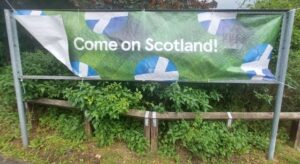
The footballing World Cup currently taking place in Canada, Mexico and some other place – oh yes, the USA – has now entered its second stage. And guess what? A certain country took part in the first stage but failed to qualify for the second one, just as it qualified for eight previous World Cups and didn’t make it to the second round of those competitions either. In fact, it’s earned itself the unenviable record of being the most-useless-at-getting-to-the-second-round-of-the-World-Cup country ever. Which hapless nation could this be?
Here’s a clue: “Yes sir, I can boogie…”
I had a fortnight off work during the second half of June and spent that time in Scotland, in the Borders town of Peebles, where my family have lived for nearly 50 years after relocating from Northern Ireland in 1977. My fortnight in Scotland coincided with the Scottish men’s team playing their second and third games of the World Cup, which they’d qualified for in November last year. Well, I thought beforehand, I’ll be in Scotland in time to see if, finally, they can beat the jinx that’s stopped them from getting past the competition’s initial stage in 1954, 1958, 1974, 1978, 1982, 1986, 1990 and 1998. And this time, with so many countries participating in the 2026 competition, surely it’ll be easy to get into that elusive second stage? Surely they’ll beat the curse at last?
Thus, I braced myself for the Scottish World Cup 2026 experience, thinking of a lyric from the Eagles’ Hotel California: “This could be heaven or this could be hell.”
Guess which one it turned out to be.
When I arrived in Scotland on June 17th, the national team had already secured three points from their first World Cup game. It had defeated by one goal to nil the footballing colossus that is… Haiti. Actually, given Scotland’s history of embarrassing scores against minor footballing nations they were expected to beat, such as Iran in 1978 and Costa Rica in 1990, the win over Haiti felt like the clearing of an important psychological hurdle. Now Scotland needed just one more point to be sure of getting through to the second round. As I traversed the streets of Peebles, folk around me were cautiously positive. There was a certain sense of optimism. Hope was definitely in the air…
But as older, wiser heads who’d experienced countless Scottish World Cup agonies in the 20th century would inevitably muse: “It’s the hope that kills you.”
June 19th saw Scotland’s second World Cup game, against Morocco. By now, like humidity in the air triggering a spectacular thunder-and-lightning storm, that pervasive sense of hope had transformed into full-scale mass euphoria. Mind you, I was slightly less euphoric, remembering Scotland’s last game in the last World Cup they qualified for, in France in 1998, which was against Morocco too. Back then, Morocco had humped them three-nothing.
I watched the game in the social building of Peebles Rugby Club, where for once the crowd contained more fans of the round ball than fans of the oval one. I’d never seen the place as wild as it was during the build-up to the game – people were yelling, singing, dancing on tables, waving glow sticks like demented cheerleaders. In fact, there was so much merry-making and hullabaloo that most folk didn’t even notice when the first whistle blew and the match kicked off. They also didn’t notice when two minutes later Morocco penetrated Scotland’s somnolent defence and knocked in an embarrassingly early goal. There was some remarkable sobering-up done when the revellers finally focused their gaze on the Rugby Club’s TV screens and realised, one goal down already – how the f*ck did that happen?
To be fair, Morocco didn’t look much more accomplished than Scotland, certainly not during the second half. But the North Africans hung onto their slender lead for the next 90-odd minutes and the game ended one-nil to them and with Scotland acquiring zero points. If only the team had been awake from the very start and denied Morocco that early goal. They’d have scraped a nil-nil draw, got a point, qualified for the second round and made history. I tried to console myself with the thought that as it was a three-nil defeat against Morocco in 1998, and only a one-nil defeat in 2026, this marked a 66% improvement on Scotland’s part. Right?
The next day, June 18th, was the biggest day in Peebles’ annual Beltane festival. Among other things, there was a parade of floats, bands and people in fancy dress along the town’s high street. Many of the revellers were in the regalia of the Tartan Army, the Scottish football team’s travelling support – one guy in such attire was even riding a penny farthing.
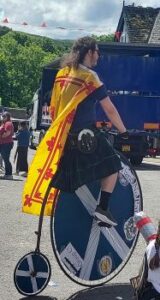
Yet an unhappy sense of reality about Scotland’s World Cup prospects was tangible now. Some of the bands were still dutifully playing Yes Sir, I Can Boogie (1977) by the Spanish disco duo Baccara, which has been the Tartan Army’s favourite anthem since 2020. However, Langholm Town Band definitely had their finger on the pulse when they marched by me playing Ally’s Tartan Army, which was Scotland’s World Cup song in Argentina in 1978 and whose lyrics go, “We’re on the march with Ally’s army / We’re going to the Argentine / And we’ll really shake them up / When we win the World Cup / Cos Scotland are the greatest football team.”
Ally’s Tartan Army serves as a painful reminder of what happened during Scotland’s World Cup campaign in 1978. The Scotland manager then, Ally MacLeod, was breezily optimistic about his team’s chances of winning the World Cup; his optimism was amplified by Scotland’s sporting press; the whole nation drank the Kool-Aid and believed their team only had to turn up in Argentina to lift the trophy… And when Scotland were knocked out in the first round, it was seen as a national disaster and humiliation. For years afterwards, the Scots suffered from P.A.S.D., i.e., Post-Ally Stress Disorder.
Scotland’s final first-round game was against Brazil on June 24th. The Scottish World Cup record against Brazil had been woeful. In the 1982 competition in Spain, Brazil beat them four-one, a cruel result considering that Scotland went one-nil up after 17 minutes, courtesy of a goal by David Narey. (Big-chinned English football commentator Jimmy Hill earned himself the lasting hatred of Scotland fans by dismissing Narey’s goal as a ‘toe-poke’.) A rematch at the 1990 World Cup saw Brazil beat them one-nil and caused Scotland’s elimination from the tournament. Despite this, I heard slivers of optimism in people’s conversations: “We only need a draw… One point, that’s all… And Brazil… They’re not the great team they once were… They’ve been disappointing so far…”
Yes, it’s the hope that kills you.
I watched the game at my brother’s house, where the audience included my nephew and his girlfriend, who hadn’t even been born when Scotland last played in a World Cup. Brazil knocked the ball three times into Scotland’s goal – actually four times, but one of the goals was disallowed – without Scotland even achieving what the late Jimmy Hill would describe as a ‘toe-poke’ in return. Afterwards, I said to my nephew and his partner something along the lines of, “Welcome to us old folk’s world – one of Scottish World Cup misery.”
Even then, it wasn’t absolutely certain that Scotland was out of the World Cup. So many countries were involved in this competition, and the rules for making progress in it were so complex, that they still had a chance. Some of the best-placed teams with three points would go through to Round Two. Scotland might be one of the lucky ones if certain results went certain ways. By June 27th, though, it was clear the results hadn’t gone the right way and Scotland were taking their ninth World Cup early bath.
Yes, it’s the hope that… Oh, shut up.
If nothing else, the Tartan Army showed yet again that they’re one of the best sets of football fans in the world. Despite the hassle of entering Donald Trump’s increasingly authoritarian USA, and the excruciating price of match tickets, transport, refreshments and everything else in a World Cup orchestrated by the rip-off maestro and evil Mekon Gianni Infantino, head of FIFA, they won American hearts and minds by supporting their team with good humour and self-deprecation and avoiding any nationalistic preening or belligerence. And, along the way, they had a hell of a party.
The citizens of Boston, where they played their first two games, were particularly impressed. They didn’t even mind the Tartan Army’s custom of plonking traffic cones on the heads of their municipal statues. The day after the Haiti victory in this, the home city of the Irish-American diaspora, at a downtown Irish pub called Henessey’s Bar, Scotland fans managed the exceptional feat of drinking three times more beer than is normally sold on St Patrick’s Day. “We’ve been here for over 30 years and we’ve never seen anything like it,” marvelled the pub’s boss. Even the New York Times was moved to publish a feature about the Boston-Tartan Army love affair.
Those fans were merely enjoying the Scotland World Cup experience, and squeezing in as much hectic partying, while it lasted. Because, as 2026 proves for the umpteenth time, the Scotland World Cup experience never lasts for long.