Favourite temples 2: the temple of revenge in Sri Lanka


Continuing my occasional series about memorable temples I have visited – here’s something about the Temple of Devol (Seenigama Devalaya) off the Sri Lankan coast, which I encountered in 2018.


Just offshore from the coastal village of Seenigama in south-western Sri Lanka, you’ll find a temple consisting of two small buildings perched on top of a rocky little island.  The temple is devoted to an imperious-looking deity called Devol, who’s believed to look after the local fishermen and, it’s said, local truck drivers too.  But he’s more famous for being a god of revenge.  If someone has wronged you, you can travel to the island and make an offering to Devol in the hope that he’ll impose retribution on the culprit.


To get from the island from Seenigama’s beach, you have to travel in a flimsy-looking boat with an outboard motor.  It can take twenty or more people at a time, some of whom – not all – are given life-jackets.  When I got to the beach, I discovered that most of my fellow passengers were feisty old Sri Lankan ladies who boarded the boat by enthusiastically beetling up over its stern and sides and into its two rows of seats.  A little later, they transferred themselves from the boat to the island itself with a similar, impressive display of agility and sprightliness.  I couldn’t help but wonder if those elderly ladies were heading to the temple to call on Devol to wreak revenge on their enemies.


The boat-trip only took a minute or two.  The island quickly swelled up out of the sea ahead of us, the rocks at the waterline black, the higher rocks grey, and then these natural formations giving way to manmade walls of faded yellow with blue-painted arched crests along their tops.  The boat ended up bobbing and swiveling drunkenly in the surf next to some slimy boulders that, further up, transformed into stone steps.  Walking around the island in footwear isn’t allowed and I’d already removed my boots and stashed them in my bag – which was just as well, because to get from the boat and onto the boulders I needed to wade through a swash of seawater.


While I got up to the steps, I felt uncomfortably like Stephen Maturin, the landlubberly and accident-prone ship’s surgeon in Patrick O’Brian’s Master and Commander books, who “at one time or other… had contrived to fall between the boat that was carrying him and almost every class of ship and vessel in the Royal Navy.”  But I managed to negotiate the boulders, ascend the steps and get onto the temple grounds up-top without slipping, drenching and embarrassing myself.


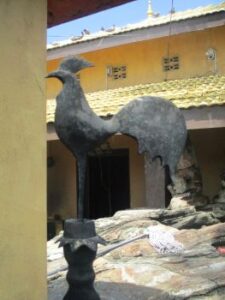
In addition to the buildings, the temple contains a small tiled yard, a clump of palm trees, a well, a small metal sculpture in the shape of a rooster and a tall concrete pole with spotlights attached.  The day I was there, many pigeons were perched on the golden-yellow roofs and flies were crawling in great profusions about the tiled ground.


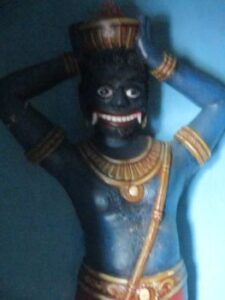
I found inside the smaller temple building a tall statue of Devol with a coppery red face and an impressively curly moustache.  His image is partially obscured by curtains, supposedly – I’ve read somewhere – to lessen the harmful effects of his wrath as it radiates out of him.


After taking a few photographs in that room, I turned around and stepped out of it again.  The moment my bare feet touched the moonstone at the threshold – which like all the horizontal surfaces here was wet and treacherous – I slipped spectacularly and landed with a great thud on my ‘jacksy’, as they say in Glasgow.  Thankfully, my bag, with my boots inside it, muffled the impact of the fall and possibly saved me from breaking my tail-bone.  It was embarrassing, however.  All the visitors in the yard outside promptly looked my way and enjoyed a quiet chuckle at my haplessness.


The larger temple building contained an altar on which, if you wish Devol to wreak revenge on someone, you present offerings of chilis, garlic and hot spices that, later, a priest grinds up in a ritual outside.  That’s right, that’s how it works here – to place a curse on the person who’s mistreated you, you need to contribute to the making of a chili paste.  Three deities lurk in alcoves behind and to the left and right of the altar.  The central one look fairly benign, but the other two are more sinister.  The left-hand deity wears a helmet and girdle made out of interlocking cobras while the right-hand one looks even more ghoulish, with a rictus grin and fangs protruding downwards from the ends of its long mouth.


Various travel blogs in which I’ve read about the temple have gone on in detail about how the visiting pilgrims, seemingly intoxicated by the idea of getting revenge on their persecutors, work themselves into states of ecstasy and hysteria.  But I saw none of that.  The crowd who’d come with me in the boat seemed very calm, composed and quietly respectful.  (Well, apart from their moment of mirth when I keeled over on that slippery moonstone).  As I’d said earlier, most of them were elderly local ladies.


It occurred to me afterwards that Devol has several roles – he’s a guardian of fishermen (and truck-drivers) as well as a bringer of revenge – and maybe the ladies had come with a more benign purpose.  Maybe they just wanted to pay their respects to Devol and ask him to look after their sons and husbands while they made their livings out on the waves or out on the roads.


Uncle Sam (Part 2)


© Universal Pictures / Amblin Entertainment


Continuing my tribute to the great New Zealand actor Sam Neill, who died on July 13th


Sam Neill got top billing alongside Laura Dern and Jeff Goldblum in Steven Spielberg’s Jurassic Park (1993), the highest-grossing movie of all time until James Cameron’s Titanic was released four years later.  While it was gratifying that Neill’s career get a boost from his involvement in such a blockbuster, I have to say I’m not  a great fan of it.  That’s probably because prior to seeing the film, I read the book it’s based upon, Michael Crichton’s Jurassic Park (1990), wherein the story and characters are darker, more complex and more interesting than Spielberg’s interpretation of them.


As Alan Grant, a palaeontologist asked to assess the titular theme park where, it’s planned, visitors will pay good money to gawk at dinosaurs that’ve been cloned back into life using bits of ancient DNA, Neill is inevitably – and literally – dwarfed by his co-stars, the dinosaurs that Spielberg’s special-effects team, headed Stan Winston, created using then-cutting-edge animatronics and computer-generated imagery.  Still, he invests Grant with enough quirks to make him memorable.


He’s sometimes curmudgeonly and not fond of children, even ones who like dinosaurs – see how he spooks one youngster with an account of how velociraptors killed their prey, or how he freaks out the grandchildren of park-owner John Hammond (Richard Attenborough) by pretending to get fried by an electric fence.  Paradoxically, he can be child-like himself.  When he first sees one of Hammond’s dinosaurs, his wonderment leaves him struggling for words and he almost faints.  And he shows juvenile delight when he encounters a triceratops, which he hails as “my favourite when I was a kid… the most beautiful thing I ever saw.”  (When I was a kid, the triceratops was my favourite dinosaur too.)


When Jurassic Park received a royal premiere in London, Neill found himself sitting between his 10-year-old son and Princess Diana.  According to Neill, his son got so worked up at the film’s scary bits that he started farting uncontrollably, and Neill became paranoid about what his royal neighbour would think when she smelled the fumes: “Princess Di is being exposed to the horrors of a little boy’s fart, but she’s going to think it’s me.  I am going to be subliminally blamed for my son’s crimes, and I don’t think she’ll talk to me afterwards.”  However, gallantly, the princess did speak to him later and ‘never mentioned’ the flatulence.  Jeff Goldlum commented drolly on Neill’s anecdote: “I’ve heard him tell that a couple of times and it’s just amazing the lengths that he will go to still blame the boy.”


Neill played Grant twice more, in the second sequel Jurassic Park III (2003), which I saw on TV and found pretty inconsequential; and the fifth one, Jurassic World Dominion (2022), which got lousy reviews and which I’m in no rush to see.
 

© Miramax / Buena Vista international / Jan Chapman Productions


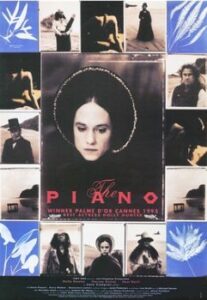
As well as being in 1993’s biggest blockbuster, Neill was in the same year’s biggest arthouse movie, Jane Campion’s The Piano.  He plays Alisdair Stewart, a settler in 19th century New Zealand who, via an arranged marriage, suddenly acquires a wife, the mute Ada (Holly Hunter).  He also acquires a piano, the playing of which is Ada’s only opportunity to express herself.  Predictably, Alister and Ada don’t enjoy a happy marriage and the piano is the catalyst for trouble.  It becomes the means by which Ada, unable to tolerate Alisdair’s sexual advances, instead discovers sensuality with a neighbouring settler, George Baines (Harvey Keitel), under the pretext of giving him piano lessons.


While Keitel’s character first seems weird and brutish, but gradually shows himself capable of tenderness and decency, Neill’s goes the other way – we initially have some sympathy for Alisdair, but he becomes a villain who propels the plot towards its climax of mutilation and attempted suicide (though, ultimately, it ends happily).  In his 2023 autobiography, Did I Ever Tell You This: A Memoir, Neill wrote of the film, “I don’t think I can overestimate how important The Piano is for me in hindsight.  It sits in my funny old CV like a medal on my chest.  It wasn’t my film.  It was Jane Campion’s.  I wasn’t the star of the film.  That was Holly Hunter.  But there is honour to be found in the second fiddle.  Or fourth.  No one notices you much, you don’t get nominated for things.  But you served.  I was there in an important feminist film.  I was there in the front line in an important New Zealand film.”


As many have noted, The Piano is an example of how Neill used his screen presence to generous effect.  He didn’t hog the limelight but gave his co-stars space to perform to their full potential.  This was especially so with his female co-stars.  While Neill reined himself in a little, they got the chance to bloom in their roles – not only Holly Hunter in The Piano, but Isabelle Adjani in Possession (1981), Nicole Kidman in Dead Calm (1989), and reportedly – I’ve unfortunately never seen it – Judy Davis in My Brilliant Career (1979).


In 1995, Neill worked with cult American director John Carpenter and made the horror movie In the Mouth of Madness, which critics greeted unenthusiastically at the time but which, gradually, has been re-evaluated and is seen now as a misunderstood classic.  It features Neill as an insurance investigator called John Trent, who’s hired by a publishing company to track down its missing star author (Jurgen Prochnow).  The author’s name is Sutter Kane and though his initials, and massive sales, suggest he was inspired by Stephen King, his tales of cosmic horror and fearsome ancient beings called the ‘Old Ones’ indicate he’s based on the legendary Providence writer H.P. Lovecraft.  Trent’s investigations bring him into ever-stranger situations where he encounters characters and settings from Kane’s fiction.  It’s as if the writer is controlling what happens in reality – which is worrying, since his new novel concerns the end of the world.
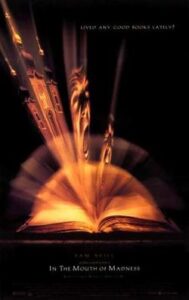
 

© New Line Cinema


While I’m glad a movie involving Sam Neill, John Carpenter and H.P. Lovecraft has received some retrospective love, I’m afraid I agree with those unenthusiastic critics in 1995.  Like many of Carpenter’s later movies, there’s just too much going on in In the Mouth of Madness and you get the impression the director’s throwing everything at the wall in the hope some of it sticks.  That said, the movie has some memorable moments, such as a scene where Trent and a client discuss business in a restaurant, not noticing a mad axeman creating mayhem in the street outside their window.  Carpenter also stages a spooky sequence wherein a night-time cyclist keeps inexplicably reappearing in front of a cruising car – and keeps changing.


I prefer an earlier Neill-Carpenter collaboration, Memoirs of an Invisible Man (1992), an adaptation of H.F. Saint’s 1987 novel of the same name, itself inspired by H.G. Wells’s novel The Invisible Man (1897).  It’s a somewhat awkward film – the tension between the studio, Warner Bros, who wanted an out-and-out comedy, and the star, Chevy Chase, who wanted to show he could do ‘serious acting’, is palpable – but nonetheless I think it’s underrated.  I certainly enjoyed Memoirs of an Invisible Man more than director Carpenter did, who once said of it: “I really wanted to quit the business after that movie…  I don’t want to talk about why, but let’s just say there were personalities on that film.  He shall not be named who needs to be killed.  No, no, no, that’s terrible.  He needs to be set on fire…  No, no, no.  Anyway, it’s all fine.  I survived it.”  Presumably Carpenter was referring to Chase, who has a reputation for being, shall we say, difficult.  Even an invisible Chevy Chase was too much for him.


Carpenter certainly didn’t mean Neill, who played the film’s slightly James Mason-like villain.  “I love working with him,” the director said of Neill.  “He comes prepared.  He knows what he’s going to do.  He reacts to other actors who are there.  I mean, he’s just a dream come true.”
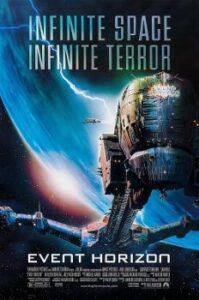
 

© Paramount Pictures / Golar Productions / Impact Pictures


Another horror movie Neill made in the 1990s, which initially got savaged by the critics but was retrospectively reassessed and lauded as a classic, is Paul W. S. Anderson’s Event Horizon (1997).  Set in 2047, it’s about an experimental spaceship that’d disappeared during its maiden voyage inexplicably reappearing years later with no sign of its crew.  When a rescue mission, whose members include Neill, investigate, it becomes clear the ship’s hyperdrive system accidentally sent it into another dimension – a dimension known to religious folk as ‘hell’ – and back.  And it’s returned with something nasty on board.


Well, I’m sorry to be a misery-guts again, but I also agree with the 1997 reviews of Event Horizon and don’t see it as an unappreciated masterpiece.  It strikes me as a muddled mixture of Ridley Scott’s Alien (1979) and Clive Barker’s Hellraiser (1987), with that old chestnut of ‘characters being tormented by their innermost fears brought to life’ thrown in.  To be fair to Paul W. S. Anderson, the studio, Paramount Pictures, removed much footage from his original edit, believing it was too gory and horrific, and the finished product was not what he and scriptwriter Philip Eisner had envisioned.  Incidentally, as Neill’s character is Australian, he had him wear a uniform with an Australian flag-patch – but one where the Union-Jack part of it has been replaced by the Aboriginal flag.  Neill hoped that by 2047 a more tolerant, Pauline Hanson-free Australia would better honour its indigenous inhabitants.


By the start of the 21st century, and his sixth decade, Neill had become something of an institution and seemed the personification of the word ‘avuncular’.  A good example of this is in the Australian movie The Dish (2000), a gentle comedy in which he plays the boss of an Australian radio telescope that, in 1969, is landed with the job of relaying film-footage from the Apollo 11 moon-mission to the eagerly-awaiting world’s TV screens. This isn’t easy for Neill and his team as, first, they suffer a crippling power cut and then, on July 20th, the day of the landing, a violent storm threatens to blow their dish over.  Neill is reassuringly calm and reasonable throughout.  Thinking about the film now, I can’t recall any moment in it where he didn’t seem to be wearing a cardigan or puffing at a pipe.

 

© Madman Films / Piki Films / Defender Films


He’s somewhat less avuncular, but still loveable, in Hunt for the Wilderpeople (2016).  He plays Hector, a grumpy old misfit who takes to the New Zealand mountains with his chubby, juvenile-delinquent foster-kid Ricky (Julian Dennison) when the latter panics about being returned to state care.  They soon have police, social services, vigilantes and the media after them.  Along the way they encounter hardship, killer wild boars and a literally tinfoil-hat-wearing lunatic called Psycho Sam (Rhys Darby) but also form a genuine, father-son bond.  Director Taiki Waititi creates an affecting and funny movie but avoids easy laughs and cloying sentimentality.  Neill and Dennison’s characters take some hard knocks and their happy ending is hard won.


During the 21st century Neill also became a fixture on television – appearing in shows like The Tudors (2007), Crusoe (2008-9), Happy Town (2010), Alcatraz (2012), Peaky Blinders (2013-14), Old School (2014), Tutankhamun (2016), The Twelve (2022-25) and Apples Never Fall (2024) –  and on social media, where he regularly posted updates about Two Paddocks, his beloved farm and vineyard in New Zealand’s Central Otago wine region.  Famously, Neill named the animals on his farm after celebrities he knew in showbusiness, supposedly because it made him less inclined to eat them: “Well, you can’t eat a friend…  I’m not a vegetarian, but I have a ram called Jeff Goldblum.  You wouldn’t want to eat Jeff, would you?”


This led to some memorable moments as, for example, Neill posted, “MICHAEL FASSBENDER ASSAULTED!” – his rooster, named after Michael Fassbender, had had his tail-feathers torn out by a rogue dog.  Or a comment he made about Helena Bonham-Carter, one of his cows: “She’s had 16 calves now.  She’s up for it, if nothing else.”  Or a sad disclosure that Meryl Streep, a chicken, had been “…killed by a ferret recently.”  During Covid-19, his gentle and good-humoured updates about his farm and its whimsically-named inhabitants was an antidote to the stress and boredom of lockdown.  They certainly cheered me up more than, say , Gal Gadot and a bunch of her thespian pals crooning John Lennon’s Imagine on Instagram.


In a 2023 interview in the Guardian, Neill opined, “I’m not afraid to die but it would annoy me. Because I’d really like another decade or two, you know? We’ve built all these lovely terraces, we’ve got these olive trees and cypresses, and I want to be around to see it all mature. And I’ve got my lovely little grandchildren. I want to see them get big…  But as for the dying? I couldn’t care less.”  A lot of people would have loved to have got another decade or two of Sam Neill, and his acting talents, and his sense of fun.  But we should be grateful for what we did get.


© Universal Pictures / Amblin Entertainment

Uncle Sam (Part 1)


From wikipedia.org / © Sean Koo


Having just paid tribute to the centenarian Mel Brooks, I hadn’t intended to post another film-related entry so soon on this blog.  Sadly, however, Sam Neill, whom I admired both as an actor and as a person, passed away three days ago and I thought I should pen some words in honour of him too.


Neill’s passing was made even sadder by the fact he’d recently been declared cancer-free after a five-year battle against the disease.  Seemingly, his immune system was so weakened by the treatment he’d received that he fell prey to pneumonia.  Rima Te Wiata, Neill’s co-star in Hunt for the Wilderpeople (2016) told the New Zealand Herald: “It really sucks, actually… I think he would be like: ‘For goodness sake, I got over my cancer. And now look, now I get pneumonia. What next?'”


Though officially a New Zealander, Neill could also be called a Northern Irishman because in 1947 he was born in Omagh, county-town of County Tyrone (17 miles away from where I spent my childhood), to New Zealand and English parents.  He moved from there to Christchurch in 1954 and presumably, if he’d ever acquired a Northern Irish accent, he soon lost it.  Decades later, when he played the psychotic Belfast policeman Chester Campbell in the first two seasons of the TV show Peaky Blinders (2013-14), he asked two mates – Northern Irish actors Liam Neeson and James Nesbitt – for coaching so that he could produce a convincing ‘Norn Irn’ accent.


He also began life as ‘Nigel’, but by the age of 11 had taken to calling himself ‘Sam’.  When he started acting, he was glad he’d chosen the blokey ‘Sam’ over the slightly effete ‘Nigel’.  In an interview published recently in the Guardian, he commented, “If I’d stayed with Nigel Neill, I don’t think I would have had a film career.”  He’d obviously never encountered the great screenwriter Nigel Kneale, whose creations included the Quatermass films and TV dramas.


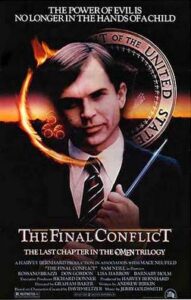
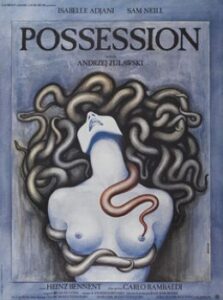
Though he’d done film and TV work throughout the 1970s, including Roger Donaldson’s thriller Sleeping Dogs (1977), described on its Wikipedia page as “the first feature-length 35 mm film produced entirely in New Zealand”, Neill first came to my attention in 1981, when I was a horror-film-obsessed teenager and when he appeared in two fairly high-profile horror films, Graham Baker’s Omen III: The Final Conflict and Andrzej Żuławski’s Possession.  I read about them in film magazines like Starburst and Fangoria, though I was too young to see them in a cinema because in the UK they were given ‘X’ certificates, meaning only people aged 18 and over could see them.  In the case of Possession, I didn’t even have a chance to see it later on video for it ended up on the Britain’s infamous (and idiotic) ‘video nasties’ list, deemed likely to ‘deprave or corrupt’ its viewers and thus banned from home viewing.


© Mace Neufeld Productions / 20th Century Fox


Omen III: The Final Conflict was the third in the trilogy that’d started with Richard Donner’s The Omen (1976) and continued with Don Taylor’s DamienOmen II (1978) and that told the tale of Damien Thorn, the son of Satan and the Antichrist who, according to Biblical prophecies, will rise to power in end times.  Unlike the earlier two movies, where Damien is depicted as a kid (first played by Harvey Spender Stephens, then Jonathan Scott-Taylor), he’s now an adult.  Portrayed by Neill, he’s the powerful CEO of Thorn Industries and soon into the film also becomes US ambassador to Britain, a position from which he hopes to launch his biggest project yet – the thwarting of the Second Coming of Christ.


As Damien, Neill is suave enough to be convincing as a powerful operator in purely human affairs, one who can rub shoulders with top people in top places and get what he wants; whilst also having a sinisterness and darkness that makes you accept him as the same, infernal creature he was in the earlier films (especially the disturbingly baleful Spender Stephens in the first Omen).  Alas, Neill is the only thing of value in the film.  Coming after the original, which was very enjoyable hokum, and the second film, which at least had its moments, The Final Countdown is a damp squib.  Unlike his predecessors Donner and Taylor, Graham Baker doesn’t have the directing chops to properly mount the Omen films’ main attractions – the set-piece ‘accidents’, elaborate, supernaturally-engineered and inevitably fatal, that bump off anyone who gets in Damien’s way.  That said, the scene early on where the previous American ambassador commits ‘suicide’ and conveniently creates a job opening for him, is agreeably splattery.


A far less conventional horror film, and a far better one, is the same year’s Possession.  Though it defies all description, you could say it was a particularly traumatic and traumatising break-up movie…  Or a brooding parable about the Cold War (it was filmed in West Berlin)…  Or a psychological thriller involving doppelgangers…  Or a body-horror film wherein a woman makes repeated love to a vilely tentacled, half-human, half-squid creature…  Or an espionage thriller leading to an apocalyptic World War III finale.


Director Andrzej Żuławski – himself suffering from depression after recently being expelled from his native Poland – put Neill and his co-star Isabelle Adjani through the wringer during the film’s making.  Neill remarked in 2021 that he ‘escaped’ from the movie with his ‘sanity barely intact’.  Adjani suffered even more, though, and supposedly needed a couple of years to get over the experience.  That’s understandable when, for instance, you see the berserk intensity of the now-legendary sequence where she suffers a miscarriage in a subway corridor.  Actually, a young Gaspar Noé must have been highly impressed by that sequence because he basically got Sofia Boutella to recreate it in his 2018 movie Climax.


© Gaumont Distribution


Things were looking up for Neill’s career in 1983, when he played the title role in Reilly, Ace of Spies, a 12-part TV series dramatizing the life of real-life superspy Sidney Reilly during the first quarter of the 20th century.  Reilly was scripted by Troy Kennedy Martin and directed by Jim Goddard and Martin Campbell and Campbell, a fellow Kiwi, would later direct two James Bond movies, Goldeneye (1995) and Casino Royale (2006).  In fact, for a time in the mid-1980s it looked like Neill was in with a shout of becoming the next James Bond.  (It makes sense – there have been Scottish, Australian, Welsh and Irish Bonds, so why not a New Zealand one?)


In the Guardian interview I mentioned earlier, he was asked about the Bond role.  He said he would have accepted it if it’d been offered to him, but added: “I’m also aware that I wouldn’t have enjoyed my life so much if I was an ex-Bond. That’s what people would say when I went for my morning coffee. ‘Look – it’s what’s-his-name, who used to be James Bond?’ ‘Yeah, he was the one I never really liked.’”


In 1989 he had a good role in Philip Noyce’s Dead Calm, a maritime thriller / horror movie that conveys both the claustrophobia of being at sea – you’re stuck in the confined space of a boat – and the agoraphobia of it – you’re out on a vast, empty mass of water, far from civilisation and help.  Neil and Nicole Kidman (in her seventh, and breakout, film role) play a couple who, while yachting, discover a sinking schooner.  They pick up one survivor (Billy Zane) who – surprise! – turns out to be a crazed killer.


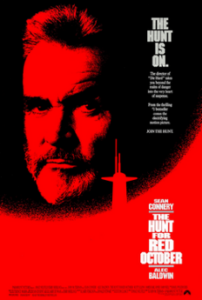
Still, I had the impression that during the late 1980s Neil’s moment had passed and he was destined to spend his remaining career in movies’ supporting casts as a reliable character actor.  This was suggested, for example, by his role in 1990’s The Hunt for Red October, where he gets fourth-place billing after Sean Connery, Alec Baldwin and Scott Glenn.  He plays the second-in-command to Connery’s Captain Marko Ramius, and a participant in a plot whereby the only submarine-commander in the Soviet fleet with a Scottish accent, and his officers, commandeer a super-submarine called Red October and attempt to defect with it to the West.  When Neill’s character starts waxing lyrically to Connery about the rabbit farm he plans to start up after they reach America, you know he’s going to get killed before the end.


© Mace Neufeld Productions / Paramount Productions


However, then, Neill’s fortunes took an upswing – because Steven Spielberg and blockbuster-dom came knocking.


To be continued…

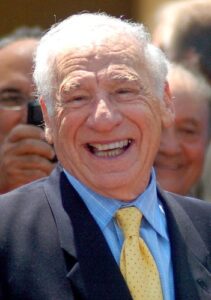
The 100-year-old Mel


From wikipedia.org / © Angela George


Last week saw much hype and noise about the United States of America celebrating its 250th birthday.  Under the leadership of Donald Trump, the USA marked the 250th anniversary of its independence from the British by holding a Great American State Fair on Washington DC’s National Mall.  This featured empty booths, cancelled musical performances, racist flags, power outages, collapsing roofs and a plywood model of the victory arch Trump wants to build on the Potomac that cracked, crumbled and oozed yellow gunk.  How odd that hardly anyone wanted to go to it.


In other moves to celebrate America’s 250th Independence Day, Trump refurbished the Lincoln Memorial’s Reflecting Pool, also in Washington DC, so that its water would shine a patriotic blue, though it immediately shone a less patriotic green thanks to a sudden and unforeseen algae bloom.  He also tried to extend the USA team’s run in the 2026 Football World Cup by arm-twisting Gianni Infantino and FIFA into breaking the sport’s red-card rules so that a key American player could play in the team’s next game – which they lost, courtesy of a 4-1 drubbing by Belgium, causing their exit from the competition.


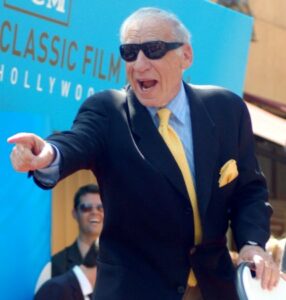
The sound and fury about the 250th anniversary of American independence, and the Trump-esque shenanigans accompanying it, have obscured the fact that, one week earlier, the USA witnessed another important three-digit birthday.  June 28th saw the 100th birthday of the legendary American filmmaker, comedian and general funnyman Mel Brooks.  By the time he turned his hand to making movies in the late 1960s, Brooks already had impressive comic credentials – devising the famed 2000-Year-Old Man comedy sketch with Carl Reiner, for instance, or creating the classic spy-comedy TV show Get Smart (1965-70) with Buck Henry.  But it’s fair to say his films are the body of work for which he’s most beloved.


Like much of the comedy I experienced from an early age – the CarryOn movies, or those starring Abbott and Costello, or the telly career of Ronnie Corbett – I’ve had a complicated and changing relationship with the oeuvre of Mel Brooks.  As a youngster, I thought it was brilliant.  As a young adult, who took himself much too seriously, I dismissed it – certainly, the later films Brooks made – as crass, cringeworthy guff.  Now, in my old age, I can find pleasure in the entirety of Brooks’s canon and appreciate the artistry displayed in even what are, by general consensus, his lesser efforts.  A bad joke might provoke a groan rather than a laugh, but to engineer that groan you still need a certain, warped skill.


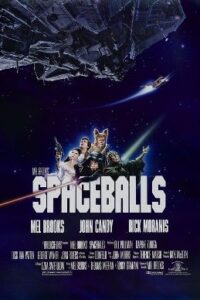
I think I passed from my youthful period of Brooks-disdain to my more mature period of Brooks-admiration in the 1990s.  This was when I was attempting to woo (with a total lack of success) a lady from New York whom I considered, for a while, the coolest thing on earth.  We were chatting one evening about our favourite films and the object of my affections suddenly astounded me by saying she was a huge fan of…  No, not Jean-Pierre Melville’s Le Samourai (1967), or Terence Mallick’s Badlands (1973), or Jim Jarmusch’s Mystery Train (1989), but…  Mel Brooks’s Spaceballs (1987).


From wikipedia.org / © Metro-Goldwyn-Mayer / Brooksfilms


“Seriously?” I spluttered.  I’d seen this science-fiction / Star Wars piss-take shortly after its release and thought it was dreadful.  But, patiently, the lady explained to me the sociological depth and cleverness of some of Spaceballs’ jokes that I’d missed – for example, when Bill Pullman and John Candy rescue the princess (Daphne Zuniga) and Pullman remarks, “That’s all we needed…  A Jewish princess!”  I had to concede there was more to Brooks’s humour than I’d thought.


So, I had my moment of epiphany.  I decided, to misquote a line in The Producers, “Don’t be stupid, be a smarty / Come and join the Mel Brooks party.”


Anyway, it’s a fortnight late for the great man’s 100th, but here is a belated guide to the funniest bits, in my opinion, of his movies.  There’s no mention of The Twelve Chairs (1970) and Life Stinks (1991) because I haven’t seen those two.


L.S.D. gets auditioned in The Producers (1967)

The movie that put Brooks on the cinematic map, The Producers has had quite an afterlife, becoming a successful Broadway musical that, in 2005, was turned into a film itself.  For me, its highlight isn’t the famous song-and-dance number Springtime for Hitler that’s the centrepiece of the show that impresario Zero Mostel and accountant Gene Wilder stage in the hope it’ll be a massive flop (allowing them to make a fortune from the shares they’ve sold in it).  No, the highlight comes earlier.


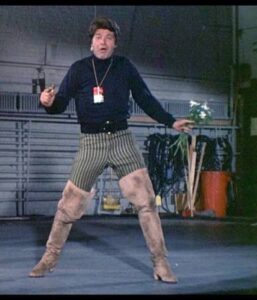
That’s when hippy Lorenzo St. DuBois – L.S.D. to his friends – stumbles into the show’s auditions by mistake and performs, with his female guitar / keyboards / sax backing band, a funny-terrible number called Love Power.   (“And I give a flower to the big fat cop / He takes his glove and he beats me up!”)  Played by Dick Shawn with thigh-high furry boots and a Campbell’s soup-can hanging on a chain around his neck, the hapless L.S.D. is hilarious – and the sequence reaches a perfect conclusion when Mostel bellows ecstatically, “THAT’S OUR HITLER!”


From instagram.com / (c) Embassy Pictures


The campfire scene in Blazing Saddles (1974)

If I was more sophisticated, I’d nominate as the funniest moments in Brook’s smash-hit comedy-western the scenes where he skewers the residents of frontier town Rock Ridge for their bone-headed racism.  (“You’ve got to remember that these are just simple farmers.  These are people of the land.  The common clay of the new West. You know…  morons.”)  However…  I’m nominating instead the sequence in Blazing Saddles where Slim Pickens’s men sit around a campfire and stuff themselves with traditional cowboy fare – beans – with flatulent results.


I first saw Blazing Saddles when it played on a big screen in the assembly hall of my school as one of the movies chosen for the school’s Film Club.  When the farting began, the teenaged audience, including myself, laughed like drains.  We were still roaring our heads off minutes after the sequence finished.  No other film shown during the several years I was a member of that Film Club – not Alfred Hitchcock’s Psycho (1960), not Nicolas Roeg’s Don’t Look Now (1973), not Ridley Scott’s Alien (1979) – provoked so tumultuous a reaction.  I’m not proud.


The monster meets the blind hermit in Young Frankenstein (1974)

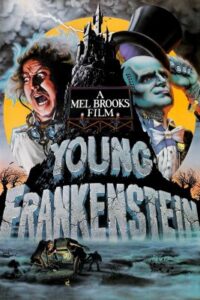
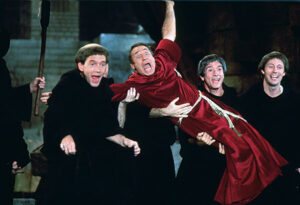
The most genuinely affectionate of Brooks’s genre parodies, Young Frankenstein pokes fun at the black-and-white Frankenstein movies made by Universal Pictures in the 1930s.  My favourite part of it is when Brooks sends up the sequence in Bride of Frankenstein (1936) where the Frankenstein monster (Boris Karloff) is touchingly but briefly befriended by a lonely blind hermit (O.P. Heggie) who’s unaware of his monstrousness.  Here, the well-meaning but, well, blind hermit (Gene Hackman) accidentally and repeatedly scalds and burns the unfortunate monster (Peter Boyle) whilst trying to offer him broth, cigars, etc., until the latter flees from his cottage in terror.  Despite the gleeful bad taste of the gags, the Young Frankenstein sequence retains some of the sweetness and sadness of the Bride of Frankenstein one.  It also makes you wish Gene Hackman had played more comedy roles.


From wikipedia.org / © Gruskoff / Venture Films / 20th Century Fox


The boardroom table in Silent Movie (1976)

This was another movie shown at my school’s Film Club and another sequence that sent us – uncivilised little oiks that we were at the time – into paroxysms of laughter.  Evil corporation Engulf & Devour intends to take over the studio of filmmaker Mel Funn (Brooks) but that won’t happen if the new movie Funn is making becomes a hit.  Engulf & Devour’s board of executives hatch a fiendish plan to sabotage Funn and his movie – they’ll send sultry nightclub singer Vilma Kaplan (Bernadette Peters) to seduce, then dump Funn and re-kindle the massive alcohol problem he had previously.  When a picture of Vilma is unveiled to the executives, sitting around the boardroom table, they’re so impressed that the table rises by several inches.


The line Funn / Brooks inspires when Vilma does dump him, and he goes on a massive bender to drown his sorrows – “He is truly the lord of the winos!” – is pretty funny too.


The orchestra in High Anxiety (1977)

Brooks’s next film takes fond aim at the thriller movies of Alfred Hitchcock.  Its hero, Dr Richard Harpo Thorndyke, again played by Brooks himself, suffers from the titular disorder, the vertigo-like ‘high anxiety’.  While travelling in the back of a car, Thorndyke / Brooks suffers a moment of ominous foreboding, which is accompanied by an equally ominous swell of Bernard Herrmann-like orchestral music – the sort that Hitchcock liked to insert into his films to augment the mood.  This being a Brooks film, though, Thorndyke’s car then passes a bus that contains, as passengers, the orchestra playing the music.


Yes, this is the second time Brooks has used that gag.  It originally appeared in Blazing Saddles and involved the Count Basie Orchestra performing in the desert,  But the orchestra-on-a-bus joke in High Anxiety works better, I think.


The Spanish Inquisition in History of the World, Part I (1981)

A truly hit-and-miss collection of gags and sketches, History of the World, Part 1 depicts five chapters in world history from the Stone Age to the French Revolution.  Its undisputed highlight is a segment about the Spanish Inquisition.  This features Brooks as Torquemada – his victims are warned not to try to talk him out of torturing them because, “You can’t Torquemada anything!” – and an elaborate Busby Berkeley-like song-and-dance number in a torture chamber which, with its exuberant bad taste, is as impressive as Springtime for Hitler in The Producers.


© Brooksfilms / 20th Century Fox


Snotty’s line in Spaceballs (1987)

Spaceballs spoofs Star Wars (1977) but also contains some elaborate send-ups of Planet of the Apes (1968) and Alien (1979) – the latter even drafts in John Hurt to reprise his role as the unfortunate Kane.  But the funniest, or groan-iest, bit in it for me is a simple pun.  A Scottish character called Snotty (Jeff MacGregor), obviously based on Scotty from Star Trek (1966-69), is in a control room flicking a series of switches.  “Lock One!” he shouts.  “Lock Two!  Lock Three!  Loch Lomond!”


The abbot in Robin Hood: Men in Tights (1993)

You have to be a connoisseur of long-ago comedy double-acts to appreciate my favourite joke in Robin Hood: Men in Tights, Brooks’ irreverent take on the then-recent and hugely-successful Robin Hood: Prince of Thieves (1991).  An abbot (Dick Van Patten) is walking in his finery outside his monastery and enjoying the adulation of the local population.  Then a guy who looks and sounds suspiciously like Lou Costello yells at him, “Hey, Abbott!”  Van Patten grumbles, “I hate that guy.”


Dracula tries to control Mina’s mind in Dracula: Dead and Loving It (1995)

I don’t hold it against Brooks’s Dracula: Dead and Loving It, which stars Leslie Neilson as the legendary vampire count, that it isn’t great.  After all, there have been many attempts over the years to spoof vampire films and hardly any of them have been funny – see Roman Polanski’s Dance of the Vampires (1967) or Stan Dragoti’s Love at First Bite (1977).  In fact, it wasn’t until Jermaine Clement and Taika Waititi’s What We Do in the Shadows (2014) that I encountered a vampire-movie parody that made me laugh.


However, Dracula: Dead and Loving It has one funny part where, from a distance, Dracula / Neilson exerts his willpower over the bitten and partly vampirised Mina (Amy Yasbeck) and tries to summon her: “Mina…  Open your eyes…  Arise…  Come to the door…”  The operation goes less smoothly when the mind-controlling vampire discovers there’s a confusing closet door in the way, and a hazardous footstool, and an inconvenient maidservant who’s also picking up his telepathic instructions: “Mina…  You are in the closet.  Open the door and come out…  Watch out for the footstool…  Stand up…  Not you, sit…  No, you sit…  You stand…”


And just before I finish, some praise is due for Brooks as a producer too.  He’s the man who oversaw both David Lynch’s The Elephant Man (1980) and David Cronenberg’s The Fly (1986).


From wikipedia.org / © Angela George