From wikipedia.org / © Mirrorme
Three days ago – June 23rd – marked ten years since the electorate of the United Kingdom voted on whether or not their country should leave the European Union. And two days ago – June 24th – marked ten years since the result of that referendum was announced. I remember switching on the TV that morning a decade ago and seeing Andrew Neil, who looked and sounded like he’d just been hit over the head with a shovel, reporting on the BBC that against all expectations a narrow majority of the UK’s population had voted for ‘Brexit’, i.e., for Britain exiting the EU. 51.9% had voted to leave and 48.1% had voted to remain.
Brexit’s impact on the UK since then, to anyone who isn’t a head-in-the-sand Brexiter, has been shite. Writing on the BBC website recently, Fasial Islam cited findings by the National Bureau of Economic Research. The consensus was that “the UK economy is smaller now than it would have been based on the trajectory it was on in 2016… The numbers range from about 3% to 8%…. These calculations are based on modelling how a UK still within the EU could have been expected to perform economically had it still experienced the pandemic and the 2022 energy shock but not Brexit… The most recent study by the NBER takes account of population growth, and says the UK lost 6-8% of per capita output.”
The result has been a country strapped for cash. Which, in turn, has helped fuel the visceral hatred directed towards Keir Starmer’s Labour government since it was elected to power with a huge parliamentary majority in July 2024. People voted for Labour desperate to see a respite from the austerity they’d suffered under the Conservatives. Yet Starmer and co. were obsessed with hoarding their pennies and served up more of the same. They refused to scrap the two-child benefit cap. They went after the universal winter fuel payment. They tried to cut incapacity benefits. And when, following outcries, they backtracked or partially backtracked on these policies, they made themselves look incredibly weak.
Yet, despite everything, Britain’s economy is still ranked by the IMF as the fifth biggest in the world, so someone must be making money there post-Brexit. Presumably ones with large, offshore bank accounts and home addresses in Dubai. Certainly not the average British citizen.
Brexit also cut the UK off from Europe at a time when it desperately needed to be part of a larger bloc for its economic and military security. In geopolitical terms, the country couldn’t have picked a worse time to pull up the drawbridge and retreat in on itself. In the east, Vladimir Putin has spent four years trying to subjugate Ukraine and, heaven forbid, if he has his evil way there he’ll have designs on more of Europe. In the west, Donald Trump has taken a wrecking ball to the military alliances, trade protocols and diplomatic norms Britain has relied on for stability and prosperity over the past 80 years. The amount of groveling Starmer has done to Trump, the modern-day Caligula, in the hope of currying at least a little of his favour testifies to the enfeebled place Britain is nowadays.
Brexit has generated huge amounts of political instability. Successive prime ministers struggled to negotiate to leave the EU on terms that satisfied the gibbering hardliners of the far right and to generally surf the waves of chaos the thing had created. In fact, we’ve had half-a-dozen prime ministers in a decade: the overconfident David Cameron, who allowed the referendum in the first place; the hapless Teresa May; the unspeakable Boris Johnson; the catastrophic but mercifully short-lived Liz Truss; the inconsequential Rishi Sunak; and the tone-deaf and charisma-free Starmer. We’re about to get a seventh, now that Starmer has just announced his resignation and the poisoned chalice, sorry, the crown seems there for Andy Burnham’s taking.
So, seven British prime ministers in just over a decade. That’s an astonishing reflection of the political shitshow the UK has become, especially when you consider there were seven prime ministers during the 46 years prior to Cameron: Harold Wilson, Ted Heath, Jim Callaghan, Margaret Thatcher, John Major, Tony Blair and Gordon Brown.
While multiple prime ministers have crashed and burned since 2016, Nigel Farage, the main architect of the Brexit fiasco, has prospered. He’s slithered with serpentine ease from the United Kingdom Independence Party to the Brexit Party and, most recently, to Reform UK, which he runs as a limited company, owning 53% of its shares. Making an outrageous race-baiting statement here – and hiding under a rock when that statement provokes violence on the streets – and accepting a dodgy five-million-pound ‘gift’ from a Thailand-based cryptocurrency investor there, Farage is the most despicable figure in British politics today.
Farage certainly knows how to divert blame. His championing of Brexit may have led to economic and social misery for the British public but he’s convinced many people that it’s not his or Brexit’s fault, but that of immigrants and asylum-seekers and the ‘establishment’. How Farage manages to keep a straight face when he – a son of a stockbroker, pupil at Dulwich College and one-time commodities trader in the City of London – rails about that establishment, I’ll never know. His policies of deflection and scapegoating have won him so much support that he’s in with a good shout of winning the next election and becoming Britain’s eighth prime minister since 2016.
A Farage government would be ruinous for Britain. No doubt it’d exhibit all the malignancies of the regime currently destroying the USA under Trump, whom he greatly admires: authoritarianism, racism, censorship, misinformation, corruption, cronyism, pseudoscience, climate-change denial, incompetence, general ignorance and much sucking up to Putin.

From pixabay.org / © Stux
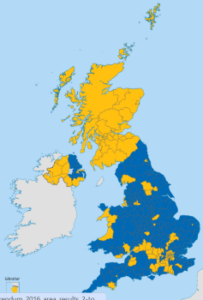
Finally, you may have noticed the UK map at the top of this entry, showing the 2016 council districts and unitary authorities that voted for leaving the EU in blue and those that voted for remaining in it in yellow. Scotland is entirely yellow – not one Scottish district recorded a majority for ‘leave’ and, overall, 62% of Scottish voters supported ‘remain’. Yet, because a majority of the electorate in England voted for Brexit, Scotland was dragged out of the EU against its will. Two years earlier, when the Scots had a referendum on whether or not their country should be an independent country, the ‘no’ side claimed that staying in the UK was the safest option for Scotland retaining its membership of the EU. The EU argument was surely a major reason why the anti-Scottish-independence, pro-UK lobby won in Scotland in 2014. So much for that. Incidentally, a recent academic study has estimated that, thanks to Brexit, Scotland is 30 billion pounds a year worse off.
In the aftermath of the 2016 referendum, Scottish Member of the European Parliament Alyn Smith gave a farewell speech to his fellow MEPs in which he summed up how many in Scotland felt. He asked the European Parliament to “leave a light on so that we can find our way back home.”
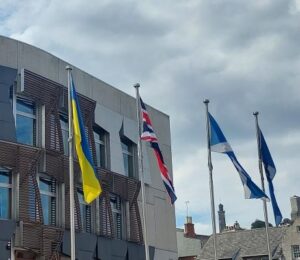
Three days ago, on the Brexit vote’s tenth anniversary, I was in Edinburgh and found myself in the vicinity of the Scottish Parliament, outside which four flags flutter at the top of four flagpoles: the Scottish saltire, the Union Jack, the Ukrainian flag and the European Union flag with its dozen stars. In 2020, in defiance of Brexit, a majority of Members of the Scottish Parliament voted to keep the European flag flying there.
The parliament now has a minority of far-right Reform MSPs and one of them, Senga Beresford – who in the past has called for mass deportations of British Muslims and expressed support for fascist rabble-rouser Stephen Yaxley-Lennon – marked the anniversary by demanding that the flag be brought down. Well, to hell with that. Especially when her party is currently planning to tear up agreements made with the EU and target EU nationals with settled status in Britain by evicting them from social housing and making it “notably more expensive for companies to employ them”. I’m sure settled-status EU nationals in Scotland are glad to see that flag at the parliament, showing some Scottish solidarity with them.
And let’s hope it continues to fly there until Scotland does find a way back to Europe – with or without the rest of the UK.