Continuing my occasional series about memorable temples I have visited – here’s something about the Temple of Devol (Seenigama Devalaya) off the Sri Lankan coast, which I encountered in 2018.
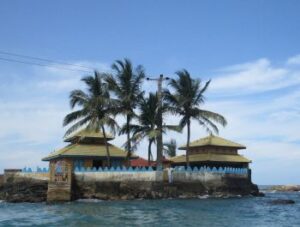
Just offshore from the coastal village of Seenigama in south-western Sri Lanka, you’ll find a temple consisting of two small buildings perched on top of a rocky little island. The temple is devoted to an imperious-looking deity called Devol, who’s believed to look after the local fishermen and, it’s said, local truck drivers too. But he’s more famous for being a god of revenge. If someone has wronged you, you can travel to the island and make an offering to Devol in the hope that he’ll impose retribution on the culprit.
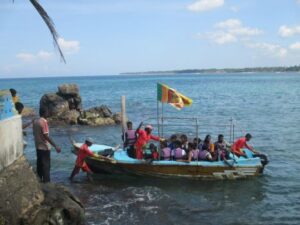
To get from the island from Seenigama’s beach, you have to travel in a flimsy-looking boat with an outboard motor. It can take twenty or more people at a time, some of whom – not all – are given life-jackets. When I got to the beach, I discovered that most of my fellow passengers were feisty old Sri Lankan ladies who boarded the boat by enthusiastically beetling up over its stern and sides and into its two rows of seats. A little later, they transferred themselves from the boat to the island itself with a similar, impressive display of agility and sprightliness. I couldn’t help but wonder if those elderly ladies were heading to the temple to call on Devol to wreak revenge on their enemies.
The boat-trip only took a minute or two. The island quickly swelled up out of the sea ahead of us, the rocks at the waterline black, the higher rocks grey, and then these natural formations giving way to manmade walls of faded yellow with blue-painted arched crests along their tops. The boat ended up bobbing and swiveling drunkenly in the surf next to some slimy boulders that, further up, transformed into stone steps. Walking around the island in footwear isn’t allowed and I’d already removed my boots and stashed them in my bag – which was just as well, because to get from the boat and onto the boulders I needed to wade through a swash of seawater.
While I got up to the steps, I felt uncomfortably like Stephen Maturin, the landlubberly and accident-prone ship’s surgeon in Patrick O’Brian’s Master and Commander books, who “at one time or other… had contrived to fall between the boat that was carrying him and almost every class of ship and vessel in the Royal Navy.” But I managed to negotiate the boulders, ascend the steps and get onto the temple grounds up-top without slipping, drenching and embarrassing myself.
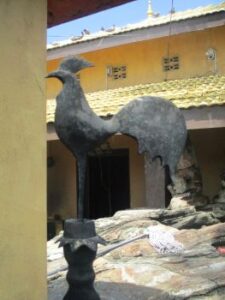
In addition to the buildings, the temple contains a small tiled yard, a clump of palm trees, a well, a small metal sculpture in the shape of a rooster and a tall concrete pole with spotlights attached. The day I was there, many pigeons were perched on the golden-yellow roofs and flies were crawling in great profusions about the tiled ground.
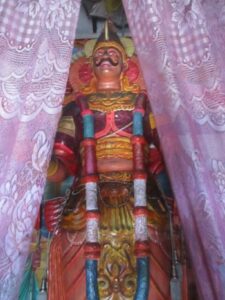
I found inside the smaller temple building a tall statue of Devol with a coppery red face and an impressively curly moustache. His image is partially obscured by curtains, supposedly – I’ve read somewhere – to lessen the harmful effects of his wrath as it radiates out of him.
After taking a few photographs in that room, I turned around and stepped out of it again. The moment my bare feet touched the moonstone at the threshold – which like all the horizontal surfaces here was wet and treacherous – I slipped spectacularly and landed with a great thud on my ‘jacksy’, as they say in Glasgow. Thankfully, my bag, with my boots inside it, muffled the impact of the fall and possibly saved me from breaking my tail-bone. It was embarrassing, however. All the visitors in the yard outside promptly looked my way and enjoyed a quiet chuckle at my haplessness.
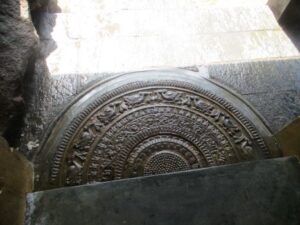
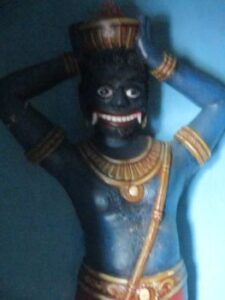
The larger temple building contained an altar on which, if you wish Devol to wreak revenge on someone, you present offerings of chilis, garlic and hot spices that, later, a priest grinds up in a ritual outside. That’s right, that’s how it works here – to place a curse on the person who’s mistreated you, you need to contribute to the making of a chili paste. Three deities lurk in alcoves behind and to the left and right of the altar. The central one look fairly benign, but the other two are more sinister. The left-hand deity wears a helmet and girdle made out of interlocking cobras while the right-hand one looks even more ghoulish, with a rictus grin and fangs protruding downwards from the ends of its long mouth.
Various travel blogs in which I’ve read about the temple have gone on in detail about how the visiting pilgrims, seemingly intoxicated by the idea of getting revenge on their persecutors, work themselves into states of ecstasy and hysteria. But I saw none of that. The crowd who’d come with me in the boat seemed very calm, composed and quietly respectful. (Well, apart from their moment of mirth when I keeled over on that slippery moonstone). As I’d said earlier, most of them were elderly local ladies.
It occurred to me afterwards that Devol has several roles – he’s a guardian of fishermen (and truck-drivers) as well as a bringer of revenge – and maybe the ladies had come with a more benign purpose. Maybe they just wanted to pay their respects to Devol and ask him to look after their sons and husbands while they made their livings out on the waves or out on the roads.