Nostalgic wallows 1: Bill McLaren


© BBC


We’re nearing the end of the 2024 Six Nations rugby championship and my mental health feels more kicked around than the ball in the matches.  Up until the Saturday just past, the two teams I support, Ireland and Scotland, had been doing well and I was entertaining hopes that the championship would conclude with them at the top of the table.  But what a difference a Saturday afternoon makes.  Ireland got beaten by England, the team nobody wants to get beaten by.  Against all expectations, Scotland lost to Italy, the team regarded as the one in the championship ‘making up the numbers’ and who usually finish bottom.


Anyhow, aside from the anguish…  The championship reminds me yet again of how much I miss being able to watch an international rugby match and at the same time listen to the knowledgeable and dulcet tones of Bill McLaren.


Although McLaren, who died in 2010 at the age of 86, worked as late as 2002, it was in the 1960s, 1970s and 1980s that he was indisputably the voice of British rugby union.  This was an era when sport, if you weren’t at the live event itself, was viewable only on a handful of terrestrial TV channels.  It was common for one channel to have a monopoly on broadcasting one sport and, by extension, for one commentator to have a monopoly on talking about that sport.  Hence, in my youth, it was almost impossible to see horse racing without hearing the posh but eerily robotic tones of Peter O’Sullivan, or boxing without hearing the excitable Harry Carpenter, or Formula One without hearing the gaffe-prone Murray Walker, or rugby league without hearing the indescribable-sounding Eddie Waring.  McLaren fulfilled this role in the world of rugby union and for me was the best sports commentator of the lot, though I’m undoubtedly biased.  Rugby has always been my favourite team sport.  Plus McLaren came from Hawick in the Scottish Borders, the region where I spent many of my formative years.


There were three reasons for McLaren’s greatness.  Firstly, he knew his stuff.  I remember watching a McLaren-commentated game on a pub TV in Aberdeen sometime in the 1980s.  I was in the company of my good friend, the late Finlay McLean, and at one point, Finlay turned around to me and marvelled, “He’s just steeped in the game, isn’t he?”


When a try was scored, McLaren didn’t just tell you the name of the player who’d crossed the line.  No, he’d also observe how the player was the great-great-nephew of the man who’d kicked the winning points in the legendary Hawick-Galashiels derby of 1937, or a direct descendent of the tight-head prop with the great Western Province team that’d dominated South Africa’s Currie Cup in the 1890s.  It wouldn’t have surprised you if he’d identified the player’s granny as the stylist responsible for grooming the mutton-chop sideburns of J.P.R. Williams, which were rugby’s main contribution to fashion in the 1970s.  McLaren seemed to know everything about rugby.


His knowledge was encyclopaedic, but this was backed by a conscientious and professional attitude to research.  I read somewhere that when preparing for a game, he’d cover a full sheet of foolscap with notes about each player.  This meant that in the commentator’s box he was constantly shuffling around some 30 sheets of paper.


Secondly, although he was a Scotsman and often commentated on games involving the Scottish rugby team, he was never biased.  On the contrary, he always applauded good rugby, no matter who was playing it and even if Scotland was on the receiving end of it.  McLaren’s neutrality was especially admirable when you compared him with the international football commentators on the BBC at the time (and indeed still now), who seemed incapable of narrating an England World Cup match without speculating every second minute about whether ‘we’ could win the World Cup just like ‘we’ won it back in 1966.


Thirdly, and most importantly for me, his commentaries were laden with poetry.  McLaren had an amusing, fanciful, frequently wonderful talent with language.  Admittedly, he could be a tad unflattering in the turn of phrase he used to describe the over-sized players on the field.  English prop Colin Smart – famous for getting stomach-pumped after drinking a bottle of aftershave as a post-match lark – consisted of ‘considerable acreage’; English captain and lock Bill Beaumont looked ‘like someone who enjoys his food’; Welsh forwards Scott and Craig Quinnell were ‘two well-nourished individuals’; Scottish flanker Finlay Calder had ‘hands like dinner plates’; and Calder’s gangly fellow-Scot Doddie Weir was ‘the lamppost of the line-out.’  As for the legendary and frankly massive New Zealand flanker Jonah Lomu, running into him was like ‘trying to tackle a snooker table’.


© BBC


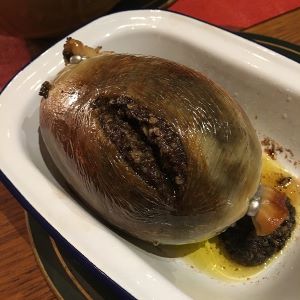
He had a fondness to likening players to animals.  They might behave like ‘a demented ferret’ or a ‘bag of weasels’ of a ‘raging bull with a bad head’ or ‘a whirling tsetse fly’ or ‘a runaway giraffe’ or ‘a slippery salmon’.  The Scottish scrum-half Roy Laidlaw (whose nephew Greig captained Scotland for seven years up until 2019) was as elusive as ‘a baggy up a Borders burn’ – a baggy being, to quote the Dictionary of the Scottish Language, ‘a species of large minnow.’  Unsurprisingly for a Borders man, Scotticisms were common in his delivery.  Rugby balls were likened to ‘three pounds of haggis’, the famously square-shouldered Scottish skipper Peter Brown was like ‘a coo kicking over a milk pail’ and an injured player sitting dejectedly at the side of the field whilst sucking on a mint was at least ‘enjoying his sweetie.’


When it came to describing the turbulent passions and physical violence often unleashed on the pitch, McLaren was amusingly euphemistic.  Cheating was frequently described as ‘jiggery-pokery’ and punch-ups were dismissed as ‘a bit of argy-bargy’.  I remember when fists started flying in the middle of one scrum, he commented: “It’s getting a bit unceremonious in that front row.”  And when Scottish centre Jim Renwick – whom McLaren had coached as a schoolboy – missed a kick and was caught by the camera mouthing the F-word, McLaren diplomatically remarked that he was ‘muttering a few naughty Hawick words.’


Some of his sayings became catchphrases.  When a player prepared to kick a conversion and half the stadium made disparaging noises in the hope of distracting him and making him fluff it, McLaren would invariably remark: “There’s some ill-mannered whistling.”  And when a conversion-kick made it between the posts despite being taken from a torturous angle, he’d declare: “It’s high enough, it’s long enough and it’s straight enough!”


Aware that in the Borders towns local players who’d made it onto the national team were seen as heroes, he’d often serenade the scorer of a Scottish try with the lines, “And they’ll be dancing on the streets of…” or “And they’ll be drinking his health in…” – Hawick, Galashiels, Kelso, Melrose, Selkirk, wherever – “…tonight!”  As an honorary Borderer, I’d say they were more likely to be drinking his health than dancing in the streets.


McLaren’s manner and delivery were immensely relaxed and comforting, but his early life had been no bed of roses.  As a young World War II serviceman, he had to endure the Battle of Monte Cassino, of which one eyewitness said, “The men were so tired that it was a living death.  They had come from such a depth of weariness that I wondered if they would quite be able to make the return to the lives and thoughts they had known.’  McLaren himself described Monte Cassino as a ‘vision of hell on earth.’


After the war, he was diagnosed as having tuberculosis, which put a prompt end to any hopes he had of becoming a rugby internationalist.  TB was then considered incurable and he wasn’t expected to survive, but he and four fellow sufferers agreed to be guinea pigs for the trials of a new drug, streptomycin.  Thanks to this treatment he recovered, but three of the four other volunteers died.  It was while he was convalescing that he produced his first sports commentaries – describing table-tennis matches over the hospital radio.


McLaren was passionately attached to his hometown and famously said, “A day out of Hawick is a day wasted.”  Several years ago I visited Hawick for the first time since the 1980s, and saw to my dismay how much it’d deteriorated.  Its high street was run-down and riddled with derelict properties – thanks to a faltering economy caused by the closure of local woolen mills, and also thanks no doubt to the opening of branches of Morrison’s, Sainsbury’s and Lidl, which’d sucked the retailing life out of the place.  My first thought was: “What would Bill McLaren have said?”


© From rugbyrelics.com


McLaren’s commentaries were emblematic of an earlier, more innocent age, when rugby was still an amateur sport and because of that it was incredibly accessible.  This was especially true if you lived in a rugby-daft place like the Borders, where the guys you saw performing heroic deeds for Scotland on TV on Saturday afternoons existed during weekdays as mortals like everyone else.  As a kid living there, I was delighted when the man from the electricity board who came to our house to check on a power outage was none other than Jim Renwick.  Meanwhile, Scottish fullback Peter Dods was a joiner down the road in Galashiels and my old man, a farmer, was on nodding terms with Scottish flanker John Jeffrey, who farmed in Kelso – Jeffrey’s teammates had nicknamed him ‘the Great White Shark’ but to Bill McLaren he was just ‘the big Kelso farmer’.  And let’s not forget local electrician Roy Laidlaw, whom legend has it had to rewire the public toilets in Jedburgh the Monday morning after the Scotland team he was part of won the Grand Slam in Paris.


Yes, Bill McLaren’s voice evokes a simpler time in rugby, before professionalism, sponsorship, corporatism, razzmatazz and a profit-driven need to win at all costs took over.  But homespun though his persona was, I don’t believe there’s been a sports commentator in the years since who’s come close to matching him.


From artuk.org / © Beltane Studios

Favourite Scots words, S – part 1


© Channel 4 Films / PolyGram Filmed Entertainment


Hot on the heels of my post about Robert Burns, here’s the latest in my series about favourite words in Scots, the language Burns wrote in.  Many Scots words begin with the letter ‘S’, so in this instalment I’m only going to list the first half of them.


Scaffy (n) – not, as you might expect, a scaffolder, but a streetcleaner or binman.


Scheme / Schemie (n) – a scheme is the Scottish word for a housing estate and schemie is the derogatory word for someone who lives on one.  One long-ago Saturday evening, while I was wandering around central Edinburgh, I went past a nightclub and was suddenly accosted by an upset young woman who demanded, “Dae I look like a schemie?”  Her supposed resemblance to a schemie was why the bouncer at the nightclub door had just turned her away.


Meanwhile, a much-quoted line from Irvine Welsh’s Trainspotting (1993) comes from Mark Renton when he turns up for a job interview: “They’d rather gie a merchant school old boy with severe brain damage a job in nuclear engineering than gie a schemie wi a Ph. D. a post as a cleaner in an abattoir.”


Scooby (n), as in ‘I havenae a Scooby’ – rhyming slang for ‘clue’.  Scooby refers to Scooby Doo, the famous American TV cartoon dog who first appeared in 1969, accompanying some ‘meddling kids’, without whose investigations many, many, many criminals “would have gotten away with it.”  I’ve seen arguments online about whether this started as Scottish rhyming slang and then spread to England, or started as Cockney rhyming slang and spread to Scotland.  But I’m sure I heard it in Scotland back in the 1980s, and it was appearing in Scottish newspapers in the 1990s, so its Caledonian pedigree is pretty venerable.


Scrieve (v) – to write.  Accordingly, a scriever is a writer.  “Just been doin’ a wee bit scrievin’ you know,” says Matt Craig, the main character and aspiring scriever in Archie Hind’s Glasgow-set novel The Dear Green Place (1966), which is as good an account of the trials and tribulations facing a working-class person trying to make a name as a writer, and a living from it, as Jack London’s better-known Martin Eden (1909).


© Corgi Books


Scunnered (adj) – sickened or disgusted.  During the 1980s and 1990s, this word was commonly used in Scotland on the mornings following general elections, when it became clear that a majority of people in Scotland had voted for the Labour Party and a majority of people in the south of England had voted for Maggie Thatcher’s Conservatives.  Guess who ended up ruling Scotland each time?  For a 21st-century variation on this, see the Brexit vote.


Sharn (n) – dung.  Yes, Dungeons & Dragons enthusiasts may know Sharn as a city that ‘towers atop a cliff above the mouth of the Dagger River in southern Breland’ in the fictional world of Eberron, but in Scots sharn refers to cow-shite.  That’s a warning to fantasy creators.  When you dream up names for your fantasy characters, creatures and places, be sure to check they don’t also mean something embarrassing in Scots.  Now please excuse me while I get back to writing my latest sword-and-sorcery epic wherein Glaikit the Barbarian rescues Princess Jobbie from the clutches of the Dark Lord Pishy-Breeks in the Kingdom of Boak.


Shauckle (v) – to shuffle along, barely raising your feet off the ground.


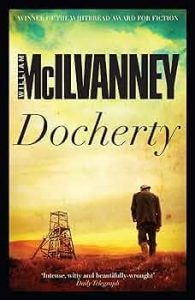
Sheuch (n) – a channel for removing wastewater, i.e., a gutter at the side of a street or a ditch at the side of a field. In William McIlvanney’s 1975 novel Docherty, the young hero Conn gets battered by his school’s headmaster for saying to him, “Ah fell an bumped ma heid in the sheuch.”  The fact that he doesn’t use the ‘correct’ word, gutter, is seen as ‘insolence’.  Early in the 20th century, when the events of Docherty take place, Scottish schoolkids would be punished for using Scots rather than the King’s English.  The only day in the year when Scots was acceptable in schools was January 25th, Robert Buns’ birthday, when they were made to recite the poetry of their national bard.


© Canongate Books Ltd


Incidentally, in Northern Ireland, where I spent my childhood, a sheuch seemed to be only a ditch.  My dad was a farmer and once or twice I heard him cry, “There’s a cow got stuck in the sheuch!”  And the North Channel – the strip of water above the Irish Sea that separates Scotland and Northern Ireland – was called ‘the Sheuch’ and the land-masses east and west of it termed ‘baith sides o’ the Sheuch.’


Shieling (n) – a hut or shelter for animals, usually out in the wilds and / or up in the hills.


Shilpit (adj) – thin, pale and weak-looking.


Shoogly (adj) – wobbly.  To hang on a shoogly peg means to be in dodgy, precarious or dire circumstances.  Since the arrival of the ineffectual and accident-prone Humza Yousaf as First Minister of Scotland, it’s fair to say the peg the electoral fortunes of the Scottish National Party hang on has been pretty shoogly.


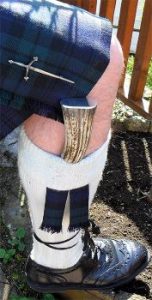
Skeandhu (n) – the Anglicised (or Scotticised) version of the Gaelic term sgian-duhb, meaning the ceremonial dagger that’s tucked behind the top of the hose in male Highland dress.  Considering the popularity of Highland dress at Scottish weddings, and the amount of alcohol consumed at them, it’s always surprised me that the country has avoided having a sky-high death-toll of wedding guests stabbed with skean-dhus in drunken altercations.


From wikipedia.org / © Stubborn Stag


Skelf (n) – a splinter.


Skelp (n / v) – to slap or a slap.  Skelps were often administered by parents and teachers to wayward kids back in the days, fondly remembered by the Daily Mail and Daily Express, when it was believed that assaulting children was good for them.


Skite (n / v) – also to strike someone or the blow thereof.  However, a skite is more likely to come from a sharp, stinging cane or stick than the open hand that delivers by a skelp.  Both are nicely onomatopoeic words, in their different ways.


Skoosh (n / v) – a squirt or spray of liquid.  A commonly heard exchange in Scottish pubs: “Dae ye want water in yer whisky?”  “Aye, but just a wee skoosh.”


Sleekit (adj) – according to the Merriam Webster dictionary, either ‘sleek’ and ‘smooth’ or ‘crafty’ and ‘deceitful’.  Presumably it was with the first meaning that this word got immortalised in a line of Robert Burns’ 1785 poem To a Mouse: “Wee, sleekit, cow’rin, tim’rous beastie…”  Nowadays, it’s used mainly with the ‘crafty’ and ‘deceitful’ application.  I can think of many politicians I’d describe as sleekit, but I won’t mention any names.


From members.parliament.uk


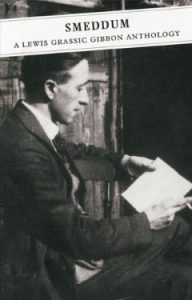
Smeddum (n) – in physical terms, a powder.  However, smeddum has also come to mean the kernel or essence of something, and presumably from that to mean its vigour, spirit, determination or grit too.  Robert Burns – him again – had the first meaning in mind when he wrote about ‘fell, red smeddum’, possibly referring to red precipitate of mercury, in his 1785 poem To a Louse.  Whereas Lewis Grassic Gibbon was thinking of smeddum’s spiritual denotation when he made it the title of his most famous short story, about a hard-working Scottish matriarch called Meg Menzies who takes no shit from anyone.  As Meg herself says: “It all depends if you’ve smeddum or not.”


Smirr (n) – a drizzly rain falling in small droplets.  This sad, ghostly word perfectly describes the sad, ghostly semi-rain that sometimes seems to envelop Scotland’s landscapes 365 days of the year.


Snaw (n) – snow.  Like snaw aff a dyke is a simile commonly used to describe something that disappears, or is disappearing, super-fast: for example, jobs for life, polar icecaps, cashiers in supermarkets, CD and DVD drives in laptops, Twitter’s credibility after Elon Musk took it over, and Liz Truss premierships.


© Canongate Books Ltd

Seven reasons why Robert Burns still rocks


From wikipedia.org / © Ron Waller


This is a revised and expanded version of a piece I had published one January 25th in the Arts section of Concrete, the students’ newspaper at the University of East Anglia, where I did a Master’s Degree many years ago.


Tonight, whisky will be guzzled, haggis devoured, bagpipes blasted and Scots-language poetry recited with gusto at thousands of special suppers and get-togethers around the globe.  This is because today, January 25th, is the 265th anniversary of the birth of Robert Burns, Scotland’s national bard and one of its most popular contributions to international culture.


Why, more than two-and-a-half centuries after he died at the age of 37, is Robert Burns such big deal?  Here are some reasons.


One.  Burns was a champion of the common man.  Born in humble circumstances, as one of seven children to a farmer in Ayrshire, he was much more in tune with the ordinary masses than any of his literary contemporaries.  The American poet Waldo Emerson described him as the poet of ‘the poor, anxious, cheerful, working humanity’.  The fullest expression of his egalitarian instincts was the song A Man’s a Man for a’ That (1795), which was adopted as an anthem by the anti-slavery abolitionist movement.  That, however, highlights an uncomfortable fact…


In 1786, Burns came within a hair’s breadth of travelling to Jamaica and taking up a job-offer as a bookkeeper on a sugar plantation – run on slave labour.  Burns’ defenders argue that as a young man at the time, pre-fame, facing destitution, and desperate to get out of Scotland, he probably didn’t consider the hideous moral implications of the job he was about to undertake.  Also, by 1792, he seemed aware enough of slavery’s horrors to pen The Slave’s Lament, which begins: “It was in sweet Senegal that my foes did me enthral / For the lands of Virginia-ginia, O.“  But the issue is murkier still, because Burns’ authorship of The Slave’s Lament has been disputed.


Anyhow, later, socialists claimed Burns as one of their own.  A 1929 translation of his works into Russian sold a million copies and the Soviet Union honoured him with a commemorative stamp in 1954.  However, Burns obviously had appeal for capitalists too, for there are allegedly more statues of him in North America than of any other writer.


Two.  Burns was a songwriter too.  Indeed, if anything, he is more pervasive as a songwriter than as a poet.  In addition to A Man’s a Man…, he put Auld Lang Syne on paper in 1788 – which, by virtue of being belted out at New Year celebrations everywhere, is arguably the most universally-sung song in the world.  In Japan it is played at everything from high school graduation ceremonies to evening closing-time in department stores.


Three.  Burns wasn’t afraid to criticise the moral and religious mores of his time.  His contempt for the censorious regime of Scotland’s Presbyterian Church was expressed most famously in Holy Willie’s Prayer (1785), wherein a supposedly pious pillar of the church prays to God and unwittingly reveals himself as a scheming, bitter, drunken hypocrite.  Particularly pathetic are his pleas to be forgiven for his lechery, which has targeted ladies by the name of Meg (“And I’ll ne’er lift a lawless leg / Again upon her”) and ‘Leezie’s lass’ (“…that Friday I was fou / When I cam near her”).  John Betjeman was so impressed by the conceit that he borrowed it for his 1940s poem In Westminster Abbey.


Four.  Burns has a massive cult that keeps his memory alive.  The first Burns societies began to congregate in his honour in about 1800, four years after his death. In 1859, the first centenary of his birth, almost 900 events were staged – 60 of them taking place outside Britain and the US.  Today, Burns societies are to be found everywhere from Rio de Janeiro to Tokyo and from Winnipeg to Jakarta.


It’s claimed that the Russians have more such societies than even the Scots do.  Well, in the unlikely of event of Vladimir Putin sticking his head into a Burns supper this evening, I hope he’s regaled with Burns’ 1792 rewrite of the song Ye Jacobites by Name, whose anti-war lyrics include: “What makes heroic strife? / To whet th’ assassin’s knife / Or hunt a parent’s life, wi’ bluidy war?


From wikipedia.org / © Melissa Highton


Burns suppers on January 25th are marked by lusty recitals of his greatest poems, speeches and copious consumption of whisky and haggis.  Praised as the ‘great chieftain o’ the puddin’ race’ in Burns’ Address to a Haggis (1786), haggis is surely the only offal-based foodstuff to have a piece of world-class literature written in its honour.  No other writer is commemorated by a yearly celebration on this scale.  Dublin’s James Joyce-themed Bloomsday on June 16th doesn’t come close.


Five.  Burns invented the concept of the doomed, decadent romantic poet.  Long before Byron and Shelley were painting the towns of Europe red and proving themselves mad, bad and dangerous to know, Burns had earned himself a mighty reputation for dissipation, both in the pub and in the bedchamber.  His love of strong drink is obvious in poems like John Barleycorn (1782) while his promiscuity led to him siring at least a dozen children with at least four different women – a common jibe at the time was that you could see his face in every pram on Edinburgh’s Princes Street.


Six.  Burns is controversial.  And no doubt the arguments that have raged about him over the centuries have helped keep his fame alive.  Much debate has centred on whether or not someone with Burns’ obvious character flaws deserves such veneration.  At the beginning of 2009, just before the 250th anniversary of his birth, right-wing Scottish historian Michael Fry caused a storm when he denounced Burns as a ‘racist misogynist drunk’ who didn’t deserve to be presented to people as a role model.  Fry sounded a bit like a rock-and-roll era parent expressing concern about the examples the likes of Jim Morrison, Sid Vicious, Liam Gallagher, Pete Docherty, Amy Winehouse, etc., set for young people.


Seven.  Burns’ work has had a considerable influence on the English language and on English-language culture.  Here are a few examples:


Proverbs:

  • The best laid plans of mice and men will go astray (‘The best-laid schemes o’ mice an’ men gang aft agley’ / from 1785’s To a Mouse).
  • To see ourselves as others see us (‘To see ousel’s as ithers see us’ / from 1786’s To a Louse).
  • There is no such uncertainty as a sure thing (attributed to Burns).


Phrases:


Burns-inspired titles:

  • John Steinbeck’s novel, Of Mice and Men (1937).
  • R. James’ short story, reckoned by some to be the greatest ghost story in English literature, O, Whistle and I’ll Come to you my Lad (1904) – which is also the title of a 1793 Burns poem.
  • Ken Loach’s film, Ae Fond Kiss (2004) – which is also the title of a 1791 Burns song.
  • The Vin Diesel car-chase / street-racing movie The Fast and the Furious (2001) – ‘fast and furious’ was a phrase Burns coined in Tam O’Shanter.


All right, with that that last example, the producers may not have been aware of the Robert Burns connection when they chose the title.


© National Trust for Scotland / Robert Burns Birthplace Museum

A Dad story


From amazon.co.uk / © Smith, Smith & Swan


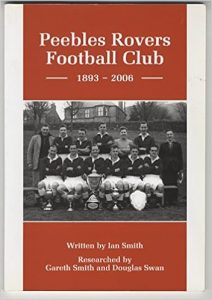
Back in 2006, I returned to my family’s home in the town of Peebles, in southeastern Scotland, for a fortnight’s vacation from a job I was doing in a particularly authoritarian, under-developed and hard-to-live-in country.  As that country offered little in the way of social life, I had plenty of free time on my hands when I wasn’t at my workplace.  And to fill in that free time, I’d spent the past year working on a project initiated by my brother Gareth and his mate Douglas Swan.  Basically, Gareth and Douglas wanted to publish a book about the history of a local football team, Peebles Rovers.  They conducted the research for it and sent the notes, newspaper cuttings, interview transcripts and so on to me.  I’d always fancied myself as a writer, so I took on the job of turning their research into prose.


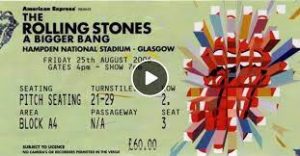
The research had all been written up and the book was soon to be published when I arrived home that August.  As a thank-you for the work I’d put into it, Gareth and Dougie bought me a present: a ticket for the Rolling Stones concert on Friday, August 25th, at Hampden Stadium in Glasgow, which coincided with my return to Scotland.


This was a little sudden and unexpected.  Also, my parents’ house, where I was staying, was offline and I didn’t have a phone – so dictatorial was the country I was working in that private citizens weren’t allowed to carry one.  Thus, I was somewhat unprepared that Friday morning when I set off, via bus from Peebles to Edinburgh, and then train from Edinburgh to Glasgow.  I hadn’t, for example, been able to search for accommodation that night in Glasgow, after the concert.  “Och,” I thought to myself in my haphazard way, “I’m sure something will turn up.”


However, before I left the house in Peebles, my Dad told me: “If you can’t find a place to stay, and have problems getting home, call me from a pay-phone.  I’ll come and collect you.”


“Sure,” I said.  But as I prided myself on being an independent, ‘low-maintenance’ sort of person, I had no intention of phoning him late at night, and probably getting him out of bed, to lament that I needed help getting home.


Anyway…  I got to Glasgow and first of all visited the Tourist Information Centre in George Square to ask if the city had any hotel rooms free that evening.  “Not really,” the lady at the desk replied. “There’s a big concert here today, you see…”  Well, I knew that, having come to attend it.  From what she said, it sounded like the nearest hotel that did have vacancies was halfway between Glasgow and John O’Groats.  Oh well, I thought.  I’ll just have to head back to Edinburgh afterwards and see if I can get to Peebles from there.  Because the Edinburgh Festival was in full swing at the time, all accommodation in the Scottish capital was already booked too.  It’d been snapped up months ago.


From mixcloud.com


I enjoyed the Rolling Stones and the Charlatans, their support band, at Hampden that evening.  Following the show, I hopped on a late train to Edinburgh.  Unfortunately, I arrived in Edinburgh sometime after the final bus of the day had left the city for Peebles.  What to do?  Well, from previous experience of the Edinburgh Festival, I knew it was virtually impossible to find a taxi at night-time.  But there was a very late bus, leaving at around three o’clock in the morning, for the town of Penicuik, which was halfway between Edinburgh and Peebles.  From Penicuik, home was another ten miles away.  First, you had to traverse the wilds of Leadburn Moor, then you had to make your way along the more sheltered and scenic Eddleston Valley.


Ten miles, I thought to myself in a gung-ho manner, having downed quite a few pints that day and being full of Dutch courage.  I could walk that in two-and-a-half hours.  And, just in case there are any cars using the road at that late hour – I can always try hitchhiking.  Maybe I’ll strike it lucky and get a lift, and get back to Peebles sooner.   


Because it was Festival time, many of the pubs in Edinburgh were open very late.  And because I felt I could do with just a wee bit more Dutch courage, I spent the run-up to three o’clock sinking more pints in the Scotsman Lounge on Cockburn Street.  Finally, it was time to go.  I got on the three o’clock bus and a half-hour later got off in the centre of Penicuik, which was utterly still and silent.


From there, I walked down a street towards the southern edge of the town.  I didn’t see another soul on the pavements.  Neither did a single vehicle pass on the road.  The outskirts of town neared and, beyond, the darkness of Leadburn Moor beckoned.  I steeled myself.  Okay, I thought.  This is going to be a hell of a walk.  But I can do it…


As I got to the town’s edge, and the beginning of the darkness, a pair of headlights went blazing past on the other side of the road – northwards, into Penicuik, the opposite direction from where I was going.  A pity, I thought.  But there’s at least one person on the road at this hour.  Maybe there’ll be others, heading my way…


And sure enough, a minute later, I heard a car engine approaching behind me – driving southwards, towards Peebles!  I turned just before the headlights reached me and stuck out my hitchhiking thumb.  The car passed, and slowed, and stopped a few yards ahead.  Fortune was smiling on me for sure.  I ran to the car, grabbed the passenger’s door, yanked it open, stuck my head in and blurted: “Are you going towards Peebles – ?”


My voice died.  For sitting in the driver’s seat was… my Dad.


I spluttered, “What are you doing here?”


“Och,” he said, “I woke up a while ago and thought to myself, that fellah hasn’t come home yet. So I wondered what you would do.  I figured you’d be daft enough to get the bus from Penicuik and try walking home from there.  So I thought I’d get in the car and take a wee scoot up the road and have a look for you.  I spotted you on the pavement there a minute ago, found a place to turn and came back.”


I didn’t know whether I should feel annoyed, insulted, pleased, amused or relieved.  I probably ended up feeling a mixture of all five, but the biggest feeling was one of relief.


That wasn’t the only occasion that my auld man, kind and shrewd, came to my rescue.  But it was perhaps the most memorable one.


My Dad passed away at the end of last month, aged 88.  So I thought I would share this Dad story with you.


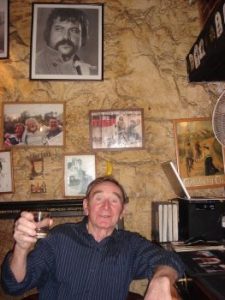
Four years after the event described above, I met up with my Dad for a week’s holiday in Malta.  Yes, we did end up one day in the pub in Valetta where thirsty movie star Oliver Reed breathed his last whilst filming Ridley Scott’s Gladiator there in 1999.

Jim Mountfield hunts for cryptids


© Sirens Call Publications


My short story The Watchers in the Forest, which is attributed to the pseudonym Jim Mountfield, can now be read in issue 62 – the summer 2023 edition – of the fiction and poetry magazine The Sirens Call.


Much of the writing in this issue is on the theme of cryptids – a ‘cryptid’ being defined by the Merriam-Webster dictionary as “an animal (such as Sasquatch or the Loch Ness Monster) that has been claimed to exist but never proven to exist.”  Accordingly, the young hero of The Watchers in the Forest one day notices something strange in the woodland that rises at the end of his grandparents’ garden, woodland in which there have been reports of mysterious ape-like creatures, and unwisely goes to investigate…


As usual with The Sirens Call, issue 62 is the sort of bargain that’s rare nowadays.  It contains 274 pages and features 169 stories and poems, yet is available free of charge.  It can be downloaded here.


Incidentally, while we’re on the subject of ape-like cryptids, here are my five favourite examples of them from the real world.  Well, I don’t think any of them are real, but there have certainly been real reports about them.


The Big Grey Man of Ben Macdui

This is Scotland’s number-one simian-cryptid.  The Big Grey Man of Ben Macdui (Am Fear Liath Mòr in Gaelic) is a huge, hairy creature that’s supposed to follow and loom up terrifyingly behind lone hikers and climbers on the country’s second-highest peak, the often-misty Ben Macdui in the Cairngorm Mountains.  Alas, nice though the idea of ape creatures lurking in Cairngorms is, I’m inclined to attribute the sightings of the Big Grey Man to the creepy optical effect known as the Brocken Spectre.  This involves the sun casting your shadow from a high position onto mist, fog or cloud and making it look monstrous.


The Bukit Timah Monkey Man

Fabulously, an ape-like cryptid is rumoured to stalk my current abode, Singapore, the island city-state that has an area of just over 700 square kilometres and is the third most densely populated nation in the world.  If cryptids can escape detection here, they can do it anywhere.  It’s said the Bukit Timah Monkey Man was originally sighted in 1805 and most recently in 2020.  In the intervening two centuries, those who claim to have seen the beast include Japanese soldiers during their country’s occupation of Singapore in World War II.


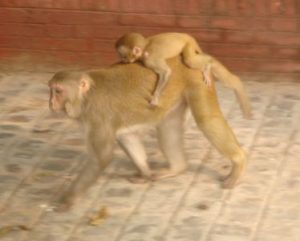
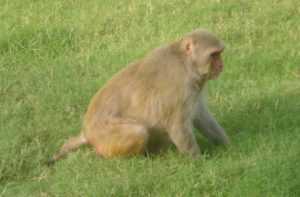
The Monkey Man’s sightings have centred around the Singaporean district of Bukit Timah where, on the slopes of Bukit Timah Hill (Singapore’s highest peak at 164 metres) there’s a nature reserve with a population of crab-eating macaque monkeys.  It’s assumed that people have seen the real monkeys in poor visibility and distorting light conditions and mistaken them for the cryptid.  Though as the crab-eating macaques are at most a half-metre long, and the Monkey Man is supposed to walk upright at a height of 1.75 metres, it seems an odd mistake to make.


A fixture in Singaporean popular culture, the Bukit Timah Monkey Man is sometimes known by the abbreviation BTM, which makes him sound like a Korean-Pop boy-band.


The Monkey Man of Delhi

Delhi is no stranger to monkeys.  The last time I was in the city, in 2014, I couldn’t believe the size of the monkey-gangs that were roaming the streets in the neighbourhood of the Indian parliament.  They swaggered about as if they owned the place.  Predictably, I heard jokes from local people about the parliament being full of monkeys in more way than one.


However, in 2001, the city’s monkey phenomenon took a sinister turn with reports about the Monkey Man of Delhi.  According to eyewitnesses, this apparition was a simian-type creature that ranged from four feet to eight feet in height.  It was seen about 350 times and supposedly attacked and injured some 60 people, even causing a couple of deaths.  The Monkey Man of Delhi’s reign of terror has been attributed to mass hysteria, not unlike the Spring-Heeled Jack panic that gripped Britain nearly two centuries earlier.  Thus, the creature is probably more of an urban myth than a ‘real’ cryptid.


The Monkey Man of Delhi had some surprisingly human tastes in accessories.  His Wikipedia entry mentions how eyewitness accounts had him not only “covered in thick black hair” but also endowed with “a metal helmet, metal claws, glowing red eyes and three buttons” on his chest.  “Some reports also claim that the Monkey Man wore roller-skates.”


The Nittaewo

Sri Lanka, the country where I lived from 2014 to 2022, is also home to tales of anthropoid cryptids.  The Nittaewo were said to be a species of bipedal, tailless primates dwelling in the nation’s forests, with talon-like fingers and a strange language that resembled the twittering of birds.  According to the traditions of the Vedda people – who are believed to be Sri Lanka’s oldest human inhabitants – the Vedda fought against and finally destroyed the Nittaewo in the 18th century.  All the same, there have been alleged sightings of the Nittaewo since then, indeed, as late as 1984.


But if you go down to the Sri Lankan woods today and hear strange rustlings and twittering sounds coming from the undergrowth, you needn’t be too alarmed.  The Nittaewo were said to be three feet tall at most.  So if they did exist, they shouldn’t have looked any more threatening than a Hobbit.


The Yeti

Obviously, the Yeti, the Abominable Snowmen of the Himalayas, vie with Bigfoot as being the world’s most famous ape-like cryptids.  I like them for two reasons.  Firstly, they inspired the haunting, wistful song Wild Man by Kate Bush, released in 2011.  (“Lying in my tent, I can hear your cry echoing round the mountainside / You sound lonely…”)


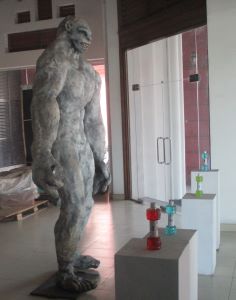
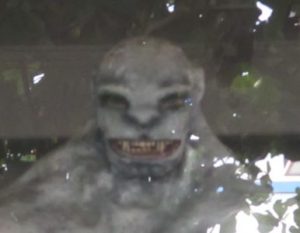
Secondly, I used to see a yeti regularly in Colombo, the Sri Lankan capital.  The venerable street-side walkway on York Street in the city’s downtown area had a huge fibreglass yeti hulking behind, and glowering out through, one of its shop windows.  The thing had been created as an eye-catching advertising gimmick for a product called Yeti Isotonic Energy.  This was a rehydrating sports drink “developed in collaboration by Austrian and Sri Lankan scientists”, and bottles of it were on display in the same window.


I wonder if he’s still there today?


Hapless Humza and heaven’s Kate


From wikipedia.org / © Scottish Government

From wikipedia.org / © ScottishPolitico


The devil and the deep blue sea.  A rock and a hard place.  Scylla and Charybdis.  These are a few phrases that spring to mind when I think of the choice facing members of the Scottish National Party as they vote for a new party leader and First Minister of Scotland to replace Nicola Sturgeon, who a month ago announced her intention to resign from those posts and last week made her final appearance at First Minister’s Questions in the Scottish Parliament.


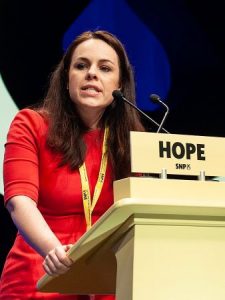
Neither of the options offered as Sturgeon’s successor is particularly inspiring. There’s Humza Yousaf, current Scottish Cabinet Secretary for Health and Social Care, and previously Minister for Transport and the Islands.  And then there’s Kate Forbes, currently Cabinet Secretary for Finance and the Economy.


Okay, there’s also a third candidate in the running, Ash Regan, former Minister for Community Safety.  But, working on the assumption that the average SNP member has at least a couple of braincells in his or her head, I imagine Regan has zero chance of prevailing.  Her big idea so far has been to have an ‘independence-readiness thermometer’ displayed in a major Scottish city.  Plus, much of her support actually seems to lie outwith the SNP, i.e., among the opportunists, grifters, misfits, transphobes and Scottish-indy ultras who joined embittered former SNP leader, former Russia Today presenter and generally-accepted lech Alex Salmond when he set up the Alba Party as a way of getting revenge on Sturgeon and his old party (and secured 1.65% of the votes cast in the subsequent Scottish parliamentary election).


Anyway, onto the two real candidates. Yousaf strikes me as a bloke with his heart in the right place…  But his performance in government has been patchy and he’s prone to making gaffes, most recently when he met with a group of Ukrainian women and inquired, “Where are all the men?”  Okay, whilst being in charge of Health and Social Care in Scotland, he’s been under constant bombardment from Scotland’s newspapers, which are almost without exception right-wing, conservative, unionist and shite-holey – the Scottish Daily Mail, the Scottish Daily Express, the Scottish Sun, the Scotsman, the Herald and the Scottish edition of the Daily Telegraph.  While their beloved Conservative Party has, in government in London, under the leaderships of Boris Johnson, Liz Truss and Rishi Sunak, wallowed in mindboggling amounts of corruption and indulged in mindboggling amounts of incompetence, their response has been to shriek and scream that the Scottish government is equally, if not more, of a basket case.  They’ve fixated on and magnified every fault and incompetence they can discover and never stopped to draw breath in their criticisms.  Generally, their modus operandi has been, in the words of far-right strategist Steve Bannon, to ‘flood the zone with shit’. “Okay,” they seem to cry, “Britain is crap!  But Scotland is even crapper!  And an independent Scotland would be even, even crapper!”


From wikipedia.org


But I don’t think Yousaf has the dexterity, the gravitas and the general intelligence to establish himself the way Sturgeon did – who, though most of the mainstream media in Scotland hated her, was able to rise above their carping, convey a sense of competence, and convince everyone bar the most rabid Scottish Conservative that she was much more effective as an administrator than, say, the venal Johnson or the barking-mad Truss.  Unfortunately, I can’t see how Yousaf will escape being portrayed by the media as a bungling klutz – in the same way that they succeeded in discrediting former Labour Party leaders like Michael Foot (supposedly a befuddled old fool who went to Remembrance services at the Cenotaph dressed as a scarecrow), Neil Kinnock (a Welsh windbag who tripped over on a beach and fell into the sea) and Ed Miliband (a two-kitchen-owning faux socialist whose dad hated Britain and who couldn’t eat a bacon sandwich properly).  That said, I doubt if they’ll be able to absolutely demonise Yousaf like they did with Jeremy Corbyn.


Incidentally, it’s interesting to compare Yousaf’s troubled tenure as Health Secretary with that of Sturgeon, who held the brief for a couple of years when Salmond was First Minister.  And if anyone says they don’t remember anything of Sturgeon as Health Secretary – well, that says a lot for her skill in keeping it a non-issue at the time.


From what I’ve seen of her, in purely political terms, Kate Forbes seems the most capable of the candidates.  But there’s a big problem.  She’s a member of the Free Church of Scotland and claims its tenets are ‘essential’ to her ‘being’ – which would be fine if her particular Kirk treated people from all walks of life non-judgementally, but it doesn’t, and Forbes has ended up saying some things that cross the line into intolerant, Bible-bashing crankery.  She’s said she would have voted against same-sex marriage, and stated her opposition to the Scottish government’s trans-friendly Gender Recognition Act, and spoken out too against abortion and sex outside of marriage.  This has put a lot of noses in the SNP out of joint.  For instance, the party’s deputy leader in Westminster Mhairi Black, a lesbian who got wed last year, has tweeted that she was ‘incredibly hurt’ by Forbes’ stance on gay marriage.


Perversely, some right-wing commentators who, in right-wing news outlets, regularly castigate Forbes’ party have ridden to her defence during the controversy about her religious views.  On February 23rd, Fraser Nelson, editor of bilious far-right magazine the Spectator, wrote an opinion piece in the no-better Daily Telegraph under the headline PROTESTANTS ARE NOW HOUNDED OUT OF POLITICS, AS KATE FORBES HAS SHOWN.  A day later, in Rupert Murdoch’s Times, the fogey-ish author and Evelyn Waugh wannabe A.N. Wilson penned a similar-minded piece entitled THE HOUNDING OF KATE FORBES SHOWS GODLESS SQUAD HAVE WON.  And if the moral support of Nelson and Wilson wasn’t enough to drain all street credibility out of Forbes, and send it down a hole deep enough to reach Australia, the ridiculous Jacob Rees-Mogg got in on the act too.  He wrote in a Daily Mail column that: “The last Scottish female public figure to be treated so badly for her religion was Mary, Queen of Scots, who was chased out of her country and eventually beheaded by her cousin Elizabeth for her Catholicism.”


From wikipedia.org


Oh, and the centre-right journalist and commentator Chris Deerin – director of the think-tank Reform Scotland, crooner with arthritic dad-rock band the Fat Cops, worshipper of Ruth Davidson and, mind-shreddingly, Scottish Editor for the supposed left-leaning New Statesman – has been carrying a torch for her recently too.  Just in case the Kate Forbes Media Fan Club didn’t sound hellish enough.


Personally, I suspect the reason why so many personages in the right-wing press are currently batting for Forbes is because they’re licking their lips with anticipation about what might happen if she wins.  They’d have a field-day reporting on the latest messes involving the First Minister of Scotland as, speaking her Free Kirk mind, she upsets gay people, trans people, unmarried mothers, women who’ve had abortions, etc.  She could also very easily piss off Scotland’s sizeable Roman Catholic community, since the brand of old-school Scottish Presbyterianism she adheres to is not exactly known for its love of the Pope and the Church of Rome.  And her social conservatism would probably mean the SNP’s current, informal governing alliance with the Scottish Green Party would end.


All in all, the Yousaf / Forbes leadership race looks like a lose-lose situation for the SNP and a win-win one for the right-wing mainstream media that would love to see the back of the party.  Meanwhile, I have a feeling that a lot of people in the Scottish independence movement who’d expressed impatience, dissatisfaction and frustration with Nicola Sturgeon’s performance in recent years – well, apart from those bampots in Salmond’s wee faction – will soon realise how much they miss her.


From wikipedia.org / © Scottish Government

Remember the Ally-mo


© BBC


It’s come to my attention that a football World Cup is in progress.  Time, then, to dust down and repost the following item, which surfaces on this blog every four years when the competition is underway to decide the global champions of the ‘beautiful game’.


One unsettling feature of growing older is that when an anniversary arrives and you think back to the original event, you feel shocked when you realise how much time separates now and then.  The other week, the 2022 World Cup competition began in Qatar, and it’s just occurred to me that the 1978 World Cup in Argentina took place 44 whole years and eleven whole World Cups ago.  It’s almost traumatic to realise how much time has elapsed.


However, if you’re old enough to remember the 1978 Argentinian World Cup and you were in Scotland at the time, you’ll testify that the event itself was traumatic.


For those of you who’re unacquainted with the topic…  What happened in 1978 was that of the four national football teams in the UK, Scotland was the only one to qualify for Argentina.  And the country had a team that, on paper, looked like it might achieve something.  It boasted players from some of the mightiest football clubs in Britain: for example, from Manchester United (Martin Buchan, Gordon McQueen, Lou Macari, Joe Jordan), Liverpool (Graham Souness, the legendary Kenny Dalgleish), Glasgow Rangers (Derek Johnstone, Tom Forsyth, Sandy Jardine), Nottingham Forest (Kenny Burns, John Robertson, Archie Gemmill) and, er, Partick Thistle (Alan Rough).  And in charge of these remarkable players was a manager called Ally MacLeod, who was remarkable in his own way.  Though not necessarily in the right way.


From the Independent / © Getty Images


Ally had been emboldened by wins in 1977 over the European champions Czechoslovakia and over the Auld Enemy, England.  The game against England concluded with the Scottish fans swarming onto the pitch at Wembley and digging up clods of the turf and breaking the goalposts into wee pieces to bring home as souvenirs, much to the horror of the English commentators and much to the hilarity of everyone in Scotland.  He then began to talk up his team’s chances in Argentina.  When early in 1978 Scotland failed to win the Home International championship involving England, Wales and Northern Ireland, Ally shrugged it off with the tantalising comment that the championship’s title “could be dwarfed by the World Cup.”  Such statements, and Ally’s general air of swagger and optimism – “My name is Ally MacLeod,” he announced when he became Scotland manager, “and I am a born winner!” – acted like catnip to both football fans and the hacks working on the sports pages of Scotland’s newspapers.


As the World Cup approached, a heady sense of expectation began to infect the Scottish population.  Folk started to believe that the Argentinian World Cup would be a jamboree of Scottish footballing genius, culminating in Ally and the gang lifting the trophy.  No wonder a carpet company cannily signed Ally to do a commercial where he sat on one of their rugs whilst dressed as a gaucho, which was 1970s Britain’s idea of what everybody in Argentina looked like.  This led to a priceless incident where, just before he departed for Argentina, Ally was accosted by an exuberant fan who announced, “Ally, see the day after your commercial?  My ma bought one o they carpets!”


Ally was indeed a great salesman.  He could truly market the brand.  Unfortunately, that was not quite the same as delivering the goods.


Even one of my favourite rock bands, the Australian (but mostly Scottish-born) AC/DC, got in on the act and played a gig in 1978 at Glasgow Apollo Theatre wearing Scotland football strips.  Also getting in on the act was the Scottish comedian Andy Cameron, who recorded a song called Ally’s Tartan Army that soon rode high in the charts.  It contained such catchy, if posthumously cringeworthy, lines as: “And we’re fairly shake them up / When we win the World Cup / Cos Scotland’s got the greatest football team!


From pinterest.co.uk


Being in Scotland in the spring of 1978 and watching this happen was disconcerting for me.  The year before, my family had moved from Northern Ireland and taken up residency in a farm near the Scottish town of Peebles.  I’d assumed that the Scots were a stoical, down-to-earth lot, not given to flights of fancy.  But then, all-of-a-sudden, they’d succumbed to this madness about Ally MacLeod, winning the World Cup and having the greatest football team in the universe.  What was going on?  I found it particularly noticeable the day before Scotland played Northern Ireland in the Home Internationals.  When I walked into a meeting of the local Scouts that evening, all the other (Scottish) scouts had an insane glint in their eyes and were gleefully predicting how Scotland was going to slaughter, dismember and stomp on the grave of poor, lowly Northern Ireland the next day.  As it turned out, all Scotland could manage with Northern Ireland was a 1-1 draw, much to my satisfaction.


Still, over time, the madness seemed to seep into even my non-ethnically Scottish soul.  Hey, I thought, it would be cool to live in the country that’d won the World Cup, wouldn’t it?


After a delirious send-off at Hampden Stadium where 30,000 Scotland fans whooped and screamed as if their team had just come back from Argentina clutching the World Cup trophy, Ally’s Tartan Army flew out and got ready for their first game of the competition’s first round, which was against Peru.  The evening that the game was on TV, I missed the beginning of it for my dad had sent me out to move some cows from one field to another.  I was in the middle of moving those cows when I heard a huge rumbling roar.  It was like how I’d imagine the approach of a tsunami to sound.  I needed a few seconds to realise I was hearing cheering coming from the town, a half-mile away beyond the last of my parents’ fields.  It was the sound of 5000-odd people in Peebles celebrating Joe Jordan knocking in a first goal for Scotland in the game’s 14th minute.  Gosh, I thought, it’s startedScotland really are going to win the World Cup!


I completed my task, hurried back to the house and hunkered down in front of the television next to my younger brother, who’d really caught the Scotland World Cup bug and was watching the match with avid excitement.  Scarcely had I arrived there when, just before half-time, Peru equalised.  Then in the second half Peru scored two more, so that by the game’s end Scotland had been beaten 3-1.  In a pathetic attempt to hide my disappointment, I pretended that, being Northern Irish, I hadn’t really been supporting Scotland and I thought their defeat was funny.  So I turned around and started laughing at my brother.  I stopped, though, when I realised he was in floods of tears.  However, my mother had already seen me laughing at him and she gave me a deserved bollocking for making him even more upset.


Next up for Scotland was Iran, an unstable country in the early throes of a revolution.  Scotland was surely going to win this one, right?  Wrong.  The team played so badly that they scraped a 1-1 draw and that was only because an Iranian player called Eskandarian scored an own-goal.  This game was famous for its images of a totally-deflated Ally Macleod sitting hunched over in the Scotland dugout, his hands clamped over the top of his skull in an attempt to shut out the world – “Ally trying to dismantle his head,” as one wag described it later.


© Daily Record


To heighten the misery, the Scottish striker Willie Johnston was sent home after failing a drugs test.  Other football players have suffered drugs scandals, most notably the cocaine-snorting Diego Maradona.  But the hapless Johnston wasn’t even caught taking a glamorous, hedonistic drug.  He tested positive for Reacitivan, a medication prescribed to him because he had hay fever.  Poor old Willie might as well have been busted for taking Benylin Chesty Cough Mixture.


By now the Scotland situation was looking grim.  Also grim was the atmosphere at Peebles High School.  One guy in my class told me there was a record shop in Glasgow that was now selling copies of Ally’s Tartan Army by Andy Cameron for a penny each, so that disgruntled punters could make a public display of smashing them into vinyl slivers on the pavement outside.  Meanwhile, a girl told me she couldn’t bear to drink Scotland’s national fizzy drink Irn Bru any more, because its name sounded it too much like ‘Iran Peru’.  Lessons with our English teacher, Iain Jenkins, strayed off the topic of Shakespeare and became lengthy post-mortem discussions about what was going horribly wrong in Argentina.


In fact, I remember us doing some creative writing one day and then Iain Jenkins reading out a poem that a mischievous pupil from south of the border – England – had just penned about Scotland’s faltering World Cup campaign.  It contained the memorable line, “Poor Ally will have to emigrate to the moon” and the even more memorable couplet, “Willie Johnston is over the hill / That’s why he’s on the pill.”


To get through to the World Cup’s next round, Scotland now had to beat the Netherlands… and beat them by three goals.  There seemed zero chance of that happening.  From the dire way the Scots were playing, it looked much more likely that the Dutch would murder them.  Yet it was against the Dutch – who’d eventually make it to the competition’s final – that Scotland managed a victory.  Indeed, they were 3-1 up at one point in the game and if they’d knocked in another goal they could have lived to fight another day.   Alas, it wasn’t to be.  The Dutch eventually pulled one back, making the final score 3-2.  Scotland had won, but not by enough to stop them going home early.


Still, the game produced a brilliant Scottish goal by the diminutive Nottingham Forest player Archie Gemmill.  It was the best goal of that World Cup and possibly the greatest World Cup goal ever.  Incidentally, it’s also the goal whose footage is intercut with the hectic sex sequence in Danny Boyle’s Trainspotting (1995).  No wonder a dazed Ewan MacGregor murmurs at the end of it, “I haven’t felt that good since Archie Gemmill scored against Holland in 1978!”  Though I’m pretty sure that back in 1978 the Scottish football commentator Archie Macpherson didn’t really exclaim, as he does in Trainspotting, “A penetrating goal for Scotland!”


Thus, Scotland was out of the World Cup but with, technically, a wee bit of pride salvaged.  Sadly, such was the hype that’d accompanied them to Argentina that their campaign didn’t feel like anything other than an absolute disaster.  The day after the Holland game, I remember a classmate, the local postman’s son, coming into class.  He pulled out a tartan scarf, waved it around for five seconds and said flatly and unenthusiastically, “See that?  We beat Holland.  Magic.”  Then he put the scarf back in his bag and zipped it up again.  And nobody at school seemed to talk about Scotland, Argentina and the World Cup ever again.


Mind you, later that summer, I returned to Northern Ireland for a holiday.  People there seemed to view me as 100% Scottish now and they didn’t stop tearing the piss out of me about how crap Scotland had played in Argentina.


From twitter.com


But let’s be fair to Ally MacLeod, who died in 2004.  In popular Scottish mythology he’s often depicted as a vainglorious balloon, bragging that his team would win the World Cup, and then win the next World Cup, and probably the Ryder Cup, the Stanley Cup, the America’s Cup, the Ashes and the Tour de France as well.  But I’ve scoured the Internet and been unable to find most of the hyperbolic quotes that I’ve heard attributed to him.  It’s fairer to say that he made a few tactless comments and exuded a lot of optimism, which the overheated imaginations of fans and journalists turned into mass hysteria.  In the dispirited environment of post-World Cup Scotland, though, nobody wanted to admit their own culpability and poor Ally became the scapegoat.


Anyway, if you can ignore the hubris and focus only on the football, Ally’s 1978 squad didn’t do that badly.  Yes, they had two duff games but they only lost one of those, and then they achieved a win against the eventual finalists.  If the cards had fallen differently elsewhere in their first-round group, they might have got through to the competition’s next stage; and, having had their wake-up call, performed better.  Other teams in other World Cups have done so with the same first-round record of one win, one draw and one defeat – including England.


Much has been blamed on that ill-fated World Cup campaign.  People have found significance in how it came shortly before the 1979 referendum on creating a devolved Scottish parliament, which died a death because of apathy.  The Scottish public voted for the parliament, but not in sufficiently high numbers.  It’s tempting to join those two dots, but I’m inclined to blame this collapse in Scottish political willpower at the end of the decade on factors a lot more complex than Ally MacLeod bullshitting us a bit about football in 1978.


One thing that can be attributed to 1978 is the evolution of the Scotland football team’s travelling support, the Tartan Army.  Thanks to the bitter lessons learnt then, modern Scotland fans have dumped any belligerent, nationalistic sense of expectation and have gone about the (often thankless) task of supporting Scotland with humour, irony, self-deprecation and a determination to have a good time no matter how bad the results.  As a result, they’re now one of the most popular sets of fans in the world.


Actually, when Scotland played England several years ago at Wembley, I saw a picture of some Scottish fans posing in Trafalgar Square with a life-sized cut-out of Ally MacLeod they’d brought along.   That made me smile.  With his erratic management skills and over-exuberant PR skills, the daft bugger put us through the wringer in 1978.  But it’s nice to know his spirit still gets invited to the party.


From the Guardian / © Dan Kitwood, Getty Images

© Daily Record

Student politics


© Profile Books


I’ve just read a review in the Guardian of Simon Kuper’s new book, Chums: How a Tiny Caste of Oxford Tories Took Over the UK. Chums tell the real-life story of student politics at Oxford University during the 1980s, a world whose inhabitants would often become well-known public figures in the 21st century.  On the Labour side there were ‘the Miliband Brothers, Dave and Ted, and Eddie Balls and Yvette Cooper’, who were busy ‘organising rent protests at their respective colleges’.  However, it was some Conservative student politicos at Oxford in the 1980s who’d become particular big-hitters and who’d handle – or mishandle – the levers of power in Britain during the 2010s and 2020s.


They included Michael Gove, whom Kuper says was bought, wearing a kilt, for 35 pounds at a charity-fundraising ‘slave auction’ at Oxford Union in 1987.  Even in 2022 and even after three-and-a-half decades of inflation, 35 pounds seems rather more than Michael Gove is worth, though maybe the kilt bumped up his value a bit.


They also included Britain’s current Prime Minister, the walking disaster area that is Boris Johnson.  Recently, the Mail on Sunday claimed that Johnson’s ‘Oxford Union debating skills’ were so formidable that, during debates in the House of Commons, Labour’s working-class, comprehensive-school-educated deputy leader Angela Rayner had to resort to crossing her legs like Sharon Stone in Basic Instinct (1992) to distract him.  According to Kuper, the young Johnson’s debating strategy was ‘to defeat opponents whose arguments were better simply by ignoring their arguments’ and rely instead on ‘carefully timed jokes, calculated lowerings of the voice, and ad hominem jibes’.


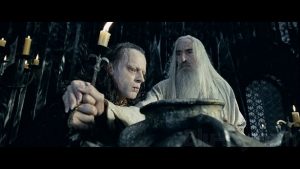
Also spicing up life in 1980s Tory Oxford University was David Cameron, though he was ‘rich enough and connected enough to feel himself above the “hackery” of student politics’; the BBC’s future political editor Nick Robinson; Daniel Hannan, NHS-basher, Enoch Powell fan, arch-Brexiteer and now in the House of Lords as Baron Hannan of Kingsclere, who, it’s been said, ‘may have contributed more to the ideas, arguments and tactics of Euroscepticism than any other individual’; and the future spin-doctoring Svengali behind Boris Johnson, Dominic Cummings.  Cummings, apparently, was a protégé of Dr Norman Stone, the historian, lecturer, author, advisor to Margaret Thatcher and student-groping pisshead from Glasgow.  One obituary published after Stone’s death in 2019 hilariously noted that he ‘hated Oxford, which he thought… was full of Marxists.’  Actually, I can’t imagine Stone and Cummings together without thinking of Saruman and Grima Wormtongue in The Lord of the Rings movies (2002-04).


© New Line Cinema / WingNut Films


Incidentally, Kuper acknowledges that Oxford University educated and employed not only J.R.R. Tolkien but also Lewis Carroll and C.S. Lewis.  He notes how ‘the timeless paradise of Oxford inspired its inhabitants to produce timeless fantasies like Alice in Wonderland, The Hobbit, Narnia and, incubating from the late 1980s, Brexit.’


Anyway, apart from making me mightily glad that I didn’t attend Oxford University during the 1980s, reading about Kuper’s book has got me thinking about the place where I was a student during the 1980s, Aberdeen University.  What about the student politicians I encountered there?  Did any of them ever get near – remotely near – those all-important ‘levers of power’?  There follows a heavily revised, fully up-to-date version of a piece about this subject I first posted in 2014.


To be honest, I wouldn’t have encountered any student politicians at all if I hadn’t got involved with Aberdeen University’s student newspaper and co-edited it for a term in 1986.  The newspaper office was located in the same building as the offices and meeting rooms where the members of the Students’ Representative Council did their business.  And obviously, those student politicians also figured in a lot of the stories we reported on.  So, I got to observe the species close up.


The one who probably did best for himself was Stephen Carter, who served as SRC President from 1985 to 1986.  I found Carter lacking in warmth, humour and character and at one point, in a fit of naughtiness, I published in the newspaper a spoof article depicting him as an aloof Roman Emperor in the manner of Robert Graves’ I, Claudius novels.  The article was entitled I, Carterus.  We didn’t get on very well, though not because I’d likened him to one of the Caesars.  Near the end of my editorship, I wrote a front-page article that made several criticisms of his reign as student president, which infuriated him.  To be fair, I later discovered that I’d made an error with a financial figure I’d quoted, so at least part of his anger was justified.  Being bawled out by the bland, automation-like Carter was a strange experience.   The abuse didn’t seem to emanate from a real human being.  It was like being scolded by an indignant speak-your-wait machine or a cranky elevator voice-recording.


From gov.uk


Decades later, in 2008, Carter served as Gordon Brown’s Downing Street Chief of staff.  Also, from 2008 to 2009, he was Brown’s Minister for Communications, Technology and Broadcasting.  As he wasn’t a member of either house at Westminster at the time, which would have barred him from taking on a ministerial position, he was quickly ennobled.  He was made Baron Carter of Barnes and entered the House of Lords.  I didn’t hear much about how that he got in on those roles, except for claims that his relationship with Brown’s notorious spin-doctor Damian McBride was ‘fractious’.  Actually, McBride was such a scumbag that it’s to Carter’s credit that the pair of them didn’t get along.


Coincidentally, days before Stephen Carter – sorry, Baron Carter of Barnes – ended his stint as Brown’s Chief of Staff, I found myself a full-time student again.  In October 2008 I started an MA course at the University of East Anglia.  The students there had mounted a protest against student debt, with hundreds of them sticking fake cheques to a campus wall.  On each cheque was written the sum of money that each student expected to owe by the time of his or her graduation.  To me (who’d graduated in 1987 with an overdraft of £1,500, which I paid off within two years), some of those sums were eye-watering: £40,000 or more.  What, I wondered, would we have thought at Aberdeen University in the mid-1980s if we’d known that our student president would one day be a key figure in a government presiding over levels of student debt we wouldn’t have imagined in our worst nightmares?


Another student politician from that era who’s done well is Katy Clark.  She was a leading light in Aberdeen University’s Labour Party and in 2005 became Labour Member of Parliament for North Ayrshire and Arran.  Her career as an MP ended in 2015 with the virtual wipe-out of Scotland’s Labour seats that happened under the kamikaze leadership of Scottish Labour leader Jim Murphy and spin-doctor John McTiernan.  However, she kept busy, working as a strategist for Jeremy Corbyn and authoring for him a review of the Labour Party’s democratic structures. Then, in 2021, she got elected to the Scottish Parliament as a Labour MSP for the West of Scotland region.


From wikipedia.org / © The Scottish Parliament


When I co-edited the student newspaper, Katy came to our attention when she led protests against Aberdeen University’s then-rector, the former Scottish National Party MP Hamish Watt.  At a debate during Freshers’ Week, Watt had made some supposedly-jovial comments in which he compared the young female students who’d just arrived on campus to ‘unbroken fillies’.  Now, while Watt undoubtedly deserved to be strung up by his sexist testicles, I didn’t enjoy having to speak to Katy about the incident.  I found her to be intense, one-note, lacking in personality and devoid of humour.  Actually, looking at what I’ve just written about Stephen Carter, a theme seems to be emerging in that regard.


Despite that, I felt some admiration for Katy because, unlike many other student politicians, she stuck by the left-wing principles she’d had as a university student and didn’t drift rightwards as she started to earn money.  During her career as an MP, she voted against the introduction of ID cards, against the renewal of the Trident missile system and against bombing campaigns in Iraq.  However, in 2020, that admiration was dampened by the fact that she accepted a peerage and entered the House of Lords as Baroness Clark of Kilwinning.


What were you thinking, Katy?  I don’t know how any socialists could debase themselves by becoming members of the archaic, undemocratic and embarrassing Lords.  It’s a place where you rub ermine-clad shoulders with the likes of Baroness Michelle Mone of Mayfair (who’s just had her home raided by police as part of a fraud investigation into her links with a dodgy PPE company); and Baroness Dido Harding of Winscombe (who got where she is today through cronyism and blew 22 billion pounds of taxpayers’ money on a failed Covid-19 track-and-trace system); and Baroness Claire Fox of Buckley (the former Revolutionary Communist Party member, Bosnian genocide denier and IRA supporter, now swivel-eyed Brexiteer and enthusiast for all things right-wing); and the afore-mentioned Baron Daniel Hannon of Kingsclere… and many more.


While she was there, I wonder if Katy ever bumped into her old Aberdeen University compadre Lord Carter of Barnes and they reminisced about their days on campus in the 1980s. (“What was the name of that hairy, beer-swilling prick with the Northern Irish accent who used to edit the student newspaper?”  “Can’t remember…”)


I should add that while running for the Scottish Parliament, Katy promised to ‘stand down’ from the House of Lords; and, according to her Wikipedia entry, on becoming an MSP she took ‘a leave of absence’ from the decrepit institution.  That, though, isn’t the same as ‘quitting’ it.  Also, I notice that on Wikipedia she’s still billed as ‘Baroness Clark of Kilwinning.’


From wikipedia.org / © The Scottish Parliament


To the rightward end of the spectrum, meanwhile, I have to mention someone else from my old alumni – Murdo Fraser, who’s in the Scottish Parliament as an MSP for the Mid-Scotland and Fife region and was once deputy leader of the Scottish Conservative Party.  That Murdo became a big name in Tory circles surprised me because he’d seemed an unprepossessing character in Aberdeen.  The detail I remember most about him was that he wore a Glasgow Rangers scarf 24/7, to the point where I wondered if it’d been stitched on.  A good friend who knew him a little, the late Finlay McLean, told me once that he had ‘the personality of a deep-frozen Cyberman’.  Then again, for an ambitious politician, not having a personality seems to be part of the course.


Murdo’s political ascendancy happened despite the fact that he was once associated with the notorious Federation of Conservative Students, an organisation that by the 1980s had become more right-wing than the Conservative Party of which it was the university branch.  At the time the Conservative Party was led by Margaret Thatcher, so being more right-wing than her was quite an achievement.  In 1986, after a string of well-publicised incidents – wherein FCS members had abused ethnic-minority staff at student bars, brayed their support for the Contras in El Salvador, sang the Special AKA song Free Nelson Mandela with the words changed to ‘Hang Nelson Mandela’, and so on – this extreme-minded group was disbanded by Tory Party Chairman Norman Tebbit.  And yes, being disbanded by Norman Tebbit for being too extreme was quite an achievement too.


The FCS at Aberdeen University were particularly obnoxious.  Among other things, they had a penchant for insulting gay people and taunting them about AIDS.  The start of my term as newspaper editor coincided with an incident wherein a bunch of FCS students invaded and disrupted a health-and-welfare talk being given to an audience of new students.  Their motive for disrupting the talk seemed to be because it covered safe sex for gay as well as straight students and was therefore, somehow, encouraging AIDS.


Later, after the newspaper had published an article about the society for gay students, Gay Soc, we received a letter from one deranged FCS member accusing us of furthering the interests of ‘the plague rats of the 20th century’.  We published his letter in the belief that by allowing the FCS to air their views publicly, we were letting people see what arseholes they were.  Give them enough rope and they’d hang themselves, we felt.  However, at least one gay friend of mine was deeply upset that the letter had appeared in our newspaper.  Today, 35 years on, I’d think twice about publishing it.


In Murdo Fraser’s defence, I’ll admit that he seemed aware of what a squad of bampots he was having to keep company with in the FCS.  He kept his mouth shut when the rest of them were being as offensively vocal as possible, and whenever I saw them strutting about the campus en masse he seemed to trail silently and reluctantly along at the back, rather like Eddie Bunker’s Mr Blue in Reservoir Dogs (1992).  Actually, being Mr Blue was appropriate given his footballing allegiances.


Having dissed the Labour and the Conservative Parties, I suppose in the interest of balance I should say something about Aberdeen University’s 1980s Liberal Party, the Liberal Democrats as they are now.  The Liberals’ most visible representative was one Dan Falchikov who, with his excitable and eccentric manner and his striking dress sense (a psychedelically-coloured sweater), possessed something that other people I’ve mentioned lacked: a personality.  And I think Dan was a genuinely well-meaning guy even if he wasn’t endowed with a great deal of common sense.  However, he was also an easy target for us unscrupulous hacks at the student newspaper and we spent a lot of time poking fun at him, calling him ‘Dan the Man’, ‘Desperate Dan’ and (when he was being particularly off-the-wall) ‘Dan F**k-me-off’.


From the Sutton & Croydon Guardian


Out of curiosity, I googled his name a while ago and discovered that, in 2010, while he was a Liberal Democrat activist in the London constituency of Kingston-upon-Thames, Dan got himself embroiled in controversy.  He was overheard boasting on a train that he’d managed to ‘plant’ a story, a false story, in the Evening Standard newspaper about the Labour Party having plans to close Kingston Hospital.  Unbeknownst to Dan while he blabbed about this into a mobile phone, a train-passenger sitting nearby was none other than the journalist Kevin Maguire, political editor of the Daily Mirror.  Maguire not only tweeted about what he was overhearing but also sneaked a camera-phone picture of Dan and posted it online.  Thus, it was a bit unsettling to find the eccentric, psychedelically-sweatered Dan the Man of Aberdeen University dabbling in the political dark arts and establishing himself as the bad boy of local politics in Kingston-upon-Thames.


I should add that since then Dan seems to have ditched the Liberal Democrats and joined the Green Party.  Considering that the Lib Dems were part of David Cameron’s discredited, austerity-obsessed coalition government from 2010 to 2015, and were disastrously led by Jo ‘nuke-’em’ Swinson in 2019, this suggests he has more sense than I’d credited him with.


I don’t think any of the student politicos I knew in the Scottish National Party went on to have political careers.  Probably having to deal with Hamish Watt, the university rector, ex-SNP MP and vocal admirer of young unbroken fillies, put them off politics for good.


I’ve tried to keep this account of student politics at Aberdeen University light-hearted, but there were some goings-on I found pretty unsavoury.  For example, before I graduated, some nasty rumours circulated in the SRC building about one student politician making another one pregnant.  There wasn’t actually a pregnancy but this didn’t prevent two SRC people, from two different political parties, both of whom had axes to grind with the guy involved, from approaching me and assuring me it was true.  One even swore that she’d seen the results of a pregnancy test.  Presumably, I was fed this false information in the hope that, as a student journalist, I’d spread the word to the detriment of the guy’s reputation.  Never mind what distress it’d cause him or the woman.  None of the people I’ve mentioned above, I should say, were involved in this saga.


Some student politicians I did genuinely like.  Indeed, if I ever bumped into the likes of Graeme Whiteside, Tim Morrison, Alan Strain or Stuart Black again on the High Street of Old Aberdeen, I’d invite them into the St Machar Bar and buy them a pint.  However, with regard to those people, there’s a sobering point to make.  None of those decent sorts, as far as I know, pursued their political careers any further than university.  None of them ended up becoming real politicians.


It reinforces Douglas Adams’ famous comment in The Restaurant at the End of the Universe (1980) that “it is a well-known and much lamented fact that those people who most want to rule people are, ipso facto, those least suited to do it.”


From wikipedia.org / © Nick Bramhall

Who is the Macbeth-est of them all?


© A24 / IAC Films / Apple TV+


I recently watched The Tragedy of Macbeth (2021), directed by Joel Cohen (without, for the first time ever, his brother Ethan co-directing) and starring Denzel Washington as William Shakespeare’s king-stabbing, crown-grabbing Scotsman.  Meanwhile, in the role of Macbeth’s spouse, the ruthless Lady Macbeth, is Cohen’s real-life spouse Frances McDormand.  It’s difficult to sum up my reaction to the film. I suppose you could say: liked it… stopped liking it… started liking it again.


The opening sequence, the aftermath of the battle between Scotland and the combined armies of Ireland and Norway, takes place on a beach.  Thanks to Bruno Delbonnel’s monochrome cinematography, it’s palely, clammily and impressively atmospheric.  Mind you, within a couple of minutes of hearing the performers’ accents – Ralph Ineson speaking broad Yorkshire, Harry Melling speaking broad RP and Brendan Gleason speaking broad Irish – you realise this isn’t going to be a particularly Scottish take on the Scottish play.


Enter Washington’s Macbeth, speaking broad American, and Bertie Carvel’s Banquo. They encounter the Weird Sisters (Kathryn Hunter) and hear their fateful prophecies.  Soon after, the prophecies start coming true as Macbeth is made Thane of Cawdor thanks to his valour during the battle.  And the plot – literally a plot, with Washington and McDormand conspiring to kill Gleason’s King Duncan and seize the Scottish throne – is underway.


So, for me, the film gets off to a strong start.  I went off it, however, when the action relocates to Macbeth’s castle, where Duncan spends the night as a guest, and we get the build-up, execution and aftermath of his murder.  Ironically, this was because of something many critics have praised the film for, its stylised sets and lighting, which give the castle’s interior the look of a perspective-bending M.C. Escher illustration, shot in the manner of a German expressionist silent movie or a 1940s American film noir.


My problem was that the shafts of stark white light (necessary to produce the black shadows elsewhere) and the sense of silence, stillness and solidity evoked by the sets make a nonsense of Shakespeare’s theme that, by murdering Duncan and violating the human social order, Macbeth sparks a chain reaction with violent effects in the natural world too: “Where we lay / Our chimneys were blown down and, as they say / Lamentings heard i’ th’ air, strange screams of death / And prophesying, with accents terrible / Of dire combustion and confused events… / …Some say the earth / Was feverous and did shake.” Well, you don’t get any impression of falling-down chimneys, lamentings, dire combustion, confused events and feverous earthquakes in an environment as still and sombre as this.  In fact, there’s little suggestion that night-time occurred at all – the castle windows seem to blaze permanently with light.


I actually didn’t respond well to the overall, stylised, sometimes artificial look of the film, though I suspect that’s just me.  I spent some of my formative years in Scotland, so to me the places mentioned in the play – Glamis, Cawdor, Fife – aren’t just names but real geographical locations.  I prefer Macbeth movies with proper Scottish landscapes, with primordial mountains, moors, glens and lochs that to my mind create an appropriate backdrop for the dark and bloody goings-on.


© A24 / IAC Films / Apple TV+


However, The Tragedy of Macbeth regained my interest later on.  The sequence where Macbeth has his second meeting with the Weird Sisters is staged with wonderful inventiveness and thereafter the movie gets its second wind.  The slaughter of Macduff’s family is impressively done too, conveying the cruelty of the deed without descending into a bloodbath.  (As the first murderer assaults one of the young Macduff-lings, he utters the memorable Shakespearean cry, “What, you egg!”, although the punning follow-up line, “Young fry of treachery!” is excised here.  Also removed is the doomed youngster’s exclamation, “He has kill’d me, mother!”  At school, while my classmates and I studied Macbeth for the Scottish O-Grade, we found this really funny for some reason.)


One thing many critics have remarked upon is the age of the two leads. Washington and McDormand are both in their late middle-age, no longer able to have children.  This makes their murder of Duncan and the seizing of the throne more egotistical – they aren’t doing it for their line, which doesn’t and won’t exist, but purely for themselves.  Their childlessness, of course, contrasts with the fecundity of the two thorns in their sides.  Banquo has a son, Fleance, and Macduff has a whole brood of kids.  It also underlines Macbeth’s wariness of Banquo, for whom the Weird Sisters prophesise: “Thou shalt get kings, though thou be none.”


Elsewhere, my impression of The Tragedy of Macbeth was that some things worked well and other things less well.  Kathryn Hunter is splendid as the Weird Sisters.  There’s only one of them who’s flesh and blood, though that twisted, contorted body of hers seems to be inhabited by the spirits of all three.  The figures of the other two only materialise in the physical world as reflections – Macbeth’s and Banquo’s first sighting of them, at the edge of a pool, is memorably creepy. Perhaps Hunter’s performance gets slightly too Andy Serkis at times, but it’s still very effective.


On the other hand, the promotion of the character of Ross (Alex Hassell) from being one of the original play’s interchangeable Scottish thanes to, here, being a Machiavellian, possibly even supernatural, manipulator who’s playing both sides – he delivers the warning to Lady Macduff about Macbeth’s evil intentions, but also turns up as the mysterious third murderer who does for Banquo, and there’s even a suggestion that he has a hand in Lady Macbeth’s suicide – is intriguing but doesn’t really come off.  With the Weird Sisters, the play already has Machiavellian manipulators.  It doesn’t need any more.


© StudioCanal / Film4


It’s interesting to compare this Macbeth with the cinematic adaptations that have come before.  I preferred it to the Justin Kurzel-directed version, released in 2015, which despite a great cast – Michael Fassbender as Macbeth, Marion Cotillard as Lady Macbeth, David Thewlis as Duncan, Paddy Considine as Banquo, Sean Harris as Macduff – seems rather subdued, thanks to the amount of low-volume muttering and mumbling going on that takes the fire out of Shakespeare’s lines.  It also chops out parts of the play that, while admittedly hammy, I’ve always enjoyed, for example, the post-regicide comedy relief with the porter, and most of the “Double, double toil and trouble / Fire burn and cauldron bubble” hijinks with the Weird Sisters.  At least in The Tragedy of Macbeth these are reinstated.  Stephen Root gives a funny turn as the porter and Joel Cohen seems to relish the macabre incantations of the Weird Sisters: “Finger of birth-strangled babe / Ditch-deliver’d by a drab / Liver of blaspheming Jew / Gall of goat and slips of yew…”  Well, he did start his movie career as an assistant editor on Sam Raimi’s The Evil Dead (1981).


Still, the 2015 Macbeth looks lovely and it satisfies my craving for proper Scottish landscapes in a Macbeth movie.  Many of its outdoor scenes were shot on the Isle of Skye, although admittedly parts of it were also filmed in England, at Bamburgh Castle in Northumberland and Ely Cathedral in Cambridgeshire.  Also visually striking is the sequence where Macbeth squares up to Macduff.  Their swordfight takes place against an infernal, almost hallucinogenic orange-red backdrop while Birnam Wood burns off-screen.  For yes, the scriptwriters cooked up – and ‘cook’ is the operative word – a novel way of bringing Birnam Wood to the castle on Dunsinane Hill.


For me, though, the best movie Macbeth is Roman Polanski’s version of it back in 1971, which had Jon Finch and Francesca Annis in the lead roles.  This made a big impression on me.  I was 15 when I saw it, so no doubt one reason why I took to it was because the film’s qualities – its simultaneous bleakness, bloodiness, bawdiness, gothic-ness, gorgeousness, rebelliousness and artiness – mirrored the mix of emotions and hormones seething at the time in my teenaged self.  And no doubt I felt a connection with the film too because Finch and Annis were both so young when they made it.  In fact, their youthfulness suggests they have little power to control their destinies.  They’re swept along with events, propelled by dark forces that are both political and supernatural.


© Playboy Productions / Columbia Pictures


Polanski’s Macbeth was disliked by many critics, upset by its violence and disturbed by the fact that Polanski’s recent past had been pretty violent too.  In August 1969, his pregnant wife Sharon Tate and four others were butchered at his home in Beverly Hills by followers of the hippie-cult lunatic Charles Manson.  Pauline Kael, the film critic for the New Yorker, even wondered if Polanski’s staging of the murder of Macduff’s family was an attempt to replicate the carnage that Manson had authored in his own life.  Famously, the film’s screenwriter, Kenneth Tynan, challenged Polanski about the amount of blood shown in this scene – to which the director retorted, “You should have seen my house last summer.”


Incidentally, the exteriors in Polanski’s Macbeth look rugged enough to be Scottish, but the film was actually shot elsewhere, in Wales (including Snowdonia) and north-eastern England.  And, yes, Northumberland’s Bamburgh Castle makes an appearance in this version too.


One other cinematic Macbeth I’ve seen is the 1948 production directed by, and starring, Orson Welles.  I watched this on TV a long time ago and wasn’t impressed by its apparent staginess and melodramatics – by then I was in thrall to the Polanski version.  However, lately, I’ve watched a few parts of it on Youtube and revised my opinion of it somewhat.  Yes, it’s cheap.  Welles made it for Republic Pictures, a studio that normally specialised in low-budget westerns, had to shoot it on some of Republic’s leftover western sets, and had only a 23-day shooting schedule.  But scenes like Act 3 Scene 4, where Banquo’s ghost shows up at the feast with ‘no speculation’ in its eyes and shaking its ‘gory locks’ at his killer, are surprisingly well-staged.  Though I suppose you’d expect that from Welles.


There are problems, however.  Though he was only 33 at the time, Welles was already getting portly and resembled Falstaff more than Macbeth.  It doesn’t help that he appears in an eccentric costume that, he grumbled later, made him look like the Statue of Liberty.


And then there are the accents – dear God.  Welles’s American cast dial the fake twee Scottish-ness up to 11 and roll their ‘r’s for minutes at a time.  Jeanette Nolan as Lady Macbeth is shrill and hard to listen to and even Welles himself, during his more excitable moments, sounds like Scotty in the original series of Star Trek (1966-69).  Meanwhile, the Weird Sisters’ accents are so piercing they remind me of those advertisements that Scottish children’s entertainer and showbiz personality Molly Weir used to make for Flash, the household cleaning agent, back in the 1970s: “Flash cleans baths without scr-r-r-r-ratching!”


And on that topic…  While one of the play’s strengths is that it can be adapted to countless different settings and styles, I would one day like to see a truly Scottish film version of Macbeth, with authentic Scottish actors and accents as well as those brooding Scottish landscapes I’ve talked about.  You can’t claim, as you might have been able to in the past, that there aren’t enough bankable Scottish actors to draw audiences to it.  Not with the likes of Peter Capaldi, Robert Carlyle, Robbie Coltrane, Martin Compston, James Cosmo, Brian Cox, Kate Dickie, Lindsay Duncan, Karen Gillan, Shirley Henderson, Jack Lowden, James McAvoy, Kelly Macdonald, Ewan McGregor, Kevin McKidd, Bill Paterson, Dougray Scott, Ken Stott, David Tennant, etc., on the go nowadays.


Hell, I’d even pay money to see Gerald Butler as Macbeth.  Cawdor Has Fallen, anyone?


© Mercury Productions / Republic Pictures

Things get frosty for Tiger Tim


From durham.academia.edu


The other day I discovered that my old alma mater, Peebles High School in the Scottish Borders, had a Wikipedia entry.  Near the end of it was a ‘notable alumni’ section.  I reacted with a disgruntled “Oh God, him,” when I saw listed among those notable alumni ‘Tim Luckhurst, journalist and academic’.


Minutes later, I headed over to the Guardian’s website to check the news headlines.  It seemed a mighty coincidence when I started reading a story under the headline DURHAM HEAD STEPS BACK AFTER CALLING STUDENTS ‘PATHETIC’ AT ROD LIDDLE EVENT and discovered that the head in question, the principal of Durham University’s South College, was none other than Tim Luckhurst – that distinguished journalistic and academic graduate mentioned in Peebles High School’s Wikipedia entry.


During the mid-to-late 1970s, Tim was a few years ahead of me at school.  He was a well-kent figure, lanky, curly-haired, lugubrious-faced and sloping around the place in a combat jacket and a T-shirt saying LEGALISE CANNABIS – in those permissive times at Peebles High you weren’t obliged to wear a school uniform.  To my mates and I he was known contemptuously  as ‘Chairman Mao’.  I think he spoke to me just once, at a careers evening being held in the school.  I was about to go into a classroom where the affable Atholl Innes, then editor of local newspaper the Peeblesshire News, was dispensing advice to young people who were interested in becoming journalists.  Out of that classroom emerged Tim and, to me, he declared emphatically, “Well, I know what I want to be!”


Probably Tim had already resolved to become a journalist and Atholl Innes had been preaching to the already-converted.  But I sometimes wonder if he hadn’t made up his mind until entering that classroom and his meeting with Athol Innes had been a moment of revelation – “Yes, newspapers,” Tim had cried, “that’s the life for me!”  If the latter is the case, I can only say, “Atholl…  You created a monster.”


Incidentally, that Tim had to attend a lowly comprehensive school like Peebles High, up in the windy wilds of North Britain, full of horrible little oiks like myself, still rankles with the man.  Writing for the Guardian in 2010 he quoted Ellen Wilkinson, Secretary of State for Education in the post-war British Labour government, as saying of her childhood in non-selective schooling in Manchester: “The top few pupils were intelligent and could mop up facts like blotting paper, but we were made to wait for the rest of the huge classes…  We wanted to stretch our minds but were merely a nuisance.”  Tim noted sourly, “Thirty years later I experienced comparable misery at my Scottish comprehensive.”


From the Peeblesshire News


I should point out that although it denied Tim the chance to stretch his fabulous mind and soak up facts like a sheet of super-absorbent blotting paper, Peebles High School must have done something for his education.  In fact, it was good enough to get him into Cambridge University.  At Cambridge, incidentally, according to one Luckhurst-bio I’ve found online, “…he played bass guitar in Tony Tiger and the Frosties.”  I know it’s wrong to judge bands by their names alone, but Tony Tiger and the Frosties sound like the most horrible thing to have strutted onstage on the Oxbridge music scene since the early 1970s, when a student band called the Ugly Rumours featured one Tony Blair as their frontman.


I suspect the disdain Tim feels for his alma mater in Peebles is mutual.  I recall several years back chatting to one of my old teachers, now a sweet little pensioner, when Tim’s name somehow cropped up in the conversation.  The teacher underwent a startling metamorphosis, hands becoming clenched and claw-like, face dark and scowling, and blurted wrathfully, “Tim is just an ARSEHOLE!”


During the 1980s and 1990s, Tim served as press officer for the Labour Party’s then-sizeable cabal of Scottish MPs, including Shadow Secretary State for Scotland Donald Dewar; stood unsuccessfully as a Labour candidate in Roxburgh and Berwickshire in a general election; and worked for the BBC.  I’d forgotten that the guy existed until February 2000, when he was announced as the new editor of my Dad’s favourite newspaper, Edinburgh’s venerable and respected Scotsman.  Actually, by then, the Scotsman was a lot less respected.  It’d been acquired by the Barclay Brothers’ Press Holdings Group and for several years had suffered under the crass stewardship of Andrew Neil, the Group’s editor-in-chief.  Tim lasted as Scotsman editor only until May that same year, when he was replaced by Rebecca Hardy, whom I knew from a previous phase of my life too – but that’s a story for another day.


© BBC / From the Guardian


In 2013, Tim and his old boss at the Scotsman, Andrew Neil, had a rammy on twitter.  Tim contradicted Neil on something and Neil replied, “And I made you Editor of the The Scotsman.  Most stupid decision ever.  But at least I fired you six days later.”  When Tim countered with, “Would you care to retract that statement, Andrew?  It might be wise,” Neil retorted, “Bring it on.  And let me pay to straighten your teeth.”  For the record, I’ll print what the Evening Standard said about the row: “…Professor Luckhurst was not ‘sacked after six days’ from the Scotsman, as Neil claims, but resigned due to ill health after four months.”  And I assume that, following the debacle of his involvement with GB News, Andrew Neil now considers giving Tim the Scotsman’s editorship only his second most stupid decision ever.


Following the Scotsman, Tim spent seven years as political editor of the Scottish edition of the Daily Mail (which, with hindsight, was surely a good fit for him).  Then he entered academia with a job as Professor of Journalism at the University of Kent, and then joined Durham University in 2019.  Despite having been a one-time backroom operative with the Labour Party, his politics by this time had clearly shifted rightwards.  However, I’ll hazard a guess and say he views himself as a moderate, old-school Tory rather than a ranting, frothing, hard-right one.  From the occasional glances I’ve had at his twitter feed, he seems impressed neither by Brexit nor by the antics of Boris Johnson.


That said, his moderate Tory-ness stops at the English-Scottish border.  One step north of that border and his moderate Tory-ness changes to rabid Unionism.  He might once have worked for Donald Dewar, viewed as the ‘father’ of the Scottish devolution settlement and the devolved Scottish parliament, but by 2001 he was demanding in a Guardian opinion piece that Whitehall consider abolishing the parliament, Dewar’s baby: “Scotland needs Whitehall at least to threaten repeal.  To demand less in the present climate would be unpatriotic.”


That article was mild, though, compared with one he wrote for the New Statesman that same year.  Entitled SCOTLAND RETURNS TO THE DARK AGES, he used it to blame devolution for releasing a tsunami of evils like homophobia, sectarianism, misogyny, racism and, er, the banning of fox-hunting.  In the civilised days before devolution unleashed the Scots’ inner beastliness, he wrote, such things had been ‘diluted by the soothing balm of the British state’.  Strangely enough, that article is no longer available on the New Statesman’s website.


Meanwhile, his twitter feed has been punctuated by tone-deaf pronouncements on Scotland that surely only appeal to a minority of ultra-Unionist Scots for whom 1690 is as important a year as 1707.  I remember him expressing horror at the Scottish government punting a few million pounds towards the promotion of the Gaelic language; or retweeting a video of Ross Thomson – the demented hard-Brexiting, Boris-worshipping Tory ex-MP for Aberdeen South – professing his undying love for the United Kingdom amid a thicket of Union Jacks.  I wonder what will happen if Scotland becomes independent.  Poor Tim’s head will probably explode like the guy’s head did at the beginning of David Cronenberg’s Scanners (1981).


But onto 2021.  Tim landed himself in hot water when, as head of South College at Durham University, he invited his old mate and colleague Rod Liddle to give a speech at a ‘college formal’ event in early December.  He and Liddle have known each other since 1985 and worked together on BBC Radio 4’s Today programme.  Indeed, in 2010, Tim wrote a Guardian piece in support of Liddle’s candidacy to become editor of the Independent newspaper.  This was a prospect that alarmed many readers of the reasonably-liberal Independent because Liddle had earned himself a reputation for being misogynistic, homophobic and racist.  Pretty much all the things Tim once accused the Scottish parliament of being.


From twitter.com/sunapology


Liddle is a ‘columnist’ – i.e., gobshite-provocateur – with the Spectator, Sun and Sunday Times and even by the standards of the gobshite-provocateurs that infest the pages of Britain’s mostly right-wing press, forever seeking new ways to upset people, the charge-sheet against him is disproportionately long.  Here’s just a few of his low-points.  He was a pig towards Labour politician Harriet Harman.  (“So – Harriet Harman, then.  Would you?  I mean after a few beers obviously, not while you were sober.”  In his Guardian puff-piece about Liddle, Tim euphemistically described this remark as ‘not gallant’.)  He mocked another female Labour MP, Rosie Duffield, for speaking out about verbal abuse and humiliation she’d received from a former partner – “the sobbing and oppressed Rosie ‘MeToo’ Duffield”.  He’s complained about the Conservative party not being Islamophobic enough and suggested that elections be held on days when “Muslims are forbidden to do anything on pain of hell.”  He’s raved about “black savages”.  He’s dismissed Welsh language activists as “miserable, seaweed-munching, sheep-bothering pinch-faced hill-tribes”.  He’s explained: “…the one thing that stopped me from being a teacher was that I could not remotely conceive of not trying to shag the kids.”  And so on, and so forth.


When Liddle stood up at the event and launched into a speech filled with his predictably reactionary schtick – jokes about sex workers, comments about trans-women having ‘long, dangling penises’ and the charming hypothesis that British colonialism never did anyone any harm because its subjects weren’t intelligent anyway – members of the student audience started walking out.  Tim, tigerish about defending everyone’s right to freedom of expression, and everyone’s right to have Rod Liddle inflicted upon them, reportedly shouted at them that they were ‘pathetic’.  There’s also video footage in circulation on twitter showing Tim arguing with students after the event.  Meanwhile, his wife Dorothy Luckhurst, who might have been slightly over-refreshed at the time, can be seen shouting at those students things like, “I think you are an arse…  Arse, arse, arse, arse, arse…!  Arse, arse, arse, arse, arse…!”


From twitter.com/RDuskedd


Did Tim honestly believe that he could invite Liddle onto a university campus and there wouldn’t be trouble?  He must be a bit thick.  Or maybe he was deliberately trying to stir up a hornet’s nest – which, if that was the case, he succeeded in doing.


I’m actually not a fan of censorship by the left, in the form of ‘no-platforming’, ‘cancel culture’ or whatever you want to call it.  That’s because I’d always assumed censorship was an instrument used by the right and there was no excuse for the left to use it too.  But there’s a time and place for debates where extreme views, offensive to many, can be aired and argued with.  And the event at South College was clearly neither the time nor place.  For one thing, the attendees had paid ten pounds a head to be there and hadn’t been warned in advance that the entertainment included Rod ‘shag the kids’ Liddle.  If I’d been present, I’d have walked out too when Liddle started spewing his crap at me – just as I’d have done in the 1980s or 1990s if I’d bought a ticket for what I expected to be a mild-mannered comedy night and then Bernard Manning had lumbered on stage and started cracking jokes about ‘darkies’ and ‘poofs’ and ‘Paddies’.  And incidentally, isn’t walking out a legitimate form of expression in itself?  Especially when, as with Liddle’s audience, you don’t have access to a microphone.


It’s fascinating how Tim, and the whole media / political establishment that he’s a member of, claim to be champions of free speech when there’s a danger that people might stop listening to right-wing establishment opinions.  Yet it’s pretty difficult in Britain, if you interact with the media in anyway at all, not to be assailed relentlessly by right-wing opinions.  There’s the front-page headlines of reactionary rags like the Sun, Mail and Express screaming at you daily from the newsstands.  There’s the now completely cowed and broken-backed BBC parroting the right-wing agenda of the press when it does its morning newspaper round-ups.  There’s a seemingly endless parade of right-wing pundits from Nigel Farage downwards (and Farage is pretty far down already) getting platforms on TV news channels.  If Tim and co. are so desperate about promoting freedom of expression and making people experience views they wouldn’t otherwise hear, shouldn’t they be trying to expose hardcore readers of the Sun, Mail and Express to the opinions of Owen Jones, George Monbiot, Laurie Penny, John Pilger, Naomi Klein and Noam Chomsky?  Well, they should, but I’m not holding my breath.


Currently, following a storm of Liddle-related protests, Tim has been parked on the naughty step at Durham University while his employers decide what action, if any, should be taken against him.  But even if he’s shown the door, I’m sure that a lucrative future awaits him at one of Britain’s countless right-wing news and / or opinion outlets, which will take him to its bosom as a martyr to the cause of freedom of (right-wing) speech and as a blameless victim of horrible, lefty, woke, cancel culture.


Now that his old nemesis Andrew Neil has left the building, I could even see him ending up at GB News.  He could form a double act with Neil Oliver, where they both whinge and gurn about the ghastliness of modern-day Scotland under the leadership of Nicola Sturgeon and how the Scots need their uncivilised natures to be ‘diluted by the soothing balm of the British state’.  Meanwhile, Tim’s better half could get a gig there as well.  Perhaps Talking Pints with Nigel Farage?