Cormac’s tales from the riverbank


© Vintage


I’d assumed I was long past the age where I could get really, really excited about books.  If I had to compile a list of my favourite 20 books of all time, I would expect everything on it to be stuff I’d read in my teens, twenties or, at a stretch, my thirties: James Joyce’s Ulysses (1922), Walter Scott’s The Bride of Lammermoor (1819), Malcolm Lowry’s Under the Volcano (1947), Mervyn Peake’s Gormenghast trilogy (1946-59}, etc.  I still read a fair bit, but nothing I peruse these days seems to generate the same frisson that certain books did in me during my youth.


I wouldn’t completely agree with the legendary blues singer and musician B.B. King when, in 1969, he sang The Thrill is Gone.  But I would say the thrill survives in a reduced capacity.  You get older, you become less impressionable, and nothing surprises you anymore.  Or so I thought.


I was surprised when, a couple of years back, I read the books in Bernard Cornwell’s Warlord trilogy (1995-97), about King Arthur, and found myself entranced by them – so much so that when I got to the final volume, 1997’s Excalibur, I wrote on this blog that I was “almost reluctant to read it because I’d come to know so well, even love, the characters from the earlier two books – and this being the King Arthur legend, I was aware things wouldn’t end happily for them.”  It’d been a long time indeed since a series of book had had such an effect on me.


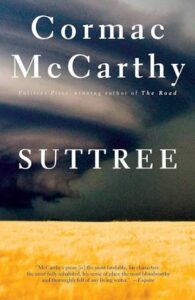
Now the same thing has happened with Cormac McCarthy’s semi-autobiographical novel Suttree (1979).  A few pages in, I realised I was reading a very special book – for me, anyway – and I consumed the rest of it with a passion.  And I imagine that in my top-20 books list, one of the entries that I read during the first half of my life has just been demoted from it and Suttree has taken its place.  Yes, I reckoned McCarthy’s novel was that good.


Before I continue talking about Suttree, a warning – there will be spoilers.


The novel recounts the adventures, and misadventures, of a young man called Cornelius Suttree while he lives on a houseboat on the Tennessee River by the rundown edge of Knoxville in the early 1950s.  He ekes out a living fishing and selling his catches at the local market.  He also fraternises with the neighbourhood’s underclass, a rogue’s gallery of misfits, eccentrics, down-and-outs and mad people.  McCarthy, who died in 2023, was not one for giving interviews, so I assume it’s never been determined how much of Suttree is autobiographical.  I’d imagine, though, that the novel – written over 20 years – is at least partly inspired by the period of his marriage to Lee Holleman in the 1960s when, according to his Wikipedia entry, “McCarthy moved to what Holleman’s obituary calls ‘a shack with no heat and running water in the foothills of the Smoky Mountains outside of Knoxviille.’”


As the narrative unfolds, we learn about Suttree’s past.  He’s from a well-to-do family and his lifestyle choices haven’t pleased his father.  In a letter to him, that father states his belief that “the world is run by those willing to take the responsibility for the running of it.  If it is life that you feel you are missing I can tell you where to find it.  In the law courts, in business, in government.  There is nothing occurring in the streets.  Nothing but a dumbshow composed of the helpless and the impotent.”  We also learn that he’d been in a marriage that, ultimately, he’d run away from.  More on that in a minute.


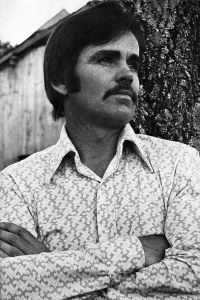
Incidentally, we get clues that Suttree is quite a handsome devil – as McCarthy himself was in his young days.  At one point he and some mates get into a catastrophic brawl in a dodgy Knoxville dance-place: “Before they reached the door someone hit him in the head with a bottle…  He must have fallen foul of yet other hands afterwards because when he woke in the hospital he had a broken finger, three broken ribs, a mouthful of loose teeth and one missing.”  Though he’s now gap-toothed, Suttree has the following conversation with a nurse: “You created quite a sensation.”  “What, among the inmates?”  “No, silly.  Among the nurses.”
 

From wikipedia.org / © Evening Star Books


I’ve used the word ‘narrative’ but Suttree doesn’t have the structure of a typical novel.  It’s rambling and episodic, really a patchwork of vignettes and short stories featuring the same characters in the same setting.  The reader takes pleasure in the randomness of it, not knowing what grotesqueness, hilarity, idiocy, beauty, horror, weirdness or, indeed, moment of sheer poetry is going to appear next.


A couple of the longer ‘short stories’ see Suttree leave Knoxville, temporarily, with painful results.  In one episode, he discovers that the son he left behind has died and sets off to attend his funeral, even though he has barely any money.  When he gets to his destination, his former wife and in-laws, and indeed the whole community, react to him with contempt and hatred.  He only leaves the town alive thanks to the begrudging intervention of its sheriff, who opines: “You, my good buddy, are a 14-carat plated son of a bitch.  That’s what your problem is…  Now I’m goin to do you a favour.  Against my better judgement.  And it’s not goin to make me no friends.  I’m goin to drive your stinkin ass to the bus station and give you an opportunity to get out of here.”


Another time, a chancer called Reese and his family arrive on the scene.  This symbolically occurs during a flood, when all sorts of flotsam and jetsam are being washed past Suttree’s houseboat: “Next came looming out of the yellow mist a patchwork shack composed of old slats and tarpaper and tin snuff signs all mounted in wild haphazard upon a derelict barge and turning with the keelless rotations of a drunken bear…”  Reese inadvertently befriends Reese, his wife and his children, who inhabit that barge-shack and, for all his worldly wisdom, gets suckered into helping Reese with a get-rich scheme we know is doomed from the start.  They travel upriver and begin fishing for mussels, believing there’s money to be made from selling their shells and pearls.  Though there’s a little light, with Suttree romancing Reese’s daughter, what follows is mostly a gruelling litany of hardship, futility and, finally, tragedy.


However, much of the book simply records Suttree’s interactions with the characters who live, fish and scavenge around him.  They’re an intriguing bunch even if you don’t envy them their existences.  They include the Ragpicker – his title says it all – who claims not to believe in God because “I got no reason to think he believes in me”; Daddy Watson, a former railwayman happy to tell Suttree about the gory train crashes he witnessed during his working life; Ab Jones, a black man who with his wife Dolly runs an illicit bar on another houseboat and whose defiant nature invariably gets him into trouble; Mother She, an ancient and decrepit witch who provides the novel with its most hallucinatory episode; Michael, a native American fisherman whom Suttree briefly befriends; and Red Callahan, who ‘s perhaps the closest thing in Suttree to the psychotic Francis Begbie in Irvine Welsh’s Trainspotting (1993), another episodic book about a bunch of misfits living in punishing circumstances.


One part of Suttree that’s particularly Welsh-like – i.e., simultaneously horrible and funny – concerns a male prostitute called Leonard.  He enlists Suttree’s reluctant help to dispose of the corpse of his father, which his family has kept hidden at home for months, pretending the old man is still alive so they can keep collecting his social security money.  At one point during the operation, Suttree protests, “That’s the awfullest stink I ever smelted.”  Leonard retorts, “That‘s the biggest reason we had to get him out of the house.”


Apart from Suttree, though, the most prominent character is the chaotic Gene Harrogate, a youth whom Suttree first encounters while they’re both in prison – Harrogate for the unusual crime of sneaking into a watermelon field near his home, cutting holes in the crop and then having intercourse with them.  (As the stunned farmer says, “You ain’t goin to believe this…  Somebody has been f*ckin my watermelons.”)  Following his release, Harrogate takes up residence in Suttree’s neighbourhood, living “under the final concrete arches of the viaduct where they ran to earth…  The earth was cool and naked and dry.  Here some bones.  Broken glass.  A few stray dog-turds…  there was never a retreat so secluded.”

 

From pixabay.com / © Riedlinger


Suttree becomes his surrogate big brother, trying to rein in his wildest and daftest impulses and having to mop up after him when his antics end in disaster.  He’s remarkably patient, considering how madcap Harrogate’s schemes are.  At one point, the lad learns he can earn a dollar for every dead bat he finds and hands into Knoxville’s medical authorities, who are keen to monitor rabies in the local chiropteran population.  Soon Harrogate is firing poisoned pellets into the air from his skiff, at dusk, hoping the swooping bats will mistake them for insects.  “Bats had begun to drop everywhere from the heavens.  Little leatherwinged creatures struggling in the river…”  More spectacular, and no more successful, is a project he devises after finding a cave / tunnel system that takes him under Knoxville – where, he believes, he can dynamite his way into the vault of the city treasury.


Incidents like these make Suttree the funniest of McCarthy’s books.  Although folk who’ve read Child of God (1973), or Blood Meridian (1985), or The Road (2006) would probably argue that having more laughs than the norm in McCarthy’s oeuvre is not a particularly high bar.  Anyway, I found myself guffawing loudly in places.


The prose oscillates between Joycean flamboyance and Hemingway-esque precision.  The opening paragraph reads: “Dear friend now in the dusty clockless hours of the town when the streets lie black and steaming of the wake of the watertrucks and now when the drunks and the homeless have washed up in the lee of walls in alleys or abandoned lots and cats go forth highshouldered and lean in the grim perimeters about, now in these sootblacked brink or cobbled corridors where lightwire shadows make a gothic harp of cellar doors no soul shall walk save you.”


In contrast, after Suttree’s friend J-Bone informs him of his son’s death, McCarthy describes the moment thus: “Suttree set his cup down and looked out of the window.  There was a small pool of spilled cream on the marble countertop at his elbow and flies were crouched about it lapping like cats.  He got up and went out.”  Some may find this disparity in writing styles off-putting.  I have to say, for me, the combination is like catnip.


Unflinchingly, the book explores a harsh, brutal but somehow fascinating world, one whose inhabitants certainly suffer, yet you also understand the hold that world exerts over them – through the moments of peace and calm, the occasional pleasures, the camaraderie, the satisfaction of knowing you’re not bound by the rules and regulations of conventional society.   But it’s also a transitory world where nothing lasts for long, including the people living in it.  As the book progresses, characters get killed, get permanently incarcerated (in the prison or asylum) or simply vanish.  As you near the book’s end, you wonder what Suttree’s choice will be.  Will he decide to stay here and become a casualty too, or will he try to escape?


But if he does escape, you suspect his experiences on the river will haunt him for his remaining days.  Just as Cormac McCarthy’s experiences of poverty and desperate living in Tennessee haunted him for 20 years and informed this marvellous novel.

 

From pixabay.com / © Leoleobobeo

Attack ‘n’ Byrne


In the past few weeks I’ve been fortunate enough to attend two of the best musical concerts I’ve ever experienced.  Both took place at Singapore’s Star Theatre.


On July 29th, the Star hosted the English trip-hop collective Massive Attack.  Formed in Bristol in 1988 by Robert ‘3D’ Del Naja, Grant ‘Daddy G’ Marshall, Adrian ‘Tricky’ Thaws and Andre ‘Mushroom’ Vowles, Massive Attack is less massive in terms of members nowadays.  Only 3D and Daddy G remain, Tricky and Mushroom having left in 1995 and 1999 respectively.  What we got on July 29th still sounded massive, though.


In the 1990s, I loved the band.  Their three albums from that decade, Blue Lines (1991), Protection (1994) and Mezzanine (1999), are all-time favourites of mine.  I found their sound irresistible: its hypnotic melodies, its measured pace, its building crescendos, its atmospherics, its lurking orchestral grandeur – composer John Barry never seemed far away – and, unpinning everything, its relentless drums and basslines.  After hearing them, I had a hard time getting songs like the soaring Unfinished Symphony or the sublimely restless Safe from Harm from Blue Lines, or the haunting Teardrop from Mezzanine, out of my head.


My ultimate Massive Attack song, though, was Mezzanine’s Angel, which after a slow but remorseless build-up lets fly two minutes and 19 seconds in.  That’s the best crescendo in music ever.  It would make a terrific accompaniment to a movie sequence where there’s a brooding sense of unease, then an explosion of action.  It has been used in films, actually, but the only one I’ve heard it in was the forgettable 2004 remake of Robert Aldrich’s The Flight of the Phoenix (1965).  I know it turned up in Guy Ritchie’s Snatch (2000) too, but I’ve never watched that one.


The one time I saw them live during the 1990s was in insalubrious circumstances.  They played at the now-defunct Scottish music festival T in the Park in 1999.  The crowd was boozed-up and raucous and I’d been at the front of it all afternoon, before they performed, watching earlier bands on the bill.  These included the then-popular rock band Reef.  While Reef were playing, someone bodysurfed past me and accidentally struck me in the head with a boot.  A week previously, I’d been the victim of an assault, which resulted in me getting multiple stitches in the back of my head in an A and E department.  The body-surfer’s boot opened those stitches and blood leaked out everywhere, including down my face.  Consequently, when Massive Attack came on, I looked like I’d just strolled off the set of a horror movie.


It didn’t help that a crowd-member then flung a bottle at the stage, which smashed down close to their frequent collaborator, the reggae roots singer Horace Andy.  They continued playing, but looked extremely pissed off.  (They should have followed the example of Jim Kerr, the frontman of Simple Minds.  Supposedly, once, when somebody chucked a bottle at Simple Minds during a Parisian gig, he told the crowd, “I hope whoever threw that dies of cancer.”)


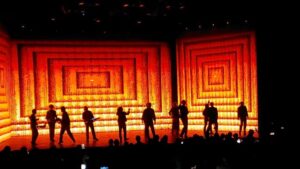
So, what a contrast to see them again, 27 years later, from a vantage point high in the circle of the grand and comfortable Star Theatre.  On the stage, 3D, Daddy G and their team of travelling musicians were ensconced, in near-darkness for much of the time, among their instruments and consoles while the theatrics were provided by dazzling visuals that materialised on giant screens above them to accompany each song.  In fact, ‘visuals’ is too lame a word to describe what the audience saw.  A reviewer in Australian Musician wrote that the band used “monolithic LED screens, archival footage, political imagery and dreamlike sequences to create a constantly shifting portrait of a world where personal freedom, privacy and even human emotion are increasingly commodified.”


As the visuals shifted wrenchingly from the picturesque Swiss lakeside city of Zug (where much equity money ends up, apparently) to Africa and impoverished locals having to dig up precious minerals in wretched  conditions, from worrying graphics illustrating the global reach of mass surveillance to gibbering headlines about celebrities, from Peter Thiel quotations about why democracy is a bad idea to bald statements that could have come from 1984’s Ministry of Truth (‘WHAT IS PURPOSE?’), I was reminded of the work of radical documentary filmmaker Adam Curtis.  Later, I learnt that Curtis and the band have enjoyed a long association and he worked with them to put these digital displays and film clips together.


Not that the visual show was entirely serious.  I was delighted to see the great horror actor Bruce Campbell get chased through a cabin by the forces of darkness in The Evil Dead (1982) while a message flashed up telling us we can’t escape ‘the algorithm’.  Later, another great horror actor, Boris Karloff, appeared as the title character in The Mask of Fu Manchu (1932) in an ironic commentary on the West’s tendency to blame China for everything.  (See Covid-19.)


Musically, it was superb.  The crowd gave roars of appreciation for Horace Andy, singing on three tracks, including – yes! – Angel; and for other longtime collaborators Deborah Miller,  singing on Unfinished Symphony and Safe From Harm, and Elizabeth Fraser, who did vocal duties on Mezzanine’s Black Milk and Group Four and a cover of Tim Buckley’s Song to the Siren (1970).  Fraser also brought the evening to a perfect close with the final song, Teardrop.


The gig was overshadowed by an incident at the end when, briefly, 3D and Daddy G brandished a Palestinian flag onstage.  Singapore’s Straits Times newspaper reported that this broke a local law forbidding “the public display of foreign national emblems without a permit or exemption.”  Afterwards, according to the Times, the authorities released a statement saying, “…the police… administered stern warnings to both men for the offences of Section 3 of the Foreign National Emblems (Control of Display) Act and Section 16 of the Public Order Act,” and “both men will be banned from re-entering Singapore.”  The BBC, meanwhile, quoted an official spokesman as saying Singapore’s police “take a serious view of acts which could potentially harm the racial and religious harmony in Singapore”.


This leaves me with mixed feelings.  I believe people should be free to express their opinions, so long as that expression doesn’t cause innocent parties any harm, and I don’t see how two 60-something men holding a flag for a few seconds in a theatre full of Massive Attack fans could cause much harm.  However, I also believe in the old adage, ‘When in Rome, do as the Romans do’.  Singaporeans are proud of the stable, prosperous, multicultural society they’ve created, in a region that, elsewhere, has often been troubled by ethnic and religious conflicts.  For many people, having strict laws outlawing the display of foreign flags (and eliminating any possibility they could be used to stir up trouble) is a price worth paying.  I didn’t see much sympathy for the band on local Internet discussion-forums, where the sentiment was largely, “Bloody foreigners, coming over here, breaking our laws.”  “Good riddance to bad rubbish,” said one commentator, evidently not a fan.


It’s worth noting that the UK authorities have given Massive Attack a hard time too for their pro-Palestinian sympathies.  3D was arrested in Trafalgar Square in April this year for carrying a sign expressing support for the proscribed, allegedly terrorist group Palestine Action.


Anyway, this furore obscures the fact that the concert itself was exceptional.


Then on August 7th, singer-songwriter David Byrne – one-time vocalist and guitarist with legendary American new-wave band Talking Heads – performed at the Star to promote his 2025 solo album Who is the Sky?  This gig didn’t begin well for me.  When I bought my ticket via Ticketmaster, I got an email warning me not to try to enter the venue using a screenshot of it.  I should have the ticket open in my Ticketmaster account, on my phone, ready for security staff to scan its QR code.  Just before I set off for the Star, I discovered the link in the email was taking me not to the David Byrne ticket in my account, but to the Massive Attack one from 10 days earlier.  This kept happening on my phone only.  When I clicked the link on my computer, I was taken to the correct ticket.  Finally, exasperated, I took a screenshot of the Byrne one on my computer and sent it to my phone, as proof I’d at least bought the ticket.


When I explained the problem to the ladies at the Ticketmaster table outside the Theatre entrance, they told me to use the screenshot on my phone.


“But your instructions said…”


“Just use it!”


The security lady looked at me tetchily when I presented the screenshot, but she scanned its QR code and it was accepted.  I was in.


I wasn’t only me suffering technical difficulties.  The gig was scheduled to start at eight o’clock but nothing happened onstage for another half-hour – except for a few minutes when David Byrne himself walked into view.  He explained that some glitches were delaying proceedings and, by way of apology, entertained us with some sightseeing photos he’d taken that day in Singapore.  He did this with much enthusiasm.  His photos appeared on big screens above him and included one taken at Singapore’s marvellous Haw Par Villa, where you can stroll through a giant diorama depicting the 10 Courts of Hell from Chinese and Buddhist mythology.  That photo depicted sinners impaled bloodily on a ‘hill of knives’, which Byrne cheerfully informed us was the afterlife punishment awaiting people who charge too much interest on loans.  You know, bankers.


Byrne came across as someone with genuine interest in the places he travelled to and his good humour was greatly engaging.  I’d always thought he was decent, but after this episode I decided he was an absolutely top bloke.


During the delay I’d observed how the stage was empty.  It contained no instruments or equipment.  When the gig finally started, I understood why.  After the opening number, a static rendition of the 1979 Talking Heads song Heaven, which Byrne sang accompanied by two musicians playing a violin and portable keyboard (while the earth rose majestically through space on the screens behind), the show really became a show – a dance one as well as a musical one.


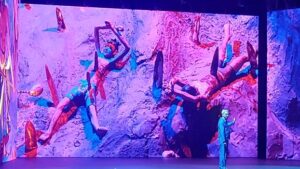
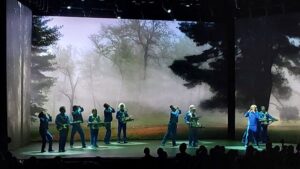
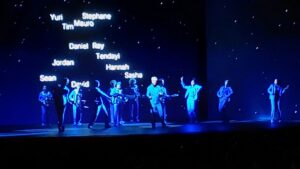
For each song, Byrne and eleven blue-clad co-performers went through a set of choreographed moves.  Six of the eleven were dancers and background singers.  The other five were musicians, carrying their instruments with them – guitars and keyboards, drums such as a tom-tom, timbale, snare drum and marching bass drum, and, when the song required, a violin or saxophone.  The musicians especially impressed me, keeping focused on where they were going as well as on what they were playing.  Meanwhile, the screens conjured up various backdrops: American suburbia, a forest, a skyscape, psychedelic patterns, a disorientating video where the same performers followed the same moves they were currently doing onstage but wearing animal-heads.


It felt part Broadway musical, part cheerleader routine, part circus (with Byrne as the ringmaster), part parade by a marching band.  Byrne even reminded me at times of Willy Wonka, orchestrating his co-performers like Oompa Loompas.  (I have to say, though, that with his blonde hair and cheery demeanour, Byrne looked more like Peter Isherwell, the sinister, ultimately incompetent billionaire played by Mark Rylance in the 2021 end-of-the-world movie Don’t Look Up.)  It’s also pretty astonishing how Byrne can do all this, seemingly effortlessly, at the age of 74.


With a plethora of drums, the music was percussion-heavy, which suited the catchy rhythms of Byrne’s solo songs perfectly.  I wondered if his Talking Heads songs would come across as well, but they did.  Several (including 1985’s And She Was) were performed during the first half of the set, before the focus switched to his solo stuff.  Then, near the end, out came the biggest Talking Heads numbers: Psycho Killer (1977), Life During Wartime (1979), Once in a Lifetime (1981) and Burning Down the House (1983).  Psycho Killer got the biggest reaction from the crowd, who inevitably chanted “Fa-fa-faa-fa-fa, fa-fa-faa-fa-fa!” in unison.  But I think it’s Once in a Lifetime that’s my favourite in Byrne’s oeuvre.  I remember first hearing it on Top of the Pops (1964-2006) when I was 16 and thinking it was bloody weird.  A week later, when I heard it again, I was hooked.


Anyway, this was a wonderful concert too.  Maybe not quite a once-in-a-lifetime experience, but not far off one.


School’s out forever


It’s weird to see a place that dominated your life for five years – setting parameters on how you spent most of your time, determining most of the people whom you met and became friends (or enemies) with, and having a considerable bearing on how the rest of your life would turn out – in rubble.  I’m talking about my old alma mater Peebles High School, which I attended from 1977 to 1982.  Most of it has now been demolished.  I visited the remnants of it when I was back in Peebles, in the south of Scotland, two months ago.


Okay, Peebles High School isn’t really a pile of rubble.  It lives on in a new form.  Since November last year, a brand new school, built at a cost of 46 million pounds, standing where some of the playing fields used to be, has been open for business.  (“A bit IKEA,” was the verdict of my two nieces, who’ve been pupils there.)  I’m talking about the old Peebles High School.  A third of it got destroyed in a fire in November 2019 and for the next half-dozen years, while the new school was approved, planned and constructed, it limped on in a moribund condition.  Now it’s almost completely gone.


I made a pilgrimage to what’s left of the old school one afternoon and spent five minutes peering through the mesh on the copious barriers, placed around the site to keep the curious public at bay, and thinking such melancholy thoughts as: “Jings!  That hillock of debris is the spot where I once had a fight with Roy Kilner!”  It looked desolate and depressing.


The few parts of the premises still standing that afternoon included the four-storey tower – once the tallest structure in Peebles – which contained an entrance hall, cloakrooms and toilets (on the ground floor), the maths department (first floor), the business studies department (second floor) and the geography department (third floor).  It was as a fifth-year student that, one day, I exited the late John Cornwall’s geography class rather too enthusiastically and  tripped coming down the staircase from the top floor to the second floor.  I sprained my right ankle so badly that for the next month I hobbled around on crutches with my right foot in plaster.   The reason the tower hasn’t been demolished yet is, depending on whom you speak to in Peebles, because bats, a protected species, have been discovered roosting inside it, or because it’s been found to be riddled with asbestos.


Also still there was part of a building to the north of the tower, which if I remember correctly contained the home economics department and which you passed through to get to the (now flattened) science labs.  Did the side of that building facing onto the playground also contain the home of the school janitor, who was affectionately known to pupils as ‘Johnnie the Jannie?”  I can’t remember now.


There’s a Facebook page dedicated to past times in Peebles, one that’s popular with the area’s older folk.  A vintage black-and-white photo of the town, or a reference to something in it that no longer exists, frequently attracts nostalgic comments – about how Peebles was so much better when, for example, it still had a railway or its edges didn’t sprawl with new housing developments.  I was surprised, then, when someone recently posted photos of the ruins of the old school and many of the comments underneath – frequently from people who’d been pupils at it in the 1950s and 1960s – were decidedly not nostalgic.


One wrote, “…for me seeing the rubble certainly doesn’t encourage any tears.”  Another described a lot of the teachers in her schooldays as “cruel bullies”, which prompted somebody else to reply, “back then they were the very worst you could find.  Most of them should have been sacked for what they did to us.”  Yet another commentator stated, “I would quite like to go up and throw a couple of bricks at what’s left of the windows…”


Well, I have certain memories from my five years at Peebles High School that would make me happily undergo electroconvulsive therapy if I thought it would erase them from my brain, forever.  But generally my recollections of the place aren’t bad.  Some of them are quite good, actually.  I think the fact that by the 1970s the school contained some younger teachers with more humane and principled ideas about what teaching involved – i.e., imparting knowledge to juvenile minds and maybe even trying to instill a love of learning in them, as opposed to acting like cops on riot duty and herding, containing and controlling them – made my experiences there better than those of the older Facebook commentators.


That said, in the late 1970s and early 1980s there certainly were a few throwbacks left in the teaching staff.   I remember a decrepit old science teacher handing back exam papers one day and a sleepy pupil failing to hear his name being called out repeatedly.  When the pupil woke up and hurried forward to belatedly collect his paper, the teacher flung it on the floor in front of him and ordered him, “Well, pick it up, lad!”  The pupil crouched down and the teacher started kicking him about the floor.  Another time, that teacher lost the rag at a pupil who, at the end of an experiment — heating a solution over a Bunsen burner — had made the mistake of pouring the solution down a sink.  He chastised the kid by seizing him by the hair and shaking him like a ragdoll, which must have left his scalp in agony.  That old git was an incredibly shite teacher, by the way.


I should add that a few of the older teachers were good.   I liked Mr. MacPherson, the art teacher, who was a kindly soul.  I belonged to the local scout troop and one Remembrance Sunday us scouts were made to attend a Remembrance service in Peebles’ Saint Andrews Leckie Parish Church.  There, Mr.  MacPherson gave one of the Bible readings.  He turned up with a bunch of medals fixed to the breast of his jacket, signifying that in addition to being kind he’d been brave during his days in uniform.  Meanwhile, Miss Spence, one of the maths teachers, was a fearsome disciplinarian and ran her classes with military precision.  But she was an excellent teacher.  Despite being crap at maths, I scraped a pass in the Higher exam after a year of her tutelage – a great achievement on her part.


But it was the younger teachers who were responsible for most of the good memories I have of Peebles High School.  And some of them taught us stuff I actually still remember.  When I read news reports about the current, catastrophic wildfires in Spain, France, Greece, Canada and elsewhere, I recall Mr. Roxborough telling my second-year, general-science class about the Greenhouse Effect.  That was the first time I ever heard the term used.  “I won’t be around to experience it,” he said, his eyes twinkling mischievously, “but you young folks probably will.”  Or when the news that a mouse had been cloned made the headlines in 1979, I remember our biology teacher Dr McHardy explaining to us just what exactly cloning involved – and when asked the inevitable question about cloning humans, replying, “Oh, it’s certainly possible to clone a human.  We simply haven’t developed the science to do it yet.”


Who else?  I have fond memories of Ian Jenkins and Dick Thornton teaching English, Sandy Boak teaching modern studies, Midge Jenkins and Dave Mallon teaching languages…  At the end of my schooldays, I was accepted as a participant on a European Economic Community scheme whereby young people were given grants to allow them to visit an EEC country and do a project about some aspect of the local culture.  Dave Mallon went out of his way to fix me up with contacts in France and arrange accommodation for me there for three weeks.  Doing that project was first time I’d ever set foot outside the United Kingdom and Ireland and I was grateful to him for helping me have that experience.  Alas, while I was back in Peebles, I learned that he’d passed away in 2025.


Anyway, all this proves that it doesn’t matter how financially well-off or well-resourced or high-tech a school is.  It’s useless if it doesn’t have decent teachers.  My old high school might be rubble now, but at least it had a few of those.


My apologies to any teachers whose surnames I may have misspelled.  I think my memory’s good, but it’s not that good…