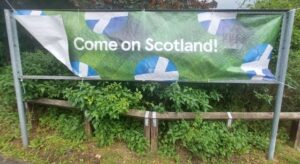
It’s the hope that kills you


The footballing World Cup currently taking place in Canada, Mexico and some other place – oh yes, the USA – has now entered its second stage.  And guess what?  A certain country took part in the first stage but failed to qualify for the second one, just as it qualified for eight previous World Cups and didn’t make it to the second round of those competitions either.  In fact, it’s earned itself the unenviable record of being the most-useless-at-getting-to-the-second-round-of-the-World-Cup country ever.  Which hapless nation could this be?


Here’s a clue: “Yes sir, I can boogie…


I had a fortnight off work during the second half of June and spent that time in Scotland, in the Borders town of Peebles, where my family have lived for nearly 50 years after relocating from Northern Ireland in 1977.  My fortnight in Scotland coincided with the Scottish men’s team playing their second and third games of the World Cup, which they’d qualified for in November last year.  Well, I thought beforehand, I’ll be in Scotland in time to see if, finally, they can beat the jinx that’s stopped them from getting past the competition’s initial stage in 1954, 1958, 1974, 1978, 1982, 1986, 1990 and 1998.  And this time, with so many countries competing in the 2026 competition, surely it’ll be easy to get into that elusive second stage?  Surely they’ll beat the curse at last?


Thus, I braced myself for the Scottish World Cup 2026 experience, thinking of a lyric from the Eagles’ Hotel California: “This could be heaven or this could be hell.”


Guess which one it turned out to be.


When I arrived in Scotland on June 17th, the national team had already secured three points from their first World Cup game.  It had defeated by one goal to nil the footballing colossus that is… Haiti.  Actually, given Scotland’s history of embarrassing scores against minor footballing nations they were expected to beat, such as Iran in 1978 and Costa Rica in 1990, the win over Haiti felt like the clearing of an important psychological hurdle.  Now Scotland  needed just one more point to be sure of getting through to the second round.  As I traversed the streets of Peebles, folk around me were cautiously positive.  There was a certain sense of optimism.  Hope was definitely in the air…


But as older, wiser heads who’d experienced countless Scottish World Cup agonies in the 20th century would inevitably muse: “It’s the hope that kills you.”


June 19th saw Scotland’s second World Cup game, against Morocco.  By now, like humidity in the air triggering a spectacular thunder-and-lightning storm, that pervasive sense of hope had transformed into full-scale mass euphoria.  Mind you, I was slightly less euphoric, remembering Scotland’s last game in the last World Cup they qualified for, in France in 1998, which was against Morocco too.  Back then, Morocco had humped them three-nothing.


I watched the game in the social building of Peebles Rugby Club, where for once the crowd contained more fans of the round ball than fans of the oval one.  I’d never seen the place as wild as it was during the build-up to the game – people were yelling, singing, dancing on tables, waving glow sticks like demented cheerleaders.  In fact, there was so much merry-making and hullabaloo that most folk didn’t even notice when the first whistle blew and the match kicked off.  They also didn’t notice when two minutes later Morocco penetrated Scotland’s somnolent defence and knocked in an embarrassingly early goal.  There was some remarkable sobering-up done when the revellers finally focused their gaze on the Rugby Club’s TV screens and realised,  one goal down already – how the f*ck did that happen?


To be fair, Morocco didn’t look much more accomplished than Scotland, certainly not during the second half.  But the North Africans hung onto their slender lead for the next 90-odd minutes and the game ended one-nil to them and with Scotland acquiring zero points.  If only the team had been awake from the very start and denied Morocco that early goal.  They’d have scraped a nil-nil draw, got a point, qualified for the second round and made history.  I tried to console myself with the thought that as it was a three-nil defeat against Morocco in 1998, and only a one-nil defeat in 2026, this marked a 66% improvement on Scotland’s part.  Right?


The next day, June 18th, was the biggest day in Peebles’ annual Beltane festival.  Among other things, there was a parade of floats, bands and people in fancy dress along the town’s high street.  Many of the revellers were in the regalia of the Tartan Army, the Scottish football team’s travelling support – one guy in such attire was even riding a penny farthing.
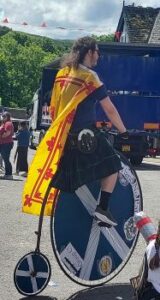


Yet an unhappy sense of reality about Scotland’s World Cup prospects was tangible now.  Some of the bands were still dutifully playing Yes Sir, I Can Boogie (1977) by the Spanish disco duo Baccara, which has been the Tartan Army’s favourite anthem since 2020.  However, Langholm Town Band definitely had their finger on the pulse when they marched by me playing Ally’s Tartan Army, which was Scotland’s World Cup song in Argentina in 1978 and whose lyrics go, “We’re on the march with Ally’s army / We’re going to the Argentine / And we’ll really shake them up / When we win the World Cup / Cos Scotland are the greatest football team.”


Ally’s Tartan Army serves as a painful reminder of what happened during Scotland’s World Cup campaign in 1978.  The Scotland manager then, Ally MacLeod, was breezily optimistic about his team’s chances of winning the World Cup; his optimism was amplified by Scotland’s sporting press; the whole nation drank the Kool-Aid and believed their team only had to turn up in Argentina to lift the trophy…  And when Scotland were knocked out in the first round, it was seen as a national disaster and humiliation.  For years afterwards, the Scots suffered from P.A.S.D., i.e., Post-Ally Stress Disorder.


Scotland’s final first-round game was against Brazil on June 24th.  The Scottish World Cup record against Brazil had been woeful.  In the 1982 competition in Spain, Brazil beat them four-one, a cruel result considering that Scotland went one-nil up after 17 minutes, courtesy of a goal by David Narey.  (Big-chinned English football commentator Jimmy Hill earned himself the lasting hatred of Scotland fans by dismissing Narey’s goal as a ‘toe-poke’.)  A rematch at the 1990 World Cup saw Brazil beat them one-nil and caused Scotland’s elimination from the tournament.  Despite this, I heard slivers of optimism in people’s conversations: “We only need a draw… One point, that’s all…  And Brazil…  They’re not the great team they once were…  They’ve been disappointing so far…”


Yes, it’s the hope that kills you.


I watched the game at my brother’s house, where the audience included my nephew and his girlfriend, who hadn’t even been born when Scotland last played in a World Cup.  Brazil knocked the ball three times into Scotland’s goal – actually four times, but one of the goals was disallowed – without Scotland even achieving what the late Jimmy Hill would describe as a ‘toe-poke’ in return.  Afterwards, I said to my nephew and his partner something along the lines of, “Welcome to us old folk’s world – one of Scottish World Cup misery.”


Even then, it wasn’t absolutely certain that Scotland was out of the World Cup.  So many countries were involved in this competition, and the rules for making progress in it were so complex, that they still had a chance.  Some of the best-placed teams with three points would go through to Round Two.  Scotland might be one of the lucky ones if certain results went certain ways.  By June 27th, though, it was clear the results hadn’t gone the right way and Scotland were taking their ninth World Cup early bath.


Yes, it’s the hope that…  Oh, shut up.


If nothing else, the Tartan Army showed yet again that they’re one of the best sets of football fans in the world.  Despite the hassle of entering Donald Trump’s increasingly authoritarian USA, and the excruciating price of match tickets, transport, refreshments and everything else in a World Cup orchestrated by the rip-off maestro and evil Mekon Gianni Infantino, head of FIFA, they won American hearts and minds by supporting their team with good humour and self-deprecation and avoiding any nationalistic preening or belligerence.  And, along the way, they had a hell of a party.


The citizens of Boston, where they played their first two games, were particularly impressed.  They didn’t even mind the Tartan Army’s custom of plonking traffic cones on the heads of their municipal statues.  The day after the Haiti victory in this, the home city of the Irish-American diaspora, at a downtown Irish pub called Henessey’s Bar, Scotland fans managed the exceptional feat of drinking three times more beer than is normally sold on St Patrick’s Day.  “We’ve been here for over 30 years and we’ve never seen anything like it,” marvelled the pub’s boss.  Even the New York Times was moved to publish a feature about the Boston-Tartan Army love affair.


Those fans were merely enjoying the Scotland World Cup experience, and squeezing in as much hectic partying, while it lasted.  Because, as 2026 proves for the umpteenth time, the Scotland World Cup experience never lasts for long.
 

Remember the Ally-mo


© BBC


It’s come to my attention that a football World Cup is in progress.  Time, then, to dust down and repost the following item, which surfaces on this blog every four years when the competition is underway to decide the global champions of the ‘beautiful game’.


One unsettling feature of growing older is that when an anniversary arrives and you think back to the original event, you feel shocked when you realise how much time separates now and then.  The other week, the 2022 World Cup competition began in Qatar, and it’s just occurred to me that the 1978 World Cup in Argentina took place 44 whole years and eleven whole World Cups ago.  It’s almost traumatic to realise how much time has elapsed.


However, if you’re old enough to remember the 1978 Argentinian World Cup and you were in Scotland at the time, you’ll testify that the event itself was traumatic.


For those of you who’re unacquainted with the topic…  What happened in 1978 was that of the four national football teams in the UK, Scotland was the only one to qualify for Argentina.  And the country had a team that, on paper, looked like it might achieve something.  It boasted players from some of the mightiest football clubs in Britain: for example, from Manchester United (Martin Buchan, Gordon McQueen, Lou Macari, Joe Jordan), Liverpool (Graham Souness, the legendary Kenny Dalgleish), Glasgow Rangers (Derek Johnstone, Tom Forsyth, Sandy Jardine), Nottingham Forest (Kenny Burns, John Robertson, Archie Gemmill) and, er, Partick Thistle (Alan Rough).  And in charge of these remarkable players was a manager called Ally MacLeod, who was remarkable in his own way.  Though not necessarily in the right way.


From the Independent / © Getty Images


Ally had been emboldened by wins in 1977 over the European champions Czechoslovakia and over the Auld Enemy, England.  The game against England concluded with the Scottish fans swarming onto the pitch at Wembley and digging up clods of the turf and breaking the goalposts into wee pieces to bring home as souvenirs, much to the horror of the English commentators and much to the hilarity of everyone in Scotland.  He then began to talk up his team’s chances in Argentina.  When early in 1978 Scotland failed to win the Home International championship involving England, Wales and Northern Ireland, Ally shrugged it off with the tantalising comment that the championship’s title “could be dwarfed by the World Cup.”  Such statements, and Ally’s general air of swagger and optimism – “My name is Ally MacLeod,” he announced when he became Scotland manager, “and I am a born winner!” – acted like catnip to both football fans and the hacks working on the sports pages of Scotland’s newspapers.


As the World Cup approached, a heady sense of expectation began to infect the Scottish population.  Folk started to believe that the Argentinian World Cup would be a jamboree of Scottish footballing genius, culminating in Ally and the gang lifting the trophy.  No wonder a carpet company cannily signed Ally to do a commercial where he sat on one of their rugs whilst dressed as a gaucho, which was 1970s Britain’s idea of what everybody in Argentina looked like.  This led to a priceless incident where, just before he departed for Argentina, Ally was accosted by an exuberant fan who announced, “Ally, see the day after your commercial?  My ma bought one o they carpets!”


Ally was indeed a great salesman.  He could truly market the brand.  Unfortunately, that was not quite the same as delivering the goods.


Even one of my favourite rock bands, the Australian (but mostly Scottish-born) AC/DC, got in on the act and played a gig in 1978 at Glasgow Apollo Theatre wearing Scotland football strips.  Also getting in on the act was the Scottish comedian Andy Cameron, who recorded a song called Ally’s Tartan Army that soon rode high in the charts.  It contained such catchy, if posthumously cringeworthy, lines as: “And we’re fairly shake them up / When we win the World Cup / Cos Scotland’s got the greatest football team!


From pinterest.co.uk


Being in Scotland in the spring of 1978 and watching this happen was disconcerting for me.  The year before, my family had moved from Northern Ireland and taken up residency in a farm near the Scottish town of Peebles.  I’d assumed that the Scots were a stoical, down-to-earth lot, not given to flights of fancy.  But then, all-of-a-sudden, they’d succumbed to this madness about Ally MacLeod, winning the World Cup and having the greatest football team in the universe.  What was going on?  I found it particularly noticeable the day before Scotland played Northern Ireland in the Home Internationals.  When I walked into a meeting of the local Scouts that evening, all the other (Scottish) scouts had an insane glint in their eyes and were gleefully predicting how Scotland was going to slaughter, dismember and stomp on the grave of poor, lowly Northern Ireland the next day.  As it turned out, all Scotland could manage with Northern Ireland was a 1-1 draw, much to my satisfaction.


Still, over time, the madness seemed to seep into even my non-ethnically Scottish soul.  Hey, I thought, it would be cool to live in the country that’d won the World Cup, wouldn’t it?


After a delirious send-off at Hampden Stadium where 30,000 Scotland fans whooped and screamed as if their team had just come back from Argentina clutching the World Cup trophy, Ally’s Tartan Army flew out and got ready for their first game of the competition’s first round, which was against Peru.  The evening that the game was on TV, I missed the beginning of it for my dad had sent me out to move some cows from one field to another.  I was in the middle of moving those cows when I heard a huge rumbling roar.  It was like how I’d imagine the approach of a tsunami to sound.  I needed a few seconds to realise I was hearing cheering coming from the town, a half-mile away beyond the last of my parents’ fields.  It was the sound of 5000-odd people in Peebles celebrating Joe Jordan knocking in a first goal for Scotland in the game’s 14th minute.  Gosh, I thought, it’s startedScotland really are going to win the World Cup!


I completed my task, hurried back to the house and hunkered down in front of the television next to my younger brother, who’d really caught the Scotland World Cup bug and was watching the match with avid excitement.  Scarcely had I arrived there when, just before half-time, Peru equalised.  Then in the second half Peru scored two more, so that by the game’s end Scotland had been beaten 3-1.  In a pathetic attempt to hide my disappointment, I pretended that, being Northern Irish, I hadn’t really been supporting Scotland and I thought their defeat was funny.  So I turned around and started laughing at my brother.  I stopped, though, when I realised he was in floods of tears.  However, my mother had already seen me laughing at him and she gave me a deserved bollocking for making him even more upset.


Next up for Scotland was Iran, an unstable country in the early throes of a revolution.  Scotland was surely going to win this one, right?  Wrong.  The team played so badly that they scraped a 1-1 draw and that was only because an Iranian player called Eskandarian scored an own-goal.  This game was famous for its images of a totally-deflated Ally Macleod sitting hunched over in the Scotland dugout, his hands clamped over the top of his skull in an attempt to shut out the world – “Ally trying to dismantle his head,” as one wag described it later.


© Daily Record


To heighten the misery, the Scottish striker Willie Johnston was sent home after failing a drugs test.  Other football players have suffered drugs scandals, most notably the cocaine-snorting Diego Maradona.  But the hapless Johnston wasn’t even caught taking a glamorous, hedonistic drug.  He tested positive for Reacitivan, a medication prescribed to him because he had hay fever.  Poor old Willie might as well have been busted for taking Benylin Chesty Cough Mixture.


By now the Scotland situation was looking grim.  Also grim was the atmosphere at Peebles High School.  One guy in my class told me there was a record shop in Glasgow that was now selling copies of Ally’s Tartan Army by Andy Cameron for a penny each, so that disgruntled punters could make a public display of smashing them into vinyl slivers on the pavement outside.  Meanwhile, a girl told me she couldn’t bear to drink Scotland’s national fizzy drink Irn Bru any more, because its name sounded it too much like ‘Iran Peru’.  Lessons with our English teacher, Iain Jenkins, strayed off the topic of Shakespeare and became lengthy post-mortem discussions about what was going horribly wrong in Argentina.


In fact, I remember us doing some creative writing one day and then Iain Jenkins reading out a poem that a mischievous pupil from south of the border – England – had just penned about Scotland’s faltering World Cup campaign.  It contained the memorable line, “Poor Ally will have to emigrate to the moon” and the even more memorable couplet, “Willie Johnston is over the hill / That’s why he’s on the pill.”


To get through to the World Cup’s next round, Scotland now had to beat the Netherlands… and beat them by three goals.  There seemed zero chance of that happening.  From the dire way the Scots were playing, it looked much more likely that the Dutch would murder them.  Yet it was against the Dutch – who’d eventually make it to the competition’s final – that Scotland managed a victory.  Indeed, they were 3-1 up at one point in the game and if they’d knocked in another goal they could have lived to fight another day.   Alas, it wasn’t to be.  The Dutch eventually pulled one back, making the final score 3-2.  Scotland had won, but not by enough to stop them going home early.


Still, the game produced a brilliant Scottish goal by the diminutive Nottingham Forest player Archie Gemmill.  It was the best goal of that World Cup and possibly the greatest World Cup goal ever.  Incidentally, it’s also the goal whose footage is intercut with the hectic sex sequence in Danny Boyle’s Trainspotting (1995).  No wonder a dazed Ewan MacGregor murmurs at the end of it, “I haven’t felt that good since Archie Gemmill scored against Holland in 1978!”  Though I’m pretty sure that back in 1978 the Scottish football commentator Archie Macpherson didn’t really exclaim, as he does in Trainspotting, “A penetrating goal for Scotland!”


Thus, Scotland was out of the World Cup but with, technically, a wee bit of pride salvaged.  Sadly, such was the hype that’d accompanied them to Argentina that their campaign didn’t feel like anything other than an absolute disaster.  The day after the Holland game, I remember a classmate, the local postman’s son, coming into class.  He pulled out a tartan scarf, waved it around for five seconds and said flatly and unenthusiastically, “See that?  We beat Holland.  Magic.”  Then he put the scarf back in his bag and zipped it up again.  And nobody at school seemed to talk about Scotland, Argentina and the World Cup ever again.


Mind you, later that summer, I returned to Northern Ireland for a holiday.  People there seemed to view me as 100% Scottish now and they didn’t stop tearing the piss out of me about how crap Scotland had played in Argentina.


From twitter.com


But let’s be fair to Ally MacLeod, who died in 2004.  In popular Scottish mythology he’s often depicted as a vainglorious balloon, bragging that his team would win the World Cup, and then win the next World Cup, and probably the Ryder Cup, the Stanley Cup, the America’s Cup, the Ashes and the Tour de France as well.  But I’ve scoured the Internet and been unable to find most of the hyperbolic quotes that I’ve heard attributed to him.  It’s fairer to say that he made a few tactless comments and exuded a lot of optimism, which the overheated imaginations of fans and journalists turned into mass hysteria.  In the dispirited environment of post-World Cup Scotland, though, nobody wanted to admit their own culpability and poor Ally became the scapegoat.


Anyway, if you can ignore the hubris and focus only on the football, Ally’s 1978 squad didn’t do that badly.  Yes, they had two duff games but they only lost one of those, and then they achieved a win against the eventual finalists.  If the cards had fallen differently elsewhere in their first-round group, they might have got through to the competition’s next stage; and, having had their wake-up call, performed better.  Other teams in other World Cups have done so with the same first-round record of one win, one draw and one defeat – including England.


Much has been blamed on that ill-fated World Cup campaign.  People have found significance in how it came shortly before the 1979 referendum on creating a devolved Scottish parliament, which died a death because of apathy.  The Scottish public voted for the parliament, but not in sufficiently high numbers.  It’s tempting to join those two dots, but I’m inclined to blame this collapse in Scottish political willpower at the end of the decade on factors a lot more complex than Ally MacLeod bullshitting us a bit about football in 1978.


One thing that can be attributed to 1978 is the evolution of the Scotland football team’s travelling support, the Tartan Army.  Thanks to the bitter lessons learnt then, modern Scotland fans have dumped any belligerent, nationalistic sense of expectation and have gone about the (often thankless) task of supporting Scotland with humour, irony, self-deprecation and a determination to have a good time no matter how bad the results.  As a result, they’re now one of the most popular sets of fans in the world.


Actually, when Scotland played England several years ago at Wembley, I saw a picture of some Scottish fans posing in Trafalgar Square with a life-sized cut-out of Ally MacLeod they’d brought along.   That made me smile.  With his erratic management skills and over-exuberant PR skills, the daft bugger put us through the wringer in 1978.  But it’s nice to know his spirit still gets invited to the party.


From the Guardian / © Dan Kitwood, Getty Images

© Daily Record