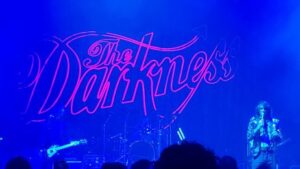
The Darkness descends on Singapore


Andy Warhol’s prediction that one day everyone would be famous for 15 minutes seems cruelly appropriate when I think about English glam rock / metal band the Darkness.  In 2003 they released their debut album Permission to Land and for the next year they were huge. The album went platinum and the band racked up three awards – Best British Group, Best British Rock Act and Best British Album – at 2004’s BRIT Awards.


But then…  Suddenly, they weren’t huge.  Their second album One Way Ticket to Hell… and Back (2005) being a flop and their singer and lead guitarist Justin Hawkins quitting the band after struggling with drug and alcohol addiction didn’t help, though overall they gave the impression their popularity would be brief.  With the over-the-top theatricality of their music – crowned by Hawkins’ falsetto vocals – and the cartoonish-ness of their videos and general image, the band obviously didn’t take themselves seriously, which was admirable.  Alas, there’s a problem with presenting yourself as something of a joke, i.e., even the funniest joke in the world stops being funny when you’ve heard it a number of times.


For the record, I should say I liked One Way Ticket to Hell… and Back, if only for its title track, which contained the immortal lyrics: “The first line hit me like a kick in the face / Thought I better have another one just in case…”  I also liked them because they came from Lowestoft, the rather rough-and-ready seaside resort in County Suffolk.  I was spending much of my time in Suffolk when, temporarily, they hit the big time.  Indeed, at the height of their celebrity, they threatened to buy big, fancy houses in Southwold, the more upmarket, snootier seaside resort a few miles along the coast from Lowestoft – a threat some Southwolders took seriously.  I seem to recall a newspaper article where the journalist visited Southwold and interviewed some locals about the prospect of having Justin Hawkins and co. as residents.  One old lady expressed her disapproval of them because they ‘had tattoos’.


However, as evidenced by John Travolta – who went from the highs of Saturday Night Fever (1977) and Grease (1978) to the lows of the Look Who’s Talking movies (1989-93), but then enjoyed a comeback with Pulp Fiction (1994) – or Robert Downey Jr – who, after Air America (1990) and Chaplin (1992), seemingly destroyed his career with cocaine and heroin abuse, but then made a half-billion dollars playing Iron Man in the Marvel Cinematic Universe – or even Sir Michael Caine – whose route from Zulu (1964) and Alfie (1966) to having roles in eight Christopher Nolan movies and becoming a British national treasure had to go through a mid-career trough containing the likes of The Swarm (1978), Beyond the Poseidon Adventure (1979), The Island (1980), The Hand (1981) and Jaws: the Revenge (1987) – just because you were once fashionable, but then went out of fashion, doesn’t mean you won’t ever come back into fashion.   So it is with the Darkness.  After being off the radar for a long time, they’ve lately acquired some retro-coolness.


Their eighth and most recent album, 2025’s Dreams on Toast, got to Number 2 in the British charts.  They’re due to support Iron Maiden at their 50th anniversary show at Knebworth Park in July this year.  And in December 2026 they’ve lined up no fewer than seven UK arenas to perform in for their Band of Brothers tour.  They even generated some headline-making controversy when Justin Hawkins, who reunited with the Darkness in 2011, and younger brother Dan, who plays lead guitar in the band too, criticized Yungblud’s performance at the late Ozzy Osbourne’s farewell concert last summer.  The elder Hawkins commented: “…if the future of rock comes from musical theatre and Disney, if this is Ozzy’s heir, we’re in trouble.”  Finally, it hasn’t done the band’s renewed popularity any harm that, since 2021, Justin Hawkins has had a YouTube channel where he reviews and analyses songs.  It currently has 600,000 subscribers.


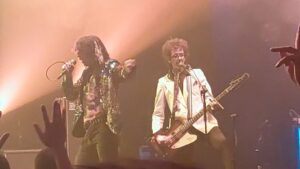
Last week, the Darkness made their first-ever appearance in Singapore, my current abode, with a gig at the Capitol Theatre.  In terms of musicality, it wasn’t the best concert I’ve attended in the city-state.  That accolade probably belongs to Jack White, whom I saw at the same venue three-and-a-half years ago.  But in terms of showmanship… This gig was pretty awesome.


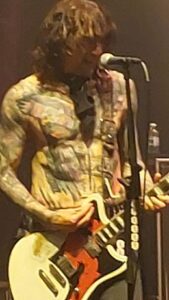
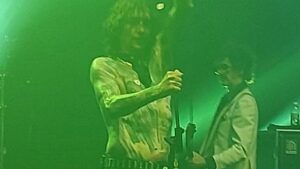
Yes, the band-members are two decades older than they were in their mid-noughties heyday – bassist Frankie Poullain, who once resembled a moustached villain from a spaghetti western, appears to have transformed into Kurt Vonnegut – but the encroachment of middle age hasn’t slowed, calmed or subdued them.  Justin Hawkins, for example, in an impressive display of spriteliness, performed a handstand at one point.  Also, admirably un-self-conscious, he stripped off to the waist early in the gig and flaunted a torso slathered in tattoos.  No wonder that old lady in Southwold objected to him.


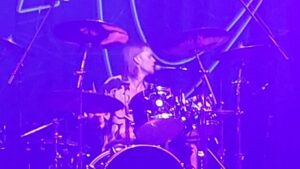
When you list the bands that had an influence on the Darkness, the one topping the list is surely Queen.  Accordingly, there were moments tonight when I felt I was listening to the rockier end of Queen’s musical repertoire – without the detours into opera, funk, disco, music hall, electronica and so on that the older band were so fond of – with Justin Hawkins providing plenty of Freddie Mercury-style flamboyance.  But I mean that in a good way.  Those Queen-esque moments smacked of loving homage rather than slavish imitation.  And on the subject of Queen, I should mention that since 2015 the Darkness’s drummer has been Rufus Tiger Taylor, whose dad is none other than the legendary Queen tub-thumper Roger Taylor.  Justin Hawkins cracked a joke about this at one point, quipping that Rufus’s father used to ‘play the drums in Status Quo’.  I laughed, though nobody else in the crowd seemed to.  Maybe because I was the only audience-member old enough to know who Status Quo were.


The setlist balanced half-a-dozen songs from their first and still most famous album Permission to Land, including such crowd-pleasing items as I Believe in a Thing Called Love and Get Your Hands Off My Woman Motherf*cker, with half-a-dozen from their recent comeback Dreams on Toast.  Of the latter songs, Rock and Roll Party Cowboy, which served as the opening number and set the tone for what was to follow, was a particularly glorious slab of glam-metal genius / stupidity (“Leather jacket, no sleeves / Harley-Davidson? Yes, please!“).  Some of their in-between albums were represented by a song each and they also did a cover, a guitar-heavy rendition of Jennifer Rush’s The Power of Love (1984), which Hawkins’ voice was highly suited to.  The cover was fun, though one ironic take on a power ballad was enough.  They thankfully didn’t follow it up with versions of, say, Bonnie Tyler’s Total Eclipse of the Heart (1983) or Celine Dion’s It’s All Coming Back to Me Now (1996).
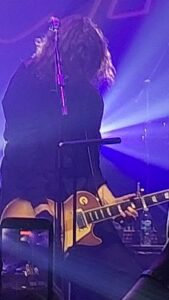
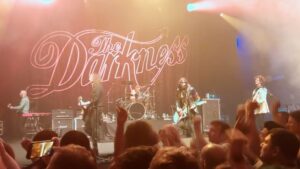


The band played epically with instruments cranked up to 11 at all times, Justin Hawkins antics’ as frontman achieved the right alchemy of melodrama and hilarity, and consequently the evening was high in entertainment value and the crowd had an excellent time. What helped, I felt, was that the Darkness came across as being a bunch of genuinely decent lads.  For instance, Justin Hawkins showed his appreciation of the guitar-tech guy who sporadically had to run on and off-stage.  The band also made sure their touring member, the keyboardist and guitarist Ian Norfolk – who, with his bald head, trimmed beard and sensible clothes looked as unlike the other performers as was possible – got a minute in the limelight.  By the way, I appreciate a guy called Norfolk playing with a band from Suffolk.


Moreover, the one moment that could have soured things – the band stopped a half-minute into I Believe in a Thing Called Love to ask certain members of the audience at the front of the stalls to stop filming on their phones – was well-handled by Hawkins.  Speaking like the nice, popular teacher at school who, once in a blue moon, has to discipline an unreasonably rowdy class, he pointed out in an I’m-not-angry-just-a-bit-disappointed voice, “Imagine if I sang the song while filming you on my phone…  It’d be really boring!”  He was more restrained than Brett Anderson of Suede, who in a 2023 gig at Singapore’s Star Theatre reacted to phone-filming spectators by tussling with them and knocking the infernal devices out of their hands.


Incidentally, when I arrived before the show, I noticed that one of the counters selling drinks at the back of the stalls belonged to the Flying V, Singapore’s premiere – well, probably only – heavy-metal bar.  And when I approached that counter to buy a beverage, I discovered they were selling Aspall Cyder.  The cidery producing this particular brew is located in the Suffolk village of Aspall, about 30 miles southwest of Lowestoft.  Wow, I thought, is this on sale because the Darkness are performing tonight?  Are they supporting the Suffolk economy whilst playing in Asia?  Momentarily, I had a vision of the Darkness’s tour-jet being accompanied by a cargo plane loaded with bottles of East Anglian scrumpy.  However, I visited the Flying V after the gig and learnt that they sell Aspall Cyder there all the time.  So it was just a coincidence.
 

In at the Deep end


I love live music and I live in Singapore, where in recent months there’s been much excitement about major bands and singers coming and staging concerts.  But I’ve felt like the title character in Samuel Coleridge’s The Rime of the Ancient Mariner (1834) when he laments, “Water, water everywhere, nor any drop to drink.”  Yes, there’s been a buzz about Singapore being south-east Asia’s number-one stop for famous musicians on tour.  But frankly, as a grumpy old punk / goth / heavy-metal guy, the music made by the acts performing lately in Singapore really isn’t my thing.  Indeed, if I had to choose between listening to it and sticking a sharp stick into my ear, I’d probably go for the ‘sharp stick’ option.


Firstly in January 2024, Singapore’s National Stadium hosted half-a-dozen concerts by English group Coldplay, whom Wikipedia describes as a ‘pop rock’, ‘post-Britpop’, ‘pop’ and, supposedly, ‘alternative rock’ band.  I regard Coldplay as being so wimpy they make Belle and Sebastian sound like Rage Against the Machine.  That’s all.


Then in February English singer-songwriter Ed Sheeran played the National Stadium too.  Regarding Ed Sheeran, I can only say I agree with the late Mark E. Smith, mainstay of the fabulously unhinged post-punk / alternative rock group the Fall, who likened him to “a duff singer songwriter from the 70s you find in charity shops.”


And then, in March at the National Stadium, Taylor Swift put on six shows of her Eras tour.  That meant for a week Singapore’s usually orderly streets were filled with fans from all over Asia – ‘Swifties’ I believe they’re called in modern-day parlance – clad in spangly skirts, pink gowns, cowboy hats and friendship bracelets and with rhinestones arranged in the shape of hearts adorning their faces.  Taylor’s lengthy stopover in Singapore – the only shows of the Eras tour in Asia – prompted politicians in Thailand and the Philippines to grumble about the generous subsidies Singapore offered for each concert.  According to the Straits Times newspaper, these allegedly “were contingent on Swift not performing in other South-east Asian nations.”   To be honest, as someone immune to Taylor’s musical charms, if I was a politician in Thailand or the Philippines, I’d be thanking Singapore for keeping her away from my shores.


Anyway, this is a preamble to the fact that, last week, I felt totally starved of decent live music – I hadn’t been to a gig for half-a-year – and did something I wouldn’t normally do.  I bought a ticket for a Deep Purple concert.


Deep Purple are often referred to as one of the ‘holy trinity’ who, in the 1970s, fathered heavy metal.  But while I love the other two members of that trinity, Led Zeppelin and Black Sabbath, I’ve never been into Deep Purple.  To me, they didn’t have Led Zeppelin’s knack for coming up with irresistible guitar riffs nor that band’s ability to experiment, successfully, with other musical genres: blues, folk, reggae, rockabilly, world music.  And they didn’t have the splendidly ominous sound of Black Sabbath, which would influence future sub-genres of heavy metal like black and doom metal.


© Phonogram Ltd


I also wasn’t into Deep Purple because, even as a teenager in the late 1970s and early 1980s, the band seemed like ancient history to me.  This was because when I was at secondary school in Scotland, Deep Purple had split up – temporarily, it turned out – and spawned a bunch of splinter groups with former Purple members as their movers and shakers.  Ritchie Blackmore, Purple guitarist from 1968 to 1975, had formed Rainbow, which during the early 1980s included in its line-up Purple bassist Roger Glover.  For a while, Rainbow had as their singer the late Ronnie James Dio, a man I greatly admired, and I think their 1976 song Stargazer is a work of stomping, over-the-top brilliance.  But their later stuff I found mostly lame.


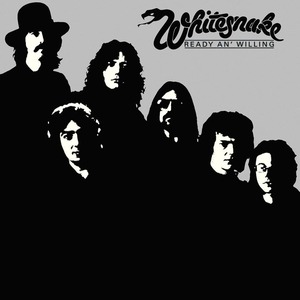
Meanwhile, David Coverdale, who’d been Deep Purple’s singer from 1973 to 1976, had formed Whitesnake, which during its early years contained such other Deep Purple stalwarts as drummer Ian Paice and keyboardist Jon Lord.  I liked the 1980 Whitesnake album Ready an’ Willing for its agreeable, aggressively bluesy sound, but later albums like 1981’s Come an’ Get It and 1984’s Slide It In seemed, in their inuendo-heavy way, to be about the size of Coverdale’s todger and his irresistibility to the ladies, and I gave them a body-swerve.  Later still, Whitesnake metamorphosised into a then-modish, American-west-coast hair-metal band à la Motley Crue, which in my mind made them yet more unspeakable.


© EMI


I’m writing about this in detail because, at my school, the great Deep Purple break-up had resulted in there being two antagonistic tribes among the kids who were into heavy metal.  Those who had the Rainbow logo (with a giant fist bursting out of the sea and grabbing hold of, yes, a rainbow) emblazoned on the backs of their denim jackets, and who thought David Coverdale was a giant dickhead.  And those who had the Whitesnake logo (WHITESNAKE spelt in joined-up letters by an ultra-long and ultra-squiggly white snake) emblazoned on the backs of their denim jackets, and who entertained a similarly uncomplimentary opinion of Ritchie Blackmore.


Incidentally, there was a third Deep Purple splinter group on the go at the time – Gillan, unsurprisingly fronted by Ian Gillan, who’d served as the Purple vocalist from 1969 to 1973.  But nobody I knew at school liked poor old Gillan or his eponymous band.  My beef with Ian Gillan, though, is that afterwards, from 1983 to 1984, he sang with the mighty Black Sabbath and the album he recorded with them, Born Again (1983), is dire.


In 1984, Deep Purple reformed with their most popular line-up: Blackmore, Gillan, Glover, Lord and Paice.  But I had zero interest in this.  And while over the decades since, I heard about comings and goings within the band – Blackmore quitting again in 1993 and Steve Morse replacing him a year later, Glover departing in 2002 and being replaced by Don Airey, and Morse leaving in 2022 with Northern Irish guitarist Simon McBride stepping into his shoes – I’d never felt any inclination to listen to their music or see them live.  In fact, I could only name three Deep Purple Songs: Smoke on the Water (1972), Black Night (1970) and Hush (1968).  Oh, and Woman from Tokyo (1973), which makes it four.


And it didn’t surprise me to learn that Deep Purple was why Mark E. Smith (him again) sacked Marc Riley, bassist, guitarist and keyboard player (and future DJ) from the Fall.  Riley got his marching orders in part because Smith saw him dancing to Deep Purple in an Australian nightclub: “Get in the hotel and stay there till I tell you.” Smith raged.  “You don’t need to be dancing to Smoke on the Water.”


Anyway…  Onto last week’s Deep Purple gig, which took place at Singapore’s Star Theatre.  I found it a mixed bag – but the good bits in that bag were enough to make the evening worthwhile.  It was noticeable how Simon McBride and Don Airey, the band’s newest members, did a lot of heavy lifting, embarking on lengthy guitar and keyboard instrumentals that allowed Gillan, Glover and Paice, all in their mid-to-late seventies, to take a break.  Admittedly, Airey is no spring chicken himself, but presumably being behind a keyboard is less tiring than having to prowl continuously around a stage or belt continuously at a drumkit.  My tastes in music developed after the advent of punk rock and I’ve been conditioned to believe that instrumental solos are inherently evil, and believe that those who perpetrate instrumental solos should be locked away for 20 years in Prog Rock Prison.  However, tonight, I made an effort to switch off the punk part of my brain and just enjoy the quality musicianship on display as McBride twiddled his guitar-strings and Airey plinked his keyboards.


One of a long line of rock guitarists from Belfast – see also Gary Moore, Vivian Campbell, Gerry McAvoy and Eric Bell – and, at 45, three decades younger than his Deep Purple compadres, McBride must find these moments a dream come true.  According to Wikipedia, McBride started to teach himself guitar when he was nine years old and while he was listening to his dad’s hard-rock collection, which included Deep Purple, on the family stereo.  Now, 36 years on, there are times when he’s practically carrying Deep Purple on his shoulders.


Airey knows how to play too and, perched over his keyboards and grinning manically like a mad scientist at work over a table laden with smoking vials, he was clearly enjoying himself.  Incidentally, in the past, Airey has played with Rainbow, Whitesnake, Black Sabbath, Saxon, Judas Priest and Iron Maiden’s Bruce Dickinson, among many others, and thus has a heavy metal CV to die for.


Of the other members… Roger Glover and Ian Paice did what was required of them.  Whenever the giant screen above the stage showed a close-up of Paice, he seemed to me to be a dead ringer these days for the actor Timothy Spall.  Which is ironic since Spall has played a rock drummer – he was Beano Baggett, the hapless tub-thumper with fictional 1970s rock band Strange Fruit in the underrated 1998 comedy movie Still Crazy, directed by Brian Gibson and written by Dick Clement and Ian La Frenais.


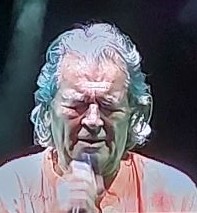
As for Ian Gillan…  Well, I don’t want to rag on him because of his age, but his voice has definitely seen better days and there were moments, as he tottered stiffly about the stage, when he looked like he was in pain.  Also, during some of the stretches in the songs when he wasn’t required to sing, he’d hirple offstage where, presumably, a chair awaited him.  Still, I’m past the days when I used to believe that old rockers should be forced to retire and make way for the Young Turks.  Probably that change in attitude is because I’m now an old codger myself.  If Gillan still enjoys what he does, and people are still willing to pay money to watch him do it…  Good on him.


The songs were well-performed even if, tune-wise, they didn’t leave much of an impression on me afterwards – I can still only identify four Deep Purple songs.  And at the end, rather wonderfully, the band signed off with three of those four: Smoke on the Water, Hush and Black Night.  As Gillan finally managed to hit the operatic high notes, and Airey channelled the spookily thunderous organ sound that was the speciality of the late Jon Lord, the hairs rose on the back of even my sceptical neck.  Finally, I understood why so many people loved this band.


Loved?  A lot of people evidently still love them. The concert attracted a good-sized crowd, not all of them old buggers like myself, and everyone seemed extremely happy by the end.  It was just a pity that many folk spent the gig staring at their phones whilst dutifully filming everything.  Jesus.  Why remove yourself from the occasion and gaze zombie-like at tiny figures moving about a tiny stage on a tiny screen?  Why not immerse yourself in the excitement and drama of what’s actually happening around you?  It’s also, needless to say, disrespectful of the performers onstage.  (Suede’s Brett Anderson made this point forcefully in the same theatre six months ago.)  Honestly, there were times when the auditorium was so densely flecked with glowing phone-screens you felt you were flying over Las Vegas at night.


I’m no bigger a Deep Purple fan now than I was before the gig, but credit where it’s due.  Despite the occasional shortcoming, they made an effort and put on a decent show, when they could easily have coasted on past glories and phoned in their performances.  I only wish someone had de-phoned the audience.