Films I’d like to see remade (Part 1)


From imdb.com / © Rank Organisation


I still find it disconcerting when films I enjoyed in my youth are remade in the 21st century: for example, 1980’s The Fog (remade in 2005), 1981’s The Evil Dead (remade in 2013) and Clash of the Titans (remade in 2010), 1986’s The Hitcher (remade in 2007), 1987’s Robocop (remade in 2014) and 1988’s Hairspray (remade in 2007).  My immediate and automatic response to such remakes is, “What, they’re remaking that movie already?  Have you no shame, Hollywood?”


This is followed by a feeling of horror as I realise just how long ago it was when those original movies were released.  The first Evil Dead movie was 32 years old – 32 years! – when its remake surfaced, though in my mind it was only yesterday when Sam Raimi’s Deadites made their first-ever appearance and started making life difficult for Bruce Campbell.   And actually, three of the films I remember most fondly from my youth, Philip Kaufman’s Invasion of the Body Snatchers (1978), John Carpenter’s The Thing (1982) and Brian De Palma’s Scarface (1983) were remakes themselves.  Body Snatchers appeared just 22 years after the 1956 original and The Thing appeared 32 years after its 1950 one.  Scarface was an outlier, since the first Scarface came out in 1932, more than a half-century earlier.


Maybe I shouldn’t be so concerned about how soon after the original movie that a remake appears.  I should be concerned about the quality of it – for remakes tend to be shite.  I haven’t seen all those mentioned at the beginning of this entry, but the ones I have seen have been nowhere near as good as the originals.  (The Evil Dead remake probably comes closest, but I still much prefer the ramshackle and low-budget, but resourceful, charm of Raimi’s 1981 film.)  That said, remakes don’t have to be bad all the time – the aforementioned ones by Kaufman, Carpenter and De Palma testify to that.


So, without further ado, here are some films – and one series of films – I wouldn’t mind seeing remade in the 21st century, with bigger budgets and better special effects.  But remade decently.
 

From wikipedia.org / © Rank Organisation


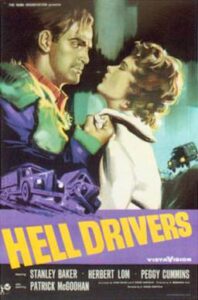
Hell Drivers (1957)

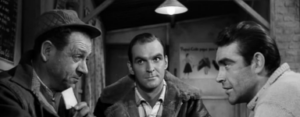
Blacklisted by the House Committee on Un-American Activities in 1951, American director Cy Endfield moved to Britain where, half-a-dozen years later, he made Hell Drivers.  Given the persecution Endfield had suffered, it unsurprisingly takes a dim view of American-style, cut-throat capitalism.  It has that underrated but magnificent actor Stanley Baker as an ex-con who finds a job as a truck driver with a dodgy haulage company, which threatens its drivers with the sack if they don’t deliver loads of gravel across treacherous roads at breakneck speeds.  The reason there aren’t more drivers employed to relieve the pressure, and reduce the danger, is because of a scam involving the local depot manager and its off-his-head Irish foreman (played by Patrick McGoohan like a brawnier version of Shane MacGowan).  The latter soon becomes Baker’s nemesis.


As well as a political message, Endfield injects Hell Drivers with an American-style grittiness rarely seen in British films of the period.  But what really makes the film a joy to watch nowadays is the cast.  As Kim Newman has written of it in Empire Magazine, “how many other movies have an ensemble which includes the original Dr Who (Hartnell), the first James Bond (Sean Connery), the Prisoner (McGoohan), a Man From UNCLE (David McCallum), a Professional (Gordon Jackson), Clouseau’s boss (Herbert Lom), plus Alfie Bass, the excellent Peggy Cummins (of the cult items Gun Crazy and Night of the Demon), the inimitably boozy Wilfrid Lawson, Jill Ireland and Sid James?”


In 2026, with capitalism more cut-throat than ever, a remake of Hell Drivers would be timely.  I don’t think, though, setting it in the wilds of Middlesex, West Sussex and Buckinghamshire, where the original was filmed, would work now, so it’d have to have its hard-pressed truck drivers pounding the roads of a less hospitable locale – the Alaskan tundra, say, or somewhere that retains some near-impenetrable tropical rainforest.


And to pay proper homage to the original, you’d definitely need a cast made up of actors who’ve played iconic roles in iconic TV shows or movie series.  You could have one of the grittier Bonds (Daniel Craig or Timothy Dalton), one of the grittier Doctors Who (Christopher Eccleston or Peter Capaldi), plus a Sherlock Holmes (Benedict Cumberbatch, maybe), a Harry Potter (Daniel Radcliffe), perhaps someone from the Breaking Bad universe (Bryan Cranston, say, or Bob Odenkirk)…  The possibilities are endless.


From wikipedia.org


The Margaret Rutherford Miss Marple movies (1961-64)

This is a little different.  I’d like to see the four movies made about Agatha Christie’s genteel sleuth of a certain age, Miss Marple, which had the delightful Margaret Rutherford in the leading role – Murder She Said (1961), Murder at the Gallop (1963), Murder Most Foul (1964) and Murder Ahoy! (1964) – rebooted as a TV show.  Not just another show about Miss Marple per se – there have been ones with Joan Hickson, Geraldine McEwan and Julia McKenzie – but one set in the universe of the four Rutherford movies.


Thus, its episodes would be set against the tableau of early-1960s England, with Miss Marple depicted as an obstinate, feisty old lady who refuses to know her place and keeps barging into and solving mysteries.  There’d be as much as humour as tension and the show would have the films’ supporting characters, like the timid librarian Mr Stringer (Rutherford’s real-life husband Stringer Davis), who reluctantly helps Miss Marple out, and the exasperated copper Inspector Craddock (Charles Tingwell), who begins each instalment telling her to mind her own business but ends it taking orders from her.  Meanwhile, Ron Goodwin’s jaunty Miss Marple Theme would burble in the background.


I suspect in a 2026 version Mark Gatiss would make a lovely Mr Stringer, while Daniel Mays would nicely fill the shoes of the long-suffering Inspector Craddock.  But who would play Miss Marple – or more precisely, play Margaret Rutherford playing Miss Marple?  Perhaps Dawn French, though she’d have to spend a long time in the make-up chair to recreate Rutherford’s famously jowly, hangdog features.


In the original movies, each murder that Rutherford / Marple investigated involved a British institution – a country manor, horse riding, the theatre and the Navy.  She’d duly rattle establishment cages by sticking her nose in where it wasn’t welcome.  So perhaps each episode of this hypothetical series would have her ruffling the feathers of other British institutions of the time – the Army, the House of Lords, Savile Row, Crufts, the country’s nascent rock ‘n’ roll industry…  Miss Marple meets the young Rolling Stones?  I’d pay good money to see that.
 

From wikipedia.org / © 20th Century Fox


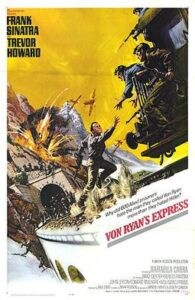
Von Ryan’s Express (1965)

I never had much time for Frank Sinatra, neither as an entertainer nor as a person, but he left an impression on my 10-year-old self the first time I saw the ripping World War II yarn Von Ryan’s Express.  It’s the story of an American airman, Ryan (Sinatra), downed in Italy, who joins forces with some Allied prisoners of war, led by Trevor Howard.  They attempt an audacious escape into neutral Switzerland by seizing control of a train and steering it up a railway line into the Alps.  Much derring-do is involved as German troops and aircraft go all-out to stop them reaching their destination.


It’s great, crowd-pleasing stuff until the ending – spoilers are coming! – which is depicted on the movie poster, painted by the great Frank McCarthy.  The train has almost made it to safety.  Having fought a rearguard action against the Germans, Sinatra is running after the train and has almost caught up with it.  But then….  What happened next put a dampener on things.  But it also lodged the film in my mind forever.


With 2009’s Inglourious Basterds, Quentin Tarantino showed his love for rip-roaring if cheesily improbable World War II adventures, so perhaps he could helm a remake of Von Ryan’s Express?  To stick to the innocent, uncomplicated spirit of the original, though, he’d have to forgo his use of the F-word and N-word, and his fetish for close-ups of ladies’ feet, and his nerdish references to ‘film-study criticism of the work of German director G.W. Pabst’.
 

© Hammer Film Productions / Seven Arts Productions


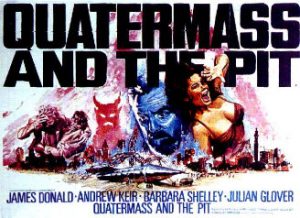
Quatermass and the Pit (1967)

Hammer Films’ sci-fi horror film Quatermass and the Pit was based on the 1958 BBC TV serial of the same name.  Both film and serial were written by Nigel Kneale.  It begins with workers on a London Underground extension project digging up an alien spacecraft full of dead, horned, insect-like creatures that are identified by scientist-hero Professor Bernard Quatermass (Andrew Keir) as inhabitants of the now-lifeless planet Mars.  It transpired that millions of years ago, these sneaky Martians arrived on earth and did some evolutionary tinkering on the apes who were the ancestors of modern humanity.  This tinkering included implanting in the apes an urge to conduct occasional culls whereby those with pure Martian programming exterminated those who’d developed mutations and lost that programming.


When some TV news crews descend on the scene, a power surge from their camera-cables reactivates the spacecraft and it triggers a new cull.  London becomes an apocalyptic hellscape where the human inhabitants who retain their Martian conditioning roam around, zombie-like, and use newly awoken telekinetic powers to kill everyone who’s lost it.


I still find Quatermass and the Pit impressive today, and scary, though inevitably there are special effects that reflect the limitations of Hammer’s budget.  I’d relish the prospect of a modern, big-budget retelling of the story.


One thing that makes the film effective, and affecting, is Kneale’s portrayal of the scientists.  Unlike usual movie-scientists, they aren’t cold-blooded, delusional, self-serving or plain weird.  Instead, Quatermass and his colleagues, Dr Roney (James Donald) and Barbara Judd (Barbara Shelley), are portrayed as decent human beings, working with an eager curiosity, a sense of duty and a sense of humour.  Keir and Donald were both Scots, so maybe a modern movie could cast Brian Cox as Quatermass and James McAvoy as Dr Roney.  Actually, I think a third Scottish actor, Karen Gillan, would be excellent as Barbara Judd.


To be continued…


© Metro-Goldwyn-Mayer
Mama Mia


© A24 / Little Lamb / Mad Solar Productions


One more post in advance of Halloween…


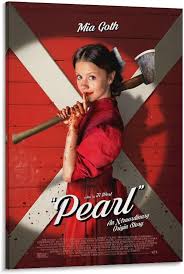
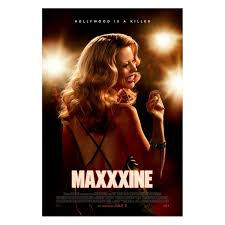
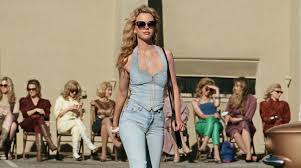
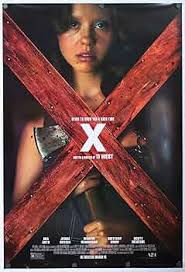
I’ve now watched all of the X trilogy of horror movies directed and written by Ti West and starring Mia Goth (who also co-wrote one of them).  These are X (2022), Pearl (2022) and MaXXXine (2024), which focus on the characters of ruthlessly determined actress Maxine Minx and frustrated wannabe actress Pearl Douglas, both played by Goth.  At its best, the trilogy is great.  At its worst, it’s still good fun.


X is the story of some city-folk heading out into the countryside and falling prey to a foe their slick city ways can’t deal with.  Yes, that’s the plot of half the horror movies ever made, from Tobe Hooper’s The Texas Chainsaw Massacre (1974) to Sam Raimi’s The Evil Dead (1982), from John Boorman’s Deliverance (1972) to Daniel Myrick and Eduardo Sanchez’s The Blair Witch Project (1999), from Eli Roth’s Cabin Fever (2002) to Ari Aster’s Midsommar (2019).  In West’s spin on it, the city-folk are six young filmmakers, including Goth’s character Maxine.  The year is 1979 and they intend to make a porno movie on the quick and on the cheap.  As a market for their product, they’re eyeing the up-and-coming technology of VHS, which will allow people to pay money and watch steamy movies they’re never likely to see in their local cinemas.  The filmmakers have rented a building on an out-of-the-way farm for the shoot, a farm belonging to an elderly couple called Howard and Pearl.


© A24 / Little Lamb / Mad Solar Productions


Incidentally, Howard and Pearl are also the names of an elderly couple featured in the BBC’s long-running, almost never-ending – and terrible – situation comedy Last of the Summer Wine (1973-2010).  I guess an American like West wouldn’t have known that.  Though maybe Mia Goth, who’s English, could have warned him that those character names were likely to give viewers from the United Kingdom PTSD-type flashbacks to Last of the Summer Wine.


X‘s Pearl is clearly unhinged and she’s about to get worse.  Ruminating on her current wrinkly decrepitude, mourning the loss of her youth, and jealously resenting the nubile young bodies performing sex-acts for the cameras on the other side of the farmstead, the old woman flips.  Bloody mayhem ensues, involving guns, knives, pitchforks and a large alligator who hungrily lurks in a pond elsewhere on the premises.  The scene where Maxine takes a naked dip in the pond, not suspecting that its scaly occupant is slowly closing in on her, is one of the creepiest things in the movie.  Rarely have aerial shots been so unnerving.


© A24 / Little Lamb / Mad Solar Productions


In all three movies, West revels in the setting.  X takes place during a Texas summer and the heat and sweatiness are nicely conveyed by the 1970s-aesthetic of the visuals.  The daytime shots, at least, have a faintly bleached and blurry look that evoke all sorts of bucolic American horror movies really made in that decade – the aforementioned Texas Chainsaw Massacre and the likes of John Hancock’s Let’s Scare Jessica to Death (1971), Jack Starrett’s Race with the Devil (1975) and Jeff Lieberman’s Squirm (1976).  Meanwhile, the way Pearl embodies the horrors of the aging process gives the film an extra depth.  This theme is touched upon both melancholically, as when Pearl realises how much Maxine resembles her when she was young, and queasily, with Pearl shuffling down to the makeshift film studio, spying on the actors doing their sex scenes and imagining she’s taking part herself.


But X’s greatest gimmick is its casting, for Mia Goth plays not one, but two characters.  She’s Maxine and Pearl.  The latter role required her to spend ‘a good 10 hours in the make-up chair’ in order to get the old-lady prosthetics applied.


© A24 / Little Lamb / Mad Solar Productions


X ends with Maxine’s escape from the farm.  She drives off into the night, still determined to make it big as an actress.  But what comes next isn’t a sequel but a prequel.  If it was plausible for Goth to play Pearl with heavy make-up as an old woman, she could obviously play the character without make-up as a young woman.  Hence, we got Pearl, also released in 2022.  This is set in 1918 with the title character stuck on her parents’ farm (the same one as in X, though disarmingly smart and new-looking compared with the crumbling, rundown version of it in the previous film) whilst waiting for husband Howard to return from World War I.  She’s especially stuck because the Spanish flu pandemic, the early 20th century’s equivalent of Covid-19, is raging and Pearl’s family are isolating themselves.  It doesn’t help matters that her father (Matthew Sunderland) has been crippled by a stroke and her mother Ruth (Tandi Wright) is humourless, censorious and bitter.  Pearl responds to the situation by fantasising about becoming an all-singing, all-dancing silent-movie star – which increasingly provokes Ruth’s wrath.


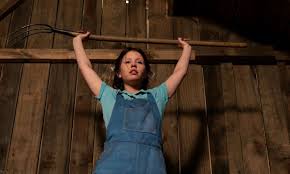
Meanwhile, Pearl is already subject to the psychopathy that’ll lead to X’s bloody events 60 years later.  In an early scene, she takes a hay-fork to an unfortunate goose who didn’t display sufficient enthusiasm for a show she put on for the animals in the barn. She then goes to the pond and feeds the dead fowl to an alligator, whom she’s named Theda after the silent movie actress Theda Bara (and who’s presumably the granny of the alligator in X).


Though her mother is determined to clip her wings, other things seemingly pull Pearl in the direction of her dreams – namely, the flattery of a handsome but lecherous projector at the local town’s movie theatre, and a once-in-a-lifetime opportunity to join a travelling dance troupe, the auditions for which are being held in the local church.  Predictably, during the ensuing conflicts, betrayals and disappointments, Pearl snaps.  The bodies pile up and Theda the Alligator gets some unexpected meals.


© A24 / Little Lamb / Mad Solar Productions


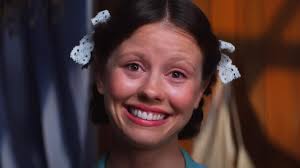
Even more so than X, Pearl shows West and Goth at the top of their games.  The director excels in orchestrating the showbiz-y fantasies that Pearl weaves around herself, including one set in a cornfield and involving a scarecrow that’s inspired by The Wizard of Oz (1939).  We can’t help but pity her even though we know she’s turning into a monster.  And Goth is amazing.  She’s particularly awesome at the end, when Howard finally arrives back from the war and finds the farmhouse kitchen in a less than decorous state.  Pearl presents herself – “I’m so happy you’re home!” – with a rictus-like smile, simultaneously heartfelt and terrifying, that seems to stay on her features forever.  No wonder Peter Bradshaw, film critic in The Guardian newspaper, hailed Goth as ‘the Judy Garland of horror’.


Pearl isn’t around for MaXXXine, released in 2024 and set in 1985, six years after the events of X.  But we glimpse her in flashbacks and her presence is felt in one of the film’s most harrowing scenes.  This is when Maxine – now in Hollywood and trying to graduate from starring in porn movies to starring in something slightly more upmarket, i.e., horror movies – sits in a make-up chair and has a cast made of her head.  With her face buried in the cast, and blinded by it, she suffers a panic attack and imagines Pearl is in the room, caressing her, as she did during one creepy moment in X.


Whereas the action in X and in much of Pearl was confined to a farm, MaXXXine is far more expansive.  Its story unfolds all over Los Angeles, from the Hollywood Hills to the back-lots of Universal Studios (where, significantly, we see the Bates house and motel from Alfred Hitchcock’s Psycho), from the city’s luxurious mansions to its ultra-dodgy strip-clubs, peepshows and back alleyways.  But it’s the time rather than the place that gives the film its vibe.  MaXXXine unashamedly immerses itself in the garish sleaze and excessiveness of the 1980s: big hair, Ray-Ban sunglasses, spandex, lip-gloss, neon colours, graffiti, cocaine, hustlers, flashy convertibles with personalised number-plates, X-rated video stores, lascivious hair-metal bands, gory slasher movies and general ‘me’-generation greed.  West depicts this world as a cesspit, but a somehow joyous cesspit.  Maxine, of course, has taken to it like a duck to water.


But it’s still water that contains alligators.  Maxine gets caught up in a murder spree by an apparently Satan-worshipping serial killer who’s targeting people close to her.  She also has to deal with a crooked private investigator, played with scenery-chewing magnificence by Kevin Bacon, who knows she was present at the bloodbath at Pearl and Howard’s farm in 1979.  These things happen while she’s pursuing what she believes is her big break – a starring role in a schlocky horror sequel called The Puritan II, about to be filmed by a hard-as-nails lady director (Elizabeth Debicki).


© A24 / Motel Mojave / Access Entertainment


This leads to the first of a few unsatisfactory things in MaXXXine’s plotting.  Maxine is so determined to hold onto the film-role that she refuses to cooperate with the cops investigating the serial killer, because getting involved in a murder case will prevent her working on The Puritan II.  We know that Maxine is now in some ways as psychopathically ruthless as Pearl – early on, she’s shown dealing with a would-be mugger in a manner that’ll bring a grimace to the face of anyone possessing a pair of testicles – but come on.  Your friends are being slaughtered around you.  There’s a good chance you’ll be next.  How could you not go to the cops, important impending film-role or not?


Also awkward is the film’s ending, which veers off into a completely different style of movie – admittedly still a 1980s style, that of a Jerry Bruckheimer-Don Simpson action thriller.  At the same time, when the identity of the villain is finally revealed, it’s scarcely a surprise, since it was heavily signalled beforehand.


However, criticising a film paying homage to the 1980s for being illogical is self-defeating, considering that bona fide 1980s movies were hardly known for their logic.  It’s telling that one 1980s movie  MaXXXine has been compared to is Brian De Palma’s violent thriller Body Double (1984).  (Both have scenes prominently featuring Frankie Goes to Hollywood songs, Relax in Body Double, Welcome to the Pleasure Dome in MaXXXine.)  Body Double is regarded as a classic now, but on its release the critics dismissed it as De Palma at his most throwaway, as a series of stylish set-pieces in search of a plot.  MaXXXine is a similar, De Palma-esque mixture of splendidness and shonkiness.


© A24 / Motel Mojave / Access Entertainment


Anyway, there’s much to enjoy in it.  Goth’s first scene as Maxine is brilliant.  It culminates in her emerging from the audition for The Puritan II and contemptuously informing the long queue of would-be starlets waiting outside that they’re wasting their time because she has the job in the bag.  She then struts off to the sound of ZZ Top’s Gimme All Your Lovin’.  The cast is great too.  As well as Goth, Bacon and Debicki, it has Giancarlo Esposito playing Maxine’s shady agent.  Esposito, of course, was the terrifying Gus Fring in Breaking Bad (2008-13) and Better Call Saul (2015-22) and here he does a shockingly Gus Fring-like thing near the movie’s end.


In my opinion, then, X is the best horror movie of the three, Pearl is the best movie full-stop, and MaXXXine, despite its flaws, is very entertaining.  I wonder if West and Goth will get around to making a fourth film.  Goth has played Pearl young and old, but played Maxine only young.  How about a fourth movie set in the 2020s, with Maxine now as aged as Pearl was in X and living reclusively like the embittered Norma Desmond in Billy Wilder’s Sunset Boulevard (1950)?


Being a horror movie, though, it would be in the vein of what used to be called ‘psycho-biddy’ or ‘hagsploitation’ movies.  These constituted a sub-genre of horror that featured aging female movie stars playing old ladies who’ve become psychopathically loopy: for example, Betty Davis and Joan Crawford in What Ever Happened to Baby Jane? (1962), Tallulah Bankhead in Die! Die! My Darling! (1965) Zsa Zsa Gabor in Picture Mommy Dead (1966), Shelley Winters in Whoever Slew Auntie Roo? (1971) and Lana Turner in Persecution (1974).  I have every confidence that the mighty Mia Goth, in old-lady make-up, would hold her own among the likes of Davis, Crawford, Bankhead, Gabor, Winters and Turner.


Come to think of it, she’s done it already, in X.


© A24 / Little Lamb / Mad Solar Productions