Uncle Sam (Part 1)


From wikipedia.org / © Sean Koo


Having just paid tribute to the centenarian Mel Brooks, I hadn’t intended to post another film-related entry so soon on this blog.  Sadly, however, Sam Neill, whom I admired both as an actor and as a person, passed away three days ago and I thought I should pen some words in honour of him too.


Neill’s passing was made even sadder by the fact he’d recently been declared cancer-free after a five-year battle against the disease.  Seemingly, his immune system was so weakened by the treatment he’d received that he fell prey to pneumonia.  Rima Te Wiata, Neill’s co-star in Hunt for the Wilderpeople (2016) told the New Zealand Herald: “It really sucks, actually… I think he would be like: ‘For goodness sake, I got over my cancer. And now look, now I get pneumonia. What next?'”


Though officially a New Zealander, Neill could also be called a Northern Irishman because in 1947 he was born in Omagh, county-town of County Tyrone (17 miles away from where I spent my childhood), to New Zealand and English parents.  He moved from there to Christchurch in 1954 and presumably soon lost his Northern Irish accent.  Decades later, when he played the psychotic Belfast policeman Chester Campbell in the first two seasons of the TV show Peaky Blinders (2013-14), he asked two mates – Northern Irish actors Liam Neeson and James Nesbitt – for coaching so that he could ‘retrieve’ his old accent.


He also began life as ‘Nigel’, but by the age of 11 had taken to calling himself ‘Sam’.  When he started acting, he was glad he’d chosen the blokey ‘Sam’ over the slightly effete ‘Nigel’.  In an interview published recently in the Guardian, he commented, “If I’d stayed with Nigel Neill, I don’t think I would have had a film career.”  He’d obviously never encountered the great screenwriter Nigel Kneale, whose creations included the Quatermass films and TV dramas.


Though he’d done film and TV work throughout the 1970s, including Roger Donaldson’s thriller Sleeping Dogs (1977), described on its Wikipedia page as “the first feature-length 35 mm film produced entirely in New Zealand”, Neill first came to my attention in 1981, when I was a horror-film-obsessed teenager and when he appeared in two fairly high-profile horror films, Graham Baker’s Omen III: The Final Conflict and Andrzej Żuławski’s Possession.  I read about them in film magazines like Starburst and Fangoria, though I was too young to see them in a cinema because in the UK they were given ‘X’ certificates, meaning only people aged 18 and over could see them.  In the case of Possession, I didn’t even have a chance to see it later on video for it ended up on the Britain’s infamous (and idiotic) ‘video nasties’ list, deemed likely to ‘deprave or corrupt’ its viewers and thus banned from home viewing.
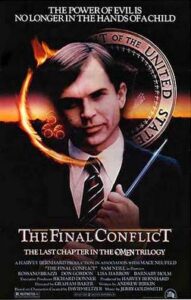
 

© Mace Neufeld Productions / 20th Century Fox


Omen III: The Final Conflict was the third in the trilogy that’d started with Richard Donner’s The Omen (1976) and continued with Don Taylor’s DamienOmen II (1978) and that told the tale of Damien Thorn, the son of Satan and the Antichrist who, according to Biblical prophecies, will rise to power in end times.  Unlike the earlier two movies, where Damien is depicted as a kid (first played by Harvey Spender Stephens, then Jonathan Scott-Taylor), he’s now an adult.  Portrayed by Neill, he’s the powerful CEO of Thorn Industries and soon into the film also becomes US ambassador to Britain, a position from which he hopes to launch his biggest project yet – the thwarting of the Second Coming of Christ.


As Damien, Neill is suave enough to be convincing as a powerful operator in purely human affairs, one who can rub shoulders with top people in top places and get what he wants; whilst also having a sinisterness and darkness that makes you accept him as the same, infernal creature he was in the earlier films (especially the disturbingly baleful Spender Stephens in the first Omen).  Alas, Neill is the only thing of value in the film.  Coming after the original, which was very enjoyable hokum, and the second film, which at least had its moments, The Final Countdown is a damp squib.  Unlike his predecessors Donner and Taylor, Graham Baker doesn’t have the directing chops to properly mount the Omen films’ main attractions – the set-piece ‘accidents’, elaborate, supernaturally-engineered and inevitably fatal, that bump off anyone who gets in Damien’s way.  That said, the scene early on where the previous American ambassador commits ‘suicide’ and conveniently creates a job opening for him, is agreeably splattery.


A far less conventional horror film, and a far better one, is the same year’s Possession.  Though it defies all description, you could say it was a particularly traumatic and traumatising break-up movie…  Or a brooding parable about the Cold War (it was filmed in West Berlin)…  Or a psychological thriller involving doppelgangers…  Or a body-horror film wherein a woman makes repeated love to a vilely tentacled, half-human, half-squid creature…  Or an espionage thriller leading to an apocalyptic World War III finale.


Director Andrzej Żuławski – himself suffering from depression after recently being expelled from his native Poland – put Neill and his co-star Isabelle Adjani through the wringer during the film’s making.  Neill remarked in 2021 that he ‘escaped’ from the movie with his ‘sanity barely intact’.  Adjani suffered even more, though, and supposedly needed a couple of years to get over the experience.  That’s understandable when, for instance, you see the berserk intensity of the now-legendary sequence where she suffers a miscarriage in a subway corridor.  Actually, a young Gaspar Noé must have been highly impressed by that sequence because he basically got Sofia Boutella to recreate it in his 2018 movie Climax.
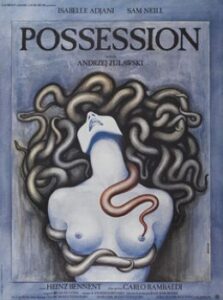
 

© Gaumont Distribution


Things were looking up for Neill’s career in 1983, when he played the title role in Reilly, Ace of Spies, a 12-part TV series dramatizing the life of real-life superspy Sidney Reilly during the first quarter of the 20th century.  Reilly was scripted by Troy Kennedy Martin and directed by Jim Goddard and Martin Campbell and Campbell, a fellow Kiwi, would later direct two James Bond movies, Goldeneye (1995) and Casino Royale (2006).  In fact, for a time in the mid-1980s it looked like Neill was in with a shout of becoming the next James Bond.  (It makes sense – there have been Scottish, Australian, Welsh and Irish Bonds, so why not a New Zealand one?)


In the Guardian interview I mentioned earlier, he was asked about the Bond role.  He said he would have accepted it if it’d been offered to him, but added: “I’m also aware that I wouldn’t have enjoyed my life so much if I was an ex-Bond. That’s what people would say when I went for my morning coffee. ‘Look – it’s what’s-his-name, who used to be James Bond?’ ‘Yeah, he was the one I never really liked.’”


In 1989 he had a good role in Philip Noyce’s Dead Calm, a maritime thriller / horror movie that conveys both the claustrophobia of being at sea – you’re stuck in the confined space of a boat – and the agoraphobia of it – you’re out on a vast, empty mass of water, far from civilisation and help.  Neil and Nicole Kidman (in her seventh, and breakout, film role) play a couple who, while yachting, discover a sinking schooner.  They pick up one survivor (Billy Zane) who – surprise! – turns out to be a crazed killer.


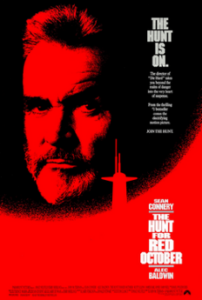
Still, I had the impression that during the late 1980s Neil’s moment had passed and he was destined to spend his remaining career in movies’ supporting casts as a reliable character actor.  This was suggested, for example, by his role in 1990’s The Hunt for Red October, where he gets fourth-place billing after Sean Connery, Alec Baldwin and Scott Glenn.  He plays the second-in-command to Connery’s Captain Marko Ramius, and a participant in a plot whereby the only submarine-commander in the Soviet fleet with a Scottish accent, and his officers, commandeer a super-submarine called Red October and attempt to defect with it to the West.  When Neill’s character starts waxing lyrically to Connery about the rabbit farm he plans to start up after they reach America, you know he’s going to get killed before the end.
 

© Mace Neufeld Productions / Paramount Productions


However, then, Neill’s fortunes took an upswing – because Steven Spielberg and blockbuster-dom came knocking.


To be continued…
A sad day for the Sisters


© Merciful Release


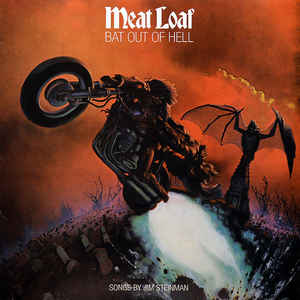
When American music composer and producer Jim Steinman died last week, the tributes paid to him made heavy mention of two titles: 1977’s Bat Out of Hell, the album by Meat Loaf, and 1983’s Total Eclipse of the Heart, the ballad by Bonnie Tyler.  Steinman wrote the songs, played keyboards and percussion and provided ‘lascivious effects’ on the former and wrote and produced the latter.  He was not a man who did things by halves in his orchestrations, in his lyrics or in the performances he encouraged from his singers.  Thus, both Bat and Eclipse are synonymous with bombast, histrionics, chest beating, garment rending, howling at the moon and general wildly over-the-top melodrama.


Which makes my experiences with Steinman’s two most famous pieces of work strange.  Because when I hear Bat Out of Hell nowadays, the images that it conjures up in my head are of the summer landscapes of bucolic Country Tyrone in Northern Ireland: of hayfields, barley-fields and pastureland populated by herds of cattle and flocks of sheep.  Whereas if I hear a burst of Total Eclipse of the Heart, I’m immediately transported to the wolds of equally bucolic County Lincolnshire in England, during the early springtime, with freshly ploughed fields undulating off into the soft morning mist.


To elaborate. In the summer of 1982 I worked on the farm of my Uncle Annett, in the Clogher Valley in County Tyrone. My cousin there was a big Meat Loaf fan and when we weren’t toiling in the fields and were back in the farmhouse, Bat Out of Hell never seemed to be off the stereo. The farmhouse reverberated with the vrooming of motorcycles and Meat Loaf hollering about screaming sirens, howling fires, evil in the air, thunder in the sky, being all revved up with nowhere to go, praying for the end of time, glowing like metal on the edge of a knife, etc.  Stirring stuff, but it was incongruous background music for my life at the time, which consisted of lugging around bales of hay, mucking out cowsheds, feeding pigs, thinning turnips and holding down sheep while they had their fleeces sheared.


Admittedly, I did ride a motorbike that summer.  My cousin had recently graduated from riding a motorbike to driving a car and his old motorcycle was stashed in an outhouse on the farm. My uncle took it out and taught me how to ride it.  I didn’t venture out onto the roads, though.  Instead, I’d ride it up the surrounding slopes and across the surrounding fields when I had to check on my uncle’s sheep.  So no doubt while I cruised past those woolly flocks, Meat Loaf was roaring in my brain about hitting the highway like a battering ram on a silver-black phantom bike and so on.


© Sony / Epic / Cleveland International Records


Fast-forward eight months from then to March 1983 and I was employed in a different job in a different part of the world. I was working as a volunteer houseparent and classroom-assistant at a residential school for ‘maladjusted boys’, which was the un-politically correct 1980s parlance for what today would be termed ‘boys with behavioural issues’.  The school was on the outskirts of the town of Louth in Lincolnshire, in the English Midlands. Walk one way from the school and you’d end up in the town, walk the other way and you’d soon be among the gently curving Lincolnshire wolds.  The school’s older boys stayed in their own residence, with its own kitchen and living room, and I was doing an evening shift there one Thursday when Top of the Pops started on the living-room TV. The show aired a newly released song and video by Bonnie Tyler, Total Eclipse of the Heart.


The Lincolnshire lads in the residence were either sharp-footed Michael Jackson wannabes or bequiffed rockabilly types who’d been influenced by the Elvis albums in their dads’ record collections. Their immediate reaction, and my immediate reaction, was: “What the f**k are we listening to?”  For Ms Tyler’s tonsil-rattling performance, caterwauling about falling in love, falling apart, living in a powder keg, giving off sparks, forever going to start tonight, etc., was unlike anything we’d heard before.


It was also unlike anything we’d seen before.  The video, directed by Australian filmmaker Russell Mulcahy, and full of fluttering candles, billowing lace curtains, slow-motion flapping doves, dancing ninjas, nocturnal fencers, indoor American football players, acrobats in bondage gear and glowing-eyed demonically possessed choirboys, was pretty far-out too.


The song immediately went to number one in the British singles charts so I heard a lot of it in the ensuing weeks.  In particular, it got played a lot in Louth’s top – only? – post-pub nightspot of the time, which was the social club for the local branch of the Liberal Party.  Thus, while its dance floor quaked to the bellowing of Bonnie Tyler, I’d be sitting having a pint with some regulars who were proudly telling me for the umpteenth time how they’d ‘had David Steel in here just the other year.’


Today I don’t mind Bat Out of Hell too much, but I could happily live the rest of my life – and any future lives, if reincarnation is a thing – without ever hearing Total Eclipse of the Heart again.  For one thing, Eclipse’s success spawned a zillion hideous 1980s and 1990s power ballads, sung under the misapprehension that the louder and shriller you are, the greater the emotion you convey.  The biggest culprit here is Celine Dion and yes, it was Jim Steinman who penned her interminable 1996 ballad It’s All Coming Back to Me Now.


From jimsteinman.com


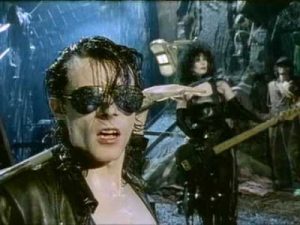
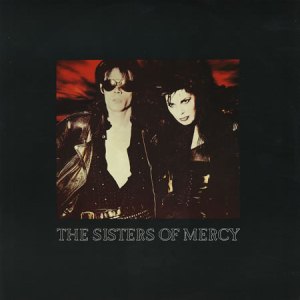
And yet…  I can forgive Steinman for any crimes he indirectly committed against music by encouraging the growth of the power ballad.  That’s because for a couple of years at the end of the 1980s he worked with the Goth-rock band the Sisters of Mercy and made them sound like the mightiest group in the universe.  In 1990 he co-wrote and co-produced the storming tune More with the band’s frontman Andrew Eldritch, while in 1987 he produced two Sisters songs, Dominion / Mother Russia and This Corrosion.  The latter is surely one of the greatest Goth anthems ever.


Although This Corrosion was written by Andrew Eldritch, it has Steinman’s aural fingerprints all over it, most notably the Wagnerian squalls of guitar and the use of the 40-strong New York Choral Society to provide a celestial choir at the beginning.  Sweetly, the first comment below the song’s video on YouTube claims that “When a Goth dies, their voice gets added to the choir at the intro.”


Eldritch once told Sounds magazine that “It’s about the idiots, full of sound and fury, who stampede around this world signifying nothing… about people who sing about the corrosion of things while they themselves are falling apart.”  Supposedly, the sound-and-fury-filled idiots he had in mind were his former colleagues Wayne Hussey and Craig Adams, who quit the Sisters of Mercy in 1985 and formed their own band the Mission.  Elsewhere, in Q magazine, he likened the relationship between the Sisters of Mercy and the Mission to that between China and Taiwan.  It was obvious which band Eldritch considered the equivalent of the massive, nuclear-armed superpower.


Now I like the Mission.  However, in 1998, a 36-song compilation of 1980s and 1990s Goth, industrial, synth and dark indie music was put together under the title of Nocturnal and it had This Corrosion as its opening track and then the Mission’s song Deliverance as its second one.  And when I heard the two played together, I realised that with their Steinman-produced opus the Sisters of Mercy blasted the Mission out of the water.  Incidentally, This Corrosion is used to great effect in the finale of Edgar Wright’s underrated 2013 sci-fi / horror / comedy movie The World’s End.


Despite having a reputation for being a bit of a dick to work with, Eldritch spoke generously of Steinman.  For instance, he said that Steinman “really knows how to make a wonderfully stupid record.  Totally outrageous.  Every time you think to yourself, do we really want to go this far, and you say to Jim, ‘Jim, are sure about this?’ and anybody else will go, ‘Don’t do it!’, Jim goes, ‘More!  More!  More people singing!’  It works.”


That’s the spirit.  And here, for anyone wishing to really immerse themselves in Jim Steinman’s glorious bombast, is a link to the 11-minute remix of This Corrosion.


From marktracks.blogspot.com / youtube.com