Happy World Goth Day 2026


From youtube.com© South Park Studios


I know time seems to speed up as you grow older, but it still feels weird to me that we’re not only into another year, 2026, but we’re already nearing its halfway point.  In fact, today, we’ve reached May 22nd.  And rolling around again – again? – is World Goth Day.


According to its Wikipedia entry, May 22nd became the annual day of celebration for the world’s darkest-clad, whitest-eyelinered, most sunlight-shunning musical sub-culture when “UK-based goth DJ Lee Meadows, aka DJ Cruel Britannia (currently known as BatBoy Slim), wrote a MySpace blog suggesting the idea of initiating a ‘Goth Day’ to a very positive reception.  In 2010, he and London-based DJ Martin Oldgoth decided to make the concept global, both ‘as a bit of fun’ and to create an environment of positivity and unity within the goth community.”
 

From worldgothday.com / © BatBoy Slim


As is customary on this blog, I’ll mark the occasion by providing links to a dozen of my favourite Goth songs on YouTube.  As ever, I apologise if you first have to endure some annoying corporate and insipid YouTube advertisements, packed with AI-generated visual crap, which are the antithesis of the mystical, elegiac and tenebrous aesthetic of Goth culture.


To get the ball rolling, here’s Wytches Chant ’98 by English Goth band Inkubus Sukkubus, whom noted punk / Goth journalist Mick Mercer described as ‘a zombie version of Fleetwood Mac.’  (Many would argue that the real Fleetwood Mac have been fairly zombified for the past few decades anyway.)  So, let’s raise our voices and sing along to that Wytches Chant ‘98: “Isis, Astarte, Diana, Hecate, Demeter, Kali, Inanna…”


A while ago I was looking at an online list of ‘underrated Goth bands’ and discovered Container 47 and their song Razor End Falling.  The band don’t have a Wikipedia page and all I know about them is that they’re from Italy and have been on the go since the early 2000s.  This song, to me at least, is agreeably heavy.


On the same ‘underrated Goth bands’ list, I noticed the name the Rose of Avalanche.  Wow, I thought – I hadn’t heard of them since they supported the Mission at a gig in Aberdeen in the mid-1980s.  They originally broke up in 1993 but, following a 26-year hiatus, reformed in 2019.  I found their 1985 single LA Rain enjoyably audacious – it takes the sound, ambience and languid pace of a typical Lou Reed / Velvet Underground song and drenches it in a shimmery, Gothy 1980s guitar-sound.  Though some people may not feel the same way about it.
 

From roseofavalanche.com / © The Rose of Avalanche


Here’s some more rain, served up by the Swedish Goth band Miazma (which, from soon after its inception in the late 1990s, has apparently consisted of just one musician, Kristian Olofsson).  It’s called Black Rain.  Including this song on the list saves me having to include anything by the seminal Goth outfit the Sisters of Mercy because, frankly, Miazma sounds uncannily like the Sisters of Mercy, down to Olofsson’s vocals, which reproduce the nonchalant gruffness of the Sisters’ frontman, Andrew Eldritch.  On the other hand, a band whom this Miazma shouldn’t be confused with is another band called Miazma, which is actually a death metal one from Australia’s Alice Springs.


And yet more rain…  If Scottish alternative-rock brothers Jim and William Reid, aka the mighty Jesus and Mary Chain, knew I’d included one of their songs in a list of Goth tunes, I suspect they’d come round to my house and murder me – using hammers.  Well, tough luck, guys – I am including you.  I saw the Jesus and Mary Chain perform in Singapore last month and the gig, at the city-state’s Esplanade Theatre, attracted a fair number of Singaporean Goths.  And I think their song Nine Million Rainy Days, from the aptly titled 1987 album Darklands, is dripping with Gothic doom, gloom and darkness, as evidenced by the lyrics, “As far as I can tell / I’m being dragged from here to hell / All my time in hell was spent with you…”


Halfway through, however, Nine Million Rainy Days veers off in an unexpected direction when it borrows the famous ‘woo-woo’ backing vocals that grace the Rolling Stones’ Sympathy for the Devil (1969), though here they mutate into ‘woo-woo, woo-woo, woo!’


Talking of the Rolling Stones, eyebrows were recently raised when Mick, Keef and Ronnie announced that Robert Smith of the legendary Goth band the Cure would be contributing to their next album.  The Stones’ straight-up, unpretentious, bluesy, rock ‘n’ roll swagger seems light-years removed from the Cure’s meticulous, brooding atmospherics, so I don’t know how that’ll work out.  Meanwhile, the Cure and possibly their greatest album, 1989’s Disintegration, have been on my mind lately because my lovely mother-in-law gave me a Cure / Disintegration T-shirt as a present for my last birthday.  So, from that album, here’s the song Lullaby.  The link takes you to the song’s memorable video, where Smith, in pyjamas, sings worriedly about “Mr Spider-man” having him “for dinner tonight.”
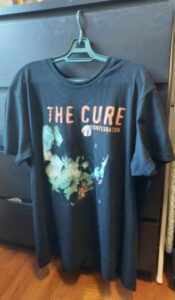


In fact, Disintegration is such a masterpiece I could have included any song off it: Fascination Street, Plainsong, Pictures of You, etc.  No wonder that in a 1998 episode of South Park, Kyle Broflovski shouts at Robert Smith, “Disintegration is the best album ever!”  (Admittedly, he was rather excitable by that point.  His town had been pulverised by Barbra Streisand, who’d transformed into a giant, robot-kaiju called Mecha-Streisand, and Robert Smith had saved the day by transforming into a giant moth and hurling her into outer space: “I have to try,” sighed the Cure’s front-man. “I can’t let Barbra Streisand do this to the entire world.”)


And now for a younger band.  Boy Harsher are a darkwave duo consisting of singer Jae Matthews and producer Augustus Muller, who hail from the American state of Georgia.  They cite among their influences the late, visionary filmmaker David Lynch, though with the next track on my list, a remastered version of Boy Harsher’s 2014 single Pain, I get more of a vibe of the synth tracks John Carpenter devised for the soundtracks of his 1970s and 1980s movies.  That’s initially at least, before Pain’s propulsive beat carries all before it.


Actually, Pain features in a movie itself.  It can be heard during a party scene in the 2022 horror film Terrifier 2.  I haven’t seen it, but I think that’s the one where the villain (Art the Clown) flays a victim and then rubs salt into the wound by, er, rubbing salt into the victim’s catastrophic wounds.  So, having a song called Pain in the film was appropriate.

 

From wikipedia.org / © GRIT PHOTOZINE


In fact, Pain got a remix in 2018 courtesy of the American musician and producer Luis Vasquez who from 2009 was also the single, official member of the band the Soft Moon.  Fittingly, an influence on the Soft Moon’s sound was the celebrated industrial / electronic rock band Nine Inch Nails, itself a one-man-band for the musician and producer Trent Reznor.  (More on Nine Inch Nails later.)  The next item on the list is one of my favourite Soft Moon songs, Become the Lies, from the band’s final album, Exister (2022).  I have to write about Luis Vasquez and the Soft Moon in the past tense because, tragically, Vasquez died in 2024 aged just 44.


Another musician specialising in dark electronica who left us much too soon was Frank Tovey, who as Fad Gadget at the very end of the 1970s and in the early 1980s helped pioneer both the synth-pop and darker Goth sounds that became popular soon after.  Alas, a heart attack claimed Tovey / Gadget at the age of 45 in 2002.  Here’s his first and possibly most famous single, Back to Nature, from 1979.


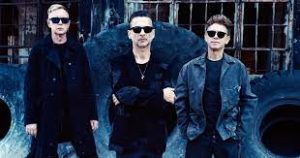
Fad Gadget has been credited as a big influence on Depeche Mode, though beyond the use of newly affordable musical technology, like synthesisers, I personally can’t see much connection between the ruminative likes of Back to Nature and Depeche Mode’s early, chirpy (and for me, annoying) hits like New Life and Just Can’t Get Enough (both 1981).  Despite being irritated by the early ‘Mode’, I’ve gradually grown to love them as, in their later incarnations, they’ve shifted away from a poppy, kid-friendly synth sound and embraced a darker, harsher, more industrial and Gothic one.


Here’s the stomping Barrel of a Gun, the first single off Depeche Mode’s 1997 album Ultra.  The accompanying video shows how far they’d progressed by then from their early-1980s clean-cut-boys-with-synthesisers phase – this is grungy, decadent, Anton Corbijn-directed artiness.  At least, it is until Dave Gahan starts wandering around in a silly coat covered in Christmas-tree lights.
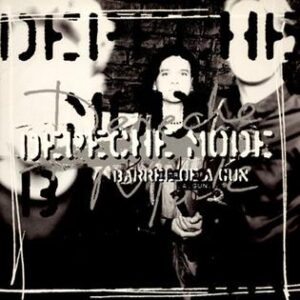
 

From wikipedia.org / © Mute Records


Here’s something else that’s silly, this time involving America’s awesomely dark and bleak industrial-rock juggernaut Nine Inch Nails (which is basically musician / vocalist / producer Trent Reznor and whoever happens to be in the studio with him at the time).  No, I’m not saying Nine Inch Nails are silly.  But some years ago, they were the subject of a celebrated musical / video ‘mashup’ whereby editor and content creator Garren Lazar married the band’s disturbing song Closer, from the 1994 album The Downward Spiral, onto clips taken from the beloved children’s TV programme The Muppet Show (1976-81).  Hence, the song’s opening drumbeat is performed in the video by Animal, the drummer in the Muppets’ house band, Dr Teeth and the Electric Mayhem.  (Thankfully, Animal doesn’t feature when Reznor sings Closer’s most notorious lyric, “I want to f**k you like an animal.”)


Watching Kermit, Gonzo, Miss Piggy and the rest cavort to this song is a reminder that, loveable though the Muppets are, if you first encountered them at a very young age you might have found them a bit sinister.  For example, the stuff in the video involving a frenetically speeded-up Dr Teeth is downright freaky.  Also featured are some of the human guests who appeared on The Muppet Show, such as Alice Cooper, Cloris Leachman, Rita Moreno, Harry Belafonte and Dudley Moore – Moore’s cameo is particularly worth waiting for.


However, should anyone be upset at me linking to a comical Nine Inch Nails / Muppets mashup, I’ll throw in a bonus link – to a more sombre and majestic mashup where Rory Gamble transposes Nine Inch Nails’ The Day the World Went Away (from 1999’s The Fragile) onto the trailer for Mad Max: Fury Road – Black & Chrome.  Both sonically and visually, it’s a work of genius.  You’ll punch the air when, one minute and ten seconds in, things get cranked up to 11.


Eat Your Makeup is the name of a short film made by American’s God-Emperor of Bad Taste, John Waters, back in 1968.  However, Eat Your Make Up – note the slight difference in the wording – is also the name of a French Goth band and here, to round things off, is their 2005 song I was the Murderer.  It’s a pleasant reminder that at least some of Goth’s musical roots lie in punk rock.
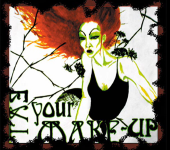
 

© Adipocere Records
Thom is da bomb


I don’t know when I became a fan of the band Radiohead.  They seemed to creep up on me by stealth.  I’d been aware of them for years before suddenly, one day, I realised: “Hey! I really like them!”


Appropriately for a band who crept up on me, the first song by them I heard was Creep from their debut album Pablo Honey (1993).  Though a massive hit, I didn’t actually like Creep, finding it dull and plodding.  My disdain for it was shared by Radiohead themselves, with guitarist Ed O’Brien saying of their performances of the song during the early 1990s: “We seemed to be living out the same four and a half minutes of our lives over and over again.  It was incredibly stultifying.”


At this time I worked as a university lecturer in the northern Japanese city of Sapporo.  One day  in 1995 I received a gift from a cool indie-kid in one of my classes, Yoko Koyama, who’d discovered that despite my outward veneer of grumpiness and grouchiness I was, underneath, a sensitive soul who was heavily into music.  The gift was a cassette recording of Radiohead’s newly-released second album, The Bends.  I diplomatically accepted it, not expecting to like it much on the basis that I hadn’t been impressed by Creep.  But when I listened to it, I thought, “This is actually pretty good.”  Not brilliantly good, but definitely good.


Around then, Radiohead visited Sapporo and played a gig, but the night of their concert was one when I had to teach a couple of evening classes at the university.  So I missed the chance to see them.  The next day, I went into one of my regular Sapporo drinking hangouts, the Beifu-tei Bar, and got talking to a mate of mine, a Scotsman from St Andrews called Stevie Malcolm.  Stevie informed me, “Aye, thon English rock band were in here last night after their gig.  What dae ye call them?  Thingmie-heid.”


“You mean, Radiohead?”


“Aye, Radio-heid!”


I got the impression Stevie had chatted away to Radiohead barely knowing who they were.  Though from the band’s unconventional approach to the music industry and their discomfort with the trappings of superstardom, they probably liked chatting to strangers in bars with barely any idea of who they were.


In 1997 Radiohead released their third album OK Computer, which even my snobbiest, most purist music-loving friends, who’d dismissed Pablo Honey and The Bends with a contemptuous flick of the hand, had to admit was an awesome record.  It still figures prominently when music publications list the best rock albums of all time and retrospective reviews frequently award it a full five stars.  And though subsequent albums – Kid A (2000), Amnesiac (2001), Hail to the Thief (2003), In Rainbows (2007), The King of Limbs (2011) and A Moon Shaped Pool (2016) – never created quite the same stir, and often made demands on the listener by veering off into the avantgarde, experimental and left-field, I’ve found all of them laudable.


It helped that, unlike other bands who at various times were massively loved by audiences and hailed by critics as world-straddling musical colossi, Radiohead never seemed in your face that much.  So you didn’t grow sick of them.  Whereas for a few years U2 or Oasis, or even REM, seemed to be everywhere in the media, with the result that their ubiquity led to a backlash – the public losing interest, the critics getting disenchanted, familiarity generally breeding contempt – Radiohead were more subtle, less intrusive and lower profile.  Perhaps their credibility endured because of that.


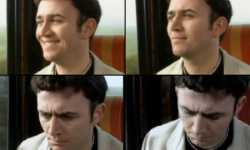
Even their appearances in popular culture tended to be wry and quirky and happened in unexpected, and cool, places.  For example, I remember the very last episode of Father Ted (1995-98) when the suicidal priest Father Kevin (Tommy Tiernan) gets cured of his depression by Ted playing to him Isaac Hayes’ joyous Theme from Shaft (1971) – only to lapse back into suicidal depression when he hears Radiohead’s Exit Music (For a Film) (1997) playing on the radio in a bus.  Or when they turned up in a 2001 episode of South Park called Scott Tenorman Must Die and added a final layer of torment to the unfortunate Scott Tenorman of the title.  Scott is a kid who’s been tricked by Eric Cartman into eating the minced bodies of his dead parents.  When he discovers what he’s done, he understandably bursts into tears.  Just then, his favourite band, Radiohead, happen to stroll past, see him and cruelly mock him for being a ‘cry-baby’.


From x.com / © Hat Trick Productions

© South Park Studios


Anyway, last week on November 5th, Radiohead’s vocalist and main songwriter Thom Yorke rolled up here in Singapore to play a solo concert as part of his Everything tour.  Yorke has a long history of making music on his own, from his 2006 album The Eraser, through 2014’s Tomorrow’s Modern Boxes, to 2019’s ANIMA, and he’s also been involved in a couple of side-bands like Atoms for Peace and The Smile, so it’s not a surprise to find him performing without the rest of Radiohead.  I attended the gig accompanied by my better half, Mrs Blood and Porridge, who wouldn’t have missed this occasion for the world.  She’s such a dyed-in-the-wool Radiohead fan that the other day she even made our cat watch the video for 2016’s Burn the Witch on YouTube.


Yorke played at the Star Theatre, which I’ve visited a couple of times in the past.  At previous gigs there, I was not greatly impressed by the crowd, many of whom seemed more interested in filming the event on their phones than getting into the excitement and vibe of the music itself.  As I wrote a while ago about a Deep Purple concert: “Why remove yourself from the occasion and gaze zombie-like at tiny figures moving about a tiny stage on a tiny screen…?  It’s also, needless to say, disrespectful of the performers onstage…  Honestly, there were times when the auditorium was so densely flecked with glowing phone-screens you felt you were flying over Las Vegas at night.”  But tonight’s audience, Singaporeans and foreigners alike, seemed to be genuine Radiohead fans and Thom Yorke-lovers who knew the great man wasn’t going to appreciate having a thousand phones pointed at him by a thousand glaikit dimwits.  So, thankfully, phone-usage was at a minimum.


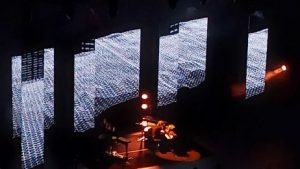
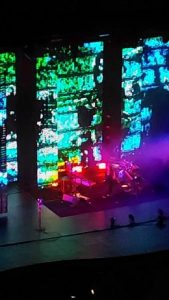
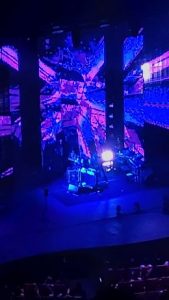
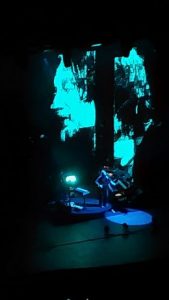
It wasn’t the most physical of performances.  Yorke spent most of his time on a patch of stage encircled by musical equipment, including several keyboards, and looked like a cross between Rick Wakeman of Yes and Captain Nemo tinkling out Sebastian Bach’s Toccata and Fugue in D Minor on his organ.  He did, occasionally, venture towards the audience to play guitar or indulge in some shuffling dancing.  The latter drew affectionate cheers.  I have to say seeing Thom make his funky moves brought a smile to my face, as it seemed to prove there was at least one person on the planet whose dancing is even worse than mine is.


But what of the music?  I’d read a worrying review of a gig from earlier in the tour, in Sydney, where the writer observed, “Each Radiohead song that’s played – they make up just under half the setlist – is met with a hushed reverence, while loud chatter is heard every time something else gets an airing.”  Maybe that means modern-day Sydney concertgoers are disrespectful bozos, for that certainly wasn’t my impression of the Singapore crowd.  Yes, the ten Radiohead numbers he played during the set – coming from a range of the band’s albums, though nothing featured from Pablo Honey, Hail to the Thief or The King of Limbs – were enthusiastically received.  But the audience showed their appreciation of the non-Radiohead stuff as well.  This included material from all three of Yorke’s solo albums, two new songs (Back in the Game and Hearing Damage), and two he’d composed for the 2018 soundtrack for Luca Guadagnino’s remake of the Dario Argento 1977 horror classic Suspiria.


It all meshed together nicely.  The solo material evoked at different times the sounds of the Aphex Twin, Depeche Mode and Nine Inch Nails and I even wondered if Yorke was getting a bit disco-y at one or two points.  Naturally, electronica-rooted Radiohead numbers like Idioteque, Everything in its Right Place or Packt Like Sardines in a Crushd Tin Box (off Kid A) slotted in seamlessly among that lot.  Surprisingly, though, the band’s more conventional – dare I say more tuneful – songs, like How to Disappear Completely (Kid A again) Fake Plastic Trees (off The Bends), and All I Need (off In Rainbows) fitted in smoothly too, making it an impressively cohesive set.  Maybe it was because Yorke’s falsetto – often mocked, but inimitable, haunting and gorgeous – provided the aural thread that stitched together all these disparate pieces of musical cloth.


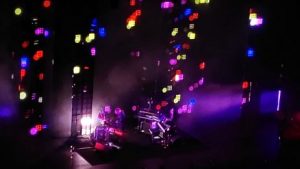
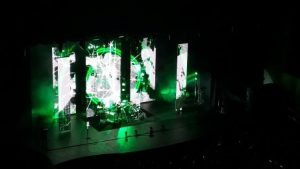
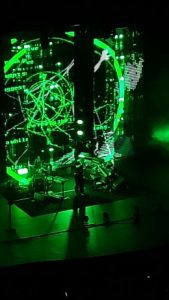
Praise is due too for the accompanying light show, with several tall screens treating the audience to dazzling and dizzying displays that, during the evening, seemed to range from daubs of luminous green graffiti to blizzards of multicoloured confetti, from drizzles of Matrix-style code to what looked like, frankly, masses of glowing spaghetti.  Occasionally, these gave way to stark white light, and darkness, where, at his consoles, Yorke looked like a torturer operating his torture-machines in a gothic dungeon.  Occasionally too, the chaotic patterns coalesced into the ghostly features of the man himself.  Thus, the show was an impressively visual as well as aural experience.  I have to say it was easier on the eyes than the screens at the previous gig I’d been to at the Star Theatre, which’d subjected me to regular, unflinching close-ups of the 78-year-old visage of Deep Purple’s Ian Gillan.


By the concert’s end it seemed the many diehard fans in the crowd had got their money’s worth.  Their frequent cries of “I love you, Thom!” had never lessened in enthusiasm while the 22-song set wound on.  And presumably the guy who shouted, before the gig and behind us on the escalator while we rode up to the theatre’s entrance, “Please, Thom, don’t play Creep tonight!”, went home happy too.


A good evening, then.  It certainly took our minds off the horror that was happening elsewhere on November 5th.


Happy World Goth Day 2023


From worldgothday.com / © BatBoy Slim


Today, May 22nd, is among other things International Day for Biological Diversity, Buy a Musical Instrument Day, National Vanilla Pudding Day and, due to it being Sir Arthur Conan Doyle’s birthday, Sherlock Holmes Day.  However, what piques my interest in May 22nd is the fact that it’s also World Goth Day. Yes, it’s that date in the calendar when we celebrate Goth, the world’s most black-clad, most kohl-eyeliner-rimmed, most sunlight-adverse musical sub-culture.  Today even has its own Goth-themed logo, designed by the fabulously-named BatBoy Slim.


To mark the occasion, here are links to a dozen of my favourite Goth tunes on YouTube.  My apologies if, first, you have to sit through a few of those annoying and asinine adverts that nowadays seem to clog the channel like fatbergs in a London sewer. .


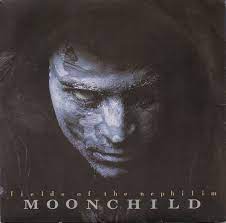
To start with, here’s one of the genre’s most old-school bands, Fields of the Nephilim, with their 1987 anthem Moonchild – I’m sure it’s no coincidence that Moonchild is also the name of a novel that occult icon and self-styled ‘wickedest man in the world’ Aleister Crowley had penned 70 years earlier.  With the sepulchral voice of singer Carl McCoy and the band’s peculiar look – moth-eaten Wild West gunslingers covered in flour – I thought Fields of the Nephilim were a bit of joke during their 1980s heyday, but I have to say they’ve grown on me since then and I find Moonchild and its lyrical refrain (“Moonchild, lower me down, lower me down / Moonchild…. Lower me down, down, down, down, down, dowww-wwwn!”) irresistible.


© Situation Two


Also defiantly old-school in sound, but of a more recent vintage – it was originally released in 2006 – is Tear You Apart by Californian band She Wants Revenge.  Like many people, I hadn’t heard the song before it was used in a 2015 episode of the TV show American Horror Story (apparently at the insistence of Lady Gaga, who featured among the cast).  When I did hear it, with its cheeky emulation of the dub-style guitar sound from Bauhaus’s 1982 epic Bela Lugosi’s Dead, and its titular homage to Love Will Tear Us Apart (1980) by Joy Division, I genuinely believed for a moment this was a 35-year-old Goth classic that’d somehow eluded me since the 1980s.


Another band hailing from California is London After Midnight, who no doubt took their name from the long-lost 1927 silent vampire film London After Midnight, which starred Lon Chaney Sr.  In a genre where too often songs lapse into pompous, overblown melodrama, their 1992 song Sacrifice manages the difficult trick of being stately and melodramatic – check out that thunder in the background – while being rather sweet and jaunty as well.


© Rotation


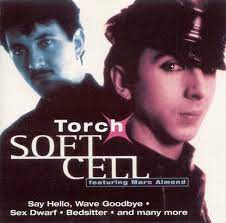
Now for a classic from the early 1980s and the nascent years of Goth music: 1982’s Torch by Soft Cell.  The Soft Cell duo of Marc Almond and Dave Ball would probably hate to see themselves categorised as ‘Goth’ and have one of their songs included in a playlist like this, but their sound – and especially the gorgeous trumpet-synth sound featured here – has always, for me, evoked the scene’s candlelit melancholia.  Incidentally, when the pair of them were interviewed in the Guardian earlier this month, Almond made a memorable observation about how old age suddenly sneaks up on you: “One day you’re smearing your naked body in cat food at art college, the next you’re choosing terracotta pots at the garden centre.”  Yes, Marc, I wholly agree.  Not that I ever smeared my naked body in cat food at art college, though.


And here’s another synth-orientated duo.  In 2011 Light Asylum consisted of Brooklyn singer Shannon Funchess and keyboardist Bruno Coviello – the latter departed shortly afterwards – and I found this clip of them on YouTube performing their song Dark Allies live at the time. Funchess’s barnstorming vocal performance is amazing.  It’s just a pity that the audience seem as animated and appreciative as an army of arthritic zombies.


Still keeping with synth-y musical outfits…  Despite the death of founding member Andy Fletcher in 2022, the veteran Basildon band Depeche Mode have a new album, Momento Mori, out this year and, like Jason Voorhees in the Friday the 13th movies, seem unkillable.  I’m partial to this remix – the ‘Headcleanr Rock Mix’ – of their song Nothing from the 1987 album Music for the Masses.  The Rock Mix takes out much of the original’s synth sound and replaces it with one that’s, well, rocky.  It also plays up the song’s ‘Woo-woo!’ backing vocals and the result is like an up-tempo version of the Rolling Stones’ Sympathy for the Devil (1968).


© Mute


Goth icon Nick Cave received some flak this month for being part of the Australian delegation that attended the coronation ceremony of King Charles III.  When challenged about this on his website The Red Hand Files, Nick declared an admiration for the House of Windsor, stating that the late Queen Elizabeth II “seemed almost extra-terrestrial and was the most charming woman I have ever met.”  This from someone who once duetted with P.J. Harvey?  Wow!  Nick must have found Queen Liz powerful stuff indeed.  He also answered the question, “What would the young Nick Cave have thought of that?” by saying: “…well, the young Nick Cave was, in all due respect to the young Nick Cave, young, and like many young people, mostly demented, so I’m a little cautious about using him as a benchmark for what I should or should not do.”


In fact, I wouldn’t have minded Cave attending the coronation if he’d brought his band the Bad Seeds along with him and they’d been allowed to perform my all-time favourite Nick Cave and the Bad Seeds number Stagger Lee, which is the next song on my list.  (In the Stagger Lee video, Nick looks scary even while wearing a pink T-shirt.)  Yes, the coronation would have been a much livelier affair if, instead of Handel’s Zadok the Priest, Westminster Abbey had resounded to Nick Cave hollering about slobbering on someone’s head and climbing over pussies to get to ‘one fat boy’s asshole’.  And having Blixa Bargeld shrieking animalistically at the moment that Charles got crowned would have worked perfectly.


There was never much chance of Robert Smith, frontman and mainstay of the Cure, getting invited to the coronation.  Not as he once said of the Royal Family, “I’m much better than them.  They’ve never done anything.  They’re f**king idiots.”  Anyway, here’s footage of the glorious Mr Smith performing, not with the Cure, but as a collaborator with the Canadian band Crystal Castles in 2010.  They’re doing a cover of the song Not in Love, originally recorded by another Canadian outfit, Platinum Blonde, in 1983.


From indy100.com


I don’t know why I like this cover of the 1968 Yardbirds number Heart Full of Soul by the Goth band Ghost Dance – who were formed in 1985 by Gary Marx (late of the Sisters of Mercy) and Anne-Marie Hurst (late of Skeletal Family), and who disbanded in 1989, but who have recently reformed again.  I just do.  It’s a joyous-sounding thing.


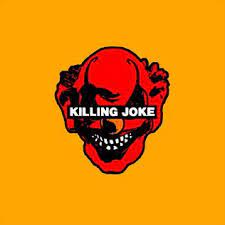
Not normally joyous is the sound of Goth / industrial-rock juggernaut Killing Joke, whose mission according to singer and keyboardist Jaz Coleman was to “define the exquisite beauty of the atomic age in terms of style, sound and form”.  Actually, the band’s crunching, thunderous urgency rarely sounded ‘exquisite’ or ‘beautiful’, but it was pretty impressive.  Here’s a track I like very much from their eponymous 2003 album.  It’s called Asteroid and features Coleman screeching the blunt but memorable refrain, “Asteroid…!  Coming in from the void!”  The hectic drums are courtesy of a guest artist, Nirvana and the Foo Fighters’ Dave Grohl.  Killing Joke had once accused Nirvana of plagiarism because of the similarity of the guitar riff in Nirvana’s Come as You Are (1991) to the one in their 1985 song Eighties, so clearly there were no hard feelings between them and Grohl.


© Zuma / Epic / Columbia


Idiosyncratic Birkenhead indie-rock troubadours Half Man Half Biscuit could in no way be described as ‘Goth’, but their 2000 song With Goth on our Side not only takes the mickey out of a certain Bob Dylan effort, but also pokes affectionate fun at music’s darkest subculture with its tale of Dai Young, who’s ‘the king of Welsh Goths’, and his girlfriend: “She sits and she crimps / Her mother’s convinced / She’s communing with imps.”  The girlfriend also has a kid brother called Wilf, who’s all right because ‘he’s into Placebo and Cradle of Filth’.


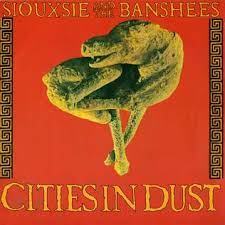
And to call the curtain on World Goth Day 2023, here’s Cities in Dust by Siouxsie and the Banshees, the stand-out track on their 1986 album Tinderbox – which, incidentally, was the first album by the band that I ever bought.  Needless to say, I hold Siouxsie Sioux in high regard.  Indeed, if Nick Cave believes Queen Elizabeth II is the most extra-terrestrial and most charismatic woman he’s ever met, well, I can only surmise that he’s never met Her Gothic Highness, the majestic and imperious Siouxsie.


© Polydor / Geffen

Music à la Mode


From Facebook / © Depeche Mode


Well, bugger.  Just as I’m starting to get into Depeche Mode again, one of the sods goes and dies on us.


I’m referring to Andy Fletcher, founding member of Depeche Mode, bass, keyboard and synth-player, and from all accounts the bloke who dealt with the business, financial and legal matters that his two bandmates (Dave Gahan and Martin Gore) found too boring to deal with.  Fletcher passed away on May 26th.  Considering the industrial amounts of drugs and booze that Gahan and Gore have put away over the years, he surely wasn’t the band-member most people would have bet money on to pop their clogs first.


Not that Fletcher escaped all the excesses of Depeche Mode, which were at their most destructive in the early-to-mid-1990s, around the time of their notorious 1993 Devotional and 1994 Exotic tours.  While Gahan suffered cracked ribs and internal haemorrhaging from a botched stage-dive, became convinced he was a vampire and tried to bite a music journalist, had a drug-induced heart attack, attempted suicide and spent a few minutes technically dead after a 1996 heroin / cocaine speedball overdose, and while Gore experienced seizures that were the culmination of long-term alcohol and substance abuse, and while one-time member Alan Wilder quit due to what he euphemistically described as relations in the band being ‘seriously strained, increasingly frustrating and, ultimately, in certain situations, intolerable’, Fletcher had to temporarily leave Depeche Mode and check into hospital suffering from severe anxiety issues.


For me, one fact sums up the kamikaze state of Depeche Mode at the time.  Their support band during the North American leg of their 1994 tour was so horrified by what they saw that they recorded their next album in conditions of strict sobriety.  The support band was none other than the druggy, leather-trousered, hard-living, psychedelia-loving, Rolling Stones-worshipping Primal Scream.  Yes, Primal Scream!  As journalist Phil Sutcliffe noted in Q magazine, “Behold, then, Depeche Mode: the band who frightened Primal Scream into temperance.”


That Depeche Mode in the 1990s mutated into such out-and-out rock monsters came as a shock to me.  When they started at the beginning of the 1980s, I thought they were insufferable, synth-twiddling wimps.  Their maddeningly jaunty hit singles, like New Life and Just Can’t Get Enough (both 1981), made them popular with the sort of brainless pubescents whose purchasing power had recently clogged up the pop-charts with the unspeakable likes of Duran Duran and Spandau Ballet (and had recently turned me, at the age of 17, into the musical equivalent of a grumpy old man: “Kids today!  They call this shit music?  Gah!”)  And even if Depeche Mode hadn’t won the adoration of those dopey New Romantic fans, and were judged purely by the standards of being an early 1980s synth-pop act, they seemed much less interesting than other acts of that type, like Soft Cell and the Human League.


It was funny, though, that Just Can’t Get Enough eventually became a football anthem. One set of supporters would sing it with the words slightly amended to insult an opposing set of supporters: “You just can’t get it up!  You just can’t get it up!”


© Mute


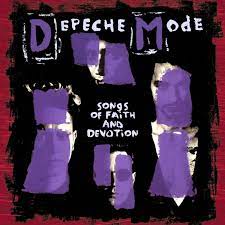
However, in the early 1990s – by which time I was living in Japan – I noticed something odd.   People whom I liked and whose musical tastes I respected, such as a friend from New York called Mary Beth Maslowski, and another friend, a Sapporo-ite called Satomi Munakata, had started arguing with me that Depeche Mode were good.  “Impossible,” I’d retort.  “They’re wimps!  Haven’t you heard Just Can’t Get Enough or  New Life?  What piffle!”  In fact, Satomi felt so strongly about the matter that she presented me with five of their albums recorded on cassette tapes and insisted that I listen to them.  Setting my prejudices aside, I slotted the things into the tape-deck of my stereo…  And, I had to admit, some of the stuff on them was actually really decent.  This was especially true of the more recent Depeche Mode albums, like Violator (1990) and Songs of Faith and Devotion (1993).


While it’s customary for bands to begin strong, full of youthful energy, imagination and enthusiasm, and then, having fired all their creative bolts during their first few albums, to become shite, the opposite had happened with Depeche Mode.  They’d begun shite but gradually become good.  Their annoyingly dinky sound of the early 1980s had gradually given way to a darker, crunchier one that had the relentlessness of industrial music but was also leavened with some melodies.  Goths, I noted, had become especially partial to the band.


After I’d decided I liked them, I bought each new Depeche Mode album that came out: Ultra (1997), Exciter (2001), Playing the Angel (2005), Sounds of the Universe (2009), Delta Machine (2013) and Spirit (2017).  These were sometimes uneven, but all had moments of quality.  Playing the Angel, full of groovy tunes like A Pain that I’m Used to, John the Revelator, Suffer Well and The Sinner in Me, is a particular favourite of mine, though nothing quite beats the mighty Barrel of a Gun on Ultra.


That said, I hadn’t listened to the band so much in recent years.  However, during the past month, alarmed at the state of my health – about as good as that of the average Depeche Mode member between 1993 and 1996 – I decided to get back into the habit of going to a gym.  And in the gym, I decided to spend most of my time running on the treadmill.  I used to be a keen jogger, but had pretty much given up because running on pavements and tarmacked roads and footpaths was subjecting my ageing knees and ankles to too much wear and tear.  Running on a treadmill, I thought, would be less damaging.  And to stop myself getting bored on the treadmill, I found myself listening to loads of Depeche Mode on my iPod.  (Yes, my iPod.  I told you I was ageing.)


I’ve especially listened to Depeche Mode: Remixes 81-04.  A bunch of Depeche Mode classics remixed by DJs, producers and bands like François Kervorkian, William Orbit, DJ Shadow, Goldfrapp, Underworld and the Beatmasters, where things go (electronically) ‘Thud!’ and ‘Thump!’ and ‘Crash!’ with machine-like regularity, are the perfect soundtrack when you’re trying to get your body into the rhythm of running again.


But then, suddenly, Andy Fletcher died.  Which sucks.


© Mute


Meanwhile last month, nine days before Fletcher passed away, another maestro of electronic music, whom I’d originally considered to be a bit crap but later changed my mind about, died too.  I’m talking about Evángelos Odysséas Papathanassíou, aka Vangelis.  For many years, I’d been sceptical about Vangelis’s musical talents because (a) he’d been half of the duo Jon & Vangelis (the other half being Jon Anderson), whose ultra-limp hit single I’ll Find My Home cleared dance floors the length and breadth of Britain in 1982; and (b) he provided the ponderous music for the ponderous 1981 movie Chariots of Fire.  The history of the British film industry is littered with boringly worthy costume dramas that I hate, but Chariots of Fire is probably the boringly worthy costume drama that I hate most.  Also, is it just me, or does the Chariots of Fire theme not sound like the Alexander Brothers’ These are my Mountains played at the wrong speed?


And yet…  Vangelis’s soundtrack album for Ridley Scott’s science-fiction masterpiece Blade Runner (1982) is a work of genius.  I didn’t appreciate the music so much when I originally saw the film, because I was overwhelmed by its cyberpunk visuals.  But a few years later, when I bought the soundtrack album, I realised how good it was.  Aurally, it perfectly captures Blade Runner’s aesthetic of toweringly futuristic skyscrapers, street-level mazes of Asian-style food counters and market stalls, high-tech corporations, low-fi 1940s-esque film noir sleuthing, neon, rain, grime and smoke.


Tracks like Tales of the Future, which featured the singer Demis Roussos, Vangelis’s fellow Greek and former colleague in the late 1960s / early 1970s prog-rock band Aphrodite’s Child, were spine-tingling.  (At the time poor Demis was something of a joke in Britain, thanks to his high-pitched warbling being featured in Mike Leigh’s hilarious satire on social class and social mobility, 1977’s Abigail’s Party).  I now regard the urgent end-credits theme as one of the most rousing pieces of film-music ever.  And then, when it segues into the late, great Rutger Hauer doing his ‘Tears in Rain’ monologue…  Well, what can you say?


Vangelis certainly wouldn’t have been my first choice to create the musical accompaniment to Blade Runner.  But as things turned out, I’m glad he got the gig.


© East West / Atlantic