The comeback kid


From wikipedia.org / © Scottish Government


I’ve always had an unhealthy obsession with politics.  Lately, however, I’ve written less about the subject on this blog because my obsession was becoming literally unhealthy – ruminating on politics and politicians in 2026 was filling my head with dark and depressing thoughts.  Nonetheless, I’ll now make some comments about the election for the Scottish Parliament, which happened on May 7th. That day also saw elections for the Welsh Senedd and for various local authorities in England, but I’ll only mention those in passing.


If you’re not a political anorak, you might want to skip this.


So: the results were 58 seats for the Scottish National Party (down six from the previous election in 2021); 17 for Scottish Labour (down five); 17 for Reform UK (up 17); 15 for the Scottish Greens (up seven); 12 for the Scottish Conservative and Unionist Party (down 19); and ten for the Scottish Liberal Democrats (up six).


Despite securing six seats less than their 2021 total, and seven seats short of a parliamentary majority, the result was impressive for the SNP in that this is the fifth election in a row where they’ve ended up as the biggest, government-forming party.  Keir Starmer’s Labour government at Westminster, which hasn’t been in power for two years yet and is already as popular as a fart in a spacesuit, would kill for such longevity and  durability.


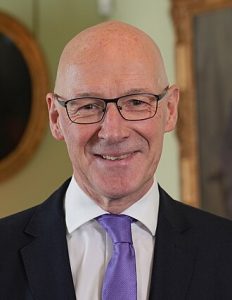
It’s also quite a comeback for SNP leader John Swinney.  Originally Swinney served as SNP leader from 2000 to 2004, when his party was in opposition in the Scottish Parliament.  It wasn’t a happy experience for him.  In the 2003 Scottish election his party dropped from 35 to 28 seats and the following year he resigned.  He later described being opposition leader as “the worst, most awful, most sapping, most soul-destroying job in politics…”


Having enjoyed spells as a cabinet minister and Deputy First Minister, Swinney was planning to retire at this year’s election.  However,  in May 2024, after the affable but hapless Humza Yousaf resigned as First Minister, Swinney surprised everyone by standing unopposed for – with his famous negotiating skills, he managed to sweet-talk the formidable likes of Kate Forbes into not running against him – and winning the leadership again, 20 years after losing it.  And this time, he became First Minister of Scotland too.  Many assumed he would act as a ‘caretaker’ FM, until someone younger and with more chutzpah came along, but thanks to this election result he’s likely to be around for a while.


While I’d never describe Swinney as someone who sets the heather alight, and if he got a fiver every time someone likened his demeanour to that of a bank manager he’d probably be a billionaire by now, I have to say I think he’s a decent guy and I’d rather have him in charge of Scotland than most other Scottish politicians.  I’m biased in this regard.  As I wrote on this blog before, I encountered him a couple of times during my youth, via my old schoolmate Roger Small, who was best friends with him at university, and I liked him.  But it’s not just me.  Most people, political friends and foes alike, seem to like Swinney.


Even the world’s most horrible man, Donald Trump, has a soft spot for him.  In 2025, Trump declared, “John Swinney is a terrific guy — and loves golf and loves the people of this country, and we really appreciate it.”  Yes, I know that Trump thinks Vladimir Putin, Xi Jinping and Kim Jong Un are the bees’ knees, so being liked by him isn’t necessarily a ringing endorsement of your character.


More recently, when Trump announced the removal of US tariffs on Scotch whisky, Swinney claimed this was due in part to a meeting he had with the US president last September.  He was criticised for saying this by the UK government’s Secretary of State for Scotland Douglas Alexander, who argued that trade agreements weren’t in the remit of a leader of a devolved administration.  But after the election result, Trump messaged, “Congratulations to John Swinney on winning his Re-Election for First Minister of Scotland.  He is a good man, who worked very hard along with the King and Queen of the United Kingdom, with respect to Tariff Relief for Great Scottish Whiskey – and deserves this Big Electoral Victory!”  So now, Dougie Alexander looks a bit of a chump.


Trump, being a low IQ individual, misspelt ‘Scottish whisky’ as ‘Scottish whiskey’.  The stuff spelt with an ‘e’ is actually made in Ireland.
 

From wikipedia.org / © Scottish Parliament / youtube.com


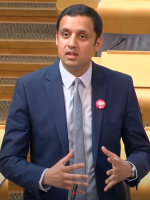
Elsewhere, Scottish Labour and the Scottish Conservatives had their worst ever performances in a Scottish parliamentary election.  Labour leader Anas Sawar hit the headlines back in February when he demanded that Keir Starmer resign as British Prime Minister: “The situation in Downing Street is not good enough. There have been too many mistakes.”  Sarwar’s resignation-call distanced him and his branch of the Labour party from the wildly unpopular Starmer and it generated  a lot of publicity at the time.  But when Starmer said no, he wouldn’t be resigning, it looked less like a political earthquake and more like a mild political bowel-movement.  It highlighted Sarwar’s place as Scottish party leader in the great scheme of things – not high.  It also meant Starmer was embarrassingly conspicuous by his absence in Scotland when Labour started campaigning for the election there.


The Scottish Tories have been reduced to a rump, their number of Members of the Scottish Parliament (MSPs) barely in double figures.  Their leader Russell Findlay has tried to talk them up in the Tory-friendly pages of the Scottish Daily Mail, describing them as the ‘Dynamic Dozen’.  I wouldn’t describe any dozen that includes such numpties as Murdo Fraser, the man who once asked Donald Trump if he’d consider buying Glasgow Rangers Football Club, as ‘dynamic’.  Maybe ‘dysfunctional’ or ‘dystopian’.


Following a near-extinction event caused by their coalition with the Conservatives in Westminster in the early 2010s, the Liberal Democrats have enjoyed something of a revival.  The passing of time has clearly detoxified their reputation a little in folk’s memories.  That said, I don’t know how anyone can stomach their Scottish leader Alexander Cole-Hamilton, who to me comes across as being insufferably arrogant.


And the Scottish Greens have almost doubled their representation in the parliament.  Without wishing to downplay this achievement, I suspect they enjoyed the best of both worlds in relation to the English and Welsh Greens – a separate party – south of the border.  They benefited from the wave of enthusiasm, and publicity, that their southern counterparts experienced earlier this year.  Simultaneously, as a separate party, they were distant enough from them to escape the more recent backlash against the English / Welsh party’s leader Zack Polanski, who stupidly retweeted something about the attack on two Jewish men in Golders Green and then suffered an all-out assault from the right-wing media determined to portray him as an antisemite.  (This despite Polanski being Jewish himself and despite some of the media’s caricatures of him being… hideously antisemitic.)


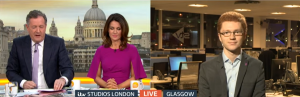
The Scottish Greens are co-led by Gillian Mackay and the chirpy Ross Greer.  I know Greer is a ‘Marmite’ politician for many, but I like how he puts the wind up gammons like Piers Morgan.
 

From youtube.com / © ITV


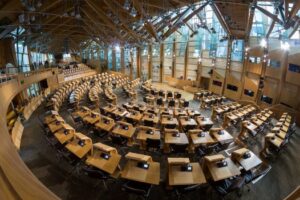
With the SNP on 58 MSPs, and the pro-Scottish-independence Greens on 15, 73 MSPs now support Scotland leaving the United Kingdom, as opposed to 56 unionist MSPs who don’t.  It’s the parliament’s biggest ever pro-independence majority.  Of course, you won’t have heard much about that fact from Scotland’s (unionist-owned) mainstream media, who instead have obsessed on a different fact – that the parliament suddenly has 17 far-right Reform MPs.  Nigel Farage’s extremist party had representation there before, thanks to one MSP defecting to them from the Conservatives.  But today, with Labour, they’re the joint-second biggest party.


This has prompted journalists like the Times’s Kenny Farquharson to declare ‘the death of Scottish exceptionalism’ – Scottish exceptionalism being the idea that Scottish voters are more community-orientated, more considerate of their fellow citizens, more leftwing and, generally, nicer than voters than those elsewhere in the UK, especially in England.  Reform’s showing proves that, no, the Scots are just as right-wing and awful as everyone else.


Well, I find it nauseating that the  parliament contains 17 MSPs who, if their party ever came to power, would enact Trump-style authoritarian and racist policies.  One of them, Senga Beresford, representing the South Scotland region, has already caused controversy by expressing admiration for fascist lout Stephen Yaxley-Lennon on social media.  But I derive some comfort from the fact that none of those MSPs were elected through the parliament’s first-past-the-post, constituency-based voting system, responsible for deciding 73 of the 129 MSPs.  Reform’s 17 sneaked in afterwards, via the additional, regional-based ‘list’ system.  Also, the Conservatives won 31 seats at the previous election, but have been culled to 12, and that number plus Reform’s 17 puts the total number of right-wingers  at 29 – two less than before.


I certainly don’t see Scotland as being exceptional, i.e., better than anywhere else.  I’ve met plenty of Scots who’ve been arseholes as much as arsehole-y people from other places.  But Scotland is still different from other parts of the UK.  If it wasn’t different, it wouldn’t have its own languages, literature, music, sports teams, legal system, educational system, etc.  It wouldn’t have been scunnered by Margaret Thatcher in the 1980s while people elsewhere were proclaiming her the new, handbag-wielding messiah.  It wouldn’t have voted heavily against Brexit when people in England and Wales voted for it.  It wouldn’t have its own independence movement with, now, a 57% majority in the Scottish parliament.  I know that sticks in the craws of unionist politicians and journalists who’d have you believe that Scotland is absolutely indistinguishable from the rest of the UK, that a punter from Elgin is identical to a punter from Ely.


Talking of journalists, the coverage of the election in the Scottish mainstream media was woeful.  The unionist newspapers (i.e., nearly all of them) spent half the time wailing “Everything in Scotland is shite!” and the other half wailing, “How dare anyone suggest doing anything even vaguely radical to improve things!”  Swinney’s proposal that, in an emergency, the Scottish government should put a cap on the price of essential food products so that poor people could still buy them, was met with hoots of derision – and the sneering observation that the UK government would never allow it.  (A Labour government – “For the many, not the few” – denying someone the right to keep essential foodstuffs affordable for the nation’s poorest people?  Not a great look.)


I thought the recent opinion-piece by Scottish journalist Stephen Daisley in the Spectator, calling on the Labour and Conservative parties to get rid of the UK’s devolved parliaments (“Dr. Frankenstein would understand that it was his duty to put down the hideous creature his foolishness and vanity unleashed on the world”), was bad enough.  But the articles that his fellow Scottish journo Chris Deerin penned about Scottish Reform leader Malcolm Offord, for the supposedly left-wing New Statesman, went to arse-licking extremes where no article has gone before.


And now, with Plaid Cymru’s Rhun ap Iorwerth the First Minister in Cardiff, and Sinn Fein’s Michelle O’Neill the First Minister in Belfast, all three devolved governments in the United Kingdom are helmed by people who see their nations’ futures as being outside that supposedly united kingdom.  Interesting times indeed…


But you won’t ever read about that in the newspapers.
 

From wikipedia.org / © User Colin

Rishi sunk, Liz trussed, Penny dropped


From wikipedia.org / © Simon Walker, HM Treasury


Now the dust has settled after the British general election on July 4th, it’s time to offer my tuppence worth about the result.  This saw the Labour Party, led by Keir Starmer, brought to power for the first time in 14 years.  It also saw the Conservative Party, under Rishi Sunak, take an ignominious and well-deserved humping and get booted out of government.  They shed 244 seats in the Westminster parliament and ended up with just 121.


But first…  A message for viewers in Scotland.


As (a) someone who’s believed for a long time that Scotland would ultimately be better off as an independent nation rather than as a region of Britain, and (b) a total pessimist, I wasn’t surprised at the dire election result for the Scottish National Party, where it ceded many seats in Scotland to Labour and went from having 43 seats to having a mere nine.  As I said in a post a few weeks ago about the SNP’s new leader John Swinney – what a baptism in fire he’s had – “I suspect folk in Scotland are so scunnered by the SNP’s recent scandals and mishaps, and so desperate to see the back of the Tories, that they’ll vote for Labour en masse next month.”


The SNP having so few Scottish seats in parliament and Labour having so many – they’ve now got 37 in Scotland – isn’t something that thrills me.  Scotland has lost some decent SNP representatives in London, for example, Alison Thewliss, John Nicholson, Tommy Shepherd and Alwyn Smith.  To be fair, I have no idea what they were like as constituency MPs, but they impressed me with their capabilities and eloquence when I saw them speak in parliament.


Also, I’m old enough to remember the 1980s and 1990s – a period of almost continuous Conservative rule from London – when the Scottish seats were also packed with Labour MPs and, the joke went, in Glasgow you could stick a red rosette on a monkey and it’d get voted into Westminster.  The old Scottish Labour contingent contained several heavyweights like John Smith, Donald Dewar, Alistair Darling, Robin Cook and Gordon Brown, and also a few mavericks like the admirable Dennis Canavan and the gruesome George Galloway.  But the majority of those MPs were, for want of a better word, turnips.


As I wrote on this blog a few years ago: “I’m thinking of such specimens as Lanark and Hamilton East’s one-time Labour MP Jimmy Hood, who once declared he’d oppose Scottish independence even if it made the Scottish people better off – the fact that as an MP he was busy claiming £1000-a-month second-home expenses in London no doubt had something to do with his keenness to keep Westminster running the show.  And Midlothian’s David Hamilton, who in 2015 did his bit for the battle against sexism by describing Nicola Sturgeon (and her hairstyle) as ‘the wee lassie with a tin helmet on’.  And Glasgow South West’s Ian Davidson, who charmingly predicted that after 2014’s referendum on Scottish independence the debate would carry on only ‘in the sense there is a large number of wounded still to be bayoneted’.  This shower became known as the ‘low-flying Jimmies’ because of their lack of ambition in anything other than being cannon-fodder for Labour at Westminster and enjoying all the perks that came with being MPs.  And with numpties like these populating the Westminster opposition benches during the 1980s and 1990s, it’s no surprise Mrs Thatcher’s Tories had a free run to do whatever they liked in Scotland.”


It’s possible the new crop of Scottish Labour MPs will be more distinguished than their predecessors, but I’m not holding my breath.  That’s especially since the two most famous ones are the self-important Douglas Alexander and Blair McDougall, head of the ‘no’ campaign before the 2014 Scottish independence referendum, who famously reassured worried Scottish voters that Boris Johnson had no chance of ever becoming British prime minister: “I think that Boris Johnson’s a clown… he’s not even an MP let alone Prime Minister at the moment.


From wikipedia.org / © Lauren Hurley


Nor does it inspire confidence that new PM Keir Starmer has made Edinburgh Labour MP Ian Murray Secretary of State for Scotland.  Murray is more hardline-Unionist than many of the Tories.  When his predecessor as Scottish Secretary, Tory posho Alister Jack, was asked if a Conservative government would ever allow another referendum on Scottish independence, he mused that support for independence would have to be running at about 60% in opinion polls.  When Murray was asked if there were any circumstances in which he’d allow a referendum, he curtly replied: “None whatsoever.”


Not that I think Labour’s hegemony in Scotland this time will last as long as it did previously (when it had the bulk of Scottish MPs until 2015).  For one thing, the party situation and voting situation are now much too volatile.  Scotland today has six parties competing in a first-past-the-post electoral system – Labour, the SNP, the Tories, the Liberal Democrats, the Greens and, unfortunately, Nigel Farage’s far-right-wing Reform Party.  (I didn’t include Alex Salmond’s Alba Party in that list because they lost their deposit in every seat they contested.)  And Labour’s share of the vote in Scotland last week was just 5.3% ahead of that of the SNP, so their position is hardly unassailable.


Anyway, onto the results for Britain generally.  While I was delighted to see the Tories pulverized – and they thoroughly deserved to be pulverized, having presided over one of the most disastrous periods of government in British history, one that brought us austerity, Brexit, Prime Minister Boris ‘party during lockdown’ Johnson and Prime Minister Liz ‘crash the economy’ Truss – I have to say I’m worried.  Starmer’s Labour Party won the lion’s share of the seats in parliament, but the votes cast for them were not that many – they received 9,731,363 votes, 33.8% of the total cast.  That number is lower than those won by Starmer’s predecessor as Labour leader, the much-maligned Jeremy Corbyn, who managed 10,269,051 votes in 2019 and 12,877,918 votes in 2017.  What saved Labour’s bacon this time was a low turn-out and the presence of Farage’s Reform Party, luring right-wing voters away from the Tories.  If you add up the right-wing votes, those cast for the Conservative and Reform parties, they exceed Labour’s figures by more than a million votes and more than three percent of the vote-share.


Which is concerning, as I don’t think Starmer’s government is going to be popular for very long.  Again, as I wrote last month, his party was “so obsessed with attracting former Conservative Party voters they’ve made their policies a continuation of the right-wing ones that’ve damned Britain to rack and ruin during the past 14 years.  For instance, they’ve vowed not to revisit the terms of the Tories’ Brexit arrangement with the European Union, even though it’s hobbled British businesses and it’ll thwart their plans to ‘grow’ the economy; and they won’t countenance raising taxes, which makes you wonder how they’re ever going to lift Britain’s public services out of their current, dire state.”


Meanwhile, looking at what’s left of the Tory Party, I see that its surviving MPs include that self-promoting, hard-right-wing trio Priti Patel, Suella Braverman and Kemi Badenoch.  As MPs, and with Rishi Sunak on his way out, they’ll be able to run for the party leadership.  I can see one of them winning, swinging the Tories even further to the right and cutting a deal with Farage before the next election, probably in 2029.  Farage is the favourite British politician of both Vladimir Putin and Donald Trump, so I’m sure lots of foreign money would mysteriously arrive to ‘grease’ such an arrangement.


© BBC


Oh well.  You have to take your pleasures when you can, and there was much to enjoy on election night, when various Tory politicians I didn’t like lost their seats.  I shed no tears, for instance, when Penny Mordaunt got the boot in Portsmouth.  Another self-promoter, she’s always annoyed me with her jolly-hockey-sticks brand of patriotism and it confounded me how, for a while last year, she was hero-worshipped for carrying a big sword, whilst wrapped in patterned blue wallpaper, at a ridiculous Ruritanian ceremony in Westminster Abbey.  Mind you, she was talked about as potential future leadership material, and was a moderate by Tory standards, so she might have prevented the party from veering off into Farage-land if she’d kept her seat.


I was also tremendously cheered by the departures of that preposterous, top-hatted, Victorian undertaker Jacob Rees-Mogg in Somerset; the braying, bearded bovver-boy Jonathan Gullis in Stoke; the middle-finger-raising Andrea Jenkyns in Yorkshire; the absurdly-coiffured Boris-Johnson cosplayer Michael Fabricant in Lichfield; and Liam Fox, Grant Shapps, Thérèse Coffey, Johnny Mercer, Gilliam Keegan…  Oh, how I laughed.


Incidentally, on the non-Tory front, it was also fun to see the afore-mentioned gruesomeness that is George Galloway usurped from his seat in Rochdale, just four months after he’d won it in a by-election.


Obviously, the best result was the one that ended Liz Truss’s tenure as MP for South West Norfolk.  The shortest-lasting Prime Minister ever – she managed only 44 days in office, easily beating the previous record set in 1827 by George Canning (who at least had the excuse of dying after 119 days as PM) – Truss has spent her time since showing not one ounce of contrition for her brief but disastrous reign, during which her plan to bring in massive tax cuts and pay for them by increasing government borrowing resulted in the pound plummeting, banks and building societies pulling 40% of their mortgage products off the market, and 30 billion pounds getting added to the British Treasury’s fiscal hole, effectively doubling it.  Far from it.  Truss has been blaming everyone but herself.  She’s even accused a beastly ‘anti-growth coalition’ and woke ‘deep state’ of sabotaging her premiership.  Meanwhile, she’s also been ingratiating herself with the American far-right and cheerleading for Donald Trump.  I do hope July 4th’s result terminates her political career, as her industrial-scale arrogance, incompetence and lack of self-awareness are getting a bit terrifying.


From wikipedia.org / © Simon Dawson


Finally, I was pleased to see the Green Party win four seats – just one seat less than Farage’s mob, who secured five.  Does this mean the British media, including the BBC, will now be giving them nearly as much coverage as they give Farage?  Don’t bet your life savings on it.

Favourite Scots words, M-O


From wikipedia.org / Scottish National Portrait Gallery


Burns Night falls this evening, with – by my calculations – 264 years having now passed since the birth of Scotland’s greatest poet, Robert Burns.  For many decades, January 25th witnessed one of the greatest ironies in Scottish culture.  All over the country, schoolchildren would be made to memorise, then get up and recite Burns’ poems in front of their classmates and teachers.  Those poems, of course, were written in the Scots language and thus were loaded with Scots vocabulary and grammar.  However, any other day of the year, if a schoolkid had dared to speak Scots in the classroom, they’d have received a teacherly reprimand: “No, don’t speak like that.  Speak proper English…”


Actually, a famous scene in William McIlvanney’s 1975 novel Docherty, where the hero’s son gets battered by a teacher at school for daring to utter the Scots word sheuch (meaning ‘gutter’ or ‘ditch’), seems sadly credible.  At one time, speaking the language of Burns on a day that wasn’t Burns’ birthday was probably enough to get you belted in certain Scottish schools.


Anyway, here’s another slew of Scots words that I like – this time, starting with the letters ‘M’, ‘N’ and ‘O’.


Makar (n) – a poet or bard.  In 2004, the Scottish Parliament established the post of ‘Scots Makar’, i.e., a national bard or poet laureate.  Since then, the post has been occupied by Edwin Morgan, Liz Lochhead, Jackie Kay and, currently, Kathleen Jamie.


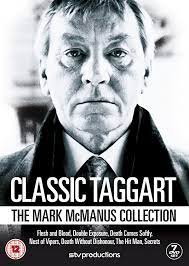
Malky (n/v) – a Glaswegian term meaning ‘a murder’ or ‘to murder’.  Research tells me that malky was originally a nickname for a razor used as a weapon, and to malky someone was to slash them with such a razor.  That said, the catchphrase of popular culture’s most famous depiction of Glaswegian crime and crime-fighting, “There’s been a murrr-der!” in the TV cop show Taggart (1983-2010), wouldn’t had the same impact if it’d been, “There’s been a malky!”


© STV Studios


Manse (n) – a manse is the house provided for a Church of Scotland minister, so basically it’s similar to a ‘rectory’ or ‘parsonage’.  Someone who grew up in a manse, because their father (or mother) was a Church of Scotland minister, is known as a son or daughter of the manse.  The Scottish Labour Party has, for some reason, given us several children of the manse, including former Prime Minister Gordon Brown, former Scottish Labour Party leader Wendy Alexander, and Wendy’s wee brother Douglas, a former cabinet minister.  Political children of the manse inevitably cite their backgrounds as evidence of their strong ‘moral compasses’, though I have to say in my time I’ve met a few inhabitants of the manse (children and parents) whose moral compasses have gone a bit wonky, usually after a few glasses of whisky.


Mawkit (adj) – extremely dirty.


Merle (n) – a blackbird.  I understand that merle is also the French word for ‘blackbird’, so presumably it’s another example of the linguistic legacy of the Auld Alliance that once existed between Scotland and France.


Messages (n) – shopping of the everyday variety, i.e., buying a few groceries rather than buying in bulk at Tesco or Sainsbury.  Hence the common expression: “I’m daein’ ma messages!”


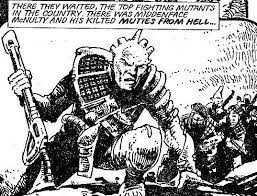
Midden (n) – a dunghill.  A word often employed by Scottish parents while they complain about the condition of their teenage kids’ bedrooms.  Also, at one point, the celebrated British sci-fi comic 2000 AD featured a character who was a Scottish bounty hunter with a gruesomely mutated visage.  His name was Middenface MacNulty.


© Rebellion Developments


Mince (n) – nonsense. Hence such exclamations as “Och, ye’re talkin’ mince!” or “Yer heid’s fu ay mince!” or “See thon new Avatar movie? It’s mince!


Ming (v) – to smell badly, with the present participle mingin’ used as adjective to mean ‘stinking’.  As a result, when I was a kid and watched the old Flash Gordon serials (1936-40) on TV, I could help wondering if the villainous Ming the Merciless was so named because of his fearsome body odour.  For a while, ming passed into popular usage all over Britain with a tweak in meaning, so that the word ‘minger’ became a common slang-term for describing someone who was ‘severely deficient in the looks department’.  But I don’t hear it used much nowadays.


Mowdie (n) – a mole.


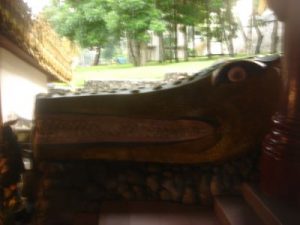
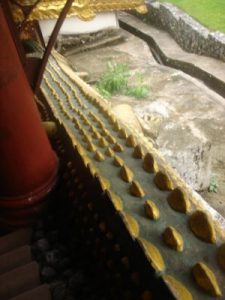
Muckle (adj) – very big.  This adjective was immortalised in the much-loved children’s poem Crocodile by J.K. Annand, which begins: “When doukin’ in the River Nile / I met a muckle crocodile. / He flicked his tail, he blinked his ee, / Syne bared his ugsome teeth at me.”


Incidentally, here’s some pictures of a muckle crocodile I once met, at the side of the stairs going up to Shwedagon Pagoda in Yangon, Myanmar.


Neb (n) – a nose, beak or projecting point.  Once upon a time, ladies of a certain age had to put up with uncomplimentary remarks about nebs whenever they played their Barry Manilow records on the household stereo.


Ned (n) – a young hooligan.  Depending on which story you believe, the word ned was derived from the term ‘never-do-well’ or was an acronym for ‘Non-Educated Delinquent’.  For a time in the early 2000s, it was ubiquitous in Scottish conversation, used as a label for any undesirable-looking youth with a penchant for wearing shell-suits, bling and Burberry-patterned caps and for swigging from bottles of Buckfast Tonic Wine.  Its popularity was no doubt increased by the neds’ sketches in the famous Scottish TV comedy show of the era, Chewin’ the Fat (1999-2005).  Indeed, ned became the north-of-the-border equivalent of the word ‘chav’, used in England to describe ‘an anti-social lower-class youth dressed in sportswear’.  Just as with ‘chav’, there were fears that ned was being used to demonise all young, working-class people. If I remember correctly, the Scottish Socialist Party MSP Rosie Kane tried to have the word banned from the Scottish parliament in 2003.


But before the controversy, I remember hearing the word ned as long ago as the early 1980s.  Folk from Glasgow I knew would use it to describe anyone who was small, mouthy and annoying.  In that way, it wasn’t much different from the abusive Scots term nyaff, which urbandictionary.com defines as “a very irritating person.  When they come into the room, you want to leave.”


© Southern Television


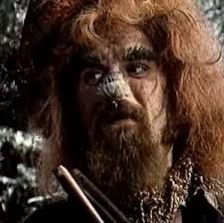
Neep (n) – a turnip.  That’s why in the 1970s kids’ TV show Wurzel Gummidge (1979-81), Billy Connolly played a turnip-headed Scottish scarecrow called ‘Bogle MacNeep’.  Turnips and potatoes together on a plate are, of course, known as neeps an’ tatties.  Meanwhile, my American partner assures me that whenever I talk about neeps an’ tatties, it sounds to her like I’m describing something extremely lewd and filthy.  Goodness!  (Or better still, jings!)


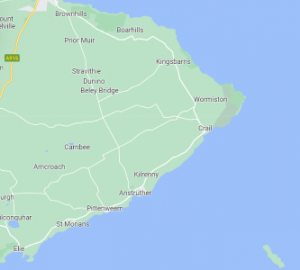
Neuk (n) – a corner, including one – i.e., a bend – in the coastline.  The most famous geographical example is East Neuk in Fife.


From maps.google.com


Nip (n) – a short, sharp measure of alcoholic spirits, often whisky, though I’ve heard people talk about ‘nips ay gin.’  I’d always assumed that, when describing a measure of whisky and the spiky, tingling effect it had when you downed it, nip was synonymous with jag.  But looking online, I’ve seen claims that it comes from the word ‘nibble’, as if a nip is just a nibble at the cake that is the full whisky bottle.  Also, I’ve seen it attributed to the archaic word ‘nipperkin’, which was ‘a unit of measurement of volume, equal to one-half of a quarter-gill, one-eighth of a gill, or one thirty-second of an English pint’.


Nippie sweetie (n) – an irritable, sharp-tongued person.  This is usually applied to the female of the species.  Disgruntled Scottish Conservatives, Liberal Democrats and Labourites frequently fling the term nippie sweetie at Scotland’s First Minister and leader of the Scottish National Party, Nicola Sturgeon.


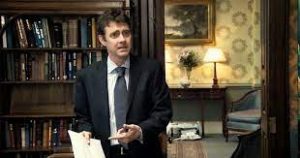
Numpty (n) – a stupid person.  To me, though, a numpty is more than that – it’s a preposterous, pompous person who is also stupid.  In In the Loop (2009), the movie spin-off from the satirical TV show The Thick of It (2005-12), the preposterous, pompous politician played by Tom Hollander becomes a laughing stock when the wall of his constituency office endangers public safety by toppling over.  Jamie MacDonald, the ferocious Motherwell-born spin doctor played by Paul Higgins, taunts him about ‘Wallgate’ by calling him ‘Humpty Numpty’.  (To quote MacDonald in full: “If it isn’t Humpty Numpty, sitting on top of a collapsing wall like some clueless egg c*nt.”)


© BBC Films / UK Film Council / Optimum Releasing


Offski (adj) – ‘away’, ‘leaving’, ‘going’, as in the common Glaswegian phrase, “I’m offski!”


Orraman (n) – in agricultural communities, an orraman was an odd-jobbing farmhand who’d muck out sheds, dig holes, put up fences, mend drystane dykes, lug bales of hay around, drive tractors and basically do whatever needed doing at the time. Now, with farming heavily mechanised, and with one farmer on a tractor (towing the appropriate machine) capable of doing what it took half-a-dozen people to do a few decades ago, the days of the orraman are probably past.


Oxster (n) – an armpit.  Dundonian poet Matthew Fitt deployed this word when he wrote the Scots-language translation of the 2013 Asterix-the-Gaul book, Asterix and the Picts.  In the original French text, Asterix’s hulking sidekick Obelisk made a joke about ‘oysters’.  Fitt converted it into a joke about oxsters / armpits to make it more Scottish-friendly.  As you do.