The Darkness descends on Singapore


Andy Warhol’s prediction that one day everyone would be famous for 15 minutes seems cruelly appropriate when I think about English glam rock / metal band the Darkness.  In 2003 they released their debut album Permission to Land and for the next year they were huge. The album went platinum and the band racked up three awards – Best British Group, Best British Rock Act and Best British Album – at 2004’s BRIT Awards.


But then…  Suddenly, they weren’t huge.  Their second album One Way Ticket to Hell… and Back (2005) being a flop and their singer and lead guitarist Justin Hawkins quitting the band after struggling with drug and alcohol addiction didn’t help, though overall they gave the impression their popularity would be brief.  With the over-the-top theatricality of their music – crowned by Hawkins’ falsetto vocals – and the cartoonish-ness of their videos and general image, the band obviously didn’t take themselves seriously, which was admirable.  Alas, there’s a problem with presenting yourself as something of a joke, i.e., even the funniest joke in the world stops being funny when you’ve heard it a number of times.


For the record, I should say I liked One Way Ticket to Hell… and Back, if only for its title track, which contained the immortal lyrics: “The first line hit me like a kick in the face / Thought I better have another one just in case…”  I also liked them because they came from Lowestoft, the rather rough-and-ready seaside resort in County Suffolk.  I was spending much of my time in Suffolk when, temporarily, they hit the big time.  Indeed, at the height of their celebrity, they threatened to buy big, fancy houses in Southwold, the more upmarket, snootier seaside resort a few miles along the coast from Lowestoft – a threat some Southwolders took seriously.  I seem to recall a newspaper article where the journalist visited Southwold and interviewed some locals about the prospect of having Justin Hawkins and co. as residents.  One old lady expressed her disapproval of them because they ‘had tattoos’.


However, as evidenced by John Travolta – who went from the highs of Saturday Night Fever (1977) and Grease (1978) to the lows of the Look Who’s Talking movies (1989-93), but then enjoyed a comeback with Pulp Fiction (1994) – or Robert Downey Jr – who, after Air America (1990) and Chaplin (1992), seemingly destroyed his career with cocaine and heroin abuse, but then made a half-billion dollars playing Iron Man in the Marvel Cinematic Universe – or even Sir Michael Caine – whose route from Zulu (1964) and Alfie (1966) to having roles in eight Christopher Nolan movies and becoming a British national treasure had to go through a mid-career trough containing the likes of The Swarm (1978), Beyond the Poseidon Adventure (1979), The Island (1980), The Hand (1981) and Jaws: the Revenge (1987) – just because you were once fashionable, but then went out of fashion, doesn’t mean you won’t ever come back into fashion.   So it is with the Darkness.  After being off the radar for a long time, they’ve lately acquired some retro-coolness.


Their eighth and most recent album, 2025’s Dreams on Toast, got to Number 2 in the British charts.  They’re due to support Iron Maiden at their 50th anniversary show at Knebworth Park in July this year.  And in December 2026 they’ve lined up no fewer than seven UK arenas to perform in for their Band of Brothers tour.  They even generated some headline-making controversy when Justin Hawkins, who reunited with the Darkness in 2011, and younger brother Dan, who plays lead guitar in the band too, criticized Yungblud’s performance at the late Ozzy Osbourne’s farewell concert last summer.  The elder Hawkins commented: “…if the future of rock comes from musical theatre and Disney, if this is Ozzy’s heir, we’re in trouble.”  Finally, it hasn’t done the band’s renewed popularity any harm that, since 2021, Justin Hawkins has had a YouTube channel where he reviews and analyses songs.  It currently has 600,000 subscribers.


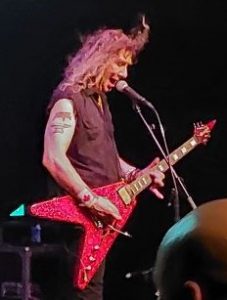
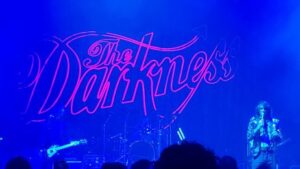
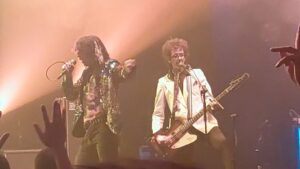
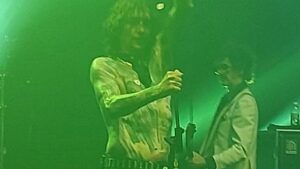
Last week, the Darkness made their first-ever appearance in Singapore, my current abode, with a gig at the Capitol Theatre.  In terms of musicality, it wasn’t the best concert I’ve attended in the city-state.  That accolade probably belongs to Jack White, whom I saw at the same venue three-and-a-half years ago.  But in terms of showmanship… This gig was pretty awesome.


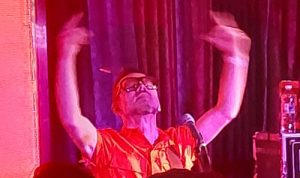
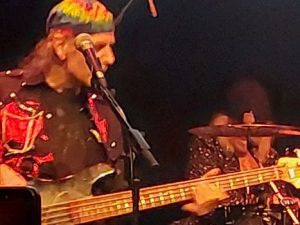
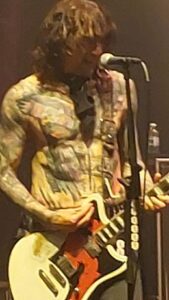
Yes, the band-members are two decades older than they were in their mid-noughties heyday – bassist Frankie Poullain, who once resembled a moustached villain from a spaghetti western, appears to have transformed into Kurt Vonnegut – but the encroachment of middle age hasn’t slowed, calmed or subdued them.  Justin Hawkins, for example, in an impressive display of spriteliness, performed a handstand at one point.  Also, admirably un-self-conscious, he stripped off to the waist early in the gig and flaunted a torso slathered in tattoos.  No wonder that old lady in Southwold objected to him.


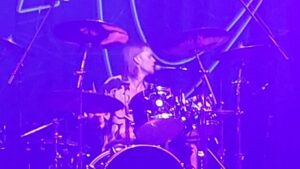
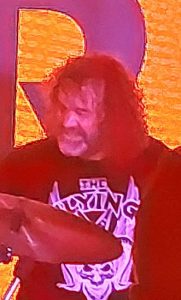
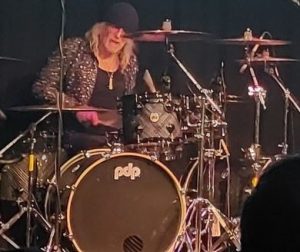
When you list the bands that had an influence on the Darkness, the one topping the list is surely Queen.  Accordingly, there were moments tonight when I felt I was listening to the rockier end of Queen’s musical repertoire – without the detours into opera, funk, disco, music hall, electronica and so on that the older band were so fond of – with Justin Hawkins providing plenty of Freddie Mercury-style flamboyance.  But I mean that in a good way.  Those Queen-esque moments smacked of loving homage rather than slavish imitation.  And on the subject of Queen, I should mention that since 2015 the Darkness’s drummer has been Rufus Tiger Taylor, whose dad is none other than the legendary Queen tub-thumper Roger Taylor.  Justin Hawkins cracked a joke about this at one point, quipping that Rufus’s father used to ‘play the drums in Status Quo’.  I laughed, though nobody else in the crowd seemed to.  Maybe because I was the only audience-member old enough to know who Status Quo were.


The setlist balanced half-a-dozen songs from their first and still most famous album Permission to Land, including such crowd-pleasing items as I Believe in a Thing Called Love and Get Your Hands Off My Woman Motherf*cker, with half-a-dozen from their recent comeback Dreams on Toast.  Of the latter songs, Rock and Roll Party Cowboy, which served as the opening number and set the tone for what was to follow, was a particularly glorious slab of glam-metal genius / stupidity (“Leather jacket, no sleeves / Harley-Davidson? Yes, please!“).  Some of their in-between albums were represented by a song each and they also did a cover, a guitar-heavy rendition of Jennifer Rush’s The Power of Love (1984), which Hawkins’ voice was highly suited to.  The cover was fun, though one ironic take on a power ballad was enough.  They thankfully didn’t follow it up with versions of, say, Bonnie Tyler’s Total Eclipse of the Heart (1983) or Celine Dion’s It’s All Coming Back to Me Now (1996).
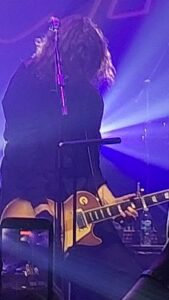
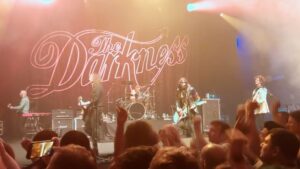


The band played epically with instruments cranked up to 11 at all times, Justin Hawkins antics’ as frontman achieved the right alchemy of melodrama and hilarity, and consequently the evening was high in entertainment value and the crowd had an excellent time. What helped, I felt, was that the Darkness came across as being a bunch of genuinely decent lads.  For instance, Justin Hawkins showed his appreciation of the guitar-tech guy who sporadically had to run on and off-stage.  The band also made sure their touring member, the keyboardist and guitarist Ian Norfolk – who, with his bald head, trimmed beard and sensible clothes looked as unlike the other performers as was possible – got a minute in the limelight.  By the way, I appreciate a guy called Norfolk playing with a band from Suffolk.


Moreover, the one moment that could have soured things – the band stopped a half-minute into I Believe in a Thing Called Love to ask certain members of the audience at the front of the stalls to stop filming on their phones – was well-handled by Hawkins.  Speaking like the nice, popular teacher at school who, once in a blue moon, has to discipline an unreasonably rowdy class, he pointed out in an I’m-not-angry-just-a-bit-disappointed voice, “Imagine if I sang the song while filming you on my phone…  It’d be really boring!”  He was more restrained than Brett Anderson of Suede, who in a 2023 gig at Singapore’s Star Theatre reacted to phone-filming spectators by tussling with them and knocking the infernal devices out of their hands.


Incidentally, when I arrived before the show, I noticed that one of the counters selling drinks at the back of the stalls belonged to the Flying V, Singapore’s premiere – well, probably only – heavy-metal bar.  And when I approached that counter to buy a beverage, I discovered they were selling Aspall Cyder.  The cidery producing this particular brew is located in the Suffolk village of Aspall, about 30 miles southwest of Lowestoft.  Wow, I thought, is this on sale because the Darkness are performing tonight?  Are they supporting the Suffolk economy whilst playing in Asia?  Momentarily, I had a vision of the Darkness’s tour-jet being accompanied by a cargo plane loaded with bottles of East Anglian scrumpy.  However, I visited the Flying V after the gig and learnt that they sell Aspall Cyder there all the time.  So it was just a coincidence.
 

Buck Rogers in the 21st century


After the rock band Feeder – consisting of Welsh vocalist and guitarist Grant Nicholas, Welsh drummer Jon Lee and Japanese bassist Taka Hirose – appeared in the 1990s, I bought their first few albums: Polythene (1997), Yesterday Went Too Soon (1999) and Echo Park (2001).  I enjoyed them at the time, but don’t remember much about them now – just a few songs like High (1997) and their biggest hit, Buck Rogers (2001).


After Echo Park, I stopped listening to Feeder.  This wasn’t because of a decline in their musical quality.  I moved around a lot in the 2000s and 2010s and lost touch with many of the bands I’d been into during the previous decade.  Often I was living in countries where it was impossible to hear about and buy new music by Western rock bands.  And YouTube isn’t much help if you’re somewhere with little or zero Internet connectivity.


Also – in an echo of the tragedy that befell fellow Welsh rockers the Manic Street Preachers – Feeder lost their drummer Jon Lee when he committed suicide in 2002.  I actually suspected the band had called it a day after that.  However, now I’ve done some research, I see that Nicholas and Hirose have soldiered on and produced nine further albums to date.


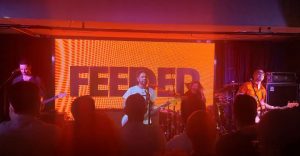
Anyway, it was recently announced that, as part of their current Black / Red tour, Feeder would perform at Singapore’s Hard Rock Café on April 2nd.  Though the band are now officially a two-man outfit, Nicholas and Hirose are accompanied by rhythm guitarist and backing vocalist Tommy Gleason and drummer Geoff Holroyde.  So, I purchased a ticket and, come April 2nd, got myself along to the Hard Rock Café.


This was the second gig I’ve attended at that venue.  With uncanny symmetry, the previous band I saw there was another Celtic one who came to prominence during the Britpop era playing indie / punky rock music, Northern Ireland’s Ash.  Consequently, I couldn’t help but compare this Feeder gig with the Ash one… and it seemed slightly inferior.


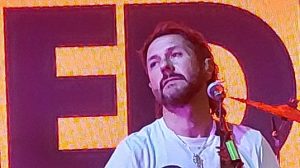
For one thing, it was shorter.  Feeder played for 80 minutes.  I think they could have chucked in a couple of extra songs to get the gig to the hour-and-a-half mark.  A more important issue, though, was the crowd.  Ash had attracted a good mixture of Western expatriates and Singaporeans, who’d bopped to the band’s songs with great enthusiasm.  The Feeder audience, however, consisted mostly of expats in their thirties and forties and they were, frankly, a bit lame.  Stuck at the back of the crowd, I found myself staring across a sea of sensible T-shirts, slightly-greying hair, bald-spots, baseball caps (strategically placed to conceal bald-spots) and shaven scalps (strategically shaven to camouflage bald-spots).  When they were at their most enthusiastic, they reacted to the music by, well, jiggling a bit.  (Admittedly, that’s what I did – I jiggled a bit.  But I have an excuse.  I’m a frail old man now.)  I felt sorry for Grant Nicholas when he suggested, “Let’s get a 1990s mosh-pit going…”, and nothing happened.


My mood was also dampened by the fact that the gig took place in the Hard Rock Café – surrounded by such holy rock-and-roll artefacts as J.J. Cale’s guitar, Michael Jackson’s cymbals and, er, the drumkit of Rob Blotzer from RATT.  Yes, with the café’s tables and chairs removed for the evening, you get the feeling you’re in a small, sweaty, standing-room-only venue where the band are just a few yards away.  That intimacy is great (and uncommon in Singapore).  However, the Hard Rock Café doesn’t have a stage – or, if it does, it has no stage to speak of.  It looks like the bands play on a strip of floor at one end of the main room.  Thus, even if you aren’t far from the performers, you won’t see much of them over the heads of the spectators at the very front.


There’s the matter too of having to pay Hard Rock Café prices for your drinks.  A pint of Carlsberg set me back a blood-curdling 28 Singaporean dollars, which is 16 British pounds sterling.


Still, despite the subdued crowd and the problems with the venue, once I relaxed and focused only on the show, I did enjoy it.  Bravely, Feeder didn’t go down the easy route of pandering to 1990s nostalgia, which is currently modish thanks to the hype over this summer’s reunion tour by the Gallagher siblings, and they played just four songs off those first three albums I mentioned earlier – though the songs were well-received and Buck Rogers inevitably got a good reception late on in the set.  On the other hand, they devoted more than half their set to material off their three most recent albums, Tallulah (2019), Torpedo (2022) and Black / Red (2024) and it was absolutely fine.  The standout for me was their 2024 song Playing with Fire – I definitely prefer Feeder when they’re being heavier and Playing with Fire was a good essay in heaviness.


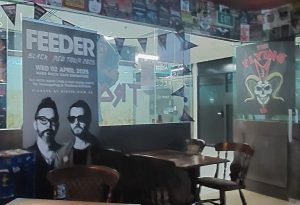
Kudos, by the way, to drummer Geoff Holroyde (who looks like a slightly-better-groomed Alan Moore) for wearing a Flying V Bar T-shirt and thus giving a plug to Singapore’s premier heavy metal pub.  Mind you, I was in the Flying V a week earlier and they had a big banner up promoting tonight’s gig, so perhaps he was just returning the compliment.


My safe space


The world is in a terrible state at the moment.  It’s apparently morphing into a real-life version of the scenario imagined by George Orwell’s 1984 (1949), wherein the planet is divided into three authoritarian superstates, Eurasia, Eastasia and Oceania.  We now have Russia run by Vladimir Putin, China run by Xi Jinping, and the USA run by the grotesque triumvirate of orange gobshite Donald Trump, viper-in-hillbilly-form J.D. Vance, and the chainsaw-wielding, ketamine-popping, Seig Heiling, superrich super-dickhead Elon Musk.  All three countries have been open about their territorial ambitions, about their wish to expand and become real-life, continent-engulfing equivalents of Eurasia, Eastasia and Oceania.  Very bad news if you live in Ukraine, Poland, the Baltic states, Taiwan, Panama, Greenland or Canada.  Pretty bad news for the rest of us.


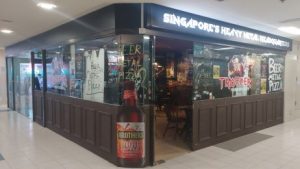
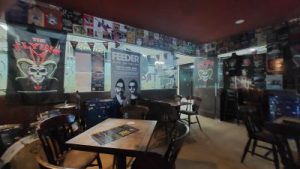
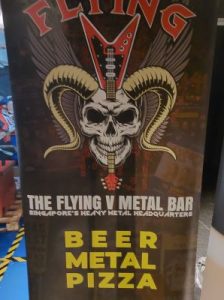
Thus, in these troubled times, it’s a relief to have a safe space: a little cubby hole you can retreat to, and hide in, and where your brain can function removed from all the awfulness happening outside for a while.  For me, that space is provided by the Flying V bar, Singapore’s self-styled ‘heavy metal headquarters’, which is hidden away in a back corridor in the basement of the Adelphi Shopping Centre on the city’s Colman Street.  Actually, the shopping centre is next door to the National Gallery, which makes the Flying V an ideal spot to sit with a beer after a visit to the gallery and ruminate on all the artwork you’ve just experienced.


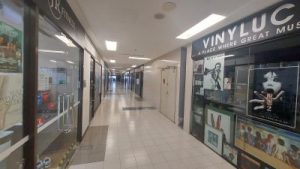
A Singaporean shopping centre may seem an incongruous place to find a heavy metal bar.  However, it isn’t the only music or metal-related business in the Adelphi.  On your way there, you pass a few units containing shops that sell vinyl records, many of the heavy-metal variety.


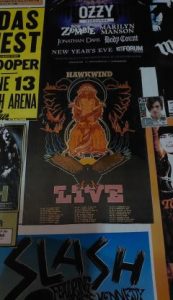
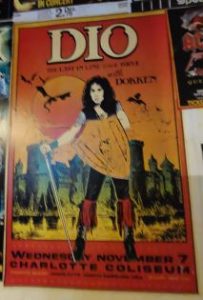
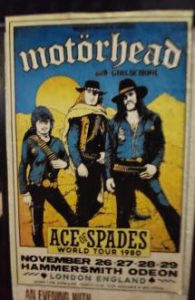
Inside, the walls of the Flying V are slathered with old posters and flyers advertising heavy-metal bands, concerts and festivals.  Even if you don’t touch a drop of alcohol, you can spend a pleasant hour in the place just reading the items crammed over the walls and enjoying the little glows of nostalgia they kindle in you.  On my part, for example, I gave happy sighs when I discovered an Art Nouveau-inspired poster for the mighty space-rock band Hawkwind, designed by the graphic artist Barney Bubbles; a picture of the late, great Ronnie James Dio tricked out in sword-and-sorcery gear, as was Ronnie’s wont to wear; and a poster for the much-missed Motörhead on their 1980 world tour, promoting their greatest-ever album Ace of Spades.


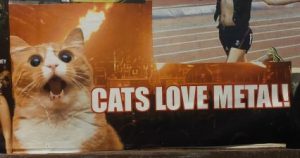
On the other hand, when I took my cat-loving partner there, she was delighted to find this proclamation about the feline species emblazoned on the wall behind our table.


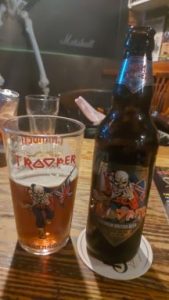
The Flying V’s drinks menu includes a beverage called Trooper Premium British Beer.  Trooper’s vivid label-design gives you a clue as to who produces it.  Yes, it’s the result of a project involving veteran heavy-metal band Iron Maiden, singers of such anthems as Number of the Beast (1982) and Bring Your Daughter to the Slaughter (1990).  The latter song will always be close to my heart because of the fact it knocked Cliff Richard’s sanctimonious Saviour’s Day (1990) off the coveted Christmas Number One slot in the 1990 British singles chart.  The band produce Trooper in partnership with England’s Robinson’s Brewery.  So, if you spend an afternoon getting sloshed on the stuff in the Flying V, you’re not being wasteful or unproductive.  You’re actually helping to fund Iron Maiden.


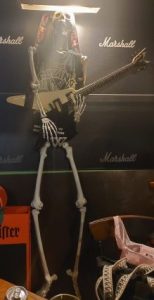
As I’ve said, the world is in a dire state just now and it sometimes feels tempting to retreat into the Flying V and hole up there for good.  However, the place does contain a warning against staying on the premises for too long.  You might end up like this guy.


Anvil show their mettle on metal


Warning — this post contains spoilers for Anvil! The Story of Anvil.


2008’s Anvil! The Story of Anvil is surely one of the best rock-music documentaries ever made.  It unflinchingly charts the multiple mishaps that befall Toronto heavy-metal band Anvil during the early 21st century.  Two decades earlier, Anvil had seemed on the cusp of making the big time – for instance, they’d headlined the 1984 Super Rock Festival in Japan alongside Bon Jovi, Whitesnake and the Scorpions – but then they’d faded into obscurity.  However, they never stopped playing and recording, albeit for small (sometimes non-existent) audiences and a very limited fanbase.  Watching The Story of Anvil, I got the impression that the reason for the band’s lack of success was simply a run of bad luck, both catastrophic and comical.


For its first 20 minutes, I found The Story of Anvil hilariously funny.  It was as amusing as the legendary spoof ‘rockumentary’ This is Spinal Tap (1984).  Indeed, it seemed ironic that Anvil’s drummer had the same name as This is Spinal Tap’s director, Rob Reiner.  Well, almost – Robb the drummer has two ‘b’s in his first name, whereas Rob the director has one ‘b’.


But as the disappointments, disagreements and disasters mount up, as the viewer is subjected to a relentless series of empty concert venues, booking mishaps, record label rejections and scenes where singer / lead guitarist Steve ‘Lips’ Kudlow gamely struggles on with his day job, which is delivering trolleys of pre-packaged, catering-company meals through Canadian blizzards, the film stops being funny.  As the fact sinks in that Anvil is a real band, not a fictional one like Spinal Tap, whose middle-aged members are striving to do the thing they love in the face of massive and soul-destroying odds, the film becomes rather tragic.  Particularly gruelling is the scene where, trying to scrape together some money to fund the recording of a new album, Kudlow takes on one of the worst jobs on earth, as a telemarketer.  When it comes to giving people unwanted phone calls and trying to persuade them to buy unwanted products, he’s as successful at it as I would be – he’s miserably crap at it.


As the film neared its end, I found myself pleading for the band to have one, just one sustained piece of good luck.  When they’re invited to perform at a three-day music festival in Japan, it looks like the good luck has finally arrived.  But no, they’re then informed that they’re scheduled to play the very first slot on the very first day, coming onstage in the morning when it’s unlikely that most of the audience will have turned up yet…  By this point, I’d concluded that The Story of Anvil was an exercise in utter nihilism, warning about the folly of trying to chase your creative dreams and not accepting your fate as a catering-company delivery man or (in Reiner’s case) a construction worker.  However, in a final twist, the documentary shows the band trudging despondently onstage at the Japanese festival, just before noon, and discovering to their joy that the auditorium is in fact packed with appreciative fans.  Talk about a cathartic finale.  I exhaled such a huge sigh of relief that I almost deflated over my cinema seat.  (Though now that I think about it, and having lived in Japan, I could have told Kudlow and Reiner that you can always depend on the Japanese to show up on time.)


It probably wasn’t how they’d wanted to re-establish their name, but The Story of Anvil was such a critical and commercial success that the band got their second wind on the back of it.  Since then, they’ve played at major heavy-metal festivals like Download, Hellfest and Wacken Open Air, provided support for the likes of Metallica and AC/DC and had their songs featured in the soundtracks of movies like It (2017) and TV shows like The Simpsons (1989-present).  Currently, the band is on its Impact is Imminent tour, the East Asian leg of which brought them to my current abode, Singapore, a week ago.


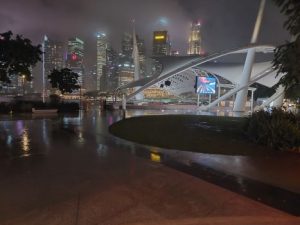
The weather that evening was the sort of thing that could have appeared in The Story of Anvil as a bad-luck factor stopping an audience from attending one of their gigs.  It’d rained torrentially since the start of the afternoon and there was still no sign of it easing off when I arrived at the venue, the Esplanade Annex Studio, just before eight o’clock.  At least the rain-drenched view outside the studio, of Singapore’s skyscraper-choked Central Area on the far side of the waters where the Singapore River reaches Marina Bay, had an evocatively Blade Runner-type vibe.


I was dreading what I’d find when I entered the Annex Studio.  An empty or near-empty auditorium, signalling that the Curse of Anvil had returned?  Or a strictly regulated, typically Singaporean venue with row upon row of seats, where there was no space to get up, move around and shake a leg – imagine having to sit during a heavy-metal concert?  Or worst of all, a combination of both, a place packed with seats but devoid of people?  Thankfully, the interior was seat-less and, while it wasn’t full yet, it seemed to be filling at a steady pace.  I was also pleased to see that a makeshift bar had been installed in a back corner, courtesy of Singapore’s premiere heavy metal-themed pub, the Flying V Metal Bar on Coleman Street.  Among the offerings on its menu were ‘Iron Maiden Trooper Beer’.  Well, with a name like that, I just had to sample a pint of it.  And then I sampled another pint.  And then I sampled another….


There was a decent-sized crowd present when the support band, local outfit Deus Ex Machina, came on and performed a well-received set.  I liked how the standard heavy-metal T-shirts, long hair and beards sported by 80% of the band contrasted with the appearance of the singer, who had a sensible haircut and was in a sensible short-sleeved shirt and looked like he’d just arrived after a (slightly dress-down) day at the office.  This being Singapore, perhaps he had.


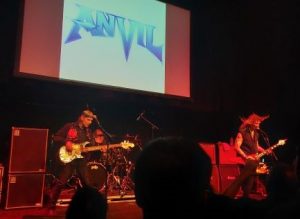
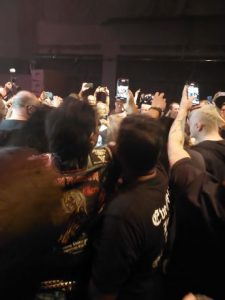
Then Anvil came onstage and it was immediately clear how much love there was for them in the room.  While they opened with their instrumental number March of the Crabs (which wasn’t inspired by pubic lice or even by the horror novels of Guy N. Smith, but by Kudlow’s observation that his hand had to move crab-like up and down his guitar strings as he played it) from the 1982 album Metal On Metal, Kudlow wasted no time in leaving the stage and joining the audience below.  At which point, he disappeared amid a sea of adoring fans and amid a forest of arms holding smartphones aloft to film him.


There ensued 90 minutes of gloriously old-school heavy metal, the tunes interspersed with crowd-pleasing banter from Kudlow.  He got a knowing and affectionate cheer when he introduced one song as being about sticking with your dreams and never giving up, which obviously he knew all about.  He also delivered an anecdote about an encounter with the late, legendary Lemmy, though to be honest his Lemmy impersonation sounded more like Dick Van Dyke’s chimney-sweep in Mary Poppins (1964) than the famously gravelly tones of the frontman of Motorhead.  Generally, after the indignities they’d suffered in The Story of Anvil, it was a tonic to see them up on stage 15 years later, thoroughly enjoying themselves – even if a moment where Kudlow and bassist Chris Robertson saluted each other got a bit Alan Partridge-esque.  The gig also demonstrated what an excellent drummer Robb Reiner is.  A couple of times during the film, he’d been shown at the end of his tether and threatening to quit the band.  Well, I’m glad he didn’t.


The closing number was probably their best-known song, the title track of Metal on Metal, which was the one featured on The Simpsons and which kicks off with the memorable lines, “Metal on metal / It’s what I crave / The louder the better / I’ll turn in my grave!”  After which, Kudlow couldn’t resist descending into the crowd again.  This time, it seemed like everyone in the venue managed to take a selfie with him.  Well, not everyone.  I didn’t want to break my phone-camera by taking a picture of my bleary, aged, worse-for-wear features.  But I did make a point of going up to him, shaking his hand and thanking him and his band for a job well done tonight.


It’s a job he’s still doing, against the odds, and a job he obviously loves.  A lucky man – at last.