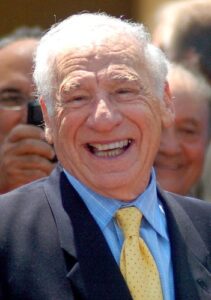
The 100-year-old Mel


From wikipedia.org / © Angela George


Last week saw much hype and noise about the United States of America celebrating its 250th birthday.  Under the leadership of Donald Trump, the USA marked the 250th anniversary of its independence from the British by holding a Great American State Fair on Washington DC’s National Mall.  This featured empty booths, cancelled musical performances, racist flags, power outages, collapsing roofs and a plywood model of the victory arch Trump wants to build on the Potomac that cracked, crumbled and oozed yellow gunk.  How odd that hardly anyone wanted to go to it.


In other moves to celebrate America’s 250th Independence Day, Trump refurbished the Lincoln Memorial’s Reflecting Pool, also in Washington DC, so that its water would shine a patriotic blue, though it immediately shone a less patriotic green thanks to a sudden and unforeseen algae bloom.  He also tried to extend the USA team’s run in the 2026 Football World Cup by arm-twisting Gianni Infantino and FIFA into breaking the sport’s red-card rules so that a key American player could play in the team’s next game – which they lost, courtesy of a 4-1 drubbing by Belgium, causing their exit from the competition.


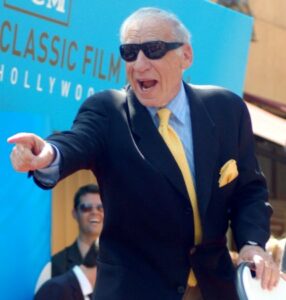
The sound and fury about the 250th anniversary of American independence, and the Trump-esque shenanigans accompanying it, have obscured the fact that, one week earlier, the USA witnessed another important three-digit birthday.  June 28th saw the 100th birthday of the legendary American filmmaker, comedian and general funnyman Mel Brooks.  By the time he turned his hand to making movies in the late 1960s, Brooks already had impressive comic credentials – devising the famed 2000-Year-Old Man comedy sketch with Carl Reiner, for instance, or creating the classic spy-comedy TV show Get Smart (1965-70) with Buck Henry.  But it’s fair to say his films are the body of work for which he’s most beloved.


Like much of the comedy I experienced from an early age – the CarryOn movies, or those starring Abbott and Costello, or the telly career of Ronnie Corbett – I’ve had a complicated and changing relationship with the oeuvre of Mel Brooks.  As a youngster, I thought it was brilliant.  As a young adult, who took himself much too seriously, I dismissed it – certainly, the later films Brooks made – as crass, cringeworthy guff.  Now, in my old age, I can find pleasure in the entirety of Brooks’s canon and appreciate the artistry displayed in even what are, by general consensus, his lesser efforts.  A bad joke might provoke a groan rather than a laugh, but to engineer that groan you still need a certain, warped skill.


I think I passed from my youthful period of Brooks-disdain to my more mature period of Brooks-admiration in the 1990s.  This was when I was attempting to woo (with a total lack of success) a lady from New York whom I considered, for a while, the coolest thing on earth.  We were chatting one evening about our favourite films and the object of my affections suddenly astounded me by saying she was a huge fan of…  No, not Jean-Pierre Melville’s Le Samourai (1967), or Terence Mallick’s Badlands (1973), or Jim Jarmusch’s Mystery Train (1989), but…  Mel Brooks’s Spaceballs (1987).
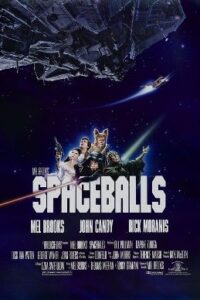
 

From wikipedia.org / © Metro-Goldwyn-Mayer / Brooksfilms


“Seriously?” I spluttered.  I’d seen this science-fiction / Star Wars piss-take shortly after its release and thought it was dreadful.  But, patiently, the lady explained to me the sociological depth and cleverness of some of Spaceballs’ jokes that I’d missed – for example, when Bill Pullman and John Candy rescue the princess (Daphne Zuniga) and Pullman remarks, “That’s all we needed…  A Jewish princess!”  I had to concede there was more to Brooks’s humour than I’d thought.


So, I had my moment of epiphany.  I decided, to misquote a line in The Producers, “Don’t be stupid, be a smarty / Come and join the Mel Brooks party.”


Anyway, it’s a fortnight late for the great man’s 100th, but here is a belated guide to the funniest bits, in my opinion, of his movies.  There’s no mention of The Twelve Chairs (1970) and Life Stinks (1991) because I haven’t seen those two.


L.S.D. gets auditioned in The Producers (1967)

The movie that put Brooks on the cinematic map, The Producers has had quite an afterlife, becoming a successful Broadway musical that, in 2005, was turned into a film itself.  For me, its highlight isn’t the famous song-and-dance number Springtime for Hitler that’s the centrepiece of the show that impresario Zero Mostel and accountant Gene Wilder stage in the hope it’ll be a massive flop (allowing them to make a fortune from the shares they’ve sold in it).  No, the highlight comes earlier.


That’s when hippy Lorenzo St. DuBois – L.S.D. to his friends – stumbles into the show’s auditions by mistake and performs, with his female guitar / keyboards / sax backing band, a funny-terrible number called Love Power.   (“And I give a flower to the big fat cop / He takes his glove and he beats me up!”)  Played by Dick Shawn with thigh-high furry boots and a Campbell’s soup-can hanging on a chain around his neck, the hapless L.S.D. is hilarious – and the sequence reaches a perfect conclusion when Mostel bellows ecstatically, “THAT’S OUR HITLER!”
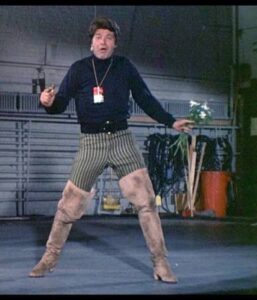
 

From instagram.com / (c) Embassy Pictures


The campfire scene in Blazing Saddles (1974)

If I was more sophisticated, I’d nominate as the funniest moments in Brook’s smash-hit comedy-western the scenes where he skewers the residents of frontier town Rock Ridge for their bone-headed racism.  (“You’ve got to remember that these are just simple farmers.  These are people of the land.  The common clay of the new West. You know…  morons.”)  However…  I’m nominating instead the sequence in Blazing Saddles where Slim Pickens’s men sit around a campfire and stuff themselves with traditional cowboy fare – beans – with flatulent results.


I first saw Blazing Saddles when it played on a big screen in the assembly hall of my school as one of the movies chosen for the school’s Film Club.  When the farting began, the teenaged audience, including myself, laughed like drains.  We were still roaring our heads off minutes after the sequence finished.  No other film shown during the several years I was a member of that Film Club – not Alfred Hitchcock’s Psycho (1960), not Nicolas Roeg’s Don’t Look Now (1973), not Ridley Scott’s Alien (1979) – provoked so tumultuous a reaction.  I’m not proud.


The monster meets the blind hermit in Young Frankenstein (1974)

The most genuinely affectionate of Brooks’s genre parodies, Young Frankenstein pokes fun at the black-and-white Frankenstein movies made by Universal Pictures in the 1930s.  My favourite part of it is when Brooks sends up the sequence in Bride of Frankenstein (1936) where the Frankenstein monster (Boris Karloff) is touchingly but briefly befriended by a lonely blind hermit (O.P. Heggie) who’s unaware of his monstrousness.  Here, the well-meaning but, well, blind hermit (Gene Hackman) accidentally and repeatedly scalds and burns the unfortunate monster (Peter Boyle) whilst trying to offer him broth, cigars, etc., until the latter flees from his cottage in terror.  Despite the gleeful bad taste of the gags, the Young Frankenstein sequence retains some of the sweetness and sadness of the Bride of Frankenstein one.  It also makes you wish Gene Hackman had played more comedy roles.
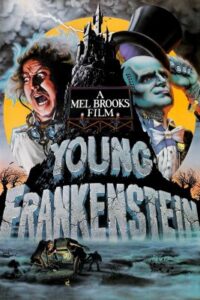
 

From wikipedia.org / © Gruskoff / Venture Films / 20th Century Fox


The boardroom table in Silent Movie (1976)

This was another movie shown at my school’s Film Club and another sequence that sent us – uncivilised little oiks that we were at the time – into paroxysms of laughter.  Evil corporation Engulf & Devour intends to take over the studio of filmmaker Mel Funn (Brooks) but that won’t happen if the new movie Funn is making becomes a hit.  Engulf & Devour’s board of executives hatch a fiendish plan to sabotage Funn and his movie – they’ll send sultry nightclub singer Vilma Kaplan (Bernadette Peters) to seduce, then dump Funn and re-kindle the massive alcohol problem he had previously.  When a picture of Vilma is unveiled to the executives, sitting around the boardroom table, they’re so impressed that the table rises by several inches.


The line Funn / Brooks inspires when Vilma does dump him, and he goes on a massive bender to drown his sorrows – “He is truly the lord of the winos!” – is pretty funny too.


The orchestra in High Anxiety (1977)

Brooks’s next film takes fond aim at the thriller movies of Alfred Hitchcock.  Its hero, Dr Richard Harpo Thorndyke, again played by Brooks himself, suffers from the titular disorder, the vertigo-like ‘high anxiety’.  While travelling in the back of a car, Thorndyke / Brooks suffers a moment of ominous foreboding, which is accompanied by an equally ominous swell of Bernard Herrmann-like orchestral music – the sort that Hitchcock liked to insert into his films to augment the mood.  This being a Brooks film, though, Thorndyke’s car then passes a bus that contains, as passengers, the orchestra playing the music.


Yes, this is the second time Brooks has used that gag.  It originally appeared in Blazing Saddles and involved the Count Basie Orchestra performing in the desert,  But the orchestra-on-a-bus joke in High Anxiety works better, I think.


The Spanish Inquisition in History of the World, Part I (1981)

A truly hit-and-miss collection of gags and sketches, History of the World, Part 1 depicts five chapters in world history from the Stone Age to the French Revolution.  Its undisputed highlight is a segment about the Spanish Inquisition.  This features Brooks as Torquemada – his victims are warned not to try to talk him out of torturing them because, “You can’t Torquemada anything!” – and an elaborate Busby Berkeley-like song-and-dance number in a torture chamber which, with its exuberant bad taste, is as impressive as Springtime for Hitler in The Producers.
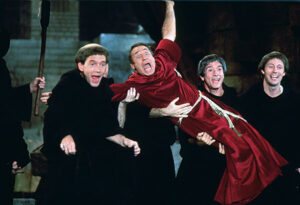
 

© Brooksfilms / 20th Century Fox


Snotty’s line in Spaceballs (1987)

Spaceballs spoofs Star Wars (1977) but also contains some elaborate send-ups of Planet of the Apes (1968) and Alien (1979) – the latter even drafts in John Hurt to reprise his role as the unfortunate Kane.  But the funniest, or groan-iest, bit in it for me is a simple pun.  A Scottish character called Snotty (Jeff MacGregor), obviously based on Scotty from Star Trek (1966-69), is in a control room flicking a series of switches.  “Lock One!” he shouts.  “Lock Two!  Lock Three!  Loch Lomond!”


The abbot in Robin Hood: Men in Tights (1993)

You have to be a connoisseur of long-ago comedy double-acts to appreciate my favourite joke in Robin Hood: Men in Tights, Brooks’ irreverent take on the then-recent and hugely-successful Robin Hood: Prince of Thieves (1991).  An abbot (Dick Van Patten) is walking in his finery outside his monastery and enjoying the adulation of the local population.  Then a guy who looks and sounds suspiciously like Lou Costello yells at him, “Hey, Abbott!”  Van Patten grumbles, “I hate that guy.”


Dracula tries to control Mina’s mind in Dracula: Dead and Loving It (1995)

I don’t hold it against Brooks’s Dracula: Dead and Loving It, which stars Leslie Neilson as the legendary vampire count, that it isn’t great.  After all, there have been many attempts over the years to spoof vampire films and hardly any of them have been funny – see Roman Polanski’s Dance of the Vampires (1967) or Stan Dragoti’s Love at First Bite (1977).  In fact, it wasn’t until Jermaine Clement and Taika Waititi’s What We Do in the Shadows (2014) that I encountered a vampire-movie parody that made me laugh.


However, Dracula: Dead and Loving It has one funny part where, from a distance, Dracula / Neilson exerts his willpower over the bitten and partly vampirised Mina (Amy Yasbeck) and tries to summon her: “Mina…  Open your eyes…  Arise…  Come to the door…”  The operation goes less smoothly when the mind-controlling vampire discovers there’s a confusing closet door in the way, and a hazardous footstool, and an inconvenient maidservant who’s also picking up his telepathic instructions: “Mina…  You are in the closet.  Open the door and come out…  Watch out for the footstool…  Stand up…  Not you, sit…  No, you sit…  You stand…”


And just before I finish, some praise is due for Brooks as a producer too.  He’s the man who oversaw both David Lynch’s The Elephant Man (1980) and David Cronenberg’s The Fly (1986).
 

From wikipedia.org / © Angela George

It’s the hope that kills you


The footballing World Cup currently taking place in Canada, Mexico and some other place – oh yes, the USA – has now entered its second stage.  And guess what?  A certain country took part in the first stage but failed to qualify for the second one, just as it qualified for eight previous World Cups and didn’t make it to the second round of those competitions either.  In fact, it’s earned itself the unenviable record of being the most-useless-at-getting-to-the-second-round-of-the-World-Cup country ever.  Which hapless nation could this be?


Here’s a clue: “Yes sir, I can boogie…


I had a fortnight off work during the second half of June and spent that time in Scotland, in the Borders town of Peebles, where my family have lived for nearly 50 years after relocating from Northern Ireland in 1977.  My fortnight in Scotland coincided with the Scottish men’s team playing their second and third games of the World Cup, which they’d qualified for in November last year.  Well, I thought beforehand, I’ll be in Scotland in time to see if, finally, they can beat the jinx that’s stopped them from getting past the competition’s initial stage in 1954, 1958, 1974, 1978, 1982, 1986, 1990 and 1998.  And this time, with so many countries participating in the 2026 competition, surely it’ll be easy to get into that elusive second stage?  Surely they’ll beat the curse at last?


Thus, I braced myself for the Scottish World Cup 2026 experience, thinking of a lyric from the Eagles’ Hotel California: “This could be heaven or this could be hell.”


Guess which one it turned out to be.


When I arrived in Scotland on June 17th, the national team had already secured three points from their first World Cup game.  It had defeated by one goal to nil the footballing colossus that is… Haiti.  Actually, given Scotland’s history of embarrassing scores against minor footballing nations they were expected to beat, such as Iran in 1978 and Costa Rica in 1990, the win over Haiti felt like the clearing of an important psychological hurdle.  Now Scotland  needed just one more point to be sure of getting through to the second round.  As I traversed the streets of Peebles, folk around me were cautiously positive.  There was a certain sense of optimism.  Hope was definitely in the air…


But as older, wiser heads who’d experienced countless Scottish World Cup agonies in the 20th century would inevitably muse: “It’s the hope that kills you.”


June 19th saw Scotland’s second World Cup game, against Morocco.  By now, like humidity in the air triggering a spectacular thunder-and-lightning storm, that pervasive sense of hope had transformed into full-scale mass euphoria.  Mind you, I was slightly less euphoric, remembering Scotland’s last game in the last World Cup they qualified for, in France in 1998, which was against Morocco too.  Back then, Morocco had humped them three-nothing.


I watched the game in the social building of Peebles Rugby Club, where for once the crowd contained more fans of the round ball than fans of the oval one.  I’d never seen the place as wild as it was during the build-up to the game – people were yelling, singing, dancing on tables, waving glow sticks like demented cheerleaders.  In fact, there was so much merry-making and hullabaloo that most folk didn’t even notice when the first whistle blew and the match kicked off.  They also didn’t notice when two minutes later Morocco penetrated Scotland’s somnolent defence and knocked in an embarrassingly early goal.  There was some remarkable sobering-up done when the revellers finally focused their gaze on the Rugby Club’s TV screens and realised,  one goal down already – how the f*ck did that happen?


To be fair, Morocco didn’t look much more accomplished than Scotland, certainly not during the second half.  But the North Africans hung onto their slender lead for the next 90-odd minutes and the game ended one-nil to them and with Scotland acquiring zero points.  If only the team had been awake from the very start and denied Morocco that early goal.  They’d have scraped a nil-nil draw, got a point, qualified for the second round and made history.  I tried to console myself with the thought that as it was a three-nil defeat against Morocco in 1998, and only a one-nil defeat in 2026, this marked a 66% improvement on Scotland’s part.  Right?


The next day, June 18th, was the biggest day in Peebles’ annual Beltane festival.  Among other things, there was a parade of floats, bands and people in fancy dress along the town’s high street.  Many of the revellers were in the regalia of the Tartan Army, the Scottish football team’s travelling support – one guy in such attire was even riding a penny farthing.


Yet an unhappy sense of reality about Scotland’s World Cup prospects was tangible now.  Some of the bands were still dutifully playing Yes Sir, I Can Boogie (1977) by the Spanish disco duo Baccara, which has been the Tartan Army’s favourite anthem since 2020.  However, Langholm Town Band definitely had their finger on the pulse when they marched by me playing Ally’s Tartan Army, which was Scotland’s World Cup song in Argentina in 1978 and whose lyrics go, “We’re on the march with Ally’s army / We’re going to the Argentine / And we’ll really shake them up / When we win the World Cup / Cos Scotland are the greatest football team.”


Ally’s Tartan Army serves as a painful reminder of what happened during Scotland’s World Cup campaign in 1978.  The Scotland manager then, Ally MacLeod, was breezily optimistic about his team’s chances of winning the World Cup; his optimism was amplified by Scotland’s sporting press; the whole nation drank the Kool-Aid and believed their team only had to turn up in Argentina to lift the trophy…  And when Scotland were knocked out in the first round, it was seen as a national disaster and humiliation.  For years afterwards, the Scots suffered from P.A.S.D., i.e., Post-Ally Stress Disorder.


Scotland’s final first-round game was against Brazil on June 24th.  The Scottish World Cup record against Brazil had been woeful.  In the 1982 competition in Spain, Brazil beat them four-one, a cruel result considering that Scotland went one-nil up after 17 minutes, courtesy of a goal by David Narey.  (Big-chinned English football commentator Jimmy Hill earned himself the lasting hatred of Scotland fans by dismissing Narey’s goal as a ‘toe-poke’.)  A rematch at the 1990 World Cup saw Brazil beat them one-nil and caused Scotland’s elimination from the tournament.  Despite this, I heard slivers of optimism in people’s conversations: “We only need a draw… One point, that’s all…  And Brazil…  They’re not the great team they once were…  They’ve been disappointing so far…”


Yes, it’s the hope that kills you.


I watched the game at my brother’s house, where the audience included my nephew and his girlfriend, who hadn’t even been born when Scotland last played in a World Cup.  Brazil knocked the ball three times into Scotland’s goal – actually four times, but one of the goals was disallowed – without Scotland even achieving what the late Jimmy Hill would describe as a ‘toe-poke’ in return.  Afterwards, I said to my nephew and his partner something along the lines of, “Welcome to us old folk’s world – one of Scottish World Cup misery.”


Even then, it wasn’t absolutely certain that Scotland was out of the World Cup.  So many countries were involved in this competition, and the rules for making progress in it were so complex, that they still had a chance.  Some of the best-placed teams with three points would go through to Round Two.  Scotland might be one of the lucky ones if certain results went certain ways.  By June 27th, though, it was clear the results hadn’t gone the right way and Scotland were taking their ninth World Cup early bath.


Yes, it’s the hope that…  Oh, shut up.


If nothing else, the Tartan Army showed yet again that they’re one of the best sets of football fans in the world.  Despite the hassle of entering Donald Trump’s increasingly authoritarian USA, and the excruciating price of match tickets, transport, refreshments and everything else in a World Cup orchestrated by the rip-off maestro and evil Mekon Gianni Infantino, head of FIFA, they won American hearts and minds by supporting their team with good humour and self-deprecation and avoiding any nationalistic preening or belligerence.  And, along the way, they had a hell of a party.


The citizens of Boston, where they played their first two games, were particularly impressed.  They didn’t even mind the Tartan Army’s custom of plonking traffic cones on the heads of their municipal statues.  The day after the Haiti victory in this, the home city of the Irish-American diaspora, at a downtown Irish pub called Henessey’s Bar, Scotland fans managed the exceptional feat of drinking three times more beer than is normally sold on St Patrick’s Day.  “We’ve been here for over 30 years and we’ve never seen anything like it,” marvelled the pub’s boss.  Even the New York Times was moved to publish a feature about the Boston-Tartan Army love affair.


Those fans were merely enjoying the Scotland World Cup experience, and squeezing in as much hectic partying, while it lasted.  Because, as 2026 proves for the umpteenth time, the Scotland World Cup experience never lasts for long.


Go west, young Scots (if you can)


From bellacaledonia.org.uk


Once upon a time, the misery involving Scotland and the FIFA World Cup hinged around the fact that, though the Scottish men’s football team usually qualified for the thing, they never, ever managed to progress beyond its first round.  This was irrespective of whether they played well (in 1974, managing a win and two draws, one of those draws with Brazil, but going out on goal difference); badly but with a flash of genius when it was too late (in 1978, getting beaten by Peru, drawing with Iran, finally finding their mojo and defeating the tournament’s eventual runners-up Holland, but going out on goal difference); or simply badly (most of the rest of the time).


My family moved from Northern Ireland to Scotland in 1977, in time for Scotland’s campaign in the 1978 World Cup.  As I noted above, that performance wasn’t all bad.  However, the team’s departure for Argentina, the host country, had been accompanied by a Scotland-wide tsunami of insane expectation and over-optimism.  The madness was caused by some witlessly hopeful predictions from Scotland manager, Ally MacLeod, which an irresponsible and headline-hungry Scottish press had amplified.  (The team had some good players, but not that good.)   When their country didn’t win the World Cup, as everyone had been braying they would, but flopped in the first round, the Scots treated it as a national humiliation.  And for years, if not decades, afterwards, they suffered from Post-Ally-MacLeod-Stress-Disorder.


During the 1982 World Cup, I was working in Northern Ireland.  I got caught up in the euphoria of Northern Ireland’s unexpected and brilliant run in it – they got past the first round and beat host nation Spain along the way – and, probably fortunately, I didn’t have to focus too much on Scotland.  By 1986, I was studying in Aberdeen.  For Scotland’s final first-round match of that competition, in Mexico, they needed to beat Uruguay by at least two goals.  A mate called Alan Kennedy invited me and a few others to his house to watch the game on TV.  For the occasion we ordered a keg of beer and tucked into it several hours before the kick-off.  Well lubricated, I dozed off in an armchair not long into the match.  What a lucky man I was.


Four years later, in 1990, I was working in Hokkaido in northern Japan.  This time, with the World Cup taking place in Italy, I invited a few of my friends to my apartment for Scotland’s final first-round game.  Their campaign had begun with another gut-wrenching, soul-destroying defeat – by Costa Rica – that added yet more scars to the nation’s psyche.  But then they’d beaten Sweden and now they needed to see off Brazil.  They didn’t.  The folk I invited to my apartment for the game consisted of some Japanese colleagues and a football-daft Glaswegian called Bill Quinn.  Afterwards, one Japanese colleague remarked, “I’ve never seen anyone look so sad as your friend Mr Quinn when the match finished.”


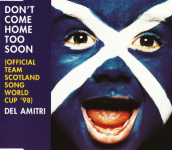
Scotland didn’t qualify for the 1994 World Cup in the USA but made it to the 1998 one in France.  By now the nation was well past any delusions that they might come near to winning the damned thing. They just prayed that their team would get past that f**king first round and into the second one.  Small wonder that for Scotland’s official 1998 World Cup anthem, the Scottish Football Association got Del Amitri to sing a wistful song called Don’t Come Home Too Soon.


From wikipedia.org / © A&M Records


During this competition I was at my family’s home in the Borders town of Peebles and I watched all three Scotland games in the town’s cosy Bridge Inn, known locally as ‘the Trust’.  After the third game, a three-goal humping by Morocco that ensured that, yes, Scotland were coming home too soon, I left the Trust and headed for the Green Tree Hotel at the far end of the High Street.  The public bar there was full of people who’d just been watching the game in full regalia – team shirts, tammy hats, tartan scarves and kilts – and whom I expected to be miserable beyond belief.  They weren’t.  Their team had taken an early bath for the umpteenth time, but what the hell?  They’d decided they might as well party.  The ensuing evening was one of the best I’ve ever had in a pub.  Someone behind the bar stuck on a compilation record called The Best Scottish Album in the World Ever (1997) and I couldn’t believe how many grown men around me knew all the words to Shang-a-Lang (1974) by the Bay City Rollers.


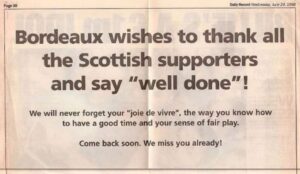
That evening in 1998 was symbolic of what’d happened regarding the Scottish football team and its supporters.  While the former seemed doomed to flounder at these big events, the latter had given up on any expectation of their team doing well and were simply determined to enjoy themselves, win, lose or draw.  In the process, their self-deprecating humour and dedication to good-natured partying earned them the reputation of being one of the best sets of football fans in the world.  For instance, the city council of Bordeaux, where Scotland had played two of their 1998 World Cup games, took out a full-page advert in Scottish newspaper the Daily Record to thank the fans for their behaviour: “We will never forget your ‘joie de vivre, the way you know how to have a good time and your sense of fair play.  Come back soon.  We miss you already!”  I’m sure those sentiments were shared by Bordeaux’s bar and off-licence industry.


Indeed, I felt sorry for bigger countries with a reputation for greater footballing prowess, whose fans did expect them to deliver the goods.  I’d see those countries’ fans gather to watch a make-or-break World Cup game…  And, when the final whistle blew and their country had messed up, lost the game and exited the competition, those fans immediately headed home with scowls on their faces.  Wait, I’d think, aren’t you at least going to hang around and party?  (Yes, I’m looking at you, England fans.)


We’re more than a quarter-century on from the 1998 World Cup.  The issue with Scotland since then is that they’ve failed to qualify for the competition at all.  Bellyaching about them never progressing beyond the first round of it seems like an unobtainable luxury now.  We didn’t know how lucky we were back in the late 20th century.


Happily, though, all that has changed.  November 18th saw Scotland clinch qualification for next year’s World Cup tournament in Mexico, Canada and the USA by beating Denmark 4-2 at Hampden Park in Glasgow.  Sure, Denmark had the lion’s share of the play, and John McGinn was perhaps not being too modest when he commented afterwards, “I thought we were pretty rubbish to be honest, but who cares?”  But three of Scotland’s four goals were amazing: Scott McTominay managing to backwards / overhead-kick the ball into the Danish net whilst seemingly levitating in the air; Kieran Tierney sending the ball scouring around the penalty area and just making it inside the Danes’ goalpost; and, with brilliant insouciance, Kenny McLean punting the ball in the final seconds from the halfway line – and seeing it go over the Danish goalie’s head and into the net.


Mads Mikkelsen, your boys took a hell of a beating.


From wikipedia.org / © Luca Faz


My excitement about Scotland being on their way to a World Cup for the first time in 28 years is tempered, though, by the fact that it’s being held in North America.  Under the FIFA presidency of Gianni Infantino – a man who’s managed the difficult feat of making Sepp Blatter look wholesome – the sale of tickets has been, in the words of the Guardian, ‘a late capitalist hellscape’ plagued by ‘dynamic pricing, crypto detritus and corporate doublespeak’.  How many ordinary Scotland fans, whose presence at past matches has created such a memorable atmosphere, can afford to attend a game?  Not so many, I imagine.  Plus, if Scotland’s games are played in the USA, the fans will have to get past that country’s increasingly autocratic rules on who gets allowed in.  Dare to criticize President Trump on social media and you get barred, apparently.  And I’d guess that, online, more than a few Scotland fans have referred to the American Commander-in-Chief as ‘a big orange bawbag’ at some point.


No, I have a horrible suspicion that the majority of Scotland’s support at any USA-held games would consist of well-heeled, conservative and sober Americans who happen to have a ‘Mac’ in their surnames thanks to some Scottish ancestor – folk who like to see a few kilts at their weddings but who quietly prefer American football and baseball to what they call ‘soccer’.  The atmosphere at those games could be terribly lame.


That’s on top of my horrible suspicion, based on past experience, that Scotland will screw up against some embarrassing opposition.  I have a bad feeling about the Dutch Caribbean island of Curaçao, who have just become the smallest-ever country to qualify for a World Cup, under the management of none other than former Glasgow Rangers boss Dick Advocaat.  I can just imagine them ending up in Scotland’s first-round group.  And then Scotland making a giant hash of things against them…


Meanwhile, as the USA’s orange Commander-in-Chief loves bragging about his Scottish roots – his mother came from the Isle of Lewis – I bet he’d make a great show of turning up in person to watch any Scottish World Cup game that takes place on American soil.  Mind you, he might not survive the ordeal.


From the Daily Record / © Bordeaux City Council