© Polygon Books
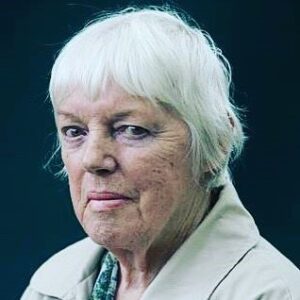
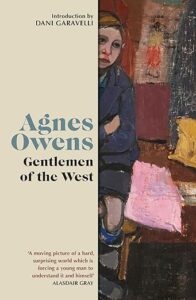
By a coincidence I’d just finished reading Gentlemen of the West (1984), the first book published by the late Scottish writer Agnes Owens, when I learned that May 24th – last Sunday – was the 100th anniversary of Owens’s birth. This article in last Sunday’s Observer informed me.
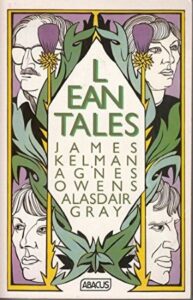
A long time ago, I’d read nine of Owens’s short stories included in Lean Tales (1985), an anthology showcasing work by her and her friends (and originally mentors) Alasdair Gray and James Kelman. No disrespect to Gray and Kelman, but I thought her stories were the best stuff in Lean Tales and one of them, Arabella, blew me away. In just six pages, Arabella paints a devastating picture of the title character, who may or may not be a witch. Arabella obviously doesn’t have much command of , or regard for, normal social skills. She visits her parents seemingly oblivious to the fact her mother can’t stand the sight of her, she isn’t someone you’d want looking after your pets (though she owns four dogs, whom she carts around in a pram), and her way of dealing with a sanitary inspector’s visit to her ruinous house is not for the weak-stomached.
Arabella was the story that brought her to the attention of her literary peers. In the late 1970s Gray, Kelman and the poet Liz Lochhead ran evening classes in creative writing in Owens’s hometown of Alexandria, northwest of Glasgow. Owens attended the first class and gave a copy of Arabella to Lochhead, who read it on the train back to Glasgow. Lochhead recalled trying “to put this terrifying, terribly funny story, so anarchic and archetypal, so short and so complete, together with the class I’d just left and that middle-aged lady in the neat coat and woolly hat with the fringe of dark blonde hair sticking out and the full mouth that turned so decisively down at the corners.” Owens, who’d been busy raising seven children and working variously as a typist, factory worker and cleaner, later claimed she’d only signed up for the writing course to ‘get out of the house’.
Anyway, I’m a fan of Douglas Stuart, author of Shuggie Bain (2020), Young Mungo (2022) and the forthcoming John of John (2026), and I recently read an article of his on Literary Hub entitled Poverty, Anxiety and Gender in Scottish Working-Class Literature. This recommended a reading list that included Agnes Owens’s Gentlemen of the West alongside such better-known titles as Kelman’s How Late It Was, How Late (1994), Alexander Trocchi’s Young Adam (1954), Irvine Welsh’s Trainspotting (1993) and Alan Warner’s Morvern Callar (1995). Stuart described her as “one of the most detailed observers of working-class life that I have ever read” and opined that “her writing brings a tenderness and a kindness to a hard, industrial landscape that is usually dominated by men.” I realised I had on my bookshelf a very old copy of Gentlemen of the West that I’d purchased in a charity shop and, following Stuart’s endorsement, I retrieved it and read it.
The book can be described as either a collection of connected short stories, told by the same narrator, or an episodic novel, each chapter recounting an adventure experienced by its hero. That hero is Mac, a young west-of-Scotland man who spends his time toiling in frequently shite weather on a building site, jousting with his curmudgeonly mother in the small tenement flat he shares with her, and drinking in the local pub, the Paxton, among a weird, sometimes frightening range of what could be euphemistically termed ‘characters’. The tenor of Mac’s existence is nicely summed up by the opening paragraphs of one story / chapter entitled Christmas Day at the Paxton:
“It was Christmas Day, a Saturday. The streets were covered in ice and nothing was moving except me. There was not a soul, a dog or even a bus in sight and worst of all I suspected the pubs would be closed. I headed in the direction of the Paxton with my mother’s Christmas message ringing in my ears.
“’Where’s yer Christmas present ye ask? Well, where’s mine? Every year it’s the same. Not a sausage dae I get aff ye. No’ even an extra pound an’ a’ the neighbours showing aff their presents. Well, I’m sick o’ it – ‘
“’And a Merry Christmas to you!’ I had shouted as I walked out.”
The reader never loses sight of the precariousness of Mac’s life. In the following story, The Aftermath, he reports, “All the week after Christmas I was in a foul mood. It was a long holiday for the building-site worker. My money was gone by Boxing Day. I faced New Year without a penny in my pocket…” In the Paxton, he often wonders where his next beer or whisky will come from – though modern readers may find it quaint that the stories are set in an era when a pint cost 50 pence. Of course, wages then were correspondingly low. (Incidentally, I’m of a vintage whereby I can just remember being able to buy two pints of Light for a pound at the Rugby Club’s wee upstairs bar on the Northgate in Peebles.)
Among the tales recounted in Gentlemen of the West… Mac, a Protestant, goes looking for a dead friend’s memorial service and gets stuck in a Roman Catholic chapel while mass is being performed. He encounters an old schoolmate who then limpets onto him when he discovers there’s a gang after him. He intervenes when he believes his mother is getting too friendly with a character called Proctor Mallion, who’s the very last person he wants as a stepdad – “His first wife ran away wi’ the insurance man and his second left him efter he pushed her out the windae. Lucky for her it wis on the ground floor”.
He gets paid off at his work following a row between the brickies and the building site’s boss-man. He gets re-hired, only to discover later the boss-man has employed as a general labourer someone called McCluskie, who’s just spent time in prison for manslaughter. Mac explains the crime to a young apprentice thus: “…if I take this brick hammer an’ smash it ower yer heid, that would be murder. On the other haun’, if I accidentally push ye aff the scaffolding when ye get up, that’s manslaughter.”
© Little, Brown Book Group Limited
There’s a supporting cast that includes the winos who drink by a local riverbank – “Billy Brown, Big Mick, Baldy Paterson and Craw Young… huddled round a large flat stone that displayed two bottles of Eldorado wine and some cans of beer” – and the memorably erratic Paddy McDonald who lives in a tumbledown bothy alongside “live rabbits in the oven – lucky for them it was in disuse – pigeons in a cage in the bedroom, and a scabby cat always asleep at the end of a lumpy sofa, with the dog at the other end.”
It’s tempting to view Gentlemen of the West, episodic in nature and populated by unfortunates and never-do-wells, as a forerunner to Irvine Welsh’s Trainspotting. But there are important differences. Mac and at least some of his associates are in employment. That employment’s shaky, though. And as the 1980s unfold, you dread to think how the doctrine of Thatcherism (resources concentrated in London and southeastern England, to hell with the rest of Britain) will upend their community. Also, they don’t have the drug-fueled nihilism of Welsh’s characters, though I suppose the Trainspotting gang could be seen as the feral, heroin-raddled offspring of Mac and his mates a generation later.
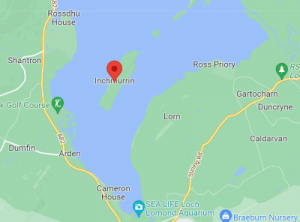
If you compare the chapter / story Up Country, in which Mac makes a spontaneous daytrip out of his town, ends up on a boat on the Firth of Clyde with “some sightseers on deck with the loud English patter”, and then ends up for a few hours on an uninhabited island, with the episode in Trainspotting where Renton and co. briefly visit the Scottish Highlands, the differences are stark. Mac blunders around the island like an innocent child, first feeling euphoric (“The view was terrific, all lochs and mountains. I felt contempt for my mates who would be firmly established in the boozer by now, slugging away at whisky and beer, unaware that were better ways of passing the time”), then feeling creeped out as he realises he’s all alone there and stumbles across a small cemetery. In Trainspotting, the Scottish scenery inspires the far more cynical Renton to embark on his famous rant about the Scots: “The lowest of the low, the scum of the earth. The most wretched servile, miserable, pathetic trash that was ever shat intae creation.”
On his way back from the island, Mac encounters an eccentric German tourist who’s come to Scotland “to study castles… Then I shall write my book.” Mac reacts with bemusement but also respect: “I looked after him wishing I could be as sure of everything.” He even takes inspiration from him and the story ends with the line, “…some day I will get away from this place. Some day I might go and see castles myself.” In Welsh’s novel, unlike Danny Boyle’s 1996 film adaptation of it, Renton and the others don’t run into a foreign tourist. But with drug habits to finance, you know their reaction to one would be far more predatory.
In other parts too of Gentlemen of the West, we see decency in Mac, for example, in his interactions with the hapless Paddy McDonald. And we see it in other characters. McCafferty, in charge of the building site, comes across as an insufferable dick in the episode Paid Aff, but in the very next one, McCluskie’s Out, he’s willing to give a second chance to a guy just out of prison.
But the book’s real heart isn’t Mac but his long-suffering and sharp-tongued mother, the ‘auld wife’ as he calls her. On the surface, their relationship is one of never-ending bickering and arguing – ‘banter’ is much too gentle a word for it. Yet it’s clear that the auld wife is the bedrock supporting Mac’s meandering, occasionally chaotic existence. And no doubt there are countless other, resilient women in the surrounding tenements providing a similar service to countless other men. Owens, whose son John was a bricklayer, was probably all too familiar with the role. In the article in the Observer, John is quoted as saying that if his mother based Mac and the Auld Wife’s relationship on the relationship she had with him, things were “a bit exaggerated… though I may be forgetting how cheeky I could have been as a young man.”
Only at the end of the final story / chapter, Goodbye Everybody, is the true nature of their relationship made explicit. Mac makes good on the promise he made in Up Country and sets off for Aberdeen in the hope of finding a better living for himself. It’s impossible not to feel a lump in your throat as you read his account of the morning of his departure and he describes how his usually formidable mother is ‘shaking’ and ‘searching for words’. When he walks off down the street, not looking back, he knows “she would stay there watching until I was out of sight.”
And you suddenly appreciate Douglas Stuart’s observation that Agnes Owens brings a ‘tenderness’ and ‘kindness’ to a ‘hard, industrial landscape… dominated by men.’