Happy World Goth Day 2026


From youtube.com© South Park Studios


I know time seems to speed up as you grow older, but it still feels weird to me that we’re not only into another year, 2026, but we’re already nearing its halfway point.  In fact, today, we’ve reached May 22nd.  And rolling around again – again? – is World Goth Day.


According to its Wikipedia entry, May 22nd became the annual day of celebration for the world’s darkest-clad, whitest-eyelinered, most sunlight-shunning musical sub-culture when “UK-based goth DJ Lee Meadows, aka DJ Cruel Britannia (currently known as BatBoy Slim), wrote a MySpace blog suggesting the idea of initiating a ‘Goth Day’ to a very positive reception.  In 2010, he and London-based DJ Martin Oldgoth decided to make the concept global, both ‘as a bit of fun’ and to create an environment of positivity and unity within the goth community.”

 

From worldgothday.com / © BatBoy Slim


As is customary on this blog, I’ll mark the occasion by providing links to a dozen of my favourite Goth songs on YouTube.  As ever, I apologise if you first have to endure some annoying corporate and insipid YouTube advertisements, packed with AI-generated visual crap, which are the antithesis of the mystical, elegiac and tenebrous aesthetic of Goth culture.


To get the ball rolling, here’s Wytches Chant ’98 by English Goth band Inkubus Sukkubus, whom noted punk / Goth journalist Mick Mercer described as ‘a zombie version of Fleetwood Mac.’  (Many would argue that the real Fleetwood Mac have been fairly zombified for the past few decades anyway.)  So, let’s raise our voices and sing along to that Wytches Chant ‘98: “Isis, Astarte, Diana, Hecate, Demeter, Kali, Inanna…”


A while ago I was looking at an online list of ‘underrated Goth bands’ and discovered Container 47 and their song Razor End Falling.  The band don’t have a Wikipedia page and all I know about them is that they’re from Italy and have been on the go since the early 2000s.  This song, to me at least, is agreeably heavy.


On the same ‘underrated Goth bands’ list, I noticed the name the Rose of Avalanche.  Wow, I thought – I hadn’t heard of them since they supported the Mission at a gig in Aberdeen in the mid-1980s.  They originally broke up in 1993 but, following a 26-year hiatus, reformed in 2019.  I found their 1985 single LA Rain enjoyably audacious – it takes the sound, ambience and languid pace of a typical Lou Reed / Velvet Underground song and drenches it in a shimmery, Gothy 1980s guitar-sound.  Though some people may not feel the same way about it.

 

From roseofavalanche.com / © The Rose of Avalanche


Here’s some more rain, served up by the Swedish Goth band Miazma (which, from soon after its inception in the late 1990s, has apparently consisted of just one musician, Kristian Olofsson).  It’s called Black Rain.  Including this song on the list saves me having to include anything by the seminal Goth outfit the Sisters of Mercy because, frankly, Miazma sounds uncannily like the Sisters of Mercy, down to Olofsson’s vocals, which reproduce the nonchalant gruffness of the Sisters’ frontman, Andrew Eldritch.  On the other hand, a band whom this Miazma shouldn’t be confused with is another band called Miazma, which is actually a death metal one from Australia’s Alice Springs.


And yet more rain…  If Scottish alternative-rock brothers Jim and William Reid, aka the mighty Jesus and Mary Chain, knew I’d included one of their songs in a list of Goth tunes, I suspect they’d come round to my house and murder me – using hammers.  Well, tough luck, guys – I am including you.  I saw the Jesus and Mary Chain perform in Singapore last month and the gig, at the city-state’s Esplanade Theatre, attracted a fair number of Singaporean Goths.  And I think their song Nine Million Rainy Days, from the aptly titled 1987 album Darklands, is dripping with Gothic doom, gloom and darkness, as evidenced by the lyrics, “As far as I can tell / I’m being dragged from here to hell / All my time in hell was spent with you…”


Halfway through, however, Nine Million Rainy Days veers off in an unexpected direction when it borrows the famous ‘woo-woo’ backing vocals that grace the Rolling Stones’ Sympathy for the Devil (1969), though here they mutate into ‘woo-woo, woo-woo, woo!’


Talking of the Rolling Stones, eyebrows were recently raised when Mick, Keef and Ronnie announced that Robert Smith of the legendary Goth band the Cure would be contributing to their next album.  The Stones’ straight-up, unpretentious, bluesy, rock ‘n’ roll swagger seems light-years removed from the Cure’s meticulous, brooding atmospherics, so I don’t know how that’ll work out.  Meanwhile, the Cure and possibly their greatest album, 1989’s Disintegration, have been on my mind lately because my lovely mother-in-law gave me a Cure / Disintegration T-shirt as a present for my last birthday.  So, from that album, here’s the song Lullaby.  The link takes you to the song’s memorable video, where Smith, in pyjamas, sings worriedly about “Mr Spider-man” having him “for dinner tonight.”
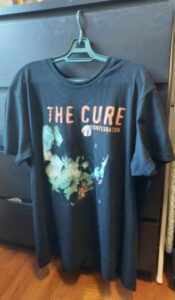


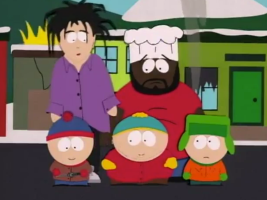
In fact, Disintegration is such a masterpiece I could have included any song off it: Fascination Street, Plainsong, Pictures of You, etc.  No wonder that in a 1998 episode of South Park, Kyle Broflovski shouts at Robert Smith, “Disintegration is the best album ever!”  (Admittedly, he was rather excitable by that point.  His town had been pulverised by Barbra Streisand, who’d transformed into a giant, robot-kaiju called Mecha-Streisand, and Robert Smith had saved the day by transforming into a giant moth and hurling her into outer space: “I have to try,” sighed the Cure’s front-man. “I can’t let Barbra Streisand do this to the entire world.”)


And now for a younger band.  Boy Harsher are a darkwave duo consisting of singer Jae Matthews and producer Augustus Muller, who hail from the American state of Georgia.  They cite among their influences the late, visionary filmmaker David Lynch, though with the next track on my list, a remastered version of Boy Harsher’s 2014 single Pain, I get more of a vibe of the synth tracks John Carpenter devised for the soundtracks of his 1970s and 1980s movies.  That’s initially at least, before Pain’s propulsive beat carries all before it.


Actually, Pain features in a movie itself.  It can be heard during a party scene in the 2022 horror film Terrifier 2.  I haven’t seen it, but I think that’s the one where the villain (Art the Clown) flays a victim and then rubs salt into the wound by, er, rubbing salt into the victim’s catastrophic wounds.  So, having a song called Pain in the film was appropriate.

 

From wikipedia.org / © GRIT PHOTOZINE


In fact, Pain got a remix in 2018 courtesy of the American musician and producer Luis Vasquez who from 2009 was also the single, official member of the band the Soft Moon.  Fittingly, an influence on the Soft Moon’s sound was the celebrated industrial / electronic rock band Nine Inch Nails, itself a one-man-band for the musician and producer Trent Reznor.  (More on Nine Inch Nails later.)  The next item on the list is one of my favourite Soft Moon songs, Become the Lies, from the band’s final album, Exister (2022).  I have to write about Luis Vasquez and the Soft Moon in the past tense because, tragically, Vasquez died in 2024 aged just 44.


Another musician specialising in dark electronica who left us much too soon was Frank Tovey, who as Fad Gadget at the very end of the 1970s and in the early 1980s helped pioneer both the synth-pop and darker Goth sounds that became popular soon after.  Alas, a heart attack claimed Tovey / Gadget at the age of 45 in 2002.  Here’s his first and possibly most famous single, Back to Nature, from 1979.


Fad Gadget has been credited as a big influence on Depeche Mode, though beyond the use of newly affordable musical technology, like synthesisers, I personally can’t see much connection between the ruminative likes of Back to Nature and Depeche Mode’s early, chirpy (and for me, annoying) hits like New Life and Just Can’t Get Enough (both 1981).  Despite being irritated by the early ‘Mode’, I’ve gradually grown to love them as, in their later incarnations, they’ve shifted away from a poppy, kid-friendly synth sound and embraced a darker, harsher, more industrial and Gothic one.


Here’s the stomping Barrel of a Gun, the first single off Depeche Mode’s 1997 album Ultra.  The accompanying video shows how far they’d progressed by then from their early-1980s clean-cut-boys-with-synthesisers phase – this is grungy, decadent, Anton Corbijn-directed artiness.  At least, it is until Dave Gahan starts wandering around in a silly coat covered in Christmas-tree lights.

 

From wikipedia.org / © Mute Records


Here’s something else that’s silly, this time involving America’s awesomely dark and bleak industrial-rock juggernaut Nine Inch Nails (which is basically musician / vocalist / producer Trent Reznor and whoever happens to be in the studio with him at the time).  No, I’m not saying Nine Inch Nails are silly.  But some years ago, they were the subject of a celebrated musical / video ‘mashup’ whereby editor and content creator Garren Lazar married the band’s disturbing song Closer, from the 1994 album The Downward Spiral, onto clips taken from the beloved children’s TV programme The Muppet Show (1976-81).  Hence, the song’s opening drumbeat is performed in the video by Animal, the drummer in the Muppets’ house band, Dr Teeth and the Electric Mayhem.  (Thankfully, Animal doesn’t feature when Reznor sings Closer’s most notorious lyric, “I want to f**k you like an animal.”)


Watching Kermit, Gonzo, Miss Piggy and the rest cavort to this song is a reminder that, loveable though the Muppets are, if you first encountered them at a very young age you might have found them a bit sinister.  For example, the stuff in the video involving a frenetically speeded-up Dr Teeth is downright freaky.  Also featured are some of the human guests who appeared on The Muppet Show, such as Alice Cooper, Cloris Leachman, Rita Moreno, Harry Belafonte and Dudley Moore – Moore’s cameo is particularly worth waiting for.


However, should anyone be upset at me linking to a comical Nine Inch Nails / Muppets mashup, I’ll throw in a bonus link – to a more sombre and majestic mashup where Rory Gamble transposes Nine Inch Nails’ The Day the World Went Away (from 1999’s The Fragile) onto the trailer for Mad Max: Fury Road – Black & Chrome.  Both sonically and visually, it’s a work of genius.  You’ll punch the air when, one minute and ten seconds in, things get cranked up to 11.


Eat Your Makeup is the name of a short film made by American’s God-Emperor of Bad Taste, John Waters, back in 1968.  However, Eat Your Make Up – note the slight difference in the wording – is also the name of a French Goth band and here, to round things off, is their 2005 song I was the Murderer.  It’s a pleasant reminder that at least some of Goth’s musical roots lie in punk rock.

 

© Adipocere Records

Paul Thomas Anderson wins this battle


© Warner Bros. Pictures / Ghoulardi Film Company


The critics have, almost universally, lavished praise on One Battle after Another (2025), the new movie written and directed by Paul Thomas Anderson.  (Though he didn’t try to adapt it directly, Anderson’s script took some inspiration from Thomas Pynchon’s 1990 novel Vineland.)  The praise is richly deserved.  I went to see it in my local cinema a few days ago and, afterwards, I hadn’t felt so exhilarated by a film since watching Mad Max: Fury Road (2015) on a big screen a decade earlier.


Heading the movie’s cast is Leonard DiCaprio, who plays Pat, a bomb-maker involved in a revolutionary American group called the French 75.  The ’75 stick it to The Man by freeing recent Latin-American immigrants from detention centres and blowing up banks and the offices of right-wing politicians.  Surprisingly, the plodding, unshowy Pat has a relationship, then sires a child, with fellow-revolutionary Perfidia Beverley Hills.  Essayed by Teyana Taylor in a short but devastating performance, Perfidia is the opposite of DiCaprio’s character.  She’s a force of nature: loud, fearless and given to flamboyant gestures, like humiliating the sleazy commander of a detention centre by forcing him to jerk off in front of her.  It’s entirely in keeping with her character when she’s shown firing a machine gun whilst massively pregnant.


To put an end to the French 75, the authorities appoint the ruthless and immoral Captain Steven Lockjaw (Sean Penn), coincidentally the detention-centre commander who was made to have that embarrassing, public wank.  Lockjaw captures Perfidia and compels her to rat on her colleagues, and thereafter it becomes open season on the ’75, with most of them being arrested or – more often – summarily executed.  Pat and his now-infant daughter manage to escape with new identities (‘Bob and Willa Ferguson’) and end up living a low-key, mostly off-grid existence in a Californian town called Baktan Cross.  Pat / Bob decays into a booze and dope-raddled paranoid, terrified the past will catch up with them.  Wilma (Chase Infiniti) grows up with no idea of her real origins and becomes a teenager bemused by, and frequently having to nursemaid, her eccentric old dad.


15 years later, Captain Lockjaw is invited to join an Illuminati-like organization called the Christmas Adventurers Club, whose members belong to the white American elite and are wealthy, powerful… and extremely racist.  Lockjaw’s relationship with Pefidia in the days of the French 75 was more than one of pursuer and quarry.  He came to fetishise her, his obsession triggered by that first, masturbatory encounter, and they were briefly intimate prior to her capture – which highlights what a wild, try-anything-once character Perfidia was.  Now Lockjaw fears that he might be Wilma’s father, not Pat / Bob, and having a mixed-race daughter would obviously torpedo his chances of joining the Christmas Adventurers.  So he launches a military crackdown on Baktan Cross, ostensibly to round up illegal immigrants, but really so he can find Pat / Bob and the inconvenient Wilma and erase them.


© Warner Bros. Pictures / Ghoulardi Film Company


That’s the set-up established during One Battle After Another’s first quarter and it’s all you need to know.  What follows is a cinematic rollercoaster ride as Pat / Bob and Wilma, in separate locations when Lockjaw and his uniformed, heavily-armed goons crash into Baktan Cross, flee, hide, fight back and try to find each other and escape.  Along the way, they  encounter Sensei Sergio St. Carlos (Benicio del Toro), Willa’s local karate teacher who’s much more than he seems; a bounty hunter with a conscience (Eric Schweig); an assassin sent by the Christmas Adventurers to clean up Lockjaw’s mess (John Hoogenakker); some skateboarding radicals; a nasty far-right militia who dispose of people for money; and a secret enclave of nuns with guns


As you’ll gather from the synopsis, One Battle After Another is a politically charged movie.  It regularly focuses on how how the USA reacts to immigrants,  often impoverished, frightened and vulnerable people, both mistreating them and unscrupulously using them as pawns in power games and culture wars.  This is timely considering what Trump and his minions are doing at the moment.  It has to be said, though, that Lockjaw and the police and troops under his command go about their business with much more precision, organization and efficiency than the masked, clumping thugs in Trump’s Immigration and Customs Enforcement (ICE) agency have managed so far.  Predictably, you don’t have to look far on the Internet before you find negative reviews of the movie posted by far-right frothers, incensed by what they see as its Marxist / communist / socialist / radical-leftist leanings.


But as well as being political, One Battle After Another is very funny.  DeCaprio’s Pat / Bob may have been a revolutionary once, but for most of the movie he’s an amusingly grumpy and befuddled middle-aged dad, showing zero patience, say, for his daughter’s insistence that he respects her schoolfriends’ preferred pronouns.  Particularly funny are the scenes where, on the run from Lockjaw, he tries to phone what’s left of the French 75 to beg them for help.  He’s far from impressed when they demand he reels off an array of code-phrases to prove he’s who he says he is – codes he’s mostly forgotten during the past 15 years.  DeCaprio’s subsequent meltdowns are hilarious, though these scenes will strike a chord with anyone who, in the days before voice-recognition, tried to phone their bank but failed to cite the right security numbers.


The film makes interesting parallels between the French 75 and the Christmas Adventurers Club.  Though they’re positioned at different ends of society, at the bottom and at the top, both are shrouded in secrecy and pompous security protocols and both believe they are doing great works and bending history to their wills.  Seen from outside, though, they seem like two groups of overgrown kids who’ve set up gangs with stroppy rules about who gets to be ‘in’ and who doesn’t.


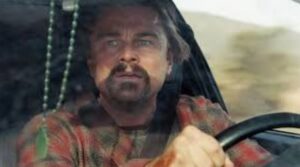
One Battle After Another features, perhaps, Leonardo DeCaprio’s best-ever performance.  His Pat / Bob character is an extension of Rick Dalton, the frustrated over-the-hill movie star he played in Quentin Tarantino’s Once Upon a Time in Hollywood (2019).  But while Dalton had his loyal buddy and stunt double Cliff Booth (Brad Pitt) to keep him from going off the rails, Pat / Bob has no one when the shit hits the fan.  His daughter Willa is elsewhere and he has to overcome his many insecurities and get his act together alone.  At the same time, DeCaprio convinces us that Pat / Bob, despite his chaotic nature, is a loving father.  It’s his desire to save her that keeps him going, no matter what fate throws at him.  And in this film, it throws a lot.


© Warner Bros. Pictures / Ghoulardi Film Company


He’s excellently partnered by Chase Infiniti as Willa.  Though in reality the actress is 25 years old, she convincingly plays a teenager – one who has her head well-screwed-on at the start of proceedings, but who still has to deal with a very steep learning curve.


Meanwhile, Sean Penn is splendidly villainous as Lockjaw.  He’s memorable both because of his grotesque physicality – with his contorted face, weird musculature and lurching gait, he looks like Popeye the Sailor Man rendered in human flesh – and because of his deeply screwed-up personality, which is simultaneously psychotic and pathetic and driven by a juvenile sense of entitlement.


Great though DeCaprio, Infiniti and Penn are, Benicio del Toro comes close to quietly stealing the show.  When he first appears, you see him as a character who’s popped up in DeCaprio’s movie.  But later, having learnt more about him – his character runs an extensive and meticulously-organised sanctuary and support-network for undocumented immigrants in the town – you begin to feel DeCaprio has strayed into his movie.


There’s also a lovely score courtesy of Radiohead’s Johnny Greenwood and, late on, a car chase that could become as legendary as the one in the Steve McQueen classic Bullit (1968).  And Paul Thomas Anderson handles things at all times with aplomb.


One Battle After Another should win a slew of Oscars at next year’s Academy Awards.  By then, though, Donald Trump may have banned all opposition parties in the USA and put the country under martial law, enforced by real-life Steven Lockjaws in ICE, the National Guard and various far-right militias.  So it might not.


If that proves to be the case, I can only say, “Viva la revolution!”


© Warner Bros. Pictures / Ghoulardi Film Company

Furiosa and curiosa


© Warner Bros. Pictures / Kennedy Miller Mitchell


What a strange beast Furiosa: A Mad Max Saga (2024) is.  Yes, it’s a Mad Max movie, directed and co-written by the franchise’s mastermind George Miller.  But it’s one (almost) devoid of Mad Max.  Instead, it concentrates on Imperator Furiosa, the formidable warrior-woman played by Charlize Theron who partnered the title character in 2015’s Mad Max: Fury Road.  Furiosa fills us in on her backstory, from her childhood to early womanhood.  Thus, it’s a prequel to Fury Road and a discombobulating departure from the customary format of the Mad Max films.


If you had to sum up the structure of the earlier four movies in one word, that word would be linear.  Things just barrelled along in a straight line.  Indeed, the two best ones, Mad Max II (1982) and Fury Road, were basically ongoing vehicle chases, with plot and characterisation having to scramble on board during the brief moments when people’s feet eased on the accelerators.  Not that I’m knocking them.  Mad Max II is one of my favourite films of the 1980s and I consider Fury Road one of the best films of the 21st century.


But with Furiosa, Miller – bravely or foolishly, depending on your point of view – abandons the formula that’s hitherto served him so well and presents a movie with other things besides big, metallic, wheeled things hurtling after and crashing into one another.  There are periods of quiet and calm, where the emphasis is on dialogue, characterisation and violence-free drama rather than on hectic, in-your-face action.  Parts of it even get a bit slow.


Which isn’t to say Furiosa lacks action.  It begins with an edge-of-your-seat (if small-scale) chase, and later there are two lengthy action set-pieces that rank among the most thrilling the franchise has produced, even if one of them incorporates a bit too much CGI.  Overall, though, comparing one of the earlier Mad Maxes with this entry is like – to cite two examples from a sub-genre that heavily influenced the series originally, the spaghetti western – comparing Sergio Leone’s lean, taut A Fistful of Dollars (1964) with his sprawling epic Once Upon a Time in the West (1968).


© Warner Bros. Pictures / Kennedy Miller Mitchell


No, I’m not claiming that Furiosa is as good as Once Upon a Time in the West (one of my top half-dozen movies ever, incidentally).  I also think it falls short of the greatness achieved by Fury Road.  But I still found it pretty impressive.  Before I discuss the movie in detail, though, I should warn you – from here on there will be spoilers.


The film gets going with the afore-mentioned chase.  Some scumbag bikers abduct little Furiosa (Alyla Browne) from her community in the Green Place, a Garden of Eden-like hideaway that’s somehow survived the apocalypse that’s ravaged the rest of the earth in the Mad Max version of the future.  Her mother (Charlee Fraser) pursues them into the Wasteland and the scumbag bikers are killed one by one, but not before the last of them manages to deliver Furiosa to Dementus (Chris Hemsworth), leader of a gang with a self-explanatory name, the Biker Horde.


A subsequent attempt to rescue Furiosa results in the mother’s death and Dementus keeps the little girl, partly as his gang’s mascot, partly as a surrogate daughter.  “Do not look away, you mustn’t look away!” he urges her while he crucifies her mother in front of her, believing that the trauma will toughen her up and make her better suited to the Wasteland.  He’s obviously a dad who believes in the ‘school of hard knocks’ approach to raising kids.  He also muses, “When things go bonkers, you have to adapt.”


Later, he and his Horde stumble across the Citadel that figured, or will figure, in Fury Road and come face to face with the Citadel’s implacable, pustular ruler Immortan Joe.  Here, Joe is played by Lachie Hulme.  Hugh Keays-Byrne, the actor who played him in Fury Road (and also played the franchise’s original villain, Toecutter, back in 1979’s Mad Max) passed away in 2020.  The Biker Horde manages to capture the Citadel’s satellite-settlement Gastown, responsible for producing the fuel for Joe’s vehicles.  After some hard bargaining, Joe reluctantly cedes control of Gastown to Dementus, but demands some concessions from the biking warlord in return.  These include him taking custody of Furiosa.


© Warner Bros. Pictures / Kennedy Miller Mitchell


Born in the healthy environs of the Green Place, Furiosa is genetically undamaged and Joe, desperate for some normal-bodied and able-minded offspring, fancies her as a future wife.  As we know from Fury Road, he has a squad of young wives locked away for breeding purposes, though the results have been disappointing so far – as evidenced by the two sons he’s acquired, the hulking, thick-as-mince Rictus Erectus (Nathan Jones) and the psychotic Scabrous Scrotus (Josh Helman).  Not keen on the idea of ending up a spouse to Immortan Joe, Furiosa escapes from his harem, disguises herself as a boy, pretends to be mute and finds employment in the Citadel’s garages.


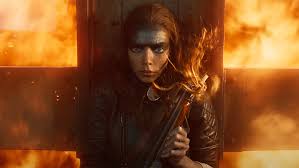
A few years later, after various adventures, and now played by Anya Taylor-Joy, Furiosa becomes apprenticed to the tough but kindly Praetorian Jack (Tom Burke), driver of the War Rig, the giant truck that’s the pride of Joe’s vehicular fleet.  “You have about you a purposeful savagery,” Praetorian Jack informs her, which in the Wasteland is as close to a compliment as you can get.


Praetorian Jack and the now Praetorian Furiosa gradually bond, to the point where Jack agrees to help her return to the Green Place.  But bigger events get in their way.  Namely, Dementus’s running of Gastown becomes such a disaster that Immortan Joe and his allies vow to get rid of him, even if this means a full-scale war raging in the Wasteland…


One thing I liked about Furiosa was the chance to see certain characters from Fury Road again.  Not just Immortan Joe, but subsidiary villains like Rictus Erectus, the People Eater (John Howard), the Bullet Farmer (Lee Perry, replacing the original actor Richard Carter, who died in 2019) and the Organic Mechanic (Angus Sampson), who’s the nearest thing in the Wasteland to a GP and has the thankless task of delivering Joe’s stillborn and / or mutant kids.  But what pleased me most was a fleeting reappearance by the Doof Warrior, the goon who rides in front of a giant wall of speakers whilst playing a splendid, flamethrowing electric guitar.


© Warner Bros. Pictures / Kennedy Miller Mitchell


Furiosa presents us with some cool new characters as well, mostly in Dementus’s entourage.  There’s the piratical Rizzdale Pell (Lachy Hulme in a second role) who, unlike normal movie pirates, doesn’t bother to conceal an empty eye-socket with an eyepatch.  Also facially disfigured is the zombie-like Mr. Norton, who’s actually a Ms. and is played by Elsa Pataky, Chris Hemsworth’s real-life wife, no less.  And I was impressed by the Octoboss (Goran D. Kleut), a satanic figure clad in black, horned armour who rides / flies into battle on a motorbike-cum-kite, trailing a long, black, tendrilous parachute behind him.


Dementus also employs two cheerleaders.  He has a Gollum-like weirdo called Smeg (David Collins) acting out his ever-changing moods in a series of strange, performative dances.  And he has a warm-up man called the History Man (George Shevstov) who warns potential adversaries about his boss’s ‘congress of destruction’, i.e., the thousands of motorbikes massed behind him.  The History Man additionally serves the gang as a bard and as an archivist of knowledge, stories and language, which he has tattooed in tiny writing all over his body.  He’s asked to dredge up appropriate words from the mostly-forgotten lexicon of English to mark special occasions: “History Man!  A word-burger if you please!”  And he provides the film with its narration, which implies the saga of Furiosa has been added to this anarchic society’s repository of legend and lore.


But among the new characters, the biggest star is Dementus himself.  Chris Hemsworth obviously relished the opportunity to set aside his goody-two-shoes image as Thor in the Marvel cinematic universe and play somebody gloriously, evilly unhinged.  While cunning and ruthless enough to make a credible post-apocalyptic warlord, there’s also a touch of ridiculous, Spinal Tap-style heavy metal-ness about him.  This means that, ultimately, he’s never going to be smart enough to defeat Immortan Joe, still Top Dog when Fury Road rolls around.  He’s merely likely to cause a lot of damage along the way. Inevitably, Dementus gets the best lines.  He goadingly demands of Furiosa, “Do you have it in you to make it epic?” or “Where were you going, so full of hope?  There is no hope!”  Best of all is a muttered aside when a minion disputes his orders: “Hmm, questioning my boss-ority…”


© Warner Bros. Pictures / Kennedy Miller Mitchell


It says a lot for the more measured performances by Anya Taylor-Joy and Tom Burke that they manage to make their presences felt, and Hemsworth doesn’t walk away with the film.


With so many good elements, then, why do I feel Furiosa is less effective than Fury Road?  Well, it’s a bit too long and, while earlier parts of the film are languidly paced, there’s rather too much happening, too much Machiavellian scheming and double-crossing going on, in its later stages.  Also, the franchise’s long-term fans will be frustrated that the war between Dementus and Irmmortan Joe, when it finally arrives, is represented only by a brief montage and a voice-over from the History Man.  Instead, the film’s focus becomes personal.  It zooms in on Furiosa pursuing and confronting Dementus over her mother’s long-ago murder.  I can see what Miller was trying to do, and respect his bravery in doing it, but I’d have preferred things to end with a bigger bang.


Still, after seeing it a few days ago, I haven’t stopped thinking about Furiosa.  Things about it that didn’t occur to me in the cinema have occurred to me since.  For example, the nature of Praetorian Jack’s relationship with Furiosa is kept vague and at the time I wasn’t sure if it was supposed to be a romantic one.  Now I see him more as being a father-figure to her, which nicely fills the void left by her mother’s death.  I also appreciate, with hindsight, how the script uses peaches – yes, peaches – as a motif.  Furiosa is seen picking them at the start, her mother gives her a peach-pit as a memento shortly before she dies, and the same pit has a bearing on what Furiosa does to Dementus at the end (at least, according to the story she tells the History Man).


© Warner Bros. Pictures / Kennedy Miller Mitchell


And during a Wasteland sequence that’s particularly brutal and traumatic for Furiosa, Miller’s camera leaps back into the surrounding mountains for a moment, and we see a familiar silhouette watching events from afar, next to his trademark V8 Interceptor.  I wonder now if Mad Max’s cameo is meant to show he has a connection with Furiosa even before he meets her in Fury Road.  Does what he observes here remind him of the loss of his family in the original movie?


Despite its quality, Furiosa has done badly at the box office.  I suspect many blokes who enjoy action movies chose to skip this one because it wasn’t about Mad Max but about – ugh! – a girl.  Conversely, it obviously didn’t appeal to family audiences.  About a girl it may be, but Furiosa is also the most brutal Mad Max film yet.  It’s got the highest body-count and, while the franchise has always managed to be violent without wallowing in gore, there are more moments than usual where bullets strike faces, flamethrowers torch bodies, throats get slashed and body-parts are severed.  Sadly, Furiosa‘s underperformance has cast doubt on whether George Miller’s planned sixth entry in the franchise, Mad Max: The Wasteland, will ever be filmed.


To borrow two of Dementus’s quotes…  It’s a pity that after Furiosa’s box-office flop, people are questioning Miller’s boss-ority.  Because he still has in him to be epic.


© Warner Bros. Pictures / Kennedy Miller Mitchell