30 years on, it’s still the worst toilet in Scotland


© Channel Four Films / PolyGram Filmed Entertainment


Just over a year ago, I posted on this blog about the sad closure of The Projector, Singapore’s alternative cinema.  According to a statement on the cinema’s Facebook page, this was caused by “rising operational costs, shifting audience habits, and the global decline in cinema attendance,” factors that had “made sustaining an independent model in Singapore especially challenging.”  The Projector was the one venue in the city-state where you could see, on a big screen, independent and arthouse films, ones that were generally offbeat, ones focused on minorities and not necessarily made in the handful of big international languages.  It also offered opportunities to watch older movies in a cinema, for example, ones by Alfred Hitchcock, Akira Kurosawa and David Lynch.  Though sometimes it showed modern Hollywood and Chinese blockbusters too.


The Projector operated at two locations, the Cineleisure shopping mall on Grange Road and the Golden Mile Tower on Beach Road.  Happily, this year, a new cinema called The Filmhouse has started doing business in The Projector’s Golden Mile Tower premises and has a similar agenda of showing films you wouldn’t otherwise see in Singaporean cinemas.  According to Wikipedia, The Filmhouse retains “certain key team members and features” from The Projector.


Last week, I made my first visit to The Filmhouse and was pleased to find it busy.  It’s a smaller operation than The Projector with, as far as I can ascertain, just two screens, but probably that makes more financial sense – a non-mainstream cinema can’t afford to have many overheads.  The lobby contained a bar, comfortable seats and, most importantly, a relaxed and friendly ambience.


When I went into one of the halls and found my seat, I was slightly disappointed that, before the movie started, the short film warning patrons to keep their phones silent and refrain from using them during the show wasn’t the famous one used by The Projector.  That had footage from the super-schlocky Turkish science-fiction movie Dünyayı Kurtaran Adam, better known as Turkish Star Wars, and featured ‘Turkish Luke Skywalker’ training for battle by smashing his big fists repeatedly against a desert boulder.  You were warned that if you violated the cinema’s policy on phone-use, you would suffer punishment similar to that being inflicted on the rock.


Still, The Filmhouse’s anti-phone film is cute enough.  It has a brief clip of the late David Lynch telling us, “You have a very good heart.’  Then we’re asked to prove Lynch right about our hearts by turning off or muting our devices and not spoiling anyone else’s enjoyment of the movie with them.


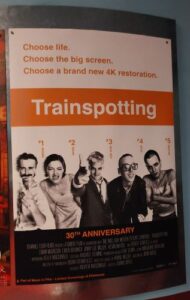
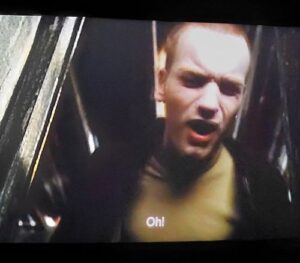
Anyway, what was the film I went to see?  It was a 30th-anniversary showing of Danny Boyle’s Trainspotting (1996), freshly spruced up for cinematic re-release.  As the movie poster’s tagline announced: “Choose life.  Choose the big screen.  Choose a brand new 4K restoration.”


At the time of its release, Trainspotting caught the zeitgeist of mid-1990s Britain, obsessed with Britpop and all things Cool Britannia.  Yes, how long ago that all seems now.  To be honest, it annoyed me in some ways that the movie got lumped in with the Britpop / Cool Britannia thing, even if the filmmakers opportunistically loaded its soundtrack with music of the time, by bands such as Pulp, Blur, Sleeper, Elastica, Leftfield and Underworld.  That said, the two songs that defined the film, Iggy Pop’s Lust for Life from 1977 and Lou Reed’s Perfect Day from 1972, had nothing to do with 1990s Britain.


To me Trainspotting sprang from an earlier, darker and less glamorous era than the one of Damien Hirst’s formaldehyde shark, Geri Halliwell’s Union Jack mini-skirt and Blur-versus-Oasis – namely, the mid-to-late 1980s, when Edinburgh’s boom in heroin use and the subsequent, resultant HIV / AIDS epidemic led to the city being dubbed ‘the AIDS capital of Europe’.


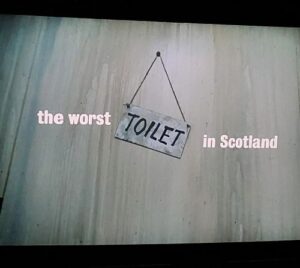
This became material for the book that inspired the film, Irvine Welsh’s novel Trainspotting (1993), which is an altogether bleaker and rougher-edged piece of work than Boyle’s cinematic version.  Though of course the film isn’t without its bleak or rough-edged moments either.  The worst toilet in Scotland, anyone?


© Channel Four Films / PolyGram Filmed Entertainment


Still, I’m not complaining too much.  I think both Trainspotting the book and Trainspotting the movie are great and are classics in their respective fields, 1990s Scottish literature and 1990s British cinema.  But after 30 years, how would the latter work hold up?


Pretty well, I thought, though the animatronic zombie-baby that Renton (Ewan McGregor) imagines crawling across the ceiling during a traumatic ‘cold turkey’ episode looks terrible now.  Mind you, it looked ropey enough in 1996.


I wondered how, in these days of extreme anxiety about sex predators preying on children, the gag about Renton meeting Diane (Kelly Macdonald) in a nightclub, going home with her and discovering the next day that she’s still at school would come across.  Not as ickily as I feared.  Diane is clearly the one doing the manipulating and Renton is properly horrified when he learns how old she is really.  Plus, McDonald’s true age at the time, 20, means the sequence’s punchline, when Diane appears in her school uniform, is cringily funny but – thankfully – a bit unbelievable.


Meanwhile, I winced at the scene following the death of Tommy (Kevin McKidd), where a grieving Spud (Ewan Bremner) pays tribute to his late friend by singing Two Little Boys – a song popularised by, and forever associated with, the Australian entertainer, TV personality and artist Rolf Harris, who had a smash-hit with it in 1969.  In 2014, Harris hit the headlines when he was found guilty of sexually assaulting four underage girls.  But to be fair to Two Little Boys, it was around long before Harris got his hands on it.  It was written in 1903 by composer Theodore F. Morse and lyricist Edward Madden.


The Singaporean audience I saw Trainspotting with certainly enjoyed it, even though I wondered how a film about heroin addicts would go down in a country with some of the strictest anti-drugs laws in the world.  If Trainspotting had taken place in Singapore, the drug dealing characters in it like ‘Mother Superior’ (Peter Mullan) and Mikey Forrester (Welsh in a cameo) would have been executed long ago.  Much of it they found funny, which is appropriate because the film is essentially a (very black) comedy.  The Worst Toilet in Scotland sequence and the one where the hapless Spud spectacularly soils the bedsheets in the house of this girlfriend Gail’s (Shirley Henderson) parents, then manages to scatter the contents of those bedsheets across Gail, her parents and their kitchen, elicited guffaws.


© Channel Four Films / PolyGram Filmed Entertainment


Also getting laughs was Renton’s famous ‘It’s shite being Scottish’ rant.  He may have hit a chord with the audience when he raged, “Some hate the English.  I don’t.  They’re just wankers.  We, on the other hand, are colonised by wankers!”  The Singaporeans, of course, were once colonised by the English too – though, technically, as part of the British Empire, they were colonised by the Scots and Welsh as well.


On the other hand, I must have been the only person in the cinema-hall chuckling during the references to and jokes about Sean Connery.  (“Do you shee the beasht?  Have you got it in your shights?”  “Clear enough, Missh Moneypenny!  This should preshent no shignificant problemsh”)  Most folk there were about half my age and I guess ‘Big Sean’ is unknown to the younger generation.


One thing I felt about seeing Trainspotting 30 years on was that now the Britpop musical soundtrack sounds quaint rather than cutting edge, and now that I know the punchlines to all the jokes about jobbies, Sean Connery and so on, its depiction of heroin addiction is more on-the-nose.  Without the film’s cultural baggage distracting me, I better perceived the horribleness of the characters’ situations.  Like when baby Dawn – whose zombie-fied form Renton will hallucinate about later – dies from neglect and her parents, Sick-Boy and Allison (Susan Vidler), after a moment’s anguish, greedily reach for the syringes, needles and smack again.  Or when Tommy – who was originally the healthiest and most level-headed of the gang – becomes ruinously addicted and, while he lies ravaged on a mattress, a conscience-stricken Renton tries to apologise for getting him hooked on the stuff.  Tommy pays the apology no heed and is interested only in getting money for his next fix.


Another thing I noticed in 2026 about Trainspotting is that, for a film supposed to be the greatest one ever set in Edinburgh, you see very little of Edinburgh in it.  You have the famous opening scene where Renton, Spud and Sick-Boy try to shoplift in (the now long-gone) John Menzies bookstore on Princes Street and are chased along the thoroughfare by security, with Renton making a last, doomed break for freedom down Calton Road and under Waterloo Place.  But that’s all.  The streets, side-streets, bunker-like nightclubs, pub-interiors and blighted junkies’ dens could be anywhere.  Though that’s hardly surprising considering it was partly funded by the Glasgow Film Fund and most of it was shot in Glasgow.


Compare that with the sequel, T2: Trainspotting (2017), which was partly based on Irvine Welsh’s literary follow-up Porno (2003), also used some bits from the novel Trainspotting that didn’t get into the first film, and also featured stuff from scriptwriter John Hodge’s own imagination – like the psychotic Frank Begbie (Robert Carlyle) staging an escape from Saughton Prison.  In T2, you get to see the Royal Mile, the Grassmarket, Cockburn Street, Harvey Nichols, the Scottish Parliament, the tram system, the Forth Road Bridge and Salisbury Crags.  It’s practically a love-letter to the Scottish capital.


Still, a few months ago, I was in Edinburgh and found myself walking down Calton Road.  And my immediate reation was, “Hey, this is where Ewan McGregor ran and got caught in Trainspotting!”  So one little piece of the city, at least, was immortalised by the original film.


Orange man upsets Orangemen


From wikipedia.org / © The White House


It’s difficult these days to find anyone outside the borders of the USA who likes President Donald J. Trump.  Not after he insisted on imposing tariffs on nearly everyone else in the world, from Canada and the European Union to remote Antarctic islands whose populations are limited to penguins.  Not after he launched his ham-fisted ‘military operation’ against Iran – and was seemingly blindsided by the fact that Iran, a country bordering the Strait of Hormuz, a vital artery for the world’s oil supplies, promptly retaliated by blocking that artery.  Didn’t see that one coming, did you, Donny?


There certainly wasn’t much love for Trump displayed when he landed in Ireland – the southern part – at the weekend and protestors marched through the streets of Dublin carrying signs saying things like: ‘DONALD TRUMP, YOU FLEW ALL THE WAY TO IRELAND JUST TO FIND WE DON’T F*CKING LIKE YOU EITHER.  NOW F*CK OFF HOME.’  They also carried some graphic Trump-shaped balloons, in the act of getting it up the butt from other human-shaped balloons, including a Benjamin Netanyahu one.  Later, on his golf course at Doonbeg in Country Clare, four protestors arranged themselves in a line and bent their bodies into the forms of four letters: ‘T’, ‘N’, ‘U’ and ‘C’.  I may have got the order of the spelling wrong.


However, there’s one group of non-American people who believe Trump is the absolute bees’ knees.  In fact, you’ll find them in another part of the island of Ireland.  I’m talking about Northern Ireland’s hard-right-wing, fiercely pro-British Democratic Unionist Party (DUP).  They love Trump.  Well, they did until very recently.


This is unsurprising.  There are many similarities between the views of the DUP and those of Trump and his cult-like Make America Great Again (MAGA) followers.  The MAGA faithful contain many evangelical Christians who believe stuff like the reason no dinosaurs exist today is because they were too large to get on board Noah’s Ark.  Similarly, the DUP includes among its ranks such God-bothering, science-hating specimens as Thomas Buchanan, Member of the Northern Irish Assembly (MLA) for West Tyrone and a campaigner for the teaching of creationism in schools, who rejects evolution as a “peddled lie” because, he reckons, “the world was spoken into existence in six days by His power”.


Trump and MAGA’s contempt for science is expressed most clearly in their claim that man-made climate change isn’t happening and is all a hoax – a convenient belief for Trump to have, seeing how much money fossil fuel companies pumped into his election campaigns – despite the fact that 97% of actively-publishing climate scientists agree that climate-warming in the past century is highly likely because of human activities.


From wikipedia.org / © UK Parliament


That’s also the DUP’s stance, articulated especially by Sammy Wilson, currently Member of Parliament for East Antrim.  It was mind-melting that Wilson served as Environment Minister at the Northern Irish Assembly from 2008 to 2009.  During his tenure, he blocked a government advertising campaign designed to encourage people to cut their energy consumption and reduce C02 emissions.  He also described climate activists as a ‘hysterical pseudo-religion’.  And he said, “The tactic used by the ‘green gang is to label anyone who dares disagree with their view of climate change as some kind of nutcase who denies scientific fact.”  Talk about incriminating yourself.


Like Trump and his adherents, the DUP likes nothing better than to dump on minorities.  These might be people of colour.  When ethnic minorities were targeted and burned out of their homes during a riot in Belfast in June, it was as much their fault – ‘problematic foreign cultures’ – as that of the rioters and arsonists, according to certain DUP politicians.


Or they might be members of the LGBTQ community.  See comments by Buchanan and Iris Robinson, senior DUP figure and wife of one-time DUP leader Peter Robinson, about homosexuality being an ‘abomination’, or Trevor Clarke, MLA for South Antrim, who until 2016 believed that HIV affected gay people only.  Oddly for a party that chants endlessly about Northern Ireland being as ‘British’ as the rest of the UK, it opposed the province allowing same-sex marriage (which finally happened in 2020) at a time when same-sex marriage was legal in England, Scotland and Wales.


Like Trump, the DUP has a fondness for lining their pockets and for dark money.  For instance, there was the ultra-dodgy Renewable Heat Incentive, or ‘cash-for-ash’ scheme, which was introduced in 2012 while Arlene Foster – later to be DUP leader and Northern Irish First Minister – ran Northern Ireland’s Department of Enterprise, Trade and Investment.  Ostensibly, this encouraged people to switch from fossil fuel to biomass heating systems.  In reality, it meant unscrupulous farmers – many of them no doubt DUP voters – could set up biomass heating systems in empty cowsheds and still claim back £1.60 for every £1 they spent.  The scheme’s believed to have cost taxpayers some £400 million.


And then there was a £425,000 donation to the DUP from the shady anti-Scottish-independence organisation the Constitutional Research Council, rumoured to have really originated in Saudi Arabia, India or even Putin’s Russia.  In 2016, in the run-up to the referendum on Britain’s continued membership of the European Union, £282,000 of this was spent by the DUP on a ‘Vote Leave’ advertisement in a newspaper that wasn’t even published in Northern Ireland.


Trump is a man who proclaims his Christianity and does photo-ops with the Bible when there’s right-wing American Christian voters to woo, yet happily does such un-Christian things as cheat on his wife and have a fling with a pornographic movie actress, or brag about his technique with the ladies, which is mainly to ‘grab ‘em by the pussy.’  He has kindred spirits in the supposedly fiercely Christian DUP.  For instance, there was the 2009 scandal involving Iris Robinson, who had an extramarital affair with a lad young enough to be her grandson and also illegally procured some £50,000 to help him with a business project.


Earlier, in 1996, Sammy Wilson was involved in a stushie when the Sunday World newspaper published photos of him and his ex-girlfriend romping nakedly during a holiday in France.  Funnily enough, Wilson went on to denounce breast-feeding in public as ‘exhibitionism’.  In Wilson’s world-view, it’s obvious that ‘bare boobs during naked holiday romps = good’, but ‘bare boobs for feeding hungry babies = bad’.


Maybe the most striking overlap between Trumpism and the DUP are sexual assault cases involving their leaders.  E. Jean Caroll claimed Trump sexually assaulted her in the mid-1990s and brought two civil lawsuits against him, which were decided in her favour – though Trump is currently pestering the Supreme Court about an appeal.  It may or may not be a coincidence that he’s mentioned 38,000 times in Justice Department files relating to the activities of the late child-sex trafficker Jeffrey Eptstein.  Meanwhile, in 2026, Newry Crown Court found Jeffrey Donaldson, leader of the DUP from 2021 to 2024, guilty of “18 charges: one count of rape, four of gross indecency, and 13 of indecent assault.”


From the Belfast Telegraph


Given all these alignments, it was no surprise that in 2020 when Trump was campaigning for re-election after his first term as president (and lost, although ever since then he’s been lying that he won), three DUP MPs – Wilson, Paul Girvan and Ian Paisley Jr – were photographed posing with a banner saying ‘TRUMP – 2020 – KEEP AMERICA GREAT!’ outside the Houses of Parliament.  Paisley Jr claimed to be ‘good friends’ with Trump and “added that the president keeps a framed picture of himself with his father, the former First Minister of Northern Ireland who died in 2014.


As one-time MP for North Antrim, Paisley Jr got “suspended from the Commons for thirty sitting days, for not declaring visits to Sri Lanka paid for by the Sri Lankan government and for breaking the Commons rule banning paid advocacy…”, i.e., for accepting “very expensive hospitality, for himself and his family, from an overseas government accused of serious human rights violations.”  He got into similar bother over an undisclosed trip to the Maldives.  So the former MP for North Antrim, Sri Lanka and the Maldives is obviously a man after Trump’s heart.


Anyway, I’ve been roaring with laughter since the weekend.  During his sojourn in southern Ireland, Trump threw his staunchly pro-British DUP admirers under the bus when he opined about the future of Ireland, north and south.  “I will ‌tell you,” he said during a press conference with the taoiseach Michael Martin, “I’d love ‌to see it unified…  You know what?  The way I look at it, it’s going to happen eventually.  It may as well happen now…  The UK will have something to say about it, obviously.  But I think it would be a great thing.  I mean, how can it be bad?”  Later, he doubled down on what he’d said.  “Many people agree.  I made what I considered to be a fairly routine comment.  I have had so much support on that.”


The moral of this story is that, once again, there is zero point in sucking up to Trump.  No matter how oleaginous you are towards him, he will, sooner or later, through malice, narcissism, stupidity or dementia, or a combination of all four, crap all over you.


Ian Paisley Jr retorted: “Everyone is allowed a personal opinion even when it’s wrong.”  Accusing Trump of being wrong?  Oh dear, Ian.  That framed picture of you and your dad may not be hanging on the White House wall for much longer.


From wikipedia.org / © UK Parliament

More musical genres I don’t like


From wikipedia.org / © Michael Spencer


It’s time to put poison pen to paper, or poison fingers to keyboard, and release more bile about more types of music I can’t stand.  Having poured scorn on jazz, country and Irish, prog rock and disco music in my previous post, I’ll now address another four musical genres that I’d sooner poke a sharpened stick into my ear than listen to. And first up is…


New romantic

Just into my teens, in the late 1970s and early 1980s, I naively thought it was a great time to like music.  Punk had recently happened and on its heels had arrived the new wave bands.  Even on mainstream outlets, such as the BBC’s Radio 1 and its flagship TV music-show Top of the Pops (1964-2006), you regularly heard the likes of Blondie, the Jam, Elvis Costello and the Attractions, Ian Dury and the Blockheads, the Boomtown Rats, Talking Heads, the Undertones and Martha and the Muffins.  Some of these artists ranked highly in the singles and albums charts and a few even made it to number one.  Thus, frequently, the period had a nice correlation between what was popular and what sounded good.


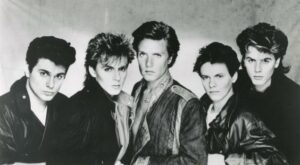
It couldn’t last.  Indeed, I remember the moment things changed.  Early in 1981, I was watching an episode of Tiswas, the anarchic Saturday-morning kids’ TV show, when presenter Chris Tarrant said words to the effect of, “Here’s a video of a song by a great new band called Duran Duran!”  Then I found myself staring at my TV screen in bafflement, trying to make sense of the figures of Simon Le Bon, Nick Rhodes and Andy, John and Roger Taylor, wearing puffy and frilly shirts, sporting floppy fringes and slathered in make-up, while they cavorted to the strains of Planet Earth.  The new romantic craze had begun.  The horror!
 

From wikipedia.org / © Ben Aris / Capitol Records


Thereafter came a flood: Spandau Ballet, Culture Club, Wham, Visage, A Flock of Seagulls, Classix Nouveaux, Kajagoogoo, the Thompson Twins, Tears for Fears, all of whom drove me up the walls.  Vacuous songs.  Production qualities that might have sounded hi-tech in the 1980s but just sound dated now, all dinky drums and plinky keyboards.  A smug dedication to style over substance, with the performers lavishly dressed and expensively coiffured.  Maybe I’m giving them more social significance than they deserved, but they seemed to personify the flash-your-cash, greed-is-good ethos of the Thatcherite 1980s.


Now you can reply to my moaning by saying, “Well, if you didn’t like them, you didn’t have to listen to them!”  But actually, back then, you did.  For a couple of years, the new romantic bands were everywhere,  On the radio.  On TV.  On the covers of glossy new teenybop magazines like Smash Hits and Number One.  In the newspapers – never more so than when the Sun famously ran the headline, ‘BOY GEORGE’S BIG SECRET: I PREFER A CUP OF TEA TO SEX’.


Things got particularly bad in 1984-85, during my second year as a student at Aberdeen University, when to make ends meet I worked in a nightclub called Ritzy’s three or four evenings a week.  I was a member of its floor-staff and the club’s DJ liked his new romantic records.  It was truly gruelling to have to collect glasses and empty ashtrays whilst being blasted by Spandau Ballet crooning their way through True (1983), and then Wham chirping Wake Me Up Before You Go-Go (1984), and then Simon Le Bon conspicuously failing to hit the high notes in Duran Duran’s Wild Boys (1984), and then, oh joy, Boy George ruminating, “War, war is stupid, and people are stupid…” in Culture Club’s The War Song (1984).  Happy memories…  Not.


Honourable exceptions: David Sylvian’s outfit Japan were sometimes called a new romantic band and I thought they were pretty good.  And I liked Adam and the Ants, at least, up until Adam Ant turned into a dandy highwayman.  And though I’ve just given Duran Duran a kicking, I’ll admit that their late-career hit Ordinary World (1992) is a lovely song.  In fact, Ordinary World has featured in not one, but two textbook examples of how to use pop music effectively in movies – Matthew Vaughan’s stylish gangster film The Layer Cake (2004) and Nia DaCosta’s superb zombie flick 28 Years Later: The Bone Temple (2026).
 

From wikipedia.org / © Capitol Records


Hair metal

During the first half of the 1980s, it wasn’t easy being a heavy metal fan, as I was.  Heavy metal had a serious image problem then.  Both conservatives and left-wingers regarded it as music made for disreputable, juvenile, sexist, dumbly hedonistic louts.  It didn’t help that metal’s most visible sub-genre at the time was all of those things.  There’s nothing wrong with being disreputable, but hair metal was also juvenile, sexist, dumbly hedonistic and loutish.  (And at the same time, kind of lame – I’ll get to that in a minute.)


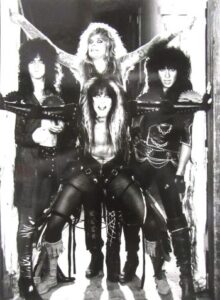
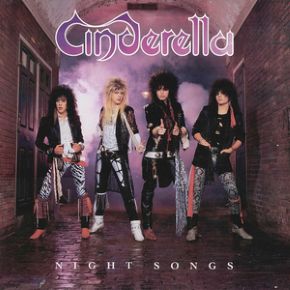
Actually, its practitioners referred to the music as ‘glam metal’ but, given the extravagant, backcombed locks they sported, and the amount of hairspray they used, I prefer the more dismissive moniker ‘hair metal’.  The movement received other disdainful nicknames too, which is a testimony to how disliked it was.  The bands – Mötley Crüe (who added umlauts to their name not because they liked listening to Motörhead, but because they liked drinking Löwenbräu), Quiet Riot, W.A.S.P., Ratt, Poison, Warrant, Dokken, Cinderella – were sneeringly called ‘poodle-heads’.  Their sound was also described as ‘butt rock’.


Clad in spandex, caked in make-up, jangling with accessories and balancing on their bonces the aforementioned ‘big’ hair, whilst singing songs whose lyrics sounded like they’d been written by Frank Kelly’s Father Jack Hackett character in Father Ted (1995-98) – see Mötley Crüe’s Girls, Girls, Girls (1987) – they were bloody awful.  To my ears, they weren’t even that metal.  They used poppy guitar riffs and harmonies and churned out an ungodly number of power ballads.


A decade earlier, God had put an end to the foolishness of prog rock by creating punk music.  Thankfully, around 1988 or so, He again decided enough was enough and created grunge.  Once kids started listening to Kurt Cobain and co, the poodle-heads became history.  Incidentally, there’s a 2005 song by the surreal English indie band Half Man Half Biscuit called Upon Westminster Bridge whose lyrics sum up my feelings about hair metal.  It goes “Oh help me Mrs Medlicott / I don’t know what to do / I’ve only got three bullets / And there’s four of Mötley Crüe.


Honourable exceptions: Guns n’ Roses.  That’s it.
 

From wikipedia.org / © Mercury Records


Thankfully, after hair metal’s demise, heavy metal couldn’t possibly produce another sub-genre that was so horrible.  Could it?  Well…


Nu metal

“I’d rather have my eyelids pulled out than listen to nu metal,” David Mustaine, the frontman of Megadeth, once remarked.  Which is ironic, considering that the one time I saw Megadeth play live, in Chicago in 1995, the support bands included Korn, an outfit credited with helping to kickstart nu metal in the first place.


Mustaine’s disdain for nu metal is typical of many in the traditional heavy metal community, who thought the music of Korn, Limp Bizkit, Linkin Park, the Deftones, Disturbed, Alien Ant Farm, Papa Roach, etc., sucked because it incorporated influences from hip-hop while neglecting the established staples of heavy metal, such as guitar solos.  Mustaine was particularly sore about nu metal’s absence of guitar solos: “I’m talking about the bands that wouldn’t do guitar solos. Guys who get out there and they’d do rhythms and stuff but they’d never do a guitar solo…”


Well, I don’t mind heavy metal music not having guitar solos and certainly don’t mind it being influenced by hip-hop.  Indeed, I love some of the bands who tried to fuse the two genres before the existence of nu metal (and inadvertently became the inspiration for it): Faith No More, the early Beastie Boys and the mighty Rage Against the Machine.  In fact, RATM’s Tom Morello has stated: “For better or worse, Rage Against the Machine seemed to have planted the seeds for the genre that sprung up known as nu metal.  My apologies.”


But I found most nu metal music to be a pain in the arse, a crime against the ears and an affront to the intelligence.  The first – and by far the worst – negative about it was the toxic, misogynistic, bro-y energy it seemed to generate in its heyday.  As Tom Morello observed, “the ethos of it tended to be… anti-woman and fratty.”  This reached its nadir at the Woodstock 1999 festival when, during a Saturday evening performance by Limp Bizkit, the crowd erupted into an orgy of vandalism, violence and sexual assault.

 

From wikipedia.org / © Ruzov Dimitry


Add to that its fashion sense, or lack of one.  Every nu metal band looks a nightmarish collision of chin beards, frosted tips, dreadlocks, shaven scalps, piercings, tattoos, baseball caps, beanies, cargo pants, baggy shorts, hoodies, sports tops and white socks.  Plus the lyrics which, when they aren’t being misogynistic, are being whiny.  The New Musical Express once summarised them as: “I hate my daddy wah wah I’m drowning do you know how it feels to be face down in a rotting corpse drownin’ in blood so ashamed of who I am… wah wah wah wah.”


Honourable exceptions: I like some stuff by Korn, Slipknot and System of a Down.


Emo

The journalist Gavin Baddeley described emo in his 2015 book Street Culture as ‘punk for kids not ashamed of being smart or showing their feelings… The look was a blend of preppy punk and geek chic… the attitude one of angst, unabashed awkwardness and frustration, making it a powerful draw for smart teenaged misfits.”  He also detailed emo fashions: “…tight black jeans and skinny-fit band t-shirts, sneakers… piercings and tattoos… plenty of black hair-dye and eyeliner…”


Well, I have difficulty telling the difference between emo and another, equally black-clad sub-culture, goth.  Yes, I know emo is supposed to have its roots in the American hardcore punk scene in the 1980s, whereas goth was a melancholy offshoot of an older punk scene, the UK one in the late 1970s.  But all the same…  I can’t help but think of a 2013 episode of the TV cartoon-show South Park in which the Goth Kids try to explain the distinction to a child-protection officer: “A goth believes that, deep down, the world is totally f*cked up, but an emo believes that, deep down, they are totally f*cked up…  Emos are more prone to suicide but goths are more prone to be depressed that so many people commit suicide…  Goths’ darkness is nihilistic whereas emos’ is cynical…  Wait, I thought we were cynical…”


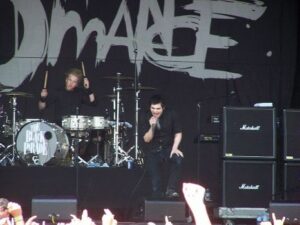
Anyway, I’ve nothing against the sub-culture of emo and its adherents.  My beef is that emo bands – like My Chemical Romance, Funeral for a Friend, Fall Out Boy, Jimmy Eat World, Paramore – simply do nothing for me.  Sorry.


Honourable exceptions: I’ve seen Death Cab for Cutie described, in their early years, as an emo band, and I like them.

 

From wikipedia.org / © Jezebel Parker


And now I have all that worked out of my system, I’ll hopefully return to writing about nicer subjects shortly.

Musical genres I don’t like


From pixabay.com / © Fietzfotos


In recent years, I’ve tried to follow the adage, “If you don’t have anything nice to say, don’t say anything at all.”  Therefore, rather than write about books, films, TV shows, etc., I thought were bad and slag them off, I’ve tried to focus on works I thought were good and be positive in my vibes.


However, I got out of the wrong side of the bed this morning and feel grumpy.  So, here’s a post radiating unapologetic negativity – about some genres of music that I always thought were a bit, or a lot, rubbish.  But my diatribes will also mention some honourable exceptions, thus leavening the darkness with a little sunshine.


Jazz

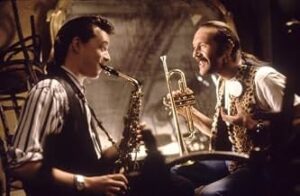
There’s a sizeable segment of the world’s music-loving population who think jazz music is the bees’ knees.  But it never did much for me.  In fact, I agree with Jimmy Rabbitte, the youthful Svengali behind the band in The Commitments (1991).  After Dean the saxophone player starts sneaking jazz bits into the band’s soul sound, Jimmy confronts him while he’s having a pee at a urinal and declares, “Jazz is musical wanking!  If you want to wank, use that thing in your hand, not your sax!


© Beacon Pictures / 20th Century Fox


It’s surprising because I love blues music, another musical genre that grew out of the culture of the American south’s black population in the early 20th century.  Yes, I can happily spend all day listening to my collection of records by bluesmen and women like John Lee Hooker, Lightnin’ Hopkins, Memphis Minnie, Freddy King, Bessie Smith, Howling Wolf and so on.  But jazz?  It strikes me as ponderous and leaves me cold.


I suspect part of my beef against jazz is powered by the fact that certain people I’ve known over the years who were into the genre were, frankly, pretentious and annoying.  This includes two ladies I’ve encountered, at different times and in different places, who fancied themselves as jazz chanteuses, fronted bands and did that ‘scat’ singing thing where they drooled ‘shooby dooby doo-wah’ into a microphone all evening thinking it made them the epitome of cool.  It didn’t.  (By the way, anyone acquainted with me when I lived in Sapporo in the 1990s, please note – the above rant does not apply to the well-known jazz fans Gordon Ents and William Green, whom I knew back then and regarded as really good guys.)


Honourable exceptions: I think Ethiopian jazz is brilliant.  Its jazziness is suffused with Middle Eastern sounds and rhythms, making it sublimely trippy.


© Ritz Records


Country and Irish

I know many folk dislike country and western music on account of some of its practitioners and fans being right-wing, red-necked and, well, a bit racist, and on account of its seemingly limited subject matter: trucks, trains, prisons, farms, horses, beer, heartbreak and patriotism.  But such generalisations do the genre a disservice.  It’s also produced some great artists: Johnny Cash, Hank Williams, Willie Nelson, Gram Parsons, Kris Kristofferson and the saintly and now sadly departed Dolly Parton.


But country and Irish music, which Wikipedia defines as “a musical sub-culture in Ireland formed by mixing North American country-style music with Irish influences” that “emerged from Ireland’s showband scene, where local bands would play American pop standards tailored to Irish sensibilities”?  Sheesh!  I find it an aural puree.  All the interesting, gritty bits (symbolised by Johnny, Hank, Willie, Gram and co. above) have been removed and what’s left are some easy-on-the-ears twangy guitars, jaunty accordions and cheery female choruses and a bloke from Athlone or Letterkenny crooning about tractors, or hayfields, or going to church, or – that great country and Irish staple – ‘mammy’.


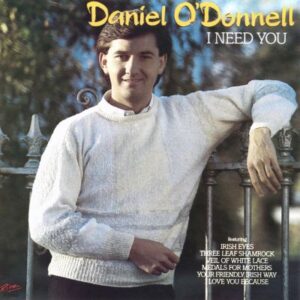
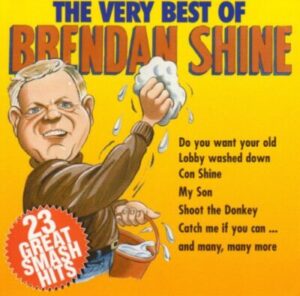
My own, late mother was into country and Irish music and her record player gave heavy rotation to the likes of Foster and Allen and the inimitable Brendan Shine, which explains why I’m so scarred.  If you can listen to Brendan Shine’s 1981 opus Spuds (“Spuds, spuds, spuds! / Ah, these spuds are really great / Good oul Irish spuds / Are on everybody’s plate!”) all the way through without having a breakdown, you’re made of sterner stuff than I am.  At least my mum wasn’t that keen on the country-and-Irish superstar and knitwear-clad cultural juggernaut that is Daniel O’Donnell.  O’Donnell’s reputed to have sold 10 to 15 million records globally and was parodied in the 1998 Father Ted episode Night of the Nearly Dead, in which a much-loved singer called Eoin McLove visits Craggy Island and bluntly informs Ted, “I have no willy.”


Honourable exceptions: I’m not wild about the music, but Philomena Begley can certainly sing.


From wikipedia.org / © Atlantic Records


Prog rock

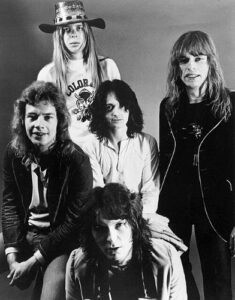
Prog rock, or to give it its full title, progressive rock, was initially essayed by bands in the early 1970s like Emerson, Lake and Palmer, Jethro Tull, Yes, Pink Floyd after Sid Barrett left and Genesis before Phil Collins took over.  It had guitar solos and keyboard solos that twiddled on forever because the musicians wanted to convince everyone that, no, they weren’t just dumbass rock or pop musicians but proper artistes pushing boundaries by fusing rock with classical music and (eek!) jazz.  Much of it is unlistenable to me.  I agree with John Peel, who once observed, “the one distinguishing feature about early-70s progressive rock was that it didn’t progress.”  Anyway, by the mid-1970s, God decided that enough was enough and created punk rock, which seemed to put an end to it.  (Though Marillion popped up in the 1980s and the genre lives on today.)


Honourable exceptions: Okay, I’ve been facetious.  I have a few nice things to say about prog rock too.  Firstly, looking at Wikipedia’s List of Progressive Rock Bands, I see many names on it whom I actually like.  However, while those bands may have been prog-rock-tinged at times, I view them as essentially playing different types of music: Hawkwind (space rock), Can (Krautrock), Rush (hard rock and heavy metal), Ozric Tentacles (psychedelic rock), etc.  Secondly, you can’t deny that, judiciously used, the music of prog rock bands has enlivened many movies – see Michael Mann’s use of Tangerine Dream on his soundtracks, or Dario Argento’s use of Goblin on his, or Vangelis’s contribution to Blade Runner (1982), or how that bit from Mike Oldfield’s Tubular Bells (1971) turned up brilliantly in The Exorcist (1973).  And thirdly, among albums by latter-day prog rock bands, I thought Porcupine Tree’s Fear of a Blank Planet (2007) was wonderful.


From wikipedia.org / © RSO Records


Disco

I don’t hate disco.  I was just never into it.  So sorry, ABBA, Chic, KC and the Sunshine Band and Earth, Wind and Fire.  The problem, of course, is that to be a fan of disco music, you have to be a fan of dancing, and as I have always danced like I possessed two left feet, that’s excluded me from the culture.


Incidentally, it’s weirdly ironic – considering how disco was a big thing among the black, Latino and gay communities in the late 1970s – that two legendary disco bands have been tarnished by associating with intolerant far-right-wing politicians recently.  Admittedly, these are modern incarnations of the bands, i.e., with hardly any of the original line-ups remaining in them.  A version of Boney M has been in talks to perform at this month’s conference by Nigel Farage’s Reform Party, while a version of Village People played at inaugural events for Donald Trump in 2025.  Of course, Village People’s YMCA (1978) is much-loved by Trump, who dances to it at every opportunity – arthritically shuffling about whilst joggling his little fists in front of him like he’s trying to milk a levitating cow.


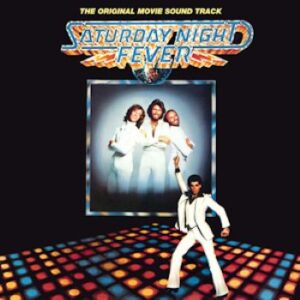
Honourable exceptions: The Bee Gees’ Stayin’ Alive (1977) is a sprightly tune, though I like it even more in this mash-up with AC/DC’s Back in Black (1980) from Wax Audio.


Right, I’ve released some of that yellow bile from my system, am feeling better and will end this post here.  But stay tuned.  I’ll be writing about more musical genres I can’t stand soon.  (Hint: we’re getting near the 1980s…)


© Beaumex Music