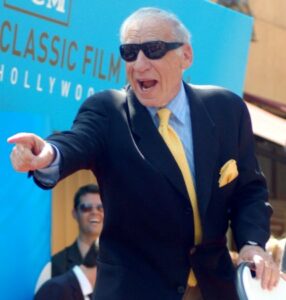
The 100-year-old Mel


From wikipedia.org / © Angela George


Last week saw much hype and noise about the United States of America celebrating its 250th birthday.  Under the leadership of Donald Trump, the USA marked the 250th anniversary of its independence from the British by holding a Great American State Fair on Washington DC’s National Mall.  This featured empty booths, cancelled musical performances, racist flags, power outages, collapsing roofs and a plywood model of the victory arch Trump wants to build on the Potomac that cracked, crumbled and oozed yellow gunk.  How odd that hardly anyone wanted to go to it.


In other moves to celebrate America’s 250th Independence Day, Trump refurbished the Lincoln Memorial’s Reflecting Pool, also in Washington DC, so that its water would shine a patriotic blue, though it immediately shone a less patriotic green thanks to a sudden and unforeseen algae bloom.  He also tried to extend the USA team’s run in the 2026 Football World Cup by arm-twisting Gianni Infantino and FIFA into breaking the sport’s red-card rules so that a key American player could play in the team’s next game – which they lost, courtesy of a 4-1 drubbing by Belgium, causing their exit from the competition.


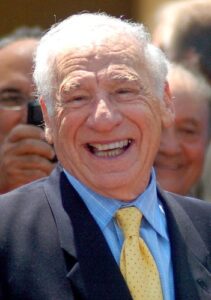
The sound and fury about the 250th anniversary of American independence, and the Trump-esque shenanigans accompanying it, have obscured the fact that, one week earlier, the USA witnessed another important three-digit birthday.  June 28th saw the 100th birthday of the legendary American filmmaker, comedian and general funnyman Mel Brooks.  By the time he turned his hand to making movies in the late 1960s, Brooks already had impressive comic credentials – devising the famed 2000-Year-Old Man comedy sketch with Carl Reiner, for instance, or creating the classic spy-comedy TV show Get Smart (1965-70) with Buck Henry.  But it’s fair to say his films are the body of work for which he’s most beloved.


Like much of the comedy I experienced from an early age – the CarryOn movies, or those starring Abbott and Costello, or the telly career of Ronnie Corbett – I’ve had a complicated and changing relationship with the oeuvre of Mel Brooks.  As a youngster, I thought it was brilliant.  As a young adult, who took himself much too seriously, I dismissed it – certainly, the later films Brooks made – as crass, cringeworthy guff.  Now, in my old age, I can find pleasure in the entirety of Brooks’s canon and appreciate the artistry displayed in even what are, by general consensus, his lesser efforts.  A bad joke might provoke a groan rather than a laugh, but to engineer that groan you still need a certain, warped skill.


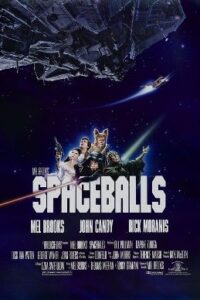
I think I passed from my youthful period of Brooks-disdain to my more mature period of Brooks-admiration in the 1990s.  This was when I was attempting to woo (with a total lack of success) a lady from New York whom I considered, for a while, the coolest thing on earth.  We were chatting one evening about our favourite films and the object of my affections suddenly astounded me by saying she was a huge fan of…  No, not Jean-Pierre Melville’s Le Samourai (1967), or Terence Mallick’s Badlands (1973), or Jim Jarmusch’s Mystery Train (1989), but…  Mel Brooks’s Spaceballs (1987).
 

From wikipedia.org / © Metro-Goldwyn-Mayer / Brooksfilms


“Seriously?” I spluttered.  I’d seen this science-fiction / Star Wars piss-take shortly after its release and thought it was dreadful.  But, patiently, the lady explained to me the sociological depth and cleverness of some of Spaceballs’ jokes that I’d missed – for example, when Bill Pullman and John Candy rescue the princess (Daphne Zuniga) and Pullman remarks, “That’s all we needed…  A Jewish princess!”  I had to concede there was more to Brooks’s humour than I’d thought.


So, I had my moment of epiphany.  I decided, to misquote a line in The Producers, “Don’t be stupid, be a smarty / Come and join the Mel Brooks party.”


Anyway, it’s a fortnight late for the great man’s 100th, but here is a belated guide to the funniest bits, in my opinion, of his movies.  There’s no mention of The Twelve Chairs (1970) and Life Stinks (1991) because I haven’t seen those two.


L.S.D. gets auditioned in The Producers (1967)

The movie that put Brooks on the cinematic map, The Producers has had quite an afterlife, becoming a successful Broadway musical that, in 2005, was turned into a film itself.  For me, its highlight isn’t the famous song-and-dance number Springtime for Hitler that’s the centrepiece of the show that impresario Zero Mostel and accountant Gene Wilder stage in the hope it’ll be a massive flop (allowing them to make a fortune from the shares they’ve sold in it).  No, the highlight comes earlier.


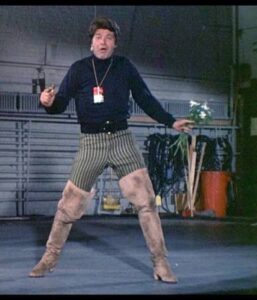
That’s when hippy Lorenzo St. DuBois – L.S.D. to his friends – stumbles into the show’s auditions by mistake and performs, with his female guitar / keyboards / sax backing band, a funny-terrible number called Love Power.   (“And I give a flower to the big fat cop / He takes his glove and he beats me up!”)  Played by Dick Shawn with thigh-high furry boots and a Campbell’s soup-can hanging on a chain around his neck, the hapless L.S.D. is hilarious – and the sequence reaches a perfect conclusion when Mostel bellows ecstatically, “THAT’S OUR HITLER!”
 

From instagram.com / (c) Embassy Pictures


The campfire scene in Blazing Saddles (1974)

If I was more sophisticated, I’d nominate as the funniest moments in Brook’s smash-hit comedy-western the scenes where he skewers the residents of frontier town Rock Ridge for their bone-headed racism.  (“You’ve got to remember that these are just simple farmers.  These are people of the land.  The common clay of the new West. You know…  morons.”)  However…  I’m nominating instead the sequence in Blazing Saddles where Slim Pickens’s men sit around a campfire and stuff themselves with traditional cowboy fare – beans – with flatulent results.


I first saw Blazing Saddles when it played on a big screen in the assembly hall of my school as one of the movies chosen for the school’s Film Club.  When the farting began, the teenaged audience, including myself, laughed like drains.  We were still roaring our heads off minutes after the sequence finished.  No other film shown during the several years I was a member of that Film Club – not Alfred Hitchcock’s Psycho (1960), not Nicolas Roeg’s Don’t Look Now (1973), not Ridley Scott’s Alien (1979) – provoked so tumultuous a reaction.  I’m not proud.


The monster meets the blind hermit in Young Frankenstein (1974)

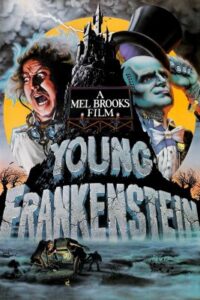
The most genuinely affectionate of Brooks’s genre parodies, Young Frankenstein pokes fun at the black-and-white Frankenstein movies made by Universal Pictures in the 1930s.  My favourite part of it is when Brooks sends up the sequence in Bride of Frankenstein (1936) where the Frankenstein monster (Boris Karloff) is touchingly but briefly befriended by a lonely blind hermit (O.P. Heggie) who’s unaware of his monstrousness.  Here, the well-meaning but, well, blind hermit (Gene Hackman) accidentally and repeatedly scalds and burns the unfortunate monster (Peter Boyle) whilst trying to offer him broth, cigars, etc., until the latter flees from his cottage in terror.  Despite the gleeful bad taste of the gags, the Young Frankenstein sequence retains some of the sweetness and sadness of the Bride of Frankenstein one.  It also makes you wish Gene Hackman had played more comedy roles.
 

From wikipedia.org / © Gruskoff / Venture Films / 20th Century Fox


The boardroom table in Silent Movie (1976)

This was another movie shown at my school’s Film Club and another sequence that sent us – uncivilised little oiks that we were at the time – into paroxysms of laughter.  Evil corporation Engulf & Devour intends to take over the studio of filmmaker Mel Funn (Brooks) but that won’t happen if the new movie Funn is making becomes a hit.  Engulf & Devour’s board of executives hatch a fiendish plan to sabotage Funn and his movie – they’ll send sultry nightclub singer Vilma Kaplan (Bernadette Peters) to seduce, then dump Funn and re-kindle the massive alcohol problem he had previously.  When a picture of Vilma is unveiled to the executives, sitting around the boardroom table, they’re so impressed that the table rises by several inches.


The line Funn / Brooks inspires when Vilma does dump him, and he goes on a massive bender to drown his sorrows – “He is truly the lord of the winos!” – is pretty funny too.


The orchestra in High Anxiety (1977)

Brooks’s next film takes fond aim at the thriller movies of Alfred Hitchcock.  Its hero, Dr Richard Harpo Thorndyke, again played by Brooks himself, suffers from the titular disorder, the vertigo-like ‘high anxiety’.  While travelling in the back of a car, Thorndyke / Brooks suffers a moment of ominous foreboding, which is accompanied by an equally ominous swell of Bernard Herrmann-like orchestral music – the sort that Hitchcock liked to insert into his films to augment the mood.  This being a Brooks film, though, Thorndyke’s car then passes a bus that contains, as passengers, the orchestra playing the music.


Yes, this is the second time Brooks has used that gag.  It originally appeared in Blazing Saddles and involved the Count Basie Orchestra performing in the desert,  But the orchestra-on-a-bus joke in High Anxiety works better, I think.


The Spanish Inquisition in History of the World, Part I (1981)

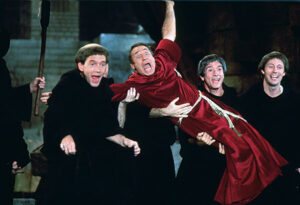
A truly hit-and-miss collection of gags and sketches, History of the World, Part 1 depicts five chapters in world history from the Stone Age to the French Revolution.  Its undisputed highlight is a segment about the Spanish Inquisition.  This features Brooks as Torquemada – his victims are warned not to try to talk him out of torturing them because, “You can’t Torquemada anything!” – and an elaborate Busby Berkeley-like song-and-dance number in a torture chamber which, with its exuberant bad taste, is as impressive as Springtime for Hitler in The Producers.
 

© Brooksfilms / 20th Century Fox


Snotty’s line in Spaceballs (1987)

Spaceballs spoofs Star Wars (1977) but also contains some elaborate send-ups of Planet of the Apes (1968) and Alien (1979) – the latter even drafts in John Hurt to reprise his role as the unfortunate Kane.  But the funniest, or groan-iest, bit in it for me is a simple pun.  A Scottish character called Snotty (Jeff MacGregor), obviously based on Scotty from Star Trek (1966-69), is in a control room flicking a series of switches.  “Lock One!” he shouts.  “Lock Two!  Lock Three!  Loch Lomond!”


The abbot in Robin Hood: Men in Tights (1993)

You have to be a connoisseur of long-ago comedy double-acts to appreciate my favourite joke in Robin Hood: Men in Tights, Brooks’ irreverent take on the then-recent and hugely-successful Robin Hood: Prince of Thieves (1991).  An abbot (Dick Van Patten) is walking in his finery outside his monastery and enjoying the adulation of the local population.  Then a guy who looks and sounds suspiciously like Lou Costello yells at him, “Hey, Abbott!”  Van Patten grumbles, “I hate that guy.”


Dracula tries to control Mina’s mind in Dracula: Dead and Loving It (1995)

I don’t hold it against Brooks’s Dracula: Dead and Loving It, which stars Leslie Neilson as the legendary vampire count, that it isn’t great.  After all, there have been many attempts over the years to spoof vampire films and hardly any of them have been funny – see Roman Polanski’s Dance of the Vampires (1967) or Stan Dragoti’s Love at First Bite (1977).  In fact, it wasn’t until Jermaine Clement and Taika Waititi’s What We Do in the Shadows (2014) that I encountered a vampire-movie parody that made me laugh.


However, Dracula: Dead and Loving It has one funny part where, from a distance, Dracula / Neilson exerts his willpower over the bitten and partly vampirised Mina (Amy Yasbeck) and tries to summon her: “Mina…  Open your eyes…  Arise…  Come to the door…”  The operation goes less smoothly when the mind-controlling vampire discovers there’s a confusing closet door in the way, and a hazardous footstool, and an inconvenient maidservant who’s also picking up his telepathic instructions: “Mina…  You are in the closet.  Open the door and come out…  Watch out for the footstool…  Stand up…  Not you, sit…  No, you sit…  You stand…”


And just before I finish, some praise is due for Brooks as a producer too.  He’s the man who oversaw both David Lynch’s The Elephant Man (1980) and David Cronenberg’s The Fly (1986).
 

From wikipedia.org / © Angela George

Hey, hey, we’re the munchies


© Duckworth Books


Another Halloween-inspired post…


Zombie movies used to be my favourite sub-genre of horror cinema.  Okay, at first, it’s difficult to see the charms of a school of movies about reanimated corpses shambling around and trying to munch on the living.  But what I liked about zombies was that they could be a brilliant metaphor for any group that was large in number but, according to the powers-that-be, mindless: consumers, blue-collar workers, the homeless, etc.  This gave filmmakers endless opportunities for social comment and allowed zombie movies to have brains figuratively as well as literally.


Thus, George Romero’s Night of the Living Dead (1968) is a parable about a United States rattled by racial tensions and the Vietnam War.  His 1979 sequel Dawn of the Dead takes potshots at a consumerist America where shopping malls had become part of both the landscape and the social fabric.  Danny Boyle’s 28 Days Later (2002) reflects a Britain where anger was an increasingly common social phenomenon, terms like ‘road rage’ and ‘air rage’ having entered the popular vernacular.  Its sequel, Juan Carlos Fresnadillo’s 28 Weeks Later (2007) is an allegory about the post-war occupation of Iraq.  And Edgar Wright’s Shaun of the Dead (2004) takes the piss out of a twenty-something slacker generation who can’t tell if someone’s a zombie or just stoned, drunk or hungover.


But I said I used to be fond of zombie movies, because in the last few years I feel there’s been too damned many of them, offering the same old apocalyptic visions and same old shambling tropes.  Zombies have become ubiquitous, not just in the cinema but in TV series, books, graphic novels and computer games.  With popular TV shows like The Walking Dead (2010-present), derived from a graphic novel, and The Last of Us (2023), derived from a computer game, filling our screens with zombie carnage week after week after week, surely it’s impossible now to do anything fresh with the concept?


Despite my zombie-fatigue, however, I recently read Max Brooks’ bestselling 2006 novel World War Z: An Oral History of the Zombie War.  This is probably the number-two urtext in the zombie pantheon.  (Obviously, the number-one urtext is George A. Romero’s original trilogy of Living Dead movies, Night, Dawn and 1986’s Day of the Dead, which created the template: the flesh-eating, the infection being spread by bites, the need to shoot them in the head, the humans reacting to the crisis soon becoming more monstrous than the zombies themselves.)  Brooks updated the sub-genre for the 21st century and imagined a zombie plague happening on a global scale, with different countries responding in different ways.


From wikipedia.org / © Rhododendrites


World War Z is a mock non-fictional tome modelled on Studs Terkel’s The Good War: An Oral History of World War Two (1984).  It’s purportedly a compilation of interviews by a United Nations expert who, sometime after a worldwide zombie crisis ended, worked on a UN Postwar Commission Report.  He collected oral testimonies from survivors but, ultimately, the commission’s chairperson decided not to include the testimonies in the report, reasoning: “It was all too intimate…  Too many opinions, too many feelings.  That’s not what this report is about.  We need clear facts and figures, unclouded by the human factor.”  So instead, the UN expert publishes the survivors’ stories in book-form.


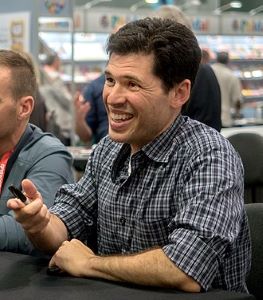
One’s first impression of World War Z is that Brooks – who in real life is the son of venerable funnyman and comic filmmaker Mel Brooks – has not only set his sights high but done his homework.  The book believably presents the voices not just of ordinary people, but of politicians, scientists, doctors, soldiers, mercenaries, pilots, etc.  It nicely captures their particular sets of jargon, slang and cadences as they describe their  experiences of the conflict with the undead.  The political protocols, science, technology, medicine, weaponry and equipment referred to sound convincingly well-researched.  Brooks is also authoritative when his UN official interviews people from more specialist walks of life, such as deep-sea divers (these zombies can move underwater) and astronauts (there’s a section about the crew of the International Space Station who, after things kick off, find themselves in orbit for longer than planned and do all they can to help humanity below).


The jargon occasionally gets a bit dense.  For instance, a diver grumps: “Kids today… f*ckin’ A.  I sound like my pops, but it’s true, the kids today, the new ADS divers in the Mark 3s and 4s, they have this ZeVDek – Zero Visibility Detection Kit – with colour-imaging sonar and low-light optics…  We couldn’t see, we couldn’t hear – we couldn’t even feel if a G was trying to grab us from behind.”  But then, people in any profession use plenty of jargon when they talk with passion about their work.  And you have to be passionate about your work when it involves relentless waves of zombies coming at you.


From pixabay.com / © Syaibatul Hamadi


A few entries stray into stereotypes and caricature, though.  An account by one Kondo Tatsumi, a teenaged computer geek so addicted to hacking into systems and obtaining information that he stays at his bedroom computer long after his parents have vanished, and the zombies have started eating his neighbours, without any awareness of the peril he’s in, ladles on the stereotype of the Japanese otaku too thickly.  To rub it in, Kondo is described as being at the time ‘a skinny acne-faced teenager with dull red eyes and bleached blond highlights streaking his unkempt hair.’


Another Japanese-set instalment is rather cheesy too.  It concerns an elderly blind man called ‘Sensei’ Tomonaga Ijiro.  Though old and blind, his sense of hearing and smell are acute and he’s also skilled at using a samurai sword – well, it’s really a sharp-bladed shovel that he used during his pre-World-War-Z days working as a gardener.  He manages to survive for years in the forested mountains of Hokkaido, slaying any zombie that ventures near him.  Here, Brooks is clearly riffing on the legendary blind swordman Zatoichi, a fixture of Japanese cinema and fiction.  But the story’s unlikeliness is out-of-place in a tome that generally aims for documentary realism.  Even if Sensei Tomonaga’s non-visual senses and swordsmanship enable him to fight off zombies for several years, I don’t see how an old blind bloke could stay alive in Hokkaido, in the open, for so long.  I’ve lived in Hokkaido and know how brutal its winters are.


Worst of all is the testimony of David Allen Forbes, a stereotypical Richard Curtis / Hugh Grant-style silly-ass Englishman whom Brooks’ dad could have featured in one of his films – Robin Hood: Men in Tights (1993), say, or Dracula: Dead and Loving It (1995).  An expert on castles, he begins by explaining how modern-day humans used the medieval structures as refuge against the zombie hordes.  Then he gets onto his own experiences of World War Z, which he spent holed up in Windsor Castle, just outside London.  There’s some utter guff where Forbes gets teary recalling Queen Elizabeth II.  She refused to join the rest of the Royal Family when they were evacuated to Ireland – yes, it shows how desperate things were that the Royal Family, for their safety, had to be sent to Ireland.  Instead, she stayed with the garrison in Windsor to ‘be an example to the rest of us, the strongest, and bravest, and absolute best of us.’  Of castles and Her Majesty, Forbes concludes: “One defended our bodies, the other, our souls.”  That bit turned my stomach more than the most graphic gore I’ve seen in a zombie movie.


Still, the good parts of World War Z more than outweigh the duff ones.  Most effective for me is a section where an American woman, Jesika Hendricks, recalls her experiences as a girl early in the crisis.  Following government advice to move north – by then it’d been noticed that zombies freeze up in cold weather – her urban, white-collar family load up a van and head for Canada.  They join some fellow refugees who’ve set up camp beside a lake.  Initially, everything is cheery, with communal bonhomie, singing around the campfire, and the nearby forest and lake-waters providing fuel and food.  Then, as the trees get cut down, and the fish get dynamited to non-existence, and the days grow shorter and colder, the mood sours.  “The camp became a mess, nobody picking up their trash anymore.  A couple of times I stepped in human shit.  Nobody was even bothering to bury it.”  By mid-winter, things have become truly nasty.  It’s a grim and believable account of what frightened and unprepared people can end up doing in an emergency.  And the zombies aren’t even around.  They figure in the punchline, though: “It took a lot of time, but eventually the sun did come out, the weather began to warm, and the snow finally began to melt.. spring was finally here, and so were the living dead.”


Meanwhile, Brooks devises a neat explanation for the zombies’ origins and how they spread everywhere.  The zombie-creating virus first appeared in China – possibly somehow spawned in the areas flooded by the Three Gorges dam project – and went on to infect the country’s supply of organs that’d been forcibly-harvested in its prisons.  Some of these organs were exported around the world and they released the virus into the bodies of their recipients.  Incidentally, in real life, China announced in 2014 that it would no longer use prisoners as forced organ-donors.


© Skydance Productions / Paramount Pictures


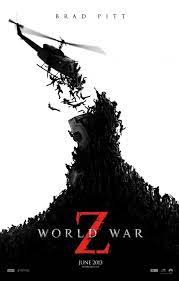
This premise didn’t make it into the big-budget, but disappointing movie version that Hollywood made of World War Z in 2013.  No doubt the studio, Paramount Pictures, was mindful of the growing importance of Chinese audiences for international movie profits and didn’t want to include anything that might annoy the Chinese government.


Finally, I noticed how the book makes references, mostly indirectly, to personages like Nelson Mandela, Fidel Castro and the aforementioned Queen Elizabeth II.  This gives it an oddly historical feel now.  Its story evidently began in the mid-noughties and concluded sometime in the 2010s.  And while Brooks pours scorn on inept and corrupt politicians, and other assholes in positions of power and influence (like a crooked pharma tycoon who lulls the West into a false sense of security with an ‘anti-rabies’ vaccination), he obviously believes the era still has enough people with the leadership skills, knowhow and courage to win the day for humanity.


But the mind boggles at the thought of such a scenario occurring in 2023.  For years now, we’ve been subjected to the callousness, venality and stupidity of leaders like Putin, Bolsonaro, Modi, Netanyahu, Johnson and, of course, Trump.  Also, we’ve seen how so many of them botched the handling of the Covid-19 epidemic.  If a zombie apocalypse started under the watch of the far-right-wing populist authoritarians who currently run too many countries in the world, they’d probably use it as an excuse to invade neighbouring countries, burn the Amazon, bash the Muslims, avoid corruption charges, hold raucous parties, inject themselves with bleach or, indeed, abandon the ‘blue states’ to the zombies.


And on the fake-news front, millions of ‘zombie sceptics’ would agree with Alex Jones, who’d dismiss news footage of zombie carnage as the work of ‘crisis actors’.  Millions of supposed ‘freethinkers’ would applaud the tweets of Right Said Fred and Neil Oliver, who’d dismiss the thing as a hoax engineered by a shadowy global cabal wanting to foist a ‘world government’ on us all.  Actually, I could imagine Oliver defying zombie-emergency lockdown by announcing on GB News: “If your freedom means I might get bitten by a zombie then so be it.  If my freedom means you might get bitten by a zombie, then so be it.”


Max Brooks’ 2006 World War Z chronicles a horror-show, but in hindsight, there’s ultimately something positive and uplifting about it.  A 2023 World War Z would be a horror-show full-stop.


From invaluable.com / © Motik One