
It’s the hope that kills you


The footballing World Cup currently taking place in Canada, Mexico and some other place – oh yes, the USA – has now entered its second stage.  And guess what?  A certain country took part in the first stage but failed to qualify for the second one, just as it qualified for eight previous World Cups and didn’t make it to the second round of those competitions either.  In fact, it’s earned itself the unenviable record of being the most-useless-at-getting-to-the-second-round-of-the-World-Cup country ever.  Which hapless nation could this be?


Here’s a clue: “Yes sir, I can boogie…


I had a fortnight off work during the second half of June and spent that time in Scotland, in the Borders town of Peebles, where my family have lived for nearly 50 years after relocating from Northern Ireland in 1977.  My fortnight in Scotland coincided with the Scottish men’s team playing their second and third games of the World Cup, which they’d qualified for in November last year.  Well, I thought beforehand, I’ll be in Scotland in time to see if, finally, they can beat the jinx that’s stopped them from getting past the competition’s initial stage in 1954, 1958, 1974, 1978, 1982, 1986, 1990 and 1998.  And this time, with so many countries competing in the 2026 competition, surely it’ll be easy to get into that elusive second stage?  Surely they’ll beat the curse at last?


Thus, I braced myself for the Scottish World Cup 2026 experience, thinking of a lyric from the Eagles’ Hotel California: “This could be heaven or this could be hell.”


Guess which one it turned out to be.


When I arrived in Scotland on June 17th, the national team had already secured three points from their first World Cup game.  It had defeated by one goal to nil the footballing colossus that is… Haiti.  Actually, given Scotland’s history of embarrassing scores against minor footballing nations they were expected to beat, such as Iran in 1978 and Costa Rica in 1990, the win over Haiti felt like the clearing of an important psychological hurdle.  Now Scotland  needed just one more point to be sure of getting through to the second round.  As I traversed the streets of Peebles, folk around me were cautiously positive.  There was a certain sense of optimism.  Hope was definitely in the air…


But as older, wiser heads who’d experienced countless Scottish World Cup agonies in the 20th century would inevitably muse: “It’s the hope that kills you.”


June 19th saw Scotland’s second World Cup game, against Morocco.  By now, like humidity in the air triggering a spectacular thunder-and-lightning storm, that pervasive sense of hope had transformed into full-scale mass euphoria.  Mind you, I was slightly less euphoric, remembering Scotland’s last game in the last World Cup they qualified for, in France in 1998, which was against Morocco too.  Back then, Morocco had humped them three-nothing.


I watched the game in the social building of Peebles Rugby Club, where for once the crowd contained more fans of the round ball than fans of the oval one.  I’d never seen the place as wild as it was during the build-up to the game – people were yelling, singing, dancing on tables, waving glow sticks like demented cheerleaders.  In fact, there was so much merry-making and hullabaloo that most folk didn’t even notice when the first whistle blew and the match kicked off.  They also didn’t notice when two minutes later Morocco penetrated Scotland’s somnolent defence and knocked in an embarrassingly early goal.  There was some remarkable sobering-up done when the revellers finally focused their gaze on the Rugby Club’s TV screens and realised,  one goal down already – how the f*ck did that happen?


To be fair, Morocco didn’t look much more accomplished than Scotland, certainly not during the second half.  But the North Africans hung onto their slender lead for the next 90-odd minutes and the game ended one-nil to them and with Scotland acquiring zero points.  If only the team had been awake from the very start and denied Morocco that early goal.  They’d have scraped a nil-nil draw, got a point, qualified for the second round and made history.  I tried to console myself with the thought that as it was a three-nil defeat against Morocco in 1998, and only a one-nil defeat in 2026, this marked a 66% improvement on Scotland’s part.  Right?


The next day, June 18th, was the biggest day in Peebles’ annual Beltane festival.  Among other things, there was a parade of floats, bands and people in fancy dress along the town’s high street.  Many of the revellers were in the regalia of the Tartan Army, the Scottish football team’s travelling support – one guy in such attire was even riding a penny farthing.



Yet an unhappy sense of reality about Scotland’s World Cup prospects was tangible now.  Some of the bands were still dutifully playing Yes Sir, I Can Boogie (1977) by the Spanish disco duo Baccara, which has been the Tartan Army’s favourite anthem since 2020.  However, Langholm Town Band definitely had their finger on the pulse when they marched by me playing Ally’s Tartan Army, which was Scotland’s World Cup song in Argentina in 1978 and whose lyrics go, “We’re on the march with Ally’s army / We’re going to the Argentine / And we’ll really shake them up / When we win the World Cup / Cos Scotland are the greatest football team.”


Ally’s Tartan Army serves as a painful reminder of what happened during Scotland’s World Cup campaign in 1978.  The Scotland manager then, Ally MacLeod, was breezily optimistic about his team’s chances of winning the World Cup; his optimism was amplified by Scotland’s sporting press; the whole nation drank the Kool-Aid and believed their team only had to turn up in Argentina to lift the trophy…  And when Scotland were knocked out in the first round, it was seen as a national disaster and humiliation.  For years afterwards, the Scots suffered from P.A.S.D., i.e., Post-Ally Stress Disorder.


Scotland’s final first-round game was against Brazil on June 24th.  The Scottish World Cup record against Brazil had been woeful.  In the 1982 competition in Spain, Brazil beat them four-one, a cruel result considering that Scotland went one-nil up after 17 minutes, courtesy of a goal by David Narey.  (Big-chinned English football commentator Jimmy Hill earned himself the lasting hatred of Scotland fans by dismissing Narey’s goal as a ‘toe-poke’.)  A rematch at the 1990 World Cup saw Brazil beat them one-nil and caused Scotland’s elimination from the tournament.  Despite this, I heard slivers of optimism in people’s conversations: “We only need a draw… One point, that’s all…  And Brazil…  They’re not the great team they once were…  They’ve been disappointing so far…”


Yes, it’s the hope that kills you.


I watched the game at my brother’s house, where the audience included my nephew and his girlfriend, who hadn’t even been born when Scotland last played in a World Cup.  Brazil knocked the ball three times into Scotland’s goal – actually four times, but one of the goals was disallowed – without Scotland even achieving what the late Jimmy Hill would describe as a ‘toe-poke’ in return.  Afterwards, I said to my nephew and his partner something along the lines of, “Welcome to us old folk’s world – one of Scottish World Cup misery.”


Even then, it wasn’t absolutely certain that Scotland was out of the World Cup.  So many countries were involved in this competition, and the rules for making progress in it were so complex, that they still had a chance.  Some of the best-placed teams with three points would go through to Round Two.  Scotland might be one of the lucky ones if certain results went certain ways.  By June 27th, though, it was clear the results hadn’t gone the right way and Scotland were taking their ninth World Cup early bath.


Yes, it’s the hope that…  Oh, shut up.


If nothing else, the Tartan Army showed yet again that they’re one of the best sets of football fans in the world.  Despite the hassle of entering Donald Trump’s increasingly authoritarian USA, and the excruciating price of match tickets, transport, refreshments and everything else in a World Cup orchestrated by the rip-off maestro and evil Mekon Gianni Infantino, head of FIFA, they won American hearts and minds by supporting their team with good humour and self-deprecation and avoiding any nationalistic preening or belligerence.  And, along the way, they had a hell of a party.


The citizens of Boston, where they played their first two games, were particularly impressed.  They didn’t even mind the Tartan Army’s custom of plonking traffic cones on the heads of their municipal statues.  The day after the Haiti victory in this, the home city of the Irish-American diaspora, at a downtown Irish pub called Henessey’s Bar, Scotland fans managed the exceptional feat of drinking three times more beer than is normally sold on St Patrick’s Day.  “We’ve been here for over 30 years and we’ve never seen anything like it,” marvelled the pub’s boss.  Even the New York Times was moved to publish a feature about the Boston-Tartan Army love affair.


Those fans were merely enjoying the Scotland World Cup experience, and squeezing in as much hectic partying, while it lasted.  Because, as 2026 proves for the umpteenth time, the Scotland World Cup experience never lasts for long.

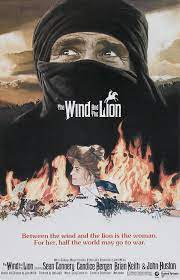
 

Seriously Sean – ‘The Wind and the Lion’


© United Artists / Colombia Pictures / MGM


Written and directed by John Milius, released in 1975 and very loosely based on a real-life incident that occurred in 1904, The Wind and the Lion is a tale of derring-do in the Moroccan Rif combined with political intrigue in Washington DC.  I first saw it when I was in my late teens and appropriately for a film with ‘wind’ in its title – that’s wind of the meteorological, non-flatulent variety – it blew me away.


Following the death of its star Sean Connery last year, I decided to watch The Wind and the Lion again. I felt slightly trepidant doing so, as there’s more than one film that I admired in my youth but found less-than-brilliant when I saw it again at a more mature age.  A prime example is Robert Altman’s 1970 comedy about the Korean War, M*A*S*H, which once upon a time seemed exhilarating in its irreverence and anarchy, but nowadays strikes me as juvenile and mean-spirited.


The Wind and the Lion’s opening sees Connery’s character, master-brigand Mulai Ahmed el Raisuli – the Raisuli – lead a raid on the Moroccan home of wealthy American widow Eden Pedecaris (Candice Bergen) and abduct her and her young children (Simon Harrison and Polly Gottesman).  My hopes that I’d hang onto my previous high opinion of The Wind and the Lion took a blow at this early point.  It isn’t so much the fact that Eden’s houseguest at the time, Sir Joshua Smith (played by Billy Williams, not an actor but the movie’s cinematographer, who’d later win an Academy Award for his work on Richard Attenborough’s 1982 epic Gandhi), gallantly fights off the attacking hordes, is killed and then despite his heroism is barely mentioned by the Pedecarises or anyone else during the rest of the film.  No, it’s the fact that Eden, understandably upset by what’s happened, laughs in scorn when the Raisuli is thrown off a recalcitrant horse – and the Raisuli reacts by whacking her across the face.  “I am Raisuli,” he snarls.  “Do not laugh at me again.”


Yes, it’s 1904, when misogyny was a universal and unremarked-upon fact of life.  (It still is in many places, of course.)  But Connery’s later years and posthumous reputation were tainted by allegations of domestic abuse against his ex-wife Diane Cilento and by troubling comments he’d made about the acceptability of slapping women.  This moment in The Wind and the Lion is a dismaying reminder of that.


The Raisuli and his men carry the Pedecarises off to their camp in the Rif, beyond the reach of the Moroccan authorities.  His motive for kidnapping them is to damage Morocco’s Sultan Abdelaziz.  By issuing an extravagant ransom demand, he hopes to embarrass the Sultan, provoke the Americans and generally stir up trouble.  The Sultan’s uncle is the wily Bashaw of Tangier, the Raisuli’s brother, and he deeply resents how this wing of his family have allowed their country to become humiliatingly and corruptingly mired in foreign influence.  As the Bashaw himself admits at one point: “I have been threatened by the French, the Germans, the English… Yes, we have French infantry and German cavalry.  Our currency is Spanish.  But my nephew is the Sultan of Morocco.  As it is, it shall be.”


The Bashaw, incidentally, is played by the Polish character actor Vladek Sheybal, who was memorable as the villainous Kronsteen in Connery’s second Bond outing From Russia with Love (1963).  But it has to be said that the strapping, hairy Connery and the sleek, lupine Sheybal look as much like brothers as Arnold Schwarzenegger and Danny DeVito did in Ivan Reitman’s Twins (1988).


© United Artists / Colombia Pictures / MGM


Happily, once the main narrative of The Wind and Lion gets underway, the film becomes as good as I remembered it to be.  Connery and Bergen make the scenes featuring Eden Pedecaris and the Raisuli a joy.  She gradually shifts from being deeply unimpressed by him – “It is not my intention to encourage braggers,” she tells curtly him after he’s given a windy introduction calling himself ‘Raisuli the Magnificent’ and ‘the true defender of the faithful’ with the ‘blood of the prophet’ in his veins – to feeling affection for the twinkly-eyed old rogue.  Likewise, Connery’s admiration for her increases, although the banter between them never quite loses its edge.  After they start to spend the evenings playing chess, she warns him, “You are in a lot of trouble!  You should never have moved that knight or kidnapped me.  Both will see you undone.”  He responds, “It is not I who determine the outcome of events.  It is the will of Allah…”


Meanwhile, the Pedecaris children, removed from an upper-class Western world of manners, gentility and stuffiness, begin to have a whale of a time. For the boy, William, hanging out in a desert camp with the Raisuli and his sword-wielding, rifle-popping Berber militia is like Tom Sawyer’s dream of running away from home and becoming a pirate made real.


But this is only half of the story of The Wind and the Lion.  For on the far side of the Atlantic, President Teddy Roosevelt (Brian Keith) is seeking re-election.  He seizes upon the incident as an opportunity to show the voters his mettle, although his Secretary of State John Hay (John Huston) is less keen on the idea.  The garrulous and ebullient Roosevelt has his consul in Morocco (Geoffrey Lewis) and a US military force headed by an admiral (Roy Jenson) and a marine captain (Steve Kanaly) stage what nowadays would be called an intervention.  A squad of marines and sailors blast their way into the Bashaw’s palace in Tangiers, determined to knock heads together so that some sort of deal is reached and the Pedecarises are freed.  This is regardless of local sensibilities and the interests of the European colonial powers with fingers in the Moroccan pie.


A bargain is made and the three Pedecarises are released into the custody of a group of US marines headed by Kanaly’s character, Captain Jerome.  But the Sultan’s Moroccan soldiers and their German allies capture the Raisuli, going against what was agreed.  Thus, Eden, his erstwhile prisoner, has to persuade Jerome and his men to rescue him, so that the deal made in Roosevelt’s name is fully honoured…


Images of gung-ho Americans stomping into foreign lands they don’t properly understand, shooting first and asking questions later, trying to get the job (as they see it) done irrespective of local complexities, were not, it’s fair to say, popular in liberal mid-1970s Hollywood just after the Vietnam War.  And John Milius himself, co-writer of Apocalypse Now (1979) with Francis Ford Coppola, was obviously aware of the omnishambles Vietnam had been.  However, with The Wind and the Lion, he seems to hark back longingly to simpler times when America could do this sort of thing with fewer complications and consequences.  He particularly idolizes Teddy Roosevelt for embodying all the things he believes America should be about.  Roosevelt has brains, yes, but he has brawn too and is plain-speaking and no-bullshitting, and is none the worse for that.


© United Artists / Colombia Pictures / MGM


This adulation comes to the fore in a few scenes where Roosevelt joins a hunting party that shoots a grizzly bear and then he has the big, fearsome beast stuffed and mounted.  “The American grizzly,” he tells a reporter, “is a symbol of the American character: strength, intelligence, ferocity.  Maybe a little blind and reckless at times, but courageous beyond all doubt.  And one other trait…  Loneliness.  The American grizzly lives out his life alone.  Indomitable, unconquered, but always alone.  He has no real allies, only enemies, but none of them as great as he.”  Fair enough, you find yourself thinking – but if the grizzly bear is as noble as old Teddy claims it is, why did he have the poor bloody thing shot in the first place?


To be fair, the film gives a more rounded portrayal of Roosevelt than that.  He’s shown to be somewhat pompous and smug, annoying in his loquaciousness, and clearly a scheming sort.  I wonder, though, how much of this is due to Brian Keith’s performance rather than to Milius’s script.


What redeems the film politically – at least, if you’re a left-wing pinko like me – is the fact that as it progresses, Keith’s Roosevelt and Connery’s Raisuli, though they never get to meet, feel a growing respect and even kinship for each other.  By the film’s close, the Raisuli has penned Roosevelt a letter, which says: “…you are like the wind and I like the lion.  You form the tempest.  The sand stings my eyes and the ground is parched.  I roar in defiance but you do not hear…  I, like the lion, must remain in my place. While you, like the wind, will never know yours…”


If you’re going to have movies full of jingoistic American nonsense, at least have ones like this, where the American protagonists don’t see foreigners as drone-like commies, gooks or towel-heads but as fellow human beings with equivalent amounts of nobility and courage.  It just grieves me that a decade later, Milius had abandoned all attempts at nuance and was directing unashamedly right-wing and brainless shite like Red Dawn (1984).


Overall, then, I’m pleased and relieved to say that The Wind and the Lion still holds up well.  Milius directs with aplomb.  His orchestration of the sequence where the Americans storm the Bashaw’s palace is worthy of Sam Peckinpah while the desert scenes, accompanied by Jerry Goldsmith’s sumptuous and yearning score, are frequently gorgeous.  Brian Keith and Candice Bergen are excellent and Connery, intoning such great lines as “Ignorance is a steep hill with perilous rocks at the bottom,” or “If I miss the morning prayer, I pray twice in the afternoon – Allah is very understanding,” or finally, “I’ll see you again, Mrs Pedecaris, when we’re both like golden clouds on the wind!”, has never been better.


Although how this Moroccan Berber brigand ended up speaking with such a mellifluous brogue is a mystery.  Perhaps his English teacher came from Edinburgh.


© United Artists / Colombia Pictures / MGM