The comeback kid


From wikipedia.org / © Scottish Government


I’ve always had an unhealthy obsession with politics.  Lately, however, I’ve written less about the subject on this blog because my obsession was becoming literally unhealthy – ruminating on politics and politicians in 2026 was filling my head with dark and depressing thoughts.  Nonetheless, I’ll now make some comments about the election for the Scottish Parliament, which happened on May 7th. That day also saw elections for the Welsh Senedd and for various local authorities in England, but I’ll only mention those in passing.


If you’re not a political anorak, you might want to skip this.


So: the results were 58 seats for the Scottish National Party (down six from the previous election in 2021); 17 for Scottish Labour (down five); 17 for Reform UK (up 17); 15 for the Scottish Greens (up seven); 12 for the Scottish Conservative and Unionist Party (down 19); and ten for the Scottish Liberal Democrats (up six).


Despite securing six seats less than their 2021 total, and seven seats short of a parliamentary majority, the result was impressive for the SNP in that this is the fifth election in a row where they’ve ended up as the biggest, government-forming party.  Keir Starmer’s Labour government at Westminster, which hasn’t been in power for two years yet and is already as popular as a fart in a spacesuit, would kill for such longevity and  durability.


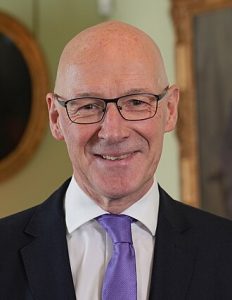
It’s also quite a comeback for SNP leader John Swinney.  Originally Swinney served as SNP leader from 2000 to 2004, when his party was in opposition in the Scottish Parliament.  It wasn’t a happy experience for him.  In the 2003 Scottish election his party dropped from 35 to 28 seats and the following year he resigned.  He later described being opposition leader as “the worst, most awful, most sapping, most soul-destroying job in politics…”


Having enjoyed spells as a cabinet minister and Deputy First Minister, Swinney was planning to retire at this year’s election.  However,  in May 2024, after the affable but hapless Humza Yousaf resigned as First Minister, Swinney surprised everyone by standing unopposed for – with his famous negotiating skills, he managed to sweet-talk the formidable likes of Kate Forbes into not running against him – and winning the leadership again, 20 years after losing it.  And this time, he became First Minister of Scotland too.  Many assumed he would act as a ‘caretaker’ FM, until someone younger and with more chutzpah came along, but thanks to this election result he’s likely to be around for a while.


While I’d never describe Swinney as someone who sets the heather alight, and if he got a fiver every time someone likened his demeanour to that of a bank manager he’d probably be a billionaire by now, I have to say I think he’s a decent guy and I’d rather have him in charge of Scotland than most other Scottish politicians.  I’m biased in this regard.  As I wrote on this blog before, I encountered him a couple of times during my youth, via my old schoolmate Roger Small, who was best friends with him at university, and I liked him.  But it’s not just me.  Most people, political friends and foes alike, seem to like Swinney.


Even the world’s most horrible man, Donald Trump, has a soft spot for him.  In 2025, Trump declared, “John Swinney is a terrific guy — and loves golf and loves the people of this country, and we really appreciate it.”  Yes, I know that Trump thinks Vladimir Putin, Xi Jinping and Kim Jong Un are the bees’ knees, so being liked by him isn’t necessarily a ringing endorsement of your character.


More recently, when Trump announced the removal of US tariffs on Scotch whisky, Swinney claimed this was due in part to a meeting he had with the US president last September.  He was criticised for saying this by the UK government’s Secretary of State for Scotland Douglas Alexander, who argued that trade agreements weren’t in the remit of a leader of a devolved administration.  But after the election result, Trump messaged, “Congratulations to John Swinney on winning his Re-Election for First Minister of Scotland.  He is a good man, who worked very hard along with the King and Queen of the United Kingdom, with respect to Tariff Relief for Great Scottish Whiskey – and deserves this Big Electoral Victory!”  So now, Dougie Alexander looks a bit of a chump.


Trump, being a low IQ individual, misspelt ‘Scottish whisky’ as ‘Scottish whiskey’.  The stuff spelt with an ‘e’ is actually made in Ireland.
 

From wikipedia.org / © Scottish Parliament / youtube.com


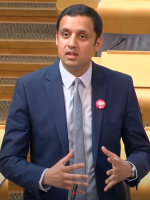
Elsewhere, Scottish Labour and the Scottish Conservatives had their worst ever performances in a Scottish parliamentary election.  Labour leader Anas Sawar hit the headlines back in February when he demanded that Keir Starmer resign as British Prime Minister: “The situation in Downing Street is not good enough. There have been too many mistakes.”  Sarwar’s resignation-call distanced him and his branch of the Labour party from the wildly unpopular Starmer and it generated  a lot of publicity at the time.  But when Starmer said no, he wouldn’t be resigning, it looked less like a political earthquake and more like a mild political bowel-movement.  It highlighted Sarwar’s place as Scottish party leader in the great scheme of things – not high.  It also meant Starmer was embarrassingly conspicuous by his absence in Scotland when Labour started campaigning for the election there.


The Scottish Tories have been reduced to a rump, their number of Members of the Scottish Parliament (MSPs) barely in double figures.  Their leader Russell Findlay has tried to talk them up in the Tory-friendly pages of the Scottish Daily Mail, describing them as the ‘Dynamic Dozen’.  I wouldn’t describe any dozen that includes such numpties as Murdo Fraser, the man who once asked Donald Trump if he’d consider buying Glasgow Rangers Football Club, as ‘dynamic’.  Maybe ‘dysfunctional’ or ‘dystopian’.


Following a near-extinction event caused by their coalition with the Conservatives in Westminster in the early 2010s, the Liberal Democrats have enjoyed something of a revival.  The passing of time has clearly detoxified their reputation a little in folk’s memories.  That said, I don’t know how anyone can stomach their Scottish leader Alexander Cole-Hamilton, who to me comes across as being insufferably arrogant.


And the Scottish Greens have almost doubled their representation in the parliament.  Without wishing to downplay this achievement, I suspect they enjoyed the best of both worlds in relation to the English and Welsh Greens – a separate party – south of the border.  They benefited from the wave of enthusiasm, and publicity, that their southern counterparts experienced earlier this year.  Simultaneously, as a separate party, they were distant enough from them to escape the more recent backlash against the English / Welsh party’s leader Zack Polanski, who stupidly retweeted something about the attack on two Jewish men in Golders Green and then suffered an all-out assault from the right-wing media determined to portray him as an antisemite.  (This despite Polanski being Jewish himself and despite some of the media’s caricatures of him being… hideously antisemitic.)


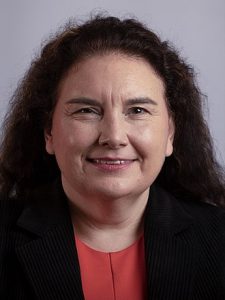
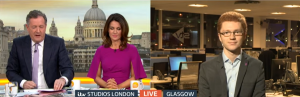
The Scottish Greens are co-led by Gillian Mackay and the chirpy Ross Greer.  I know Greer is a ‘Marmite’ politician for many, but I like how he puts the wind up gammons like Piers Morgan.
 

From youtube.com / © ITV


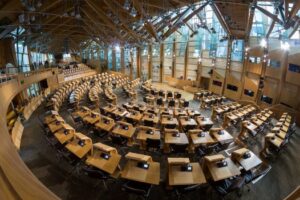
With the SNP on 58 MSPs, and the pro-Scottish-independence Greens on 15, 73 MSPs now support Scotland leaving the United Kingdom, as opposed to 56 unionist MSPs who don’t.  It’s the parliament’s biggest ever pro-independence majority.  Of course, you won’t have heard much about that fact from Scotland’s (unionist-owned) mainstream media, who instead have obsessed on a different fact – that the parliament suddenly has 17 far-right Reform MPs.  Nigel Farage’s extremist party had representation there before, thanks to one MSP defecting to them from the Conservatives.  But today, with Labour, they’re the joint-second biggest party.


This has prompted journalists like the Times’s Kenny Farquharson to declare ‘the death of Scottish exceptionalism’ – Scottish exceptionalism being the idea that Scottish voters are more community-orientated, more considerate of their fellow citizens, more leftwing and, generally, nicer than voters than those elsewhere in the UK, especially in England.  Reform’s showing proves that, no, the Scots are just as right-wing and awful as everyone else.


Well, I find it nauseating that the  parliament contains 17 MSPs who, if their party ever came to power, would enact Trump-style authoritarian and racist policies.  One of them, Senga Beresford, representing the South Scotland region, has already caused controversy by expressing admiration for fascist lout Stephen Yaxley-Lennon on social media.  But I derive some comfort from the fact that none of those MSPs were elected through the parliament’s first-past-the-post, constituency-based voting system, responsible for deciding 73 of the 129 MSPs.  Reform’s 17 sneaked in afterwards, via the additional, regional-based ‘list’ system.  Also, the Conservatives won 31 seats at the previous election, but have been culled to 12, and that number plus Reform’s 17 puts the total number of right-wingers  at 29 – two less than before.


I certainly don’t see Scotland as being exceptional, i.e., better than anywhere else.  I’ve met plenty of Scots who’ve been arseholes as much as arsehole-y people from other places.  But Scotland is still different from other parts of the UK.  If it wasn’t different, it wouldn’t have its own languages, literature, music, sports teams, legal system, educational system, etc.  It wouldn’t have been scunnered by Margaret Thatcher in the 1980s while people elsewhere were proclaiming her the new, handbag-wielding messiah.  It wouldn’t have voted heavily against Brexit when people in England and Wales voted for it.  It wouldn’t have its own independence movement with, now, a 57% majority in the Scottish parliament.  I know that sticks in the craws of unionist politicians and journalists who’d have you believe that Scotland is absolutely indistinguishable from the rest of the UK, that a punter from Elgin is identical to a punter from Ely.


Talking of journalists, the coverage of the election in the Scottish mainstream media was woeful.  The unionist newspapers (i.e., nearly all of them) spent half the time wailing “Everything in Scotland is shite!” and the other half wailing, “How dare anyone suggest doing anything even vaguely radical to improve things!”  Swinney’s proposal that, in an emergency, the Scottish government should put a cap on the price of essential food products so that poor people could still buy them, was met with hoots of derision – and the sneering observation that the UK government would never allow it.  (A Labour government – “For the many, not the few” – denying someone the right to keep essential foodstuffs affordable for the nation’s poorest people?  Not a great look.)


I thought the recent opinion-piece by Scottish journalist Stephen Daisley in the Spectator, calling on the Labour and Conservative parties to get rid of the UK’s devolved parliaments (“Dr. Frankenstein would understand that it was his duty to put down the hideous creature his foolishness and vanity unleashed on the world”), was bad enough.  But the articles that his fellow Scottish journo Chris Deerin penned about Scottish Reform leader Malcolm Offord, for the supposedly left-wing New Statesman, went to arse-licking extremes where no article has gone before.


And now, with Plaid Cymru’s Rhun ap Iorwerth the First Minister in Cardiff, and Sinn Fein’s Michelle O’Neill the First Minister in Belfast, all three devolved governments in the United Kingdom are helmed by people who see their nations’ futures as being outside that supposedly united kingdom.  Interesting times indeed…


But you won’t ever read about that in the newspapers.
 

From wikipedia.org / © User Colin

Student politics


© Profile Books


I’ve just read a review in the Guardian of Simon Kuper’s new book, Chums: How a Tiny Caste of Oxford Tories Took Over the UK. Chums tell the real-life story of student politics at Oxford University during the 1980s, a world whose inhabitants would often become well-known public figures in the 21st century.  On the Labour side there were ‘the Miliband Brothers, Dave and Ted, and Eddie Balls and Yvette Cooper’, who were busy ‘organising rent protests at their respective colleges’.  However, it was some Conservative student politicos at Oxford in the 1980s who’d become particular big-hitters and who’d handle – or mishandle – the levers of power in Britain during the 2010s and 2020s.


They included Michael Gove, whom Kuper says was bought, wearing a kilt, for 35 pounds at a charity-fundraising ‘slave auction’ at Oxford Union in 1987.  Even in 2022 and even after three-and-a-half decades of inflation, 35 pounds seems rather more than Michael Gove is worth, though maybe the kilt bumped up his value a bit.


They also included Britain’s current Prime Minister, the walking disaster area that is Boris Johnson.  Recently, the Mail on Sunday claimed that Johnson’s ‘Oxford Union debating skills’ were so formidable that, during debates in the House of Commons, Labour’s working-class, comprehensive-school-educated deputy leader Angela Rayner had to resort to crossing her legs like Sharon Stone in Basic Instinct (1992) to distract him.  According to Kuper, the young Johnson’s debating strategy was ‘to defeat opponents whose arguments were better simply by ignoring their arguments’ and rely instead on ‘carefully timed jokes, calculated lowerings of the voice, and ad hominem jibes’.


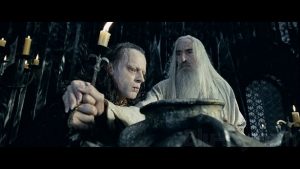
Also spicing up life in 1980s Tory Oxford University was David Cameron, though he was ‘rich enough and connected enough to feel himself above the “hackery” of student politics’; the BBC’s future political editor Nick Robinson; Daniel Hannan, NHS-basher, Enoch Powell fan, arch-Brexiteer and now in the House of Lords as Baron Hannan of Kingsclere, who, it’s been said, ‘may have contributed more to the ideas, arguments and tactics of Euroscepticism than any other individual’; and the future spin-doctoring Svengali behind Boris Johnson, Dominic Cummings.  Cummings, apparently, was a protégé of Dr Norman Stone, the historian, lecturer, author, advisor to Margaret Thatcher and student-groping pisshead from Glasgow.  One obituary published after Stone’s death in 2019 hilariously noted that he ‘hated Oxford, which he thought… was full of Marxists.’  Actually, I can’t imagine Stone and Cummings together without thinking of Saruman and Grima Wormtongue in The Lord of the Rings movies (2002-04).


© New Line Cinema / WingNut Films


Incidentally, Kuper acknowledges that Oxford University educated and employed not only J.R.R. Tolkien but also Lewis Carroll and C.S. Lewis.  He notes how ‘the timeless paradise of Oxford inspired its inhabitants to produce timeless fantasies like Alice in Wonderland, The Hobbit, Narnia and, incubating from the late 1980s, Brexit.’


Anyway, apart from making me mightily glad that I didn’t attend Oxford University during the 1980s, reading about Kuper’s book has got me thinking about the place where I was a student during the 1980s, Aberdeen University.  What about the student politicians I encountered there?  Did any of them ever get near – remotely near – those all-important ‘levers of power’?  There follows a heavily revised, fully up-to-date version of a piece about this subject I first posted in 2014.


To be honest, I wouldn’t have encountered any student politicians at all if I hadn’t got involved with Aberdeen University’s student newspaper and co-edited it for a term in 1986.  The newspaper office was located in the same building as the offices and meeting rooms where the members of the Students’ Representative Council did their business.  And obviously, those student politicians also figured in a lot of the stories we reported on.  So, I got to observe the species close up.


The one who probably did best for himself was Stephen Carter, who served as SRC President from 1985 to 1986.  I found Carter lacking in warmth, humour and character and at one point, in a fit of naughtiness, I published in the newspaper a spoof article depicting him as an aloof Roman Emperor in the manner of Robert Graves’ I, Claudius novels.  The article was entitled I, Carterus.  We didn’t get on very well, though not because I’d likened him to one of the Caesars.  Near the end of my editorship, I wrote a front-page article that made several criticisms of his reign as student president, which infuriated him.  To be fair, I later discovered that I’d made an error with a financial figure I’d quoted, so at least part of his anger was justified.  Being bawled out by the bland, automation-like Carter was a strange experience.   The abuse didn’t seem to emanate from a real human being.  It was like being scolded by an indignant speak-your-wait machine or a cranky elevator voice-recording.


From gov.uk


Decades later, in 2008, Carter served as Gordon Brown’s Downing Street Chief of staff.  Also, from 2008 to 2009, he was Brown’s Minister for Communications, Technology and Broadcasting.  As he wasn’t a member of either house at Westminster at the time, which would have barred him from taking on a ministerial position, he was quickly ennobled.  He was made Baron Carter of Barnes and entered the House of Lords.  I didn’t hear much about how that he got in on those roles, except for claims that his relationship with Brown’s notorious spin-doctor Damian McBride was ‘fractious’.  Actually, McBride was such a scumbag that it’s to Carter’s credit that the pair of them didn’t get along.


Coincidentally, days before Stephen Carter – sorry, Baron Carter of Barnes – ended his stint as Brown’s Chief of Staff, I found myself a full-time student again.  In October 2008 I started an MA course at the University of East Anglia.  The students there had mounted a protest against student debt, with hundreds of them sticking fake cheques to a campus wall.  On each cheque was written the sum of money that each student expected to owe by the time of his or her graduation.  To me (who’d graduated in 1987 with an overdraft of £1,500, which I paid off within two years), some of those sums were eye-watering: £40,000 or more.  What, I wondered, would we have thought at Aberdeen University in the mid-1980s if we’d known that our student president would one day be a key figure in a government presiding over levels of student debt we wouldn’t have imagined in our worst nightmares?


Another student politician from that era who’s done well is Katy Clark.  She was a leading light in Aberdeen University’s Labour Party and in 2005 became Labour Member of Parliament for North Ayrshire and Arran.  Her career as an MP ended in 2015 with the virtual wipe-out of Scotland’s Labour seats that happened under the kamikaze leadership of Scottish Labour leader Jim Murphy and spin-doctor John McTiernan.  However, she kept busy, working as a strategist for Jeremy Corbyn and authoring for him a review of the Labour Party’s democratic structures. Then, in 2021, she got elected to the Scottish Parliament as a Labour MSP for the West of Scotland region.


From wikipedia.org / © The Scottish Parliament


When I co-edited the student newspaper, Katy came to our attention when she led protests against Aberdeen University’s then-rector, the former Scottish National Party MP Hamish Watt.  At a debate during Freshers’ Week, Watt had made some supposedly-jovial comments in which he compared the young female students who’d just arrived on campus to ‘unbroken fillies’.  Now, while Watt undoubtedly deserved to be strung up by his sexist testicles, I didn’t enjoy having to speak to Katy about the incident.  I found her to be intense, one-note, lacking in personality and devoid of humour.  Actually, looking at what I’ve just written about Stephen Carter, a theme seems to be emerging in that regard.


Despite that, I felt some admiration for Katy because, unlike many other student politicians, she stuck by the left-wing principles she’d had as a university student and didn’t drift rightwards as she started to earn money.  During her career as an MP, she voted against the introduction of ID cards, against the renewal of the Trident missile system and against bombing campaigns in Iraq.  However, in 2020, that admiration was dampened by the fact that she accepted a peerage and entered the House of Lords as Baroness Clark of Kilwinning.


What were you thinking, Katy?  I don’t know how any socialists could debase themselves by becoming members of the archaic, undemocratic and embarrassing Lords.  It’s a place where you rub ermine-clad shoulders with the likes of Baroness Michelle Mone of Mayfair (who’s just had her home raided by police as part of a fraud investigation into her links with a dodgy PPE company); and Baroness Dido Harding of Winscombe (who got where she is today through cronyism and blew 22 billion pounds of taxpayers’ money on a failed Covid-19 track-and-trace system); and Baroness Claire Fox of Buckley (the former Revolutionary Communist Party member, Bosnian genocide denier and IRA supporter, now swivel-eyed Brexiteer and enthusiast for all things right-wing); and the afore-mentioned Baron Daniel Hannon of Kingsclere… and many more.


While she was there, I wonder if Katy ever bumped into her old Aberdeen University compadre Lord Carter of Barnes and they reminisced about their days on campus in the 1980s. (“What was the name of that hairy, beer-swilling prick with the Northern Irish accent who used to edit the student newspaper?”  “Can’t remember…”)


I should add that while running for the Scottish Parliament, Katy promised to ‘stand down’ from the House of Lords; and, according to her Wikipedia entry, on becoming an MSP she took ‘a leave of absence’ from the decrepit institution.  That, though, isn’t the same as ‘quitting’ it.  Also, I notice that on Wikipedia she’s still billed as ‘Baroness Clark of Kilwinning.’


From wikipedia.org / © The Scottish Parliament


To the rightward end of the spectrum, meanwhile, I have to mention someone else from my old alumni – Murdo Fraser, who’s in the Scottish Parliament as an MSP for the Mid-Scotland and Fife region and was once deputy leader of the Scottish Conservative Party.  That Murdo became a big name in Tory circles surprised me because he’d seemed an unprepossessing character in Aberdeen.  The detail I remember most about him was that he wore a Glasgow Rangers scarf 24/7, to the point where I wondered if it’d been stitched on.  A good friend who knew him a little, the late Finlay McLean, told me once that he had ‘the personality of a deep-frozen Cyberman’.  Then again, for an ambitious politician, not having a personality seems to be part of the course.


Murdo’s political ascendancy happened despite the fact that he was once associated with the notorious Federation of Conservative Students, an organisation that by the 1980s had become more right-wing than the Conservative Party of which it was the university branch.  At the time the Conservative Party was led by Margaret Thatcher, so being more right-wing than her was quite an achievement.  In 1986, after a string of well-publicised incidents – wherein FCS members had abused ethnic-minority staff at student bars, brayed their support for the Contras in El Salvador, sang the Special AKA song Free Nelson Mandela with the words changed to ‘Hang Nelson Mandela’, and so on – this extreme-minded group was disbanded by Tory Party Chairman Norman Tebbit.  And yes, being disbanded by Norman Tebbit for being too extreme was quite an achievement too.


The FCS at Aberdeen University were particularly obnoxious.  Among other things, they had a penchant for insulting gay people and taunting them about AIDS.  The start of my term as newspaper editor coincided with an incident wherein a bunch of FCS students invaded and disrupted a health-and-welfare talk being given to an audience of new students.  Their motive for disrupting the talk seemed to be because it covered safe sex for gay as well as straight students and was therefore, somehow, encouraging AIDS.


Later, after the newspaper had published an article about the society for gay students, Gay Soc, we received a letter from one deranged FCS member accusing us of furthering the interests of ‘the plague rats of the 20th century’.  We published his letter in the belief that by allowing the FCS to air their views publicly, we were letting people see what arseholes they were.  Give them enough rope and they’d hang themselves, we felt.  However, at least one gay friend of mine was deeply upset that the letter had appeared in our newspaper.  Today, 35 years on, I’d think twice about publishing it.


In Murdo Fraser’s defence, I’ll admit that he seemed aware of what a squad of bampots he was having to keep company with in the FCS.  He kept his mouth shut when the rest of them were being as offensively vocal as possible, and whenever I saw them strutting about the campus en masse he seemed to trail silently and reluctantly along at the back, rather like Eddie Bunker’s Mr Blue in Reservoir Dogs (1992).  Actually, being Mr Blue was appropriate given his footballing allegiances.


Having dissed the Labour and the Conservative Parties, I suppose in the interest of balance I should say something about Aberdeen University’s 1980s Liberal Party, the Liberal Democrats as they are now.  The Liberals’ most visible representative was one Dan Falchikov who, with his excitable and eccentric manner and his striking dress sense (a psychedelically-coloured sweater), possessed something that other people I’ve mentioned lacked: a personality.  And I think Dan was a genuinely well-meaning guy even if he wasn’t endowed with a great deal of common sense.  However, he was also an easy target for us unscrupulous hacks at the student newspaper and we spent a lot of time poking fun at him, calling him ‘Dan the Man’, ‘Desperate Dan’ and (when he was being particularly off-the-wall) ‘Dan F**k-me-off’.


From the Sutton & Croydon Guardian


Out of curiosity, I googled his name a while ago and discovered that, in 2010, while he was a Liberal Democrat activist in the London constituency of Kingston-upon-Thames, Dan got himself embroiled in controversy.  He was overheard boasting on a train that he’d managed to ‘plant’ a story, a false story, in the Evening Standard newspaper about the Labour Party having plans to close Kingston Hospital.  Unbeknownst to Dan while he blabbed about this into a mobile phone, a train-passenger sitting nearby was none other than the journalist Kevin Maguire, political editor of the Daily Mirror.  Maguire not only tweeted about what he was overhearing but also sneaked a camera-phone picture of Dan and posted it online.  Thus, it was a bit unsettling to find the eccentric, psychedelically-sweatered Dan the Man of Aberdeen University dabbling in the political dark arts and establishing himself as the bad boy of local politics in Kingston-upon-Thames.


I should add that since then Dan seems to have ditched the Liberal Democrats and joined the Green Party.  Considering that the Lib Dems were part of David Cameron’s discredited, austerity-obsessed coalition government from 2010 to 2015, and were disastrously led by Jo ‘nuke-’em’ Swinson in 2019, this suggests he has more sense than I’d credited him with.


I don’t think any of the student politicos I knew in the Scottish National Party went on to have political careers.  Probably having to deal with Hamish Watt, the university rector, ex-SNP MP and vocal admirer of young unbroken fillies, put them off politics for good.


I’ve tried to keep this account of student politics at Aberdeen University light-hearted, but there were some goings-on I found pretty unsavoury.  For example, before I graduated, some nasty rumours circulated in the SRC building about one student politician making another one pregnant.  There wasn’t actually a pregnancy but this didn’t prevent two SRC people, from two different political parties, both of whom had axes to grind with the guy involved, from approaching me and assuring me it was true.  One even swore that she’d seen the results of a pregnancy test.  Presumably, I was fed this false information in the hope that, as a student journalist, I’d spread the word to the detriment of the guy’s reputation.  Never mind what distress it’d cause him or the woman.  None of the people I’ve mentioned above, I should say, were involved in this saga.


Some student politicians I did genuinely like.  Indeed, if I ever bumped into the likes of Graeme Whiteside, Tim Morrison, Alan Strain or Stuart Black again on the High Street of Old Aberdeen, I’d invite them into the St Machar Bar and buy them a pint.  However, with regard to those people, there’s a sobering point to make.  None of those decent sorts, as far as I know, pursued their political careers any further than university.  None of them ended up becoming real politicians.


It reinforces Douglas Adams’ famous comment in The Restaurant at the End of the Universe (1980) that “it is a well-known and much lamented fact that those people who most want to rule people are, ipso facto, those least suited to do it.”


From wikipedia.org / © Nick Bramhall