Films I’d like to see remade (Part 2)


From wikipedia.org / © Metro-Goldwyn-Mayer


Here are some more films I remember fondly from my youth that, with sufficient love and skill, I think could be remade as wonderful new films.


Dark of the Sun (1968)

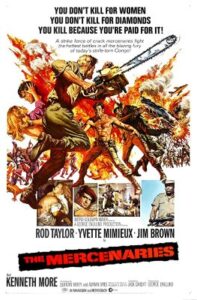
When, in my early teens, I saw this action / adventure / war movie on late-night TV, I believed it was the toughest movie ever.  At least, I believed that until I saw William Friedkin’s nail-biting Sorcerer (1977), itself a remake, of Henri-George Clouzot’s The Wages of Fear (1953), which promptly stole its crown as Most Badass Film I’d Ever Seen


But no matter – Dark of the Sun, or The Mercenaries as it was also known, still seemed pretty hardcore to me.  Why, it even had a chainsaw fight in it!  Thanks to the Texas Chainsaw Massacre movies (1974 onwards) and the Evil Dead movies (1981 onwards), and to one-off entries like Motel Hell (1980) and Mandy (2018), chainsaw fights are ten a penny nowadays.  But back then, seeing someone lunge at someone else with a whirring, metal-toothed power tool was an intense experience.


Based on a 1965 Wilbur Smith novel and directed by Jack Cardiff, Dark of the Sun tells the story of some mercenaries being sent into action amidst the Simbas rebellion in early 1960s Congo. It stars Robert Taylor, Yvette Mimieux – Taylor and Mimieux reunited eight years after appearing in George Pal’s charming 1960 adaptation of H.G. Wells’s The Time Machine – Jim Brown, Kenneth More (subverting his usual, cuddly English-gentleman image by playing an alcoholic doctor) and Peter Carsten (playing a vile, child-murdering Nazi).  At the time, critics lambasted the film for what they saw as its extreme violence.  However, as Cardiff noted, the violence depicted didn’t come anywhere near the real atrocities that’d happened in the Congo then, or near the violence featured in movies in later decades.


I’d like to see a remake of Dark of the Sun that updates the intensity, grittiness and violence to fit with 2026 sensibilities and that places the action within the context of 2026 geopolitics.  And is more racially sensitive – any racism in the original movie went over my 13-year-old head but I’m sure that, viewing it today, I’d cringe at parts of it.   At the very least, and despite the presence of Jim Brown as one of the mercenaries, I suspect I’d find it infused with a ‘white saviour’ or ‘white man’s burden’ complex.


Quentin Tarantino is a huge fan of this film (as is Martin Scorsese) so, as I did with Von Ryan’s Express (1965), I recommend old Quent as the man to helm a remake of it.  I know he’s sworn that he’s only going to make ten films in his lifetime, and his next one will be his last, but I don’t believe that for an instant.


Come to think of it, Dark of the Sun has quite a few things in common with Von Ryan’s Express, including a cracking movie film poster designed by the splendid Frank McCarthy and the presence of Nazis.  And like the earlier film, Dark of the Sun prominently features a train.


As does my next candidate for a modern remake, which is….


© Granada Films


Horror Express (1972)

The much-loved British-Spanish movie Horror Express is set on a train hurtling across Siberia in the early 20th century.  The train is being stalked by a decomposing ape-man fossil that’s seemingly come back to life – in fact, it’s possessed by an alien lifeforce and has the power to suck people’s brains out through their eyeballs.  Trying to thwart it are British scientists Sir Alexander Saxon (Christopher Lee) and Dr Wells (Peter Cushing).  Things become even more complicated in the film’s final act when the train is invaded by a bunch of Cossack soldiers, led by Telly Savalas’s villainous Captain Kazan.


Directed by Eugenio Martin, Horror Express is basically The Thing (1982) set on board the train from Alfred Hitchcock’s 1938 classic The Lady Vanishes.  Saxon and Wells are variations on the characters of Charters and Caldicott, the stuffy but unflappable English cricket-lovers in Hitchcock’s movie who get caught up in the chaos.  That said, you never feel Christopher Lee and Peter Cushing are playing anyone other than themselves in Horror Express.  During their careers, the two actors made 22 movies together, were close friends offscreen and have an effortless chemistry here.


The decaying ape-man in the original movie is still icky, but it would be nice to see it in a modern remake with a decent special-effects budget where it could do properly mind-blowing, spectacularly gruesome Thing-like things.  To play Saxon and Wells, you’d need a pair of British actors who’ve worked together already and possess some of that Lee-Cushing chemistry – maybe Benedict Cumberbatch and Martin Freeman, from the BBC TV show Sherlock (2010-17)?


And to play Savalas’s murderous Captain Kazan, there can be only one man: Nicolas Cage.


Theatre of Blood (1973)

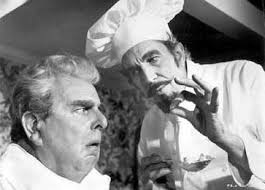
Until recently, I’d have been aghast at the thought of anyone remaking Douglas Hickox’s brilliant horror comedy Theatre of Blood, wherein Vincent Price plays an insane and hammily over-the-top Shakespearean actor called Edward Lionheart.  Enraged by the snobbish London theatre critics who’ve bad-mouthed his performances, Lionheart murders them one by one using methods borrowed from the Bard’s plays.  “They’re not going to start killing critics for giving bad notices, are they?” exclaims the campest critic, played by Robert Morley, who eventually meets a grisly fate modelled on events in Titus Andronicus.  A very distinguished cast of English character actors goes the same way as Morley: Michael Hordern, Dennis Price, Arthur Lowe, Harry Andrews, Robert Coote and Coral Browne.
 

© Harbour Productions Ltd / Cineman Productions / United Artists


There’s no shortage of famous modern-day British thespians who could play the supporting cast of doomed theatre critics in a remake – I’d enjoy seeing James Corden get the Titus Andronicus treatment – but surely, surely nobody could recreate the absolutely delicious performance that Vincent Price gives as Lionheart in the original movie?


Well, I thought that until I saw Ralph Fiennes in this year’s 28 Years Later: The Bone Temple.  Now I’m pretty sure he could be the Vincent Price of 2026.  And actually, Fiennes has played a character not dissimilar to Lionheart in 2022’s The Menu.


And if Fiennes wasn’t available, I suppose they could always call on Matt Berry.


The Beast Must Die (1974)

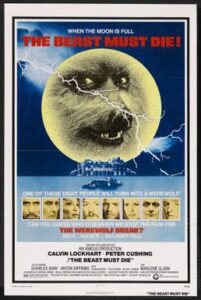
Paul Annett’s The Beast Must Die is a low-budget horror movie with an irresistible premise.  It’s about a millionaire big-game hunter, played by Calvin Lockhart, determined to bag a werewolf.  He rigs up his country estate with CCTV cameras and motion sensors, procures a helicopter and invites five unsavoury people to visit for a few days convinced that one of them  is a werewolf.  Among those playing Lockhart’s house-guests and staff are Peter Cushing, Charles Gray, Anton Diffring and a youthful Michael Gambon.  Needless to say, there is a werewolf present, but it gradually turns the tables on Lockhart and his hi-tech equipment, whilst also bumping off the supporting cast.


The ideas is irresistible, as I said, but watching The Beast Must Die on TV as a kid was a frustrating experience.  Due to the inevitable budgetary constraints, Lockhart’s mansion house and grounds aren’t that hi-tech and the werewolf, when it appears, just looks like a big dog.  You’d think the sequence where the werewolf takes out a helicopter would be thrilling, but it isn’t.  Let’s remake this one with a proper budget, so that it’s as awesome as it sounded on paper in 1974.
 

From wikipedia.org / © Amicus Productions / British Lion Films


Juggernaut (1974)

The most underrated but, in my mind, the greatest of 1970s disaster movies, Richard Lester’s Juggernaut is mostly set on a British ocean liner stuck out in the stormy north Atlantic.  An anonymous call to the company that owns the liner informs it that half-a-dozen bombs have been stashed on board and they’ll explode unless a ransom is paid.  With weather conditions too severe to allow the ship’s crew and passengers to be evacuated, and the authorities forbidding the company to pay the ransom – which would be surrendering to terrorism – a team of bomb-disposal experts led by Fallon (Richard Harris) and his sidekick Charlie (David Hemmings) are sent to try and make the bombs safe.


Back on dry land, a policeman (Anthony Hopkins), whose family are among those trapped on the ship, tries to discover the bomber’s identity.  I don’t want to give away any spoilers, but when a twitchy Freddie Jones appears onscreen, you know who it is.


Juggernaut has a wonderful cast all round – not just the three ‘H’s of Harris, Hemmings and Hopkins, but also Omar Sharif, Ian Holm, Shirley Knight, Clifton James, Julian Glover and many more.  But the show is quietly stolen by Roy Kinnear, playing the ship’s entertainment officer, who has the thankless task of keeping the passengers’ spirits up when at any moment they could be blown to smithereens.  When he organises a fancy-dress party, one passenger appears dressed as the Grim Reaper and carrying a round black object with BOMB written on it.


As well as being massively suspenseful, the film offers social commentary.  The ship is called the Britannic and it’s not difficult to see Juggernaut as a meditation on the sorry plight of Britain in the mid-1970s, its days as a world power well behind it, being battered by global events it had no power over, such as the Oil Crisis.  In 2026, a decade after Brexit and during the chaotic era of Trump, a remake of Juggernaut would be both more poignant and more cutting.


You could also cast, in a Juggernaut remake, the sons of three of its original stars, now well established as actors in their own right: Jared Harris, Toby Jones and Rory Kinnear.  But it’d be fun to see them in roles different from those their dads played.  Kinnear as the policeman, Jones as the entertainment officer, Harris as the bomber?
 

© Two Roads / United Artists

Just a flesh wound


© Ley Line Entertainment / Bron Creative / A24


It’s fair to say that the regal, if probably hypothetical, legend of King Arthur has suffered more than a few flesh wounds from filmmakers over the years.


At least in the case of the Monty Python team, the filmmakers were deliberately taking the piss.  Their 1974 movie Monty Python and the Holy Grail inflicted on poor Arthur such indignities as the Knights Who Say ‘Ni!’, the bloodthirsty Rabbit of Caerbannog, the Holy Hand Grenade of Antioch, Dennis of the Autonomous Collective (“Listen, strange women lying in ponds distributing swords is no basis for a system of government. Supreme executive power derives from a mandate from the masses, not from some farcical aquatic ceremony.”) and the outrageously rude French guard (“You don’t frighten us, English pig-dogs! Go and boil your bottoms, sons of a silly person!”).


More worryingly, other filmmakers have tried to be serious, though with cringeworthy results.  I’m thinking of 1967’s Camelot, which has Richard Harris’s Arthur bursting into song and warbling, “You mean a king who fought a dragon / Whacked him in two and fixed his wagon / Goes to be wed in terror and distress? / Yes!”  Or 2004’s King Arthur, which has a grimly wooden Clive Owen in the title role and which, according to the Times’ reviewer Wendy Ide, ‘attaches itself to the Arthurian legend like some parasitic worm’.  Or 2017’s King Arthur: The Legend of the Sword, which was directed by Guy Ritchie in the manner you’d expect from Guy Ritchie, complete with a cameo appearance by that well-known icon of the Dark Ages, David Beckham.


Actually, I’ve immersed myself a lot in the King Arthur legend recently, not through films but through books, which I’ve found much more rewarding.  Not long ago, I managed to finish off T. H. White’s Once and Future King series, comprised of The Sword in the Stone (1938), The Queen of Air and Darkness (1939), The Ill-Made Knight (1940), The Candle in the Wind (1958) and The Book of Merlyn (1977).  Yes, I know, the first book was the basis for the underwhelming 1963 Walt Disney cartoon, but the series becomes impressively philosophical, political and tragic as it goes on.  I’ve also lately read Kazuo Ishiguro’s 2015 novel The Buried Giant, set a short period after the death of Arthur.  Come to think of it, The Buried Giant could almost qualify as a postscript to White’s series, although there are a few differences in continuity.  (For example, Merlin is said to be dead by the time of Ishiguro’s novel, whereas in the timeline established by White he’d be alive.  His ability in the Once and Future King books to live through time in the opposite direction from human beings, from the future to the past, would ensure that.)


© Faber & Faber


A figure from Arthurian legend who plays a major role in The Buried Giant, as an elderly man, is Arthur’s nephew Sir Gawain.  Gawain, of course, occupies his own niche in the Arthurian mythos because he’s the main character in Sir Gawain and the Green Knight, the late 14th century poem written in a North West Midlands dialect of Middle English.  The poem has Sir Gawain respond to the mysterious Green Knight who arrives at Arthur’s court one Christmas Eve with an unusual challenge: who is prepared to strike him a blow with the axe he is carrying, on the condition that one year from now the Green Knight gets an opportunity to return the blow on his home turf, a place called the Green Chapel?  Gawain takes up the challenge and uses the axe to whack off the Green Knight’s head.  That, however, doesn’t resolve the matter, because the Green Knight refuses to die.  He picks up his head and rides off, leaving Gawain honour-bound to keep the appointment at the Green Chapel next Christmas.  Obviously, there, he’ll receive an equivalent blow that he’s less likely to be impervious to.


The poem was filmed twice in the 20th century by the director Stephen Weeks, first in 1973 as Sir Gawain and the Green Knight with singer Murray Head as Gawain and Nigel Greene as the Green Knight, and again in 1984 as Sword of the Valiant. Both versions made little impact and the clearly well-intentioned Weeks was hampered by low budgets.  With the second version, he was no doubt hampered too by the fact he made the film for the notoriously schlocky Cannon Group, whose co-owners Menahem Golan and Yoram Globus overrode his choice of Mark Hamill to play Gawain and instead foisted on him Miles O’Keefe, who’d previous played the Lord of the Jungle in 1981’s dire Tarzan the Ape Man.  A better casting choice was Sean Connery as the Green Knight.


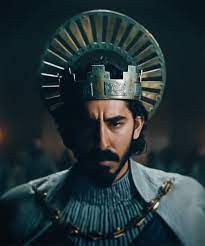
Now, however, Sir Gawain and the Green Knight has received the big budget treatment.  Well, at 15 million dollars, not that big, but certainly a lot more than Stephen Weeks had to play with.  David Lowery has written and directed a new version with Dev Patel, of 2008’s Slumdog Millionaire, stepping into Gawain’s armour.  I have to say the resulting film, with the shortened title The Green Knight, isn’t perfect, but nonetheless it does justice to the poem at last.  It also qualifies as that rare beast – a quality King Arthur movie.


The Green Knight doesn’t present a fanciful or idealised picture of Arthur’s court, if that court had ever actually existed.  While it doesn’t wallow in medieval dirt, muck and shit like Monty Python and the Holy Grail (“Dennis!  There’s some lovely filth down here!”), it does show life in and around Arthur’s citadel as wintry, draughty, farmyard-y and unglamorous.  Accordingly, Arthur and Guinevere (Sean Harris and Kate Dickie) are portrayed as an ageing, rather threadbare couple, who don’t even get the accolade of being referred to by their legendary names.  They’re just ‘the king’ and ‘the queen’.


On the other hand, the film is keen to show how unspectacular characters, settings and events get exaggerated and mythologised and turned into legends.  It makes much of story-telling and myth-making.  For example, no sooner has Gawain had his first encounter with the Green Knight than the tale is being retold as a puppet show for the neighbourhood’s children.  On a battlefield strewn with newly-dead corpses, a scavenger (Barry Keoghan) is already recounting stories of derring-do about the battle that are clearly over-the-top bullshit.  And Arthur himself pleads with his court, “Friends, brothers and sisters, who can regale me and my queen with some myth or tale?”  When he asks Gawain, “Tell me a tale of yourself so that I might know thee,” and Gawain replies, “I have none to tell,” Guinevere interjects with: “Yet. You have none to tell yet.”


© Ley Line Entertainment / Bron Creative / A24


It reminds me of another movie with a focus on myth-making, but a very different setting, The Man Who Shot Liberty Valance (1962), John Ford’s meditation about the end of America’s Wild West. As Carleton Young’s newspaper-editor character says in that film, “When the legend becomes fact, print the legend!”


I thought the first hour-and-a-bit of The Green Knight was splendid.  The Green Knight himself is presented wonderfully as a proper green man, all gnarled wood and straggly tree-root beard, and his appearance is complemented by his voice, which is that of gravelly Yorkshireman Ralph Ineson.  Actually, it’s nice to see Ineson and Kate Dickie together in a film again after they played the doomed Puritan parents in Robert Eggers’ The Witch (2015).


Once Gawain sets off in search of the Green Chapel, to keep his unwanted appointment, he has several phantasmagorical adventures that involve phantoms, giants and supernaturally intelligent animals and that are gorgeously shot by cinematographer Andrew Droz Palermo.  However, it’s the episode with Barry Keoghan and his grubby little band of thieves that’s perhaps most haunting, thanks to an amazing sequence with a rotating camera-shot and time-lapse special effects that makes you wonder if anything else you see in the film is going to be true.


But The Green Knight does, in my opinion, have a structural problem.  This is because in the original poem the adventures Gawain has during the first half of his journey are not described in any detail, and what we see on screen presumably comes from Lowery’s imagination.  However, later events in the film are based on the poem and form an important part of the plot.  These involve Gawain coming to a castle near the Green Chapel and enjoying the hospitality of its lord (Joel Edgerton) and lady (Alicia Vikander) during the last few days before his appointment.  His experiences there become strange and prove to be a series of tests.  That’s fine, but after the fantastical episodes that Gawain’s been through earlier on, these castle-bound scenes feel something of a let-down and act as a brake on the film’s momentum.


The climax bravely departs from the denouement of the poem (which had Arthur’s sister, and Gawain’s aunt, Morgan Le Fay popping up as a sort of medieval deus ex machina).  Instead, it does something that had me thinking of the climax of Martin Scorsese’s The Last Temptation of Christ (1988).  This neatly echoes the earlier themes of storytelling and myth-making.


The Green Knight certainly isn’t to everyone’s tastes.  For example, a certain well-known science-fiction author, clearly more a Guy Richie / King Arthur: Legend of the Sword man, denounced it on twitter recently as “the worst film I’ve watched this year…  What a waste of good actors.  I want my two hours back.”  However, if you’re in the right frame of mind, not expecting anything like the usual cinematic Arthurian fare, and willing to tolerate some ruminative, slow-moving stuff in the second half, you may find it magical.


© Ley Line Entertainment / Bron Creative / A24