How low will you go?


From pixabay.com / © Geralt


When The Simpsons was the greatest thing on television a long – a very long – time ago, I remember a 1999 episode, They Saved Lisa’s Brain, that began with a contest being held in Springfield and broadcast live on TV called How Low Will You Go?  According to the entry about it on the WikiSimpsons site, How Low Will You Go? was ‘sponsored by Grandma Plopwell’s Pudding’ and its winner ‘would be the person who did the stupidest thing on the stage.’  Contestants included Bart Simpson eating ‘everything that was thrown at him’, Homer Simpson wearing ‘a suit made of popcorn kernels’ and singing a song called Kernel Knowledge, and Moe Szyslak ‘dressed in a sailor suit with a giant lollipop.’


When I saw the episode more than a quarter-century ago, I remember reacting to this indictment of how people are humiliated and degraded by TV and its promises of instant celebrity by thinking: Wow, that is pretty low!  Of course, I didn’t know it at the time, but I hadn’t seen anything yet.  In the decades since, TV – often of the ‘reality’ variety – has induced folk to do far worse things and make far bigger dicks of themselves on camera, to the point where cavorting around in a suit made of popcorn kernels actually seems quite highbrow in comparison.


Anyway, I feel like How Low Will You Go? has now become a TV series that’s in the middle of its second season.  Each season lasts for four years and takes place in the White House whenever Donald Trump is the US president.  Season one lasted from 2016 to 2020.  Season two began in 2024 and is due to end in 2028.  That is, if the USA still exists by 2028.  Come to think of it, if the world still exists by 2028.


In season one, Trump proved that yes, he could go pretty low.  He shamelessly sucked up to Putin.  He belittled a war veteran, John McCain, who’d served his country in Vietnam and spent more than five years as a prisoner of war there.  (“I like people who weren’t captured!”)  He skipped attending an event in honour of American soldiers killed in World War One at France’s Aisne-Marne American Cemetery on the 100th anniversary of Armistice Day because he couldn’t handle the fact it was raining.  He mocked a reporter suffering from congenital joint condition in front of a rally by doing an impersonation of him that an obnoxious kid would do of someone with cerebral palsy.


He suggested injecting bleach as a cure for Covid-19.   He describing developing-world nations as ‘shithole countries’.  He leched after his own daughter, talking about her ‘breasts, her backside, and what it might be like to have sex with her.’  He told 30,573 lies, according to the Washington Post.  Oh, and when he lost the presidential election in 2020, he claimed, baselessly, it’d been ‘rigged’ and incited a mob of his dingbat supporters to attack the US Capitol, where they chanted about hanging Trump’s own vice-president and tried to prevent Joe Biden’s victory in the election being formalised.


The Trump version of How Will You Go?, season one, was a ratings hit.  In fact, a sufficient number of Americans thought it was so wonderful that they voted Trump back into the White House in 2024 for a second season.  And, so far, season two hasn’t disappointed.  How far can the man go this time?  Why, far, far lower!


He’s threatened to annex the USA’s next-door neighbour and important ally and trading partner Canada, so that now everyone in Canada hates his guts, won’t visit his country and spend money there, and won’t buy American products like American bourbon.  He’s threatened to annex Greenland, which belongs to a country in a military alliance the USA is in, an alliance whose basic doctrine would require all the other member countries to go to war with the USA if he attempted to annex it.  Makes sense, yes?


From wikipedia.org / © The White House


He’s shamelessly sucked up to Putin, again.  He’s insulted reporters, often female ones – intelligent and independent-minded women are obviously a group he has serious issues with – calling them ‘piggie’ and ‘crooked or stupid’ and ‘corrupt’ with ‘hatred in her eyes’.  He’s whinged like a spoilt brat about not receiving a Nobel Peace Prize.  He’s fallen asleep in meetings and press conferences after he sneeringly dubbed his presidential predecessor ‘Sleepy Joe’ Biden.  He’s relentlessly posted AI crap on his Truth Social platform, including footage of him in a plane dropping gigantic turds on ‘No Kings’ protestors, pictures of himself as Jesus, and images depicting Barack and Michelle Obama as apes.


He’s also allowed himself to be bounced into a war against Iran by Benjamin Netanyahu, with the result that the Strait of Hormuz, and the maritime route carrying 20 percent of the world’s oil supply, are now blocked.  The other day, he claimed his administration and the Iranians were on the brink of agreeing on a peace deal…  But as he’s already claimed this about 40 times since the conflict started in February, I’m not going to hold my breath.  At least for Trump, it takes folk’s minds off his sizeable presence in the Epstein Files.


To spice things up even further, the producers of season two of How Low Will You Go? have brought in additional cast-members to give Trump a run for his money in going low.  Thus, we’ve had Vice President J. D. Vance insulting single women who keep cats and being a malicious prick towards the Ukrainian president Volodymyr Zelensky, a leader with more courage in his little finger than Vance and Trump have in their entire, make-up-enhanced bodies.


They’ve also introduced the ultra-ridiculous Pete Hegseth, who was Trump’s Secretary of Defence until Hegseth persuaded him to change the title to the more manly and harder-sounding ‘Secretary of War’, and who pees his pants in rage when press photographers take pictures of him from what he considers unflattering angles.  At a recent gathering in France commemorating the 82nd anniversary of the D-Day landings, Hegseth gave a speech condemning European nations for allowing their beaches to be “stormed by different, dangerous ideologies”, i.e., people he considers not sufficiently white enough and Christian enough to be let in.  I really don’t know why Hegseth turned up at this event.  After all, 82 years ago, his side lost.


Today, June 14th, we get another episode in How Low Will You Go?  It’s Trump’s 80th birthday and he’s marking it by staging Ultimate Fighting Championship (UFC) bouts on the South Lawn of the White House.  The Las Vegas-based UFC organises ‘mixed martial-arts’ combat – basically, violent ‘anything-goes’ scraps – inside cages.  So, the seat of the American presidency is about to host cage fights.  That really resonates with the dignity of the place and those who’ve lived there in the past, one-time holders of the USA’s highest office like Abraham Lincoln, Teddy and Franklin D. Roosevelt, Harry S. Truman, Dwight D. Eisenhower and John F. Kennedy.  If Honest Abe, FDR, JFK and the rest are watching this from the clouds, they’ll be doing so between their fingers.


What’s been installed for those UFC bouts consists of an enclosed octagonal ring with a huge, claw-like superstructure built over it with clusters of lights and big TV screens attached.  The ring is emblazoned with the names of sponsors like Bud Light, Toyo Tires and Pit Boss Grills.  And, inevitably, the web address crypto.com features prominently too.


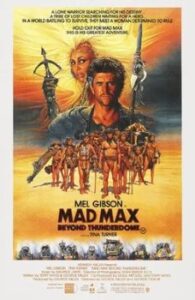
It makes me think of the 1986 movie Mad Max Beyond Thunderdome and the hemispherical gladiatorial arena where Max and Blaster had to fight it out with chainsaws and sledgehammers.  Trump’s spectacle at the White House sounds just as dystopian – though at least in the Mad Max movie, the dictator presiding over things was played by Tina Turner.  I’d have her as my dystopian overlord rather than the revolting, decaying Trump any day of the week.


From wikipedia.org / © Warner Bros / Kennedy Miller Productions


Oh well, I suppose there’s one silver lining to this.  Trump’s crass preoccupation with having UFC fighters slug it out on his lawn has at least diverted his attention from the Football World Cup, which kicked off in Canada, Mexico and the USA a few days ago.  He hasn’t tried to insert himself into that, so far.  I was particularly worried he’d turn up at yesterday’s match between Scotland and Haiti in Boston, since he loves talking about his Scottish roots – his mother hailed from the Isle of Lewis – and since he hates Haitians.  (During the run-up to the 2024 presidential election, both he and Vance yet again showed how low they’d go by lying about Haitian immigrants in Ohio eating people’s domestic pets.)  If he’d shown his orange face at the match, I think I would have found myself wanting Haiti to win, just to sicken him.*


*Trump didn’t appear, I was able to support Scotland as normal and Scotland won, just about.  Phew.       

Go west, young Scots (if you can)


From bellacaledonia.org.uk


Once upon a time, the misery involving Scotland and the FIFA World Cup hinged around the fact that, though the Scottish men’s football team usually qualified for the thing, they never, ever managed to progress beyond its first round.  This was irrespective of whether they played well (in 1974, managing a win and two draws, one of those draws with Brazil, but going out on goal difference); badly but with a flash of genius when it was too late (in 1978, getting beaten by Peru, drawing with Iran, finally finding their mojo and defeating the tournament’s eventual runners-up Holland, but going out on goal difference); or simply badly (most of the rest of the time).


My family moved from Northern Ireland to Scotland in 1977, in time for Scotland’s campaign in the 1978 World Cup.  As I noted above, that performance wasn’t all bad.  However, the team’s departure for Argentina, the host country, had been accompanied by a Scotland-wide tsunami of insane expectation and over-optimism.  The madness was caused by some witlessly hopeful predictions from Scotland manager, Ally MacLeod, which an irresponsible and headline-hungry Scottish press had amplified.  (The team had some good players, but not that good.)   When their country didn’t win the World Cup, as everyone had been braying they would, but flopped in the first round, the Scots treated it as a national humiliation.  And for years, if not decades, afterwards, they suffered from Post-Ally-MacLeod-Stress-Disorder.


During the 1982 World Cup, I was working in Northern Ireland.  I got caught up in the euphoria of Northern Ireland’s unexpected and brilliant run in it – they got past the first round and beat host nation Spain along the way – and, probably fortunately, I didn’t have to focus too much on Scotland.  By 1986, I was studying in Aberdeen.  For Scotland’s final first-round match of that competition, in Mexico, they needed to beat Uruguay by at least two goals.  A mate called Alan Kennedy invited me and a few others to his house to watch the game on TV.  For the occasion we ordered a keg of beer and tucked into it several hours before the kick-off.  Well lubricated, I dozed off in an armchair not long into the match.  What a lucky man I was.


Four years later, in 1990, I was working in Hokkaido in northern Japan.  This time, with the World Cup taking place in Italy, I invited a few of my friends to my apartment for Scotland’s final first-round game.  Their campaign had begun with another gut-wrenching, soul-destroying defeat – by Costa Rica – that added yet more scars to the nation’s psyche.  But then they’d beaten Sweden and now they needed to see off Brazil.  They didn’t.  The folk I invited to my apartment for the game consisted of some Japanese colleagues and a football-daft Glaswegian called Bill Quinn.  Afterwards, one Japanese colleague remarked, “I’ve never seen anyone look so sad as your friend Mr Quinn when the match finished.”


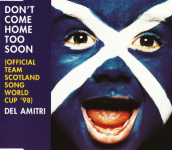
Scotland didn’t qualify for the 1994 World Cup in the USA but made it to the 1998 one in France.  By now the nation was well past any delusions that they might come near to winning the damned thing. They just prayed that their team would get past that f**king first round and into the second one.  Small wonder that for Scotland’s official 1998 World Cup anthem, the Scottish Football Association got Del Amitri to sing a wistful song called Don’t Come Home Too Soon.


From wikipedia.org / © A&M Records


During this competition I was at my family’s home in the Borders town of Peebles and I watched all three Scotland games in the town’s cosy Bridge Inn, known locally as ‘the Trust’.  After the third game, a three-goal humping by Morocco that ensured that, yes, Scotland were coming home too soon, I left the Trust and headed for the Green Tree Hotel at the far end of the High Street.  The public bar there was full of people who’d just been watching the game in full regalia – team shirts, tammy hats, tartan scarves and kilts – and whom I expected to be miserable beyond belief.  They weren’t.  Their team had taken an early bath for the umpteenth time, but what the hell?  They’d decided they might as well party.  The ensuing evening was one of the best I’ve ever had in a pub.  Someone behind the bar stuck on a compilation record called The Best Scottish Album in the World Ever (1997) and I couldn’t believe how many grown men around me knew all the words to Shang-a-Lang (1974) by the Bay City Rollers.


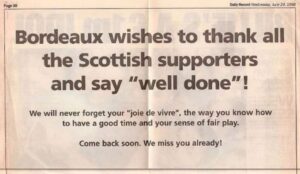
That evening in 1998 was symbolic of what’d happened regarding the Scottish football team and its supporters.  While the former seemed doomed to flounder at these big events, the latter had given up on any expectation of their team doing well and were simply determined to enjoy themselves, win, lose or draw.  In the process, their self-deprecating humour and dedication to good-natured partying earned them the reputation of being one of the best sets of football fans in the world.  For instance, the city council of Bordeaux, where Scotland had played two of their 1998 World Cup games, took out a full-page advert in Scottish newspaper the Daily Record to thank the fans for their behaviour: “We will never forget your ‘joie de vivre, the way you know how to have a good time and your sense of fair play.  Come back soon.  We miss you already!”  I’m sure those sentiments were shared by Bordeaux’s bar and off-licence industry.


Indeed, I felt sorry for bigger countries with a reputation for greater footballing prowess, whose fans did expect them to deliver the goods.  I’d see those countries’ fans gather to watch a make-or-break World Cup game…  And, when the final whistle blew and their country had messed up, lost the game and exited the competition, those fans immediately headed home with scowls on their faces.  Wait, I’d think, aren’t you at least going to hang around and party?  (Yes, I’m looking at you, England fans.)


We’re more than a quarter-century on from the 1998 World Cup.  The issue with Scotland since then is that they’ve failed to qualify for the competition at all.  Bellyaching about them never progressing beyond the first round of it seems like an unobtainable luxury now.  We didn’t know how lucky we were back in the late 20th century.


Happily, though, all that has changed.  November 18th saw Scotland clinch qualification for next year’s World Cup tournament in Mexico, Canada and the USA by beating Denmark 4-2 at Hampden Park in Glasgow.  Sure, Denmark had the lion’s share of the play, and John McGinn was perhaps not being too modest when he commented afterwards, “I thought we were pretty rubbish to be honest, but who cares?”  But three of Scotland’s four goals were amazing: Scott McTominay managing to backwards / overhead-kick the ball into the Danish net whilst seemingly levitating in the air; Kieran Tierney sending the ball scouring around the penalty area and just making it inside the Danes’ goalpost; and, with brilliant insouciance, Kenny McLean punting the ball in the final seconds from the halfway line – and seeing it go over the Danish goalie’s head and into the net.


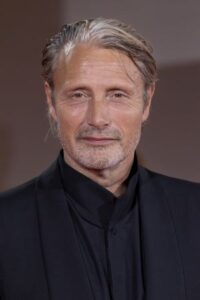
Mads Mikkelsen, your boys took a hell of a beating.


From wikipedia.org / © Luca Faz


My excitement about Scotland being on their way to a World Cup for the first time in 28 years is tempered, though, by the fact that it’s being held in North America.  Under the FIFA presidency of Gianni Infantino – a man who’s managed the difficult feat of making Sepp Blatter look wholesome – the sale of tickets has been, in the words of the Guardian, ‘a late capitalist hellscape’ plagued by ‘dynamic pricing, crypto detritus and corporate doublespeak’.  How many ordinary Scotland fans, whose presence at past matches has created such a memorable atmosphere, can afford to attend a game?  Not so many, I imagine.  Plus, if Scotland’s games are played in the USA, the fans will have to get past that country’s increasingly autocratic rules on who gets allowed in.  Dare to criticize President Trump on social media and you get barred, apparently.  And I’d guess that, online, more than a few Scotland fans have referred to the American Commander-in-Chief as ‘a big orange bawbag’ at some point.


No, I have a horrible suspicion that the majority of Scotland’s support at any USA-held games would consist of well-heeled, conservative and sober Americans who happen to have a ‘Mac’ in their surnames thanks to some Scottish ancestor – folk who like to see a few kilts at their weddings but who quietly prefer American football and baseball to what they call ‘soccer’.  The atmosphere at those games could be terribly lame.


That’s on top of my horrible suspicion, based on past experience, that Scotland will screw up against some embarrassing opposition.  I have a bad feeling about the Dutch Caribbean island of Curaçao, who have just become the smallest-ever country to qualify for a World Cup, under the management of none other than former Glasgow Rangers boss Dick Advocaat.  I can just imagine them ending up in Scotland’s first-round group.  And then Scotland making a giant hash of things against them…


Meanwhile, as the USA’s orange Commander-in-Chief loves bragging about his Scottish roots – his mother came from the Isle of Lewis – I bet he’d make a great show of turning up in person to watch any Scottish World Cup game that takes place on American soil.  Mind you, he might not survive the ordeal.


From the Daily Record / © Bordeaux City Council


Scotland or Not-land?


From unsplash.com / © Stewart M


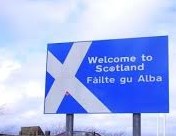
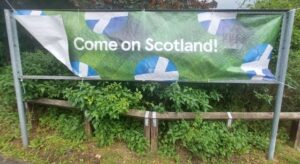
Most people in Scotland last week were disappointed, though probably not greatly surprised, to see their national team get a drubbing in the first round of the Euro 2021 tournament.  However, I suspect not everyone in Scotland was sad to see the team fail.


One person I’m sure was delighted was the Scottish, but very British-nationalist, blogger Effie Deans, who before the start of the tournament had tweeted a picture of a past Scotland-England football match and demanded angrily, “Why are there international matches between parts of the same country?” Similarly, I imagine certain fans of Glasgow Rangers, a football club whose culture revolves around such British symbols as the Queen and the Union Jack, weren’t sorry to see the Scottish national team flop.  Indeed, an article in the Daily Record newspaper on July 8th confirmed that some Rangers fans were unwilling to support Scotland during Euro 2021.


For Deans and a certain segment of the Rangers faithful, the belief seems to be that if you regard your country primarily as Britain, then you can’t support Scotland.  In fact, acknowledging Scotland on an international stage is damaging to your sense of Britishness and shouldn’t be encouraged.  Scotland?  No, it’s Not-land.


It’s not just in sport.  The idea that Scotland might have its own culture and languages is anathema to some people.  The right-wing Spectator magazine has printed pieces by embittered Scottish Daily Mail columnist Stephen Daisley and uptight Scottish composer James MacMillan complaining that (a) Scottish culture is infantile and embarrassing; but (b) if you’re stupid enough to be into Scottish culture, you’re somehow a Mussolini-type fascist too.  Amusingly, after MacMillan complained – falsely, because the man has actually won a number of Scottish awards – about Glaswegian novelist Andrew O’Hagan being cold-shouldered by the Scottish arts establishment for not being sufficiently supportive of Scottish independence, O’Hagan began, in the wake of the Brexit referendum, making favorable noises about Scotland becoming independent.


Particularly nasty has been the abuse aimed at the Scottish Gaelic and Scots languages.  Right-wing unionist twitter in Scotland is a constant whinge-fest about road-signs having names printed in Gaelic as well as in English.  Effie Deans again, complaining about travelling to Fort William last year: “The number of times I missed my turning made me wish the signs were in one language or the other, but not both…”  Well, dear, maybe try reading the parts of the signs that are written in the language you understand?


Meanwhile, dodgy, right-wing Unionist political carpetbagger George Galloway – at least, he’s right-wing when he’s in Scotland trying to hoover up Conservative votes; when he’s in England he campaigns as a left-wing man of the people – recently caused a pile-on on Scots-language poet Len Pennie after he made disparaging remarks on twitter about her and the medium in which she works.  And a few years back, Jackie Kay, Scotland’s Machar (poet laureate) received brickbats when one of her Scots-language poems was among the items given to new mothers as part of Scotland’s ‘baby box’ initiative.  “A woman from Bishopbriggs, writing doggerel,” sneered Ian Smart, prominent social media presence and self-styled ‘lefty lawyer’ and ‘Scottish Labour Party hack’.


Again, among many Scottish people who don’t see Scotland as a country but as a region, or as a big glorified county, of the mightier and more majestic entity that is the United Kingdom, there’s a conviction that Scottish culture can’t be real.  Accepting the existence of Scottish culture implies the place being different from the rest of the UK.  Therefore, culturally, there’s no such thing as Scotland either.  It’s Not-land.


From youtube.com


Predictably, the fact that there’s now a Scottish parliament in existence, separate from the parliament in London, is something that drives many British-loyal Scots to distraction, especially when the past 14 years have seen it run by a party, the Scottish National Party, dedicated to pulling Scotland out of their beloved UK.  Particularly guaranteed to make them gnash their teeth and froth at the mouth is any suggestion that the Scottish government, like the Scottish football team, might be recognized on an international level.  The moment First Minister Nicola Sturgeon pronounces on some international matter or dares to show her face at some international conference, Scottish twitter is raging with indignant people who have Union Jacks in their profiles (and usually the words ‘Rangers’ and the acronym ‘WATP’, which a Glasgow-Celtic-supporting friend assures me stands for ‘We adore the Pope’) slavering about her having ‘ideas above her station’ and being just the head of a ‘wee parish council’, and not knowing ‘her place’.  Can’t she see that she isn’t the First Minister of Scotland, but that of Not-land?


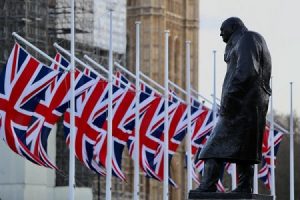
This desire to erase the concept of Scotland from everyone’s consciousness is, it has to be said, one that’s been exhibited lately by the British government too.  British diplomats have been ordered to stop talking about the ‘four nations’ of the UK and talk about it as a single country only, while supermarkets have seen a recent craze for plastering Union Jacks over foodstuffs made in Scotland.  Meanwhile, Prime Minister Boris Johnson, that symbol of everything decent, moral, honest and faithful about dear old Blighty, was heard bragging that at the upcoming COP26 climate summit in Glasgow he was going to slather the event in Union Jacks and wouldn’t allow Nicola Sturgeon anywhere near it.


Just last Friday, Johnson’s education minster urged schools across the UK to honour something called One Britain, One Nation Day, wherein schoolchildren were made to sing a song, specially composed for the occasion, that ended with the four-times-repeated refrain: “Strong Britain, great nation!”  Though considering what’d come to light by Friday, I suspect the savvier kids had changed the words to: “Matt Hancock, penetration!”  Unfortunately, hopes that this would convert all Scottish children to worshipping Winston Churchill, Spitfires and the Union Jack were dashed by the fact that in Scotland most schools had broken up for the summer holidays the day before.


This strikes me as ironic because I’m old enough to remember a time in Scotland when it was perfectly possible for many people, possibly even a majority of people, to wear their Scottish identity as proudly as they wore their British identity and segue effortlessly from one to the other even when it involved expressing contradictory sentiments.  This meant they enthusiastically supported Scottish sports teams, enthusiastically recited Scots-language poetry by Robert Burns and, generally, enthusiastically indulged in all things Scottish: golf, whisky, tartan, ceilidhs, Highland games, etc.  Simultaneously, though, they thought the Royal Family were wonderful, cheered on the British Olympics team and got misty-eyed with nostalgia about how ‘we’, meaning Britain, had fought off the Nazis during World War II.


They also voted for anti-Scottish-independence political parties, mainly the Labour Party, although there was support for the Conservative Party too.  Scotland’s Tory MPs, incidentally, were experts at broadcasting a dual Scottish / British identity.  See Albert McQuarrie, MP for Banff and Buchan, who loved whisky and called himself the ‘Buchan Bulldog’; or Nicholas Fairbairn, the tartan-swathed representative of Perth and Kinross.  Although McQuarrie worshipped the ground Margaret Thatcher walked on, I think he was at heart a decent bloke.  Fairbairn, however, was a vile specimen.


When I look at Scottish right-wing / pro-British twitter, I see a common sentiment expressed in many of the profiles: “Hate what the SNP have done to Scotland!”  Which suggests that in the old days, before the SNP achieved political dominance, Scotland was a kinder, less partisan place.  But I remember it being far worse when there was no parliament, the SNP had only a handful of MPs and independence was regarded as a crazy pipe-dream.  In the 1980s, I recall crowds of Scottish rugby fans in pubs in Edinburgh, after international rugby matches, coming out with vehemently anti-English abuse that would probably get them arrested today.  Indeed, English rugby skipper Will Carling has terrible memories of playing in Edinburgh in 1991, when the Scottish Rugby Union decided to air the anthem Flower of Scotland, with its references to sending the English ‘homeward, to think again,’ before the start of the match.  There was, he claimed, “more noise, more patriotism – more hatred – than I have ever experienced”.  Yet many of these Scottish rugby enthusiasts were well-to-do and would have voted Tory. The prospect of an independent Scotland would have horrified them.  Evidently, feeling British for a good part of the time was no barrier to you wanting to stick it to the English.


Incidentally, before the SNP took power in Scotland and even before the Scottish parliament was created, Scotland was still allowed near the international stage occasionally.  This was despite it being an era when Margaret Thatcher and then John Major ran Scotland from London with what at times seemed an imperious disdain you’d associate with a colonial governor.  For instance, in 1993, while I was living on the northern Japanese island of Hokkaido, I remember the Scottish Office sending a group of officials there for a special Hokkaido-Scotland link-up.  I blagged an invitation to the event through a Japanese colleague with political connections who’d later serve in the House of Representatives in the Japanese Diet.  Obviously, the Scottish group had the delicate job of talking up Scotland without commenting on the running of the place by their bosses, the British Conservative government, whom few Scottish people had voted for.  They remained impeccably straight-faced, non-committal and evasive when, during a panel discussion, my colleague raised the possibility of a devolved Scottish parliament being set up.  (Actually, I’d primed her to mention this.) Their masks only slipped, from blandness to dismay, at the reception afterwards.  Some hapless Hokkaido bigwig gave them a speech of welcome and told them how he loved “that great Scottish song, Danny Boy.


© James S. Kerr


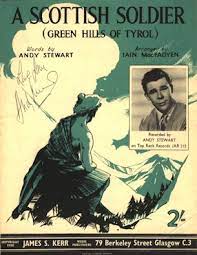
I suspect the comfortable co-existence of Scottish and British loyalties was fostered largely by the military. The British Army’s Scottish regiments were canny in exploiting soldiers’ sense of Scottishness, decking them out in tartan and having them led by pipe bands, even while they defended and promoted Britain, the Crown and the Empire (an empire that, admittedly, the Scots did very well out of).  I found it fascinating in my youth to see how normally uppity and cantankerous Scotsmen would suddenly become deferential and forelock-tugging at the sound of a posh, officer-class, English accent.  However, cuts to the military budget have left the 21st century British Army a shadow of its former self and the old Scottish infantry regiments have been reduced to just one, the Royal Regiment of Scotland.  So that influence barely exists now.


Another thing that once made Scots feel proudly British, certainly working-class ones, was the existence of many nationalized industries that provided them with employment and had the name ‘British’ in their titles: British Coal, British Gas, British Rail, British Steel and so on.  These encouraged the idea that working-class Scots were toiling alongside their comrades in England and Wales for a common cause, for the good of a benign, fair, welfare-state-supporting UK.  Of course, that idea died a death when Thatcher, with her zeal for privatizing the British economy, arrived in power in the 1980s.


I’m not sure how this will end.  It may be that Scotland gets another shot at an independence referendum in the future and votes to go its own way.  Or it may be that the stringent British nationalism / unionism of the 21st century prevails and Scotland becomes merely a Union-Jack-swathed province at the rump-end of right-wing, post-Brexit Britain.  If the latter option happens, I expect Westminster to abolish the Scottish parliament at some point.  Not-land indeed.


But what’s isn’t an option now is the comfy middle-ground, the old fashioned, dual-loyalty, at-ease-with-both-worlds, Scottish / British identity.  As far as that’s concerned…  Well, to quote a well-kent Scottish anthem: “Those days are past now, and in the past, they must remain.”


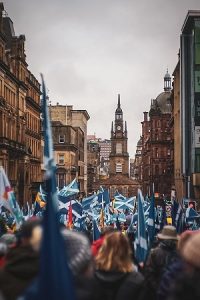
From unsplash.com / © Kristina G.