The comeback kid


From wikipedia.org / © Scottish Government


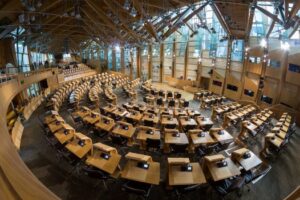
I’ve always had an unhealthy obsession with politics.  Lately, however, I’ve written less about the subject on this blog because my obsession was becoming literally unhealthy – ruminating on politics and politicians in 2026 was filling my head with dark and depressing thoughts.  Nonetheless, I’ll now make some comments about the election for the Scottish Parliament, which happened on May 7th. That day also saw elections for the Welsh Senedd and for various local authorities in England, but I’ll only mention those in passing.


If you’re not a political anorak, you might want to skip this.


So: the results were 58 seats for the Scottish National Party (down six from the previous election in 2021); 17 for Scottish Labour (down five); 17 for Reform UK (up 17); 15 for the Scottish Greens (up seven); 12 for the Scottish Conservative and Unionist Party (down 19); and ten for the Scottish Liberal Democrats (up six).


Despite securing six seats less than their 2021 total, and seven seats short of a parliamentary majority, the result was impressive for the SNP in that this is the fifth election in a row where they’ve ended up as the biggest, government-forming party.  Keir Starmer’s Labour government at Westminster, which hasn’t been in power for two years yet and is already as popular as a fart in a spacesuit, would kill for such longevity and  durability.


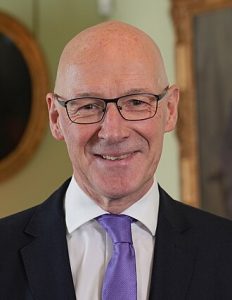
It’s also quite a comeback for SNP leader John Swinney.  Originally Swinney served as SNP leader from 2000 to 2004, when his party was in opposition in the Scottish Parliament.  It wasn’t a happy experience for him.  In the 2003 Scottish election his party dropped from 35 to 28 seats and the following year he resigned.  He later described being opposition leader as “the worst, most awful, most sapping, most soul-destroying job in politics…”


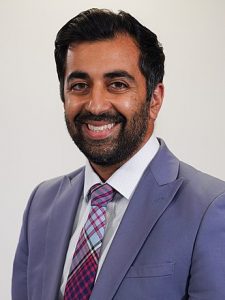
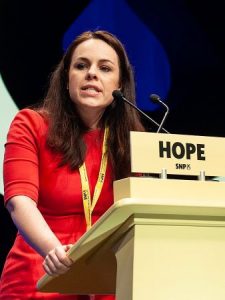
Having enjoyed spells as a cabinet minister and Deputy First Minister, Swinney was planning to retire at this year’s election.  However,  in May 2024, after the affable but hapless Humza Yousaf resigned as First Minister, Swinney surprised everyone by standing unopposed for – with his famous negotiating skills, he managed to sweet-talk the formidable likes of Kate Forbes into not running against him – and winning the leadership again, 20 years after losing it.  And this time, he became First Minister of Scotland too.  Many assumed he would act as a ‘caretaker’ FM, until someone younger and with more chutzpah came along, but thanks to this election result he’s likely to be around for a while.


While I’d never describe Swinney as someone who sets the heather alight, and if he got a fiver every time someone likened his demeanour to that of a bank manager he’d probably be a billionaire by now, I have to say I think he’s a decent guy and I’d rather have him in charge of Scotland than most other Scottish politicians.  I’m biased in this regard.  As I wrote on this blog before, I encountered him a couple of times during my youth, via my old schoolmate Roger Small, who was best friends with him at university, and I liked him.  But it’s not just me.  Most people, political friends and foes alike, seem to like Swinney.


Even the world’s most horrible man, Donald Trump, has a soft spot for him.  In 2025, Trump declared, “John Swinney is a terrific guy — and loves golf and loves the people of this country, and we really appreciate it.”  Yes, I know that Trump thinks Vladimir Putin, Xi Jinping and Kim Jong Un are the bees’ knees, so being liked by him isn’t necessarily a ringing endorsement of your character.


More recently, when Trump announced the removal of US tariffs on Scotch whisky, Swinney claimed this was due in part to a meeting he had with the US president last September.  He was criticised for saying this by the UK government’s Secretary of State for Scotland Douglas Alexander, who argued that trade agreements weren’t in the remit of a leader of a devolved administration.  But after the election result, Trump messaged, “Congratulations to John Swinney on winning his Re-Election for First Minister of Scotland.  He is a good man, who worked very hard along with the King and Queen of the United Kingdom, with respect to Tariff Relief for Great Scottish Whiskey – and deserves this Big Electoral Victory!”  So now, Dougie Alexander looks a bit of a chump.


Trump, being a low IQ individual, misspelt ‘Scottish whisky’ as ‘Scottish whiskey’.  The stuff spelt with an ‘e’ is actually made in Ireland.
 

From wikipedia.org / © Scottish Parliament / youtube.com


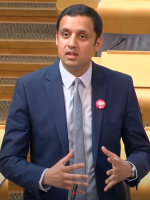
Elsewhere, Scottish Labour and the Scottish Conservatives had their worst ever performances in a Scottish parliamentary election.  Labour leader Anas Sawar hit the headlines back in February when he demanded that Keir Starmer resign as British Prime Minister: “The situation in Downing Street is not good enough. There have been too many mistakes.”  Sarwar’s resignation-call distanced him and his branch of the Labour party from the wildly unpopular Starmer and it generated  a lot of publicity at the time.  But when Starmer said no, he wouldn’t be resigning, it looked less like a political earthquake and more like a mild political bowel-movement.  It highlighted Sarwar’s place as Scottish party leader in the great scheme of things – not high.  It also meant Starmer was embarrassingly conspicuous by his absence in Scotland when Labour started campaigning for the election there.


The Scottish Tories have been reduced to a rump, their number of Members of the Scottish Parliament (MSPs) barely in double figures.  Their leader Russell Findlay has tried to talk them up in the Tory-friendly pages of the Scottish Daily Mail, describing them as the ‘Dynamic Dozen’.  I wouldn’t describe any dozen that includes such numpties as Murdo Fraser, the man who once asked Donald Trump if he’d consider buying Glasgow Rangers Football Club, as ‘dynamic’.  Maybe ‘dysfunctional’ or ‘dystopian’.


Following a near-extinction event caused by their coalition with the Conservatives in Westminster in the early 2010s, the Liberal Democrats have enjoyed something of a revival.  The passing of time has clearly detoxified their reputation a little in folk’s memories.  That said, I don’t know how anyone can stomach their Scottish leader Alexander Cole-Hamilton, who to me comes across as being insufferably arrogant.


And the Scottish Greens have almost doubled their representation in the parliament.  Without wishing to downplay this achievement, I suspect they enjoyed the best of both worlds in relation to the English and Welsh Greens – a separate party – south of the border.  They benefited from the wave of enthusiasm, and publicity, that their southern counterparts experienced earlier this year.  Simultaneously, as a separate party, they were distant enough from them to escape the more recent backlash against the English / Welsh party’s leader Zack Polanski, who stupidly retweeted something about the attack on two Jewish men in Golders Green and then suffered an all-out assault from the right-wing media determined to portray him as an antisemite.  (This despite Polanski being Jewish himself and despite some of the media’s caricatures of him being… hideously antisemitic.)


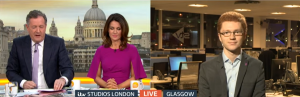
The Scottish Greens are co-led by Gillian Mackay and the chirpy Ross Greer.  I know Greer is a ‘Marmite’ politician for many, but I like how he puts the wind up gammons like Piers Morgan.
 

From youtube.com / © ITV


With the SNP on 58 MSPs, and the pro-Scottish-independence Greens on 15, 73 MSPs now support Scotland leaving the United Kingdom, as opposed to 56 unionist MSPs who don’t.  It’s the parliament’s biggest ever pro-independence majority.  Of course, you won’t have heard much about that fact from Scotland’s (unionist-owned) mainstream media, who instead have obsessed on a different fact – that the parliament suddenly has 17 far-right Reform MPs.  Nigel Farage’s extremist party had representation there before, thanks to one MSP defecting to them from the Conservatives.  But today, with Labour, they’re the joint-second biggest party.


This has prompted journalists like the Times’s Kenny Farquharson to declare ‘the death of Scottish exceptionalism’ – Scottish exceptionalism being the idea that Scottish voters are more community-orientated, more considerate of their fellow citizens, more leftwing and, generally, nicer than voters than those elsewhere in the UK, especially in England.  Reform’s showing proves that, no, the Scots are just as right-wing and awful as everyone else.


Well, I find it nauseating that the  parliament contains 17 MSPs who, if their party ever came to power, would enact Trump-style authoritarian and racist policies.  One of them, Senga Beresford, representing the South Scotland region, has already caused controversy by expressing admiration for fascist lout Stephen Yaxley-Lennon on social media.  But I derive some comfort from the fact that none of those MSPs were elected through the parliament’s first-past-the-post, constituency-based voting system, responsible for deciding 73 of the 129 MSPs.  Reform’s 17 sneaked in afterwards, via the additional, regional-based ‘list’ system.  Also, the Conservatives won 31 seats at the previous election, but have been culled to 12, and that number plus Reform’s 17 puts the total number of right-wingers  at 29 – two less than before.


I certainly don’t see Scotland as being exceptional, i.e., better than anywhere else.  I’ve met plenty of Scots who’ve been arseholes as much as arsehole-y people from other places.  But Scotland is still different from other parts of the UK.  If it wasn’t different, it wouldn’t have its own languages, literature, music, sports teams, legal system, educational system, etc.  It wouldn’t have been scunnered by Margaret Thatcher in the 1980s while people elsewhere were proclaiming her the new, handbag-wielding messiah.  It wouldn’t have voted heavily against Brexit when people in England and Wales voted for it.  It wouldn’t have its own independence movement with, now, a 57% majority in the Scottish parliament.  I know that sticks in the craws of unionist politicians and journalists who’d have you believe that Scotland is absolutely indistinguishable from the rest of the UK, that a punter from Elgin is identical to a punter from Ely.


Talking of journalists, the coverage of the election in the Scottish mainstream media was woeful.  The unionist newspapers (i.e., nearly all of them) spent half the time wailing “Everything in Scotland is shite!” and the other half wailing, “How dare anyone suggest doing anything even vaguely radical to improve things!”  Swinney’s proposal that, in an emergency, the Scottish government should put a cap on the price of essential food products so that poor people could still buy them, was met with hoots of derision – and the sneering observation that the UK government would never allow it.  (A Labour government – “For the many, not the few” – denying someone the right to keep essential foodstuffs affordable for the nation’s poorest people?  Not a great look.)


I thought the recent opinion-piece by Scottish journalist Stephen Daisley in the Spectator, calling on the Labour and Conservative parties to get rid of the UK’s devolved parliaments (“Dr. Frankenstein would understand that it was his duty to put down the hideous creature his foolishness and vanity unleashed on the world”), was bad enough.  But the articles that his fellow Scottish journo Chris Deerin penned about Scottish Reform leader Malcolm Offord, for the supposedly left-wing New Statesman, went to arse-licking extremes where no article has gone before.


And now, with Plaid Cymru’s Rhun ap Iorwerth the First Minister in Cardiff, and Sinn Fein’s Michelle O’Neill the First Minister in Belfast, all three devolved governments in the United Kingdom are helmed by people who see their nations’ futures as being outside that supposedly united kingdom.  Interesting times indeed…


But you won’t ever read about that in the newspapers.
 

From wikipedia.org / © User Colin
An honest John


From wikipedia.org / © Scottish Government


John Swinney became leader of the Scottish National Party on May 6th and was sworn into office as First Minister of Scotland two days later.  His arrival in the two roles comes during a difficult period for his party.  First, the SNP has had to endure the spectacle of its once-mightily-respected, once-seemingly-unassailable former boss Nicola Sturgeon, who served as First Minister from 2014 to 2023, mired in a scandal whereby her husband, Peter Murrell, has been investigated and arrested over possible mismanagement of the party’s finances.


Then came the sorry saga of Sturgeon’s replacement as party leader and First Minister, Humza Yousaf.   Yousaf was brave enough to defy the British-establishment line and challenge Benjamin Netanyahu’s policy of killing huge numbers of innocent Palestinians in revenge for Hamas’s slaughter of Israeli civilians on October 7th, 2023.  But in most other respects, he was pretty hapless.


Most notably, he didn’t so much shoot himself in the foot as blow the foot off at the ankle when he ended his party’s alliance with Scotland’s other pro-independence party, the Scottish Greens. The Greens were so outraged they made it clear that they would vote against Yousaf in a no-confidence vote in the Scottish Parliament.  Realising he was going to lose that vote, Yousaf resigned.  His resignation at least seems principled compared with the behaviour of another First Minister recently.  Labour’s Vaughan Gething, First Minister of Wales, recently lost a no-confidence vote in the Welsh Senedd and blithely refused to quit, dismissing the vote as a ‘gimmick’.


Swinney’s arrival as Yousaf’s replacement happened at an incredibly inopportune time.  Barely had he got through the door of Bute House, the First Minister’s official residence in Edinburgh, than Rishi Sunak, British Prime Minister and a politician so clodhopping he makes Humza Yousaf look like a smooth operator, announced a general election for July 4th.  The polls say the SNP are going to lose a swathe of seats in the London parliament to Keir Starmer’s Labour Party.  Even if Swinney was the best politician in the world, I don’t see what he could do to avoid that.


Not that I think Scottish voters are enamoured with Labour, who are so obsessed with attracting former Conservative Party voters they’ve made their policies a continuation of the right-wing ones that’ve damned Britain to rack and ruin during the past 14 years.  For instance, they’ve vowed not to revisit the terms of the Tories’ Brexit arrangement with the European Union, even though it’s hobbled British businesses and it’ll thwart their plans to ‘grow’ the economy; and they won’t countenance raising taxes, which makes you wonder how they’re ever going to lift Britain’s public services out of their current, dire state.  But I suspect folk in Scotland are so scunnered by the SNP’s recent scandals and mishaps, and so desperate to see the back of the Tories, that they’ll vote for Labour en masse next month.


For this reason, and because of Swinney’s bespectacled, unexcitable and unshowy demeanour – he’s often likened to a ‘bank manager’ or an ‘accountant’, although I remember one Scottish hack comparing him to ‘Harry Potter’, which I’m sure didn’t please the famously anti-SNP J.K. Rowling – there’s been speculation that he’s serving merely as a ‘caretaker’ leader, steadying the helm until someone of more substance takes over.  In particular, many in the Scottish media expect the leadership to soon go to Kate Forbes, who’s currently Deputy First Minister.  Famous for his negotiating skills, Swinney managed to talk Forbes out of taking him on in a leadership contest in May.


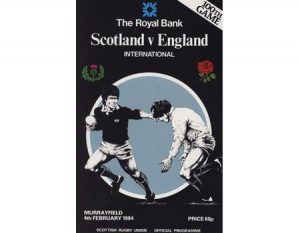
Anyway, I should say that back in my misspent youth, I crossed paths a few times with John Swinney – whose youth, I imagine, was somewhat less misspent than mine.  When I’d been a pupil at Peebles High School in the late 1970s and early 1980s, one of my best pals was a guy called Roger Small.  Once we finished school, Roger went to university in Edinburgh and I to university in Aberdeen.  I kept in touch with him and on a few weekends came down from Aberdeen to stay in his flat in Edinburgh.  My reasons for those visits were not wholly because of friendship.  They coincided with the Five Nations Rugby championship, as it was then, which was held every spring and saw two Scottish home-games played at Edinburgh’s Murrayfield Stadium.  I’d get a ticket, arrange to spend the night at Roger’s place, go to see the game in the afternoon and enjoy the post-match festivities in the evening.


From www.sportspages.com


On February 4th, 1984, I dropped my stuff off at Roger’s and went to Murrayfield to see Scotland play England.  Scotland won 18-6.  In the Scotsman newspaper, back in those long-ago, pre-Andrew Neil days when it was worth reading, Chris Rea – no, not that Chris Reaopined: “The Scottish forwards… were immense – a finely blended unit, alert and supportive. Their breakaways forced England into elementary errors.  They foraged with devastating accuracy…  Every Scot… played his part to the full.”


When the final whistle blew, I was extremely pleased that Scotland had demolished England, the Auld Enemy.  So pleased that, on my way back to Roger’s flat, I indulged in a wee, celebratory pub-crawl along Rose Street, taking in such hostelries as the Auld Hundred, the Kenilworth and the Abbotsford.  It probably didn’t help that I’d already done a pub crawl of Rose Street in the late morning and early afternoon, on my way to Murrayfield.  Anyway, the result was that I was well-refreshed when I returned to the flat.


Roger had told me he was entertaining some Edinburgh University mates that evening, with the intention of going to a party later on.  I was welcome to join them.  So, at about seven o’clock, I trotted into Roger’s living room, plonked myself on the sofa in the midst of some people I hadn’t met before and, trying to be sociable, joined in the conversation.  After a few minutes, a tall, lean, slightly intense-looking young man sitting on the sofa beside me turned his head towards me and asked incredulously, “Are you drunk?”


Ladies and gentlemen, meet John Swinney, future leader of the Scottish National Party, an outfit dedicated to the cause of Scottish independence, to freeing Scotland from the shackles of political rule from London, capital of England.  Shocked that someone in Edinburgh, capital of Scotland, should be a wee bit inebriated after Scotland had trounced England at rugby.


But I can’t have been that inebriated because I managed to accompany Roger, John and friends to the party that night and managed to participate in the conversation enough to form the opinion that Roger’s mate John was a decent-enough, if sober, bloke.  It turned out that the party was being held by someone from Peebles, the town where Roger and I had attended school, so I knew some of the folk there.  Actually, it amuses me to think that the future First Minister of Scotland was once at a party rubbing shoulders with such well-kent Peebles eccentrics as the late Andrew Cleghorn.


Thereafter, I encountered John Swinney a couple of times in Edinburgh, briefly, while I was in Roger’s company.  The last time was a summer or two later, during the Edinburgh Festival, when Teviot Row, the Edinburgh University students’ union building, had been turned into a venue and the pair of them were working there as bouncers.  What a pity Oxford University’s notorious Bullingdon Club didn’t arrange a field-trip to Edinburgh at the time and try to subject Teviot Row to their yobbish antics…  I would have paid good money to see John Swinney eject Boris Johnson from the premises.


I lost touch with Roger for a while after that, but bumped into him again in the late 1980s after I’d moved to Edinburgh.  He kindly fixed me up with a part-time job at the (now-long-gone) Greyfriars Bookshop at the bottom of George IV Bridge.  At some point I asked how John Swinney was getting on and Roger told me he was ascending in the ranks of the SNP.  Later, when I mentioned his name to some mates from Aberdeen who were heavily into the cause of Scottish independence, they reported they’d seen him deliver a speech at an SNP conference and were greatly impressed by him.


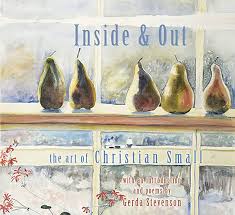
I completely lost touch with Roger Small in the 1990s – he took off for Australia – and, several years ago, wondering what’d happened to him, I tried Googling him.  I didn’t find him, but learnt something about his mother, Christian Small, who’d passed away in 2016 at the age of 90.  Christian had been an immensely-talented amateur painter, but according to a friend she was ‘extraordinarily diffident about her work’ and needed ‘a great deal of persuasion’ to allow her paintings to appear in local exhibitions.  Because of her modesty, presumably, it didn’t really dawn on people – family and friends alike – how good an artist she’d been until after her death.  However, in 2018 and 2019, some events were held to commemorate her and her art, including exhibitions and the launch of a book called Inside & Out.  The book featured her paintings interspersed with verse written by another friend, the poet and actress Gerda Stevenson.


One of those events was attended by John Swinney, who by then was Deputy First Minister of Scotland.  On Twitter, he remarked that Christian Small had been the mother ‘of my dear university friend Roger.’  So, I’m glad he still remembers his old mate and still holds him in high regard.


© Scotland Street Press


Though he’s made his name as a cautious type – too cautious for some people’s tastes, which has led to them questioning his political acumen – it’s hard to find anyone with a bad word to say about John Swinney as a person.  For example, the former Scottish Labour Party leader Jim Murphy once commented: “There’s nobody in Scotland who doesn’t like John Swinney.”  I recall my old English teacher, Ian Jenkins, who served in the Scottish Parliament for four years as the Liberal Democrat representative for Tweeddale, Ettrick and Lauderdale, speaking highly of him too.


Thus, I’m pleased that Swinney now holds the highest political office in his country.  He struck me as a decent guy and it’s good to see decency rewarded.  Unfortunately, politics isn’t an arena where being decent always works in your favour.  I suspect he has his work cut out for him – especially if the polls prove to be right and his party takes a pounding in the general election.

Hapless Humza and heaven’s Kate


From wikipedia.org / © Scottish Government

From wikipedia.org / © ScottishPolitico


The devil and the deep blue sea.  A rock and a hard place.  Scylla and Charybdis.  These are a few phrases that spring to mind when I think of the choice facing members of the Scottish National Party as they vote for a new party leader and First Minister of Scotland to replace Nicola Sturgeon, who a month ago announced her intention to resign from those posts and last week made her final appearance at First Minister’s Questions in the Scottish Parliament.


Neither of the options offered as Sturgeon’s successor is particularly inspiring. There’s Humza Yousaf, current Scottish Cabinet Secretary for Health and Social Care, and previously Minister for Transport and the Islands.  And then there’s Kate Forbes, currently Cabinet Secretary for Finance and the Economy.


Okay, there’s also a third candidate in the running, Ash Regan, former Minister for Community Safety.  But, working on the assumption that the average SNP member has at least a couple of braincells in his or her head, I imagine Regan has zero chance of prevailing.  Her big idea so far has been to have an ‘independence-readiness thermometer’ displayed in a major Scottish city.  Plus, much of her support actually seems to lie outwith the SNP, i.e., among the opportunists, grifters, misfits, transphobes and Scottish-indy ultras who joined embittered former SNP leader, former Russia Today presenter and generally-accepted lech Alex Salmond when he set up the Alba Party as a way of getting revenge on Sturgeon and his old party (and secured 1.65% of the votes cast in the subsequent Scottish parliamentary election).


Anyway, onto the two real candidates. Yousaf strikes me as a bloke with his heart in the right place…  But his performance in government has been patchy and he’s prone to making gaffes, most recently when he met with a group of Ukrainian women and inquired, “Where are all the men?”  Okay, whilst being in charge of Health and Social Care in Scotland, he’s been under constant bombardment from Scotland’s newspapers, which are almost without exception right-wing, conservative, unionist and shite-holey – the Scottish Daily Mail, the Scottish Daily Express, the Scottish Sun, the Scotsman, the Herald and the Scottish edition of the Daily Telegraph.  While their beloved Conservative Party has, in government in London, under the leaderships of Boris Johnson, Liz Truss and Rishi Sunak, wallowed in mindboggling amounts of corruption and indulged in mindboggling amounts of incompetence, their response has been to shriek and scream that the Scottish government is equally, if not more, of a basket case.  They’ve fixated on and magnified every fault and incompetence they can discover and never stopped to draw breath in their criticisms.  Generally, their modus operandi has been, in the words of far-right strategist Steve Bannon, to ‘flood the zone with shit’. “Okay,” they seem to cry, “Britain is crap!  But Scotland is even crapper!  And an independent Scotland would be even, even crapper!”


From wikipedia.org


But I don’t think Yousaf has the dexterity, the gravitas and the general intelligence to establish himself the way Sturgeon did – who, though most of the mainstream media in Scotland hated her, was able to rise above their carping, convey a sense of competence, and convince everyone bar the most rabid Scottish Conservative that she was much more effective as an administrator than, say, the venal Johnson or the barking-mad Truss.  Unfortunately, I can’t see how Yousaf will escape being portrayed by the media as a bungling klutz – in the same way that they succeeded in discrediting former Labour Party leaders like Michael Foot (supposedly a befuddled old fool who went to Remembrance services at the Cenotaph dressed as a scarecrow), Neil Kinnock (a Welsh windbag who tripped over on a beach and fell into the sea) and Ed Miliband (a two-kitchen-owning faux socialist whose dad hated Britain and who couldn’t eat a bacon sandwich properly).  That said, I doubt if they’ll be able to absolutely demonise Yousaf like they did with Jeremy Corbyn.


Incidentally, it’s interesting to compare Yousaf’s troubled tenure as Health Secretary with that of Sturgeon, who held the brief for a couple of years when Salmond was First Minister.  And if anyone says they don’t remember anything of Sturgeon as Health Secretary – well, that says a lot for her skill in keeping it a non-issue at the time.


From what I’ve seen of her, in purely political terms, Kate Forbes seems the most capable of the candidates.  But there’s a big problem.  She’s a member of the Free Church of Scotland and claims its tenets are ‘essential’ to her ‘being’ – which would be fine if her particular Kirk treated people from all walks of life non-judgementally, but it doesn’t, and Forbes has ended up saying some things that cross the line into intolerant, Bible-bashing crankery.  She’s said she would have voted against same-sex marriage, and stated her opposition to the Scottish government’s trans-friendly Gender Recognition Act, and spoken out too against abortion and sex outside of marriage.  This has put a lot of noses in the SNP out of joint.  For instance, the party’s deputy leader in Westminster Mhairi Black, a lesbian who got wed last year, has tweeted that she was ‘incredibly hurt’ by Forbes’ stance on gay marriage.


Perversely, some right-wing commentators who, in right-wing news outlets, regularly castigate Forbes’ party have ridden to her defence during the controversy about her religious views.  On February 23rd, Fraser Nelson, editor of bilious far-right magazine the Spectator, wrote an opinion piece in the no-better Daily Telegraph under the headline PROTESTANTS ARE NOW HOUNDED OUT OF POLITICS, AS KATE FORBES HAS SHOWN.  A day later, in Rupert Murdoch’s Times, the fogey-ish author and Evelyn Waugh wannabe A.N. Wilson penned a similar-minded piece entitled THE HOUNDING OF KATE FORBES SHOWS GODLESS SQUAD HAVE WON.  And if the moral support of Nelson and Wilson wasn’t enough to drain all street credibility out of Forbes, and send it down a hole deep enough to reach Australia, the ridiculous Jacob Rees-Mogg got in on the act too.  He wrote in a Daily Mail column that: “The last Scottish female public figure to be treated so badly for her religion was Mary, Queen of Scots, who was chased out of her country and eventually beheaded by her cousin Elizabeth for her Catholicism.”


From wikipedia.org


Oh, and the centre-right journalist and commentator Chris Deerin – director of the think-tank Reform Scotland, crooner with arthritic dad-rock band the Fat Cops, worshipper of Ruth Davidson and, mind-shreddingly, Scottish Editor for the supposed left-leaning New Statesman – has been carrying a torch for her recently too.  Just in case the Kate Forbes Media Fan Club didn’t sound hellish enough.


Personally, I suspect the reason why so many personages in the right-wing press are currently batting for Forbes is because they’re licking their lips with anticipation about what might happen if she wins.  They’d have a field-day reporting on the latest messes involving the First Minister of Scotland as, speaking her Free Kirk mind, she upsets gay people, trans people, unmarried mothers, women who’ve had abortions, etc.  She could also very easily piss off Scotland’s sizeable Roman Catholic community, since the brand of old-school Scottish Presbyterianism she adheres to is not exactly known for its love of the Pope and the Church of Rome.  And her social conservatism would probably mean the SNP’s current, informal governing alliance with the Scottish Green Party would end.


All in all, the Yousaf / Forbes leadership race looks like a lose-lose situation for the SNP and a win-win one for the right-wing mainstream media that would love to see the back of the party.  Meanwhile, I have a feeling that a lot of people in the Scottish independence movement who’d expressed impatience, dissatisfaction and frustration with Nicola Sturgeon’s performance in recent years – well, apart from those bampots in Salmond’s wee faction – will soon realise how much they miss her.


From wikipedia.org / © Scottish Government