© Rizzoli Film / Seda Spettacoli / Cineriz
Continuing my list of favourite giallo movies – a giallo being an Italian “horror-thriller hybrid”, mostly made in the 1970s, “wherein a group of people, usually affluent and beautiful, get despatched by a mysterious killer (identity revealed only in the closing moments) stabbing, slashing and hacking his or her way through them for some unlikely reason. The results are often Italian films at their most glamorous, stylish, violent, ridiculous and politically incorrect.”
All the Colours of the Dark (1972)
Like the stereotypical London bus, you spend all day waiting for a London-set giallo and then two arrive at once. Hot on the heels of Lucio Fulci’s A Lizard in a Woman’s Skin (1971) came All the Colours of the Dark, directed by Sergio Martino who, though not as acclaimed as Fulci, Mario Bava or Dario Argento, is to my mind the fourth master of the genre.
Colours features several performers who were regulars in Martino’s movies, including George Hilton, Ivan Rassimov and the droopy-eyed, lushly-haired and slightly feline-featured Algerian-Maltese-Sicilian actress Edwige Fenech, considered by many to be the Queen of Gialli. Its story is about a woman (Fenech) who, traumatised after a miscarriage, becomes involved with a London-based and apparently murderous Satanic sect. Thus, it veers towards supernatural territory. It finally transpires, however, that the killings in the film are part of a non-supernatural conspiracy to relieve her of a family inheritance. As with A Lizard in a Woman’s Skin, Colours is too long and ultimately loses momentum, but Martino orchestrates some impressive scenes along the way. Surprisingly for a genre fond of beautifying its characters and settings, a Satanic orgy that Fenech finds herself participating in at one point is determinedly unglamorous. In fact, the gormless-looking, frankly pug-ugly Satanists around her seem to have wandered in from the set of a leery 1970s British sitcom like ITV’s On the Buses (1969-73).

© Lea Film / National Cinematografica / C.C. Astro / Interfilm
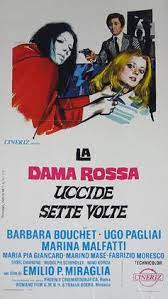
The Red Queen Kills Seven Times (1972)
Emilio Miraglia’s The Red Queen Kills Seven Times is a cheap and cheerful retread of Mario Bava’s seminal Blood and Black Lace (1964), with another series of murders taking place in a fashion house. This time, though, the setting is Bavaria, not Rome. While the plot references the legend of an evil Red Queen who’s said to come back from the dead every 100 years to commit seven murders, the real killer proves to be a human one. What particularly endears this film to me is the histrionic cackle, supposedly emanating from the Red Queen herself, that we hear on the soundtrack following each murder. Playing the film’s heroine is German actress Barbara Bouchet, who that same year would appear in the next film on this list.
© Phoenix Cinematografica / Cineriz / Cannon Films
Don’t Torture a Duckling (1972)
Don’t Torture a Duckling is Lucio Fulci’s other great giallo movie. Indeed, it’s one of the best things he ever did. It has none of the excess and goofiness of his later horror films and it benefits from its distinctly un-giallo-like setting. For a change, it doesn’t take place in an affluent urban world inhabited by high-fliers. Duckling is set instead in a rural and backward south Italian village, its separation from modernity symbolised by the nearby highway where traffic rumbles past oblivious to its existence. While Fulci uses the setting to take pot-shots at the institutions of conservative, traditional, Catholic Italy, his cameras make the most of the sumptuous local countryside.
That said, 21st-century viewers will be bothered by some early scenes, seemingly played for laughs, which show Bouchet teasing the village’s young boys by brazenly exposing herself to them. I doubt if Fulci would have entertained the idea of having hero Tomas Milian expose himself to the village’s young girls, but surely Bouchet’s behaviour is just as bad. It’s a clumsy foreshadowing of the film’s themes, which are the threat an immoral world poses to childhood innocence, and a serial killer’s determination to preserve the innocence of the children around him by any means necessary.

© Medusa Distribuzione
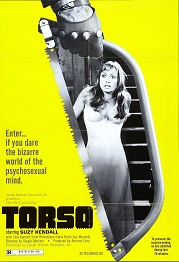
Torso (1973)
Sergio Martino made several gialli in the early 1970s, but I think All the Colours of the Dark and Torso are his strongest. Torso is certainly his most troubling. Even culture-warring, anti-feminist, male-chauvinistic reactionaries will find its plot, wherein a succession of nubile young ladies are ogled by various, creepy men before being murdered by a masked killer, pretty distasteful.
Nonetheless, I admire Torso for its audacious shifts in plot and mood. It begins in traditional giallo fashion with a serial killer stalking the picturesque, historical city of Perugia. However, when a group of female students decide to avoid becoming the killer’s next victims by leaving Perugia, travelling into some remote countryside and holing up in a mountaintop villa, and the killer, predictably, follows them and lurks stalkily in the undergrowth and darkness outside the villa, it becomes a prototype for the American slasher / body-count horror movies of the 1980s, epitomised by Halloween (1978) and Friday the 13th (1980). And the final 20 minutes see an abrupt change of tone again. The film’s ‘final girl’ – Suzy Kendall from Dario Argento’s The Bird with the Crystal Plumage (1970) – wakes up after a long sleep in a bedroom, her leg disabled by an injury and her senses dulled by anaesthetic, and realises she’s sharing the villa with the killer… who isn’t aware of her presence there… yet. It makes for a splendidly Hitchcockian finale.
© Compagnia CInematografica Champion / Interfilm
Deep Red (1975)
And now for my favourite giallo ever, Dario Argento’s Deep Red. This has David Hemmings as a musician who witnesses a murder. The victim is a psychic who recently claimed to have picked up murderous thoughts from a mysterious somebody in her vicinity – and that somebody evidently decided to silence her before she acquired any clues to his or her identity. As with the hero of The Bird with the Crystal Plumage, Hemmings is troubled by the notion that he saw something at the crime scene that is a clue to the culprit’s identity, but can’t figure out exactly what. And while Hemmings struggles with this, the murders continue and the killer starts to home in on him…
Deep Red contains some of the best set-pieces in the history of giallo cinema and some hardly-vital-for-the-plot but disturbingly barmy details, such as a cackling clockwork doll that totters into view just before the killer strikes. There’s also a baroque, pulsating score by the German prog-rock band Goblin that, in my opinion, just manages to pip the work of Ennio Morricone to earn the title of Greatest Giallo Music Ever.

© Rizzoli Film / Seda Spettacoli / Cineriz
And Deep Red boasts a wonderful performance by Daria Nicolodi as kooky journalist Gianna Brezzi. For me, Brezzi is up there alongside Jean-Pierre Marielle’s Arrosio in Four Flies on Grey Velvet (1971) as one of the most memorable characters featured in a giallo. Nicolodi – who, alas, passed away in 2020 – was married to Argento while he enjoyed his filmmaking heyday during the second half of the 1970s and she made a big contribution to the scripts of his supernatural classics Suspiria (1977) and Inferno (1980). I suspect it wasn’t a coincidence that Argento’s movies rapidly went downhill in quality after the mid-1980s, which was when their marriage ended.
I love Deep Red, then, but… It’s evidently not to everyone’s tastes. When I showed it to my partner last year, she professed to finding it ‘dull’ and dismissed Goblin’s soundtrack as being ‘like something from a 1970s disco.’ So that was me told.
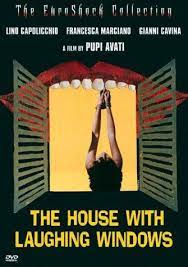
The House with Laughing Windows (1976)
Like Don’t Torture a Duckling, this film benefits from being set far away from the usual giallo environment of lavish lifestyles, expensive apartments and cosmopolitan cities. Unlike Duckling, it’s set not in the rural south of Italy but in its rural north, in the damp, squelchy lagoon area of Valli di Comacchio in the province of Ferrara. Pupi Avati’s The House with Laughing Windows has a restorer (Lino Capolicchio) arriving in a village to work on a crumbling fresco in a church and learning that the artist responsible for the work was a madman who got inspiration for his images of martyred saints from torturing and killing people. When a new wave of murders sweeps the village, it seems that someone is carrying on with the artist’s gruesome traditions. The gloomy, marshy setting helps the film’s atmosphere immeasurably, and its ending is as pessimistic and disturbing as that of Short Night of Glass Dolls (1971) five years earlier.
© A.M.A. Film / Euro International Films
Honourable mentions? Cat O’ Nine Tails (1971), the middle entry in Dario Argento’s ‘animal’ trilogy, doesn’t have the gusto of The Bird with the Crystal Plumage or Four Flies on Grey Velvet, the films that bookend it, but it’s still worth catching up with. Meanwhile, Argento’s 1980s gialli Tenebrae (1982) and Opera (1987) have their moments but aren’t as involving as his 1970s work – due, I suspect, to their lack of engaging characters.
Also of interest are Sergio Martino’s other two gialli, The Strange Vice of Mrs Wardh (1971) with Martino regulars Edwige Fenech, George Hilton and Ivan Rassimov, and the fabulously titled Your Vice is a Locked Room and Only I Have the Key (1972) with Fenech and Rassimov, plus Luigi Pistilli from Mario Bava’s A Bay of Blood (1971) and Anita Strindberg from Lucio Fulci’s A Lizard in a Woman’s Skin. Your Vice is memorable for having some of the ghastliest characters to ever appear in a giallo, and for its plot basically being an outrageous reworking of Edgar Allan Poe’s 1843 short story The Black Cat. But it’s spoiled by Martino’s inexplicable insertion of a dirt-motorbike race that seems to go on forever.
Elsewhere, Fenech and Hilton turn up in the decent, meat-and-two-veg giallo The Case of the Bloody Iris (1972), directed by Giuliano Carnimeo. I have a soft spot too for Umberto Lenzi’s agreeably shonky Spasmo, with music by Ennio Morricone and a cast that includes Suzy Kendall, Ivan Rassimov and Robert Hoffman, star of the fondly remembered French-German children’s series The Adventures of Robinson Crusoe (1964). And I can’t possibly finish a piece about giallo movies without mentioning Giulio Questi’s mad 1968 epic Death Laid an Egg, which boldly places its beautiful giallo characters in the glamorous, stylish world of… intensive poultry farming.