Films I’d like to see remade (Part 2)


From wikipedia.org / © Metro-Goldwyn-Mayer


Here are some more films I remember fondly from my youth that, with sufficient love and skill, I think could be remade as wonderful new films.


Dark of the Sun (1968)

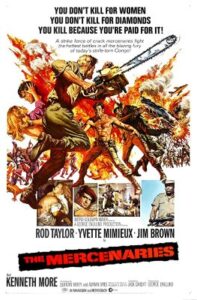
When, in my early teens, I saw this action / adventure / war movie on late-night TV, I believed it was the toughest movie ever.  At least, I believed that until I saw William Friedkin’s nail-biting Sorcerer (1977), itself a remake, of Henri-George Clouzot’s The Wages of Fear (1953), which promptly stole its crown as Most Badass Film I’d Ever Seen


But no matter – Dark of the Sun, or The Mercenaries as it was also known, still seemed pretty hardcore to me.  Why, it even had a chainsaw fight in it!  Thanks to the Texas Chainsaw Massacre movies (1974 onwards) and the Evil Dead movies (1981 onwards), and to one-off entries like Motel Hell (1980) and Mandy (2018), chainsaw fights are ten a penny nowadays.  But back then, seeing someone lunge at someone else with a whirring, metal-toothed power tool was an intense experience.


Based on a 1965 Wilbur Smith novel and directed by Jack Cardiff, Dark of the Sun tells the story of some mercenaries being sent into action amidst the Simbas rebellion in early 1960s Congo. It stars Robert Taylor, Yvette Mimieux – Taylor and Mimieux reunited eight years after appearing in George Pal’s charming 1960 adaptation of H.G. Wells’s The Time Machine – Jim Brown, Kenneth More (subverting his usual, cuddly English-gentleman image by playing an alcoholic doctor) and Peter Carsten (playing a vile, child-murdering Nazi).  At the time, critics lambasted the film for what they saw as its extreme violence.  However, as Cardiff noted, the violence depicted didn’t come anywhere near the real atrocities that’d happened in the Congo then, or near the violence featured in movies in later decades.


I’d like to see a remake of Dark of the Sun that updates the intensity, grittiness and violence to fit with 2026 sensibilities and that places the action within the context of 2026 geopolitics.  And is more racially sensitive – any racism in the original movie went over my 13-year-old head but I’m sure that, viewing it today, I’d cringe at parts of it.   At the very least, and despite the presence of Jim Brown as one of the mercenaries, I suspect I’d find it infused with a ‘white saviour’ or ‘white man’s burden’ complex.


Quentin Tarantino is a huge fan of this film (as is Martin Scorsese) so, as I did with Von Ryan’s Express (1965), I recommend old Quent as the man to helm a remake of it.  I know he’s sworn that he’s only going to make ten films in his lifetime, and his next one will be his last, but I don’t believe that for an instant.


Come to think of it, Dark of the Sun has quite a few things in common with Von Ryan’s Express, including a cracking movie film poster designed by the splendid Frank McCarthy and the presence of Nazis.  And like the earlier film, Dark of the Sun prominently features a train.


As does my next candidate for a modern remake, which is….


© Granada Films


Horror Express (1972)

The much-loved British-Spanish movie Horror Express is set on a train hurtling across Siberia in the early 20th century.  The train is being stalked by a decomposing ape-man fossil that’s seemingly come back to life – in fact, it’s possessed by an alien lifeforce and has the power to suck people’s brains out through their eyeballs.  Trying to thwart it are British scientists Sir Alexander Saxon (Christopher Lee) and Dr Wells (Peter Cushing).  Things become even more complicated in the film’s final act when the train is invaded by a bunch of Cossack soldiers, led by Telly Savalas’s villainous Captain Kazan.


Directed by Eugenio Martin, Horror Express is basically The Thing (1982) set on board the train from Alfred Hitchcock’s 1938 classic The Lady Vanishes.  Saxon and Wells are variations on the characters of Charters and Caldicott, the stuffy but unflappable English cricket-lovers in Hitchcock’s movie who get caught up in the chaos.  That said, you never feel Christopher Lee and Peter Cushing are playing anyone other than themselves in Horror Express.  During their careers, the two actors made 22 movies together, were close friends offscreen and have an effortless chemistry here.


The decaying ape-man in the original movie is still icky, but it would be nice to see it in a modern remake with a decent special-effects budget where it could do properly mind-blowing, spectacularly gruesome Thing-like things.  To play Saxon and Wells, you’d need a pair of British actors who’ve worked together already and possess some of that Lee-Cushing chemistry – maybe Benedict Cumberbatch and Martin Freeman, from the BBC TV show Sherlock (2010-17)?


And to play Savalas’s murderous Captain Kazan, there can be only one man: Nicolas Cage.


Theatre of Blood (1973)

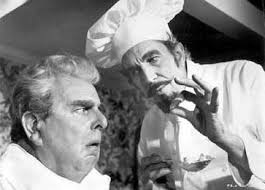
Until recently, I’d have been aghast at the thought of anyone remaking Douglas Hickox’s brilliant horror comedy Theatre of Blood, wherein Vincent Price plays an insane and hammily over-the-top Shakespearean actor called Edward Lionheart.  Enraged by the snobbish London theatre critics who’ve bad-mouthed his performances, Lionheart murders them one by one using methods borrowed from the Bard’s plays.  “They’re not going to start killing critics for giving bad notices, are they?” exclaims the campest critic, played by Robert Morley, who eventually meets a grisly fate modelled on events in Titus Andronicus.  A very distinguished cast of English character actors goes the same way as Morley: Michael Hordern, Dennis Price, Arthur Lowe, Harry Andrews, Robert Coote and Coral Browne.
 

© Harbour Productions Ltd / Cineman Productions / United Artists


There’s no shortage of famous modern-day British thespians who could play the supporting cast of doomed theatre critics in a remake – I’d enjoy seeing James Corden get the Titus Andronicus treatment – but surely, surely nobody could recreate the absolutely delicious performance that Vincent Price gives as Lionheart in the original movie?


Well, I thought that until I saw Ralph Fiennes in this year’s 28 Years Later: The Bone Temple.  Now I’m pretty sure he could be the Vincent Price of 2026.  And actually, Fiennes has played a character not dissimilar to Lionheart in 2022’s The Menu.


And if Fiennes wasn’t available, I suppose they could always call on Matt Berry.


The Beast Must Die (1974)

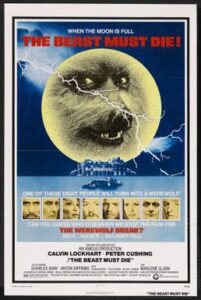
Paul Annett’s The Beast Must Die is a low-budget horror movie with an irresistible premise.  It’s about a millionaire big-game hunter, played by Calvin Lockhart, determined to bag a werewolf.  He rigs up his country estate with CCTV cameras and motion sensors, procures a helicopter and invites five unsavoury people to visit for a few days convinced that one of them  is a werewolf.  Among those playing Lockhart’s house-guests and staff are Peter Cushing, Charles Gray, Anton Diffring and a youthful Michael Gambon.  Needless to say, there is a werewolf present, but it gradually turns the tables on Lockhart and his hi-tech equipment, whilst also bumping off the supporting cast.


The ideas is irresistible, as I said, but watching The Beast Must Die on TV as a kid was a frustrating experience.  Due to the inevitable budgetary constraints, Lockhart’s mansion house and grounds aren’t that hi-tech and the werewolf, when it appears, just looks like a big dog.  You’d think the sequence where the werewolf takes out a helicopter would be thrilling, but it isn’t.  Let’s remake this one with a proper budget, so that it’s as awesome as it sounded on paper in 1974.
 

From wikipedia.org / © Amicus Productions / British Lion Films


Juggernaut (1974)

The most underrated but, in my mind, the greatest of 1970s disaster movies, Richard Lester’s Juggernaut is mostly set on a British ocean liner stuck out in the stormy north Atlantic.  An anonymous call to the company that owns the liner informs it that half-a-dozen bombs have been stashed on board and they’ll explode unless a ransom is paid.  With weather conditions too severe to allow the ship’s crew and passengers to be evacuated, and the authorities forbidding the company to pay the ransom – which would be surrendering to terrorism – a team of bomb-disposal experts led by Fallon (Richard Harris) and his sidekick Charlie (David Hemmings) are sent to try and make the bombs safe.


Back on dry land, a policeman (Anthony Hopkins), whose family are among those trapped on the ship, tries to discover the bomber’s identity.  I don’t want to give away any spoilers, but when a twitchy Freddie Jones appears onscreen, you know who it is.


Juggernaut has a wonderful cast all round – not just the three ‘H’s of Harris, Hemmings and Hopkins, but also Omar Sharif, Ian Holm, Shirley Knight, Clifton James, Julian Glover and many more.  But the show is quietly stolen by Roy Kinnear, playing the ship’s entertainment officer, who has the thankless task of keeping the passengers’ spirits up when at any moment they could be blown to smithereens.  When he organises a fancy-dress party, one passenger appears dressed as the Grim Reaper and carrying a round black object with BOMB written on it.


As well as being massively suspenseful, the film offers social commentary.  The ship is called the Britannic and it’s not difficult to see Juggernaut as a meditation on the sorry plight of Britain in the mid-1970s, its days as a world power well behind it, being battered by global events it had no power over, such as the Oil Crisis.  In 2026, a decade after Brexit and during the chaotic era of Trump, a remake of Juggernaut would be both more poignant and more cutting.


You could also cast, in a Juggernaut remake, the sons of three of its original stars, now well established as actors in their own right: Jared Harris, Toby Jones and Rory Kinnear.  But it’d be fun to see them in roles different from those their dads played.  Kinnear as the policeman, Jones as the entertainment officer, Harris as the bomber?
 

© Two Roads / United Artists
Mama Mia


© A24 / Little Lamb / Mad Solar Productions


One more post in advance of Halloween…


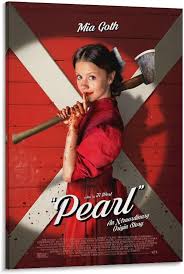
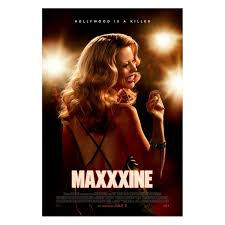
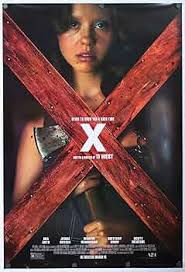
I’ve now watched all of the X trilogy of horror movies directed and written by Ti West and starring Mia Goth (who also co-wrote one of them).  These are X (2022), Pearl (2022) and MaXXXine (2024), which focus on the characters of ruthlessly determined actress Maxine Minx and frustrated wannabe actress Pearl Douglas, both played by Goth.  At its best, the trilogy is great.  At its worst, it’s still good fun.


X is the story of some city-folk heading out into the countryside and falling prey to a foe their slick city ways can’t deal with.  Yes, that’s the plot of half the horror movies ever made, from Tobe Hooper’s The Texas Chainsaw Massacre (1974) to Sam Raimi’s The Evil Dead (1982), from John Boorman’s Deliverance (1972) to Daniel Myrick and Eduardo Sanchez’s The Blair Witch Project (1999), from Eli Roth’s Cabin Fever (2002) to Ari Aster’s Midsommar (2019).  In West’s spin on it, the city-folk are six young filmmakers, including Goth’s character Maxine.  The year is 1979 and they intend to make a porno movie on the quick and on the cheap.  As a market for their product, they’re eyeing the up-and-coming technology of VHS, which will allow people to pay money and watch steamy movies they’re never likely to see in their local cinemas.  The filmmakers have rented a building on an out-of-the-way farm for the shoot, a farm belonging to an elderly couple called Howard and Pearl.


© A24 / Little Lamb / Mad Solar Productions


Incidentally, Howard and Pearl are also the names of an elderly couple featured in the BBC’s long-running, almost never-ending – and terrible – situation comedy Last of the Summer Wine (1973-2010).  I guess an American like West wouldn’t have known that.  Though maybe Mia Goth, who’s English, could have warned him that those character names were likely to give viewers from the United Kingdom PTSD-type flashbacks to Last of the Summer Wine.


X‘s Pearl is clearly unhinged and she’s about to get worse.  Ruminating on her current wrinkly decrepitude, mourning the loss of her youth, and jealously resenting the nubile young bodies performing sex-acts for the cameras on the other side of the farmstead, the old woman flips.  Bloody mayhem ensues, involving guns, knives, pitchforks and a large alligator who hungrily lurks in a pond elsewhere on the premises.  The scene where Maxine takes a naked dip in the pond, not suspecting that its scaly occupant is slowly closing in on her, is one of the creepiest things in the movie.  Rarely have aerial shots been so unnerving.


© A24 / Little Lamb / Mad Solar Productions


In all three movies, West revels in the setting.  X takes place during a Texas summer and the heat and sweatiness are nicely conveyed by the 1970s-aesthetic of the visuals.  The daytime shots, at least, have a faintly bleached and blurry look that evoke all sorts of bucolic American horror movies really made in that decade – the aforementioned Texas Chainsaw Massacre and the likes of John Hancock’s Let’s Scare Jessica to Death (1971), Jack Starrett’s Race with the Devil (1975) and Jeff Lieberman’s Squirm (1976).  Meanwhile, the way Pearl embodies the horrors of the aging process gives the film an extra depth.  This theme is touched upon both melancholically, as when Pearl realises how much Maxine resembles her when she was young, and queasily, with Pearl shuffling down to the makeshift film studio, spying on the actors doing their sex scenes and imagining she’s taking part herself.


But X’s greatest gimmick is its casting, for Mia Goth plays not one, but two characters.  She’s Maxine and Pearl.  The latter role required her to spend ‘a good 10 hours in the make-up chair’ in order to get the old-lady prosthetics applied.


© A24 / Little Lamb / Mad Solar Productions


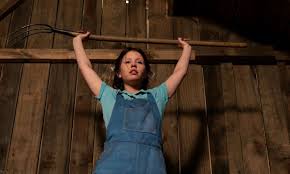
X ends with Maxine’s escape from the farm.  She drives off into the night, still determined to make it big as an actress.  But what comes next isn’t a sequel but a prequel.  If it was plausible for Goth to play Pearl with heavy make-up as an old woman, she could obviously play the character without make-up as a young woman.  Hence, we got Pearl, also released in 2022.  This is set in 1918 with the title character stuck on her parents’ farm (the same one as in X, though disarmingly smart and new-looking compared with the crumbling, rundown version of it in the previous film) whilst waiting for husband Howard to return from World War I.  She’s especially stuck because the Spanish flu pandemic, the early 20th century’s equivalent of Covid-19, is raging and Pearl’s family are isolating themselves.  It doesn’t help matters that her father (Matthew Sunderland) has been crippled by a stroke and her mother Ruth (Tandi Wright) is humourless, censorious and bitter.  Pearl responds to the situation by fantasising about becoming an all-singing, all-dancing silent-movie star – which increasingly provokes Ruth’s wrath.


Meanwhile, Pearl is already subject to the psychopathy that’ll lead to X’s bloody events 60 years later.  In an early scene, she takes a hay-fork to an unfortunate goose who didn’t display sufficient enthusiasm for a show she put on for the animals in the barn. She then goes to the pond and feeds the dead fowl to an alligator, whom she’s named Theda after the silent movie actress Theda Bara (and who’s presumably the granny of the alligator in X).


Though her mother is determined to clip her wings, other things seemingly pull Pearl in the direction of her dreams – namely, the flattery of a handsome but lecherous projector at the local town’s movie theatre, and a once-in-a-lifetime opportunity to join a travelling dance troupe, the auditions for which are being held in the local church.  Predictably, during the ensuing conflicts, betrayals and disappointments, Pearl snaps.  The bodies pile up and Theda the Alligator gets some unexpected meals.


© A24 / Little Lamb / Mad Solar Productions


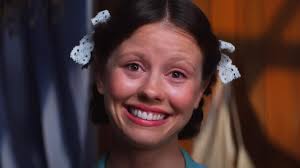
Even more so than X, Pearl shows West and Goth at the top of their games.  The director excels in orchestrating the showbiz-y fantasies that Pearl weaves around herself, including one set in a cornfield and involving a scarecrow that’s inspired by The Wizard of Oz (1939).  We can’t help but pity her even though we know she’s turning into a monster.  And Goth is amazing.  She’s particularly awesome at the end, when Howard finally arrives back from the war and finds the farmhouse kitchen in a less than decorous state.  Pearl presents herself – “I’m so happy you’re home!” – with a rictus-like smile, simultaneously heartfelt and terrifying, that seems to stay on her features forever.  No wonder Peter Bradshaw, film critic in The Guardian newspaper, hailed Goth as ‘the Judy Garland of horror’.


Pearl isn’t around for MaXXXine, released in 2024 and set in 1985, six years after the events of X.  But we glimpse her in flashbacks and her presence is felt in one of the film’s most harrowing scenes.  This is when Maxine – now in Hollywood and trying to graduate from starring in porn movies to starring in something slightly more upmarket, i.e., horror movies – sits in a make-up chair and has a cast made of her head.  With her face buried in the cast, and blinded by it, she suffers a panic attack and imagines Pearl is in the room, caressing her, as she did during one creepy moment in X.


Whereas the action in X and in much of Pearl was confined to a farm, MaXXXine is far more expansive.  Its story unfolds all over Los Angeles, from the Hollywood Hills to the back-lots of Universal Studios (where, significantly, we see the Bates house and motel from Alfred Hitchcock’s Psycho), from the city’s luxurious mansions to its ultra-dodgy strip-clubs, peepshows and back alleyways.  But it’s the time rather than the place that gives the film its vibe.  MaXXXine unashamedly immerses itself in the garish sleaze and excessiveness of the 1980s: big hair, Ray-Ban sunglasses, spandex, lip-gloss, neon colours, graffiti, cocaine, hustlers, flashy convertibles with personalised number-plates, X-rated video stores, lascivious hair-metal bands, gory slasher movies and general ‘me’-generation greed.  West depicts this world as a cesspit, but a somehow joyous cesspit.  Maxine, of course, has taken to it like a duck to water.


But it’s still water that contains alligators.  Maxine gets caught up in a murder spree by an apparently Satan-worshipping serial killer who’s targeting people close to her.  She also has to deal with a crooked private investigator, played with scenery-chewing magnificence by Kevin Bacon, who knows she was present at the bloodbath at Pearl and Howard’s farm in 1979.  These things happen while she’s pursuing what she believes is her big break – a starring role in a schlocky horror sequel called The Puritan II, about to be filmed by a hard-as-nails lady director (Elizabeth Debicki).


© A24 / Motel Mojave / Access Entertainment


This leads to the first of a few unsatisfactory things in MaXXXine’s plotting.  Maxine is so determined to hold onto the film-role that she refuses to cooperate with the cops investigating the serial killer, because getting involved in a murder case will prevent her working on The Puritan II.  We know that Maxine is now in some ways as psychopathically ruthless as Pearl – early on, she’s shown dealing with a would-be mugger in a manner that’ll bring a grimace to the face of anyone possessing a pair of testicles – but come on.  Your friends are being slaughtered around you.  There’s a good chance you’ll be next.  How could you not go to the cops, important impending film-role or not?


Also awkward is the film’s ending, which veers off into a completely different style of movie – admittedly still a 1980s style, that of a Jerry Bruckheimer-Don Simpson action thriller.  At the same time, when the identity of the villain is finally revealed, it’s scarcely a surprise, since it was heavily signalled beforehand.


However, criticising a film paying homage to the 1980s for being illogical is self-defeating, considering that bona fide 1980s movies were hardly known for their logic.  It’s telling that one 1980s movie  MaXXXine has been compared to is Brian De Palma’s violent thriller Body Double (1984).  (Both have scenes prominently featuring Frankie Goes to Hollywood songs, Relax in Body Double, Welcome to the Pleasure Dome in MaXXXine.)  Body Double is regarded as a classic now, but on its release the critics dismissed it as De Palma at his most throwaway, as a series of stylish set-pieces in search of a plot.  MaXXXine is a similar, De Palma-esque mixture of splendidness and shonkiness.


© A24 / Motel Mojave / Access Entertainment


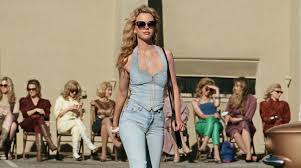
Anyway, there’s much to enjoy in it.  Goth’s first scene as Maxine is brilliant.  It culminates in her emerging from the audition for The Puritan II and contemptuously informing the long queue of would-be starlets waiting outside that they’re wasting their time because she has the job in the bag.  She then struts off to the sound of ZZ Top’s Gimme All Your Lovin’.  The cast is great too.  As well as Goth, Bacon and Debicki, it has Giancarlo Esposito playing Maxine’s shady agent.  Esposito, of course, was the terrifying Gus Fring in Breaking Bad (2008-13) and Better Call Saul (2015-22) and here he does a shockingly Gus Fring-like thing near the movie’s end.


In my opinion, then, X is the best horror movie of the three, Pearl is the best movie full-stop, and MaXXXine, despite its flaws, is very entertaining.  I wonder if West and Goth will get around to making a fourth film.  Goth has played Pearl young and old, but played Maxine only young.  How about a fourth movie set in the 2020s, with Maxine now as aged as Pearl was in X and living reclusively like the embittered Norma Desmond in Billy Wilder’s Sunset Boulevard (1950)?


Being a horror movie, though, it would be in the vein of what used to be called ‘psycho-biddy’ or ‘hagsploitation’ movies.  These constituted a sub-genre of horror that featured aging female movie stars playing old ladies who’ve become psychopathically loopy: for example, Betty Davis and Joan Crawford in What Ever Happened to Baby Jane? (1962), Tallulah Bankhead in Die! Die! My Darling! (1965) Zsa Zsa Gabor in Picture Mommy Dead (1966), Shelley Winters in Whoever Slew Auntie Roo? (1971) and Lana Turner in Persecution (1974).  I have every confidence that the mighty Mia Goth, in old-lady make-up, would hold her own among the likes of Davis, Crawford, Bankhead, Gabor, Winters and Turner.


Come to think of it, she’s done it already, in X.


© A24 / Little Lamb / Mad Solar Productions