Films I’d like to see remade (Part 2)


From wikipedia.org / © Metro-Goldwyn-Mayer


Here are some more films I remember fondly from my youth that, with sufficient love and skill, I think could be remade as wonderful new films.


Dark of the Sun (1968)

When, in my early teens, I saw this action / adventure / war movie on late-night TV, I believed it was the toughest movie ever.  At least, I believed that until I saw William Friedkin’s nail-biting Sorcerer (1977), itself a remake, of Henri-George Clouzot’s The Wages of Fear (1953), which promptly stole its crown as Most Badass Film I’d Ever Seen


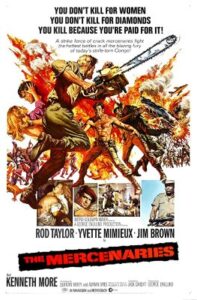
But no matter – Dark of the Sun, or The Mercenaries as it was also known, still seemed pretty hardcore to me.  Why, it even had a chainsaw fight in it!  Thanks to the Texas Chainsaw Massacre movies (1974 onwards) and the Evil Dead movies (1981 onwards), and to one-off entries like Motel Hell (1980) and Mandy (2018), chainsaw fights are ten a penny nowadays.  But back then, seeing someone lunge at someone else with a whirring, metal-toothed power tool was an intense experience.


Based on a 1965 Wilbur Smith novel and directed by Jack Cardiff, Dark of the Sun tells the story of some mercenaries being sent into action amidst the Simbas rebellion in early 1960s Congo. It stars Robert Taylor, Yvette Mimieux – Taylor and Mimieux reunited eight years after appearing in George Pal’s charming 1960 adaptation of H.G. Wells’s The Time Machine – Jim Brown, Kenneth More (subverting his usual, cuddly English-gentleman image by playing an alcoholic doctor) and Peter Carsten (playing a vile, child-murdering Nazi).  At the time, critics lambasted the film for what they saw as its extreme violence.  However, as Cardiff noted, the violence depicted didn’t come anywhere near the real atrocities that’d happened in the Congo then, or near the violence featured in movies in later decades.


I’d like to see a remake of Dark of the Sun that updates the intensity, grittiness and violence to fit with 2026 sensibilities and that places the action within the context of 2026 geopolitics.  And is more racially sensitive – any racism in the original movie went over my 13-year-old head but I’m sure that, viewing it today, I’d cringe at parts of it.   At the very least, and despite the presence of Jim Brown as one of the mercenaries, I suspect I’d find it infused with a ‘white saviour’ or ‘white man’s burden’ complex.


Quentin Tarantino is a huge fan of this film (as is Martin Scorsese) so, as I did with Von Ryan’s Express (1965), I recommend old Quent as the man to helm a remake of it.  I know he’s sworn that he’s only going to make ten films in his lifetime, and his next one will be his last, but I don’t believe that for an instant.


Come to think of it, Dark of the Sun has quite a few things in common with Von Ryan’s Express, including a cracking movie film poster designed by the splendid Frank McCarthy and the presence of Nazis.  And like the earlier film, Dark of the Sun prominently features a train.


As does my next candidate for a modern remake, which is….


© Granada Films


Horror Express (1972)

The much-loved British-Spanish movie Horror Express is set on a train hurtling across Siberia in the early 20th century.  The train is being stalked by a decomposing ape-man fossil that’s seemingly come back to life – in fact, it’s possessed by an alien lifeforce and has the power to suck people’s brains out through their eyeballs.  Trying to thwart it are British scientists Sir Alexander Saxon (Christopher Lee) and Dr Wells (Peter Cushing).  Things become even more complicated in the film’s final act when the train is invaded by a bunch of Cossack soldiers, led by Telly Savalas’s villainous Captain Kazan.


Directed by Eugenio Martin, Horror Express is basically The Thing (1982) set on board the train from Alfred Hitchcock’s 1938 classic The Lady Vanishes.  Saxon and Wells are variations on the characters of Charters and Caldicott, the stuffy but unflappable English cricket-lovers in Hitchcock’s movie who get caught up in the chaos.  That said, you never feel Christopher Lee and Peter Cushing are playing anyone other than themselves in Horror Express.  During their careers, the two actors made 22 movies together, were close friends offscreen and have an effortless chemistry here.


The decaying ape-man in the original movie is still icky, but it would be nice to see it in a modern remake with a decent special-effects budget where it could do properly mind-blowing, spectacularly gruesome Thing-like things.  To play Saxon and Wells, you’d need a pair of British actors who’ve worked together already and possess some of that Lee-Cushing chemistry – maybe Benedict Cumberbatch and Martin Freeman, from the BBC TV show Sherlock (2010-17)?


And to play Savalas’s murderous Captain Kazan, there can be only one man: Nicolas Cage.


Theatre of Blood (1973)

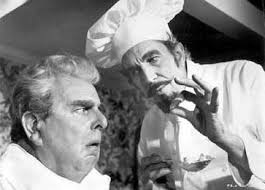
Until recently, I’d have been aghast at the thought of anyone remaking Douglas Hickox’s brilliant horror comedy Theatre of Blood, wherein Vincent Price plays an insane and hammily over-the-top Shakespearean actor called Edward Lionheart.  Enraged by the snobbish London theatre critics who’ve bad-mouthed his performances, Lionheart murders them one by one using methods borrowed from the Bard’s plays.  “They’re not going to start killing critics for giving bad notices, are they?” exclaims the campest critic, played by Robert Morley, who eventually meets a grisly fate modelled on events in Titus Andronicus.  A very distinguished cast of English character actors goes the same way as Morley: Michael Hordern, Dennis Price, Arthur Lowe, Harry Andrews, Robert Coote and Coral Browne.
 

© Harbour Productions Ltd / Cineman Productions / United Artists


There’s no shortage of famous modern-day British thespians who could play the supporting cast of doomed theatre critics in a remake – I’d enjoy seeing James Corden get the Titus Andronicus treatment – but surely, surely nobody could recreate the absolutely delicious performance that Vincent Price gives as Lionheart in the original movie?


Well, I thought that until I saw Ralph Fiennes in this year’s 28 Years Later: The Bone Temple.  Now I’m pretty sure he could be the Vincent Price of 2026.  And actually, Fiennes has played a character not dissimilar to Lionheart in 2022’s The Menu.


And if Fiennes wasn’t available, I suppose they could always call on Matt Berry.


The Beast Must Die (1974)

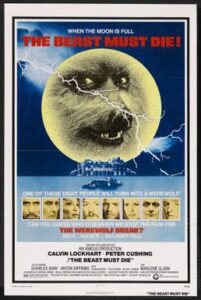
Paul Annett’s The Beast Must Die is a low-budget horror movie with an irresistible premise.  It’s about a millionaire big-game hunter, played by Calvin Lockhart, determined to bag a werewolf.  He rigs up his country estate with CCTV cameras and motion sensors, procures a helicopter and invites five unsavoury people to visit for a few days convinced that one of them  is a werewolf.  Among those playing Lockhart’s house-guests and staff are Peter Cushing, Charles Gray, Anton Diffring and a youthful Michael Gambon.  Needless to say, there is a werewolf present, but it gradually turns the tables on Lockhart and his hi-tech equipment, whilst also bumping off the supporting cast.


The ideas is irresistible, as I said, but watching The Beast Must Die on TV as a kid was a frustrating experience.  Due to the inevitable budgetary constraints, Lockhart’s mansion house and grounds aren’t that hi-tech and the werewolf, when it appears, just looks like a big dog.  You’d think the sequence where the werewolf takes out a helicopter would be thrilling, but it isn’t.  Let’s remake this one with a proper budget, so that it’s as awesome as it sounded on paper in 1974.
 

From wikipedia.org / © Amicus Productions / British Lion Films


Juggernaut (1974)

The most underrated but, in my mind, the greatest of 1970s disaster movies, Richard Lester’s Juggernaut is mostly set on a British ocean liner stuck out in the stormy north Atlantic.  An anonymous call to the company that owns the liner informs it that half-a-dozen bombs have been stashed on board and they’ll explode unless a ransom is paid.  With weather conditions too severe to allow the ship’s crew and passengers to be evacuated, and the authorities forbidding the company to pay the ransom – which would be surrendering to terrorism – a team of bomb-disposal experts led by Fallon (Richard Harris) and his sidekick Charlie (David Hemmings) are sent to try and make the bombs safe.


Back on dry land, a policeman (Anthony Hopkins), whose family are among those trapped on the ship, tries to discover the bomber’s identity.  I don’t want to give away any spoilers, but when a twitchy Freddie Jones appears onscreen, you know who it is.


Juggernaut has a wonderful cast all round – not just the three ‘H’s of Harris, Hemmings and Hopkins, but also Omar Sharif, Ian Holm, Shirley Knight, Clifton James, Julian Glover and many more.  But the show is quietly stolen by Roy Kinnear, playing the ship’s entertainment officer, who has the thankless task of keeping the passengers’ spirits up when at any moment they could be blown to smithereens.  When he organises a fancy-dress party, one passenger appears dressed as the Grim Reaper and carrying a round black object with BOMB written on it.


As well as being massively suspenseful, the film offers social commentary.  The ship is called the Britannic and it’s not difficult to see Juggernaut as a meditation on the sorry plight of Britain in the mid-1970s, its days as a world power well behind it, being battered by global events it had no power over, such as the Oil Crisis.  In 2026, a decade after Brexit and during the chaotic era of Trump, a remake of Juggernaut would be both more poignant and more cutting.


You could also cast, in a Juggernaut remake, the sons of three of its original stars, now well established as actors in their own right: Jared Harris, Toby Jones and Rory Kinnear.  But it’d be fun to see them in roles different from those their dads played.  Kinnear as the policeman, Jones as the entertainment officer, Harris as the bomber?
 

© Two Roads / United Artists

The real Princess Diana


© ITV / ABC / Thames


2020 has been a rotten year and I suspect it still has more rottenness in store.  One of the many reasons why I’ve found it so godawful has been because it’s seen the deaths of two actresses who meant a lot to me, firstly because they both had leading roles in James Bond movies and I’m a big James Bond fan, and secondly because they both starred in one of my favourite TV shows, The Avengers (1961-69).  I’m talking, of course, about Honor Blackman, who died in April, and now Diana Rigg, who died last week.


I never got to see Diana Rigg perform on stage, where she appeared in plays by Edward Albee, Bertolt Brecht, Anton Chekov, Noel Coward, Henrik Ibsen, Molière, Jean Racine, George Bernard Shaw, Tom Stoppard, Tennessee Williams and, obviously, William Shakespeare.  Nor did I catch her when, after becoming a Dame in the mid-1990s and being recognised as a national treasure, she appeared in prestigious TV productions like Rebecca (1997) or Victoria & Albert (2001), both of which resulted in her winning or being nominated for Emmy Awards.  I was living abroad and didn’t have access to English-language TV at the time.


I didn’t even watch her much-praised performance as Olenna Tyrell in the TV show Game of Thrones from 2013 to 2017, since I thought I should first read the George R.R. Martin books on which the show was based – something I’ve yet to get around to doing.


Despite what I’ve missed, however, I offer here a collection of Diana Rigg performances that I have seen and remember fondly.


Playing Tracy di Vincenzo in On Her Majesty’s Secret Service (1969)

On Her Majesty’s Secret Service is ostensibly about James Bond (George Lazenby in his one-and-only shot at the role) tangling with his arch-enemy Ernst Stavros Blofeld (Telly Savalas).  However, it also explores Bond’s emotional side and highlights his vulnerability.  Key to this is OHMSS’s sub-plot about the romance between Bond and Contessa Theresa ‘Tracy’ di Vicenzo (Rigg), daughter of the boss of the crime syndicate the Unione Corse of Corsica.  At the film’s end, Blofeld is seemingly vanquished and Bond and Tracy get married.  Then Blofeld makes a sudden reappearance in the final scene, sprays their honeymoon car with bullets, kills Tracy and leaves Bond as a babbling wreck.


Fascinatingly, for a film franchise that’s often accused of de-humanising the Ian Fleming novels that inspired it and emphasising big, dumb spectacle at the expense of characterisation, Tracy is a more fleshed-out character in OHMSS-the film than in OHMSS-the-novel.  She’s given more to do and, played by Rigg, has a sparkle that’s missing in the rather aloof, ambiguous character that Fleming sketches.


© Eon Productions


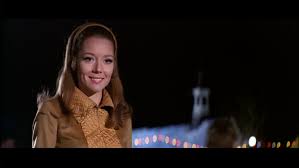
Particularly memorable is her appearance after Bond escapes from Blofeld’s Alpine headquarters.  Hunted by Blofeld’s henchmen, exhausted, frightened even – something that Lazenby, despite or perhaps because of his acting inexperience, conveys well – he takes refuge in a crowded Christmas market / ice rink in the local town.  Just as he thinks he not going to make it, Rigg comes to his rescue, unexpectedly skating into view in front of him like some heaven-sent angel of mercy.


Playing Sonya Winter in The Assassination Bureau (1969)

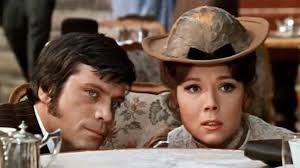
On Her Majesty’s Secret Service wasn’t the only instance in 1969 of Diana Rigg rubbing shoulders with Telly Savalas.  In Basil Deardon’s black comedy The Assassination Bureau (based on an unfinished Jack London novel), she plays an aspiring female journalist in Edwardian London sent by Savalas’s unscrupulous newspaper proprietor to investigate a secret criminal organisation offering assassins for hire.  Armed with a bagful of money that Savalas has provided, Rigg brazenly hires this Assassination Bureau to assassinate its own chairman, Ivan Dragomiloff, who’s played by Oliver Reed.  Admiring Rigg’s audacity, Reed accepts the commission and, with her in tow, spends the movie zigzagging around Europe dodging the efforts of his own board of directors to kill him.


It’s a pleasantly silly film and, admirably, doesn’t waste any time in setting up its convoluted premise and getting into the action.  Rigg is delightful as the uppity Sonya Winter, determinedly doing her job and flying the flag for women’s rights amid a world of starchy, patronising male chauvinists.  Meanwhile, Reed had only just played the brutish Bill Sikes in Oliver! (1968) and at the time was in contention to play James Bond, although his reputation for drunken offscreen hi-jinks put 007 producers Cubby Broccoli and Harry Saltzman off the idea.  His pairing with Rigg in The Assassination Bureau is no beauty-and-the-beast affair, however.  He dials down the roughness and dials up the charm so that their chemistry together is actually very pleasing.


© Paramount Pictures


Playing Edwina Lionheart in Theatre of Blood (1973)

Douglas Hickox’s brilliant comedy-horror movie Theatre of Blood has Vincent Price as an insane and hammily over-the-top Shakespearean actor who starts killing the snobbish London theatre critics who’ve bad-mouthed his performances, using murders methods borrowed from the Bard’s plays.  “They’re not going to start killing critics for giving bad notices, are they?” exclaims the campest critic Meredith Merridew, played by Robert Morley, who eventually meets a grisly fate modelled on events in Titus Andronicus.  As the corpses pile up, murdered in ways suggested by Julius Caesar, Troilus and Cressida, Cymbeline, Richard III, Henry VI: Part One and even The Merchant of Venice (Price rewrites it so that he can extract a pound of flesh from Harry Andrews), the youngest and least obnoxious critic, played by Ian Hendry, and the investigating police officers, played by Milo O’Shea and Eric Sykes, turn to Lionheart’s supposedly normal daughter, Edwina (Rigg), for help.


Distraught about what her father is doing, yet repulsed by the critics who destroyed his career, Edwina is initially a troubled and conflicted character.  Yet as the film progresses, it transpires that Rigg is having as much fun in her role as the Bard-quoting, soliloquizing Price is in his.


Taking the mickey out of herself in The Morecambe and Wise Show (1975), The Great Muppet Caper (1981) and Extras (2006)

Rigg never took herself too seriously.  She teamed up with Britain’s most famous comic double-act Morecambe and Wise for their 1975 Christmas TV special, where she appeared in the inevitable Ernie Wise-penned play.  This featured Rigg as Nell Gwynne, Eric Morecambe as Charles II and Wise as Samuel Pepys.  (“Have you read Ernie’s play?” demands Morecambe.  “Yes, I have,” replies Rigg.  “And you’re still here?”)  Better still is her appearance in The Great Muppet Caper, the second movie starring Jim Henson’s much-loved puppets, in which she plays the snooty fashion designer Lady Holiday, who’s robbed of her jewellery by a gang led by her devious brother (Charles Grodin).  Predictably, Miss Piggy approaches Rigg in the hope of securing a job as a fashion model and insists on showing Rigg her portfolio: “This is me reeking grandeur!”


And then there’s a 2006 episode of Ricky Gervais and Stephen Merchant’s comedy show Extras, which is about a struggling actor (Gervais) trying to make ends meet with bit-parts and uncredited roles in films and on television.  This scenario enables the show’s gimmick of having real, famous actors and actresses play versions of themselves – usually twisted, unpleasant versions.  In this particular episode, Gervais gets a three-day job in a new fantasy film starring the then-17-year-old Daniel Radcliffe and Dame Diana Rigg.  The joke is that Radcliffe is a randy, boorish and clueless teenager.  Whilst eating with him in the studio canteen, Radcliffe tries to convince Gervais that he’s a man of the world by whipping a condom out of his pocket – he’s unravelled it but seems to think he can still put it on – and then accidentally pings it through the air to a nearby table, where it lands on the unamused Rigg’s head.  Radcliffe asks her for his ‘johnny back’ and gets a schoolmistress-ly reply: “May I have my prophylactic back, please?”


Later, Radcliffe sidles up to her and inquires, “You still got that catsuit from The Avengers?”  Rigg retorts: “Go away, Daniel.”


© BBC / HBO


And that brings me nicely to…


Playing Emma Peel in The Avengers (1965-67)

By the time Rigg joined The Avengers in the mid-1960s, the show, under the guidance of creator Brian Clemens, had gradually mutated from being a conventional action / thriller show with Patrick Macnee’s John Steed and Ian Hendry’s Dr David Keel as a pair of crime-fighters to being a television phenomenon that did everything on its own terms, both determinedly non-realistic and restlessly inventive.


Rigg’s tenure on The Avengers was surely its golden era.  With her Emma Peel character partnering Macnee’s now surreally debonair Steed, and the show being broadcast in colour for the first time, it was a self-confident cocktail of the funny, the silly, the fantastical, the baroque and, occasionally, the gothic and the kinky.  (The kinkiness factor came to the fore in an episode called A Touch of Brimstone, wherein Rigg dons a costume comprising a spiked collar, whalebone corset, black leather boots and a snake.  Funnily enough, this attracted the highest viewing figures of any episode in The Avengers’ eight-year history.)


Rigg brought to the show a bemused, unruffled quirkiness that was the equal of Macnee’s majestic imperturbability.  She was also his equal in being proactive, having no qualms about wading into fights to show off her martial arts prowess or hurtling around in a Lotus Elan.  As a villain in one episode remarked, “She’s well and truly emancipated, is that one.”


Rigg wasn’t comfortable about the fact, but Emma Peel also became a sex symbol.  She couldn’t well avoid it, being ephemerally gorgeous and clad in a succession of leather catsuits, mini-skirts and mod-inspired outfits that, inevitably, ended up being sold in the ladies’ fashion shops of the real Britain.  Wisely, though, sex was off the agenda in her character’s onscreen relationship with Macnee’s Steed.  The two indulged in a relaxed, platonic flirtatiousness and left it at that.  Macnee did get a kiss from her at the end of her final episode on the show, when she left him with the parting advice: “Always keep your bowler on in times of stress, and watch out for diabolical masterminds.”


Appearing at the height of the swinging 1960s, but tongue-in-cheek and light-hearted rather than smug, which is how I find many productions from the time, The Avengers, and especially the Emma Peel-era Avengers, projects a charming and not-taking-itself-seriously notion of Britishness that seems light-years removed from the discredited, embittered, clapped-out Britain of 2020.  The death of Diana Rigg, who’d been one of the last links with the show, just seems to emphasise that it’s now all in the past.


© ITV / ABC / Thames