Films I’d like to see remade (Part 2)


From wikipedia.org / © Metro-Goldwyn-Mayer


Here are some more films I remember fondly from my youth that, with sufficient love and skill, I think could be remade as wonderful new films.


Dark of the Sun (1968)

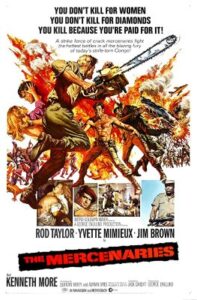
When, in my early teens, I saw this action / adventure / war movie on late-night TV, I believed it was the toughest movie ever.  At least, I believed that until I saw William Friedkin’s nail-biting Sorcerer (1977), itself a remake, of Henri-George Clouzot’s The Wages of Fear (1953), which promptly stole its crown as Most Badass Film I’d Ever Seen


But no matter – Dark of the Sun, or The Mercenaries as it was also known, still seemed pretty hardcore to me.  Why, it even had a chainsaw fight in it!  Thanks to the Texas Chainsaw Massacre movies (1974 onwards) and the Evil Dead movies (1981 onwards), and to one-off entries like Motel Hell (1980) and Mandy (2018), chainsaw fights are ten a penny nowadays.  But back then, seeing someone lunge at someone else with a whirring, metal-toothed power tool was an intense experience.


Based on a 1965 Wilbur Smith novel and directed by Jack Cardiff, Dark of the Sun tells the story of some mercenaries being sent into action amidst the Simbas rebellion in early 1960s Congo. It stars Robert Taylor, Yvette Mimieux – Taylor and Mimieux reunited eight years after appearing in George Pal’s charming 1960 adaptation of H.G. Wells’s The Time Machine – Jim Brown, Kenneth More (subverting his usual, cuddly English-gentleman image by playing an alcoholic doctor) and Peter Carsten (playing a vile, child-murdering Nazi).  At the time, critics lambasted the film for what they saw as its extreme violence.  However, as Cardiff noted, the violence depicted didn’t come anywhere near the real atrocities that’d happened in the Congo then, or near the violence featured in movies in later decades.


I’d like to see a remake of Dark of the Sun that updates the intensity, grittiness and violence to fit with 2026 sensibilities and that places the action within the context of 2026 geopolitics.  And is more racially sensitive – any racism in the original movie went over my 13-year-old head but I’m sure that, viewing it today, I’d cringe at parts of it.   At the very least, and despite the presence of Jim Brown as one of the mercenaries, I suspect I’d find it infused with a ‘white saviour’ or ‘white man’s burden’ complex.


Quentin Tarantino is a huge fan of this film (as is Martin Scorsese) so, as I did with Von Ryan’s Express (1965), I recommend old Quent as the man to helm a remake of it.  I know he’s sworn that he’s only going to make ten films in his lifetime, and his next one will be his last, but I don’t believe that for an instant.


Come to think of it, Dark of the Sun has quite a few things in common with Von Ryan’s Express, including a cracking movie film poster designed by the splendid Frank McCarthy and the presence of Nazis.  And like the earlier film, Dark of the Sun prominently features a train.


As does my next candidate for a modern remake, which is….


© Granada Films


Horror Express (1972)

The much-loved British-Spanish movie Horror Express is set on a train hurtling across Siberia in the early 20th century.  The train is being stalked by a decomposing ape-man fossil that’s seemingly come back to life – in fact, it’s possessed by an alien lifeforce and has the power to suck people’s brains out through their eyeballs.  Trying to thwart it are British scientists Sir Alexander Saxon (Christopher Lee) and Dr Wells (Peter Cushing).  Things become even more complicated in the film’s final act when the train is invaded by a bunch of Cossack soldiers, led by Telly Savalas’s villainous Captain Kazan.


Directed by Eugenio Martin, Horror Express is basically The Thing (1982) set on board the train from Alfred Hitchcock’s 1938 classic The Lady Vanishes.  Saxon and Wells are variations on the characters of Charters and Caldicott, the stuffy but unflappable English cricket-lovers in Hitchcock’s movie who get caught up in the chaos.  That said, you never feel Christopher Lee and Peter Cushing are playing anyone other than themselves in Horror Express.  During their careers, the two actors made 22 movies together, were close friends offscreen and have an effortless chemistry here.


The decaying ape-man in the original movie is still icky, but it would be nice to see it in a modern remake with a decent special-effects budget where it could do properly mind-blowing, spectacularly gruesome Thing-like things.  To play Saxon and Wells, you’d need a pair of British actors who’ve worked together already and possess some of that Lee-Cushing chemistry – maybe Benedict Cumberbatch and Martin Freeman, from the BBC TV show Sherlock (2010-17)?


And to play Savalas’s murderous Captain Kazan, there can be only one man: Nicolas Cage.


Theatre of Blood (1973)

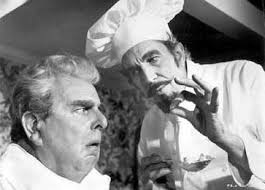
Until recently, I’d have been aghast at the thought of anyone remaking Douglas Hickox’s brilliant horror comedy Theatre of Blood, wherein Vincent Price plays an insane and hammily over-the-top Shakespearean actor called Edward Lionheart.  Enraged by the snobbish London theatre critics who’ve bad-mouthed his performances, Lionheart murders them one by one using methods borrowed from the Bard’s plays.  “They’re not going to start killing critics for giving bad notices, are they?” exclaims the campest critic, played by Robert Morley, who eventually meets a grisly fate modelled on events in Titus Andronicus.  A very distinguished cast of English character actors goes the same way as Morley: Michael Hordern, Dennis Price, Arthur Lowe, Harry Andrews, Robert Coote and Coral Browne.
 

© Harbour Productions Ltd / Cineman Productions / United Artists


There’s no shortage of famous modern-day British thespians who could play the supporting cast of doomed theatre critics in a remake – I’d enjoy seeing James Corden get the Titus Andronicus treatment – but surely, surely nobody could recreate the absolutely delicious performance that Vincent Price gives as Lionheart in the original movie?


Well, I thought that until I saw Ralph Fiennes in this year’s 28 Years Later: The Bone Temple.  Now I’m pretty sure he could be the Vincent Price of 2026.  And actually, Fiennes has played a character not dissimilar to Lionheart in 2022’s The Menu.


And if Fiennes wasn’t available, I suppose they could always call on Matt Berry.


The Beast Must Die (1974)

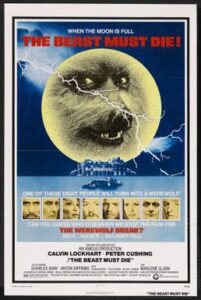
Paul Annett’s The Beast Must Die is a low-budget horror movie with an irresistible premise.  It’s about a millionaire big-game hunter, played by Calvin Lockhart, determined to bag a werewolf.  He rigs up his country estate with CCTV cameras and motion sensors, procures a helicopter and invites five unsavoury people to visit for a few days convinced that one of them  is a werewolf.  Among those playing Lockhart’s house-guests and staff are Peter Cushing, Charles Gray, Anton Diffring and a youthful Michael Gambon.  Needless to say, there is a werewolf present, but it gradually turns the tables on Lockhart and his hi-tech equipment, whilst also bumping off the supporting cast.


The ideas is irresistible, as I said, but watching The Beast Must Die on TV as a kid was a frustrating experience.  Due to the inevitable budgetary constraints, Lockhart’s mansion house and grounds aren’t that hi-tech and the werewolf, when it appears, just looks like a big dog.  You’d think the sequence where the werewolf takes out a helicopter would be thrilling, but it isn’t.  Let’s remake this one with a proper budget, so that it’s as awesome as it sounded on paper in 1974.
 

From wikipedia.org / © Amicus Productions / British Lion Films


Juggernaut (1974)

The most underrated but, in my mind, the greatest of 1970s disaster movies, Richard Lester’s Juggernaut is mostly set on a British ocean liner stuck out in the stormy north Atlantic.  An anonymous call to the company that owns the liner informs it that half-a-dozen bombs have been stashed on board and they’ll explode unless a ransom is paid.  With weather conditions too severe to allow the ship’s crew and passengers to be evacuated, and the authorities forbidding the company to pay the ransom – which would be surrendering to terrorism – a team of bomb-disposal experts led by Fallon (Richard Harris) and his sidekick Charlie (David Hemmings) are sent to try and make the bombs safe.


Back on dry land, a policeman (Anthony Hopkins), whose family are among those trapped on the ship, tries to discover the bomber’s identity.  I don’t want to give away any spoilers, but when a twitchy Freddie Jones appears onscreen, you know who it is.


Juggernaut has a wonderful cast all round – not just the three ‘H’s of Harris, Hemmings and Hopkins, but also Omar Sharif, Ian Holm, Shirley Knight, Clifton James, Julian Glover and many more.  But the show is quietly stolen by Roy Kinnear, playing the ship’s entertainment officer, who has the thankless task of keeping the passengers’ spirits up when at any moment they could be blown to smithereens.  When he organises a fancy-dress party, one passenger appears dressed as the Grim Reaper and carrying a round black object with BOMB written on it.


As well as being massively suspenseful, the film offers social commentary.  The ship is called the Britannic and it’s not difficult to see Juggernaut as a meditation on the sorry plight of Britain in the mid-1970s, its days as a world power well behind it, being battered by global events it had no power over, such as the Oil Crisis.  In 2026, a decade after Brexit and during the chaotic era of Trump, a remake of Juggernaut would be both more poignant and more cutting.


You could also cast, in a Juggernaut remake, the sons of three of its original stars, now well established as actors in their own right: Jared Harris, Toby Jones and Rory Kinnear.  But it’d be fun to see them in roles different from those their dads played.  Kinnear as the policeman, Jones as the entertainment officer, Harris as the bomber?
 

© Two Roads / United Artists
When Raquel ruled


© 20th Century Fox


From the mid-1960s to mid-1970s, Raquel Welch was probably the cinematic sex symbol as far as unreconstructed blokes in the Anglosphere were concerned – blokes who were a bit intimidated by the exoticness and general foreignness of, say, Brigitte Bardot or Ursula Andress.  Welch, who sadly died last week at the age of 82, was Chicago born but raised in San Diego.  Her time in the latter location seemed to imbue her with a healthy, clean-cut Californian glow that was an obvious physical advantage to her in her film roles.  Cerebrally, though, she didn’t win a lot of respect from her (mostly male) peers.  This sorry state-of-affairs was epitomised by some advice that Don Chaffey, director of One Million Years BC (1966), offered her early on in that movie’s filming.  Her function, he explained, was not to think, but merely to run from one rock to another.


I should say that when Raquel Welch was at the height of her popularity, I was too young to actually fancy her.  Instead, I just remember her as a talismanic presence in a number of movies that I found incredibly enjoyable at the time and that have stayed in my memory during the decades since.  Here are my half-dozen favourites that showcase the late, great Ms Welch.


Fantastic Voyage (1966)

In this science fiction epic, Welch plays Cora Peterson, technical assistant to a brain surgeon (Arthur Kennedy) and member of a medical team who are miniatured in a submarine and injected into the bloodstream of a seriously injured scientist.  Why?  Well, there’s a blood clot lodged deep in his brain that can’t be reached on an operating table, and the only option is to have miniature people inside him zapping the pesky clot to buggery with a laser beam.  Which makes sense.


© 20th Century Fox


As the scientist is a leading expert in the field of miniaturisation, which apparently is being developed on both sides of the Iron Curtain, it’s no surprise when it transpires that the Soviets have put a secret agent on board the submarine to sabotage the mission.  Neither is it a surprise when this secret agent turns out to be a character played by the reliably-twitchy Donald Pleasence.  Actually, Pleasence’s death-scene, in which he falls victim to a hungry white blood-cell, is worth the price of admission alone.


Yes, it’s all very silly.  In fact, when he wrote the film’s novelisation, the respected sci-fi author and professor of biochemistry Isaac Asimov tied himself in knots trying to make its plot seem more scientifically feasible.  But with imaginative sets representing the inside of the human body, and decent special effects depicting the movements of the cast and their submarine within this strange micro-verse, and capable direction by underrated filmmaker Richard Fleischer, it’s a piece of hokum that’s both entertaining and memorable.


One Million Years BC (1966)

To be fair to director Don Chaffey, running from rock to rock was pretty much all that Welch, as the cavewoman Loana, and John Richardson as her caveman beau Tumak, needed to do for the duration of One Million Years BC, whilst trying to escape the claws and fangs of legendary special-effects man Ray Harryhausen’s stop-motion-animation dinosaurs.  The film, made by Hammer Films, is even sillier than Fantastic Voyage.  Not scripted with much attention to paleontological science, it depicts Welch, Richardson and the rest of the human cast existing alongside monster-lizards in the Calabrian Stage of the Pleistocene Epoch.  Nonetheless, Harryhausen’s splendid work transforms it into pulp-art and its poster, with Welch standing imposingly in a fur bikini, became one of the great cinematic images of the 1960s.  It’s the last poster, for instance, on the wall of Tim Robbins’ cell in The Shawshank Redemption (1994), sneakily concealing the tunnel that he’s digging out of the place.


© Hammer Films / Seven Arts


In the late 1990s, while I was living in Edinburgh, Ray Harryhausen appeared one day at the (now sadly defunct) Lumiere Cinema to give a talk about his movie-making career.  I attended, and I recall the queue that formed afterwards at Harryhausen’s table as people got him to autograph items related to his films.  Many of these were posters and video cassettes of One Million Years BC and I remember him demanding, “Did you buy these because of my dinosaurs or because Raquel Welch is on the cover in a fur bikini?”


Bedazzled (1967)

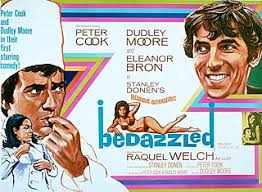
This being the late 1960s, it was inevitable that Welch would appear in a number of self-consciously groovy, achingly unfunny swinging-sixties comedy-movies, such as Leslie H. Martinson’s Fathom (1967) and Joseph McGrath’s The Magic Christian (1969).  However, I do like Stanley Donen’s Bedazzled, a comic retelling of the Faust story with Peter Cook and Dudley Moore.  Cook is the devil, trying to ensnare the soul of the hapless Moore, and he enlists the Seven Deadly Sins to help him.  Welch, as Lust, is definitely the most fetching of the sins – not that she has much competition, considering that, for instance, Barry Humphries plays Envy.


By the way – a shout-out for Bedazzled’s lovely opening credits, orchestrated by Maurice Binder and accompanied by Moore’s brassy but also subtly-melancholic theme music.


© 20th Century Fox


Bandolero (1968)

God, when I was a western-daft 10-year-old, I loved Bandolero.  Directed by seemingly inexhaustible western-movie director Andrew V. McLaglen, it contained everything I could have hoped for – action, humour, bank robberies, ghost towns, a gang of outlaws, a rival gang (consisting of bloodthirsty Mexican desperadoes, the bandoleros of the title), a tenacious sheriff and his posse, and a climactic shoot-out where (nearly) everyone gets killed.  The cast is excellent too.  In addition to Welch, there’s Dean Martin and James Stewart as the brothers leading the outlaws, the ever-reliable George Kennedy as the sheriff, and a supporting cast of familiar faces like Andrew Prine, Will Greer and Denver Pyle.  You even get a glimpse of former Tarzan actor Jock Mahoney, playing Welch’s quickly-killed-off husband.


All right, even at the age of 10, I knew Bandolero was pushing it a bit to have us believe that Dean Martin and James Stewart could be siblings.  Still, it seemed more credible than another western I saw at the same time, The Sons of Katie Elder (1965), which posited Dean Martin and John Wayne as siblings.


Hannie Caulder (1971)

Another western and a rare beast indeed, a British-made western.  It’s immeasurably better than other British efforts in the genre, such as Michael Winner’s dreadful Chatto’s Land (1972) or, gulp, Carry On Cowboy (1965).  And unlike Bandolero, which had Welch as a damsel in distress, Hannie Caulder has her playing a proactive, implacable female Clint Eastwood-type, seeking revenge on the three outlaw scumbags who raped her and murdered her husband.


© Tigon Films / Paramount Pictures


Admittedly, the tone of Hannie Caulder is badly fractured.  The villains who behave so heinously towards Welch in the movie’s early stages are otherwise portrayed as a trio of comic bumblers in the tradition of the Three Stooges, and the humour feels jarring.  But if you can get past that, you’ll enjoy a cast that’s even better than the cast of Bandolero.  Essaying the villains are legendary character actors Ernest Borgnine, Strother Martin and Jack Elam, Robert Culp turns up as a bounty hunter trying to help Welch out, and Northern Irish actor Stephen Boyd, one of Welch’s Fantastic Voyage co-stars, makes a cameo as a mysterious preacher.  The fact that Hannie Caulder was made by Tigon Films, a company more famous for its horror movies like Witchfinder General (1968) and Blood on Satan’s Claw (1970), perhaps accounts for producer Tony Tenser casting Christopher Lee as the gunsmith who provides Welch with the customised weapon necessary for taking down her antagonists.  There’s even room for Diana Dors, a sex symbol from an earlier era, playing the mistress of a bordello adept at battering obnoxious customers with her frilly umbrella.


Almost inevitably, Hannie Caulder is much-loved by Quentin Tarantino, who cites it as an influence on his Kill Bill movies (2003-4).


The Three / Four Musketeers (1973-74)

This double-movie adaptation of Alexandre Dumas’ 1844 novel was directed by Richard Lester, the man who helmed the two comedic Beatles movies in the 1960s.  He’d even, at one point, considered making a film where the Fab Four played the musketeers.  The Three and Four Musketeers are laced with many of Lester’s comic touches, often involving his regular collaborator Roy Kinnear, and Spike Milligan, who appears in the first film as Welch’s husband – surely the unlikeliest husband she was ever paired with onscreen.  Welch herself shows good comic talent, for example, at the end of The Three Musketeers where she gets knocked over by a jousting dummy.  At the same time, the films’ action sequences, orchestrated by the great sword-fight choreographer William Hobbs, look unnervingly realistic.  They come across as haphazard, exhausting and, yes, dangerous.  With Lester’s humour and Hobbs’ authenticity, then, the films shouldn’t work…  But somehow, they do.


In my mind, however, what makes these the best cinematic version of Dumas’ book is the fact that they’re packed with 1970s cinematic icons – Welch as heroine Constance Bonacieux, Michael York as hero d’Artagnan, Faye Dunaway as the villainous Milady, Christopher Lee as the equally villainous Rochefort, Charlton Heston as the equally, equally villainous Cardinal Richelieu, Oliver Reed as the brooding and frankly Oliver Reed-like Athos…  And so on.  Welch appeared in a few more films afterwards, but none were especially memorable and her time as English-language cinema’s number-one female pin-up had evidently passed.  But she could have done much worse than step out of the limelight with the Musketeers movies.


© 20th Century Fox

A Lee-centennial


© British Lion Films


The British actor Sir Christopher Lee, who was born on this day exactly 100 years ago, was a man who embodied evil to generations of film-goers.  He played Lord Summerisle, Dracula, Fu Manchu, Rasputin, Scaramanga, Comte de Rochefort, Frankenstein’s monster, the mummy, Doctor Jekyll and Mr Hyde, Blind Pew, Saruman, Count Dooku, the Jabberwocky, the Devil and, in the 2008 adaptation of Terry Pratchett’s The Colour of Magic, Death himself.  But up until his passing in 2015, I didn’t so much regard him as the embodiment of evil as one of the coolest people on the planet.


Lee did a lot during his 93 years and not just in terms of acting – though his movie resume was awesome, with some 275 titles to his name by the time he entered his tenth decade.


He was, incidentally, an incredibly literary actor too, because his massive film and television CV contained adaptations of stories by Lewis Carroll, Agatha Christie, Sir Arthur Conan Doyle, Roald Dahl, Alexandre Dumas, Rider Haggard, Washington Irving, H.P. Lovecraft, Mervyn Peake, Edgar Allan Poe, Sax Rohmer, Sir Walter Scott, Mary Shelley, Robert Louis Stevenson, Bram Stoker and Jules Verne.  In real life, he was step-cousin of James Bond’s creator, Ian Fleming; and by the time Peter Jackson got around to filming the Lord of the Rings trilogy (2002-2004), he could boast that he was the only member of the movies’ cast and crew who’d actually met J.R.R. Tolkien.  He was also good friends with Robert Bloch, author of Psycho (1959), the fabulous Ray Bradbury, and posh occult-thriller-writer Dennis Wheatley, whose potboiler The Devil Rides Out Lee would persuade Hammer Films to adapt to celluloid in 1968.  And he was one of the last people alive who could claim to have met M.R. James, the greatest ghost story writer in English literature.  As a lad Lee encountered James, who was then Provost of Eton College, when his family tried, unsuccessfully, to enrol him there.  Lee obviously didn’t hold his failure to get into Eton against James because in 2000 he played the writer in the BBC miniseries Ghost Stories for Christmas.


Before getting into acting in the late 1940s, Lee did military service during World War II, which included attachments with the Special Operations Executive and the Long Range Desert Patrol , the forerunner to the SAS.  He kept schtum about what he actually did with them.  Decades later, though, he may have unintentionally dropped a hint about his secret wartime activities to Peter Jackson when, on set, he discreetly advised the Kiwi director about the sound a dying man would really make if he’d just had a knife planted in his back.


His first years as an actor did not see much success, due to his being too tall (six-foot-four) and too foreign-looking (he had Italian ancestry).  During this period he at least learned how to swordfight, a skill he drew on when appearing in various low-budget swashbucklers.  During the making of one such film, 1955’s The Dark Avenger, the famously sozzled Errol Flynn nearly hacked off Lee’s little finger; although later Lee got revenge when, during a TV shoot with the same actor, a slightly-misaimed sword-thrust knocked off Flynn’s toupee, much to the Hollywood star’s mortification and no doubt to everyone else’s amusement.  Incidentally, I love the fact that Lee could boast of being the only actor in history who’d conducted sword fights with Errol Flynn and Yoda.


© 20th Century Fox


And I’ve read somewhere that when he made the swashbuckler The Scarlet Blade for Hammer Films in 1963, Lee taught a young Oliver Reed the basics of sword-fighting.  I’m sure fight-choreographer William Hobbs and the stunt crew who worked on The Three Musketeers a decade later quietly cursed Lee for this.  (Lee starred alongside Reed in the film, playing the memorably eye-patched Comte de Rochefort.)  From all accounts, the ever-enthusiastic Ollie threw himself into the Musketeers’ sword-fights like a whirling dervish, and eventually one stuntman had to ‘accidentally’ stab him in the hand and put him out of action before he killed someone.


In 1956 and 1957 Lee got two gigs for Hammer films that’d change his fortunes and make him a star – playing the monster in The Curse of Frankenstein and then, on the strength of that, Bram Stoker’s famous vampire count in Dracula.  Apparently, Hammer wanted originally to hire the hulking comedic actor Bernard Bresslaw to play Frankenstein’s monster.  I suppose there’s a parallel universe out there somewhere where Bresslaw actually got the job; so that the man we know as Little Heap in Carry On Cowboy (1965), Bernie Lugg in Carry On Camping (1969) and Peter Potter in Carry On Girls (1973) went on in that universe to play Count Dooku in the Star Wars movies and Saruman the White in the Lord of the Rings ones.


Playing Baron Frankenstein in The Curse of Frankenstein and Van Helsing in Dracula was the legendary Peter Cushing and he and Lee would hit it off immediately, become best mates and make another 18 films together, in which for much of the time they did bad things to each other.  As a mad-scientist-cum-asylum-keeper in The Creeping Flesh (1972), Lee brought a monster to life and then, after the monster had attacked Cushing and driven him insane with terror, he coolly incarcerated Cushing in his asylum.  Whereas in The Satanic Rites of Dracula (1973) Cushing chased him, as Dracula, through a prickly hawthorn bush – hawthorns are apparently harmful to vampires and the experience, Lee recalled in his autobiography Tall, Dark and Gruesome (1977), left him ‘shedding genuine Lee blood like a garden sprinkler’ – before impaling him on a sharp, uprooted fence-post.  Meanwhile, the 1972 British-Spanish movie Horror Express featured a decomposing ape-man fossil that’d come back to life, was possessed by an alien force and had the power to suck people’s brains out through their eyeballs.  It was such an evil motherf***er that Lee and Cushing had to join forces, for once, to defeat it.


© Granada Films


Lee was famously uncomfortable about being branded a horror-movie star and about being associated with Dracula, an association that might thwart his ambitions for a serious acting career.  He did, though, play the character another six times for Hammer, and an eighth time in the Spanish production El Conde Dracula.  Tweeting a tribute to him when he passed away, Stephen King said, “He was the King of the Vampires.”  So sorry, Sir Christopher, but when the man who wrote Salem’s Lot (1975) says you’re the King of the Vampires, you’re the King of the Vampires.


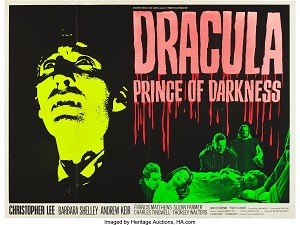
As Dracula, he got to bite Barbara Shelley, Barbara Ewing, Linda Hayden, Anouska Hempel, Marcia Hunt, Caroline Munro and Valerie Van Ost.  Last-minute interventions by Peter Cushing in Dracula AD 1972 (1972) and The Satanic Rites of Dracula (1973) prevented him from biting Stephanie Beacham and Joanna Lumley, which must have been frustrating.  Meanwhile, the 1965 movie Dracula, Prince of Darkness was the first really scary horror movie I ever saw, on TV, back when I was eight or nine years old.  I’d watched old horror films made by Universal Studios in the 1940s, like House of Frankenstein (1944) and House of Dracula (1945), in which everything was discreetly black-and-white and bloodless, so I wasn’t prepared for an early scene in Dracula, Prince of Darkness where Lee / the count is revived during a ceremony that involves a luckless traveller (Charles Tingwell) being suspended upside-down over a coffin and having his throat cut.  The sight and sound of the blood splattering noisily onto the supposedly dead vampire’s ashes traumatised me.


© Warner Pathé / Hammer Films


Thanks to Hammer’s success in the horror genre, the late 1950s, 1960s and early 1970s saw a boom in British, usually gothic, horror filmmaking.  And during that boom, Lee did many memorable, often evil, things.  He drove his car into Michael Gough and squidged off Gough’s hand in Doctor Terror’s House of Horrors (1965).  He forced Vincent Price to immerse himself in a vat of acid in Scream and Scream Again (1969).  He turned up as a snobbish senior-civil-servant type and tormented Donald Pleasance in Deathline (1972).


Lee was probably Britain’s most linguistic actor, speaking German, French, Italian and Spanish and also knowing a bit of Swedish, Russian and Greek.  Thus, he also found it easy to find employment making horror movies on mainland Europe, where the gothic tradition was raunchier, more lurid and looser in its plot logic than its counterpart in Britain.  He worked with the Italian maestro Mario Bava in 1963’s The Whip and the Body and on several occasions with the fascinatingly prolific, but erratic, Spanish director Jess Franco.  Despite Franco’s cheeky habit of shooting scenes with Lee and then inserting them into a totally different and usually pornographic movie – something Lee would only discover later, when he strolled past a blue-movie theatre in Soho and noticed that he was starring in something like Eugenie and the Story of her Journey into Perversion (1970) – Lee held the Spaniard in esteem and championed his work at a time it wasn’t fashionable to do so.  Since his death in 2013, Franco’s reputation has improved and art-house director Peter Strickland’s movie The Duke of Burgundy (2014) is a tribute, in part, to him.


Franco directed the later entries in a series of movies about Fu Manchu that Lee made in the 1960s, in which he played Sax Rohmer’s supervillain in un-PC Oriental makeup and spent his time barking orders at Chinese minions, who were usually played by Burt Kwouk.  As well as retaining some of the racism that was prominent in Rohmer’s books, the series generally wasn’t up to much in terms of quality.  However, the film’s endings have always haunted me.  Invariably, Fu Manchu’s secret headquarters would blow up and then Lee’s voice would boom imperiously through the smoke, “The world will hear of me again!”


© Eon Productions


In the early 1970s, Lee finally got opportunities to make the sort of films he wanted to make, including Richard Lester’s two Musketeers movies (1974 and 1975); the ninth official Bond movie The Man with the Golden Gun (1975), in which he taunted Roger Moore, “You work for peanuts – a hearty well-done from Her Majesty the Queen and a pittance of a pension.  Apart from that, we are the same.  To us, Mr Bond.  We are the best…  Oh come, come, Mr Bond.  You get as much fulfilment out of killing as I do, so why don’t you admit it?”; and Billy Wilder’s The Private Life of Sherlock Holmes (1970), regarded by many as the best attempt at bringing Sir Arthur Conan Doyle’s deerstalker-wearing super-sleuth to the screen.


In that latter film, Lee played Holmes’s snooty brother Mycroft.  Lee also played Sherlock Holmes himself several times, including in a couple of early-1990s TV movies with Dr Watson played by the impeccable Patrick Macnee, whom decades earlier had been Lee’s schoolmate at Summer Fields School in Oxford.  And he played Henry Baskerville in the 1959 Hammer adaptation of The Hound of the Baskervilles, which had Peter Cushing in the role of Holmes.  But for some strange reason, nobody ever thought of casting Lee as Professor Moriarty.


In 1973, he also played Lord Summerisle in The Wicker Man, a film that needs no introduction from me.  Actually, next year is the film’s fiftieth anniversary.  I trust the Scottish Tourist Board will celebrate this fact on May 1st, 2023, by lighting lots of wicker men, with lots of sanctimonious, virginal, Free Presbyterian policemen inside them, along the coasts of Scotland.


Later in the 1970s, no longer so typecast in horror movies and with the British film industry on its deathbed, Lee decamped to Hollywood.  He ended up appearing in some big-budget puddings like dire 1977 disaster movie Airport 77 and Steven Spielberg’s supposed comedy 1941 (1979), but at least he was able to rub shoulders with icons such as Muhammad Ali and John Belushi.  And he didn’t, strictly speaking, stop appearing in horror movies.  He was in the likes of House of the Long Shadows (1982), The Howling II: Your Sister is a Werewolf (1985), The Funny Man (1994) and Talos the Mummy (1998).  Amusingly, Lee usually explained this by arguing that these weren’t really horror films.  The Howling II: Your Sister is a Werewolf wasn’t a horror film?  Aye, right.


© New Line Cinema / WingNut Films


Though he never relented in his workload, it wasn’t until the 1990s that Lee experienced a late-term career renaissance – no doubt because many of the nerdish kids who’d sneaked into cinemas or stayed up late in front of the TV to watch his old horror movies had now grown up, become major players in the film industry and were only too happy to cast him in their movies: Joe Dante, John Landis, Martin Scorsese, George Lucas, Peter Jackson and Tim Burton.  Hence his roles in two of the biggest franchises in cinematic history, the Star Wars and the Lord of the Rings / Hobbit ones, plus five movies directed by Burton.


When he was in his eighties, Lee must have wondered if there were any territories left for him to conquer – and he realised that yes, there was one.  Heavy metal!  He had a fine baritone singing voice but only occasionally in his film career, for example, in The Wicker Man and The Return of Captain Invincible (1983), did he get a chance to show it off.  In the mid-noughties, however, he started recording with symphonic / power-metal bands Rhapsody of Fire and Manowar and soon after he was releasing his own metal albums such as Charlemagne: By the Sword and the Cross and Charlemagne: The Omens of Death, which had contributions by guitarist Hedras Ramos and Judas Priest’s Richie Faulkner.  He also released two collections of Christmas songs, done heavy-metal style.  The festive season will never seem the same after you’ve heard Lee thundering his way through The Little Drummer Boy with electric guitars caterwauling in the background.


© Charlemagne Productions Ltd


Obviously, the heavy metal community, which sees itself as a crowd of badasses, was flattered when the cinema’s supreme badass – Lord Summerisle, Dracula, Fu Manchu, Rasputin, etc. – elected to join them and they welcomed Lee with open arms.  They even gave him, as the genre’s oldest practitioner, the Spirit of Metal Award at the Metal Hammer Golden Gods ceremony in 2010.


So: singing heavy metal, speaking eight languages, being perhaps the 20th century’s greatest screen villain and, probably, bayoneting Nazis to death.  Was there anything this man couldn’t do?  Well, it seems the only thing he couldn’t quite manage was to live forever.  Mind you, for someone who spent his cinema career dying – even when he penned his autobiography in his mid-fifties, he reckoned he’d been killed onscreen more than any other actor in history – but kept coming back, it feels a bit odd to be writing about Christopher Lee in the past tense.


Actually, if anybody wants to congregate in a Carpathian castle after dark and perform a blood-soaked ritual to resurrect the great man, I’m up for it.


From the Independent