Great British crime movies of the 1970s


© Metro-Goldwyn-Meyer


I’ve been busy lately and unable to post much on this blog.  Here’s a reposting of something that first appeared here in 2019.


During the 1970s, when I was a kid and when I absorbed cultural influences like a sponge, crime movies made in the United Kingdom were rarer than hen’s teeth.  That’s hardly surprising.  During that decade, the British film industry practically died on its arse.


And yet, as a kid, I got the impression that 1970s Britain was so crime-ridden it was dystopian.  It was a place where every bank and security van was in constant danger of being attacked by beefy men with sawn-off shotguns and stockings pulled over their heads.  Where every street was the potential scene of a violent punch-up and every road was the potential scene of a destructive car chase.  Where the police force scarcely seemed any better than the villains, its ranks composed of hard-boozing, chain-smoking, foul-mouthed thugs wearing kipper ties.  Really, at times, I must’ve been too afraid to leave my house.


This is because 1970s British television was awash with crime and cop shows, often violent and populated by low-life characters on both sides of the law: for example, Special Branch (1969-74), Villains (1972), New Scotland Yard (1972-74), The Sweeney (1975-78), Gangsters (1975-78), The XYY Man (1976-77), Target (1977-78), Out (1978), Hazell (1978-79) and Strangers (1978-82).  Impressionable kids like me would act out things we’d seen on TV the night before, so that at breaktimes school playgrounds reverberated with shouts of “You’re nicked, sunshine!” and “You grassed me off, you slag!” and “We’re the Sweeney, son, and we haven’t had any dinner!”  My parents were happy to let me watch such programmes.  As long as I wasn’t watching that horror rubbish, which had been scientifically proven to be bad for you.


I suppose that many British directors, writers and actors who would have plied their trade on the big screen, if Britain’s film industry hadn’t been moribund, found themselves plying it on the small screen instead.  This helped inject some uncompromising cinematic rawness into the domestic TV crime genre.  But the cinematic counterpart of that genre seemed non-existent.


Well, almost non-existent.  A few crime movies did get made in 1970s Britain and these exert a fascination for me today.  Only two of them ever achieved a degree of fame and the rest are virtually forgotten, but I find all of them cherish-able.  Here are my favourites.


© MGM EMI


Get Carter (1970)

Everyone knows this 1970s British crime film, although I don’t recall it getting much attention until the 1990s, when thanks to Britpop, Damien Hirst, etc., the ‘cool Britannia’ scene took off and Get Carter’s star Michael Caine suddenly became a retro-style icon.  Ironically, Caine’s nattily dressed Jack Carter and Roy Budd’s edgy jazz score aside, there isn’t much in the Mike Hodges-directed Get Carter that feels stylish.  The drab, monochrome terraced streets of Newcastle-upon-Tyne – if the film’s premise is that Michael Caine has returned to his hometown to sort out trouble, whatever happened to Caine’s Geordie accent? – the shabby pubs, the seedy racecourses, the shit clothes and haircuts, the Neanderthal attitudes…  It’s depressing, actually.  It’s a provincial Britain where the Swinging Sixties have truly burned themselves out – if the Swinging Sixties ever reached provincial Britain in the first place.


Caine gets all the acting accolades for Get Carter but the film wouldn’t be what it is without its excellent supporting cast: Alun Armstrong, Britt Ekland, George Sewell, Tony Beckley and playwright and occasional actor John Osborne.  Best of all, there’s Ian Hendry as the film’s weasly villain, Eric Paice.  “Do you know,” Carter tells Paice at one point, “I’d almost forgotten what your eyes look like.  They’re still the same.  Piss-holes in the snow.”  Hendry was originally meant to play the virile Carter, but by 1970 his fondness for the booze had taken its toll and he was demoted to the secondary role of Paice, which supposedly caused tension and resentment during filming.  Thus, Caine may have enjoyed the irony of the film’s climax, which sees Carter force-feed Paice a bottle of whisky before clubbing him to death with a shotgun.


Villain (1971)

Villain has Richard Burton, no less, in the role of a gay, mother-fixated and paranoidly violent gang-boss who, against the counsel of wiser heads, gets himself involved in a raid on a factory’s wages van that ultimately causes his downfall.  Meanwhile, trying to stay in one piece is Ian McShane, playing a smooth but unimportant pimp who has the unenviable job of being both the object of Burton’s affections and the victim of his sadistic rages.


Villain also has a wonderful supporting cast – T.P. McKenna and Joss Ackland as fellow gang-bosses, Del Henney, John Hallam and (alas, the recently-departed) Tony Selby as henchmen, and Nigel Davenport and Colin Welland as the coppers doggedly trying to bring Burton to justice.  (Interestingly, McKenna, Henney and Welland all turned up in the cast of Sam Peckinpah’s troubling Straw Dogs, made the following year.)  The film suffers from having too many sub-plots, though the one where McShane helps Burton escape the law by getting a sleazy Member of Parliament who’s used his pimping services to testify for him is memorably believable and nauseating.  Played by Donald Sinden, you never hear which political party the MP belongs to, but you can guess.


Sitting Target (1972)

Ian McShane had to suffer some dysfunctional relationships in early 1970s British crime movies.  No sooner had he finished being Richard Burton’s lover / punchbag in Villain than he had to cope with being best friend to a psychotic Oliver Reed in Sitting Target, directed by the underrated Douglas Hickox.  With McShane in tow, Reed escapes from prison early in the film, determined to catch up with his wife Jill St John and give her what’s coming to her.  Reed doesn’t want revenge on St John, as you might expect, for her terrible performance as Tiffany Case in Diamonds are Forever (1971).  No, it’s because he’s discovered she’s betrayed him for another man.  The film’s big twist, when we find out who that other man is, isn’t altogether a surprise.


Sitting Target has many pleasures, including Edward Woodward playing a policeman assigned to protect St John against the marauding Ollie.  But nothing quite matches the thrilling early sequence where our two anti-heroes, plus a third convict played by the always-entertaining character actor Freddie Jones, bust out of prison in desperate, skin-of-the-teeth fashion.


The Offence (1972)

Okay, Sidney Lumet’s The Offence (which I’ve previously devoted a whole blog-entry to) isn’t really a crime movie.  It’s a psychological study of a macho but troubled police officer (Sean Connery) going over the edge when a hunt for a child-killer, and the provocations of the suspect the police have pulled in for questioning (Ian Bannon), push too many buttons on his damaged psyche.  But the film has that grim 1970s aesthetic that more conventional British crime movies of the period are so fond of – drab housing estates, anonymous tower blocks, serpentine pedestrian bridges.  Its supporting cast also includes strapping character actor John Hallam who, although he’s probably best remembered as Brian Blessed’s Hawkman sidekick in 1980’s Flash Gordon, was a fixture in crime movies at this time.  So, I’m putting The Offence on my list.


© American International Pictures


Hennessy (1975)

I’m also conflicted about adding Don Sharpe’s Hennessy to this list because it’s about terrorism rather than crime.  Indeed, its story of a former IRA explosive expert (Rod Steiger) who decides to destroy the British government and the Queen by blowing up the state opening of parliament after his wife and child are killed by the British Army, makes it the first movie to tackle the issue of the Troubles in Northern Ireland.  However, as the final film on the list is choc-a-bloc with IRA men, and as Richard Johnson gives a lovely performance as the weary, dishevelled, cynical copper – is there any other type in British crime movies? – trying to thwart Steiger’s plan, I thought I’d give it a mention.


The film is admittedly patchy but it has a top-notch cast that also includes Lee Remick, Trevor Howard, Eric Porter, John Hallam (again), Patrick Stewart (bald as a coot even then) and a super-young Patsy Kensit playing Steiger’s ill-fated daughter.  The climactic scenes set in the House of Commons, involving the Queen, landed the filmmakers in hot water because they used real footage that Buckingham Palace had approved without knowing it was going to end up in a film.  Also, the film’s subject, an incredibly touchy one at the time, meant that Hennessy scarcely saw the light of day in British cinemas.


Brannigan (1975)

Brannigan – also directed by Douglas Hickox – is the joker in this pack.  It features John Wayne as a tough American cop who arrives in a London of bowler hats, brollies and historic landmarks that exists only in the imagination of Hollywood scriptwriters, and who then causes mayhem as he behaves like a Wild West sheriff dealing with an unruly frontier town.  This involves such memorable sequences as Wayne doing an Evel Knievel-style car stunt where he hops across Tower Bridge while it parts to let  a ship pass below.  And Wayne triggering a cowboy-style brawl in a pub near Leadenhall Market.  And Wayne roughing up a minor villain played by the cinema’s greatest Yorkshireman, Brian Glover.  (“Now would you like to try for England’s free dental care or answer my question?”)  If you’re in the wrong mood, Brannigan is the worst film ever made.  If you’re in the right mood, it’s the best one.


© United Artists


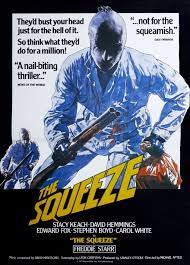
The Squeeze (1977)

Barely had John Wayne swaggered through the London underworld than another Hollywood star did too in Michael Apted’s The Squeeze – Stacy Keach, although playing an English private eye with an industrial-strength drink problem. During occasional moments of sobriety, Keach investigates the kidnapping of his ex-wife (Carol White).  She’s remarried a posh security officer (Edward Fox) tasked with overseeing the delivery of large sums of money.  Keach finds himself tangling with a kidnap gang planning to force Fox to help them mount an armed robbery.


The Squeeze suffers from being overlong, with too much time spent wallowing in Keach’s alcoholism. But its good points outweigh this.  I like its depiction of late 1970s multicultural London and its sympathetic portrayal of Keach’s Jamaican neighbours.  Also, Stephen Boyd (who died soon after the film’s completion, aged just 45) and David Hemmings give good turns as the villains.  Allowed to use his native Northern Irish accent for a change, Boyd disturbingly plays a well-heeled crime-lord who dotes over his own family whilst having zero empathy for the family he’s threatening to destroy with his kidnapping scheme.  Meanwhile, Hemmings is good as a pragmatic career criminal who doesn’t share his boss’s sunny optimism about things.


And connoisseurs of 1970s British popular culture will be fascinated to see anarchic comedian Freddie Starr play Keach’s best mate, a reformed criminal trying to make a living as a taxi driver. Indeed, such is Starr’s loyalty to Keach that he saves his neck three times at the end of the film, including by running the villains off the road in his taxi.  Starr, who died in 2019, was from all accounts an unreconstructed arsehole in real life.  Therefore, remember him this way.


© Warner Bros. Pictures


Sweeney II (1978)

The greatest of all 1970s British cop shows, The Sweeney got two movie spin-offs, Sweeney! In 1977 and Sweeney II.  I don’t think Sweeney!, which involved Flying Squad heroes Jack Regan (John Thaw) and George Carter (Dennis Waterman) in an espionage plot, is much cop, but Sweeney II captures the spirit of the TV series.  It has Regan and Carter on the trail of a gang who spend most of their time living it up in Malta as wealthy British ex-pats, but who return to Britain from time to time to stage vicious, take-no-prisoners bank robberies.  As well as marrying bloody, sawn-off-shotgun-powered violence with some off-the-wall humour, Sweeney II manages to be topical too.  London’s real Metropolitan Police force was investigated for corruption in the late 1970s.  The film reflects this with the character of Regan’s commanding officer, played by the excellent Denholm Elliot, who’s facing a long stretch in prison on account of being “so bent it’s been impossible to hang his pictures straight on the office wall for the past twelve months.”


The Long Good Friday (1980)

Although it was released at the start of the 1980s, John Mackenzie’s The Long Good Friday was made in 1979 and so I’m classifying it as a 1970s film.  It definitely feels the end of a particular era with its tale of an old school London gangster (Bob Hoskins) convinced he’s about to make a mint in the brave new world of Thatcherite London where everything is up for sale to the corporations and developers.  That’s until one day when he suddenly finds himself tangling with a ruthless foe, the IRA, who make him look hopelessly out of his depth.


The final scene sees Hoskins become a prisoner in his own, hijacked car and get driven to his doom – an IRA man played by a youthful Pierce Brosnan snakes up from behind the front passenger seat to hold him at gunpoint.  Although Hoskins doesn’t speak, the succession of emotions that flit across his face as it dawns on him that he had it all, but now he’s blown it all, make this the most powerful moment in British crime-movie history.


© Black Lion Films / Handmade Films / Paramount British Pictures

Spice-world: the movie


© Legendary Pictures / Warner Bros. Pictures


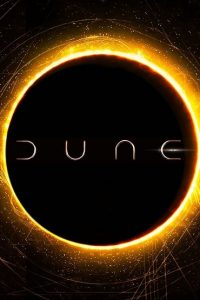
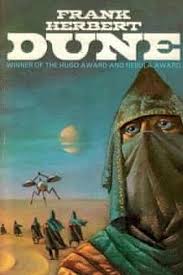
Like everywhere else, one sector in Sri Lanka heavily hit by Covid-19 was the country’s cinemas.  In Colombo, establishments like the Liberty, Savoy and Regal had stood closed-up, empty and silent for so long that I’d begun to doubt if they’d ever open their doors again.  However, with the Sri Lankan Covid-19 death toll down (for now), the authorities have permitted cinemas to reopen, albeit working at a reduced capacity.  During the first half of November, their auditoriums could only be 25% full.  For the month’s second half, the maximum capacity has been increased to 50%.  To do our bit to help Sri Lanka’s beleaguered cinema industry, myself and a mate went a few days ago to the Scope multiplex at Colombo City Centre shopping mall.  There, we watched Dune, this year’s big-budget, Denis Villeneuve-directed adaptation of the famous 1965 science-fiction novel by Frank Herbert.  Or at least, Villeneuve’s adaptation of the first half of it, as Dune is one fat book.


And we had no regrets about seeing Dune in a cinema.  It’s a visually majestic creation that needs to be seen on a big screen to be properly appreciated.  In fact, you’ll be committing a minor crime against celluloid if you watch it in reduced form on a TV or laptop screen.  And if you dare to watch it on a phone-screen…  Well, you don’t deserve to live.


I have to say, though, that I read Herbert’s novel as a teenager and it was no favourite of mine.  In part, my being unimpressed by it was probably down to bloody-mindedness.  A lot of earnest, nerdy people gushed about how great it was, which probably predisposed me to not liking it.  This was similar to my less-than-enthusiastic reaction to J.R.R. Tolkien’s much-worshipped Lord of the Rings – although unlike Rings, I did read Dune to the end.  (With Rings, I gave up four-fifths of the way through.)  Also, it didn’t help that I read Dune a couple of years after Star Wars (1977) came out.  Many of the book’s plot elements – a scheming galactic empire, a desert planet, an elite sect with psychic powers – had recently featured in George Lucas’s sci-fi / fantasy blockbuster, so they seemed less fresh than they had in 1965.


© New English Library


Though I found Lord of the Rings overrated on the page, I did enjoy the movies that Peter Jackson made of it in 2001, 2002 and 2003.  Well, apart from the last half-hour of the final one, The Return of the King, which consisted of nothing but various characters getting married.  A second-rate reading experience can, with an excellent cast, a great director and all the epic locations and special effects that Hollywood money can buy, be turned into a first-rate viewing experience.


And so it is with Dune.


Its cast is wonderful – Oscar Isaac, Rebecca Ferguson, Timothée Chalamet, Stellan Skarsgard, Dave Bautista, Josh Brolin, Jason Mamoa, Charlotte Rampling, Stephen McKinley Henderson, Sharon Duncan-Brewster and Javier Bardem – and director Villeneuve has already helmed two of the past decade’s greatest sci-fi movies, Arrival (2016) and Blade Runner 2049 (2017).  And its 165-million-dollar budget has been put to good use.  The filming locations in the UAE and Jordan really do transport you to the film’s main setting, the endlessly sandy and murderously hot desert-planet Arrakis; while the special effects, conjuring up fleets of spacecraft that stand like gigantic, angular cathedrals when they’re parked on planets’ surfaces, but look as tiny and inconsequential as pollen-grains when they’re bobbing in the black void of space, are stunning.  Hence, the absolute necessity to see Dune on a large screen.


© Legendary Pictures / Warner Bros. Pictures


Denis Villeneuve, of course, isn’t the first filmmaker to bring Dune to the screen, for an earlier cinematic version of it had appeared in 1984, directed by that genius of visionary weirdness, David Lynch.  The 1984 Dune was a box-office flop and received much abuse from critics – I remember the New Musical Express retitling it Dung – but I didn’t think it was that bad.  Lynch added some delightfully bizarre touches to the story and he arguably had an even better cast of actors than Villeneuve: Kyle MacLachlan, Jurgen Prochnow, Francesca Annis, Kenneth McMillan, Paul Smith, Patrick Stewart, Richard Jordan, Freddie Jones, Sian Phillips, Virginia Madsen, Jack Nance, José Ferrer, Everitt McGill, Brad Dourif, Max von Sydow and the great (and now, sadly, late) Dean Stockwell.  Sting was in it too.


Alas, Lynch’s producer was old-school movie mogul Dino De Laurentiis, who wanted Dune to be a regulation two-hour movie.  Cramming all the events of Herbert’s doorstop-sized book into that caused massive problems for the script.  Early on, Lynch had wisely envisioned Dune as two movies, and then proposed it as a three-hour film, but this cut no ice with old Dino.


I remember going to see Lynch’s Dune at a cinema in Aberdeen with my girlfriend of the time.  Having read the book I was familiar with the plot, which goes like this…  (Beware – spoilers are coming.)  In the distant 102nd century, the galaxy is ruled by an empire that incorporates a number of powerful families, or Houses.  One of these, the House Atreides, headed by the well-meaning Duke Leto (Isaacs in the new Dune, Prochnow in the old one), his ‘concubine’ Lady Jessica (Ferguson now, Annis then) and their son, the young Paul (Chalamet now, MacLachlan then), is entrusted with running the desert-planet Arrakis.  Arrakis is vital for the Empire because a mysterious ‘spice’- in reality a consciousness-expanding drug – is mined there and its properties enable spaceship-navigators to find their way through interstellar space.  The planet’s indigenous inhabitants, the reclusive and Bedouin-like Fremen, are suspicious of the Atreides because previously the Empire had put them under control of another House, the Harkonnen, who treated them genocidally.


Before Leto can win hearts and minds on Arrakis, the Harkonnen launch an attack to retake the planet, with the Emperor’s blessing – the whole manoeuvre has been a plot to get rid of the potentially troublesome Atreides.  The Atreides are wiped out, save for Paul and his mother Jessica, who flee into the planet’s deserts.  They now have the formidable task of rallying the distrustful Fremen and persuading them to retake Arrakis from the homicidal Harkonnen – which, in the book’s later stages, they do.


Villenueve’s film ends with Paul and Jessica fleeing the Harkonnen – a second Dune movie, which will tell the remaining story, has now been greenlighted.  Poor old Lynch, though, had to squash everything into just over two hours.  I remembering being in an Aberdonian pub after seeing his Dune with my ex-girlfriend, who hadn’t read the book.  I spent about an hour trying to explain the film’s plot to her, which she’d been flummoxed by.


© Legendary Pictures / Warner Bros. Pictures


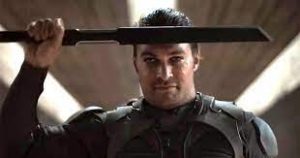
Villeneuve’s Dune only covers half of the book and is still 19 minutes longer than Lynch’s version, so obviously the story gets more space to breath.  This also enables Villeneuve to do a lot of the important sci-fi business of ‘world-building’.  It’s gratifying too that Dune’s secondary characters, the various soldiers, courtiers and allies of the House Atreides, like Gurney Halleck (Brolin now, Stewart then), Duncan Idaho (Mamoa now, Jordan then), Thufir Hawat (McKinley Henderson now, Jones then) and Dr Liet-Kynes (Duncan-Brewster now, von Sydow then) get much more time to establish themselves and win the audience’s sympathy.  In the compressed 1984 Dune, their roles were brief and their deaths, if they occurred, were blink-and-you’ll-miss-them events.


Certain critics have sniped at this new version of Dune for being humourless.  Now while I admit to counting a total of three jokes during the film’s entire 157-minute running time – it’s telling that two of those jokes turn up in the trailer – I have to say I found it refreshing to experience a science fiction film willing to treat its subject matter seriously and not populate it with, say, bumbling comedy droids or wisecracking bipedal rodents.  In effect, those critics are showing their snobbery.  They’re protesting: “But this is just science fiction!  It’s not, it can’t be serious!  You’ve got to have bumbling comedy droids in it!  And wisecracking aliens!”  So, stuff ’em.


© Legendary Pictures / Warner Bros. Pictures


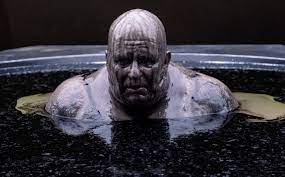
One thing David Lynch’s Dune was memorable for was its depiction of the Harkonnen.  Played by Kenneth McMillan, Paul Smith, Brad Dourif and Sting, they were a grotesque, evilly-perverted bunch – no more so than McMillan’s Baron Harkonnen, who was a levitating, leering sack of pus.  Probably wisely, Villeneuve doesn’t try to out-Lynch Lynch here and makes his Harkonnen a more sombre lot, communicating their malevolence through stillness rather than histrionics.  Stellan Skarsgard is especially effective as a brooding, Brando-esque Baron.


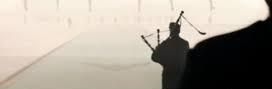
I read somewhere that Frank Herbert intended the good guys, the Atreides, to be descended from the Greeks on faraway, long-ago earth, although some visual and verbal references to bullfighting in both his book and Villeneuve’s film suggest they’re Spaniards.  However, when the Duke, his family and courtiers arrive on Arrakis, the film shows them being led out of their spaceship by a bagpiper… which implies they’re actually Scottish.  Well, their home planet’s name is Caladan, which sounds like ‘Caledonia’.  One of them is called Duncan and another is called Gurney – Scots gurn a lot.  And by half-time they’ve already been slaughtered.  So yup, I think they’re Scottish.


© Legendary Pictures / Warner Bros. Pictures


One thing I believe makes this version of Dune so good is that, in telling only the book’s first half, it’s a story of tragedy.  And tragedy, as any student of Shakespeare will confirm, is one of the most powerful forms of narrative.  I suspect Villeneuve will find it harder to make the next instalment of Dune, dealing with how Paul marshals his forces and finally restores order on Arrakis, as gripping.  For me, at least, downbeat endings last longer in the imagination than happy ones.


Anyway, for now, after Arrival and Blade Runner 2049, Dune completes a science-fictional hat-trick for Villeneuve.  Perhaps it’s not quite as impressive a run as Stanley Kubrick achieved with the sci-fi or sci-fi-related Dr Strangelove (1964), 2001: A Space Odyssey (1968) and A Clockwork Orange (1972), but it’s still pretty amazing.  Let’s hope he can knock Dune 2 out of the park and make this triumphant threesome a foursome.


© Legendary Pictures / Warner Bros. Pictures

Just a flesh wound


© Ley Line Entertainment / Bron Creative / A24


It’s fair to say that the regal, if probably hypothetical, legend of King Arthur has suffered more than a few flesh wounds from filmmakers over the years.


At least in the case of the Monty Python team, the filmmakers were deliberately taking the piss.  Their 1974 movie Monty Python and the Holy Grail inflicted on poor Arthur such indignities as the Knights Who Say ‘Ni!’, the bloodthirsty Rabbit of Caerbannog, the Holy Hand Grenade of Antioch, Dennis of the Autonomous Collective (“Listen, strange women lying in ponds distributing swords is no basis for a system of government. Supreme executive power derives from a mandate from the masses, not from some farcical aquatic ceremony.”) and the outrageously rude French guard (“You don’t frighten us, English pig-dogs! Go and boil your bottoms, sons of a silly person!”).


More worryingly, other filmmakers have tried to be serious, though with cringeworthy results.  I’m thinking of 1967’s Camelot, which has Richard Harris’s Arthur bursting into song and warbling, “You mean a king who fought a dragon / Whacked him in two and fixed his wagon / Goes to be wed in terror and distress? / Yes!”  Or 2004’s King Arthur, which has a grimly wooden Clive Owen in the title role and which, according to the Times’ reviewer Wendy Ide, ‘attaches itself to the Arthurian legend like some parasitic worm’.  Or 2017’s King Arthur: The Legend of the Sword, which was directed by Guy Ritchie in the manner you’d expect from Guy Ritchie, complete with a cameo appearance by that well-known icon of the Dark Ages, David Beckham.


Actually, I’ve immersed myself a lot in the King Arthur legend recently, not through films but through books, which I’ve found much more rewarding.  Not long ago, I managed to finish off T. H. White’s Once and Future King series, comprised of The Sword in the Stone (1938), The Queen of Air and Darkness (1939), The Ill-Made Knight (1940), The Candle in the Wind (1958) and The Book of Merlyn (1977).  Yes, I know, the first book was the basis for the underwhelming 1963 Walt Disney cartoon, but the series becomes impressively philosophical, political and tragic as it goes on.  I’ve also lately read Kazuo Ishiguro’s 2015 novel The Buried Giant, set a short period after the death of Arthur.  Come to think of it, The Buried Giant could almost qualify as a postscript to White’s series, although there are a few differences in continuity.  (For example, Merlin is said to be dead by the time of Ishiguro’s novel, whereas in the timeline established by White he’d be alive.  His ability in the Once and Future King books to live through time in the opposite direction from human beings, from the future to the past, would ensure that.)


© Faber & Faber


A figure from Arthurian legend who plays a major role in The Buried Giant, as an elderly man, is Arthur’s nephew Sir Gawain.  Gawain, of course, occupies his own niche in the Arthurian mythos because he’s the main character in Sir Gawain and the Green Knight, the late 14th century poem written in a North West Midlands dialect of Middle English.  The poem has Sir Gawain respond to the mysterious Green Knight who arrives at Arthur’s court one Christmas Eve with an unusual challenge: who is prepared to strike him a blow with the axe he is carrying, on the condition that one year from now the Green Knight gets an opportunity to return the blow on his home turf, a place called the Green Chapel?  Gawain takes up the challenge and uses the axe to whack off the Green Knight’s head.  That, however, doesn’t resolve the matter, because the Green Knight refuses to die.  He picks up his head and rides off, leaving Gawain honour-bound to keep the appointment at the Green Chapel next Christmas.  Obviously, there, he’ll receive an equivalent blow that he’s less likely to be impervious to.


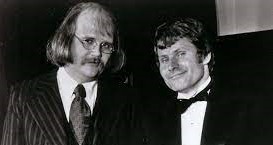
The poem was filmed twice in the 20th century by the director Stephen Weeks, first in 1973 as Sir Gawain and the Green Knight with singer Murray Head as Gawain and Nigel Greene as the Green Knight, and again in 1984 as Sword of the Valiant. Both versions made little impact and the clearly well-intentioned Weeks was hampered by low budgets.  With the second version, he was no doubt hampered too by the fact he made the film for the notoriously schlocky Cannon Group, whose co-owners Menahem Golan and Yoram Globus overrode his choice of Mark Hamill to play Gawain and instead foisted on him Miles O’Keefe, who’d previous played the Lord of the Jungle in 1981’s dire Tarzan the Ape Man.  A better casting choice was Sean Connery as the Green Knight.


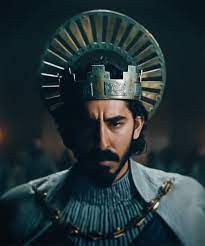
Now, however, Sir Gawain and the Green Knight has received the big budget treatment.  Well, at 15 million dollars, not that big, but certainly a lot more than Stephen Weeks had to play with.  David Lowery has written and directed a new version with Dev Patel, of 2008’s Slumdog Millionaire, stepping into Gawain’s armour.  I have to say the resulting film, with the shortened title The Green Knight, isn’t perfect, but nonetheless it does justice to the poem at last.  It also qualifies as that rare beast – a quality King Arthur movie.


The Green Knight doesn’t present a fanciful or idealised picture of Arthur’s court, if that court had ever actually existed.  While it doesn’t wallow in medieval dirt, muck and shit like Monty Python and the Holy Grail (“Dennis!  There’s some lovely filth down here!”), it does show life in and around Arthur’s citadel as wintry, draughty, farmyard-y and unglamorous.  Accordingly, Arthur and Guinevere (Sean Harris and Kate Dickie) are portrayed as an ageing, rather threadbare couple, who don’t even get the accolade of being referred to by their legendary names.  They’re just ‘the king’ and ‘the queen’.


On the other hand, the film is keen to show how unspectacular characters, settings and events get exaggerated and mythologised and turned into legends.  It makes much of story-telling and myth-making.  For example, no sooner has Gawain had his first encounter with the Green Knight than the tale is being retold as a puppet show for the neighbourhood’s children.  On a battlefield strewn with newly-dead corpses, a scavenger (Barry Keoghan) is already recounting stories of derring-do about the battle that are clearly over-the-top bullshit.  And Arthur himself pleads with his court, “Friends, brothers and sisters, who can regale me and my queen with some myth or tale?”  When he asks Gawain, “Tell me a tale of yourself so that I might know thee,” and Gawain replies, “I have none to tell,” Guinevere interjects with: “Yet. You have none to tell yet.”


© Ley Line Entertainment / Bron Creative / A24


It reminds me of another movie with a focus on myth-making, but a very different setting, The Man Who Shot Liberty Valance (1962), John Ford’s meditation about the end of America’s Wild West. As Carleton Young’s newspaper-editor character says in that film, “When the legend becomes fact, print the legend!”


I thought the first hour-and-a-bit of The Green Knight was splendid.  The Green Knight himself is presented wonderfully as a proper green man, all gnarled wood and straggly tree-root beard, and his appearance is complemented by his voice, which is that of gravelly Yorkshireman Ralph Ineson.  Actually, it’s nice to see Ineson and Kate Dickie together in a film again after they played the doomed Puritan parents in Robert Eggers’ The Witch (2015).


Once Gawain sets off in search of the Green Chapel, to keep his unwanted appointment, he has several phantasmagorical adventures that involve phantoms, giants and supernaturally intelligent animals and that are gorgeously shot by cinematographer Andrew Droz Palermo.  However, it’s the episode with Barry Keoghan and his grubby little band of thieves that’s perhaps most haunting, thanks to an amazing sequence with a rotating camera-shot and time-lapse special effects that makes you wonder if anything else you see in the film is going to be true.


But The Green Knight does, in my opinion, have a structural problem.  This is because in the original poem the adventures Gawain has during the first half of his journey are not described in any detail, and what we see on screen presumably comes from Lowery’s imagination.  However, later events in the film are based on the poem and form an important part of the plot.  These involve Gawain coming to a castle near the Green Chapel and enjoying the hospitality of its lord (Joel Edgerton) and lady (Alicia Vikander) during the last few days before his appointment.  His experiences there become strange and prove to be a series of tests.  That’s fine, but after the fantastical episodes that Gawain’s been through earlier on, these castle-bound scenes feel something of a let-down and act as a brake on the film’s momentum.


The climax bravely departs from the denouement of the poem (which had Arthur’s sister, and Gawain’s aunt, Morgan Le Fay popping up as a sort of medieval deus ex machina).  Instead, it does something that had me thinking of the climax of Martin Scorsese’s The Last Temptation of Christ (1988).  This neatly echoes the earlier themes of storytelling and myth-making.


The Green Knight certainly isn’t to everyone’s tastes.  For example, a certain well-known science-fiction author, clearly more a Guy Richie / King Arthur: Legend of the Sword man, denounced it on twitter recently as “the worst film I’ve watched this year…  What a waste of good actors.  I want my two hours back.”  However, if you’re in the right frame of mind, not expecting anything like the usual cinematic Arthurian fare, and willing to tolerate some ruminative, slow-moving stuff in the second half, you may find it magical.


© Ley Line Entertainment / Bron Creative / A24

Stop getting Bond wrong! (Part 2)


© Eon Productions


Continuing my ranking of all the James Bond films from worst to best, here are my candidates for the franchise’s top twelve.  Candidates?  No, they are the top twelve.  Don’t even try to argue with me.


12: The Living Daylights (1987)

Lately, The Living Daylights, Timothy Dalton’s debut as Bond, has seemingly been reappraised and now figures highly in some rankings of the franchise.  It was even placed at number 4 in a recent feature in the Independent.  Well, hold on.  It’s good, but not that good.  After 14 years of quips, raised eyebrows and safari suits, Dalton’s more serious Bond is a breath of fresh air.  While preparing for the role, he even read Ian Fleming’s original books, which no doubt helped.  He and love interest Maryam d’Abo make a likeable couple and the film begins strongly, its first act following Fleming’s 1962 short story of the same name.  Later, alas, it gets unnecessarily muddled and the two main villains, despite being played by Jeroen Krabbé and Joe Don Baker, are rather blah, although Andreas Wisniewski is memorable as the lethal hitman / henchman Necros.  The scene where Necros engages in vicious hand-to-hand combat in a kitchen, using various kitchen utensils and appliances, was evoked in last year’s Christopher Nolan epic, Tenet.  I hated Aha’s theme song at the time, but since then it’s grown on me.  (The same can’t be said for Duran Duran’s A View to a Kill.)


11: Dr No (1962)

I feel guilty ranking Dr No, the first entry in the series and the film that turned former Edinburgh milkman Sean Connery into a superstar, at only number 11 on this list.  However, when I saw it as a kid I was disappointed and that sense of juvenile disappointment has lingered ever since.  This was because I’d read Ian Fleming’s 1958 novel Dr No beforehand and loved the fact that (1) it had a giant squid in it and (2) Bond killed Dr No at the end by burying him alive in bird-guano.  I was looking forward to seeing these things in the film, but neither appeared – the squid presumably because of budgetary restrictions and the guano presumably because it would have grossed out the audience.  So, if Connery had got to have a scrap with a giant squid and got to drown Dr No (Joseph Wiseman) in bird-shit, I’d have enjoyed the film more and placed it higher.


10: Thunderball (1965)

The previous movie in the series, Goldfinger (1964), got the emerging Bond formula exactly right.  In comparison, Thunderball seems slightly askew.  It’s overlong and the copious underwater sequences slow the pace somewhat.  Still, it has much to enjoy.  Connery is at the top of his game and the film shows off its set-pieces (for example, Bond being pursued during some Bahamas Junkanoo festivities), its gadgets (for example, the jet-pack in the opening sequence) and its villains (for example, Luciana Paluzzi as Fiona Volpe) with as much brassy aplomb as big-lunged Welshman Tom Jones sings the theme song.


© Eon Productions


9: You Only Live Twice (1967)

I’ve always had a soft spot for You Only Live Twice, which has Sean Connery battling Ernst Stavro Blofeld and SPECTRE in Japan, although it’s commonly rated as one of the lesser Connery Bonds.  Maybe it’s because I lived in Japan for a good many years myself.  The theme song by Nancy Sinatra is, of course, lovely and there’s a good supporting cast, including Donald Pleasence as Blofeld and Tetsuro Tamba as Tiger Tanaka, head of Japanese intelligence and one of the great ‘Bond allies’ – up there with Pedro Armendariz’s Karim Bey in From Russia with Love (1963).  Apart from the Japanese setting, the film jettisons almost everything in Fleming’s dark, introspective 1964 novel and replaces it with an archetypically ludicrous Bond-movie scenario: Blofeld wanting to trigger World War III by nicking American and Soviet spacecraft and hiding them in his secret hollowed-out Japanese volcano-HQ.  The futuristic volcano set, courtesy of production designer Ken Adam, is amazing.  Alas, its impact is vitiated in the final scenes when we see it as an obvious model, being rocked by explosions, with little dolls (representing the casualties of the film’s climactic battle) bouncing up and down on its floor.


8: Casino Royale (2006)

Any half-decent movie was going to look good after the debacle of 2002’s Die Another Day, and I feel Casino Royale, which rebooted the series and introduced current 007 Daniel Craig, is slightly overrated as a result.  But it’s still pretty good.  Craig gives Bond an impressively physical exterior whilst suggesting that not all is as solid internally.  As Vesper Lynd, the sublime Eva Green is easily the best Bond girl since Michelle Yeoh.  And Mads Mikkelsen is great as the evil but harried Le Chiffre.  For once, the violence actually looks like it involves pain, stress and fear, no more so than when Bond gets his nuts whipped on a bottomless chair.  Kudos to the filmmakers for keeping the scene in which Le Chiffre gets his comeuppance as low-key as it was in Fleming’s 1953 novel, although the subsequent stuff set in Venice, where Bond has to rescue Vesper from a building sinking rapidly into the Grand Canal, seems a tad gratuitous.  It’s as if it was decided that a big, dumb action climax was necessary to keep the traditional Bond audience happy.


7: Tomorrow Never Dies (1997)

Some Roger-Moore-sized eyebrows will be raised at my inclusion of Tomorrow Never Dies in my top dozen Bonds.  But while this film isn’t massively memorable, it doesn’t do anything wrong either.  Michelle Yeoh as Wai Lin is easily the best Bond girl during Pierce Brosnan’s four-movie tenure, Vincent Schiavelli makes a brief but memorable appearance as mordant assassin Dr. Kaufman, and the scene where Q, played by a now-octogenarian Desmond Llewelyn, gives Bond custody of a remote-controlled car is delightful.  And Jonathan Pryce has fun playing villainous media tycoon Elliot Carver, trying to trigger a war between China and Britain – aye, right, the Chinese would really be quaking in their boots at the prospect of a war with Britain.  Pryce is clearly channelling Rupert Murdoch, so what’s not to love?


6: The Spy Who Loved Me (1977)

Among Roger Moore’s entries (ouch), The Spy Who Loved Me is the one that undeniably belongs in the premier league of Bond movies.  On paper it looks as lazy as all the other ones made in the 1970s and early 1980s – cars that travel underwater, a villain who kills people by dropping them into shark-pools, a giant henchman with steel teeth and a plot that’s been copied from 1967’s You Only Live Twice, though with stolen nuclear submarines instead of stolen spacecraft.  But it’s done with such élan that Moore, director Lewis Gilbert and writer Michael Wood get away with it.  The corking pre-titles sequence here made it a rule for all subsequent Bond movies that they had to begin with a big stunt.  No wonder that in season two of I’m Alan Partridge (2002), Steve Coogan gets upset when he discovers that Michael-the-Geordie has taped over his copy of The Spy Who Loved Me with an episode of America’s Strongest Man.  “Now you’ve got Norfolk’s maddest man!” he rages.  Quite.


© Eon Productions


5: From Russia with Love (1963)

Although the first Bond movie, Dr No, sets the template for the series – larger-than-life villain hatches grandiose, ludicrous scheme amid gorgeous locations, gorgeous ladies and exciting action sequences – and the third one, Goldfinger (1964), consolidates that template, the intervening movie From Russia with Love does something a little different, with a scaled-down plot-MacGuffin (getting a Soviet defector to the West with a valuable cryptography device) and a storyline that’s unusually gritty and realistic by Bond standards.  Mind you, From Russia with Love still has a great roster of villains – Lotte Lenya’s Rosa Klebb, Vladek Sheybal’s Kronsteen and Robert Shaw’s Red Grant.  Shaw’s vicious battle with Connery late in the film has been emulated in other Bond movies – see Brosnan vs. Sean Bean in Goldeneye (1995) or Craig vs. Dave Bautista in Spectre (2015) – but never bettered.  Also praiseworthy is Mexican actor Pedro Armendariz as Kerim Bey, the wise, wily head of British intelligence in Istanbul who takes Bond under his wing.  Tragically, this was Armendariz’s last movie – during filming, he was dying from cancer, quite possibly caused by his participation in the notorious 1956 John Wayne film The Conqueror, shot just 137 miles from the location of an atomic-bomb test in Nevada.


4: Skyfall (2012)

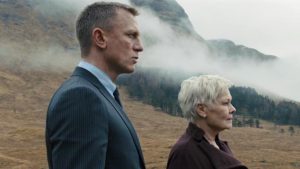
Casino Royale and Quantum of Solace (2008), the latter a direct sequel to the former, and both preoccupied with Vesper Lynd and Jesper Christensen’s villainous Mr White character, can often seem like they’re locked in their own, private, non-Bondian universe.  From the old, pre-Daniel Craig movies, only Judi Dench’s M remains.  What makes Skyfall a pleasure is that it starts to join the dots and make the series feel like the Bonds of old again, adding a new Q (Ben Wishaw) and a new Moneypenny (the divine Naomie Harris).  It also, eventually, brings in a new M to replace Dench, Ralph Fiennes, who in a gratifying bit of character-development is initially presented as an arsehole but gradually wins Bond’s respect and trust.  Javier Bardem makes a good villain and, when Bond and Dench’s M take refuge at Skyfall, the Scottish Highlands estate where Bond spent his childhood, we get a welcome appearance by Albert Finney as the estate’s irascible but handy-with-a-shotgun gamekeeper Kincaid.  It’s been said that director Sam Mendes originally wanted to cast Sean Connery as Kincaid, which would have been weird… but awesome.


© Eon Productions
 

3: Licence to Kill (1989)

The dark horse of the series in more ways than one, Licence to Kill got a bad rap because it underperformed at the box office, earned itself a British 15 certificate with its violence, and offended critics who, after condemning the Bond movies for years for being too silly, suddenly started carping about how they missed the loveable silliness of Roger Moore.  However, if you’re a Bond connoisseur who likes to see 007 taken seriously, it’s one of the best.  Timothy Dalton goes after drug baron Franz Sanchez (Robert Davi) when Sanchez maims Bond’s best buddy Felix Leiter (David Hedison) and murders Leiter’s wife on their wedding night.  This, of course, echoes what happened to Bond after his wedding back in On Her Majesty’s Secret Service (1969), making Licence to Kill a spiritual if not direct sequel to that film.  Much mayhem ensues as Sanchez and his henchmen (Anthony Zerbe, Don Stroud, Everett McGill, Anthony Starke and a young Benicio Del Toro) meet a range of gruesome fates.  The sight of Del Toro’s sneering scumbag Dario getting fed into a grinding machine is particularly delightful.  But there’s light amid the darkness.  Carey Lowell is excellent as Pam Bouvier, a truly capable and no-bullshit Bond girl, and there’s a lovely sub-plot where Desmond Llewelyn’s Q turns up to give Bond some unofficial help, showing that however much they’ve bickered in Q-Branch over the years, the two men are actually friends.  Also, Robert Davi’s Sanchez is more than a simple thug.  Valuing friendship and loyalty, he likes Bond when he first meets him and is aggrieved later when he discovers that Bond has really come to destroy him.


© Eon Productions


2: Goldfinger (1964)

The film that ticks all the boxes in the list of things you want from a Bond movie.  Action-packed opening sequence where Bond puts a previous adventure to bed?  Tick.  Shirley Bassey booming her way through a classic John Barry composition?  Tick.  Memorable villains?  Tick.  Gadgets, gimmicks, classy cars?  Tick.  A great Bond girl?  With Honor Blackman, definitely a tick.  A great Bond?  Well, it’s Sean Connery, so definitely a tick too.  Basically, the series could have stopped here, because after Goldfinger there was nothing that could be done again any better – The Spy Who Loved Me’s refrain Nobody Does It Better might have been written about this film.  Incidentally, Auric Goldfinger’s scheme in the movie makes more sense than his scheme in Ian Fleming’s 1959 novel.  In the book, Goldfinger just wants to rob Fort Knox, which would be logistically impossible.  In the film, he cannily plans to explode a nuclear device in the fort, making the US’s gold reserves unusable and skyrocketing the value of his own gold.


1: On Her Majesty’s Secret Service (1969)

It’s generally agreed that Australian actor George Lazenby wasn’t much cop as an actor.  Ironically, his single movie as Bond, On Her Majesty’s Secret Service, is in my opinion the best one of all.  It helps, of course, that the film follows Ian Fleming’s 1963 novel closely.  The main change is an upgrading of Ernst Stavro Blofeld’s fiendish plan.  In the book, he intends to decimate Britain’s agriculture, whereas in the film it’s the world’s agriculture that he’s gunning for.  (Accordingly, the instruments of Blofeld’s plan, the disease-carrying ‘Angels of Death’, are upgraded from a group of brainwashed English schoolgirl-types in the novel to a bevy of brainwashed international glamour-pusses, including Angela Scoular, Anoushka Hempel, Jenny Hanley, Julie Ege and Joanna Lumley, in the film.)  Director Peter Hunt orchestrates some brilliant action sequences on the icy slopes around Blofeld’s Alpine lair, the theme tune possibly constitutes John Barry’s finest hour, Telly Savalas makes a formidably physical Blofeld, and Diana Rigg is splendid as the confident but simultaneously vulnerable Tracy di Vicenzo, the woman who finally wins Bond’s heart and gets him to the wedding altar – though with events taking a dark turn soon after.  It’s arguable that because it’s so different from the usual entries in the series, wistful in tone and tragic in its ending, the awkward and uncertain Lazenby actually fits in nicely.  Here, Bond appears fragile and wounded, and Lazenby is believable in terms of what the character goes through.  You couldn’t imagine Connery swaggering through the movie with his usual insouciance and having the same impact.


© Eon Productions
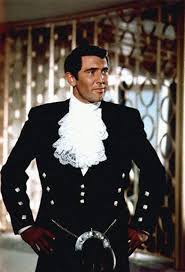
 

And now we have a new Bond movie in the cinemas.  Where will 2021’s No Time to Die figure in future rankings of the 25 Bond films, from best to worst?  Well, I see that the Guardian’s Peter Bradshaw has just given it a five-star review.  So… it’s probably rubbish.

Stop getting Bond wrong! (Part 1)


© Eon Productions


When I’m browsing through a newspaper or magazine website, or a website devoted to popular culture, no headline is more likely to fill me with despair than the one ALL THE JAMES BOND FILMS RANKED FROM WORST TO BEST.  (Well, maybe except for the headline FLEETWOOD MAC TO RELEASE NEW ALBUM.)  That’s because such articles invariably get Bond wrong.  And that’s because they’re written by young, acne-pocked dipshits with zero life experience and less-than-zero knowledge of James Bond in either his cinematic or literary incarnations.  Or, worse, they’re written by someone from the older end of the Generation X demographic, i.e., they were a kid during the 1970s and believe Roger Moore was the best actor who ever lived.


Now that the latest Bond epic No Time to Die is being released – after a zillion Covid-19-inspired delays, which had me worried that by the time it finally was released poor Daniel Craig would be turning up at the Royal Premiere with a Zimmer frame, hearing aid and dentures – there’s been another rash of these hopelessly ill-informed articles, in the likes of the Independent and Den of Geek.


So, to sort out this confusion, misinformation and stupidity once and for all, here is my – and hence the correct – ranking of all the James Bond films from best to worst.  Don’t even think about arguing with me.


© Eon Productions


24: Die Another Day (2002)

Winning the unenviable title of Worst Bond Film Ever is Pierce Brosnan’s final outing as 007.  Because it was released in the 40th anniversary year of the franchise, the makers of Die Another Day packed it with homages to the previous 19 films, such as bikini-ed heroine Halle Berry rising out of the sea like Ursula Andress in Dr No (1962) or villain Toby Stephens swooping into central London with a Union Jack-emblazoned parachute à la Roger Moore in The Spy Who Loved Me (1977).  But these homages, as well as seeming smug, highlight how inferior Die is in comparison.  And with the film’s stupid plot contrivances (an invisible car), its derivativeness (what, another killer satellite?), its Carry On-level, innuendo-ridden dialogue and Madonna’s horrible theme song, we’re talking greatly inferior.  What I hate most about it, though, is its use of Computer-Generated Imagery during the action sequences, an insult to the stuntmen in the old Bond films like Vic Armstrong, Terry Richards, Eddie Powell and Alf Joint, who did those stunts for real and made them so viscerally exciting.


23: Octopussy (1983)

I remember seriously not liking Octopussy when I saw it because it seemed desperate to cash in on the recent success of Raiders of the Lost Ark (1981) and deposited Roger Moore in a version of India populated with palaces, turbaned swordsmen, fakirs and snake-charmers, which had only ever existed in the imaginations of Hollywood scriptwriters and looked ridiculously corny by 1983.  Having worked in India several times since then, I suspect I would hate it even more now.  The film’s one saving grace is the sub-plot taking place in its other main setting, Germany, which has Steven Berkoff as a deranged Soviet general wanting to knock NATO for six by engineering an ‘accident’ with a nuclear warhead.  Opposing, and in part thwarting, Berkoff’s insane plan is General Gogol (Walter Gotell), who appeared in half-a-dozen Bond films as 007’s respectful adversary and occasional ally in the KGB.  Indeed, I’d say Octopussy marks Gogol’s finest hour.


22: Moonraker (1979)

Moonraker also attempted to cash in on a recent hit movie, in this case Star Wars (1977).  Thus, it has Roger Moore going into outer space in search of a stolen space shuttle.  It piles silliness upon silliness: not just the far-fetched science-fictional plot, but also sequences with gondolas turning into speedboats, speedboats turning into hovercraft, speedboats turning into hang gliders, steel-toothed villain Jaws (Richard Kiel) crashing through the top of a circus tent, Jaws finding a girlfriend, and so on.  Michael Lonsdale as the big villain Hugo Drax gives Moonraker some dignity it really doesn’t deserve.  Brace yourself for the inevitable “He’s attempting re-entry!” joke at the end.


© Eon Productions


21: The Man with the Golden Gun (1974)

Another entry in the series where the only thing going for it is the villain, the impeccable Christopher Lee as the super-hitman Francisco Scaramanga.  Elsewhere, Lulu warbles the cheesy, innuendo-slathered theme song (“He’s got a powerful weapon / He charges a million a shot!”), Britt Ekland is barely contained by her bikini, and redneck comedy-relief American policeman Sheriff Pepper (Clifton James), who was so annoying in the previous film Live and Let Die, makes an unwelcome reappearance even though the film’s set in East Asia.  Pepper just happens to be holidaying in Thailand with his wife when he bumps into Bond again.  (He refuses to have his picture taken with a local elephant, telling Mrs Pepper: “We’re Demy-crats, Maybelle!”  Surely not.)


20: Live and Let Die (1973)

And that brings me to Live and Let Die, in which Roger Moore makes his debut as Bond.  From all accounts Moore was a lovely bloke and he kept the franchise massively popular during the 1970s and 1980s, but his lightweight acting style meant the character was far removed from the one imagined by Ian Fleming in the original novels.  Even by 1973’s standards, Live and Let Die’s plot about a villainous organisation of black drug-smugglers, headed by Yaphet Kotto’s Mr Big, dallies worryingly with racism, although Moore’s presence actually defuses some of that.  His portrayal of Bond as a posh, silly-assed Englishman gives the bad guys some gravitas in comparison.  I suspect modern audiences might feel more uncomfortable with Bond’s pursuit / stalking of love interest Jane Seymour – Seymour was only 22 years at the time while Moore, already in his mid-forties, was old enough to be her dad.  The film’s spectacular speedboat chase anchors the film in most people’s memories, though it’s spoilt somewhat by the involvement of the aforementioned Sheriff Pepper.  The theme song by Paul McCartney’s Wings is, of course, great.


© Eon Productions


19: A View to a Kill (1985)

A View to a Kill, Roger Moore’s final film as Bond, is often ranked bottom in lists like this, but it at least has something most 1980s Bond movies lack – memorable villains, i.e., Christopher Walken’s Max Zorin and Grace Jones’s Mayday.  Also, Moore gets to form an agreeable double act, for a while, with Patrick Macnee and I like how General Gogol pops up at the end to give ‘Comrade Bond’ the Order of Lenin.  Still, the film contains much duff-ness.  Duran Duran do the theme song and one unkind critic once described Simon Le Bon’s vocal performance as ‘bellowing like a wounded elk.’


18: Quantum of Solace (2007)

Daniel Craig’s second appearance as James Bond, in which he comes up against a sinister, secret organisation called Quantum, was savaged by the critics.  When I watched the film, I remember thinking it didn’t seem as bad as everyone made out.  That said, I can hardly remember anything about it now.


17: The World is Not Enough (1999)

A frustrating film, The World is Not Enough has much going for it, including Sophie Marceau and Robert Carlyle as the baddies, Robbie Coltrane returning as ex-KGB man / lovable rogue Valentin Zukovsky, and a plot that anticipates Skyfall (2012) wherein Judie Dench’s M is threatened by a villain whose relationship with her is more complex than one of simple professional enmity.  And like Skyfall, it has scenes set in Scotland, the introduction of a new Q, and an explosion that rocks MI6’s London headquarters beside Vauxhall Bridge in London.  Plus, the theme song by Garbage is the best one in yonks.  But the quality stuff is cancelled out by some rubbish bits, including Denise Richards as Bond girl Christmas Jones – so-named, apparently, to allow Pierce Brosnan to crack a joke about ‘coming once a year’.  Particularly cringe-inducing is John Cleese’s debut as the replacement for Desmond Llewelyn’s Q, here making his 17th and final appearance in the franchise.  Not only does Cleese clown around to no comic effect whatever, but the scene where he’s introduced is also the one where Llewelyn bids farewell and Cleese’s slapstick robs the scene of its poignancy.


16: Diamonds are Forever (1971)

Diamonds are Forever features a beyond-caring Sean Connery, enticed back into 007’s shoes by a 1.25-million-pound paycheque after George Lazenby jumped ship, in a lazy film where the plot meanders nonsensically from one action set-piece to another and the visuals are packed with easy-on-the-eye spectacle and lavishness.  At least it’s pretty funny.  It depends on your tolerance level for sledgehammering 1970s political incorrectness whether or not you enjoy the banter between gay assassins Mr Kidd and Mr Wint.  (Sticking Connery into a coffin and feeding him into a crematorium furnace: “Heart-warming, Mr Kidd.”  “A glowing tribute, Mr Wint.”)  However, uber-Bond-villain Ernst Stavro Blofeld is very amusingly played by Charles Gray.  While he’s wreaking havoc with a deadly laser beam mounted on a satellite, he sneers: “The satellite is now over Kansas.   Well, if we destroy Kansas, the world may not hear about it for years.”


© Eon Productions
 

15: For Your Eyes Only (1987)

For Your Eyes Only makes a noble attempt to bring the franchise down to earth again following the excesses of Moonraker.  Mostly, it works nicely as an action / adventure piece, although the villain Krystatos, played by the normally reliable Julian Glover, is a bit drab. More effective is the excellent Michael Gothard as the taciturn Belgian assassin Locque.  Alas, it runs out of puff towards the end.  After some exciting mountaineering stunts while Roger Moore and the good guys ascend to a mountaintop monastery / villains’ lair, the climactic battle is a damp squib.  Also, there’s an excruciating ‘comic’ final scene where Margaret Thatcher (played by impressionist Janet Brown) phones Bond to congratulate him on a job well done and ends up speaking instead to a randy parrot: “Give us a kiss!”  “Oh, Mr Bond…”


14: Goldeneye (1995)

Pierce Brosnan’s debut as Bond, after the franchise had endured a six-year hiatus, won a lot of praise.  I find it slightly unsatisfying, though.  It tries a bit too hard.  There’s a bit too much packed into it, a few too many twists and turns, as it tries to prove to audiences that a Bond movie can still be relevant and with-it in the 1990s.  Also, its good intentions are undone by the occasional piece of Roger Moore-style silliness and a cobwebbed plot-MacGuffin – yes, it’s another killer satellite threatening the world, or in this case, the City of London.  Sean Bean and Famke Janssen are cool as the main villains, though it’s a pity that Alan Cumming and Joe Don Baker are both allowed to act with their brakes off.


13: Spectre (2015)

Another Daniel Craig Bond that got a critical kicking, I think Spectre deserves a little more love.  The film brings back Ernst Stavro Blofeld, played here by Christoph Waltz as a Euro-trash scumbag who commits crimes against fashion by not wearing socks under his loafers.  Also back is Blofeld’s insidious criminal organisation SPECTRE.  (After decades of legal wrangling, the Bond producers had by 2015 won the right to use Blofeld and SPECTRE again in the franchise.)  However, Spectre’s Bond / Blofeld backstory earned hoots of derision.  Blofeld, it transpires, is the son of Hannes Oberhauser, the man who looked after the young James Bond after his parents were killed in a climbing accident.  Oberhauser much preferred little James to little Ernst, leaving his biological son with some serious personality issues.  Yes, it sounds contrived, but I didn’t have a big problem with this, since the adoptive father-figure of Hannes Oberhauser existed in the original, literary Bond universe created by Ian Fleming and Bond referred to him in the short story Octopussy, published in 1966.  The opening sequence in Mexico City, filmed by director Sam Mendes in one long, supposedly continuous take, is brilliant, but the film’s attempts to incorporate / retcon the previous Daniel Craig Bond films into its plot are clunky.  For example, we learn that the Quantum organisation in Quantum of Solace is only a subsidiary of SPECTRE.  Another negative is the comatose theme song performed by Sam Smith.


© Eon Productions


And my next blog-post will rank the remaining Bond movies from number twelve to number one.

Dragged through a hedge backwards


© BBC


I’m currently halfway through William Boyd’s 2009 London-set thriller Ordinary Thunderstorms which, after a rather unengaging start, I’m happy to say is now shaping up to be a gripping read.  It’s interesting how quickly Boyd’s plot, of an innocent man being accused of a murder he didn’t commit and having to go to ground – literally so, hiding in a neglected patch of waste ground by the Embankment – to avoid both the police and the real killers, reminded me of several other books, namely, John Buchan’s The 39 Steps (1915), Geoffrey Household’s Rogue Male (1939) and, in a rather more skewed way, J.G. Ballard’s Concrete Island (1974).


It’s been a good while since I read The 39 Steps and Concrete Island, but I read Rogue Male just a couple of years ago and was impressed enough to post something about it on this blog.  Here’s the entry again, slightly updated to incorporate some Benedict Cumberbatch-related news.


For a novel whose plot hinges around an attempt to kill Adolf Hitler, there’s remarkably little about Hitler in Geoffrey Household’s Rogue Male.  In fact, the genocidal German dictator isn’t mentioned once.  Presumably this is because although Rogue Male first appeared in print in late 1939, after war had broken out between Britain and Germany, it was written before the outbreak of war when Household felt it would be diplomatic not to name names.


Thus, the book’s hero goes boar-hunting in Poland, crosses the border into a neighbouring country that isn’t identified, and one day ends up with the brutish leader of that country, also not identified, in the sights of his hunting rifle.  Is he actually in Germany and on the point of bagging Hitler?  Or could he be somewhere else, Russia say, where he’s targeting Joseph Stalin?  But although Household keeps it ambiguous, given historical events soon after the story’s late-1930s setting, it’s impossible to read Rogue Male now and not visualise in those sights a bloke with a square-shaped scrap of a moustache, an oily side-parting and a swastika armband.


Incidentally, when Rogue Male was brought to the screen, the filmmakers didn’t follow Household’s ambiguity.  A 1941 Hollywood adaptation called Manhunt, directed by Fritz Lang – who’d bailed out of Germany in 1933 after Joseph Goebbels started taking an interest in him – readily depicted the target as Hitler and, viewed today, the film feels like an unabashed wartime propaganda piece.  Meanwhile, a 1976 adaptation by the BBC, directed by Clive Donner, was also unequivocal that its hero was going after Hitler.  The actor playing Hitler was none other than Michael Sheard, fondly remembered by kids of my generation for playing Mr Bronson, the hard-nut deputy headmaster on the BBC’s children’s drama / soap opera Grange Hill (1978-2008).


Just as the book’s target is anonymous, so is its hero, even though he tells the story in the first person.  Again, the film versions differ from the book in giving him an identity.  In 1941’s Manhunt, he’s called Captain Thorndyke and is played by Walter Pidgeon.  In 1976’s Rogue Male, he’s called Sir Robert Hunter and is played by the marvellous Peter O’Toole.


© Penguin Books


Whoever he is, he’s apprehended before he can fire the rifle and subjected to a brutal interrogation.  Then his captors decide that the easiest way to deal with him is to bump him off and make his death look like an unfortunate hunting accident.  The ensuing story can be divided into two parts, with each part having a similar, contracting, funnelling structure where the action begins in an expansive setting but ends in a cramped, claustrophobic one.  First, Rogue Male’s hero manages to escape from his captors and is pursued by them across the countryside of whatever foreign nation he’s in.  Okay, for the sake of simplicity, let’s just say his captors are the Gestapo and the nation is Germany.  His pursuers close in but he manages to elude them by stowing away on a London-bound ship, hiding on board inside an empty water tank.


Then begins the second, longer part of the narrative.  Back in Blighty, he discovers that Hitler’s agents are still on his trail.  They don’t just want to eliminate him but also want to make him sign a document saying that he carried out his attempted assassination with the blessing of the British government.  Again, the pursuit begins against a broad vista, this time the streets of London and landscapes of southern England.  But again, his options narrow and eventually he digs and hides himself in a little cubbyhole under an unruly and remote hedgerow marking the boundary between two farms in Dorset.


One thing that surely inspired Rogue Male was Richard Connell’s short story The Hounds of Zaroff (1924) about a big-game hunter who gets hunted as game by another, even bigger-game hunter.   However, while Household borrows this ironic scenario of a hunter becoming the hunted, he explores it with surprising depth.  His hero obviously grew up in a rural aristocratic culture of shooting and hunting but he’s remarkably empathetic with the creatures on the receiving end of the bullets and hounds.  He mentions once or twice that he got sick of hunting rabbits because of their harmlessness and defencelessness.  And, holed up in his Dorset burrow, he becomes rabbit-like himself.


He also bonds with a cat living wild in the hedge above him, whom he names ‘Asmodeus’, presumably after the ‘worst of demons’ described in the Catholic and Orthodox Book of Tobit.  At one point he speculates of Asmodeus, “there is, I believe, some slight thought transference between us…  back and forth between us go thoughts of fear and disconnected dreams of action.  I should call these dreams madness, did I not know they came from him and that his mind is, by our human standards, mad.”


Later, he comments, “I had begun to think as an animal; I was afraid but a little proud of it.  Instinct, saving instinct, had preserved me time and again…  Gone was my disgust with my burrow; gone my determination to take to open country whatever the difficulties of food and shelter.  I didn’t think, didn’t reason.  I was no longer the man who had challenged and nearly beaten all the cunning and loyalty of a first-class power.  Living as a beast, I had become a beast, unable to question emotional stress, unable to distinguish danger in general from a particular source of danger.”


While Rogue Male’s central character becomes unhealthily animal-like, his main adversary is a hunter extraordinaire.  A German agent masquerading as an English country gent called Major Quive-Smith appears on the scene, displaying impeccable upper-class charm towards the civilians he encounters, whist ruthlessly pursuing his quarry.  Quive-Smith books a room in one of the farms adjacent to the hedge and burrow, pretending that he wants to spend a few weeks in the area doing some shooting.  Spying on him from afar, Household’s narrator notes uneasily that “the major carried one of those awkward German weapons with a rifled barrel below the two gun barrels… the three barrels were admirably adapted to his purpose of ostensibly shooting rabbits while actually expecting bigger game.”


© 20th Century Fox


In addition to The Hounds of Zaroff, Household was probably influenced by John Buchan’s The 39 Steps (1915).  But while there’s more to Buchan’s novel than its conventional action-adventure reputation would suggest, due to its recurrent theme of disguise and imposture, I think Rogue Male is superior in terms of characterisation and psychological tension.  Buchan’s Richard Hannay is an outsider in that he’s a veteran of the African colonies who finds life back in the ‘Old Country’ stuffy, pretentious and tedious; but the hero of Rogue Male is an outsider in more complex ways.  He comes from a world of wealth and entitlement but treats that world with indifference and it’s noticeable that when he’s back in London he has a lack of friends in high places to call upon for help.  Indeed, he’s such a loner that at times you wonder if he wants to resign from the human race itself.  This is even without the mental and physical stress of being hunted making him less like a man and more like an animal.  Household provides a few clues about a past tragedy that may explain his disenchantment but wisely he doesn’t get bogged down in too much backstory.


And though Hannay is no shrinking violet, it’s doubtful if he could put with living for long in the burrow that the narrator digs for himself in Dorset and where he spends a good part of 90 pages, first hiding in it from Quive-Smith and his men, and then besieged in it by them.  Household manages the tricky task of not overly describing the dirt, muck and claustrophobic darkness of this hideaway whilst implying its squalor.  His hero is accustomed to it while he’s inside it but realises how horrible it is when he’s out of it and then comes back: “The stench was appalling.  I had been out only half an hour, but that was enough for me to notice, as if it had been created by another person, the atmosphere in which I had been living.”  Then again, like many men of his generation, he’s already undergone something traumatic that puts this experience in perspective: “…my God, I remembered that there were men at Ypres in 1915 whose dugouts were smaller and damper than mine!”


I’ve known the story of Rogue Male for a long time thanks to seeing the two film adaptations.  I didn’t like the 1941 Hollywood version, which downplays the rawness of the novel and turns it into a conventional espionage thriller, reducing the amount of time Walter Pidgeon spends in the burrow and padding things out with extra characters and plot twists.  The film’s low-point comes when Pidgeon gets off the ship and is greeted by a parade of Cockney Pearly Kings and Queens waltzing and singing down a foggy street. I guess that was the filmmakers’ way of assuring American audiences that, yes, he is back in London.


But I enjoyed the 1976 BBC version.  Its scriptwriter, Frederick Raphael, streamlines parts of Household’s narrative and embellishes others – most notably, adding a new character, a pompous and unhelpful representative of the British government sublimely played by Alastair Sim – but it’s gritty and, for the time, brutal, even if Peter O’Toole never quite becomes the desperate, filthy, animalistic figure that his counterpart in the book becomes.  In addition, it has a great cast (John Standing, Harold Pinter, Michael Byrne and Mark McManus as well as O’Toole and Sim) and it even slips in a cheeky visual reference to Michael Powell and Emeric Pressburger’s wartime classic, The Life and Times of Colonel Blimp (1943).


And coincidentally, it looks like Rogue Male could be back in vogue.  For the past few years, it’s been known that Benedict Cumberbatch wants to produce (and presumably star in) a new version of it.  Let’s hope the Cumberbatch version, if it appears, is closer to the sombre tone of the 1976 adaptation than the anodyne, crowd-pleasing tone of the 1941 one.  Or, better still, it makes a real effort to capture the fascinatingly introspective, misanthropic and grimy mood of the novel that inspired those versions in the first place.


© BBC

Richard Matheson – he was legend


© Orion Publishing Co


Something has got me thinking about Richard Matheson, the science-fiction and horror author and screenwriter who passed away in 2013 at the age of 87.


What thing?  Well, the news that the anti-Covid-19-vaxxers in America, determined to plumb the depths of stupidity to find new reasons for not getting vaccinated, have found the stupidest reason yet.  Speculation is rife that the vaccine could turn you in a zombie.  You know, like one did in the 2007 sci-fi / horror movie I am Legend, with Will Smith, which was based on Matheson’s 1954 novel of the same name.  This has prompted one of the movie’s scriptwriters, Akiva Goldsman, to step up and announce on social media: “Oh.  My.  God.  It’s a movie.  I made that up.  It’s not real.” In fact, the source of the contagion in the movie wasn’t a vaccine but a virus, genetically reprogrammed by Dr Emma Thompson to combat cancer, going spectacularly rogue.


In Matheson’s novel I am Legend the monsters are vampires, not zombies.  Also, what turns people into those vampires isn’t the movie’s lab-reprogrammed virus, but a mysterious pandemic.  However, the book’s premise of the world being suddenly and nightmarishly turned upside down and a small number of uninfected humans finding themselves menaced by those who’ve been infected and turned into monsters, including their own loved ones, was one that a young George Romero appropriated for his seminal 1968 movie Night of the Living Dead.  In doing so, Romero made it the blueprint for at least 80% of the zombie movies that have lurched across cinema and TV screens ever since.


In the novel, the number of uninfected humans is small indeed: just one, Richard Neville, who is alone in the world during the daytime and then under siege in his fortified house at night, by the vampires that everyone else has turned into.  Gradually, Neville, researching the plague, stumbles on scientific explanations for the vampire-like symptoms of its victims, why they drink blood, why they can only be killed by stakes through the heart, and why they have an aversion to sunlight, garlic and crucifixes.  I am Legend also ends with an unnerving psychological twist.  Neville, who’s spent his days roaming the surrounding city and staking the slumbering vampires, realises that the vampires are now the normal ones and he’s become the monster of everyone’s nightmares, the deadly legend of the title.


It’s a pity that though I am Legend was filmed on several occasions, and though Matheson lived to a venerable age, he never got to see a satisfactory celluloid version of it.  The novel received its first film treatment in Italy, where Rome unconvincingly stood in for Los Angeles, with the cheaply and incompetently made L’Ultimo Uomo della Terra (The Last Man on Earth).  Neville was played by Vincent Price, whom Matheson admired as an actor but thought was miscast in the role.  L’Ultimo Uomo della Terra was at least fairly faithful to the book, unlike the subsequent film versions, 1970’s The Omega Man, with Charlton Heston, and the 2007 one.  In The Omega Man the vampires have become a group of demented albino mutants called, with an unsubtle reference to Charles Manson, the Family.  In the Will Smith version of I am Legend they’re even less impressive, a bunch of bald, hyperactive zombies animated by some shoddy CGI.


Both the later movie versions lack the courage to portray Neville as being totally alone and eventually have him encounter other, as yet uninfected survivors.  They also lack the courage to include Matheson’s game-changing ending.  Instead, they close with Heston and Smith depicted as Christ-like figures who nobly sacrifice themselves for the good of what’s left of humanity.  Neville was a more interesting character when he discovered he’d become a bogeyman.  Still, disappointing though all three film versions are, there’s at least a good graphic-novel adaptation of I am Legend available.


© Gold Medal Books


The more I reminisce about Matheson, the more I realise what a wonderful and influential writer he was.  His other big – though ‘big’ perhaps isn’t the most appropriate adjective – novel of the 1950s was The Shrinking Man (1956).  Its hero, an archetypal middle-class American male called Scott Carey, is exposed to a radioactive cloud that causes his body to shrink at the rate of a seventh of an inch every day.  Thereafter, Carey’s world turns nightmarishly upside down too, though at a more gradual rate than Richard Neville’s.  First, he experiences psychological and sexual humiliation as he finds himself increasingly dwarfed by his normal-sized wife.  Following an assault by the family cat, no longer a loveable moggie but a carnivorous monster, the now-tiny Carey loses all contact with humanity and finds himself trapped in his house’s basement where the dangers facing him become formidable indeed.  A common spider, for instance, takes on elephantine proportions.  And Carey’s shrinking doesn’t stop, let alone get reversed.  At the book’s close, he muses, “If nature existed on endless planes, so also might intelligence.”  Thereafter, he dwindles away into infinity.


A year after its publication, the novel was filmed as The Incredible Shrinking Man, directed by Jack Arnold and with Matheson providing the script.  Matheson was unhappy with how Arnold structured the film.  He told the story in linear fashion, whereas Matheson wanted it to begin with the shrunken Carey in the basement, reliving what had happened to him via a series of flashbacks.  However, it’s still one of the best science fiction movies of the 1950s.  It crucially retains the novel’s bleakly philosophical ending.  I can remember seeing the film on TV as a kid and being genuinely upset when the ending defied my expectations that things would finish on an upbeat note.  The Incredible Shrinking Man was, incidentally, one of the great J.G. Ballard’s top ten favourite sci-fi movies.


© Sphere Books


As well as novels, Matheson was a prolific writer of short stories, many of which were collected in four books called the Shock series.  Shock 1-4 were published in Britain in the 1970s by Sphere Books, who decorated the covers with lurid and gory images – the antithesis of the unsensational, non-violent and thoughtful works inside.  The stories I remember best include Long Distance Call, about a woman plagued by mysterious phone calls that, she discovers, emanate from a local cemetery into which the telephone wire has blown down; The Children of Noah, about a motorist who finds himself in Kafkaesque predicament when he breaks the 15-miles-per-hour speed limit of a tiny American town called Zachary; and the brilliant The Splendid Source, in which a man embarks on a quest to find out where dirty jokes really come from.


Long Distance Call was one of several Matheson stories that were turned into episodes of the celebrated TV anthology series The Twilight Zone (1959-64).  The best of these, adapted by Matheson himself, was of course Nightmare at 20,000 Feet.  In this, William Shatner essayed his second-most-famous role, that of a just-released psychiatric patient who’s on board a plane and, looking out of the window, sees a gremlin dismantling one of the engines on the wing.  Whenever he tries to alert the crew and fellow passengers, the beastie inconveniently disappears from view.  Particularly memorable is the moment when the traumatised Shatner dares to peek through the window again and discovers the gremlin pressing its face, which resembles that of a hare-lipped teddy bear, against the outside of the glass and staring in at him.  The episode was remade as a segment of the movie version of The Twilight Zone in 1983, with John Lithgow in the Shatner role, and ten years later it received the ultimate accolade – it was spoofed in a Treehouse of Horror edition of The Simpsons, with Bart Simpson the only passenger on the school bus able to see a gremlin sabotaging its engine.  This version was called Nightmare at 5½ Feet.


© Universal Pictures


Other episodes that Matheson penned for The Twilight Zone were also influential.  A World of Difference is about a businessman who makes the mind-blowing discovery that he’s a fictional character and his life is actually a movie.  Furthermore, the movie has just had its production halted, meaning he’ll have to live in the ‘real’ world as the declining, drunken movie star who’s been playing him.  This clearly informs Peter Weir’s 1998 film The Truman Show.  Meanwhile, Little Girl Lost tells the tale of a child who, one night, falls from her bed and into another dimension, a mysterious, misty void from which she can hear her parents’ concerned voices but can’t escape.  A young Steven Spielberg no doubt saw and remembered this one, because the same idea features in 1982’s Spielberg-produced Poltergeist, though this time the little girl is sucked into the other dimension through the household TV set.  And yes, The Simpsons spoofed it too in Treehouse of Horror.


Steven Spielberg has much to thank Matheson for.  Matheson’s short story Duel, based on an experience he had on November 22nd, 1963 – of driving home depressed at the news of Kennedy’s assassination and being harassed by a large, tailgating truck – was filmed as a TV movie in 1971 by Spielberg and gave the young director his first big critical success.  Again, Matheson wrote the script.  Duel-the-movie has motorist Dennis Weaver and the psychopathic driver of a 1955 Peterbilt 281 truck get into a deadly game of cat and mouse around the roads and highways of rural California.   We never see the truck driver himself, just his immense, bellowing, dinosaur-like vehicle.  Duel is the archetypal man-versus-machine story and, again, has been influential.  Stephen King basically rewrote it (but upped the ante by adding lots of malevolent vehicles) with his short story Trucks, which he later filmed as Maximum Overdrive (1986).


The made-for-television movies that filled American TV schedules in the 1970s kept Matheson busy.  As well as Duel he scripted The Night Stalker (1972) about a reporter called Carl Kolchak (Darren McGavin) who investigates a series of killings in modern-day Los Angeles and discovers that the perpetrator is a vampire.  The Night Stalker was successful enough to eventually spawn a TV show called Kolchak: The Night Stalker (1974-75), also starring McGavin, in which Kolchak investigated other strange cases involving monsters and supernatural phenomena.  Though short-lived, the show was a major inspiration for Chris Carter, whose massively popular The X-Files (1993-2018) had a similar theme.  Carter acknowledged his debt to Kolchak by having Darren McGavin guest-star in two X-Files episodes.


Meanwhile, the TV anthology movie Trilogy of Terror, from 1975, was based on three of Matheson’s short stories.  The first two segments are unmemorable, but the third one, which Matheson scripted from his story Prey, is great.  It stars Karen Black as an insecure woman who tries to shore up her relationship with her boyfriend, a lecturer in social anthropology, by buying him an antique ‘Zuma fetish doll’ as a birthday present.  The doll is a hideous-looking thing and sports a many-fanged grin resembling a Venus flytrap.  Before she can give the doll to its intended recipient, it comes to violent, gibbering life and she spends the evening fighting it off in the confines of her apartment.  Black’s plight is the inverse of the shrinking man’s.  She’s normal-sized and the threat she faces is tiny, but terrifying.  This also creates the template for Joe Dante’s movie Gremlins in 1984.  In particular, the scene in Gremlins where Frances Lee McCain fights off a horde of the sneering, reptilian mini-monsters in her kitchen, employing a blender and a microwave oven as weapons, is very reminiscent of Trilogy of Terror.


When he wasn’t writing novels, short stories and television scripts, the ever-industrious Matheson was writing for the cinema.  In the early 1960s, he scripted several of the movies based on works by Edgar Allen Poe that were made by American International Pictures and directed by Roger Corman: The House of Usher (1960), The Pit and the Pendulum (1961), Tales of Terror (1962) and The Raven (1963).  All told, Matheson did a good job of preserving the original stories’ gloomy, clammy spirit, whilst meeting the commercial demands of a studio and a director who were already famous for their exploitation movies, and keeping engaged a star – Vincent Price – whose performances tended to slip into the knowingly hammy when his material bored him.  The movies aren’t the most faithful adaptations of Poe, but they’re surely the most fondly remembered ones.


© Academy Pictures Productions / 20th Century Fox


Matheson also worked on British movies.  For AIP’s trans-Atlantic rival, Hammer Films, he scripted The Devil Rides Out in 1968 and managed to turn Dennis Wheatley’s bloated, reactionary novel about upstanding Anglo-Saxon aristocrats fighting a bunch of ghastly Satan-worshipping foreigners into something rather good.  And in 1973, he adapted his haunted-house novel Hell House for the screen.  The result was The Legend of Hell House, directed by John Hough and starring Roddy McDowall, Clive Revill, Pamela Franklin and Gayle Hunicutt as psychic investigators trying to get to the bottom of terrifying supernatural manifestations in the titular mansion.  The movie’s ending, which has the surviving investigators finding a hidden sanctum where the psychic forces are emanating from an embalmed body, played by a very un-embalmed-looking Michael Gough, is pretty stupid, which Matheson himself admitted.  Still, John Hough directs the film’s scary set-pieces with vigour and there’s an unsettling electronic score by Delia Derbyshire and Brian Hodgson.


Matheson was a modest soul and in interviews he usually seemed puzzled that so many people could be so inspired by his work.  He might have ended up a very rich man if, like his famously litigious contemporary Harlan Ellison, he’d bothered to sue every filmmaker and writer who’d ripped off his ideas.  Mind you, he’d probably have spent all his time in court, so I’m glad he just turned the other cheek and devoted that time instead to writing his marvellous stories.


© Cayuga Productions / CBS Productions
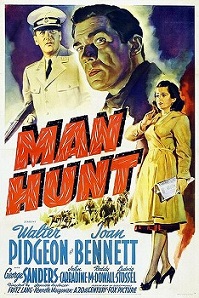
Cinematic heroes 3: David Warner


© Warner Bros.


I’ve just discovered that a few days ago was the 80th birthday of the film and TV character actor David Warner.  In honour of the great man becoming an octogenarian, here’s an updated version of a post I wrote about him eight years ago.


For most actors, becoming typecast is a pain in the neck.  The day that the lugubrious-faced, distinctive-voiced David Warner became typecast, as an actor specialising in offbeat roles in offbeat films, often horror, science fiction and fantasy ones, it was actually a pane in the neck.


As Keith Jennings, the photographer who befriends Gregory Peck’s ambassador Richard Thorne in 1976’s The Omen, he is memorably decapitated when a sheet of glass comes crashing off the back of a truck and shears his head from his shoulders.  Indeed, though The Omen was choc-a-block with people dying in gruesome freak accidents, and later there were Omen sequels with more freak accidents, and later still there were a half-dozen Final Destination movies following a similar template and serving up many more freak accidents, the cinema has seen very few freak accidents as spectacularly shocking as Warner’s in that 45-year-old movie.


© 20th Century Fox


The main actors in the big-budget Omen – Peck, Lee Remick, Billie Whitelaw – were names not normally associated with horror movies.  Until then, Warner’s name hadn’t been associated with them either.  Mancunian by birth, he started acting professionally in 1962 and the following year joined the Royal Shakespeare Company, which led to stage roles in Henry IV Part 1, Henry VI Parts I-III, Julius Caesar, Richard II, The Tempest, Twelfth Night and, in 1965, playing the title role, Hamlet.  The earliest films he appeared in were sometimes theatrical in origin too, such as A Midsummer Night’s Dream and The Sea Gull, which both appeared in 1968.  However, it was in 1966’s Morgan: A Suitable Case for Treatment that he made his biggest impression on 1960s movie audiences.  In it he plays a working-class artist who’s abandoned by his posh wife, played by Vanessa Redgrave, and goes to unhinged extremes to win her back.


When Warner’s career is discussed, it’s often overlooked that he was once a regular performer with the legendary action-movie director Sam Peckinpah.  His association with the hard-drinking, coke-snorting, near-deranged filmmaker started with 1970’s The Ballad of Cable Hogue, in which he played an eccentric preacher who befriends Jason Robards’ titular hero.  Peckinpah often boasted, “I can’t direct when I’m sober,” and for the young Warner Hogue must have been quite an initiation into the director’s weird and wonderful ways.  When bad weather held up filming, Peckinpah and his crew went on a massive drinking binge and ran up a bar-bill worth thousands and thousands of dollars.


In the next year’s Straw Dogs, Peckinpah’s taboo-busting film set in the English West Country, Warner plays a simpleton who unwittingly kills a girl and then takes refuge in Dustin Hoffman and Susan George’s house with a squad of vigilantes on his trail.  In Cross of Iron, Peckinpah’s 1977 war movie about a doomed German platoon on the Russian front, he plays a humane German officer who just wants to get through the war in one piece.  In fact, in Cross of Iron, nearly all the Germans, including James Coburn’s gallant corporal and James Mason’s world-weary colonel, are humane types who view war with extreme distaste.  What upsets the apple-cart, and eventually gets most of them killed, is the arrival of Maximillian Schell’s glory-hunting Prussian officer.  Schell is obsessed with winning an iron cross for himself and isn’t worried about other soldiers dying in the process.


© Anglo-EMI Productions
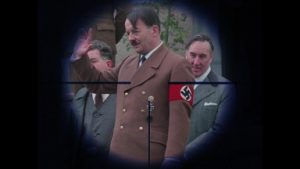
 

In 1973 Warner made his first appearance in a horror film, the British anthology movie From Beyond the Grave, whose stories were based on the writings of Ronald Chetwyn-Hayes.  In the film’s first story, The Gate Crasher, he plays an arrogant prick called Edward Charlton who acquires an old mirror from an antique shop and gets it on the cheap by lying to the shop-owner about the mirror’s likely age.  Charlton obviously hasn’t seen many horror films before.  Otherwise, he might have thought twice about cheating a proprietor played by Peter Cushing in a shop called Temptations Inc.  He gets his just deserts.  The mirror turns out to be inhabited by a malevolent spirit, which possesses him and drives him to commit murder.


It was in the late 1970s and early 1980s that Warner got his fondest-remembered roles, starting with the kindly but ill-fated Jennings in The Omen.  Then, in 1979’s Time After Time, he switches from being a nice guy to being a bad one, playing John Leslie Stevenson, a Victorian gentleman and friend of the pioneering science-fiction writer H.G. Wells, who’s played by Malcolm McDowell.  Unbeknownst to Wells, Stevenson has been making a name for himself by butchering prostitutes in Whitechapel – for he is none other than Jack the Ripper.  When Wells unveils his latest invention, a working time machine like the one he would later write about in his famous 1895 novella, Stevenson uses it to escape the closing police net and scoots one century forward into the future.  But the machine has a recall function, so a horrified Wells summons it back to the 19th century and uses it to follow Leslie to 1979.  Wells assumes that he’s let Jack the Ripper loose on Utopia and, predictably, is more than a little disappointed to find that the 20th century is less utopian than he’d anticipated.  Meanwhile, the Ripper has taken to the era’s violence, sleaze and heavy-decibel rock music like a duck to water.


A quirky and very entertaining movie, Time After Time was written and directed by Nicholas Meyer who, regrettably, devoted most of his energies to the less adventurous and eccentric, and more mainstream and family-friendly Star Trek franchise during the 1980s.  Actually, it’s probably because of Meyer’s involvement that both Warner and Malcolm McDowell have made appearances in Star Trek films – Warner was in both Star Trek V and VI (1989 and 1991).  I’m not much of a fan of Star Trek or its movie spin-offs, but I like the sixth one, largely because Warner is in it.  He plays Chancellor Gorkon, charismatic leader of the Klingons and obviously modelled on the then Soviet leader Mikael Gorbachev, who’s decided it’s time for the Klingon Empire to pursue peace-talks with the Federation.


In 1981 Warner delivered another memorable performance in Terry Gilliam’s cinematic fairy tale The Time Bandits.  He plays Evil, who’s been created by Ralph Richardson’s Supreme Being and then imprisoned in a hellish place called the Fortress of Ultimate Darkness.  Obviously, Warner and Richardson’s characters are the Devil and God under different monikers.  Some fine actors have played Old Nick in movies over the years, including Robert De Niro, Al Pacino and Jack Nicholson, but for my money Warner’s portrayal is the most entertaining.  His Devil is a petulant and embittered type who spends his time ranting at his idiotic minions (“Shut up!  I’m speaking rhetorically!”) about how rubbish God is.  The Almighty, he argues, has wasted His time creating useless things such as slugs, and nipples for men, and 43 species of parrots, when He could have concentrated on making laser beams, car phones and VCRs.  Warner steals the show in The Time Bandits, which is no minor achievement considering that in addition to Richardson the film stars Ian Holm, John Cleese, Sean Connery, Michael Palin, Shelley Duvall and a delightful gang of time-traveling dwarves led by David Rappaport.


Thereafter, Warner’s CV filled with all manner of odd movies, hardly Shakespearean in the acting opportunities they offered, but relished by obsessives like myself.  These include 1979’s Nightwing, 1980’s The Island, 1987’s Waxwork, 1991’s Cast a Deadly Spell, 1995’s In the Mouth of Madness, 1997’s Scream 2 and 2010’s Black Death.


© Walt Disney Productions


As an actor he’s adept at playing out-and-out villains, for example, his Dillinger / Sark character in the 1981 Disney computer-game fantasy Tron, a movie that was unappreciated at the time but that, in the decades since, has been accorded considerable retro-cool.  He’s also good at doing mad scientists, like the splendidly named Doctor Alfred Necessiter in the whacky 1982 comedy The Man with Two Brains, which is poignant today as a reminder of the time when Steve Martin used to be funny.


But he also has harassed and melancholic qualities, which come nicely to the fore when he’s playing fathers.  He was, for instance, the heroine’s father in 1984’s The Company of Wolves, Neil Jordan’s atmospheric and sensual adaptation of Angela Carter’s gothic short stories.  Meanwhile, in Tim Burton’s 2001 remake of Planet of the Apes, he plays Senator Sandar, father of dishy chimpanzee Helena Bonham-Carter.  In heavy simian make-up and in Warner’s unmistakable tones, Sandar sighs at one point: “Youth is wasted on the young…”


In 1997 Warner found time to appear in James Cameron’s Titanic, then the biggest-grossest movie of all time.  Say what you like about Titanic, about the mawkish love story between Kate Winslet and Leonardo Di Caprio, about Billy Zane’s cartoonish performance as the villain, about the unspeakable theme song sung by Celine Dion, but you can’t deny that it has a great supporting cast: Warner, Kathy Bates, Bernard Hill, Victor Garber, Bill Paxton.  Warner, playing Spicer Lovejoy, Zane’s valet, doesn’t have much to do apart from connive with his master, stalk around, spy on Kate Winslet and generally behave sinisterly.  He does, though, get to punch Di Caprio in the guts after he’s been handcuffed to a railing on board the sinking liner, which is actually my favourite bit in the film.  (Warner also turned up in a 1979 movie called SOS Titanic and the Titanic features in The Time Bandits too.  Thus, he’s a titanic actor in all senses of the term.)


Warner has long been a fixture on television as well.  He’s appeared in one-off TV movies and dramas like 1984’s Frankenstein, where he plays the creature to Robert Powell’s Victor Frankenstein and Carrie Fisher’s Elizabeth, 1993’s Body Bags and 2003’s Dr Jekyll and Mr Hyde; appeared in series and mini-series like 1981’s Masada, 1982’s Marco Polo, 1984’s Charlie, 2011’s Secret of Crickley Hall and, from 2008 to 2016, Wallander, in which he plays another father, this time to Kenneth Branagh; and lent his voice to animated shows, including the Superman, Batman and Spiderman ones during the 1990s.


© Greengrass Productions / ABC Distribution Company


Some of his TV work is as cult-y as his film work.  In 1991, he guest-starred in three episodes of David Lynch’s glorious, off-the-wall crime / horror / sci-fi / soap opera Twin Peaks, playing Thomas Eckhardt, a Hong Kong-based crime-lord who has a long and dark history with Joan Chen’s Jocelyn Packard.  Two years after that, he appeared in the underrated, Oliver Stone-produced mini-series Wild Palms, a hybrid of conspiracy thriller, Alice in Wonderland and the then-recent literary genre of cyberpunk.  Set in a near-future USA, under the heel of an organisation that’s part multinational corporation and part Scientology-style religious sect, the show features Warner as Eli, the leader of an underground resistance movement.  (This clip neatly encapsulates Wild Palms’ weird energy.)  And in 2014 he popped up in John Logan and Sam Mendes’ gothic horror mash-up Penny Dreadful, in the role of Bram Stoker’s vampire hunter Abraham Van Helsing.  Because Warner played Frankenstein’s creature in 1984, it’s ironic that in Penny Dreadful – in a cheeky tangling of Stoker and Mary Shelley’s original narratives – Van Helsing gets killed by the same creature, played this time by Rory Kinnear.
 

In 2005 Warner was involved with the macabre TV comedy show The League of Gentlemen, written by and starring Mark Gatiss, Reece Shearsmith, Steve Pemberton and Jeremy Dyson.  In fact, he didn’t appear in the show itself, but in its cinematic spinoff The League of Gentlemen’s Apocalypse.  Like many a film-based-on-a-TV-show, it doesn’t really work on the big screen, though its most effective scenes are definitely those featuring Warner as a 17th century magician called Dr Erasmus Pea.  His character is rottenly evil but he’s very amusing too.  For example, while Dr Pea uses a pan to fry a hellish concoction including two recently gouged-out eyeballs, from which he plans to grow a monstrous homunculus, the camera cuts to a close-up and he pulls a pretentiously absorbed, TV-chef expression worthy of Jamie Oliver.


Warner clearly gets along with The League of Gentlemen’s creators, because since then he has appeared alongside Mark Gatiss in the radio comedy show Nebulous (2005-8); in The Cold War, a 2013 Gatiss-scripted episode of Doctor Who; and in The Trial of Elizabeth Gadge, a 2015 episode of Reece Shearsmith and Steve Pemberton’s acclaimed anthology show Inside No. 9.


The 21st century has seen Warner return to the stage, giving well-received turns as the venerable and vulnerable monarch in King Lear in 2005 and as Falstaff in Henry IV Parts I and II in 2007.  His IMDb entry lists his most recent movie appearance as 2018’s Mary Poppins Returns and says he was still doing voice-work last year.  Warner is now at an age where you wouldn’t begrudge for him retiring and choosing an easier life of armchairs, cardigan, slippers and pipe, but I for one hope that some young filmmakers – perhaps ones who grew up enjoying his performances in The Omen, Time After Time, The Time Bandits and Tron when they were shown on TV – coax him into making a few more movies.  He’s the sort of actor whose mere presence in a film, no matter how good or bad, gives you a glow.


© Handmade Films / Janus Films

Seriously Sean – ‘The Wind and the Lion’


© United Artists / Colombia Pictures / MGM


Written and directed by John Milius, released in 1975 and very loosely based on a real-life incident that occurred in 1904, The Wind and the Lion is a tale of derring-do in the Moroccan Rif combined with political intrigue in Washington DC.  I first saw it when I was in my late teens and appropriately for a film with ‘wind’ in its title – that’s wind of the meteorological, non-flatulent variety – it blew me away.


Following the death of its star Sean Connery last year, I decided to watch The Wind and the Lion again. I felt slightly trepidant doing so, as there’s more than one film that I admired in my youth but found less-than-brilliant when I saw it again at a more mature age.  A prime example is Robert Altman’s 1970 comedy about the Korean War, M*A*S*H, which once upon a time seemed exhilarating in its irreverence and anarchy, but nowadays strikes me as juvenile and mean-spirited.


The Wind and the Lion’s opening sees Connery’s character, master-brigand Mulai Ahmed el Raisuli – the Raisuli – lead a raid on the Moroccan home of wealthy American widow Eden Pedecaris (Candice Bergen) and abduct her and her young children (Simon Harrison and Polly Gottesman).  My hopes that I’d hang onto my previous high opinion of The Wind and the Lion took a blow at this early point.  It isn’t so much the fact that Eden’s houseguest at the time, Sir Joshua Smith (played by Billy Williams, not an actor but the movie’s cinematographer, who’d later win an Academy Award for his work on Richard Attenborough’s 1982 epic Gandhi), gallantly fights off the attacking hordes, is killed and then despite his heroism is barely mentioned by the Pedecarises or anyone else during the rest of the film.  No, it’s the fact that Eden, understandably upset by what’s happened, laughs in scorn when the Raisuli is thrown off a recalcitrant horse – and the Raisuli reacts by whacking her across the face.  “I am Raisuli,” he snarls.  “Do not laugh at me again.”


Yes, it’s 1904, when misogyny was a universal and unremarked-upon fact of life.  (It still is in many places, of course.)  But Connery’s later years and posthumous reputation were tainted by allegations of domestic abuse against his ex-wife Diane Cilento and by troubling comments he’d made about the acceptability of slapping women.  This moment in The Wind and the Lion is a dismaying reminder of that.


The Raisuli and his men carry the Pedecarises off to their camp in the Rif, beyond the reach of the Moroccan authorities.  His motive for kidnapping them is to damage Morocco’s Sultan Abdelaziz.  By issuing an extravagant ransom demand, he hopes to embarrass the Sultan, provoke the Americans and generally stir up trouble.  The Sultan’s uncle is the wily Bashaw of Tangier, the Raisuli’s brother, and he deeply resents how this wing of his family have allowed their country to become humiliatingly and corruptingly mired in foreign influence.  As the Bashaw himself admits at one point: “I have been threatened by the French, the Germans, the English… Yes, we have French infantry and German cavalry.  Our currency is Spanish.  But my nephew is the Sultan of Morocco.  As it is, it shall be.”


The Bashaw, incidentally, is played by the Polish character actor Vladek Sheybal, who was memorable as the villainous Kronsteen in Connery’s second Bond outing From Russia with Love (1963).  But it has to be said that the strapping, hairy Connery and the sleek, lupine Sheybal look as much like brothers as Arnold Schwarzenegger and Danny DeVito did in Ivan Reitman’s Twins (1988).


© United Artists / Colombia Pictures / MGM


Happily, once the main narrative of The Wind and Lion gets underway, the film becomes as good as I remembered it to be.  Connery and Bergen make the scenes featuring Eden Pedecaris and the Raisuli a joy.  She gradually shifts from being deeply unimpressed by him – “It is not my intention to encourage braggers,” she tells curtly him after he’s given a windy introduction calling himself ‘Raisuli the Magnificent’ and ‘the true defender of the faithful’ with the ‘blood of the prophet’ in his veins – to feeling affection for the twinkly-eyed old rogue.  Likewise, Connery’s admiration for her increases, although the banter between them never quite loses its edge.  After they start to spend the evenings playing chess, she warns him, “You are in a lot of trouble!  You should never have moved that knight or kidnapped me.  Both will see you undone.”  He responds, “It is not I who determine the outcome of events.  It is the will of Allah…”


Meanwhile, the Pedecaris children, removed from an upper-class Western world of manners, gentility and stuffiness, begin to have a whale of a time. For the boy, William, hanging out in a desert camp with the Raisuli and his sword-wielding, rifle-popping Berber militia is like Tom Sawyer’s dream of running away from home and becoming a pirate made real.


But this is only half of the story of The Wind and the Lion.  For on the far side of the Atlantic, President Teddy Roosevelt (Brian Keith) is seeking re-election.  He seizes upon the incident as an opportunity to show the voters his mettle, although his Secretary of State John Hay (John Huston) is less keen on the idea.  The garrulous and ebullient Roosevelt has his consul in Morocco (Geoffrey Lewis) and a US military force headed by an admiral (Roy Jenson) and a marine captain (Steve Kanaly) stage what nowadays would be called an intervention.  A squad of marines and sailors blast their way into the Bashaw’s palace in Tangiers, determined to knock heads together so that some sort of deal is reached and the Pedecarises are freed.  This is regardless of local sensibilities and the interests of the European colonial powers with fingers in the Moroccan pie.


A bargain is made and the three Pedecarises are released into the custody of a group of US marines headed by Kanaly’s character, Captain Jerome.  But the Sultan’s Moroccan soldiers and their German allies capture the Raisuli, going against what was agreed.  Thus, Eden, his erstwhile prisoner, has to persuade Jerome and his men to rescue him, so that the deal made in Roosevelt’s name is fully honoured…


Images of gung-ho Americans stomping into foreign lands they don’t properly understand, shooting first and asking questions later, trying to get the job (as they see it) done irrespective of local complexities, were not, it’s fair to say, popular in liberal mid-1970s Hollywood just after the Vietnam War.  And John Milius himself, co-writer of Apocalypse Now (1979) with Francis Ford Coppola, was obviously aware of the omnishambles Vietnam had been.  However, with The Wind and the Lion, he seems to hark back longingly to simpler times when America could do this sort of thing with fewer complications and consequences.  He particularly idolizes Teddy Roosevelt for embodying all the things he believes America should be about.  Roosevelt has brains, yes, but he has brawn too and is plain-speaking and no-bullshitting, and is none the worse for that.


© United Artists / Colombia Pictures / MGM


This adulation comes to the fore in a few scenes where Roosevelt joins a hunting party that shoots a grizzly bear and then he has the big, fearsome beast stuffed and mounted.  “The American grizzly,” he tells a reporter, “is a symbol of the American character: strength, intelligence, ferocity.  Maybe a little blind and reckless at times, but courageous beyond all doubt.  And one other trait…  Loneliness.  The American grizzly lives out his life alone.  Indomitable, unconquered, but always alone.  He has no real allies, only enemies, but none of them as great as he.”  Fair enough, you find yourself thinking – but if the grizzly bear is as noble as old Teddy claims it is, why did he have the poor bloody thing shot in the first place?


To be fair, the film gives a more rounded portrayal of Roosevelt than that.  He’s shown to be somewhat pompous and smug, annoying in his loquaciousness, and clearly a scheming sort.  I wonder, though, how much of this is due to Brian Keith’s performance rather than to Milius’s script.


What redeems the film politically – at least, if you’re a left-wing pinko like me – is the fact that as it progresses, Keith’s Roosevelt and Connery’s Raisuli, though they never get to meet, feel a growing respect and even kinship for each other.  By the film’s close, the Raisuli has penned Roosevelt a letter, which says: “…you are like the wind and I like the lion.  You form the tempest.  The sand stings my eyes and the ground is parched.  I roar in defiance but you do not hear…  I, like the lion, must remain in my place. While you, like the wind, will never know yours…”


If you’re going to have movies full of jingoistic American nonsense, at least have ones like this, where the American protagonists don’t see foreigners as drone-like commies, gooks or towel-heads but as fellow human beings with equivalent amounts of nobility and courage.  It just grieves me that a decade later, Milius had abandoned all attempts at nuance and was directing unashamedly right-wing and brainless shite like Red Dawn (1984).


Overall, then, I’m pleased and relieved to say that The Wind and the Lion still holds up well.  Milius directs with aplomb.  His orchestration of the sequence where the Americans storm the Bashaw’s palace is worthy of Sam Peckinpah while the desert scenes, accompanied by Jerry Goldsmith’s sumptuous and yearning score, are frequently gorgeous.  Brian Keith and Candice Bergen are excellent and Connery, intoning such great lines as “Ignorance is a steep hill with perilous rocks at the bottom,” or “If I miss the morning prayer, I pray twice in the afternoon – Allah is very understanding,” or finally, “I’ll see you again, Mrs Pedecaris, when we’re both like golden clouds on the wind!”, has never been better.


Although how this Moroccan Berber brigand ended up speaking with such a mellifluous brogue is a mystery.  Perhaps his English teacher came from Edinburgh.


© United Artists / Colombia Pictures / MGM

Travellers at the bar


As I mentioned in my previous blog-entry, the latest Covid-19 lockdown in Sri Lanka, which was imposed for a good part of May and June, has recently been relaxed.  This relaxation has allowed some eating and drinking places to re-open.


However, one place that my partner and I have often retreated to in the past, when we’ve felt the need for calm and a touch of soothing, old-school luxury (to convey the illusion for a few hours that we’ve actually got money), remains off-limits to us.  This is the Traveller’s Bar and its lovely outdoor verandah, which overlooks the Indian Ocean, at Colombo’s Galle Face Hotel.  For now, the bar and verandah are open only for hotel guests, not outside customers.  This is a shame because few things are as good for the soul as sitting there between six and six-thirty on a clear evening and watching the sky segue from one gorgeous colour to another while the sun sinks behind the distant waves.


The Galle Face Hotel will soon be a venerable 120 years old and it’s prestigious enough to have featured in Patricia Schultz’s 2003 travel book 1000 Places to See Before You Die.  Predictably, during its long history, it has accommodated some very famous guests.  Many of these are commemorated by a gallery of framed photographs adorning the interior of the Traveller’s Bar, with information about the years, occasionally just the decades, when they stayed there.


Among the earliest people featured in the gallery are writers.  You see Anton Chekov (credited with being at the Galle Face in 1890), George Bernard Shaw (in the 1930s), W. Somerset Maugham (the 1920s), Noel Coward (1944) and Evelyn Waugh (the 1950s).  D.H. Lawrence showed up there in 1922, presumably either on his way to or from the 99-day sojourn he had in Australia that gave rise to his novel Kangaroo, published the following year.


One literary hero of mine, Sir Arthur Conan Doyle, stayed at the Galle Face Hotel in 1920 and, unimpressed by its prices, described it as ‘a place where the preposterous charges are partly compensated for by the glorious rollers that break upon the beach outside.”  He was also unimpressed by the equally famous Mount Lavinia Hotel, which in those days stood beyond the southern edge of Colombo.  “There are two robbers’ castles, as the unhappy visitor calls them, facing the glorious sea, the one Galle Face, the other the Mount Lavinia Hotel.” At least he appreciated the journey between the castles: “They are connected by an eight-mile road, which has all the colour and life and variety of the East for every inch of the way.”


At this point Doyle was heavily into spiritualism and had been gullible enough to believe that the notoriously faked Cottingley fairies were real.  However, he retained enough of his wits not to be taken in by a display of the famous ‘mango-tree’ trick, which a Sri Lankan magician did for him just outside the hotel.  Doyle praised the magician’s skill, though: “He did it so admirably that I can well understand those who think that it is an occult process.”


I’m perplexed by the presence of a portrait of James Joyce, supposedly a guest of the Galle Face in 1904.  (Coincidentally, June 16th, 1904, was the date of ‘Bloomsday’, the day during which all the events of Joyce’s 1922 masterpiece Ulysses take place).  To the best of my knowledge, he never travelled outside Europe, let alone visited southern Asia.  In fact, the only connections I can dig up between Joyce and Sri Lanka are that: (1) he makes mention of the ‘Cinghalese’ in Ulysses; and (2) he was known to own a copy of Henry Olcott’s Buddhist Catechism According to the Sinhalese Canon – Olcott was the American army officer who became the first president of the Theosophical Society and was an important figure in the revival of Buddhism in Sri Lanka, so much so that he’s honoured with a statue in front of Fort Railway Station today.


Perhaps somebody else with the name ‘James Joyce’ stayed at the hotel in 1904?


One writer not displayed in the Traveller’s Bar is legendary science-fiction scribe Sir Arthur C. Clarke, even though it was in the Galle Face that he supposedly wrote the last chapters of the last volume of his Space Odyssey series, 3001: The Final Odyssey (1997).  However, Clarke had lived in Sri Lanka since 1956, so he wasn’t really what you’d call a ‘visitor’ or a ‘guest’.


The Traveller’s Bar gallery is mostly a collection of the great and good, but it has at least one rogue in it, namely Richard Nixon.  He stayed at the hotel in the 1950s, sometime before he became the second-most crooked US president in modern history.  Other political dignitaries who were guests there include father and daughter Indian Prime Ministers Pandit Jawaharlal Nehru (1950) and Indira Gandhi (1976); and iconic revolutionary Che Guevara, whose portrait says he stayed in 1958, although according to a feature in Sri Lanka’s FT his visit was actually in August 1959.  He’d come to Sri Lanka because it was one of the first countries to recognize Castro’s Cuba.


From the mid-20th century onwards, Sri Lanka began to appeal as an exotic location to Western filmmakers and so the Galle Face Hotel had Hollywood movie stars stay while on their way to or from film shoots.  These include Sir Alec Guinness (1957), in town for the making of Bridge on the River Kwai and, I have to say, looking a bit shifty in his photograph; Harrison Ford (1983), there to make Indiana Jones and the Temple of Doom (whose production had switched from India to Sri Lanka after the Indian government objected to the ‘thuggee’ elements in its script); and Ursula Andress, whom I trust enjoyed her stay in Sri Lanka in 1976 even though she probably prefers to forget the film she made there, the Italian horror movie The Mountain of the Cannibal God, directed by Sergio Martini and considered so offensive in Britain that it was classified as a ‘video nasty’ and banned until 2001.


Andress, of course, found international fame as the very first Bond girl.  Meanwhile, the man responsible for the third cinematic incarnation of James Bond, Roger Moore, appears in the Traveller’s Bar too.  He’s said to have stayed at the hotel in the 1960s, but he’s depicted in his famous 1970s Bondian bowtie and dinner-suit, so the photo obviously wasn’t taken at the time.


One star in the Traveller’s Bar who’s rather forgotten nowadays is Lex Barker, who took over the role of Tarzan from Johnny Weissmuller in 1949.  Barker’s picture says he was there in the 1950s, although the only thing I can find in his filmography that was made in Sri Lanka was a 1963 movie called Storm Over Ceylon.  While Barker’s Hollywood Tarzan movies were too low-budget to be filmed on location in a tropical country like Sri Lanka, money was not a problem for Bo Derek and her director-husband John Derek, who used Sri Lanka for the jungle scenes of their notorious, mammary-obsessed Tarzan the Ape Man (1981), while using the Maldives for its beach scenes.  For their salacious take on Edgar Rice Burroughs’ Lord of the Jungle, Bo, John and their crew imported some decidedly non-native wildlife into the country.  According to an article in the New York Times, they brought with them a lion (called Dandi), an orangutan (called C.J.), three chimpanzees, two Irish wolfhounds and an 18-foot, 120-pound python.  Thus, Ms Derek is now commemorated by a portrait in the Traveller’s Bar as well.


A nice story is attached to Gregory Peck, who stayed in 1954 whilst making a film called The Purple Plain.  Apparently, he came down with a nasty bout of flu, but recovered with the help of a traditional local remedy of plain tea incorporating inguru and kothamalli (ginger and coriander).  In the 1950s Peck was a global heartthrob and his use of this remedy didn’t go unnoticed by his lady admirers in Sri Lanka.  As another article in the Daily FT observes: “It used to be said in lighter vein those days that many upper-class ladies of Colombo 7 began drinking ginger / coriander tea only after Gregory Peck told them about it.”


Finally, the gallery sports a picture of the first man in space, Yuri Gagarin, symbolically holding a white dove.  The great Russian cosmonaut came to Sri Lanka in 1961 and among the things done to mark the visit was the planting of a tree in his honour at the botanical gardens in Peradeniya, close to Kandy.  According to a piece published by the Russian Centre for Science and Culture in Colombo, the tree was said to have stopped growing at the time of Gagarin’s death in a jet crash in 1968.  However, mysteriously, it continued to live, so that it’s resembled a young tree for the past half-century.  This is contradicted by an article in Ceylon Today, which claims it merely fell ill at the time of Gagarin’s death, but recovered and kept on growing.  I was at the botanical gardens a few years ago and really wish I’d examined the Yuri Gagarin tree to find out which of these accounts was true.