

© Swords & Sorcery Magazine
I’m pleased to report that Rab Foster, the nom de plume by which I write fantasy fiction, has just had a new story published in issue 177 of Swords & Sorcery Magazine. Entitled The Illuminators, it features a recurring character of mine, the swordswoman Cranna the Crimson, who’s basically a big gobby redhead who takes no shit from anybody, least of all from male chauvinists. In The Illuminators, Cranna is hired to escort a group of pilgrims across a city, at night, to a graveyard. Ostensibly, the pilgrims’ purpose is to say prayers in memory of some fellow-believers who are buried in the graveyard – but inevitably, this being a sword-and-sorcery story, their real purpose proves to be a darker one.
The Illuminators owes a lot to a wonderful essay called On Thud and Blunder (1978) by the late science fiction and fantasy author Poul Anderson, which you can read here. First, Anderson addresses the tendency of writers of sword-and-sorcery and heroic-fantasy fiction, up until the late 1970s at least, to base the imaginary settings of their stories on pre-industrial European societies that’d existed in history: ‘often as a mishmash of Roman Empire, Dark Ages, and high Middle Ages’, though ‘with a bit of Pharaonic Egypt, Asian nomadism, and so forth on the fringes.’
He then castigates many of those writers for not creating a setting ‘which, however thaumaturgical, makes sense,’ and describes how the realities of pre-industrial European life – political structures, labour, religion, literacy, travel by land and sea, disease, warfare, weaponry, horses, hand-to-hand combat – were very different from what’s usually depicted in fantasy writing. To take just one example: “Nobody in his right mind would grab a sword two-handed, raise it over his head, and chop straight down, exposing his belly all that while.”
Something that struck me especially was Anderson’s observation about pre-industrial cities after dark: “People who have experienced blackouts will tell you that a nighted city without the modern invention of lights is black. With walls shutting off most of the sky — especially along narrow medieval streets — it is far gloomier that any open field. You’d grope your way, unless you had a torch or lantern (and then you’d better have an armed guard).” That gave me the idea of having Cranna work for a business, in a medieval-style city, that provides escorts for travelers in the city’s streets after dark. The escorts carry torches and are armed, thus providing both illumination and security.
I also took on board Anderson’s comments about the cleanliness, or lack of it, of pre-industrial streets. “Furthermore, those lanes were open sewers; in many places, stepping stones went down the middle because of that. Despite sanitary measures, metropolitan streets as late as about 1900 were often uncrossable simply because of horse droppings. Graveyards stank too: one reason why incense was used in church services.”
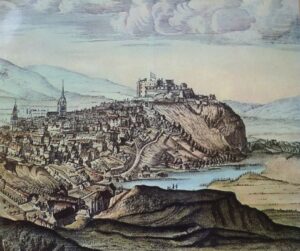
In fact, the city that appears in The Illuminators is inspired by one I’m very familiar with, Edinburgh. The Scottish capital earned itself the nickname of ‘Auld Reekie’, first of all because of the smoke it produced and then, as the meaning of ‘reek’ changed from ‘smoky’ to ‘stinky’, because of its malodorousness. My imaginary city even has a lake below its slopes, which one character describes as a ‘cesspit’ because of all the sewage and filth that’s oozed down those slopes into it. That corresponds to the Nor Loch, the body of badly-polluted water that used to exist at the bottom of the northern slopes of Edinburgh’s Auld Toon – the site of the Nor Loch is now occupied by Waverley Station and Princes Street Gardens.
For the month of November, you can read The Illuminators here, while the main page of Swords & Sorcery Magazine can be accessed here.
From wikipedia.org