Black magic and black ops


© Cork University Press


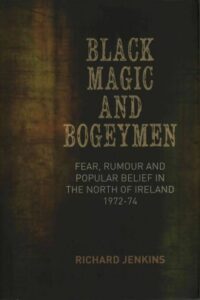
A few posts ago, I mentioned the Satanic panic that seized Northern Ireland in late 1973 and early 1974.  As Halloween is nearly upon us, I thought I would republish the following, which is a slightly revised version of something I wrote a decade ago, after I’d read Richard Jenkins’s book on the topic, Black Magic and Bogeymen (2014).


When I was eight years old, I lived in a tiny village near the border between Counties Tyrone and Fermanagh in Northern Ireland.  Thinking back, I suspect that when my neighbours saw me they’d whisper, “Look… There’s the most gullible child in the village.”


They probably thought I was gullible because I readily believed any old guff people told me, especially relating to things that, scientifically speaking, didn’t exist – i.e., manifestations of the supernatural.


I was a sucker for ghost stories.  For instance, an uncle once told me about the Cooneen Ghost – a tale involving a local family who supposedly were tormented by poltergeist-type knockings on the doors and windows of their house.  When they tried to escape the entity by emigrating to North America, it travelled with them.  The phantom knockings continued in their cabin on board the ship and then at their house in the New World.  After hearing that, I lived in dread of hearing similar knockings on the doors and windows of my house.


I also believed that fairies were real because a girl in my primary-school class had assured me that once her mother had been in the family’s stick-house (Northern Irish for ‘wood-shed’) when she’d heard crying sounds coming from a block of wood.  Presumably these were made by a fairy whose home was in the tree that’d been chopped down for the timber.


I even believed in banshees for a while because an older boy spun me a yarn about how, one night long ago, his father had heard a hideous screeching noise out in the darkness; and very soon afterwards, someone well-known to his father died unexpectedly.


So you can imagine my alarm one day when a couple of my primary-school classmates started talking about devil worshippers being active not only in Northern Ireland, but in the town of Enniskillen a few miles along the road from us.  They talked about a family in Enniskillen who, according to rumour, drew all the curtains in their house as soon as it got dark and then spent the night performing black-magic rituals.  They described the carcasses of freshly-sacrificed goats that’d been discovered beside the River Erne in Enniskillen with their hearts removed.  Most alarmingly, they claimed a child, about our age, had been abducted by devil worshippers and later been found dead and cut into pieces.  I swallowed every word of this and took it as gospel truth.


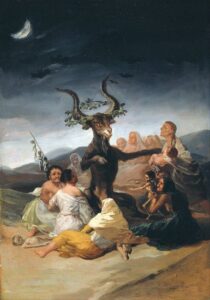
Talking of the gospel, I’ll say in my defence that I belonged to a fairly religious community of Northern Irish Protestants.  We were a paradox.  On one hand, we prided ourselves on being rational and not superstitious, seemingly unlike the Roman Catholics, with their talk about saints, visions and weeping statues; but on the other hand we believed everything that was said to have happened in the Bible because it was the Word of God.  And since the Bible said the devil existed – he did exist.  Our local clergyman confirmed this.  I remember him telling us sternly during a Sunday sermon that if you believed in the existence of God, you had to believe in the existence of the devil too.
 

From wikipedia.org


So if the devil was real, surely it followed that evil people who worshipped him by slaughtering humans and animals were also real?


During the decades since, I often wondered how my primary-school classmates got hold of those grisly stories about devil worship in early-1970s Northern Ireland.  Well, I finally found the answer when I read Black Magic and Bogeymen, a 2014 book by Richard Jenkins, Professor of Sociology at the University of Sheffield and a one-time undergraduate at Queen’s University in Belfast.  This investigates a “wave of rumours about black magic, Satanism, animal sacrifice and child abduction” that “swept across the north of Ireland in late 1973 and early 1974.”


According to Jenkins, “(b)etween 5th August and mid-December 1973, sixty-five items about witchcraft and black magic appeared in the mainstream press north and south of the Irish border: news reports, features, editorials, letters to the editor, church reports, and what appeared to be religious announcements…  Most of the reporting concerned the east of the province: Belfast and counties Antrim, Armagh and Down…  The reports peaked between mid-October and the third week in November, clustering around Hallowe’en.”


At their height, these reports seemed to reflect genuine panic in parts of Northern Ireland – adults concerned that their children might be kidnapped and sacrificed, and children generally scared witless.  (I was one of them.)  As Jenkins observes, children were also among the worst culprits for spreading the rumours.  They “seem to have actively elaborated or invented stories about bad people doing bad things” and were “likely to have contributed to the meagre ‘tangible evidence’ of supposed witchcraft and black magic practices.”


Jenkins explores the many factors likely to have fostered these stories of devil worship, black magic and ‘witchcraft’.  (My apologies to any Wiccans or other practitioners of white or pagan magic reading this, but to 1970s Northern Ireland’s Protestants and Catholics, witchcraft was devil worship and vice-versa: end of.)  He describes the heightened interest in the occult in Western culture at the time, signified by such things as the sensational black-magic novels of Dennis Wheatley and high-profile movies like Rosemary’s Baby (1968) and The Exorcist (1973).  He devotes a chapter too to “the supernatural lore that was part of the enchanted world-views that could be encountered in Northern Ireland in the early 1970s” and no doubt made some people believe the rumours more readily – supernatural lore that includes not just the ghosts, fairies and banshees that so worried my eight-year-old self, but also traditions of faith and folk healing and a great enthusiasm for celebrating Hallowe’en.


Obviously, something that casts a huge shadow over Jenkins’ subject matter is the Northern Irish Troubles.  In their fourth year when the rumours began, the Troubles had already claimed an appalling toll – 467 people killed in 1972 alone.  Jenkins discusses how “social conflicts may be symbolised and re-worked in supernatural imagery and stories, not least in threats such as witchcraft and fears of spiritual jeopardy”.  The Troubles figured in the rumours in more tangible ways too, for example, through tales of teenagers getting embroiled in the occult after “trying to contact the souls of those killed in the Troubles, using Ouija boards or other methods.”


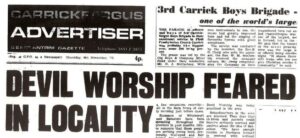
Jenkins attributes considerable blame for the scare to the province’s local newspapers, which generally reported the stories with ‘very modest facts’ that were ‘inflated and misrepresented’, ‘framed with unconnected material’ and ‘ornamented by apparently authoritative, if somewhat imprecise, anonymous information.’  Admittedly, those newspapers were under massive pressure.  A few years earlier their main stories had been about ‘livestock sales’ and ‘the Women’s Institute’ but now they were regularly covering ‘intimidation, murder and mayhem.’  Thus, standards weren’t high among their beleaguered journalists.
 

© Carrickfergus Advertiser


Fascinatingly, another possible culprit identified is the British Army, which depending on your political viewpoint was then in the province as protectors or oppressors, as peacekeepers or occupiers.  Jenkins provides evidence suggesting the army was happy to stir the pot of black-magic rumours.   It conducted ‘black propaganda’ operations promoting the belief that, yes, diabolical things were going on and religious and / or superstitious Northern Irish parents should keep their offspring off the streets at night.  On those streets, they were actually unlikely to tangle with devil worshippers; but they could tangle with paramilitaries or the security forces.


Jenkins prints an interview conducted in 1993 with the legendary Intelligence officer and ‘psychological warfare’ expert Colin Wallace, who claims he and his men went around Northern Irish properties mocking them up with magic circles, esoteric symbols, blood, bones, candles and inverted crosses to make it look like unspeakable rituals had taken place in them.


Tragically, one element in the stories was real – the child who, my classmates had told me, had been ‘cut to pieces’.   Jenkins devotes a chapter to the murder of ten-year-old Brian McDermott.  Brian was reported missing from his home in east Belfast at the start of September 1973 and his remains, ‘burned, mutilated and partially dismembered’, were discovered in the River Lagan a week later.  Although the police dismissed the idea that the murder was the result of some occult ritual, Jenkins notes how “a ‘black magic’ interpretation of the murder of Brian McDermott became an established tale of the Northern Irish Troubles.”  Officially the crime remains unsolved.  According to the journalist Martin Dillon, British Army Intelligence suspected the killer as being John McKeague (himself killed in 1982), one of the conflict’s most notorious and feared loyalist terrorists.  However, the fact that McKeague was in prison at the time of the murder casts doubt on his culpability.


Richard Jenkins conducts his investigations with academic thoroughness, analysing certain stories and rumours from different perspectives as he goes through the various actors in the drama – the Troubles, religion, superstitious belief, the media, the army, etc.  His approach is exhaustive and may seem exhausting to the casual reader.  However, I found Black Magic and Bogeymen fascinating – well, I was there at the time – and it’s surely the last word on the subject.


Returning to my own experience, I recall being asked in December 1973 if I wanted to go to the Christmas pantomime being held at Enniskillen High School and telling my parents flatly that no, I didn’t, because Enniskillen was full of witches and devil worshippers.  My Dad went ballistic at me for believing such ‘a pack of nonsense’ and then demanded to know who’d told me those stories.  I gave him the names of my guilty classmates.  “More fool you,” he raged, “for listening to them slabbering eejits!”  And that was that.  I stopped worrying and agreed to go to the pantomime.  Somehow, that angry burst of rationality from my Dad cured me of my fears.


Surprisingly, decades later, I remember my Dad – who originally hailed from Country Cavan in the Irish Republic – having a whiskey with an old Irish friend.  The pair of them started talking about their childhood in the Irish countryside and how, once the sun went down, their family members would tell ghost stories.


“I’m not kidding,” marvelled my Dad.  “After dark, you’d be too terrified to step outside the house.”


“I think,” said his friend, “that was why they told us them stories.”


Which proves I wasn’t the first member of the family to be troubled by tales of ghosts, fairies, banshees, black magic and bogeymen.
 

© Hammer Films / Seven Arts Productions / 20th Century Fox
Edith gets eerie: E. Nesbit’s ghost stories


© Greyladies


Until recently my single point of reference for the English writer E. (Edith) Nesbit, who lived from 1858 to 1924, was her children’s book The Railway Children (1906).  I have memories of my primary school teacher, Mrs Atkinson, reading this book to us in instalments when I was eight or nine years old; and, later, I saw the 1970 film version of it, directed by Lionel Jeffries, on TV.


The bit of The Railway Children that’s always remained in my head comes from the film.  The three kids, played by Jenny Agutter, Sally Thomsett and Gary Warren, witness a landslide that buries a section of railway track and they have to warn an approaching train to slow and stop before it crashes cataclysmically into the rubble.  This necessitates Agutter and Thomsett stripping off their red bloomers and waving them like flags in the air.


I should say I was at an age where I was more interested in the landslide – I recall being spooked by Gary Warren exclaiming, “Look at that tree over there… Lord, it’s moving!” – than in the sight of Jenny Agutter, who’d later appear in Walkabout (1971), Equus (1977) and An American Werewolf in London (1981), and Sally Thomsett, who’d later appear in Straw Dogs (1971) and the popular TV sitcom Man about the House (1973-76), waving their brightly-coloured undergarments at a locomotive.


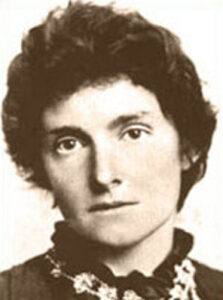
So, E. Nesbit was known to me as a children’s writer and as the author of one children’s book in particular.  But she also wrote adult literature, poetry and non-fiction, as well as being a founding member of that venerable British democratic-socialist organisation the Fabian Society, whose other early members included George Bernard Shaw, H.G. Wells, Ramsay MacDonald and Emmeline Pankhurst.  Despite writing items such as Women and Socialism: from the Middle-Class Point of View and Women and Socialism: A Working Woman’s Point of View (both 1885), she was not a fan of women’s suffrage – according to her Wikipedia entry, “mainly, she claimed, because women could swing Tory, thus harming the Socialist cause.”


Meanwhile, her personal life was unpleasantly complicated and sometimes tragic.  Her first husband, Hubert Bland, was a philandering cad who sired three children with two other women while he was ostensibly married to Nesbit – Bernard Shaw observed that Bland had “simultaneously three wives, all of whom bore him children.”  Nesbit lost her father at the age of three, her only sibling when she was around 12, and a son when she was in her early forties.


I wasn’t familiar with her backstory when, a short time ago, I picked up a paperback collection of seven of her ghost stories.  If I’d known more about her, I might have been less surprised at what I read.  Nesbit’s tales of the supernatural aren’t the comfy, cosy ones you associate with her time and place, i.e., Victorian and Edwardian England, where there’s a popular image of well-heeled gentlemen and ladies assembling around a log-fire at Christmas-time, with glasses of port and sherry, for the purpose of mildly spooking each other by telling a ghostly ‘yarn’.  No, Nesbit’s stories have unexpected bite.


The opening  one in the collection, From the Dead, begins with some painful marital complications not wholly dissimilar to those Nesbit faced with Hubert Bland.  A maliciously forged letter causes the narrator to abandon his fiancé and marry someone else.  When he learns the letter was forged, he casts out his wife in disgust.  A change of heart sends him in search of her but, months later, when he finally locates her, he’s informed that she’s just died in childbirth.  There ensues a scene that put me in mind of the apparition near the end of Edgar Allan Poe’s The Fall of the House of Usher (1839).  The newborn child survives but the final line remarks sombrely: “It is four years old now, and it has never spoken and never smiled.”


John Charrington’s Wedding is more straightforward and traditional but it ends too on a downbeat note: “I saw her face.  Shall I ever forget it.  White, white, and drawn with agony and horror, bearing such a look of terror as I have never seen since, except in dreams.”


Then comes Man-Size in Marble, perhaps the most famous of Nesbit’s ghost stories.  It has a young couple moving into a cottage in the English countryside where they discover, nearby, an ancient Norman church containing the funerary statues of two cruel-looking knights.  The husband also hears a legend about how every Halloween – or Hallowe’en as it was back then – those statues come to life and stalk around the neighbourhood.  He declines to tell his wife of the legend for the patronising reason that she “was always nervous, as highly strung natures are, and I felt that these tales… might have made our home less dear to my wife.”  Incidentally, he has a habit of calling her ‘Pussy’ and ‘Puss cat’, which reminded me of Henrik Ibsen’s famous indictment of the patriarchy, his 1879 play A Doll’s House.  In that, the beleaguered heroine Nora has to tolerate a husband who insists on calling her ‘skylark’ and ‘songbird’.


Partly due to the husband keeping his wife in the dark about the sinister legend of the statues,  Man-Size in Marble has a grim denouement too.


© Adorable Media / BBC Film


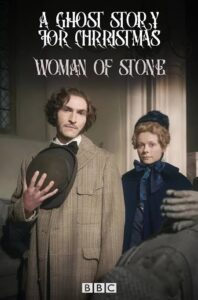
In 2024, Man-Size in Marble was adapted for television by Mark Gatiss, who retitled it Woman of Stone.  This was broadcast by the BBC on Christmas Eve as an instalment in the channel’s revived A Ghost Story for Christmas franchise (1971-78 and 2005-present).  Now I like Gatiss generally, and I like a lot of his work, but I’m not a fan of his adaptations of classic ghost stories penned by the likes of M.R. James.  I think they’re too glossy and overcooked and, somehow, they miss the authenticity that made the originals effective.  Anyway, I haven’t watched his version of Man-Size in Marble.  E. Nesbit features in it as a character, supposedly…  Played by Celia Imrie, no less.


Next is The Ebony Frame, whose narrator retrieves an aged painting from a storeroom not because of its canvas, which is blackened beyond recognition, but because he wants to reuse its frame, the ebony one of the title.  He discovers that the blackened panel at the front never had a picture at all, because the frame actually contains two pictures, turned inwards, secured face-to-face.  One of them, he’s shocked to learn, is of “Myself – in a cavalier dress, ‘love-locks and all’!”  The other is of “a woman of the type of beauty beloved of Burne-Jones and Rossetti.”  The sealed-together portraits point to a forbidden love affair in the distant past, while the narrator’s likeness to the cavalier suggests he’s the man’s descendent or even reincarnation.  Predictably, he’s soon having frighteningly realistic dreams where the saucy Burne-Jones / Rossetti lady comes to him, keen to rekindle their romance.


Yes, The Ebony Frame is yet another haunted-painting story – it was first published in 1893, three years after Oscar Wilde’s The Portrait of Dorian Gray.  But I found the idea of the two concealed pictures ingenious.


At ten pages, The Mystery of the Semi-Detached is the shortest thing in the collection.  It differs from the other stories in that it’s a dark tale of premonition.


Also different is the penultimate entry, The Pavilion.  From the conversations of the main characters, two young men and two young women, we learn how the title structure is connected to “some story about a wizard or an alchemist or something, and it was burned down, and then they rebuilt it in its present style.”  It’s also engulfed by the stems and leaves of what’s said to be a Virginia creeper, though one person observes that it looks ‘more like a South American plant’.  And because “there have always been so many rabbits and weasels and things found dead near it”, the pavilion is reputed to be haunted.  A dare is made and the young men spend the night in the place.  Needless to say, the creeper proves to be more mobile than anyone had thought.  The Pavilion contains some unexpected character dynamics, which elevate it above the level of most killer-plants-at-large horror stories.


Lastly is The Shadow, perhaps the clammiest and most dread-inducing tale in the collection.  This begins with the afore-mentioned scenario of Victorians making themselves comfortable at Christmas-time to tell ghost stories – but then takes the reader to places where there are ghosts but the vibe is definitely not comfortable.  Following a festive dance, three young woman gather in a room and entertain themselves with spooky tales.  Eventually, they invite the housekeeper to join them and coax her into telling one, and get more than they bargained for.


The Shadow features an entity that’s a harbinger – or a bringer – of death and, as the title suggests, its appearance is dark and incorporeal: “Between us and the coffin, first grey, then black, it crouched an instant, then sank and liquefied – and was gathered together and drawn till it ran into the nearest shadow.  And the nearest shadow was the shadow of Mabel’s coffin.”  Ultimately, the housekeeper’s young audience discover that the thing in her story has entered their world as well.


To sum up, these tales present a bleak view of the supernatural.  They depict it as a hostile realm, with the humans who blunder into it having mostly unhappy or tragic fates.  Also, in a couple of cases, the foolish actions of men help bring about fatal consequences for the female characters.  The stories are excellently written.  Like all good children’s writers, E. Nesbit perfected her craft writing for a readership who don’t have the patience to tolerate florid, overwrought and pretentious prose like many adults do.  As a result, her style is admirably clear and direct.


 From wikipedia.org

Steve Cashel is over the hill


© Still Here Magazine


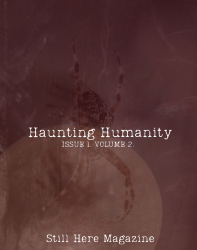
My story The Drove Road has recently been published in Volume 2, Issue 1 of Still Here magazine.  Appropriately for its appearance a few weeks before Halloween, this edition of Still Here is both themed and subtitled Haunting Humanity and, accordingly, The Drove Road is a ghost story.  However, its supernatural elements are very mild, perhaps existing only in somebody’s imagination.  So, rather than attribute the story to Jim Mountfield, the pseudonym I attach to the scary fiction I write, I’ve attributed it instead to Steve Cashel, the moniker I usually put on non-scary stories that are set in Scotland.


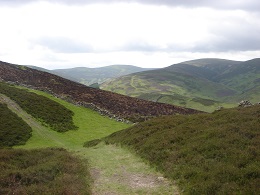
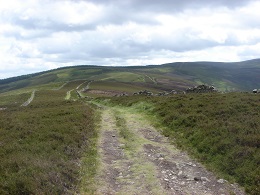
And The Drove Road has a particularly Scottish setting.  It’s inspired by the hike from Peebles, my hometown in the Scottish Borders, up to the top of 750-metre hill of Dunrig.  It’s a route that follows the old Gypsy Glen Drove Road and takes you past slightly lower summits such as Kailzie Hill, Kirkhope Law, Birkscairn Hill and Stake Law.


Two other things also inspired The Drove Road.  One is Alasdair Gray’s novel 1982, Janine (1984) – specifically a scene that occurs during a remembrance the main character, Jock McLeish, has of his youth, when he joined an amateur theatre group who were putting on a play at the Edinburgh Fringe.  One day McLeish and his aspiring-thespian friends fill in time between performances by ascending Edinburgh’s most famous natural landmark, the ancient, extinct volcano Arthur’s Seat.


The other influence is something entirely different.  It’s the Japanese YouTube anthology Fake Documentary Q (2021-present), whose episodes tell stories of the paranormal and unexplained via a ‘found footage’ (sometimes just ‘found audio’) format that employs various types of digital and analogue media.  My story’s plot is inspired by one episode in particular, which is about some friends making a pilgrimage.  But The Drove Yard also mimics the anthology generally in its use of assorted media — photographs, flyers, letters, emails, audio files, WhatsApp chats, etc. – to fill in the reader about what’s been happening.


Volume 2, Issue 1 of Still Here: Haunting Humanity can be downloaded for free here.  As ever, it’s a bargain.  This issue boasts no fewer than 19 short stories, 16 poems, two essays and seven pieces of art.


More things that terrified the young me


From wikipedia.org / © Group Three Productions


Here’s the second half of my account of things that scared me, to the point of scarring me, when I was wee.


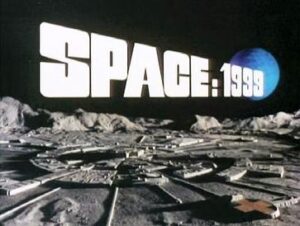
Space: 1999 – Dragon’s Domain (1975)

Even as a kid, I knew the TV show Space: 1999 was silly.  I already had enough awareness of science to realise the ridiculousness of its premise – a titanic explosion on the moon in the then-future year of 1999 sends it, and 300 human beings crewing a base there called Moonbase Alpha, careering out of earth’s orbit and into deep space.  Particularly ridiculous was how every second episode the moon hurtled into a new solar system and came close enough to an earth-type planet for the Moonbase Alpha folk to explore it.  Space: 1999 depicted the universe as a giant pinball machine with the moon bouncing between earth-type planets like the silver ball bouncing between the machine’s flippers and bumpers.


And yet…  A Space: 1999 episode called Dragon’s Domain petrified me.  It has the runaway moon approaching a sinister graveyard of abandoned spaceships in which a horrifying, one-eyed, tentacled monstrosity lurks.  Okay, seen today, the monster in Dragon’s Domain doesn’t impress, being a mass of wavy tentacles obviously animated by wires.  But the barrage of things that accompany it still inspire fear – it initially materialises as a swirling pattern of lights, it makes hideous shrieking noises and its victims are battered by gusts of wind.  Most horribly, moments after those victims are dragged into its maw, they’re spat out again as desiccated corpses, apparently drained of all their moisture.


There’s something about the episode’s ineluctability that got me too.  It focuses on a Moonbase Alpha member (Gianni Garko) who’s encountered the monster before.  While he was captaining a mission into deep space, it ate his crew and only he managed to escape.  Now stuck on the moon after its unexpected departure from earth’s orbit, fate has cruelly decreed that he’ll meet the thing again.


The pictures in The Horrific World of Monsters (1974)

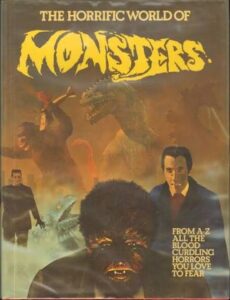
I might have been terrified by monsters like that Space: 1999 one, but I was also fascinated by them and in the mid-1970s I bought a hardcover, kids-orientated book called The Horrific World of Monsters by Dulan Barber.  This provided an A-Z of monsters from myth, folklore, cryptozoology, movies, TV and comics.


© Marshall Cavendish


Lavishly illustrated, a couple of the book’s page-sized movie-stills troubled me, lodged themselves in my psyche and occasionally caused me nightmares.  These depicted the mummy, played by Lon Chaney Jr in 1944’s The Mummy’s Ghost, throttling a victim; a fanged, hairy Michael Landon pouncing on a victim in I was a Teenage Werewolf (1957); and, in unflinching close-up, the title character of The Return of the Fly (1959), the second film in the series about a scientist experimenting with a teleportation device who gets his molecules mixed up with those of a fly and acquires a massive, insectile head.  Just as well it wasn’t a close-up of Jeff Goldblum from late in David Cronenberg’s 1986 remake of The Fly.  That sight would have left me gibbering.


Eventually, I sold the book to a schoolmate called Geoff Simmons, who was a gifted artist and who used some of its illustrations as inspiration for pictures – I remember him showing me one he’d drawn based on the mummy.  Geoff is now a graphic designer (and also a community historian) in London.  I’d like to think The Horrific World of Monsters played a small part in shaping his future career.


Bodega Bay gets attacked in The Birds (1963)

By the mid-1970s, someone had informed me that the Americans and Russians both had ‘bombs that could blow up the world’, so I had a new thing to worry about – the end of humanity.  Accordingly, apocalyptic movies frightened the bejesus out of me.  For example, Steve Sekely’s Day of the Triffids (1963), a cheap adaptation of John Wyndham’s 1951 novel, scared me with its depiction of a world where nearly everyone has gone blind.  Even at 10 years old, unfortunately, I could tell how shoddy its special effects were, especially the ones involving the triffids.


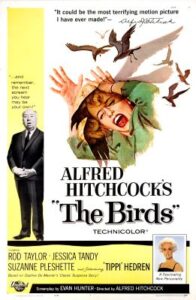
But the apocalyptic movie that traumatised me was 1963’s The Birds, directed by the impeccable Alfred Hitchcock and based on a 1952 short story by the equally impeccable Daphne du Maurier.  Most traumatic for me was the part where Tippi Hedren and Rod Taylor find themselves in a diner in the middle of the little coastal town of Bodega Bay, trying to convince the locals – who react with varying degrees of scepticism – that the area’s feathered population is behaving very strangely.  After seven minutes of conversation that mingles humour with growing unease, and is brilliantly performed by character actors like Doreen Lang (as an increasingly frightened mother), Charles McGraw (as a gruff fisherman), Ethel Griffies (as an elderly, know-all ornithologist) and Karl Swenson (as a Bible-quoting Irish drunkard), all hell breaks loose.


Multitudinous seagulls swoop down and cars and petrol pumps explode (thanks to fuel spewing from a dropped hose), more cars crash, horses run wild and many townspeople get clawed and pecked.  Hedren spends a nightmarish minute trapped inside a telephone booth with birds, plus one unlucky human victim, smashing into its sides.  Taylor rescues her and gets her into the diner again, but…  The atmosphere there is suddenly less welcoming.


From wikipedia.com / © Universal Pictures


Hitchcock’s orchestration of this blew me away.  The telephone-booth bit was possibly the first time I’d been exposed to what film-fans would describe as ‘pure cinema’.  But Taylor and Hedren’s return to the diner provides the chilling coup de grâce.  The people inside are cowering in terror, including Griffies’s no-longer-cocky ornithologist, and already a superstitious irrationality is taking hold of them.  This crystalises when a now-crazed Lang accuses Hedren of, basically, being a witch: “Who are you?”  What are you?  Where did you come from?  I think you’re the cause of all this.  I think you’re evil.  Evil!”  No doubt a young Stephen King was taking notes at this point.  Similar things happen in his 1980 novella The Mist, with many of its characters reacting to another apocalyptic event by succumbing to medieval-style hysteria.


Doctor Who – The Seeds of Doom, episode 4 (1976)

I could write a whole article based only on moments from the BBC’s long running science-fiction / fantasy / horror series Doctor Who (1963-89, 2005-25) that scared me: the shop dummies coming to life in the serial Spearhead from Space (1970); the killer plastic chair in Terror of the Autons (1971); the murderous Morris dancers in The Daemons (1971); a scaly hand appearing over a boat’s gunwale in The Sea Devils (1972); an infected crewman removing his hand from his pocket and revealing it transformed into a slab of glistening green slime (okay, it’s really green-painted bubble-wrap, but hardly anyone at the time knew what bubble-wrap was) in The Ark in Space (1975)…  But scariest of all was the 1976 serial The Seeds of Doom, about alien seed-pods that infect humans and transform them into malevolent, carnivorous plant-monsters.  Episode 4 of The Seeds of Doom, to be precise.


One alien pod becomes the possession of an insane millionaire plant-lover called Harrison Chase – played by character actor Tony Beckley, who’d been in The Italian Job (1969) and Get Carter (1971) – and at the start of episode 4 it germinates, infecting one of Chase’s minions, a hapless botanist called Arnold Keeler (Mark Jones).  Ignoring Keeler’s pleas to be taken to a hospital, Chase has him chained to a bed, purring in delight, “The rate of increase is astonishing…  Protein absorption from the animal, of course…  We shall have to give you some food soon…  You’re changing into a plant, Keeler…  a marvellous new species of plant!”


© BBC


With Keeler turning green, then fibrous, then tentacular, and Chase trying to speed up the metamorphosis by feeding him pieces of raw meat, what I was witnessing here was the icky sub-genre of horror known as ‘body horror’.  But it was the performances of Beckley and Jones, one disturbingly malevolent, the other distressingly pathetic, that truly conveyed the horribleness of the situation.


Legend Horror Classics, issue 4 (1976)

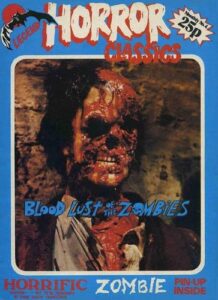
The same impulse that made me buy The Horrific World of Monsters inspired me to purchase issue 4 of a British film magazine called Legend Horror Classics, edited by Gent Shaw, who’d also edited the scary-movie magazine World of Horror in 1974-75.  Issue 4 of Legend Horror Classics was devoted to zombies, which until then I’d understood to be dead people brought back to life by voodoo and put to work on Caribbean sugar plantations.  By the 1970s, however, thanks to the influence of George A. Romero’s Night of the Living Dead (1968), zombie stories and films had become less voodoo-reliant and a lot grislier and more visceral.  This issue contained several gruesome photos that, like those in the Monsters book, gave me nightmares.


However…  Since then, I’ve discovered, indignantly, that the yuckiest pictures in the issue weren’t actually from zombie movies!  There was one of the mouldering, prehistoric ape-creature inhabited by an evil alien intelligence in the Christopher Lee / Peter Cushing horror film Horror Express (1972); and one of a rotting corpse (not reanimated as a zombie) from another 1972 movie featuring Christopher Lee, Deathline.  If you’re reading this, Gent Shaw, I’m accusing you of breaking the Trade Descriptions Act.


© Legend Publishing


The Nationwide report about the Hexham Heads (1976)

The Hexham heads were two little stone heads, possibly Celtic in origin, discovered in the northeast English town of Hexham in 1971.  Reputedly, the heads triggered paranormal activity in the homes of whoever had custody of them.  And that paranormal activity manifested itself spectacularly in the form of a werewolf that was glimpsed stalking through their homes after dark.


Infamously, Nationwide (1969-83) – normally a family-friendly TV current-affairs programme, which aired on the BBC every weekday evening after six o’clock – featured a report on the story in 1976.  The makers of the report had the not-so-family-friendly idea of spicing it up with ghastly screams, images of severed human heads and an unexpected jump-cut of Oliver Reed lurching towards the camera in 1961’s Curse of the Werewolf.  This approach traumatised every kid who happened to be watching, me included.


One eyewitness reported seeing the Hexham Heads werewolf after arriving home late at night – allegedly she spotted it prowling about her dark house before she switched on the lights.  Soon afterwards, my family moved from Northern Ireland to Scotland.  My parents frequently received invitations to Sunday lunch and dinner at the homes of Northern Irish folk they knew directly, or knew as friends of friends, who were now living in Scotland.  After much food, whisky and blethering, we wouldn’t get home until late on Sunday evening.  While my parents unlocked the front door and we entered a black, silent house, I’d think of the Nationwide report and wonder, “What if there’s a werewolf waiting in there?”


From wikipedia.org / © Archaeology Data Service / Dr Anne Ross


Footage of that legendary 1976 TV report on the Hexham Heads was long believed lost but it’s now been discovered and restored – see here and here.


Jon Voight’s dream at the end of Deliverance (1972)

By the time I was 12, I believed I was a mature, hardened type who’d seen everything and couldn’t be frightened anymore.  But then on TV one evening I watched John Boorman’s Deliverance (1972), about four Atlanta business men whose canoeing holiday in remote north Georgia turns into an ordeal, and was freaked out by it.


Oddly, it wasn’t the notorious sequence where some hillbillies rape Ned Beatty’s character and insist that he squeals ‘like a pig’ that upset me most.  Maybe I wasn’t old enough to fully understand what was happening.  No, it was the bit near the end where Jon Voigt’s character has a nightmare about the river they canoed on – which has since been dammed and turned into a lake – and sees a pale, bloated hand rising out of its water.  The image of that emerging hand haunted me for weeks afterwards.  I obviously wasn’t as tough as I thought I was.


© Elmer Enterprises / Warner Bros.


Thinking about it, I suppose I must have been a complete scaredy-cat whose childhood was one long procession of moments of terror.  So now, half-a-century later, why do I write short horror stories under the penname of Jim Mountfield?  I’ve had nearly 70 such stories published.


Perhaps it’s a case of ‘if you can’t beat ’em, join ‘em.”

Things that terrified the young me


From wikipedia.org / © Warner Bros Entertainment


We’ve entered October, the month that ends with the spooky and supernatural-tinged festival of Halloween.  I usually mark this time of year by posting some entries related to the macabre – well, I am a published writer of horror stories.  So, here is a piece listing the various things, in real life, in print, on TV or in the cinema, that terrified me as a kid and, possibly, affected my development and made me the person I am today.


The Tom and Jerry cartoon Heavenly Puss (1949)

When I was five or six years old, popular children’s cartoons that suddenly and without warning turned creepy were like booby traps for my delicate psyche.  For example, I remember watching an episode of The Inspector, which was part of The Pink Panther Show (1969-78), where the Inspector’s sleepy sidekick Sergeant Deux-Deux accidently drinks a mad scientist’s potion and turns into a hulking Mr Hyde-like monster.  This horrified me.


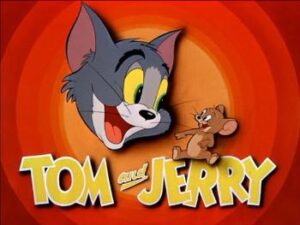
But my all-time cartoon nightmare came when I watched a Tom and Jerry short called Heavenly Puss, in which Tom is terrorised by a horned, red-pelted, green-eyed devil-dog – basically a satanic version of Spike the Bulldog – who keeps appearing and threatening to boil him alive in a cauldron.  I was living in Northern Ireland at the time, and was already having my head filled with warnings about the devil by the multiple religious personages who populated the place.  Seeing a similar, infernal figure intrude on something as innocuous as Tom and Jerry was deeply upsetting.


Incidentally, the 1942 Tom and Jerry short Fraidy Cat freaked me out too, though not quite as much as Heavenly Puss did.


Mij gets it in Ring of Bright Water (1969)

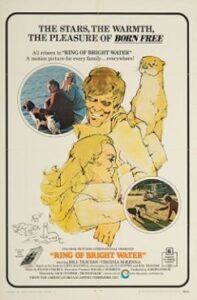
With this one I was less terrified than traumatised.  Many people my age go on about how they were reduced to quivering wrecks when they watched the animated, leporine bloodbath Watership Down (1978).  But a far worse experience for me was the movie Ring of Bright Water, based on the 1960 book of the same name by Gavin Maxwell, in which Bill Travers plays a hapless Londoner who rescues a rambunctious otter called Mij from a pet shop and ends up moving with him to the more otter-friendly environment of Scotland’s remote west coast.  Not only Mij thrives there – Travers does too, especially when he makes the acquaintance of the fanciable local doctor (Virginia McKenna).


© Palomar Pictures International / Rank Film Distributors


I saw Ring of Bright Water on TV in the early 1970s.  For most of its running time, it’s an amiable comedy in which Travers and Mij get up to amusing high-jinks.  Nothing prepares you for the ending.  McKenna is taking Mij for a walk when he gets his head flattened in a random act of violence by a shovel-wielding ditch-digger who regards otters as vermin.  It’s made even worse by the fact that Travers is in London at the time.  In the next scene he returns, cheerfully believing all is well, and McKenna has to interrupt his garrulous blather with the bald statement, “Mij is dead.”


It’s a sobering reminder of the fact that, no matter how much we sentimentalise animals, they frequently live or die – more often die – by the whims of humans beings.  But sneaking that reminder into what’d been, for the most part, a fun, good-natured family film seemed a bit rotten.


Playing the ditch-digger was the Glaswegian actor Archie Duncan, who passed away in 1976.  I wonder if that’s inscribed on his headstone: ‘HE KILLED MIJ.’


The Northern Irish satanic panic in 1973

According to the 2014 book Black Magic and Bogeymen by Richard Jenkins, Professor of Sociology at the University of Sheffield, a “wave of rumours about black magic, Satanism, animal sacrifice and child abduction… swept across the north of Ireland in late 1973 and early 1974.”  Jenkins notes that “(b)etween 5th August and mid-December 1973, sixty-five items about witchcraft and black magic appeared in the mainstream press north and south of the Irish border: news reports, features, editorials, letters to the editor, church reports, and what appeared to be religious announcements…  The reports peaked between mid-October and the third week in November, clustering around Hallowe’en.”


© Cork University Press


This was a classic example of what today we’d call a ‘satanic panic’ though, with the Northern Irish Troubles in progress at the time, Jenkins offers intriguing evidence that the British Army was stirring the pot with ‘black propaganda’ operations – i.e., trying to convince superstitious Northern Irish parents that the province was overrun with devil-worshippers so they wouldn’t let their kids outdoors at night.  Keeping them indoors meant there was less chance of them getting into genuine bother with the paramilitaries or the security forces.


Jenkins also observes that children were among the worst culprits for spreading the rumours.  I can testify to that.  I remember a girl in my class gleefully assuring me there was a family in nearby Enniskillen who drew their curtains as soon as it got dark and then spent all night performing ghastly black-magic rituals.  She also told me about goat-carcasses being found beside the river in Enniskillen with their hearts cut out and, worst of all, a child being abducted there, sacrificed and chopped into pieces.  Needless to say, gullible me swallowed every word of this and, for the next few months, the prospect of visiting Enniskillen petrified me.


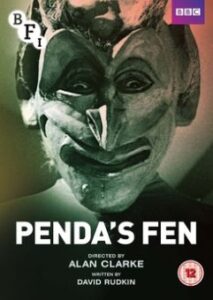
The trailer for Penda’s Fen (1974)

Today, Penda’s Fen is regarded as a visionary piece of TV drama.  Time Out magazine has described it, rather pompously, as a “multi-layered reading of contemporary society and its personal, social, sexual, psychic and metaphysical fault lines…” that fuses “Elgar’s Dream of Gerontius with a heightened socialism of vibrantly localist empathy, and pagan belief systems with pre-Norman histories and a seriously committed – and prescient – ecological awareness.”   Written by David Rudkin and directed by Alan Clarke, it was, however, seriously offbeat even by the standards of Play for Today (1970-84), the anthology series whose fourth season contained it as an episode.   Maybe that’s why I remember the trailer the BBC showed prior to its broadcast being so scary – the channel couldn’t make head nor tail of it and decided to market it as a folk-horror film.


© BBC


Two creepy moments of Penda’s Fen were included in that trailer.  Firstly, there was a sequence where the young hero (Spencer Banks) sits by the edge of a pool and sees reflected in it a statue of an angel – the statue stands behind him, but when he looks around it suddenly isn’t there anymore.  I wonder if the TV writer Steven Moffat saw this as a kid and, three decades later, it inspired him to create the Weeping Angels for the 21st-century reboot of Doctor Who (2005-25).  Even worse for my tender sensibilities was a sequence where Banks cowers in his bed while a devilish face hovers over him.  Living in super-religious Northern Ireland, I had no doubt at the time that devils and demons were real.  I didn’t want to wake up in the middle of the night and be confronted by a face like that.


Haunted by the images in its trailer, I didn’t watch Penda’s Fen when it was broadcast a few evenings later.  In fact, I didn’t see it in its entirety until several years ago and, of course, it was nothing like what my eight-year-old self had been led to believe.


Talos comes to life in Jason and the Argonauts (1963)

In my childhood I loved the movie Jason and the Argonauts, based on the Greek myth of Jason and the Golden Fleece.  I especially loved the mythical creatures in it like the hydra and harpies, which were animated by stop-motion-animation / special effects genius Ray Harryhausen.  One scene absolutely creeped me out, however, and has stuck in my memory ever since.  That’s when Jason and co. arrive on an island populated by gigantic bronze statues and Hercules (Nigel Green) and Hylas (John Cairney) not very smartly steal a giant broach from a treasure chamber inside the plinth of the statue of Talos.  They’re discombobulated, to say the least, when the head of the titanic statue slowly turns and its bronze face gazes down at them, impassively but accusingly.


© Morningside Productions / Columbia Pictures


I think it’s the creaking noise that accompanies the twisting of Talos’s neck that gets me – every time I watch it.


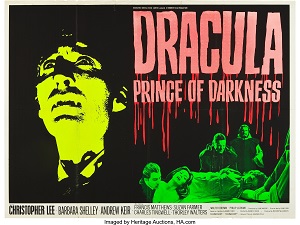
The first half of Dracula, Prince of Darkness (1966)

The horror movies made by the famous British studio Hammer Films aren’t regarded today as being particularly frightening.  At their best, they have a wonderful gothic flamboyance.  At their worst, they’re endearingly tacky.  But genuinely frightening?  Not really.  However, when I was a kid, some of them turned up on TV for the first time and, to me then, they did seem scary.  For instance, Quatermass and the Pit (1968) left me shaken.  But it was the first half of Hammer’s Dracula, Prince of Darkness that truly gave me the willies.  I say ‘first half’ because when I initially saw it on TV, that was all of it I could take.  At its midpoint, I threw in the towel and retreated to bed.


In part, the film’s impact on me was due to misleading expectations.  I knew Dracula was villainous but didn’t think he could be frightening.  I’d already seen a couple of old black-and-white films featuring the character, made by Universal Studios, where he was played in a raffish fashion, by John Carradine in House of Dracula (1945), or in an urbane and slightly camp one, by Bela Lugosi in Abbott and Costello Meet Frankenstein (1948).  So I wasn’t ready for Christopher Lee’s portrayal of him in Dracula, Prince of Darkness, where he alternates between being chillingly imperious – he unsettlingly doesn’t utter a word of dialogue during the whole film – and being a hissing, spitting hell-fiend.


In fact, Dracula is hardly in the movie’s first half.  It begins with a prologue showing him being reduced to ashes, by Peter Cushing, at the climax of the previous instalment in Hammer’s Dracula series.  What follows is a grim tale in which four naïve English travellers (Francis Matthews, Suzan Farmer, Barbara Shelley and Charles Tingwell) end up spending the night at Castle Dracula and an acolyte (Philip Latham) slaughters one of them and uses his blood to revive his dead master.  The sight and sound of copious blood splattering down onto the Count’s powdery remains inflicted another scar on my already heavily-scarred young psyche.


© Warner Pathé / Hammer Films


I’ll post about more things that terrified my juvenile self shortly.