Rab Foster does some ghostwriting


© Spiral Tower Press


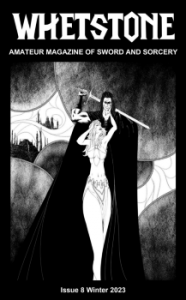
Rab Foster, the pseudonym under which I write fantasy – and usually the sweaty sub-genre of fantasy known as sword-and-sorcery – fiction, has just had a second short story published this month.  Entitled The Ghost Village, it appears in issue 8 of the magazine Whetstone from Spiral Tower Press.


Described by editor Jason Ray Carney as straddling ‘the line between folk horror and sword and sorcery’, The Ghost Village was inspired by Thailand’s San Phra Phum or, as they’re known in English, Thai spirit houses.  These are the miniature buildings you see outside nearly every Thai home and business, held aloft like bird-tables on wooden pillars, fragranced by smouldering incense sticks and often garlanded with flowers.  Their raison d’être is to provide accommodation for the spirits residing on the premises and to keep those spirits contented, so that they don’t move into the human building and cause ghostly high-jinks there.


Once, when I was in the northern Thai city of Chiang Mai, I was passing a construction site.  An old building had just been demolished and a new one was about to be built there.  Nearly everything in the area had been flattened and a digger was prowling around, removing the last of the rubble.  But remaining untouched and intact in the middle of the site were a pair of spirit houses.  Apparently, it’s a bad idea to destroy spirit houses and render their inhabitants homeless.  So even Thai developers who wouldn’t think twice about bulldozering an old human property need to exercise caution in how they treat the miniature dwelling next door to it.



I had long wanted to write a creepy story about Thai spirit houses, but was wary of penning something that used Thai people’s religious beliefs and cultural practices for a cheap scare.  As someone who’s lived long-term in Asia and Africa, I find stories that have Westerners blundering into ‘exotic’ – shorthand for ‘less civilised’ – countries where they run foul of some local deity, myth or piece of folklore extremely patronising.  Basically, they steal a bit of someone else’s culture to use as a monster or some other source of horror.  So, it made sense to me to take the basic concept of spirit houses – flesh-and-blood people maintaining a second house where beings from the incorporeal world can reside – and put it in a fantasy context instead. Then I could build up my own mythology around it.  What I ended up with was Rab Foster’s latest published story, The Ghost Village. 


For more information about Whetstone magazine, click here.  And issue 8, which contains my story and a dozen other works of short fiction and poetry, can be downloaded here for free.

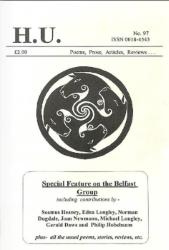
The return of Paul McAllister


© Bindweed Anthologies


My writing career has seen some unexpected pseudonymous comebacks in late 2023.  Last month, I revived the pseudonym Steve Cashel for a Scottish-set crime story entitled The Folkie, which was published in the online magazine Close 2 the Bone.  Steve Cashel was a penname I’d used a couple of times in the past, most recently in 2011, for short stories that were set in Scotland and had non-horrific and non-fantastical plots.


Now Winter Wonderland 2023, the latest in a series of biannual anthologies from Belfast’s Bindweed Magazine, features a short story of mine called The Magician’s Assistant and the name on it is another pseudonym I used in the past and didn’t expect to use again: Paul McAllister.


In fact, I only used Paul McAllister once and that was a long time ago indeed.  In the mid-1990s I had a short story called The Darkness Under the Earth published in issue 97 of the venerable Northern Irish literary magazine The Honest Ulsterman, or HU as it was sometimes abbreviated to.  I’d heard that the magazine folded in 2003, but apparently it’s been revived and is on the go again as an online publication.


© The Honest Ulsterman


I suspected that my real name, Ian Smith, was too boring and non-descript to stick at the top of a story.  Besides, the well-known Scottish writer Iain Crichton Smith, who wrote in both English and Gaelic, was still alive then.  I’d known Iain Crichton Smith slightly, as he’d been the writer-in-residence at Aberdeen University during the last two years I’d studied there, and wanted to spare him the embarrassment of having my work confused with his…  As The Darkness Under the Earth was set in Northern Ireland and was being submitted to a Northern Irish publication, I figured I should stick a vaguely Northern-Irish-sounding name on it and decided on Paul McAllister.


In fact, The Darkness Under the Earth was only the second piece of fiction I had published, and it was the first piece to appear in a magazine that paid its writers.  Not that The Honest Ulsterman paid them lavishly.  I received a cheque for five pounds.  Also, I was a bit put-out to discover that the editor had sneakily made the cheque payable to ‘Paul McAllister’, not ‘Ian Smith’, which made it impossible for me to cash.  That cheque now resides in a box somewhere as a historic artefact.


Seeing as The Magician’s Assistant was set in Northern Ireland, was a straightforward story based on a couple of incidents I remembered from my childhood there, and had none of the usual horror or fantasy shenanigans I normally write about, I thought when I submitted it to Bindweed Magazine it would be fun to dust down the name of Paul McAllister and attribute it to him.  And hey presto.  Paul McAllister is suddenly back in print.


Containing 163 pages of fiction and poetry described as ‘experimental, offbeat and one of a kind’, Winter Wonderland 2023: Bindweed Anthology can now be purchased as a paperback at Amazon US, UK and Canada.  For details of how to read it on Kindle, click here.

Rab Foster puts his boots on


© Schlock! Webzine


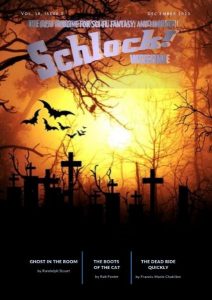
The horror, science-fiction and fantasy fiction ezine Schlock! Webzine has just made its December 2023 edition available.  This contains the first instalment of a two-part story written by Rab Foster, the pseudonym I use when I pen fantasy fiction.


Entitled The Boots of the Cat, the story is about the adventures – or misadventures – that befall a handful of mercenaries attached to a military outfit called the Legion of Beasts.  Their legion has been sequestered in the middle of a city that’s less than welcoming to them, both climatically (because it’s raining incessantly) and attitudinally (because the place is bourgeoisie and snooty), and inevitably conflict arises between them and the locals.


As the story progresses, the influence of a certain, popular fairy tale becomes more and more apparent.  And no, despite the title The Boots of the Cat, that fairy tale isn’t Puss in Boots.


For the next month, the first part of The Boots of the Cat can be read here, while Schlock! Webzine’s home page can be accessed here.

Jim Mountfield goes to the dogs


© The Stygian Lepus


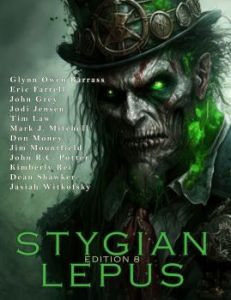
My short story A Man about a Dog is featured in the new, eighth issue of The Stygian Lepus Magazine, a short-fiction and poetry publication that ‘leans to the dark side’.  And as usual with my writing that leans that way – dark-wards – it appears under the penname of Jim Mountfield.


A parable about how human beings treat and mistreat dogs and, indeed, how human beings treat and mistreat each other, A Man about a Dog is set in an anonymous north-of-England city during the grim, austerity-stricken years of the 2010s.  Well, the setting was inspired by the three years I spent living in Newcastle-upon-Tyne, which strictly speaking isn’t a north-of-England city but a northeast-of-England one.  I lived there from 2002 to 2005, when the place had a buzz and sense of optimism about it, largely due to new developments like the Quayside, the Millennium Bridge, the Baltic Gallery, the Sage (now known as the Glasshouse) Music Centre and Antony Gormley’s striking Angel of the North statue.  Okay, most of those things are actually in Gateshead, which has its own council, independent of the Newcastle one.  So, I’m really talking about ‘Newcastle-Gateshead’ here.


From all accounts, though, the place took a battering during the 2010s, when the just-installed Conservative government imposed an austerity programme on Britain.  300 million pounds had been cut from Newcastle’s council budget by 2019 and the decade saw the closure of local libraries, youth clubs, children’s centres and other amenities.  Between 2013 and 2018 there was even an 89% reduction in the number of its lollipop men and women, leaving just seven of them to shepherd the city’s schoolkids safely across the roads.  By an evil coincidence, the week A Man About a Dog was published also saw the return to public office of the smug, oleaginous and stuck-up architect of austerity, former British prime minister David Cameron – Rishi Sunak has ennobled him as ‘Lord Cameron of Chipping Norton’ and made him the country’s Foreign Secretary.


An American publication, The Stygian Lepus requests its contributors to submit their work in American English.  I slipped up slightly and made a few references to ‘wheelie-bins’ in my submitted story.  When I saw the version of A Man about a Dog that appears in the magazine, it amused me that the wheelie-bins had been changed to ‘dumpsters’.  So, it’s just as well I kept the city in the story anonymous and didn’t identify it as Newcastle.  You don’t hear many Geordies talking about dumpsters.


For the next while, A Man About a Dog is accessible to read here, while the main page for The Stygian Lepus, Issue 8, can be reached here.

The return of Steve Cashel


© Close 2 the Bone Publishing


Because I have a dull name, I’ve normally written fiction under pseudonyms.  Most of the stories I’ve had published have been horror ones, which I’ve written under the pen-name Jim Mountfield, or fantasy ones, which I’ve written as Rab Foster.  However, many years ago, I had a couple of pieces published that didn’t qualify as horror or fantasy.  One was a crime story and I suppose the other was ‘non-genre’ – what snobby critics approvingly describe as ‘mainstream literature’.  Both were set in Scotland and I thought I’d attribute them to a different pseudonym: ‘Steve Cashel’.


Well, since then, I seem to have specialised in being a horror and fantasy writer and the names Jim Mountfield and Rab Foster have appeared fairly regularly in various short-fiction magazines and ezines.  On the other hand, I’d assumed that Steve Cashel had been retired… Until now.


That’s because I’ve just had a crime story entitled The Folkie published in the online magazine Close 2 the Bone.  As the story’s action takes place in Scotland, in Edinburgh, it seemed appropriate to put Steve Cashel’s name at the top of it.


The Folkie is about three hoodlums tasked with hurting someone who’s antagonised their crime-lord employer.  Searching for their victim, they go round several Edinburgh pubs he’s known to frequent.  They find to their disgust that he’s a folk-music fan, for the pubs are ones offering live folk music and drawing crowds of enthusiastic folk-music fans, i.e., folkies.  And then things take the inevitable Unexpected Turn…  The three pubs appearing in the story are based on real ones – the Royal Oak on Edinburgh’s Infirmary Street, the Tass on the High Street and the Hebrides Bar on Market Street.  Though for the purposes of the plot, I changed the layout of the Hebrides’ interior.


Due to its conflicting story-elements, The Folkie is a rare beast indeed – a tale that references Coolio, the great Dick Gaughan (whom I was lucky enough to see perform once, at Norwich Labour Club in 1998) and…  Andy Stewart.


For now, at least, The Folkie can be read here, while you can access the main page of Close 2 the Bone here.


© Hallmark

Jim Mountfield takes to the trees


© Spiral Tower Press


Jim Mountfield, the pseudonym under which I write horror stories, has been on a roll this month – which, appropriately enough, is October, the month of Halloween.  Already in October 2023 he’s had short stories appear in the online publication Schlock! Webzine and in the collection Nightmare Fuel: Mind Terrors 2023.  Now he’s just had a third story, entitled The Shelterbelt, published in Issue 3 of the magazine Witch House.


As its title implies, The Shelterbelt concerns a plantation of trees grown next to a property to shield it against the elements.  In the story, the property is a farm in a remote part of southern Scotland.  I didn’t have to look far for inspiration for The Shelterbelt.  In 1977, my parents sold our farm in Northern Ireland and purchased and moved to a new farm in southern Scotland, near the town of Peebles.  But the steading we found ourselves living in was hardly ‘new’ – it was a dilapidated and bleak-looking place at the time, with scarcely a tree anywhere, which was unfortunate because the steading was in a north-south-running valley and in the pathway of any bad weather borne by the north wind.  Several times during our first few winters there, we had to dig our way out from our front door, so heavily had snow been piled against it.  How long ago that seems now in these globally-warmed times…


My Dad immediately decided to create a shelterbelt on the northern side of the steading.  I still remember the day when he, my Mum and a good friend from Northern Ireland, Hugh Buchanon, planted the saplings.  Maybe I remember it because I discovered then how seriously my Dad – who was normally relaxed and easy-going – took his work.  He was very exacting.  He was very particular about how far apart those saplings were placed – not too close, not too distant.  After an hour of listening to him, my Mum and Hugh looked ready to plant him along with the trees.


Meanwhile, a literary influence for The Shelterbelt is the 1914 short story Ancient Lights by the author, broadcaster and occultist Algernon Blackwood.  And I’d be lying if I said a certain 1973 movie, about an uptight, virginal, Free Presbyterian policeman investigating a possible case of human sacrifice on a remote Scottish island, didn’t provide a little inspiration too.


For more information about Witch House magazine, click here.  And Issue 3, containing my story and a dozen others, can be downloaded here for free.

Jim Mountfield is mad about books


© Cloaked Press LLC


Nightmare Fuel: Mind Terrors 2023 is a new anthology of psychological horror stories published by Cloaked Press LLC.  I’m delighted to say it includes a story I wrote under the nom de plume of Jim Mountfield, which I use for scary fiction.  My tale is entitled One for the Books and is about weird, then macabre happenings in a second-hand bookshop that might – possibly – be taking place only in the fevered imagination of one of the bookshop’s customers.


The bookshop in the story is inspired by the real and wonderful Armchair Books, which resides at 72-74 West Port in Edinburgh.  It’s been many years since I was last in the shop.  I haven’t been in it since 2014, in fact.  Back then, I wrote of it: “A guddle of boxes of super-cheap books on the pavement outside, its walls inside stacked to the ceiling with thousands, if not zillions, of tomes, it is actually two premises – number 72 mostly sells fiction, number 74 next door sells non-fiction…  It does seem a bit better organised these days…  In times past, the supposed alphabetical arrangement of the books’ authors would lead you on a merry dance, back and forth and into all sorts of awkward nooks and crannies.  Also, the cranky and entertaining notices that used to be stuck on the walls, in which the management expressed its disdain for health-and-safety inspectors – I assume at some point the council criticised the place, with its vertiginously high shelves, for exposing customers to possible death-by-avalanche-of-books – seem to have all come down now.”


During the Covid-19 pandemic I worried about how Armchair Books was faring.  And, although I was in Edinburgh just a few weeks ago, I didn’t have time to venture down to West Port to check if it was still on the go.  Thankfully, according to its website, it is still operational.   I hope the same applies to the other second-hand bookshops that I used to visit on West Port and along the adjoining Bread Street – Peter Bell Books, Edinburgh Books, Main Point Books, Pulp Fiction, etc. – and that made the neighbourhood such a pleasure to explore.


Meanwhile, Nightmare Fuel: Mind Terrors 2023, among whose 219 pages of madness my story lurks second from the end, can be purchased on Kindle or as a paperback here.

Jim Mountfield eats his neeps


© Schlock! Webzine


We’re now into October, a month that climaxes with the festival of Halloween.  Thus, it’s appropriate that I have just had a Halloween-themed short story published in the October 2023 of the online fiction publication Schlock! Webzine.  Entitled The Turnip Thieves, it appears under the name of Jim Mountfield, the pseudonym I use for horror, ghost and generally ‘dark’ stories.


The Turnip Thieves takes place on a Scottish hill farm in the early 1980s.  It begins with a farmer noticing strange activity on a distant strip of ground where he’s planted turnips – ‘neeps’ as they’re called in the Scots language.  As it’s one day before Halloween, he thinks he knows what’s afoot.  Kids from a nearby town, he assumes, must be trying to steal his neeps, so they can make lanterns from them for the upcoming festival.  And, vengefully, he sets off to intervene…


The story is a nostalgic invocation of a time before pumpkins became widely available in Scottish supermarkets and when Scottish trick-or-treaters – or ‘guisers’, to give them the correct Scottish terminology – had to make do with the turnip, the pumpkin’s humble root-vegetable cousin, as a substitute for fashioning Halloween lanterns.  Actually, the shrunken, wizened visage of a turnip lantern is, to my mind, much creepier than that of a pumpkin one.  On the other hand, howking the hard, pale flesh out of a turnip required a lot more effort than gutting a pumpkin did.  And once you had a candle burning inside it, a turnip lantern stank…  Or, as they say in Scotland, it reeked.


The main page of Schlock! Webzine’s October 2023 edition – Volume 17, Issue 15 – can, for the next few weeks, be accessed here.  The Turnip Thieves itself can be read here.


And during the run-up to Halloween, I hope to post a few things relating to the macabre, ghostly and generally dark on this blog, in keeping with the spirit of the season.


© Dave Cockburn

Rab Foster does fear the reaper


© Cloaked Press LLC


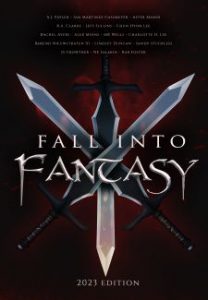
Vision of the Reaper, a short story by Rab Foster, the pseudonym under which I write fiction of a usually sword-and-sorcerous hue, is one of the tales in a new collection called Fall into Fantasy 2023 from the publisher Cloaked Press.  The story takes place in a giant wheatfield and has among its ingredients not only the titular, fearsome Reaper but also windmills, crop circles, corn dollies and pretty-much everything connected with the culture of crops and harvesting that I regard as cool.  (Not scarecrows, though – I think scarecrows are overused in the fantasy genre.)


The story also introduces a character called Cranna the Crimson, about whom I hope to write more fiction in the future.  She’s a swordswoman who, in addition to having to deal with the usual sword-and-sorcery fixtures of evil magicians, monstrous creatures and so on, has to deal with medieval-style male chauvinists as well.  Cranna is well-equipped for this, being the sort who takes no shit from anyone.


Offering 16 stories and 343 pages of fantasy-related goodness, Fall into Fantasy 2023 is available on kindle and as a paperback here.


And of course, this gives me an excuse to link you to one of the greatest songs in American rock-music history.  Guess which song.

More gibbering, and gibbeting, from Rab Foster


© Swords and Sorcery Magazine


Rab Foster, the pseudonym I use when I write fantasy fiction, has just had a second short story published in 2023.  As with the previous Foster story, The Pyre of Larros, which appeared in print five months ago, this one is featured in Swords and Sorcery Magazine and has as its main character the swordsman Drayak Shathsprey, who seems doomed to get into serious trouble wherever he goes.  In The Gibbeting of Azmyre, now available to read in issue 138 of Swords and Sorcery Magazine, that trouble involves being hired by a shady character to retrieve an insalubrious item – the corpse of an executed criminal, currently hanging on display in a city’s main street.


The idea for The Gibbeting of Azmyre came to me a while back when I started reading the 1951 novel My Cousin Rachel by one of my literary heroines, Daphne du Maurier.  This begins with an account of how the narrator, Philip, is brought by his cousin and guardian Ambrose to view the gibbeted body of a murderer.  “I can remember as a little lad seeing a fellow hang in chains where the four roads meet.  His face and body were blackened with tar for preservation.  He hung there for five weeks before they cut him down, and it was the fourth week that I saw him.”


Meanwhile, the windswept and snow-scoured city street where the action in The Gibbeting of Azmyre takes place – “its floor a band of flagstones and cobbles carpeted with snow, its walls two towering rows of facades and edifices, spires and turrets, five and six-storeyed townhouses” – was inspired by the Royal Mile in Edinburgh.  (Yes, it’s appropriate that I had the Scottish capital in mind while I wrote a story about bodysnatching, although strictly speaking Edinburgh’s two most famous bodysnatchers – Burke and Hare – didn’t actually snatch bodies.  They murdered people, and then flogged off their victims’ remains to Dr Robert Knox for vivisection during his anatomy lectures.)  The Royal Mile doesn’t experience many snowstorms in these globally-warmed times, but it’s still a challenge to walk along when there’s a stark east wind flaying in from the nearby North Sea.


For the next month, The Gibbeting of Azmyre can be read here, while the main page for issue 138 of Swords and Sorcery Magazine is accessible here.