Du Maurier, du merrier (Part 1)


© Penguin Books


As Halloween is approaching, here’s a reposting of something I once wrote about the novella that inspired one of the greatest horror movies of all time – Daphne du Maurier’s 1971 tale Don’t Look Now, turned into the Nicolas Roeg movie of the same name two years later.  And there’s mention of some other disquieting stories by her too.


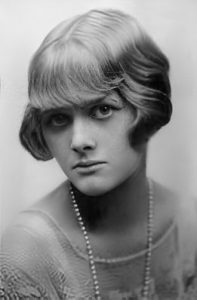
I have a tiny sliver of a connection with Daphne du Maurier, the popular 20th century English writer responsible for novels like Jamaica Inn (1936) and Rebecca (1938) and short stories like The Birds (1952) and Don’t Look Now (1971).  When I was at college in the 1980s, I knew her great-nephew very slightly.  Actually, I was better acquainted with her great-nephew’s flatmate and a few times, because of him, I visited their apartment.  Its walls were slathered with pictures of George Michael and Andrew Ridgely from the then-massive pop duo Wham, cut out of popular teen magazines of the time like Smash Hits and No 1.  I assume the young du Maurier and his flatmate had stuck up these pictures in an attempt to appear ironic.  Unfortunately, it meant that thereafter when I saw his great-aunt’s name on the cover of a book, I couldn’t help but hear, by way of association, the irritatingly bouncy strains of such Wham pop-dance numbers as Club Tropicana (1983) or Wake Me Up Before You Go-Go (1984).


For a long time the only thing by Daphne du Maurier I’d read was The Birds (1952), a story that because of its remote Cornish setting feels even more claustrophobic and desperate than the North America-set film version directed by Alfred Hitchcock in 1963.  However, a while back, I got a chance to familiarise myself with more of her fiction when my partner gave me a copy of du Maurier’s 1971 collection Don’t Look Now and Other Stories as a present.


A novella about a grieving English couple who’re taking a break in Venice when they’re approached by two strange women – one of whom claims to be a medium – and told that their dead daughter’s spirit is trying to warn them against danger, Don’t Look Now has been filmed too.  Nicolas Roeg directed a movie version in 1973 and it’s now regarded as a classic, both as a horror film and as an example of Roeg’s work in the 1970s and 1980s, which combined fragmented and elliptical narratives, haunting and recurrent images and scenes of violent and sexual intensity to unforgettable effect.  Having seen the film several times over the years, I was keen to read the piece of fiction that’d inspired it.


My first impression when I started reading Don’t Look Now was that film and story felt like they belonged to different eras.  The couple, John and Laura, seem more modern, liberated and chic in the film, though that may be because they were played by 1970s icons Donald Sutherland and Julie Christie.  On the page, John and Laura have an old-fashioned English starchiness and they try to get over their loss with stiff upper lips and a strained Keep Calm and Carry On cheerfulness.  Also, the literary John and Laura are in Venice as tourists, so they seem less confident and more vulnerable.  Their cinematic equivalents are there for work reasons – John is helping to restore a Venetian church – and thus know their way around better.


Then there’s the presentation of the story.  Du Maurier’s novella is a briefer and more economical account of the events I was familiar with from the film.  As it stands, it could easily have been made into a 45-minute TV play.  (The film clocks in at 110 minutes.)  It begins in Venice with John and Laura encountering the medium.  The death of their daughter, by meningitis, is mentioned retrospectively.  And the suggestion that the dead girl’s spirit is urging them to leave the city before something terrible happens feels like a simple device to kick-start the main story – wherein John doesn’t leave Venice, through a series of mishaps, misunderstandings and further supernatural shenanigans; and then, when he tries to intervene in what he thinks is the mistreatment of a child, something terrible does happen.


© Casey Productions / Eldorado Films / British Lion Films


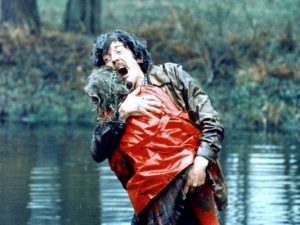
The movie opens with a harrowing sequence showing the death of John and Laura’s daughter – not by meningitis but by drowning in a pond in the English countryside.  Roeg and his scriptwriters Allan Scott and Chris Bryant create a sense of a cosmic, all-encompassing evil at work.  Even as the girl dies, everything that’s still to happen in Venice seems to be prefigured.  We see John studying pictures of the Venetian church where he’ll be working and discovering a mysterious figure wearing a red coat in one of the slides.  When he spills water onto the figure, its redness spreads across the slide like a bloodstain.  John’s daughter is also wearing a red coat when she drowns and, later, so too is the child-figure John sees scarpering alongside the night-time Venetian waterways.


Indeed, in the film, John clearly makes a connection between the two characters thanks to the coat.  Is the red-clad figure by the canals the ghost of his daughter?  But this association doesn’t appear in the original novella.


Daphne du Maurier’s Don’t Look Now is efficiently gripping.  But I think Nicolas Roeg’s brooding cinematic version, spinning a web of portents, visions and uncanny coincidences in which John’s doom seems pre-ordained from the start, is better – a work of art.  That’s despite the fact that, by changing the girl’s death from meningitis to drowning, the film can be accused of illogicality.  As the website British Horror Films observes pithily: “If tragedy has struck and drowned your daughter, why go to a place with an excess of water?”


Actually, with Don’t Look Now and Other Stories, I preferred a couple of those ‘other stories’ to the title one.  And interestingly, nearly all of them share a similar theme, in that they deal with English people going abroad and coming unstuck as they leave their cultural comfort zones.


Not After Midnight is about an amateur artist taking a holiday in Crete to do some landscape painting.  In a manner reminiscent of the hero of John Fowles’s novel The Magus (1965), he encounters a strange man and becomes embroiled in some equally-strange activities touching upon ancient Greek myths.  However, while Fowles’s novel is an airy and exuberant affair where a Prospero-like figure orchestrates spectacular and elaborate ‘masques’, Not After Midnight is altogether grungier.  The man putting the events in motion is a drunken, debauched brute and, accordingly, the myths invoked concern “Silenos, earth-born satyr, half-horse, half-man, who, unable to distinguish truth from falsehood, reared Dionysus, god of intoxication, as a girl in a Cretan cave, then became his drunken tutor and companion.”  Du Maurier doesn’t say explicitly what bacchanalian depravities her hero finally succumbs to; but as he’s a teacher at a posh English boys’ school, we can guess.
 

From wikipedia.org / © The Chichester Partnership


In A Border Line Case, a young woman who works as a theatre actress tries to honour the dying wish of her father.  She goes in search of her father’s long-lost best friend, to tell him that her father had wanted to “shake the old boy by the hand once more and wish him luck.”  She finds the missing friend in the Republic of Ireland, living as a recluse on an island, mysteriously lording it over a cohort of local men, and engaged in activities that are probably illegal and possibly weird.  Unlike the hapless protagonists in the other stories, the heroine here is a resourceful type.  She uses her skills as an actress to improvise, hide her identity and talk her way out of tight spots.  However, when at one point she suspects she’s stumbled across a secret society of homosexuals (“They were all homos…  It was the end.  She couldn’t bear it…”), you feel surprised that a theatre actress should be so wary and intolerant of gay men.  Still, A Border Line Case is well-paced and balanced nicely between an adventure story and a mystery one.  It builds up impressively to a nasty, if slightly predictable ending.


The book’s most humorous story is The Way of the Cross, about a group of disparate English tourists making their way to and then around Jerusalem.  The characters and plot seem slightly contrived at times.  It’s unlikely that a progressive left-wing lady who’s worried about the plight of the Palestinians should be married to a hard-nosed right-wing businessman.  Also, a climax where two characters are stricken by unconnected illnesses and a third one suffers a serious accident stretches credibility.  Nonetheless it’s an enjoyably satirical account of English folk abroad.


The final story, The Breakthrough, is the exception to the rule.  Its engineer hero doesn’t leave England for another country, although he is posted to the desolate flatlands and beaches of East Anglia.  There, an ambitious experiment is underway in a scientific / military laboratory, ostensibly involving computers, but really about capturing a psychic energy that surrounds people when they’re alive and escapes when they die.  The Breakthrough’s blending of the scientific and the supernatural calls to mind the famously frightening TV play The Stone Tape (1973), written by Nigel Kneale.  Bravely, du Maurier opts for a non-sensational ending that prioritises character over action or horror.  Admittedly, some readers might find that ending a bit of a let-down.


Overall, I greatly enjoyed reading Don’t Look Now and Other Stories, because of the author’s precise and no-nonsense prose, her ability to pack a lot of incident into her narratives without letting them get too convoluted, and her determination at all times to tell a rattling good yarn.


Indeed, on the strength of this, I’m now starting to think of Daphne du Maurier as being in the mould of Stephen King – and not so much in connection with George Michael and Andrew Ridgely.  Yes, better the author of The Running Man (1982) than the authors of I’m your Man (1986).
 

© Casey Productions / Eldorado Films / British Lion Films


Expect more on Daphne du Maurier very soon…
Seven favourite noirs


© Producers Releasing Corporation


One thing I’ve tried to do lately is watch more old Hollywood film noirs.  When I was a kid, the BBC used to show lots of ones with Humphrey Bogart, so I saw the likes of High Sierra (1941), The Maltese Falcon (1941), The Big Sleep (1946) and Key Largo (1948).  But I’m ashamed to say I never got around to watching the many non-Bogey film noirs, even the most famous ones.


Well, with lockdown confining me indoors for a good part of the past year, and with many of these films now in the public domain and available to watch on YouTube or archive.org, there’s been no excuse.  I’ve therefore immersed myself in the monochrome 1940s-1950s world of laconic tough guys, slinky femme fatales, guns, hats, raincoats, vintage cars, shadows, cigarette smoke, venetian blinds, whirring fans, neon signs and general, existentialist seediness.  (The genre’s great trick was to convince audiences that such a dark, downbeat world existed and yet have most of its films set in an American state as sunny and optimistic as California.)


Here are seven of my favourites…


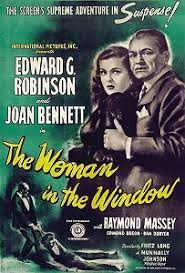
The Woman in the Window (1944)

This little gem is directed by Fritz Lang and stars Edward G. Robinson, who memorably performed in the same year’s Double Indemnity, perhaps the greatest of all film noirs.  However, whereas in Double Indemnity Robinson plays somebody investigating a suspicious death and gradually ratcheting up the pressure on the two people responsible for it, in The Woman in the Window the roles are reversed.  He plays someone responsible for a death who has the screws tightened on him, first by the police, then by a blackmailer.


Not that Robinson’s character in Woman resembles the smooth, handsome and immoral one played by Fred McMurray in Double Indemnity.  He’s a timid college lecturer who sees off his vacationing wife and kids at the film’s start and then retires to his gentlemen’s club, where he’s soon complaining to his buddies (Raymond Massey and Edmund Breon) about being middle-aged, past it and doomed to a life lacking in adventure.  Of course, barely has he uttered those words than he’s having an adventure, but not a pleasant one.  On his way home, he stops to admire a portrait of a beautiful woman in a shop window, then meets the woman (Joan Bennett) who modelled for the portrait.  He gets invited back to her apartment for late-night drinks, unexpectedly meets her jealous and violent admirer (Arthur Loft), and finds himself being throttled.  When he tries to fight his assailant off with a pair of scissors, Robinson and Bennett suddenly have a corpse on their hands.


Believing they can avoid involving the police and incriminating themselves, they dump the body out in the countryside.   Unfortunately, it transpires that the dead man was more important than they imagined and the District Attorney is soon overseeing an investigation into his murder.  And the District Attorney happens to be the Raymond Massey character, one of Robinson’s best mates.


© RKO Pictures


What’s particularly good in this film is Robinson’s mixture of horror and fascination towards Massey’s investigation.  He tries to keep clear of it, but at the same time can’t help prying into it – and inevitably incriminates himself a little bit more each time.  I also like the juxtaposition between the cosiness of the gentleman’s club with its armchairs, book-lined walls and roaring hearth fires, which symbolises Robinson’s cloistered, middle-aged existence, and the mean streets outside, full of darkness, rainstorms, criminality and – eek! – the possibility of extra-marital sex.


Alas, Woman is spoiled by a ridiculous twist ending, added to wrap up the film on a positive note that would keep the studio (and the Motion Picture Production Code) happy.  You might want to stop the film a few minutes before the finish, while things are still looking bleak for Robinson.  That way, you’ll have a film noir that’s well-nigh perfect.


Detour (1945)

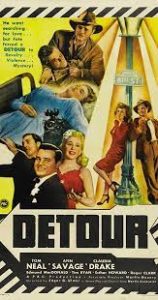
Film noirs don’t come any more existentialist than Edgar G. Ulmer’s Detour, the story of a pianist hitchhiking from New York to Los Angeles to meet up with his lover, a nightclub singer who’s trying to make it in Hollywood, and getting implicated in a couple of murders.  It’s ultra-low-budget and a very economical 67 minutes long, but it’s memorable for how it drives home its despairing message.  “Fate,” rambles its hapless hero (Tom Neal) in a voice-over, “or some mysterious force, can put the finger on you or me for no good reason at all…”


Even more memorable is its leading female character, Vera (Ann Savage), who’s a femme ferocious rather than a femme fatale.  It’s an understatement to say she enters the film halfway through like a force of nature – she’s more like a tornado of rabid dogs.  When Neal, driving a car whose real owner inopportunely died a little way back up the road, stops and gives Vera a lift, she soon figures out what’s happened and starts blackmailing him into helping her in her own nefarious schemes.  Is there a way he can get the malign Vera out of his life again?  There is, but it’s going to make matters even worse…


© 20th Century Fox


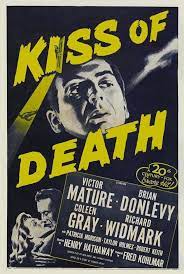
Kiss of Death (1947)

Directed by Henry Hathaway, better known for westerns like 1969’s True Grit, Kiss of Death is a crime melodrama with some suspenseful sequences.  For example, there’s the opening scene when anti-hero Nick Bianco (Victor Mature) tries to escape in a maddeningly slow elevator from a jewellery robbery he’s just carried out in the middle of the Chrysler Building; and the climactic one, when Nick has to walk out onto a night-time street and get shot at by his criminal nemesis Tommy Udo (Richard Widmark) because the cops, with whom he’s now colluding, have informed him that they can only arrest Udo if they catch him with a gun in his hand.   Both sequences are enhanced by their use of stillness and silence.  Mature, the Schwarzenegger / Stallone of his day, didn’t have much range as an actor, but his ruminative passivity is appropriate for the tone here.


Elsewhere, the story of Nick renouncing his criminal ways and turning informer for the Assistant District Attorney (Brian Donlevy), which is his only chance of ensuring a decent life for his two young daughters, is weakened by too much moralising and sentimentality.  But it’s a young Richard Widmark as the repulsive Tommy Udo who both steals the show and gives the movie a nasty edge.  Pale, irredeemably rotten and cackling like the Joker, he’s put on trial thanks to Nick’s evidence, but gets acquitted and vows revenge on Nick and his kids.  We’ve already seen him kill the wheelchair-bound mother of another antagonist by propelling her down a staircase, so we know he means business.


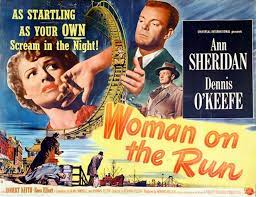
Woman on the Run (1950)

Down-on-his-luck artist Frank (Ross Elliot) is walking his dog one night when he witnesses a murder.  The police inform Frank that he’s seen a gangland killing and he’ll be expected to testify in court, so that a major criminal can be locked away.  Frank realises this makes him a likely target for the gangsters, decides not to cooperate with the cops and goes on the run instead…  And abruptly, the film’s focus shifts to his wife Eleanor (Ann Sheridan).  Although their marriage hasn’t been happy, Eleanor embarks on a quest to track Frank down, a quest complicated by the fact that she’s being followed by the cops, a persistent newspaper reporter (Dennis O’Keefe) and probably the villains.  During her search, she encounters acquaintances of Frank’s she hadn’t known existed and gradually realises that Frank has been a more affectionate and interesting husband than she gave him credit for.


© Fidelity Pictures Corporation / Universal Pictures


Woman on the Run is a cleverly constructed film that not only wrong-foots the audience by switching attention from its hero to its heroine, but also has a plot containing a personal, emotional journey as well as the usual crime and police shenanigans.  It makes good use of its San Francisco locations and portrays the Asian-American inhabitants of Chinatown with slightly more depth than you’d expect of a film of the time.  However, my better half, who’s Californian, poured cold water over the film’s climax, which takes place in the amusement park at Ocean Park Pier.  This, she pointed out, is actually in Santa Monica, which is a good 340 miles away from San Francisco.


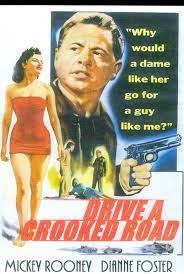
Drive a Crooked Road (1954)

I’d never been much of a Mickey Rooney fan, not when he was playing kids and teenagers in the 1930s and 1940s, nor when he was an all-round entertainer doing Broadway, TV and, in Britain, pantomimes in his old age.  However, Drive a Crooked Road offers a fascinating snapshot of Rooney during his career’s low point in the 1950s.  By then he was too old to play a youngster anymore, but he was too short to make a conventional leading man.  In Drive, he ends up playing a misfit called Eddie Shannon, as lacking in social skills as he is in stature.  Eddie’s happier being surrounded by cars than by other human beings and when he isn’t working as a garage mechanic, he drives in small-scale motor races – which, we learn early on, he’s very good at.


One day the glamorous Barbara (Dianne Foster) brings her car to Eddie’s garage for repairs and is soon paying the wee man an inordinate amount of attention.  Poor Eddie is astonished – as the film poster puts it: “Why would a dame like her go for a guy like me?” – but can’t help falling for Barbara and daring to dream that their burgeoning relationship is genuine.


© Columbia Pictures


Of course, this being a film noir, it isn’t genuine.  Barbara is just bait and Eddie is being reeled into the middle of a plot to rob a bank.  Barbara’s real lover, the smug, oily Steve (Kevin McCarthy), plans to use Eddie’s driving skills to transport the stolen money at great speed along a treacherous stretch of road before the police can set up road-blocks.  The script, by a young Blake Edwards before he hit paydirt with the Pink Panther movies in the 1960s and 1970s, contains a surprising subtext about social class.  Raffishly wearing a yachtsman’s cap (and light-years removed from the panic-stricken everyman that McCarthy would play two years later in Don Siegal’s Invasion of the Body Snatchers), Steve is no criminal low-life but a suave, educated sophisticate.  This makes his manipulation of the humble, blue-collar Eddie seem even more loathsome.


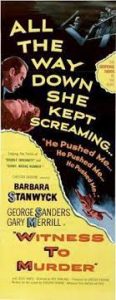
Witness to Murder (1954)

What a difference a decade makes.  1944’s Double Indemnity established Barbara Stanwyck as the imperious queen of film noir, gorgeous, ruthless, happy to use men and dump them whenever it suited her.  By 1954’s Witness to Murder, though, Stanwyck was pushing 40 and Hollywood had evidently decided she was better suited to playing dotty, slightly hysterical ladies less in control of their circumstances than they think they are.


Witness unluckily appeared at the same time as Alfred Hitchcock’s Rear Window and shared a plot component with it: someone looks out of a window, and through someone else’s window, and thinks they see a murder.  It was duly dismissed as an interior imitation of the Hitchcock classic, but it’s more interesting than that.  Whereas Rear Window dwells on the voyeuristic aspects of spying on other people’s business, Witness merely uses it as a way to kickstart its plot.  Cheryl (Barbara Stanwyck) believes she’s seen her neighbour across the street, Albert Richter – an author, a fiancé of a wealthy heiress and a one-time Nazi (but he’s ‘reformed’ now, so that makes him perfectly okay) – murder somebody.  The police don’t believe her and when she tries to conduct her own investigations, her sanity is called into question and she even has to spend time in an asylum.  All good news for Richter (George Sanders), of course. If everyone thinks this inconvenient witness to his crime is barmy, it won’t be a surprise if sooner or later she ‘appears’ to commit suicide.


Witness to Murder, then, is as much about the unfairness of the era’s gender attitudes as Drive a Crooked Road is about the unfairness of its class attitudes.  Stanwyck is sympathetic and engaging, Sanders is predictably as smooth as silk, and it’s nicely wrapped up with a Hitchcockian chase-sequence across the unfinished rooftop of an under-construction high-rise.


Chester Erskine Productions / United Artists


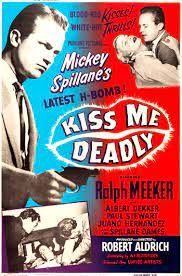
Kiss Me Deadly (1955)

Directed by Robert Aldrich, scripted by A.I. Bezzerides and based on one of Mickey Spillane’s hardboiled pulp novels about private investigator Mike Hammer, Kiss Me Deadly begins with a startling night-time sequence.  Hammer (played by a suitably blunt Ralph Meeker) is out driving, nearly runs over a distraught woman (Cloris Leachman) and reluctantly gives her a lift.  He soon finds himself in trouble when bad guys in pursuit of the woman force him off the road.  So far, so conventionally noirish.  But things get progressively weirder as Aldrich and Bezzerides dump more and more of the Spillane source material and go off and do their own thing.


You don’t get a coherent plot where Hammer moves from A to B and then to C while gradually unravelling the mystery of what happened that night.  Rather, names pop up randomly in conversations, names of people who are still alive and who are already dead.  Trying to find a common thread, Hammer plods between seemingly arbitrary locales, shabby and smart, old-worldly and 1950s cutting edge: scuzzy hotel rooms and apartments, fancy beach-houses, a boxing gym, an immigrant’s garage, a bigshot’s mansion, a modern art gallery, an opera singer’s quarters crammed with precious vinyl.  The threat largely remains anonymous and soon becomes omnipotent.  Hammer hears a lot about ‘they’ but can’t identify who ‘they’ are.  At the same time, ‘they’ seem able to kill people with a god-like ease and lack of consequence.


Eventually, we learn that the villains are pursuing something contained in a small box, something that’s massively valuable, powerful and potentially destructive, and there ensues an impressively apocalyptic finale.  Tapping into the scientific and political fears of an America already immersed in the Atomic Age and the Cold War, and about to embark on the Space Race, Kiss Me Deadly is one of the last entries from film noir’s 1940s-1950s golden age.  Indeed, it’s appropriate that by its final scenes, the film seems to have transformed into a newer, more adaptable cinematic genre – science fiction.


Parklane Pictures / United Artists

Cinematic heroes 1: Jon Finch


© Goodtimes Enterprises / Anglo-EMI Film Distributors


The film and TV actor Jon Finch died seven-and-a-half years ago.  At the time of his passing, late on in 2012, he hadn’t worked for several years and had lived quietly in the English town of Hastings and his death had apparently gone undiscovered for some time.  Word of his funeral wasn’t announced until January 2013.  For that reason, obituaries for him in the British media were intermittent and patchy.  I decided to pen a few words of tribute on this blog and the resulting post seemed to rank high on Google searches about Finch – as I’d said, obituaries for him were intermittent and patchy.  Gratifyingly, a number of people who’d known Finch over the years came across my post and left comments on it.  In fact it was one of this blog’s most commented-on entries.  (And I’m kicking myself that, because this blog had to recently get a post-hacking reboot, those comments from Finch’s friends have now been lost.)


Anyway, I thought I’d revisit, rewrite and update what I originally wrote about Finch in 2013 and repost it.  Annoyingly, though, I still haven’t managed to see 1973’s The Final Programme…


Jon Finch began his career in television, went into films and ended up back in television.  For a couple of years in the early 1970s, while he was doing film-work, he had the opportunity to become massive, but that didn’t happen.  Finch, who valued his privacy and had a low opinion of the celebrity circus, may well have preferred it that way.


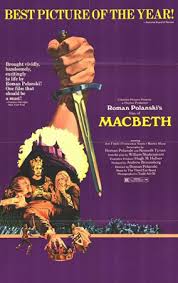
He began acting on television in 1964, appearing in ITV’s notoriously dire soap opera Crossroads.  In 1970, like many a British TV actor at the time, he got his break in movies thanks to Hammer Films – who were always looking for cheap acting talent to appear in their low-budget but cheerfully sensationalist horror movies.  He duly provided vampire-hunting support to Peter Cushing in Roy Ward Baker’s okay The Vampire Lovers and appeared in Jimmy Sangster’s dreadful Horror of Frankenstein.  Then Roman Polanski hired him to play the title role in his version of Macbeth, released in 1971, and suddenly Finch’s career trajectory had become exponentially steep.


Polanski’s take on Shakespeare’s Scottish play was bloody, dark and bleak – everything that a good production of Macbeth should be, in my opinion.  In this film, what works in favour of Finch as Macbeth, and of his co-star Francesca Annis as Lady Macbeth, is the fact that they’re both so young.  The audience therefore feels they have little power over their destiny.  Rather, they’re swept to their tragic ends by dark forces both political and supernatural.


Polanski’s Macbeth got an unsympathetic appraisal from many critics, who couldn’t see beyond the film’s high level of violence and who linked it with what Polanski had gone through in August 1969 – when his pregnant wife Sharon Tate and four others were slaughtered at his house in Beverly Hills by acolytes of hippie-cult nutcase Charles Manson.  New Yorker critic Pauline Kael even wondered if Polanski’s staging of the murder of Macduff’s family was an attempt to recreate the carnage that Manson had orchestrated.  In fact, the film’s screenwriter, celebrated theatre critic Kenneth Tynan, is reputed to have challenged Polanski about the amount of blood displayed in this scene, to which the director retorted, “You should have seen my house last summer.”


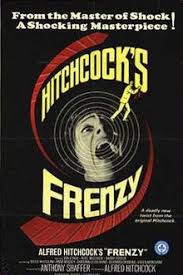
From Roman Polanski, Finch moved on to Alfred Hitchcock and landed the lead role in 1972’s Frenzy.  Although Frenzy hardly represents Hitchcock at the peak of his artistry, it’s by far and away the best of the director’s last clutch of films, which include Torn Curtain (1966), Topaz (1969) and Family Plot (1976).  It also shows Hitchcock at his most disturbing.  The murder sequence involving Barbara Leigh-Hunt, who plays Finch’s ex-wife, is the most brutal thing he ever did, and the potato-truck ride (where serial strangler Barry Foster tries to retrieve an incriminating piece of evidence from a corpse he’d concealed earlier inside a huge sack of potatoes) is gruelling too.


Playing an innocent man accused of and hunted down for Foster’s murders, Finch bravely refrains from making his character sympathetic.  Indeed, he’s something of a shit and has a violent streak, and for a period at the start of the film we think he really is the strangler.   By the time it becomes clear that Foster is actually the culprit, Hitchcock – a master manipulator of his audience’s emotions – has presented him as a chirpy, likeable chap.  Thus, we find ourselves siding more with him than we do with Finch.


© Universal Pictures


Having worked with two of the world’s greatest directors, Finch seemed destined for international fame and indeed he was soon offered the chance to replace Sean Connery in the James Bond series.  Finch, however, declined and the role went instead to the somewhat less invigorating Roger Moore.  Around this time he also turned down the role of Aramis in Richard Lester’s The Three Musketeers (1973) which, tantalisingly, would have seen him acting alongside another actor with a low opinion of movie stars and movie stardom, Oliver Reed.


In fact, in 1973, Finch did play a vaguely James Bond-like character when he took the role of Jerry Cornelius in Robert Fuest’s The Final Programme, which was based on the first of the four Cornelius novels written by Michael Moorcock, set in a surreal, 1960s-esque and science-fiction-tinged world where the fabric of reality is beginning to fray.  I’ve never seen The Final Programme, though from all accounts Fuest did a pretty cack-handed job of it.  In stills, though, Finch at least looks the part of Moorcock’s enigmatic hipster-cum-secret-agent hero.  Moorcock himself disapproved of the film adaptation, although he liked Finch’s performance and paid tribute to him on his website / discussion forum Moorcock’s Miscellany when he heard of his passing: “I was very fond of Jon and was sorry we lost touch…  He was genuinely modest.”


Towards the end of the 1970s, Ridley Scott lined Finch up to appear in his ground-breaking sci-fi horror film Alien.  Finch was supposed to play Kane, a character who doesn’t last long in the movie’s script but is certainly pivotal to it.  He’s the unfortunate crewmember who goes exploring the mysterious crashed spaceship and ends up with an alien egg inside his chest.  Two days into filming, however, Finch became too ill to work – either from bronchitis or from complications caused by his recently-diagnosed diabetes, depending on which story you believe – and was replaced by John Hurt.  Thus, he missed appearing in the infamous ‘canteen’ scene where Kane expires and the alien makes its first appearance, one of the most (literally) explosive scenes in horror-movie history.


From there on, it was through his television work that Finch remained in the public consciousness.  In the late 1970s, he appeared in the BBC Television Shakespeare, a series of adaptations of all the Bard’s plays.  Though they were criticised for their staginess and the generally conservative manner in which they were brought to the screen, the adaptations certainly couldn’t be faulted for the top-notch acting they contained.  In Richard II (1978), Finch played Henry Bolingbroke to Derek Jacobi’s Richard and John Gielgud’s John of Gaunt.  With Bolingbroke elevated to monarch, he then played the title role in the sequels Henry IV Part One and Part Two (1979), with Anthony Quayle as a jovial, red-cheeked Falstaff and David Gwillim as Henry’s offspring, Prince Hal.  (In reality, Gwillim was only six years younger than Finch.)


Still picky about his roles, he passed on the opportunity to play Doyle in Brian Clements’ hugely popular espionage / action series The Professionals (1978-81).  Ironically, the role eventually went to Martin Shaw, who’d played Banquo to Finch’s Macbeth.  On the other hand, out of loyalty to Hammer, he starred in the first episode of the studio’s 1980 anthology series The Hammer House of Horror, in which he played a modern-day composer haunted by a witch who’s popped forward through time from the 17th century (a role performed with memorable relish by Patricia Quinn).  And for a quarter century he gave guest turns in popular shows like The New Avengers, The Bill, Maigret, New Tricks and The Memoirs of Sherlock Holmes.


Frustratingly, Finch’s role in a 1994 episode of Sherlock Holmes, a combined adaptation of two of Sir Arthur Conan Doyle’s short stories The Adventure of the Mazarin Stone and The Adventure of the Three Garridebs, didn’t see him appear alongside Jeremy Brett, the actor widely regarded as the screen’s best-ever Holmes – Brett had to be written out of most of the episode due to health problems.  However, as a villain, Finch did get to face up to the almost-as-good Charles Gray, playing Sherlock’s brother Mycroft.


Finch’s final appearance was a film one, in Ridley Scott’s 2005 crusades epic Kingdom of Heaven, so at least he got to work with that director nearly three decades after his gig in Alien fell through.  Thereafter, he kept a low profile in Hastings, in declining health but seen now and again in some of the local public bars.  I wonder if the regulars in those Hastings pubs were aware that old ‘Finchy’, as he was known, had once headlined films directed by Hitchcock and Polanski and had come within a whisker of being 007.


© Playboy Productions / Columbia Productions