

From wikipedia.org / © Super Festivals
Halloween is just over a month away. Here’s a first, horror-themed post to mark the beginning of the ‘witching season’.
I didn’t particularly care for the films of American director and producer Herschell Gordon Lewis, who was nicknamed ‘the Godfather of Gore’ and who passed away ten years ago today, on September 26th, 2016. That said, I certainly liked the idea of Lewis.
Lewis’s exploitation movies spanned a variety of genres – softcore erotica (usually set in nudist colonies and including the likes of 1963’s Goldilocks and the Three Bares), comedies, children’s movies and at least one feminist biker flick, 1968’s splendidly titled She-Devils on Wheels. However, it’s for his horror films that he’ll be remembered, and for the simple but at the time innovative approach that he brought to the horror-film genre. He made the first horror movies that were truly horrible, i.e., loaded with bloodletting, dismemberment, disembowelment, scalping, eye-gouging, tongue-ripping and so on: Blood Feast (1963), 2000 Maniacs (1964), Colour Me Blood Red (1965), Taste of Blood (1967), The Gruesome Twosome (1967), The Wizard of Gore (1970) and The Gore Gore Girls (1972).
Not unexpectedly, Lewis’s approach did not go down well with mainstream movie critics – “Thoroughly revolting Z-grade garbage” was a typical assessment of Blood Feast – and was hardly the stuff that mainstream movie audiences flocked to. But his horror movies still packed enough folk into America’s drive-ins for them to turn a tidy profit and, over the years, he found a number of admirers among left-field film fans, filmmakers and commentators. More on those later.
Needless to say, his work didn’t make its way to the United Kingdom anytime soon. I remember reading about Blood Feast and 2000 Maniacs in film books and magazines when I was a kid and thinking, “Wow, these must be the most hideous and terrifying films ever made!” But at the same time I knew the chances of me seeing them in censorious Britain were non-existent. The chances became less than non-existent during the 1980s when British politicians, tabloid newspapers and moral campaigners worked themselves into a lather over the ‘video nasties’ scare.
In fact, it wasn’t until the end of the 1980s that I finally laid eyes on some footage from his movies. This was courtesy of Jonathan Ross’s offbeat TV series The Incredibly Strange Film Show (1988-89), which devoted a whole episode to Lewis.
How different it is nowadays. A while back I saw some of his movies as double-bills on Britain’s now-defunct Horror Channel, which was available for all to watch on Freeview. Quite a few of them are up on the Internet, on sites like YouTube and Dailymotion. And with modern films featuring high-tech animatronic and computer-generated effects, Lewis’s movie gore – basically all the offal he could find at the local butcher’s shop and lots of bright red paint – looks so primitive it almost has a retro charm.
From wikipedia.org / © Box Office Spectaculars
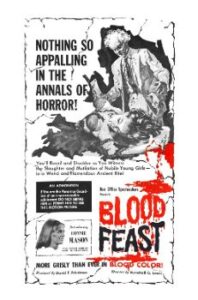
Blood Feast was the film that made Lewis’s name and it remains his most famous, or infamous, effort. I have to say it’s a very bad film. The acting is atrocious, the budget is visibly tiny and the general level of professionalism is not much higher than Ed Wood standards. And yet… It might be one of the worst films I’ve seen, but I’ve never been able to forget it. Somehow, it still creeps me out. Maybe it’s the stark, single-minded way it goes about its bloody business – something reinforced by the score, a slow, thudding, doom-laden thing that’s little more than a funereal drumbeat. It’s so minimalist it makes the sparse, pulsing synth scores that John Carpenter did for his movies sound like Vivaldi.
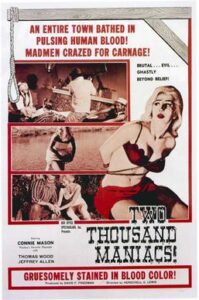
Among the rest of Lewis’s oeuvre, I’ll admit to liking (a little bit) 2000 Maniacs, possibly because it’s an insolent remake of Brigadoon, the cheesy 1954 MGM musical about a phantom Scottish Highland village that appears out of the mist for one day every century. But while the village in Brigadoon appears so that Gene Kelly and Van Johnson can perform song-and-dance numbers there like The Heather on the Hill and I’ll Go Home with Bonnie Jean, the phantom village in 2000 Maniacs has a darker purpose.
It’s a southern USA village whose inhabitants were slaughtered by northern forces during the Civil War and now, as ghosts, they reappear every so often to take bloody revenge on any hapless Yankee travellers who come their way. As a commentary on the horrors of the Civil War, it’s hardly in the class of, say, the fiction of Ambrose Bierce; but in its crude, tacky manner it’s effective.
The only other 1960s film by Lewis I’ve seen is his third ‘gore’ film, Colour Me Blood Red, which is about an unsuccessful and embittered painter (Gordon Oas-Helm) whose paintings lack a certain something… A certain colour… A certain shade of a colour… Well, the title tells what the missing shade is and, as soon as he realises that, he’s secretly murdering people and applying their blood to his canvases. Hey presto! The local, snobby art critic (William Harris) immediately switches from slagging off his work to proclaiming him a genius.
While Lewis’s previous two horror films at least did things with a gory elan, Colour Me Blood Red is a dreary, uneventful thing. Particularly duff is a sequence where the artist terrorises two victims who are out at sea in a pedal-boat – an action set-piece involving a pedal-boat is about as exciting as it sounds. Also, among the friends whom the film’s young heroine (Candi Conder) hangs out with are a beatnik couple who insist on talking in a super-annoying type of rhyming hipster / jive-speak. At one point they manage to rhyme ‘daddy-o’ with ‘patio’. I spent the film waiting for them to die horribly. But damn it, they didn’t.
From wikipedia.org / © Mayflower Pictures
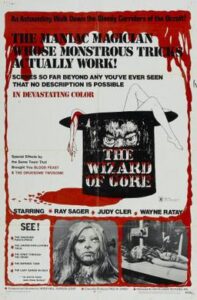
Meanwhile, I have to confess to liking, again a little bit, 1970’s The Wizard of Gore, which is about a stage magician (Ray Sager) who uses power tools to perform mind-bogglingly gruesome tricks on volunteers from the audience. When the tricks are over, the volunteers seem to be alive, well and in one piece. But later, after the show, they ‘revert’ to the grisly state they were in onstage and, obviously, die. Again, it’s cheap and ineptly made, but the film has a weirdness that’s difficult to forget.
The Wizard of Gore also won Lewis one of his very few acknowledgements from mainstream cinema. In 2007’s acclaimed comedy-drama Juno, Jason Bateman’s music / comic-book / movie nerd convinces Ellen (now Elliot) Page’s Juno that The Wizard of Gore is a better horror movie than Dario Argento’s Suspiria (1977). I have to say that if they honestly believe Lewis’s schlocky little opus to be superior to Argento’s demented masterpiece, Bateman and Page must be really thick.
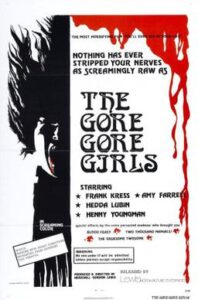
I’ve also watched Lewis’s last movie from this era, The Gore Gore Girls, which is problematic even by its director’s usual standards. It’s a horror comedy, of sorts, wherein an arrogant, dandified – complete with walking cane – private investigator (Frank Kress) and a liberated lady reporter (Nancy Farrell) investigate a series of murders where the victims are strippers and the suspects include a traumatised Vietnam War vet and a bunch of radical feminists who protest against striptease acts with placards saying things like ‘Quit with Tit!’ Finally, the investigator gets the supposedly liberated reporter drunk and goads her into participating in an amateur striptease competition with a 1000-dollar prize, which she wins, turning her into the killer’s next potential victim – and bait in the crafty investigator’s trap.
The Gore Gore Girls is unpleasantly misogynistic and voyeuristic and it handles themes like feminism and post-traumatic stress disorder with as much finesse as you’d expect, i.e., none. But for me its biggest problem is Kress’s investigator, whom Lewis evidently intends to come across as a quirky, outspoken but lovable rogue. He actually comes across as a complete dickhead.
From wikipedia.org / © Lewis Motion Picture Enterprises
After a long hiatus from filmmaking, Lewis returned to it in his later years. This was after his great influence on the horror-movie genre had been recognised – generally in, say, the slasher movies of the 1980s where the emphasis was on bloody and outrageous ‘kills’ rather than on plot or characterisation, and specifically in the works of certain filmmakers who’d drawn inspiration from him, like Eli Roth, John Waters, Quentin Tarantino and Robert Rodriguez. In 2002 he directed a belated sequel to Blood Feast, Blood Feast 2: All U Can Eat, which featured Waters in a cameo, and in 2009 a standalone horror film called The Uh-Oh! Show.
Meanwhile, without Lewis as director, 2000 Maniacs was remade in 2005 as 2001 Maniacs (which Eli Roth co-produced), and that remake received a sequel in 2010 entitled 2001 Maniacs: Field of Screams. The Wizard of Gore was remade in 2007 and Blood Feast in 2016, the latter with Lewis in a supporting role as ‘Professor Lou Herschell’, which must have been one of the last things he ever did. These films contained an element never seen before in Lewis-related movies: some decent actors. Their casts included such accomplished performers as Robert Englund, Bill Mosely, Crispin Glover, Brad Dourif and Jeffrey Combs.
A decade after his death, Lewis’s influence lives on. I recently watched Curry Barker’s acclaimed horror movie Obsession (2025). The sequence in it that’s most horrible – or depending on your point of view, most hilariously over the top – immediately put me in mind of The Gore Gore Girls.
What I love about Lewis, though, is that in the early 1970s he packed in filmmaking and turned to something very different – advertising. He became a guru on the subject and made a fortune writing books about it, such as 1974’s The Businessman’s Guide to Advertising and Sales Promotion and 1977’s How to Handle your own Public Relations. His speciality was direct marketing, the practice of bombarding large numbers of people with word of your product – which, while pissing off the vast majority of them, should hook a sufficient minority of them to make the exercise worthwhile. In a way, that’s what Lewis did with his horror movies.
In the end, Lewis became a very wealthy man – an exemplar of the American Dream. The fact that he achieved that dream on the back of direct marketing and excessive bloodletting seems odd but, also, appropriately American.
From wikipedia.org / © Box Office Spectaculars

