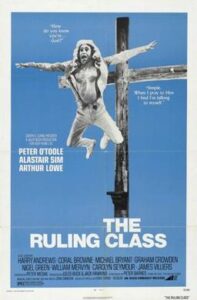
When Peter Medak showed his class


From wikipedia.org / © United Artists / AVCO Embassy Pictures


The British-Hungarian film and TV director Peter Medak died near the end of last month.  Here’s an update of something I wrote a decade ago about what I consider to be Medak’s greatest movie, 1972’s The Ruling Class…


It’s fair to say that the British film industry hasn’t produced anything else quite like The Ruling Class, the satirical 1972 movie starring flamboyant Anglo-Irish actor Peter O’Toole, directed by émigré Hungarian filmmaker Peter Medak and scripted by English playwright Peter Barnes, who adapted for the screen his 1968 play of the same name.


Okay, The Ruling Class’s surreal but relentless lampooning of Britain’s social, religious and political establishments puts it in territory similar to that occupied by the famous film trilogy directed by Lindsay Anderson, If (1968), O Lucky Man! (1973) and Britannia Hospital (1982).  Indeed, the similarities feel more pronounced due to the presence in The Ruling Class of Arthur Lowe and Graham Crowden, two actors who appeared regularly in Anderson’s work.


Also, the casting of Lowe, Coral Browne and Harry Andrews in The Ruling Class calls to mind Douglas Hickox’s delicious comedy-horror movie Theatre of Blood (1973), in which all three actors fall victim to a psychopathic Shakespearean actor played by Vincent Price.  The Ruling Class contains a dose of the macabre too and shares with Theatre of Blood a mad but compelling antihero.


But for acting gusto, for directorial flair, for a story that blends a bewildering range of genres, and for mocking humour that veers between the delightfully subtle and the bruisingly un-subtle, The Ruling Class is in, well, a class of its own.
 

© United Artists / AVCO Embassy Pictures


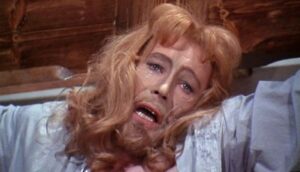
O’Toole plays Jack Gurney, the 14th Earl of Gurney, who inherits his title after the 13th Earl – a brief but barnstorming performance by Andrews – accidentally perishes during a disturbing sex-game involving a noose and a ballerina’s skirt.  To the relief of the late earl’s brother, a Church of England bishop played by the incomparable Alistair Sim, he didn’t commit suicide, which would of course have been sinful.


The Gurney family is dismayed to learn that young Jack is out-and-out, barkingly insane.  He believes he is Jesus Christ and sports an appropriately Christ-like beard and mane of hair.  He also wishes to bring peace and love to the earth and sleeps upright on a giant wooden cross.  Before long, the most unscrupulous of his relatives, his Uncle Charles (William Mervyn) and Aunt Claire (Browne), are plotting to get rid of him.


Charles decides to ensnare Jack using his young opera-singing mistress Grace (Carolyn Seymour).  He introduces them, calculating – correctly – that Jack will fall in love with her and marry her.  When the marriage is consummated and an heir produced, Charles can then have Jack committed.  Charles’s plans go astray, however.  Grace falls in love with the crazy but unsettlingly charming Jack and, later, Jack seems to be cured of his madness by his psychiatrist Dr Herder.  Herder is played by Michael Bryant, who for some reason does an uncannily accurate impersonation of the great Czech character actor Herbert Lom.  Indeed, so much is Bryant like Herbert Lom that during the film I assumed I was watching Lom.  I only realised it was Bryant in the role when I saw his name in the closing credits.


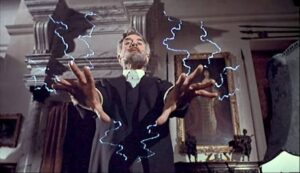
Herder bases his cure on the reasoning that there can only be one Jesus Christ, and if Jack can be convinced that somebody else is Christ then he’ll be cured of his own delusions.  There follows a sequence in which Herder introduces Jack to a psychiatric patient called McKyle, played by Nigel Green, who believes himself to be a very different sort of Messiah: a wrathful, blood-and-thunder, take-no-prisoners, Old Testament-style one with a booming Scottish accent.  Green’s performance here is electrifying – literally electrifying, because the panic-stricken Jack sees bolts of energy shooting out of his hands.  Actually, it’s disconcerting to watch Nigel Green in a role like this if, like me, you mainly remember him for playing Colour-Sergeant Bourne in Zulu (1964), who was surely the most unflappable and down-to-earth character in the history of British cinema.
 

© United Artists / AVCO Embassy Pictures


And Charles’s scheme to have his troublesome nephew banged away in the loony-bin ultimately fails when the court psychiatrist (Crowden) discovers to his joy that Jack is a fellow old Etonian – the film’s dig at the ‘old-boy network’ that’s promoted incompetence and mediocrity in the upper echelons of British society for centuries.  The pair of them then burst into a jolly rendition of The Eton Boating Song.  Incidentally, the film is peppered with musical interludes like this one.  None of them last long enough for it to quite qualify as a musical, but they add yet another colour to its palette.


Predictably, Jack isn’t really cured of his insanity.  “I’m Jack!” he affirms a little too keenly, “I’m Jack!”  He no longer believes that he’s Jesus Christ, but he soon develops a worrying interest in Victoriana and we realise that the Jack he thinks he is now isn’t Jack Gurney.  It’s a different Jack, one who gained notoriety in the back-streets of Whitechapel in the late 1880s.  In one phantasmagorical scene, splendidly orchestrated by director Medak, we see Jack step through the wall of his mansion’s living room and into a Victorian back-street, accompanied by one of the film’s female characters – who soon gets spitted on a long sharp blade.


However, in the film’s final spasm of irony, Jack Gurney’s confusion with Jack the Ripper does him no harm whatsoever.  His Ripper-style murder is blamed on someone else – the film’s sole working-class character, the Gurneys’ butler Tucker (Lowe).  Then, near the movie’s end, Jack takes his seat in the House of Lords and there delivers a debut speech that is a demented, psychotic hang-’em / flog-’em rant.  The speech, needless to say, is wildly popular among the House’s venerable members.  (Medak memorably shows the assembled lords through Jack’s eyes as a horde of rotting, cobwebbed but somehow animate corpses.)  His infant son, meanwhile, is also gurgling, “I’m Jack!  I’m Jack!” which suggests that the insanity of this particular branch of the ruling class will continue for another generation at least.


With all this going on, the success or failure of The Ruling Class depends on the ability of the actor in the lead role and Peter O’Toole is glorious.  He’s at the height of powers – still surfing the waves he made in 1962’s Lawrence of Arabia, 1964’s Beckett and 1968’s The Lion in Winter; and before booze and bad movie choices, like 1979’s Caligula and 1984’s Supergirl, took their toll on his reputation.  For the entire film his character is as mad as a hatter and yet you have no difficulty believing Carolyn Seymour’s Grace – and indeed, later, Coral Brown’s Aunt Claire – could fall for this wild-eyed, loquacious and charismatic lunatic.


But O’Toole is helped by his supporting cast.  Arthur Lowe is wonderful as the beleaguered and cantankerous butler, Tucker.  While Lowe’s career was full of delightful moments, I think the most delightful moment of all comes in The Ruling Class when he learns that the late 13th Earl of Gurney has left him 30,000 pounds in his will and he does a wee dance to celebrate.  Coral Browne, meanwhile, who was pushing 60 at the time she made the film, gives a memorable performance as a mature lady who remains sexually charged, slinky and alluring.  There’s nothing inelegant about the scene towards the movie’s end where she tries to seduce O’Toole, who’s some 20 years her junior.  Actually, I can understand why in real life Vincent Price married Browne shortly after he’d murdered her onscreen in Theatre of Blood.
 

© United Artists / AVCO Embassy Pictures


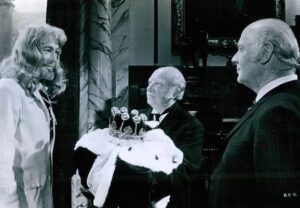
The film also showcases the talents of several actors whose careers were never quite as successful as they should have been.  Carolyn Seymour is excellent as Grace and it seems a shame that most of her subsequent work was on British and American television.  William Mervyn, who was typecast playing upper-class gentlemen in the likes of The Railway Children (1970) and various Carry On films, makes a splendid main villain, Uncle Charles, and it’s unfortunate he wasn’t given some similarly meaty roles before his death in 1976.  Also in the movie is James Villiers, playing Jack’s dim-witted but amiable cousin Dinsdale.  I was used to seeing Villiers in villainous or officious roles, like in Seth Holt’s Blood from the Mummy’s Tomb (1972) or the 12th Bond movie For Your Eyes Only (1982) and it’s a pleasure watching him play a very different character in this.


Another person connected with The Ruling Class whose talent didn’t get to blossom as much as it should have was Peter Medak.  This and his 1972 adaptation of the Peter Nichols play A Day In the Death of Joe Egg put plenty of wind in his sails, but that wind suddenly died in 1973 when he took on the near-career-ending task of directing the pirate-comedy movie Ghost in the Noonday Sun.  He later described it as “the biggest disaster of my life.”  The project was sabotaged by the almost pathological uncooperativeness of its star, Peter Sellers, then at his most unpredictable and volatile.  Having the famously bipolar Spike Milligan involved probably didn’t help.  Denied a cinematic release at the time, it finally saw the light of day on video in 1985.  I’ve watched half-an-hour of it on YouTube and it’s bloody awful.


In 1980, though, Medak directed The Changeling, a brave attempt at staging a subtle, old-fashioned ghost story during a period when most scary movies involved screaming teenagers, masked knife-wielding maniacs and buckets of gore.  And in the early 1990s he made a couple of decent British films like The Krays (1990) and Let Him Have It (1991) and also the ludicrous, overwrought but stylish thriller-noir Romeo is Bleeding (1993) with Gary Oldman and Lena Olin.  In 1998 he directed the old tosh that was Species II but thereafter, gratifyingly, was able to work on episodes of several top-quality American TV shows like The Wire (2002-8), Breaking Bad (2008-13) and Hannibal (2013-15).  Indeed, after Medak’s death on October 27th, Hannibal’s showrunner Bryan Fuller remembered him as a “gentle teddy bear of a Hungarian” and a “wonderfully talented, kind, and funny man who always had a great story to tell, both on and off the set.”


It was also gratifying that in Medak’s swansong, the 2018 documentary The Ghost of Peter Sellers, he managed to turn the darkest and most traumatic episode of his career, Ghost in the Noonday Sun, into a critically acclaimed account of the making of that luckless film.  The Ghost of Peter Sellers gives fascinating insight into how, in multitudinous ways, film projects can go wrong.  It’s also unexpectedly moving because, despite all the strife that Peter Sellers caused him, Medak vocalises with breathtaking magnanimity how much he loved and admired Sellers too.
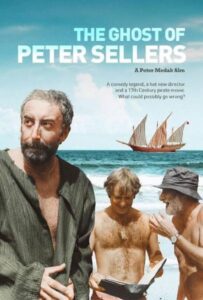
 

© Vegas Media / 1091 Pictures


But the finest monument to Peter Medak, in my opinion, remains the exuberance and chutzpah of The Ruling Class.   At one point, Nigel Green’s deranged McKyle describes himself as “the high-voltage Messiah, the electric Christ, the AC/DC god”, and the film is something like a cinematic equivalent of that.

Seriously Sean – ‘The Hill’


© Seven Arts Productions / Metro-Goldwyn-Mayer   


Social media quickly filled with tributes to Sean Connery when the venerable Scottish superstar died on October 31st.  Much, of course, was made of the fact that he’d been the cinema’s first and best James Bond.  However, I found it interesting that many people also talked about the post-Bond movies that Connery made in the 1980s and 1990s.  These were big budget, escapist and sometimes shonky, though lovable, action or fantasy films like The Time Bandits (1981), Highlander (1986), The Name of the Rose (1986), The Untouchables (1987), Indiana Jones and the Last Crusade (1989), The Hunt for Red October (1990) and The Rock (1996).


Which is all fine and good, but I was disappointed that more attention wasn’t paid to what Connery achieved back in the 1960s and 1970s, in between his assignments as Bond, when he clearly had ambitions to be not just a movie star but a serious actor.  He made several movies back then that were critically acclaimed but generally didn’t make much money.  Perhaps it was disillusionment at their lack of success that made Connery later take the easy route and appear in the simpler, cosier fare that people reminisced about after his death.


Anyway, by a coincidence, a few weeks before Connery passed on, I’d felt an urge to check out some of those older, more serious movies of his. A few I hadn’t seen before. Others I’d watched at a young age and failed to appreciate at the time, probably because I’d been perplexed by Connery’s failure to breenge onscreen in a Saville Row suit and introduce himself as ‘a shhhort of lishhhensed trouble-shhhoooter’. So now, as a tribute to him, I thought I’d post my thoughts on the Connery films that I’ve recently watched or re-watched.  I’ll start with 1965’s The Hill.


Directed by Sidney Lumet, The Hill is a war movie.  But it’s a very different beast from the previous war movie on Connery’s CV, 1962’s star-spangled blockbuster about the D-Day landings The Longest Day, which featured Connery briefly as a comic Irishman called Private Flannagan.  (It had him sporting the unconvincing – I’m being kind here – Irish accent that he’d already trotted out in 1959’s Darby O’Gill and the Little People and would trot out again for his Oscar-winning turn as Malone in The Untouchables).


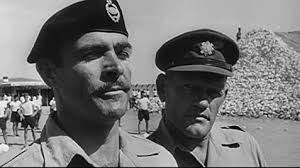
The Hill eschews the action, spectacle and heroism of conventional war movies because its setting is a prison for recalcitrant British soldiers – thieves, spivs, drunkards, deserters and those guilty of insubordination – in the Libyan desert during World War II.  Lumet and his cast and crew actually shot the film on the other side of the Mediterranean, in Almeria and Malaga in southern Spain.


Connery plays Joe Roberts, one of five new arrivals at the prison, or ‘glasshouse’ as it’s nicknamed.  Also in this batch of new inmates is young, timid George Stevens (Alfred Lynch), spiv Monty Bartlett (Roy Kinnear), gruff northerner Jock McGrath (Jack Watson) and rebellious West Indian Jacko King (Ossie Davis).  The fivesome find themselves in the custody of the hardnosed Regimental Sergeant Major Bert Wilson (Harry Andrews), who effectively runs the place.  Its Commandant is a rarely-seen and weak-willed figure, of whom Wilson says contemptuously: “The Commandant signs bits of paper.  He’d sign his own death warrant if I gave it to him.”


© Seven Arts Productions / Metro-Goldwyn-Mayer   


The prison staff also include the essentially decent if somewhat effete Staff Sergeant Charlie Harris (Ian Bannon) and the weary but also decent Medical Officer (Michael Redgrave).  Unfortunately, any goodness projected by those two officers is cancelled out by the viciousness of another staff sergeant, Williams (Ian Hendry).  Williams has recently been posted to the prison and sees it as a potential step up the promotional ladder.  He intends to make this ascent by impressing Wilson and treating his charges as brutally as possible.  “Don’t talk back, you different-coloured bastard!” he screams at King.


And that’s basically it.  The film is an ensemble piece with nine characters, five prisoners and four staff, stuck in the sweltering confines of the prison.  “We’re all doing time,” Roberts observes of the situation.  “Even the screws.”  We can believe this when we see how Wilson and Williams spend their evening hours, which is by getting as joylessly, pointlessly and paralytically drunk as possible.


However, there’s a tenth character too. This is the titular hill, a fearsome, steep-sided mass of sand that’s been assembled in the prison’s yard as a punishment for inmates who chaff against Wilson and Williams’ regime.


Williams instinctively homes in on the new arrivals and takes a particular dislike to Roberts, perhaps because of the offence that landed him here – Roberts punched an officer who’d condemned his men to death by ordering them to carry out a suicidal attack.  Stevens’ weak temperament also attracts Williams’ ire.  “One of those shy lads, are you, Stevens…?” he demands.  “One of those cads who can’t make up his mind whether he’s a boy or a girl?”  Predictably, Roberts, Stevens and the others are soon being forced to march up and down the hill, endlessly, in the blistering heat.  This has fatal consequences for one of them, which enrages Roberts and sets him on a collision course with Williams and Wilson.  Towards the end, the film’s suspense hinges on whether or not Harris and the Medical Officer will find the courage to intervene before Roberts receives a fatal punishment as well – by this point he’s already been crippled by a beating from Williams and his goons.


A situation rather than a story, The Hill is driven not by plot twists but by its performances, which are excellent.  Among the prisoners, Lynch is worryingly vulnerable as the hapless Stevens, while craggy character actor Jack Watson imbues his character McGrath with a fierce but not intransigent stubbornness.  He spends most of the film wanting to keep his head down and get his incarceration over and done with and he’s unimpressed by Roberts’ attempts to stir things up.  “You’re a clever bag of tricks, you are, Roberts,” he rages. “Not inside glasshouse half an hour and you use your bloody influence to get us a ride on the hill.  Oh I bet there’s one Saturday night booze-up your father’s always regretted.”  Yet later, sickened by what’s happening, McGrath gives Roberts his support.


The roly-poly Roy Kinnear, better known as a comic actor, plays the least sympathetic of the inmates, the cowardly and self-serving Bartlett.  But he wins our pity at one moment when he collapses while being made to run a strenuous assault course.  “I’m fat!” he cries pathetically.


And Ossie Davis, who was a writer and civil rights activist as well as a distinguished actor, is wonderful as Jacko King, the prisoner most immediately sympathetic to Roberts’ cause.  As a West Indian, a citizen of the British Empire and one of His Majesty’s subjects, he’s supposedly on an equal footing with the other soldiers – but of course, because of his skin colour, he isn’t.  He’s exposed to constant racism from both the screws and the other prisoners, though the quick-witted King gives as good as he gets.  When Bartlett has a go at him (“You’ve got it downstairs, mate, but we’ve got it upstairs.  Live up trees, you blokes do.”), King casually and accurately responds by describing Bartlett as ‘white trash’.


Later, when things come to a head, he defies Wilson and Williams by tearing off his uniform, renouncing his British citizenship and declaring that they don’t have the jurisdiction to keep him in the prison.  Actually, watching this in 2020, I was reminded of the Windrush scandal, engineered by then-Home Secretary Theresa May, wherein the British government showed elderly and long-term UK citizens of Caribbean descent what it thought of them by stripping them of their citizenship and deporting them without support to the West Indies.


© Seven Arts Productions / Metro-Goldwyn-Mayer   


Among the screws, Ian Bannon and Sir Michael Redgrave give strong performances, but they’re not as memorably forceful as those given by Ian Hendry and Harry Andrews.  Which is as it should be, because what gives The Hill its grimness is the audience’s sense that the bad outweighs the good in the penal system depicted.  Hendry essays an out-and-out bastard whose moral compass was long ago destroyed by his ambition.  It’s a little sad, retrospectively, to note how lean and mean he looks here – for as the 1960s progressed, Hendry’s well-documented alcoholism took its toll and left him increasingly frail and gaunt.  (In 1970, he lost out on the title role of the crime classic Get Carter, which of course went to Michael Caine, because the filmmakers felt he no longer had the physicality for it and cast him as the film’s weaselly villain instead.)


But even Hendry is outshone by Harry Andrews as Wilson.  I’ve seen Andrews in countless films playing crusty old buffers or authority figures, but I wasn’t prepared for his performance in this.  Wilson is a ruthlessly hard man, driven by his determination to repair the British Army’s errant and broken soldiers and build them back into fighting men (with tough love obviously), but he’s also intelligent.  He’s aware – as Williams isn’t – that there’s a line that they can’t be seen to cross.  After an inmate dies of exhaustion on the hill and Wilson manages to hush it up, he tells Williams angrily: “We’re not celebrating our glorious victory…  We’re patching up a bloody disaster.”  And when the death triggers a full-scale riot, Wilson defuses it with a masterclass in underhand, calculating diplomacy.  He faces down a whole prison’s worth of inmates with a mixture of threats, bribes, dark charisma and pure bloody-mindedness.


As for Connery, it’s impossible not to think of Bond when he first appears.  He had, after all, just played 007 in the previous year’s Goldfinger (1964).  And there’s something Bondian about how he manages to get under his enemies’ skin in The Hill, although this isn’t done with the superspy’s famous insouciance but with Roberts’ righteous perceptiveness.  He senses that Williams, despite his brutal exterior, is a coward and observes that by getting posted to a Libyan prison camp he’s managed to avoid both the front line and the Blitz in London.  Meanwhile, he neatly sums up Wilson when he shouts at him: “Oh, you crazy bastard!  You’d prop up dead men and inspect them if you was ordered to!”


But any suggestion of Bond’s alpha maleness in Roberts is gone by the final reel, after Williams has had him beaten to a pulp and he’s confined to a bed.  And the film’s final image, of Roberts crawling piteously across the floor and pleading with a couple of his fellow inmates to stop what they’re doing – what they’re doing, in fact, is snatching defeat from the jaws of a hard-won victory – ends the film on a note of chilling, though tonally appropriate, bleakness.


The Hill is a stripped-down cinematic experience.  There’s no background music and it’s shot in black and white, which gives the sand an unsettling bone-like gleam.  But its sparseness isn’t a problem because it’s so engrossing, which is due to the excellence of its cast and the unfussy but confident direction by Sidney Lumet.  It was the first, but thankfully not the last collaboration between Lumet and Connery.  Indeed, their third film together, 1972’s The Offence, would be as memorably gruelling as this one.


© Seven Arts Productions / Metro-Goldwyn-Mayer